Are Stowable Backpack Straps Worth It?
A cleaner bag for storage and hand-offs, provided the carrying system still fits you.
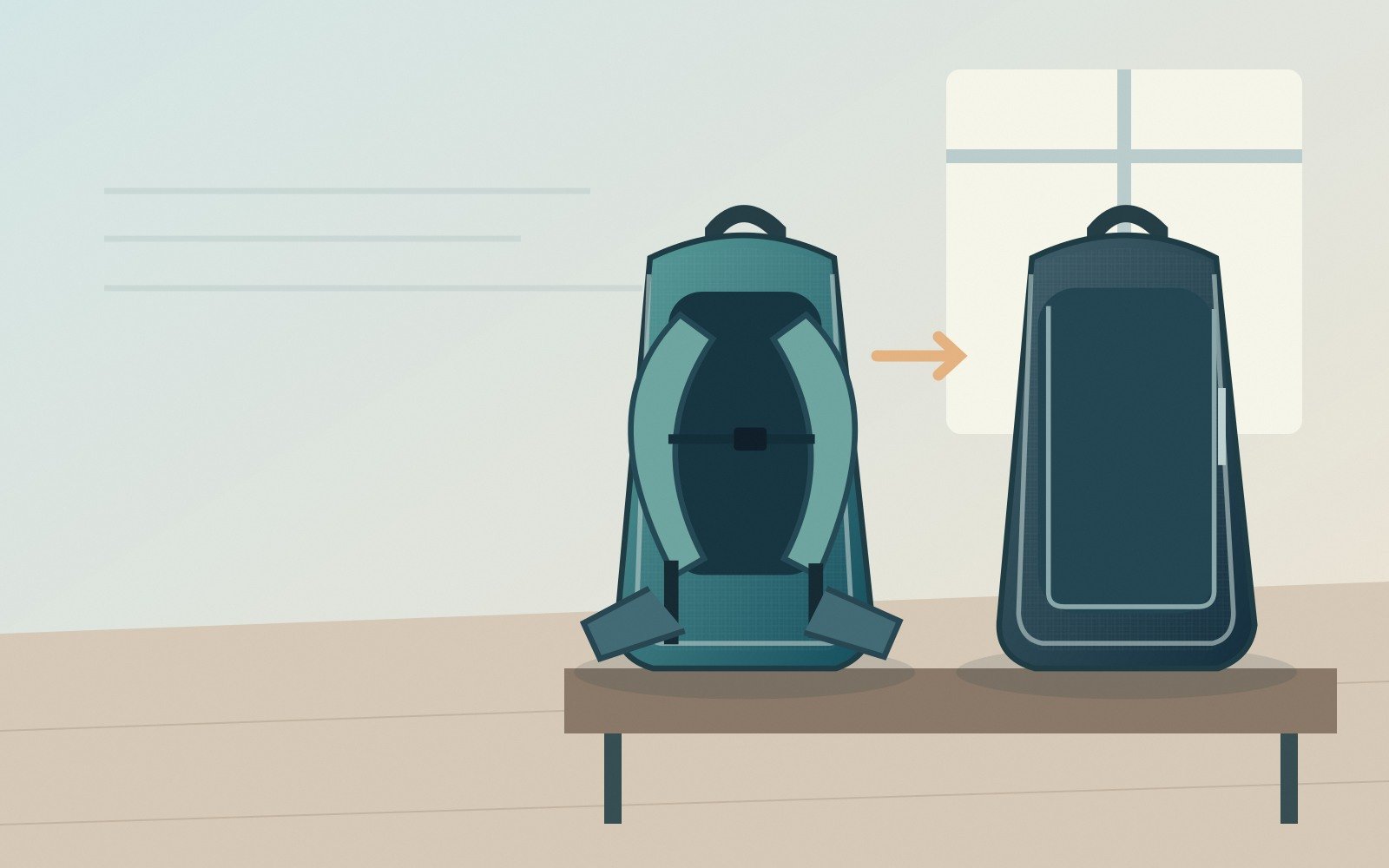
Concept scene: deployed and stored harness arrangements, not photographs of named products.
Are stowable backpack straps worth it? They can be, particularly when your bag repeatedly changes from something you wear into something you store, lift, stack or hand over. A harness that disappears neatly can make those transitions less awkward. However, a tidy exterior is not enough reason to choose a backpack whose carrying system does not fit you.
The feature is also less straightforward than it sounds. Some bags enclose the entire harness behind a zipped panel. Others let you tuck shoulder straps into recesses, hide only the hipbelt or detach a separate shoulder strap. Those designs do not provide the same coverage or require the same amount of work. The useful comparison is between complete routines, not between product listings that happen to use the word stowable.
This guide examines published designs and a practical evaluation process. No product has been worn, load-tested or subjected to a baggage conveyor test for this article. The purpose is to help you decide whether strap stowage solves a problem on your own journeys and how to check that the mechanism will be convenient enough to use.
Repeated carry changes
Prioritise stowage when a journey involves lockers, trolley rides or hand-offs.
Tucked vs fully covered
Find out which straps disappear and whether buckles remain exposed.
Convenience vs complexity
Extra pockets, fasteners and setup steps need to earn their place.
Loaded comfort first
A neat exterior is not a substitute for a well-fitting harness.
Are stowable backpack straps worth it for your trips?
Count the transitions that matter
Picture the bag during a normal travel day. It may be on your back between home and the station, carried by a handle through an aisle, rested on a suitcase, placed in a locker and unpacked beside a hotel desk. Strap stowage is most useful when those changes happen often enough that exposed webbing becomes an irritation. It is less compelling when the backpack stays on your shoulders for almost the entire journey.
Do not count every theoretical use as a benefit. Write down two or three situations that recur for you, and identify what currently goes wrong. Perhaps loose straps fall into the path of the suitcase wheels, or the harness catches when you retrieve the bag from a shelf. A feature that addresses a repeated inconvenience is easier to value than one bought for a vague sense of travel readiness.
Compare the feature with simpler solutions
Sometimes the problem is only excess adjustment webbing. Elastic keepers or careful use of the bag’s existing retainers may solve that without a fully enclosed harness. In other cases, the whole padded strap assembly is awkward and a cover provides a more complete solution. Avoid paying for a complicated mechanism before identifying which part of the harness actually causes trouble.
A removable accessory strap is another separate question. Detaching it before packing the bag into a cupboard can be easy, but repeatedly removing and reconnecting load-bearing shoulder straps during a journey may be less convenient. Judge the operation in context. The best solution is not necessarily the one that makes the bag look cleanest on a product page; it is the one you will actually use correctly.
Understand the four main stowage designs
Full zip-away harness covers
A full cover encloses the backpanel or harness area behind a dedicated panel. On the current Farpoint 40, Osprey describes a zip-away backpanel, harness and hipbelt. The design creates a clearly defined packed-away mode rather than simply shortening loose webbing. It is still important to inspect the exact model, because a familiar product name can cover more than one generation. [1]
The attraction is coverage. The compromise is that you have to position the straps and close the panel before the mode change is complete. If the compartment is difficult to use with a full bag, the feature may be ignored just when it would be useful. Look for an obvious way to deploy the harness again and a sensible place for the cover when the backpack is being worn.
Tuck-away straps and partial systems
Tuck-away designs route straps into pockets or behind the backpanel without necessarily enclosing the whole rear surface. Patagonia describes tuck-away shoulder straps on the Mini MLC and a quick-stash hipbelt that also serves as a shoulder strap. That is a different design from a single zipped harness cover, even though both can produce a cleaner carrying configuration. [2]
Partial systems require especially careful reading. A product may offer a tuckable hipbelt while leaving its shoulder straps exposed. The BAGSMART Blast Pro 40L is described with a tuckable hipbelt, but that wording alone is not evidence of a full shoulder-harness cover. Ask what disappears, where it goes and whether the process requires detaching anything. Do not infer full stowage from a photograph showing only one side of the bag. [3]
Detachable straps and travel covers
Detachable components may offer flexibility, but they also introduce a reconnection step and somewhere to store the removed parts. Follow the manufacturer’s method and check that connectors engage correctly before carrying the bag again. Never improvise a load-bearing attachment because it appears to fit a loop or buckle. A neat storage mode is not useful if the wearing mode becomes uncertain.
A separate travel cover encloses the bag itself rather than just its harness. It may be more appropriate for protecting an existing backpack during a hold-baggage hand-off. Osprey’s AirPorter range is designed for transport protection and has its own sizing guidance. It is not the same item as a rain cover, and you should check the complete packed bag against the chosen cover’s dimensions. [4]
Five examples and what they actually claim
These examples illustrate stowage approaches rather than a tested durability ranking. Published capacities and features identify the relevant products; they do not guarantee airline compliance. Confirm the edition and examine the bag with the contents you intend to carry.
| Example | Published stowage feature | Useful buying question |
|---|---|---|
| Osprey Farpoint 40, S26 | Zip-away backpanel, harness and hipbelt. [1] | Can you close the cover normally with your complete load? |
| Patagonia Mini MLC 30L, style 49266 | Tuck-away shoulder straps; quick-stash hipbelt converts for shoulder carry. [2] | Does the conversion suit how you move between carrying modes? |
| Peak Design Travel Backpack 30L, Sage | Retailer specifies tuck-away shoulder straps; hipbelt is an optional accessory. [5] | What is included, and where will any optional belt go? Inspect the 30L design |
| Antler Discovery 45L, Black | Retailer describes hidden compartments for tucking straps away. [6] | Which straps and buckles remain outside? Inspect Discovery strap storage |
| Osprey Transporter 44 Travel Backpack, S25 | Tuckaway AirScape backpanel and ventilated shoulder straps. [7] | Does the layout work for you, and are its 32cm-deep published dimensions suitable? Inspect the Transporter design |
Do not buy the feature in isolation
Each example also brings a particular opening style, mass, pocket arrangement and external shape. A strap system cannot compensate for a bag that is too deep for your flight or too large for your daily use. Narrow the shortlist to bags that already satisfy your primary requirements, then use stowage convenience as a deciding factor between them.
A useful question is whether you would still consider the backpack with the straps left out. If the answer is no because the fit is poor or the compartments do not work, the hidden-harness photograph is probably doing too much of the selling. Travel involves carrying the bag as well as storing it; the wearing mode deserves at least equal attention.
Where a covered harness can make life easier
Lockers, shelves and confined storage
When placing a backpack in a locker or under a desk, loose webbing can make the process more fiddly. Tucking it away gives you a more predictable outline to handle. That is a straightforward design advantage, not a claim that every exposed strap will snag or that every storage space needs a covered harness. The value depends on how the bag and space interact.
Inspect the other loose parts too. A covered shoulder harness does not automatically secure external compression straps, bottle-pocket contents or a detachable luggage tag. If those remain awkward, the bag may still need attention before storage. Think of stowage as reducing one category of loose components rather than transforming the backpack into a perfectly smooth suitcase.
Trolley rides and hand-carrying
A travel backpack may spend part of a journey on a rolling suitcase. A harness that stays clear of the wheels and telescopic handle can be convenient, but you still need a suitable trolley sleeve or another manufacturer-designed attachment. Do not suspend a loaded backpack from decorative loops or wrap straps around a moving handle in a way that compromises control.
For brief hand-carrying, check whether the available grab handle feels usable with the harness stored. The hand position may be different from the way you naturally pick up the backpack when wearing it. A comfortable side or top handle can matter more than how neatly the straps disappear. Try the sequence with a manageable load and avoid twisting or lifting beyond your comfort.
Where stowage contributes much less
Long walks with few mode changes
On a journey dominated by walking, the main harness characteristics are more important than how it folds away. Fit, stability, adjustment and suitable load support determine the wearing experience. A backpack that carries well but has a simple exposed harness may be preferable to a convertible design chosen mainly for its storage mode.
Do not pay a comfort penalty for an airport feature you use for only a few minutes. Compare the duration of the two modes: hours on your shoulders versus a short spell in a locker or overhead compartment. This does not mean stowage is useless for walking trips. It means the feature should support the carrying system, not dictate a choice that makes the longer part of the journey less pleasant.
A clean appearance at the destination
A tucked harness can make a travel bag look less busy when carried into an office or hotel. That may be a genuine preference, but it is an appearance benefit rather than proof of greater security or weather resistance. Be clear about what you are paying for. A smooth back does not create a lockable enclosure for every compartment or change the strength of the bag’s fabric.
Similarly, a bag that converts to shoulder carry is not necessarily comfortable as a shoulder bag with its maximum load. Conversion provides another option; it does not guarantee equal comfort in every mode. Use the mode that suits the distance and weight rather than assuming the manufacturer expects the heaviest possible contents to be carried in every advertised configuration.
Understand the limits of snag protection
Coverage reduces exposure, not every possible failure
Enclosing loose straps logically removes those straps from contact with nearby objects. However, this article does not quantify a reduction in damage and does not claim that a covered harness survives any particular handling system. Other parts of the bag remain exposed, including zips, fabric corners and carry handles. No backpack should be treated as damage-proof because the shoulder straps can be hidden.
For a hold-baggage journey, consider the carrier’s handling requirements and the bag manufacturer’s guidance. A separate cover may provide broader protection than harness stowage alone. It also adds another item to manage and must be sized correctly. Choose between those options according to the real journey, rather than treating either one as an automatic requirement for every flight. [4]
Do not mistake a harness panel for waterproofing
A panel over the straps is not a published immersion rating or a sealed rain barrier. Water can enter through other parts of a backpack even when the back looks tidy. Keep sensitive equipment in protection appropriate to its use and the expected conditions. Do not add a waterproof claim to a product because its harness compartment has a zip.
The same restraint applies to theft protection. Hidden straps do not stop someone opening a separate accessible pocket or taking the bag. Keep belongings with you and use the bag’s security features as intended. The practical value of stowage is usually cleaner handling and more convenient mode changes; it should not be inflated into a general safety guarantee.
Check the cost in weight, space and complexity
Ask which parts are doing double duty
A good convertible design may use a panel or strap for more than one purpose. The Mini MLC’s hipbelt-to-shoulder-strap arrangement is an example of a published multifunctional feature. Whether it suits you depends on the conversion process and how much time the bag spends in each mode. More functions do not automatically mean a simpler travel routine. [2]
When comparing weights, use whole-product figures rather than guessing how many grams the stowage system adds. Unless the manufacturer gives an otherwise identical version without it, that comparison is difficult to isolate. A lighter bag may also have less padding, different fabric or fewer compartments. Do not attribute the entire weight difference between unrelated backpacks to hidden straps.
Inspect the space used by the storage pocket
The straps need somewhere to go. Check whether the storage area sits outside the main compartment or competes with the way your packed contents settle. Try the operation after loading a laptop and clothing, because a very full bag may press against the space you need to tuck the harness. An empty-bag demonstration does not establish how easy it will be during travel.
Complexity also includes the number of fasteners and steps. A system with several connectors may be fine for occasional conversion but annoying when you change modes repeatedly. Count the actual actions: loosen, disconnect, fold, tuck, zip, check. Then reverse them. The result does not need to be timed competitively; it needs to feel reliable enough that you will use it without rushing.
Comfort checks before you judge the folding mechanism
Begin with an ordinary loaded fitting
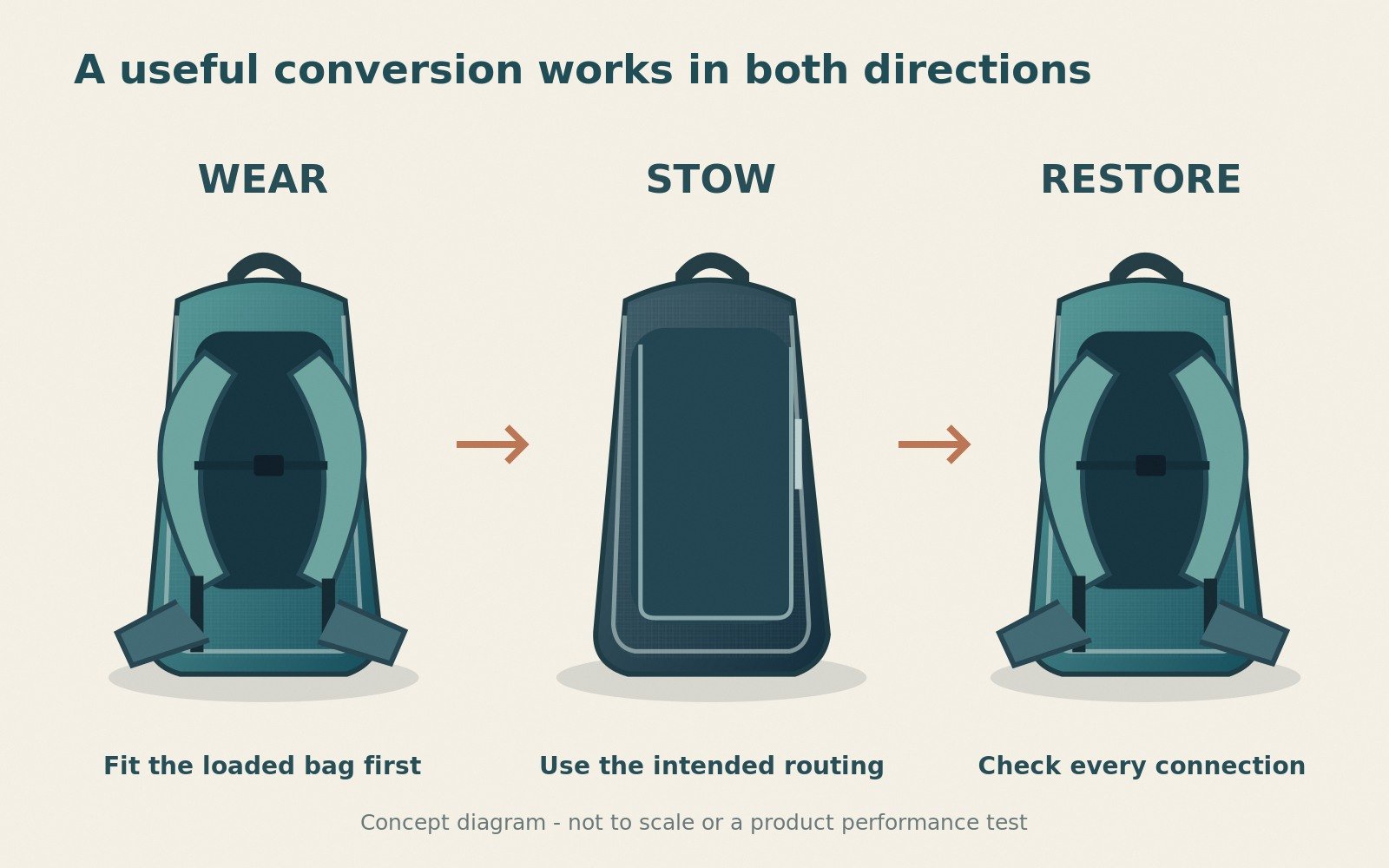
Pack a clean, representative load and adjust the harness according to the manufacturer’s instructions. Check the torso position, shoulder straps and any hipbelt before experimenting with stowage. Walk gently indoors and notice whether the bag feels stable. Stop for discomfort and reduce the load as needed; this is a suitability check, not a medical assessment or a challenge to carry more.
Include the things that change the backpanel shape, such as a laptop or a firm packing module. A bag can feel different when those items are present. Compare with your existing pack when possible, using the same load. That gives you a practical baseline and can reveal whether a new conversion feature is masking a less comfortable carrying arrangement.
Recheck fit after deploying the straps again
Some systems require you to change strap length before storing the harness. Others may preserve most of the setup. Find out what happens on the exact design. After deploying the straps, confirm that they are not twisted, that connectors are secure and that the adjustments still suit you. Do not lift the full load until you are satisfied the carrying system is correctly restored.
Look for a routine you can follow without memorising several hidden steps. Clear routing and easy visual confirmation are useful. A bag that feels excellent when carefully adjusted at home but becomes difficult to restore after each mode change may not suit frequent use. Ease of re-deployment deserves the same attention as the attractive stowed-away result.
A practical ten-minute conversion check
Prepare a safe, repeatable trial
Use a stable surface and a comfortable load. Start with the bag in normal backpack mode and photograph the strap arrangement for reference. Remove anything that could be damaged during handling. Read the return policy before the trial and keep the bag clean, labels intact where required and packaging available. Do not force a zip or buckle to discover its breaking point.
Set a simple task: convert the bag to its tidiest intended storage mode, then restore it. Note any confusing part, any connector that is hard to see and any loose section left outside. Ten minutes is a suggested planning window, not a performance standard. Take longer if necessary and ask the retailer for a demonstration rather than improvising an unclear step.
Repeat with your usual contents in place
The second trial should use the same packed layout you expect on a journey. Check that clothing does not obstruct the harness pocket and that a laptop remains protected. Compare the complete mass with your comfortable load and your travel allowance. A compact luggage scale can help keep this comparison consistent, although its reading is not an independent certification of airport compliance. [8]
Record the result in plain language: easy with the bag full, works only after loosening everything, or too awkward to repeat often. Those notes are more useful than an invented numerical score. Keep the bag only when both modes work for your needs. A mechanism that technically functions but discourages you from using it may provide little real value.
Plan the packing layout around the mode change
Keep essential pockets accessible
Storing the harness should not bury the things you need for the next stage of the journey. Check where the passport, phone, tickets and medication will be when the backpanel is closed or the bag is resting on a suitcase. A pocket that is convenient while wearing the pack may become inaccessible in another mode. That is a layout issue, not necessarily a defect, but it matters in daily use.
Practise removing one essential item without opening the main compartment. Then put it back. This prevents a neat exterior from becoming an awkward access arrangement. For business travel, consider whether you can retrieve the laptop and charging kit at a desk without completely undoing the conversion. The one-bag work-travel system provides a useful way to organise those priorities.
Avoid internal pressure that makes stowage difficult
Overfilled organisers can make the bag rigid or press into the backpanel area. Try fewer or smaller modules before concluding that the harness mechanism is inherently awkward. BAGSMART’s Blast Packing Cubes are one modular option, but use only the pieces that fit the actual interior. A matching set is not a reason to fill every available pocket. [9]
Keep hard accessories away from points where they create uncomfortable pressure. The aim is a stable load that allows both access and conversion without forcing either. Sometimes a slightly looser clothing arrangement works better than maximally compressed blocks. Evaluate the whole packing routine instead of treating the straps as a feature that can be assessed independently of the contents.
Three designs worth examining in person
Peak Design 30L for frequent short-mode changes
The Sage Peak Design Travel Backpack 30L is described by its retailer with tuck-away shoulder straps and an optional hipbelt accessory. That makes it worth examining when compact travel and occasional hand-carrying are part of the same routine. Confirm exactly what comes in the box and do not assume an optional belt is included in the listed bag price. [5]
Try the storage route with the main compartment in the state you intend to use. The retailer describes compressed and expanded capacities, so a trial in only one configuration is incomplete. Ask whether an expanded load affects how easily the straps tuck away. Its suitability depends on those practical details, not on the appeal of a clean rear panel alone.
Antler Discovery 45L for a roomier travel layout
The Black Discovery 45L offers a larger packing format, with hidden strap-storage compartments described by Case Luggage. Examine the actual coverage rather than assuming it encloses the entire harness. Check the chest strap, adjustment tails and any remaining buckles, then decide whether the result is sufficiently tidy for your storage and trolley routine. [6]
Its listed 55 x 35 x 24cm dimensions also need checking against the flights you take. A convenient stowage arrangement cannot compensate for excessive packed depth. The Black model is the reference here; compare other colours and editions separately. Choose it for an appropriate combination of space, handling and fit rather than treating 45L as inherently more travel-ready. [10]
Osprey Transporter 44 for a distinct backpanel approach
The Transporter 44 Travel Backpack uses a tuckaway AirScape backpanel and padded shoulder straps. Its split-case layout offers another way to arrange clothing and equipment. These features make it interesting to inspect, but the published 32cm depth is too substantial to ignore when planning cabin-only travel. It should not receive an unconditional carry-on recommendation from its name. [7] [11]
For a journey where its dimensions are acceptable, examine the connection between backpanel storage, trolley use and access to the laptop area. Test the complete sequence you expect to use. A feature-rich design may work very well for one routine and be unnecessarily involved for another. The purpose of seeing the bag in person is to discover that difference before the return decision becomes urgent.
Stowing before a baggage hand-off
Remove cabin-only and important items first
Before handing a backpack over for hold carriage, retrieve items that must stay with you and check the carrier’s instructions. The UK Civil Aviation Authority says power banks and spare batteries belong in the cabin and advises removing batteries or lithium-powered devices if cabin baggage is taken for the hold. Keep essentials accessible enough that this does not require a full repack at the gate. [12]
Also keep travel documents, medication and valuables with you as appropriate. Do not zip the harness cover first and discover that it obstructs the pocket you need. Build the sequence in the right order: remove essentials, secure the contents, arrange the harness, close the cover and check the remaining loose parts. A rehearsed routine is more helpful than rushing through a complicated conversion under pressure.
Check the exterior and the return to backpack mode
Use the intended carry handle and follow any staff instructions about tagging or handling. Do not attach straps or cords in ways the manufacturer has not designed. If using a separate cover, ensure it fits the whole bag and can be closed without force. Store any removed strap where it will not be lost and where you can find it before you need to carry the backpack again. [4]
After retrieving the bag, inspect the harness before putting it on. Check connectors, adjustment points and the fabric around attachments. This is a sensible visual check, not a technical guarantee that every possible problem would be visible. If something appears damaged or fails to engage normally, do not carry a heavy load with it until the manufacturer or a suitable repair service has advised you.
Care and storage without creating new problems
Let the harness dry before enclosing it for storage
Do not make a closed harness pocket a permanent home for damp straps. Follow the bag’s care instructions, allow it to dry appropriately and remove trapped grit before operating zips or hook-and-loop fasteners. The exact cleaning method depends on the product, so avoid applying one model’s washing instructions to a different material or construction.
When storing the bag at home, leave it in a state that does not unnecessarily crease padded components or strain fasteners. Keep detachable pieces together. A quick check before the next trip is easier than discovering a missing shoulder strap while leaving for the airport. Treat conversion parts as part of the carrying system rather than as expendable accessories.
Ask about repairable components before purchase
Find out whether the seller or manufacturer can help with a failed buckle, zip or strap attachment. A broad warranty phrase does not explain what happens to each part or who handles the repair. Keep proof of purchase and the exact model details. For a used bag, check whether any promised warranty support is transferable rather than assuming it follows the product automatically.
Stowage introduces components you may operate repeatedly, but their presence alone does not predict reliability. This guide has not measured zip cycles or compared failure rates. Inspect the construction and ask specific service questions instead of treating complexity as proof of poor durability or a premium label as proof of exceptional longevity.
Check usability as well as the final appearance
Small fasteners can change the practical answer
Try the conversion with your normal travel clothing and without a perfectly clear table in front of you. Keep the trial safe, but notice whether a connector requires an awkward hand position or whether a zip pull is hard to find. A mechanism that is straightforward for one traveller may be frustrating for someone with less grip strength or limited dexterity. There is no need to force the action to prove you can manage it.
Ask for a demonstration of the exact system before buying when photographs leave the method unclear. Look for steps that can be performed with the bag resting securely rather than balanced on one knee. The appropriate choice is personal: a slower but obvious full cover may suit you better than a quick-looking arrangement with several hidden connectors. Convenience is about reliable use, not the fastest demonstration.
Make reassembly easy to verify
A useful carrying mode lets you see that the important parts are correctly connected. Check for twisted webbing, an incompletely engaged buckle or a strap routed over a zip. Follow the manufacturer’s instructions rather than inventing a cleaner-looking route. If you need to consult a diagram, keep an accessible copy for the first journeys instead of relying on memory.
Do not treat a click or the appearance of a closed connector as a universal technical guarantee. Inspect the mechanism as instructed and stop when anything feels abnormal. This guide does not establish a strength standard or a safe working load for an individual buckle. The practical goal is to select a design you can operate correctly without rushing or overlooking a necessary check.
Questions that get more useful answers from a retailer
Ask about the exact version and operation
Instead of asking whether the straps are stowable, ask the retailer to identify the model code and show which components are enclosed. Request confirmation about the shoulder straps, hipbelt, sternum strap and adjustment tails separately. Also ask whether the system requires any component to be detached. These questions are specific enough to expose the difference between a full harness cover and a small pocket for one strap.
Ask whether the demonstration uses a loaded bag and whether expansion changes the available stowage space. Find out where the cover or detached pieces sit in backpack mode. A photograph of the closed rear panel shows the result but not the operation. A clear explanation of the complete sequence is more helpful than another broad statement about travel versatility.
Ask about ownership after the first trip
Find out who handles a damaged connector or zip and whether replacement parts can be supplied for that edition. Keep the answer with your purchase information. Do not assume the same part fits another capacity or generation because the product names are similar. A repair route is most useful when it can be tied to the particular bag you own.
For an online purchase, ask what indoor inspection is permitted under the seller’s return conditions. A full packing trial may be important to you, but it should be carried out within the applicable terms. Avoid making alterations or using the bag outdoors before deciding whether the basic conversion works. Clear questions beforehand are easier than resolving a disagreement after labels or packaging have been discarded.
Inspecting a used convertible backpack
Check completeness before comparing the price
A used bag can be missing a removable belt, separate shoulder strap or part of its intended storage system. Compare the contents with the manufacturer’s information for the correct generation. Ask the seller to show the harness deployed, stored and restored, rather than accepting only the tidiest view. The missing component may be inexpensive to replace, difficult to source or essential to the way you intended to use the bag.
Examine attachment areas, zipper paths and the storage pocket for obvious wear or damage. This visual inspection cannot prove remaining strength, but it can reveal a reason to ask further questions. Do not assume a covered area has seen less wear just because it is normally hidden. A low price is not a benefit when you cannot establish how the carrying system is meant to function.
Avoid improvised repairs to load-bearing parts
A strap shortened, resewn or connected with an unfamiliar buckle deserves careful scrutiny. Ask what was changed and why. Do not carry a substantial load simply to see whether an uncertain repair holds. Seek guidance from the manufacturer or a competent repair service before relying on it. The goal is to buy a usable bag, not to create an unplanned repair project immediately before travelling.
Also separate cosmetic marks from functional concerns. A scuff may not affect the conversion, while a small-looking fault in a connector can be important. Judge the actual issue rather than the overall cleanliness of the photograph. Confirm the return arrangement and any warranty position independently; support offered to an original purchaser should not be assumed to transfer automatically with the backpack.
Stowable does not mean the whole backpack packs flat
Separate harness storage from bag storage
A backpack can hide its straps while retaining a substantial frame, padded backpanel and fixed body shape. Do not assume the feature makes it suitable for folding inside another small bag. Ask about the complete storage dimensions and follow the manufacturer’s guidance before bending a structured pack. The ability to tuck a harness away describes one part of the product, not the flexibility of every other component.
This distinction matters when planning to use a travel backpack as spare luggage on the return journey. A fully packable day bag and a structured convertible travel pack solve different problems. The latter may carry equipment more conveniently, but it can consume much more space when empty. Trial the whole arrangement rather than relying on a photograph with the straps hidden and the bag viewed from its narrowest angle.
Avoid forcing a cleaner silhouette
Do not over-tighten compression straps or push the harness into an undersized space simply to reproduce the neatest product image. Use the intended routing and allow the padded components to sit as designed. If the closed cover bulges, reopen it and check for a twisted strap or misplaced buckle. A successful storage mode should work without forcing fasteners or putting persistent pressure on a part that was not intended to bear it.
Pros and cons of stowable straps
The advantages when the feature suits the routine
Stowage can create a tidier outline for confined storage, simplify some trolley and hand-carry transitions and keep the main harness out of the way during a hand-off. Full covers provide clearer enclosure, while tuck-away systems may suit quick changes. The best implementation is easy to understand, works with a full bag and leaves a practical carrying handle available.
The compromises to accept deliberately
The feature may add steps, fasteners and storage space, and some designs require adjustments to be repeated after deployment. Coverage can be partial even when the description sounds comprehensive. Most importantly, the feature may distract from a poor-fitting harness or an unsuitable external size. It is worthwhile only when the complete backpack remains a good choice in its primary wearing mode.
Common mistakes when shopping for the feature
Confusing a hipbelt pocket with a complete harness cover
Look for explicit wording and a demonstration of the actual parts being stored. A hidden hipbelt, detachable shoulder strap or trolley sleeve does not necessarily mean that both backpack straps can disappear. Ask the seller to show the conversion on the exact edition. The product family may contain related models with different arrangements, so avoid relying on a generic image or a review of an older version.
Testing empty, then expecting the same result full
The empty bag has more flexibility and makes most mechanisms easier to demonstrate. Repeat with your real load, including the laptop and ordinary organiser layout. Check the reverse operation as well: deploying straps quickly is not enough if they emerge twisted or require awkward reconnection. Also resist the temptation to modify load-bearing straps yourself to improve a storage mode. A safer purchase is a design that works as supplied.
Frequently asked questions
Do I need stowable straps for a carry-on backpack?
No. They are a convenience feature, not a universal cabin-baggage requirement. Prioritise suitable external dimensions, loaded weight, access and comfort. Stowage becomes more attractive when the bag often goes into lockers, rides on a suitcase or changes to hand-carry mode. A well-fitting pack with tidy adjustment tails can be entirely reasonable without a complete harness cover.
Are tuck-away straps the same as zip-away straps?
Not necessarily. Tuck-away usually describes routing straps into pockets or recesses, while zip-away often involves closing a panel over part or all of the carrying system. The wording is not sufficiently standardised to rely on by itself. Examine which parts are covered, whether anything must be detached and how the system works with a full bag.
Will hidden straps stop my backpack being damaged in the hold?
They cannot guarantee that. Enclosing loose harness components reduces their exposure, but the rest of the bag remains subject to handling. Consider the manufacturer’s transport guidance and whether a properly sized travel cover would be useful. Do not treat either option as damage-proof protection, and remove cabin-only items before any hold-baggage hand-off. [4] [12]
Can I use a rain cover instead of a travel cover?
Do not assume they are interchangeable. A rain cover is designed for a different purpose and may not enclose or secure the bag in the way a transport cover does. Check the manufacturer’s stated use, closure method and size. Osprey’s AirPorter is specifically described as transport protection, with separate guidance for the sizes of backpack it is intended to accommodate. [4]
Is a removable hipbelt better than a stowable one?
It depends on how often you change modes and where the removed belt will be kept. Removal can reduce clutter for a particular journey, while stowage keeps the part with the bag. Check the approved attachment method and confirm that the carrying system still functions as intended. Neither option is inherently superior without considering fit, frequency of use and the complete conversion process.
Should the straps keep their adjustment when stored?
It is convenient when they do, but the answer depends on the design. Some systems may require loosening or rerouting before the straps fit into their storage area. Test this on the actual bag. After deployment, check alignment and connector engagement before loading your shoulders. A system that repeatedly needs a complicated refit may not suit frequent transitions.
Can I add strap stowage to the bag I already own?
Simple webbing management may be possible using the manufacturer’s existing keepers, but do not cut, sew or improvise load-bearing attachments. A suitable separate transport cover can be an alternative for occasional hand-offs. Compare its added weight and storage needs with the cost of replacing a backpack that otherwise works well. Ask the manufacturer when a proposed accessory or alteration could affect safe use.
Which feature matters more: stowage or a good hipbelt?
For a load you will carry for a substantial part of the trip, appropriate fit and support usually deserve priority over storage neatness. A hipbelt must work with your torso and the bag’s suspension; merely having one is not enough. Choose a comfortable pack first, then decide whether its stowage system meaningfully improves the transitions in your travel routine.
Final recommendation: buy a better routine, not a hidden harness
Stowable straps earn their place when you repeatedly move between wearing, storing, rolling and handing over a backpack. They are less important when the bag is mainly carried on your back and the current harness already stays tidy. Decide which situation describes your journeys before paying for a convertible design.
Examine the specific storage mechanisms on a compact candidate such as the Peak Design 30L, a roomier model such as the Black Discovery 45L or the different backpanel arrangement of the Transporter 44. Check the published dimensions at the same time, especially the Transporter’s depth. The product examples are invitations to inspect a design, not blanket recommendations for every airline or traveller. [5] [6] [7]
Examine the compact option Examine the roomier option Examine the backpanel option
Keep the final test simple: does the bag carry comfortably, does the stowage work normally when full, and will you use it often enough to care? Three clear yes answers make the feature worth considering. A neat photograph cannot compensate for a no on the first question.
Sources and fact-checking notes
Product details and linked pages were reviewed on 11 October 2026. Published specifications are distinguished from illustrative calculations and planning advice. No hands-on product testing or independently measured performance results are claimed.
- Osprey UK: Farpoint 40, S26 Current UK 40L specification and zip-away harness. The checked Black page showed stock-notification controls; no available offer is assumed.
- Patagonia UK: Black Hole Mini MLC 30L, style 49266 Published dimensions, mass and convertible carry system; these do not override airline limits.
- BAGSMART UK: Blast Pro 40L Travel Backpack Conflicting size/weight blocks: 45 x 33 x 22cm and 1.3kg versus 45 x 32 x 21.5cm and 1.5kg. Obtain confirmation for the selected version.
- Osprey: AirPorter travel-cover sizing and use Manufacturer distinguishes Small up to 50L, Medium 45-75L and Large 70-110L packs. Check actual fit; this is not a rain-cover specification.
- Case Luggage: Peak Design Travel Backpack 30L, Sage BTR-30-SG-2 Retailer specifies 27L compressed and 33L expanded; the displayed 18cm depth must not be assumed to cover both states.
- Case Luggage: Antler Discovery 45L, Black Selected Black listing and strap-stowage description; retailer airline widgets are not used as baggage authority.
- Osprey UK: Transporter 44 Travel Backpack, S25 Published 54 x 42 x 32cm, 1.54kg and tuckaway system. Despite carry-on marketing, the stated depth exceeds several cabin limits.
- Case Luggage: Go Travel Digital Pro Scale, 2004.101 Retailer description of the scale and tape measure; no independent accuracy test is claimed.
- BAGSMART UK: Blast Packing Cubes Current destination of the older six-piece URL. Set comprises five packing cubes and a shoe bag; dimension ranges are not guaranteed filled thicknesses.
- Antler UK: Discovery 45L, Black Black listing specifies 55 x 35 x 24cm and 1.47kg. Other colours/editions must be checked independently.
- Case Luggage: Osprey Transporter 44, model 10006375 Retailer confirms the same dimensions. A nearby-capacity comparison, not an exact 45L backpack.
- UK Civil Aviation Authority: Pack right. Safe flight. Cabin-only power banks/spare batteries and removal of battery-powered items when cabin baggage is taken for the hold.
Illustrations in this article were created for Taylor’s Trailblazing Travel Gear. Third-party photographs, where used, are credited beside the image or in the source list.