
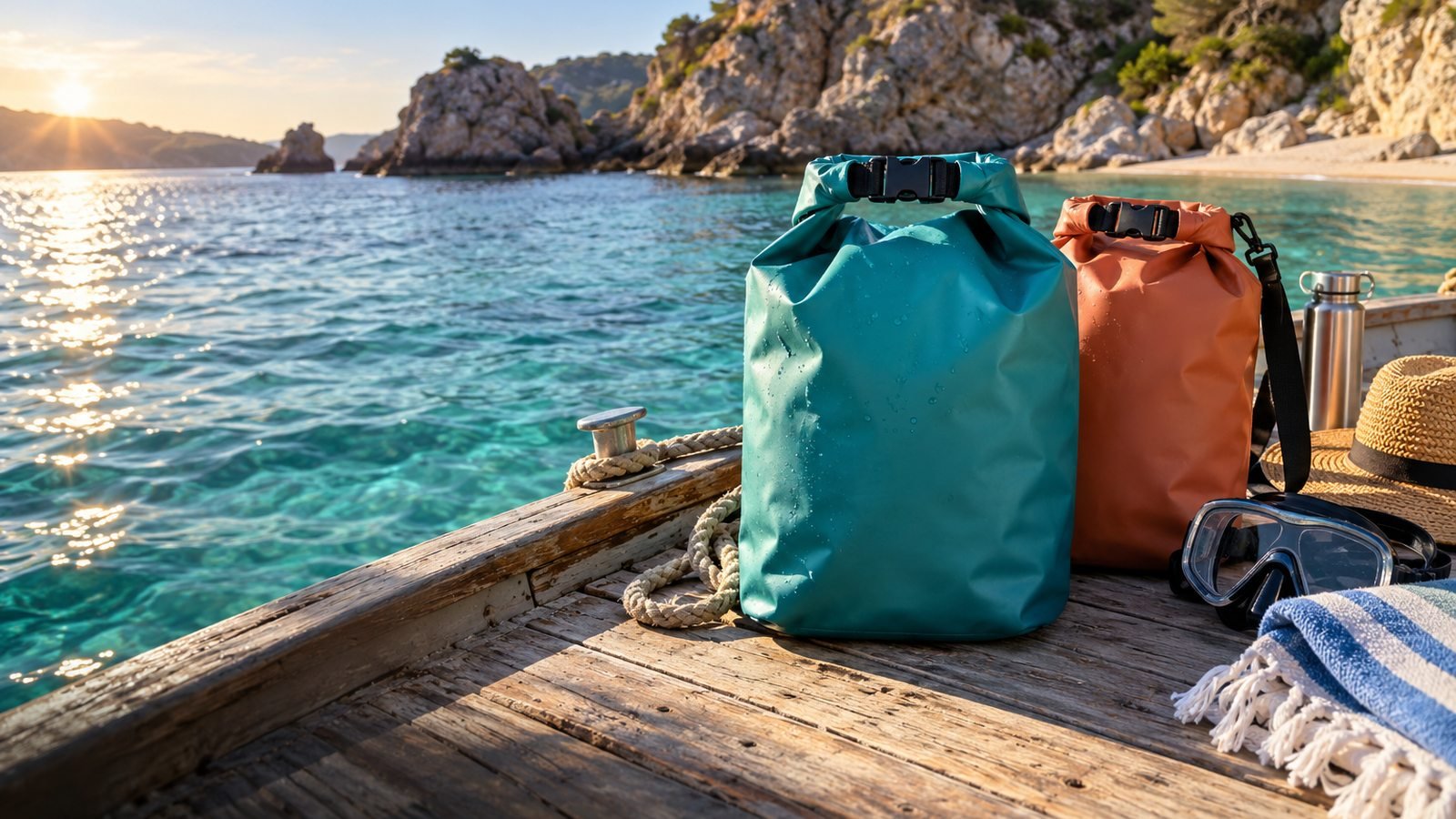
Top 10 Dry Bags for Beach and Boat Trips
Ten distinct designs, clear water-protection limits and a better way to keep your beach kit organised.
A dry bag looks simple until you try to choose one. A soft sack for keeping a jumper dry inside a backpack, a thick tube you can carry onto a boat and a pouch intended for temporary immersion can all appear in the same search results. They are not interchangeable.
The most useful dry bags for beach and boat trips are the ones that match the journey between your accommodation and the water. Think about the walk to the departure point, the space on the boat, how often you need your belongings and what would happen if the bag went overboard. A shoulder strap might matter more than shaving a few grams; a clearly stated protection limit matters more than an impressive photograph.
This selection combines ten distinct products from nine manufacturers. It is a research-led comparison of published construction, closures, capacity and practical suitability, not a report of hands-on testing. The recommendations below explain which jobs each design can reasonably solve, and where I would choose something different.
OverBoard Dry Tube 12L
A shoulder-carry tube for a modest beach-day load.
Osprey Ultralight 12L
A rectangular sack with explicit non-submersion limits.
Big River 8L
More substantial fabric and useful lash points.
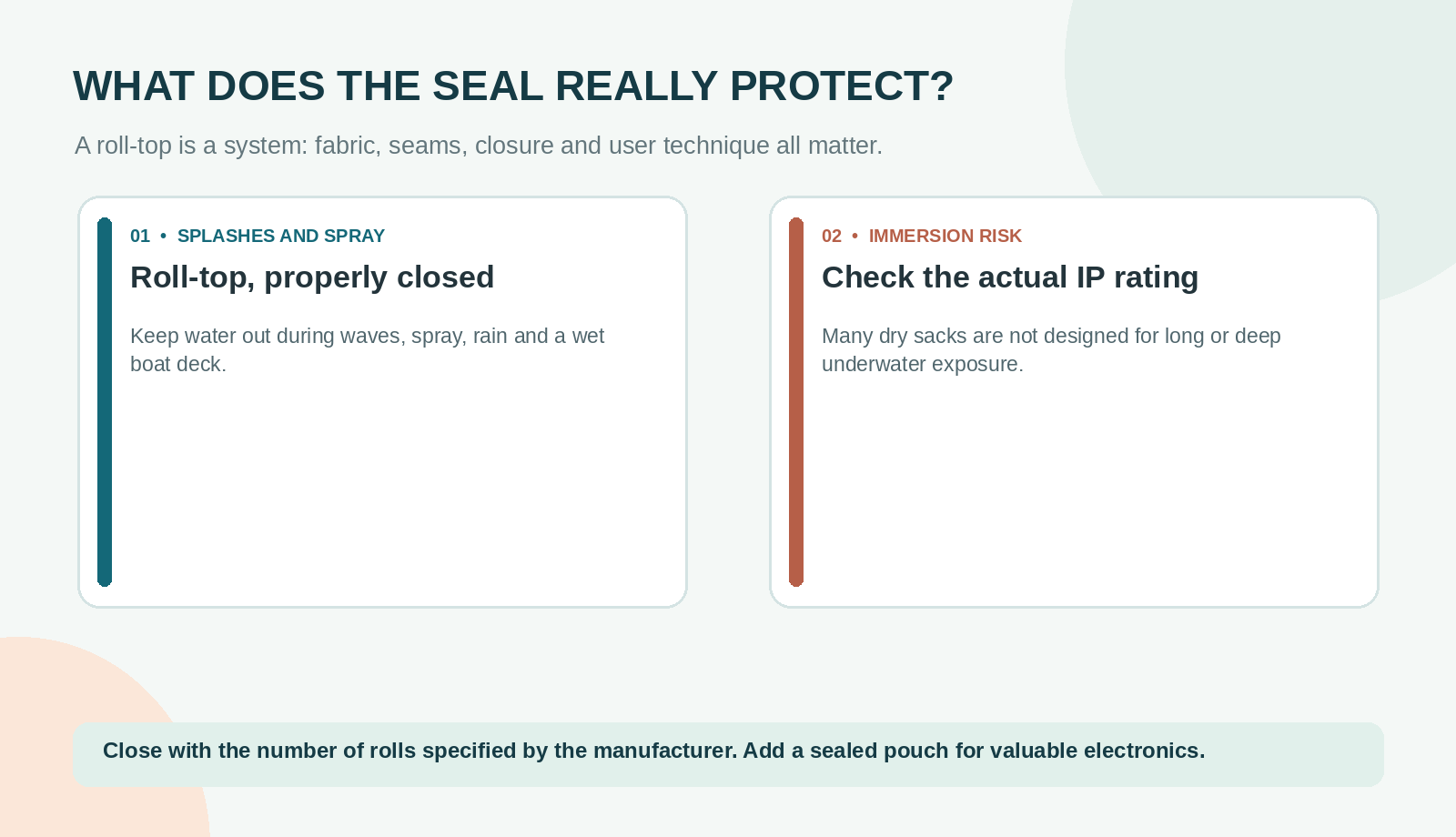
Spray is not immersion
Choose the closure and protection level before the colour.
How these dry bags for beach and boat trips compare
Start with the job, then choose the model
The order puts ordinary beach-and-boat practicality ahead of specialist features. I have considered the manufacturer's stated protection, the selected size, how the bag is carried, whether its shape works inside other luggage and the compromises created by its fabric. No numerical durability score is assigned because these products have not undergone the same independent test here.
The first choice is for someone carrying a dry bag on its own. A traveller protecting clothes inside a daypack may sensibly prefer the fifth choice. Likewise, visibility through a window is a real advantage for shared small items, but not necessarily worth paying for when the only contents are a towel and a T-shirt.
| Model and selected size | Best use | Main construction | Protection caveat |
|---|---|---|---|
| OverBoard Dry Tube 12L [1] | Standalone beach bag | 600D nylon / PVC coating | IP66; brief-submersion claim is separate |
| Sea to Summit Lightweight 8L [2] | A light inner sack | Recycled 70D nylon | Not for submersion |
| Sea to Summit Big River 8L [3] | More abrasion-prone carrying | 420D nylon / TPU | Not for submersion |
| NRS Tuff Sack 10L [4] | A tougher general-purpose sack | PVC-free TobaTex | Do not infer an immersion guarantee |
| Osprey Ultralight 12L [5] | Rectangular backpack organisation | Recycled 40D nylon | IPX5; explicitly non-submersible |
| EXPED Versa Clear 8L [6] | Finding small items quickly | 70D nylon and TPU window | No immersion duration established here |
| ORTLIEB Dry-Bag Light 7L [7] | Compact clothing protection | PS10 PU-coated nylon | IP64: splashes, not immersion |
| Itiwit IPX6 10L [8] | Simple UK beach-and-boat option | Roll-top with securing buckles | Do not immerse; five-roll closure |
| SealLine Discovery 10L [9] | Stable, oval-based storage | PU-coated polyester; PVC-free | Use the specified DrySeal closure |
| Earth Pak Original 10L [10] | Occasional shoulder-carry use | 500D PVC | No unlimited-underwater claim |
Read size and protection together
The comparison uses one named size per model rather than counting different colours as separate recommendations. Where an official page offers a whole size range, select the size named in this guide before ordering. A weight, dimension or protection statement attached to another variant is not automatically transferable.
Manufacturer buttons identify the exact model or model family. Search buttons are labelled as searches, not as promises that a particular size is currently in stock. Some official references use international stores; check the seller, regional delivery and returns before committing to a purchase.
OverBoard Waterproof Dry Tube 12L: best standalone beach-day choice
A shoulder strap earns its space
The OverBoard's appeal is straightforward: it behaves more like a small carry bag than a delicate liner. The manufacturer lists a 600D nylon construction with a PVC coating, welded seams, a removable shoulder strap and a reinforced base. Its stated weight is 420g. That is a meaningful amount of empty weight, but the strap is useful when you are also carrying sandals or helping someone board. [1]
For a short walk followed by a boat crossing, I would prioritise that carrying arrangement over the lightest possible fabric. A single tube also encourages a disciplined load: towel and clothing below, smaller items near the opening. It becomes less appealing when it must disappear inside an already full personal-item backpack.
Keep the immersion claim in perspective
OverBoard lists IP66 and separately describes protection against quick submersion when correctly sealed. IP66 itself is not an immersion rating; the distinction matters if you are comparing it with a product advertised using a different code. Follow the brand's own closing instructions rather than treating the rating as permission to leave the bag underwater. [1][11]
Choose the 12L size for a compact personal load, not on the assumption that it will swallow two large beach towels. Its strongest role is a visibly separate, shoulder-carried bag for everyday beach transport. For prolonged walking with a heavier family load, a properly designed backpack is a more sensible comparison than simply buying a larger tube.
Sea to Summit Lightweight Dry Bag 8L: best versatile inner sack
Light fabric without an all-or-nothing packing system
Sea to Summit's current Lightweight range uses recycled 70D nylon with a polyurethane coating. An oval base, light interior and replaceable buckle are useful details in a bag designed to organise and protect a smaller load. The company explicitly says this range is not intended for submersion. [2]
The 8L version makes sense when your main bag already supplies the carrying comfort. Put a spare shirt and light towel together, then move the sack between a cabin backpack and a daypack. You avoid dedicating a large part of your luggage allowance to a second substantial bag.
This is also a useful middle position between a very thin stuff sack and the heavier designs below. However, the number 70D does not prove how many seasons the product will last. Fabric specification is one input; abrasion, sharp objects, storage and closing technique all affect the practical result.
Separate clean clothing from the day's wet items
I would use this primarily as the dry-clothes compartment rather than repeatedly loading damp swimwear beside tomorrow's shirt. That gives the sack a clear purpose and avoids asking one container to keep two incompatible loads separate.
The main limitation is access. When several people need different things from one rolled sack, the protection is interrupted every time you open it. A separate small essentials pouch can be more efficient than upsizing this bag. Choose it for flexible internal organisation; choose the OverBoard when the bag itself needs to be carried comfortably on a shoulder.
Sea to Summit Big River Dry Bag 8L: best for more abrasion-prone carrying
Stronger fabric, not an underwater permission slip
The Big River is the more substantial Sea to Summit option here. Its 420D nylon construction, TPU coating, reinforced base and lash points suit a bag that may be carried outside other luggage. The current 8L specification gives a weight of 160g. Despite that tougher construction, the manufacturer still advises against submersion. [3]
This is the choice I would examine for a small load that regularly meets a boat floor or the outside of a larger pack. It does not need to be enormous to be useful: a warm layer, compact towel and small non-fragile essentials can justify a dedicated robust sack.
The lash points are a practical difference from a simple inner liner. Nevertheless, attaching a bag safely is a separate decision from keeping water out. Follow the craft operator's storage instructions, and do not improvise a tether around your body.
Consider the load you will actually lift
Eight litres becomes restrictive quickly when a thick towel or spare shoes enters the plan. Before moving up a size, remove the items that do not need waterproof storage. A bottle, for example, may have a better place in the main bag's secure pocket.
The trade-off against the Lightweight model is less about an abstract winner and more about exposure. For clothes protected inside a backpack, the additional construction may be unnecessary. For a small sack used on its own, it gives you a more purposeful design without making the false promise that rugged means submersible.
NRS Tuff Sack 10L: best PVC-free heavy-duty option
Check the current material, not an old review
NRS now describes the Tuff Sack using PVC-free TobaTex material. That matters because older references to this long-running product can describe a different construction. The current 10L listing specifies welded seams, a StormStrip roll-down closure and a D-ring; its listed weight is 0.60lb, roughly 272g. [4]
For a traveller who wants a substantial sack but prefers this material specification, the Tuff Sack is a credible alternative to the PVC designs. I would compare it with the Big River on shape, carrying method and the space available in the boat, rather than assuming the thicker-looking bag necessarily offers better protection in every situation.
A simple sack needs a separate carrying plan
The 10L version is most convincing when it travels in a larger bag or occupies a designated place on the craft. It is not the same proposition as a padded daypack. If your outing starts with a long walk, work out how it will be carried before adding accessories to compensate for the wrong basic format.
Another useful check is the exact generation at the retailer. Ask for the current TobaTex description if that is the reason for choosing it; a photograph alone may not settle the question. The official reference used here is an international manufacturer page, so UK delivery, taxes and returns depend on the actual seller.
No specific immersion duration is established in this comparison. Treat the closure instructions as essential and use separately suitable protection for fragile or high-consequence contents.
Osprey Ultralight Dry Sack 12L: best shape for a travel backpack
Rectangular packing makes better use of corners
Osprey describes this as a rectangular dry sack intended for organisation within a pack or travel luggage. The published construction is recycled 40D high-tenacity nylon, with coated fabric and seams. It carries an IPX5 designation and is explicitly described as non-submersible. [5]
That is a clear, useful brief. When the sack is going inside a rectangular cabin backpack, shape can matter as much as nominal capacity. A tube can create awkward pockets of unused space around it; this design is worth considering when clothing needs to sit beside a separate technology pouch or wash kit.
Twelve litres also gives a little more flexibility than an 8L inner sack, although the real test remains the packed shape after rolling. Do not interpret the extra litres as spare space that can be filled right to the mouth.
Treat it as organisation with weather protection
I would choose this for keeping a dry clothing bundle together during travel, then lift it out when changing bags for the day. It is less persuasive as something to drag across rough surfaces or use as the only protection during a capsize-prone activity.
The restraint in Osprey's stated use is a positive. It lets you make a sensible decision without guessing what waterproof means. If your main problem is repeated soaking rather than occasional spray reaching the inside of a backpack, change the protection strategy instead of expecting a thin packing accessory to become a specialist case.
EXPED Drybag Versa Clear 8L: best for seeing shared small items
The window solves an access problem
The Versa Clear combines a nylon body with a transparent TPU window. EXPED specifies a 70D fabric and sealed construction; the window is the feature that distinguishes it from another ordinary opaque sack. [6]
It is particularly useful for an outing where several people share a small kit. You can check whether the sunglasses case or spare strap is inside without immediately undoing the top. That does not make every item instantly accessible, but it reduces the temptation to empty the contents onto a wet surface just to find one thing.
For clothing alone, the advantage is weaker. If you already know that a sack contains only a towel, a window offers little extra value. The 8L version earns its place when visibility makes the bag easier to use, rather than simply more interesting to look at.
Pack the window deliberately
Place recognisable, frequently needed items where they can actually be seen. A jumble of overlapping dark pouches defeats the point. Meanwhile, a soft clothing layer can keep hard-edged accessories from pressing directly against the transparent panel.
A window also changes the privacy trade-off. I would not choose visible contents as an advantage for passports, cash or other valuables in a busy public setting. Nor would I treat the clear section as proof of an immersion rating: no underwater duration has been established here. Choose it for visual organisation and follow the manufacturer's protection limits, not as a substitute for a dedicated phone case.
ORTLIEB Dry-Bag Light 7L: best compact splash-protection sack
A clear IP64 limit is useful information
ORTLIEB's Dry-Bag Light uses its PS10 coated nylon and has an IP64 designation. In practical terms, the published rating covers dust protection and splashing water, not immersion. The company's instructions specify rolling the closure several times and securing it correctly. [7][11]
The 7L size is a good candidate for a small clothing bundle inside another bag. It is not a family beach holdall, and that modest ambition is part of its usefulness. A separate warm layer can remain organised while the rest of the daypack handles things that need frequent access.
When comparing it with the 8L Sea to Summit option, I would trial the shape and opening around the actual clothing rather than choose purely on a one-litre difference. A nominal capacity does not describe how easily a rolled sweatshirt slides through the neck.
Do not turn a storage sack into a food container
ORTLIEB specifically excludes storing food and drinking water directly in this product. That is worth knowing because dry bags are sometimes suggested as improvised water carriers or wash buckets without regard to the product instructions. [7]
For this guide, its role is straightforward: lightweight, compact organisation with clearly bounded water protection. If your main concern is a bag sitting in standing water, that stated splash rating should send you back to the requirements, not into an argument about how carefully you can position it. A small sack is useful when it solves one job well.
Itiwit Waterproof Bag IPX6 10L: best straightforward UK shop option
The five-roll closure is part of the specification
The Decathlon product selected here is the Itiwit 10L IPX6 bag, reference 8826347. Its instructions are unusually important to the buying decision: roll the top five times, then secure the indicated buckles. The brand explicitly says not to immerse the bag or use it for swimming. [8]
That makes it a practical option for someone who wants a simple bag for spray and wet surroundings, with a UK retailer page that can be checked against a product reference. It does not make it a cheaper substitute for immersion-rated storage.
The closure also explains why a dry bag that appears large enough in the shop may be too small at home. Five rolls need free material above the contents. If a towel prevents those rolls, the solution is a smaller load or a larger bag, not fewer turns.
Buy for the trip, not for imagined versatility
I would shortlist this for an occasional beach outing or organised boat trip where the bag has a secure, reasonably sheltered place. For a long walk, compare its carrying arrangement with a proper daypack before deciding that every waterproof-looking container will be comfortable.
Decathlon's care guidance includes rinsing away salt and drying the bag rather than leaving it folded and damp. [8] This is the kind of routine that matters more than a dramatic marketing image. Use the product reference when checking the retailer, because another Itiwit bag in a similar colour may have a different closure or intended use.
SealLine Discovery Dry Bag 10L: best oval-based alternative
Choose Discovery, not a similarly named older model
The current Discovery Dry Bag uses a PVC-free polyurethane-coated polyester construction, welded seams and SealLine's DrySeal roll-top. Its 10L specification lists 275g, with an oval base and a light interior. This recommendation is for Discovery, not Discovery View or another similarly named model. [9]
The oval shape offers a useful alternative to a round tube. I would consider it where a bag needs to sit alongside other equipment without taking up as much width in every direction. However, standing neatly on a flat surface is not the same as being secured aboard a moving boat.
A light interior is also a sensible detail for a deep sack. Small objects are easier to distinguish against it than against a uniformly dark background. That advantage is less visible in a specification comparison than capacity, but can matter when you are opening the bag only briefly.
Stability does not replace impact protection
The Discovery suits a compact load of soft kit. A camera or other fragile object still needs its own impact protection; a waterproof fabric does not prevent something being crushed by a neighbouring bag.
Compare it with the NRS on actual shape and retailer availability rather than interpreting their very similar listed weights as meaningful performance rankings. The manufacturer reference is a European storefront, not proof of delivery to every UK address. Confirm the selected 10L model and the selling store before ordering. Its appeal is a distinct shape and construction, not a claim of unlimited underwater use.
Earth Pak Original Dry Bag 10L: best simple shoulder-carry alternative
A basic format can be enough
The Earth Pak Original is a 500D PVC roll-top design offered in several capacities. The smaller versions use a single shoulder strap; the 10L selection here keeps the comparison focused on a modest personal load. [10]
For occasional use, simplicity can be attractive. There is little point buying numerous compartments when the real requirement is to put a towel and dry clothes in one place. Equally, a single strap is not automatically comfortable for a long approach walk with a heavy load.
I would compare this directly with the OverBoard on closure instructions, retailer support and how the strap sits when packed. Do not assume every bundle contains identical accessories. A phone pouch included in a particular offer would still need to be assessed on its own specification, rather than lending its rating to the large bag.
Leave space for the closure, not another accessory
The most useful question is whether your load still allows the top to be sealed without force. A low purchase price, where available, is not good value if the bag encourages you to squeeze a bulky towel against the closing strip.
Choose the Original for a simple, separately carried sack rather than a finely divided packing system. For frequent repacking inside small luggage, the Osprey or a lightweight Sea to Summit model is more logical. For water exposure beyond ordinary beach-and-boat handling, look for a clearly stated whole-bag rating that matches the activity. This assessment does not establish a submersion duration for the Earth Pak.
Understand spray, immersion and fabric ratings
The second IP digit describes water protection
An IP code is not a general quality score. The IEC guide distinguishes splashing water, water jets, powerful jets and temporary immersion as different categories. In the models above, IP64, IPX5 and IPX6 should not be read as interchangeable promises that belongings can stay underwater. The X means that a particular digit is not specified in that designation. [11]
Similarly, a hydrostatic-head figure describes a fabric test. It does not tell you that a closed, packed bag can safely sit at that depth. The mouth, seams, buckles and correct use are part of the whole product's performance.
Assess the consequence of a leak
For a spare T-shirt, minor dampness may be an inconvenience. For a phone needed to call for help, the consequence is much greater. Build the protection around the consequence, not just the likelihood that the water will be calm.
A clearly stated non-submersion limit is not a product defect. It is useful evidence that the bag is intended for a different job. Paying more for thicker fabric does not remove that limit.
Choose the smallest size that seals comfortably
Trial-pack the actual towel
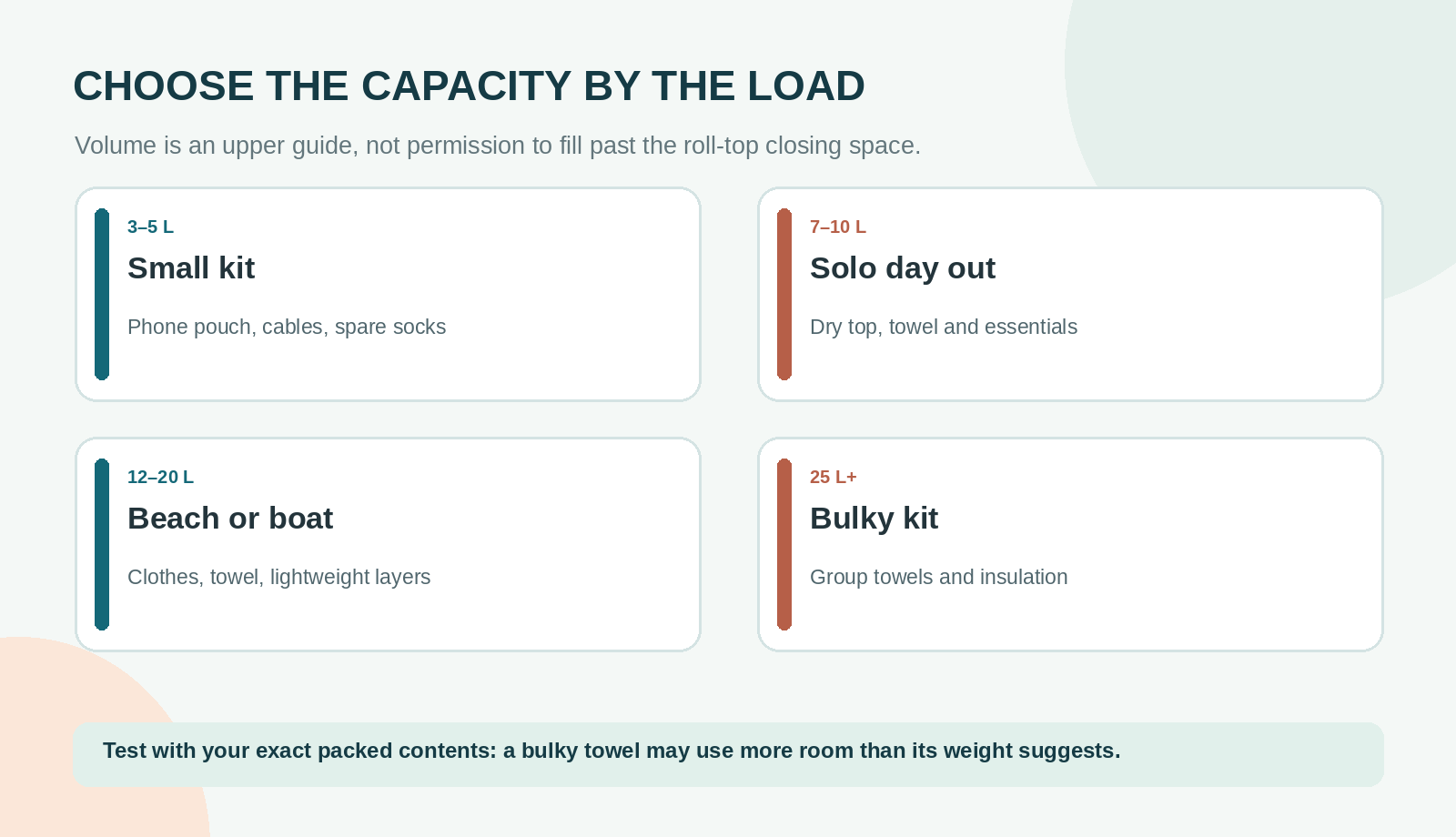
For a solo outing, begin around 8-12 litres for a thin towel, light clothing and small items. A bulky cotton towel, spare shoes or clothing for two people can push the useful size higher. These are planning judgements rather than measurements of your belongings.
Arrange the load on a bed, excluding items that can travel elsewhere. Put the largest soft item in first, then fill remaining spaces without forcing the sides. Finally, perform the full closure. The bag only passes the test if it seals correctly with the actual load inside.
Two smaller sacks can be more useful than one large tube
Separating dry clothing from damp items prevents one mistake affecting everything. It can also let two travellers carry their own essentials rather than repeatedly opening a shared container.
However, more sacks mean more buckles and more opportunities to leave something behind. For a simple day trip, a main dry-clothes sack and a small appropriate valuables pouch are usually a more manageable system than several nested containers with unclear jobs.
Pack and close the bag without undermining the seal
Keep the mouth clean and the load below it
Open the bag in a dry place, inspect the closing surfaces and remove grit or fabric caught near the mouth. Pack soft items around hard-edged objects. Leave enough free material to follow that model's roll-and-buckle sequence; the Itiwit example needs five rolls, whereas other manufacturers specify their own method. [8]
Roll evenly rather than producing a loose twist. A buckle that clicks shut does not prove the roll beneath it is correct. Before leaving, lift the packed bag using the intended carrying points and check that the closure remains stable.
Use a low-consequence trial
A dry-tissue trial can help reveal an obvious problem, but test only within the manufacturer's intended exposure. Do not submerge a non-submersible sack to see whether it might survive. A successful home check is not certification and cannot establish a protection level missing from the product information.
After use, open the bag away from dripping towels and wet clothing. Water falling through the open mouth is not evidence that the sealed material leaked. Keeping the opening routine tidy is a simple way to make your chosen protection more useful.
Protect your phone and keep help within reach
A large dry bag is not emergency equipment
For kayaking or canoeing, the RNLI advises keeping a means of calling for help on your person and within reach. A phone should have suitable waterproof protection; a sealed phone at the bottom of a bag you cannot reach is not a workable emergency plan. Follow appropriate activity-specific training and equipment guidance. [12]
For ordinary passenger boat trips, ask the operator where bags should be stored and keep access routes clear. Do not use a dry bag as a lifejacket, buoyancy aid or improvised body tether. Gear protection and personal safety are different jobs.
Buy a phone pouch for the phone it must contain
Check the pouch's internal size with the phone case still fitted, its closure instructions and its stated water-exposure limits. Touchscreen access, lanyard arrangement and whether you can operate essential controls matter more than a generic universal-size label.
Keep a power bank dry and disconnect it before storing it. A sealed bag is storage, not a suitable place to hide operating electronics that need monitoring. If wet-weather photography is central to the outing, reconsider whether a roll-top beach bag is the right primary protection at all.
Clean, dry and store the bag between trips
Salt and dampness need attention
Follow the care instructions for the material rather than washing every dry bag in the same way. ORTLIEB advises gentle cleaning and avoiding aggressive cleaners or machine washing; Decathlon's guidance includes a fresh-water rinse after use and proper drying. [7][8]
Empty the bag promptly. Leave it open until both the inside and the folded closure are dry, then store it without crushing the coating into a permanent crease. Do not hide dampness by closing the mouth and hoping the next outing will dry it.
Inspect before the next booking
Check the base, seams, closing strip and buckle for visible damage. Pay particular attention to the area that repeatedly folds. A repair or replacement decision should follow the manufacturer's guidance; covering a hole does not automatically restore a published rating.
Before a holiday, repeat your low-consequence check with the bag you actually intend to take. A bag that performed well last year still needs inspecting after months in a cupboard. This is also a good time to remove accessories that made the system heavier without making it easier to use.
Pros and cons of a dry-bag packing system
Pros
- One sealed place for clothing makes a wet landing easier to manage.
- Different shapes let you choose between luggage organisation and shoulder carry.
- Smaller separate sacks can prevent a wet towel contaminating clean clothes.
Cons
- Many roll-top sacks are not intended for immersion.
- A heavy tube adds bulk when it must fit inside a small cabin bag.
- An opaque bag and a rolled closure make frequent access less convenient.
The balance changes with the trip. A dry bag has a strong role when spray, wet surfaces or the movement between boats and beaches threaten your clothing. It is less attractive when it duplicates a well-protected compartment and creates an extra item to carry.
Think of the purchase as choosing a container for a specific load, not buying a general promise that nothing can get wet. That makes both the product choice and the packing routine easier to judge.
Common mistakes that spoil an otherwise sensible choice
Buying capacity without allowing for closure
A bag filled to the top has not passed a useful capacity test. Reduce the load until the manufacturer's closing method works comfortably. Carry the spare bulky item elsewhere rather than improvising a shallower roll.
Putting the wet and dry jobs in the same compartment
A towel used after swimming belongs in a separate temporary wet-items arrangement. Once wet fabric shares the enclosed space with clean clothing, the outside protection cannot keep those clothes dry from the inside.
Treating a rating as a guarantee against every accident
Water ingress, crushing, theft and losing the whole bag are different risks. Decide which ones matter for each item. An expensive phone may require more deliberate protection than a spare pair of socks, even when both fit in the same bag.
Frequently asked questions
Can I take a dry bag as airline hand luggage?
A dry bag is still a bag for baggage-allowance purposes. Its suitability depends on the packed external size and your airline's rules, not the word dry in its name. For a small-bag flight, I would normally pack the empty sack inside the permitted cabin bag and use it separately after arrival. Check the specific carrier rather than assuming an extra beach bag is exempt.
Does a floating dry bag mean the contents are safe?
No. Buoyancy and water resistance answer different questions, and both depend on the actual product and load. A bag that remains visible at the surface may still have a poorly closed mouth. Never depend on it as flotation equipment for a person, and do not enter unsafe water to retrieve belongings.
Is a larger dry bag always easier to use?
It gives more packing room, but can become awkward to carry and harder to search. For a modest clothing load, an oversized tube may encourage unnecessary additions. The better size is the one that closes correctly and fits the place where it will travel, with access suited to the outing.
Should I buy a transparent bag for valuables?
Visibility helps you find things, but also lets other people see the contents. The EXPED window is useful for shared small kit; it is not automatically the best choice for valuables. An opaque, separately protected arrangement may be preferable when privacy matters. Water protection and security need separate decisions.
Can a dry bag replace a backpack rain cover?
Sometimes it is a useful internal alternative for protecting a particular clothing bundle, but it does not protect the outside of the backpack or everything in its pockets. A rain cover and an inner sack can serve different purposes. Choose the combination around the vulnerable contents rather than assuming one accessory replaces every other layer.
What should I do if the bag smells after a trip?
Empty it, follow the manufacturer's cleaning method and dry it fully before storage. Inspect for trapped debris and moisture around the rolled opening. Avoid adding strong cleaning chemicals simply to mask the smell: the material and coating may have restrictions. Persistent damage or deterioration is a reason to seek the manufacturer's advice, not to trust the bag with more valuable contents.
Final recommendation: choose the carrying job first
For a typical standalone beach-day load, the OverBoard Dry Tube 12L is my first research-led shortlist choice because its carrying arrangement matches that job. For a sack living inside a cabin backpack, I would start with the Osprey Ultralight 12L or Sea to Summit Lightweight 8L. The Big River 8L makes more sense when a small load needs more substantial exterior construction.
Choose EXPED for visibility, ORTLIEB for compact splash-protection organisation, or one of the other substantial sacks when its shape and local retailer support suit you better. None needs to be declared the winner for every traveller.
The final test is practical: load your own belongings, leave the required closing space and decide whether the stated water protection is enough. When the likely exposure includes immersion, do not ask a beach-day roll-top to do a job its manufacturer has excluded.
Sources and fact-checking
Editorial review: 15 October 2026. Numbered references identify the source supporting the adjacent claim. Manufacturer specifications are not independent performance tests. Calculations and trial-packing suggestions are labelled examples; check the exact product and your journey’s current rules before buying or travelling.
- OverBoard – Waterproof Dry Tube Bag, 12 litres
- Sea to Summit – Lightweight Dry Bag
- Sea to Summit – Big River Dry Bag
- NRS – Tuff Sacks, current TobaTex construction
- Osprey – Ultralight Dry Sack 12L
- EXPED – Drybag Versa Clear
- ORTLIEB – Dry-Bag Light
- Decathlon Itiwit – Waterproof Bag IPX6 10L, reference 8826347
- SealLine – Discovery Dry Bag
- Earth Pak – Original Dry Bag
- IEC – Ingress protection ratings guide
- RNLI – Kayaking and canoeing safety
Stock, prices, retailer variants and airline policies can change. A manufacturer’s specification does not confirm availability from another seller.
Illustrations in this article were created for Taylor’s Trailblazing Travel Gear. Third-party photographs, where used, are credited beside the image or in the source list.