
Vacuum Bags vs Compression Cubes: Which Is Better for Travel?
Save usable space without creating a heavy, awkward bundle that you cannot repack for the journey home.
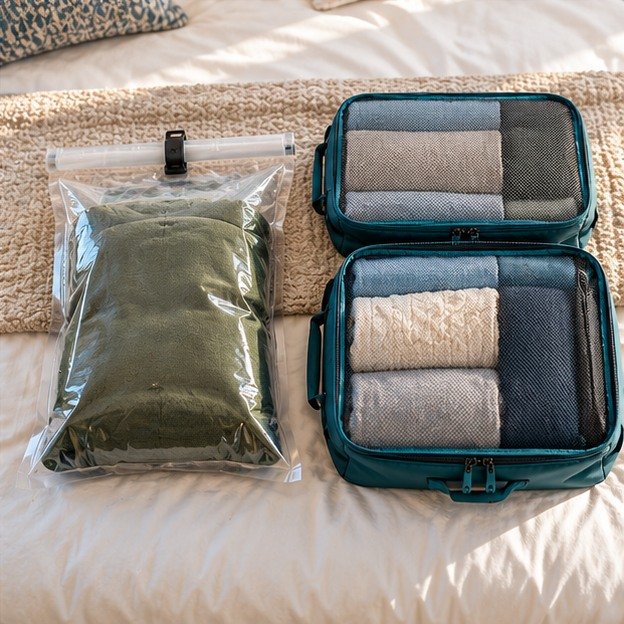
AI-created editorial comparison scene; it does not show a measured space-saving test or specific products.
The useful question in vacuum bags vs compression cubes is not which one produces the flattest bundle on a bed. It is which system leaves your whole bag easier to carry, open and repack throughout the trip. A compact bundle can still be awkward if it is too wide for the backpack, hides something you need or depends on a pump you leave at home.
For most trips with repeated access to ordinary clothing, I would start with a small number of zip-compression cubes. For one bulky soft item that can stay packed during transit, a correctly sized travel roll bag may be more useful. A pump-operated vacuum bag is a more specialised choice because you need a workable compression method at both ends of the journey.
This guide compares the mechanisms, the packing trade-offs and seven clearly identified products. It also shows how to run a fair home comparison without treating advertised percentage savings as independent test results. You can use the same method to decide that ordinary folding and an existing pouch are enough.
The recommendations are research-led. They draw on published product information and official travel guidance, not personal laboratory or flight testing. No fixed space-saving percentage, waterproof guarantee or airline approval is promised for your particular load.
Straightforward clothing separation and repacking.
A no-pump option when the finished footprint works.
Compression does not remove the weight of the clothes.
Open and repack using only equipment available away.
Vacuum bags vs compression cubes: the practical verdict
Compression cubes are the more convenient starting point when you open the bag daily, move between accommodation or want different clothing groups to stay separate. Their second zip reduces the organiser’s depth without requiring a separate pump. However, a tightly filled cube can still become a hard, rounded block that fits poorly in a small backpack.
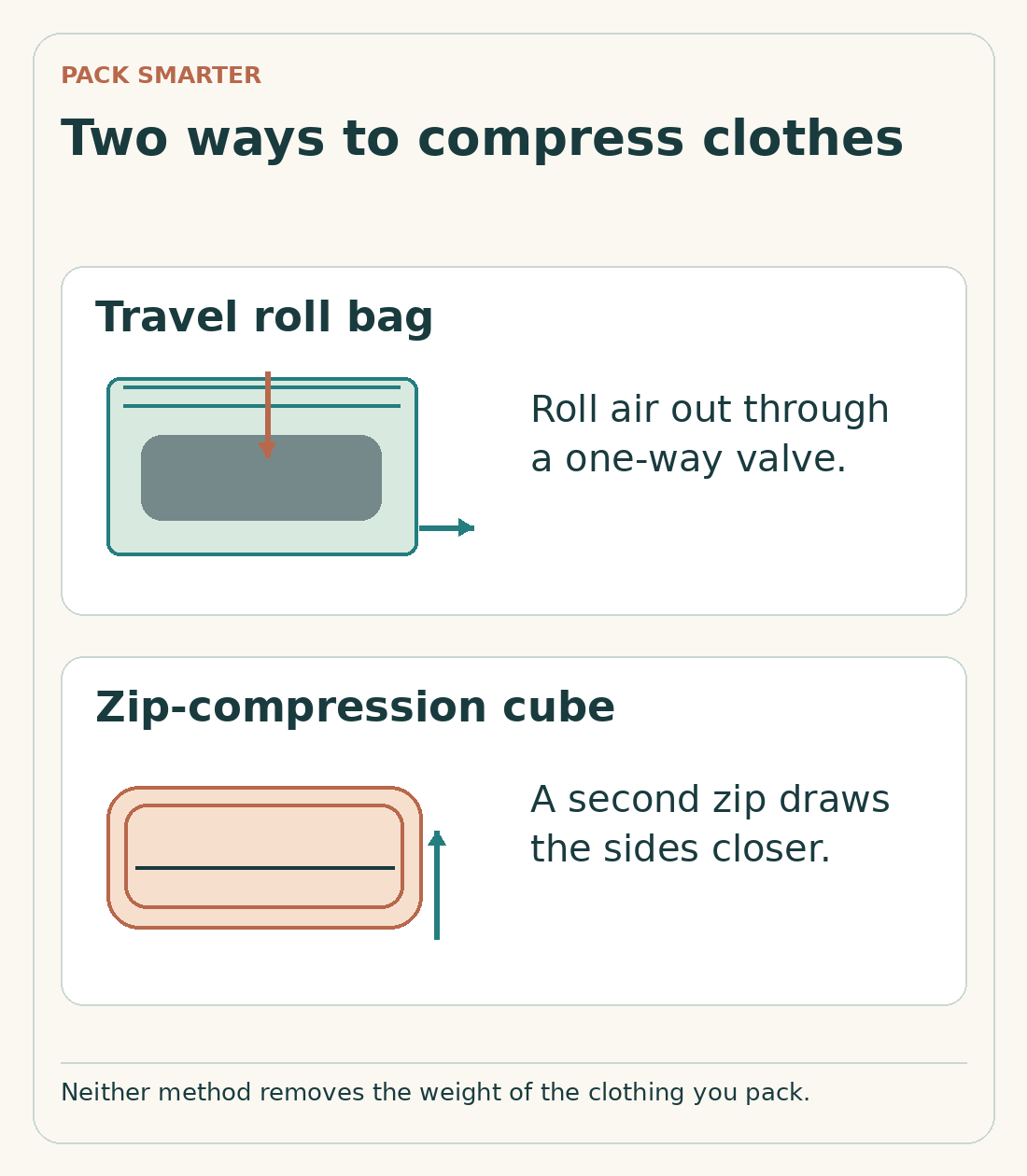
Travel roll bags are useful when a compressible garment occupies too much room and will not be needed during the journey. They expel air through a one-way valve as you roll the bag, so the process can be repeated away from home without a vacuum cleaner. Packmate describes that mechanism for its Travel Roll range. [1]
Choose by the inconvenient moment, not the departure picture
Imagine opening the bag in a small hotel room, retrieving one clean top, then leaving early the following morning. A system that makes those moments straightforward is more useful than one that produces an impressive first compression result but becomes frustrating to reuse.
A mixed approach can make sense: one roll bag for a bulky fleece and one small cube for daily changes. It does not mean you need both systems for every trip. Use the fewest organisers that solve the actual packing problem and leave necessary travel items accessible.
Understand the three mechanisms before comparing products
The word vacuum is used loosely in travel marketing. Some products rely on a pump or vacuum-cleaner nozzle, while others use rolling pressure and a one-way valve. Both aim to remove air from around and within a soft clothing bundle, but their equipment requirements differ.
A zip-compression cube works differently. Clothing goes inside a fabric organiser, the main zip closes it, and another zip draws the sides together. Air can leave through the fabric or openings; the cube is not normally an airtight vacuum enclosure.
| System | How it reduces bulk | What you need to repeat the process |
|---|---|---|
| Travel roll bag | Rolling pressure expels air through a one-way valve | A suitable flat area and enough room to roll |
| Pump-operated vacuum bag | A compatible pump or nozzle removes air through a valve | The correct working equipment and any required power |
| Zip-compression cube | A second zip reduces the organiser’s depth | Space to arrange clothes and close both zips without force |
Packmate’s Travel Roll bags and Eagle Creek’s Compression Sacks are examples of no-pump valve systems. Their use should not be confused with a storage bag that requires suction equipment. [1][3]
A compression sack is another category again
A drawcord sack with external tightening straps, such as Lifeventure’s Ultralight 10L Compression Sack, compresses a bundle mechanically rather than using a vacuum seal or a perimeter compression zip. It can suit certain bulky items, but its packed shape may be less convenient in a rectangular travel bag. [13]
Compare usable space rather than an advertised percentage
A claim that one item compresses dramatically does not tell you how much room the entire suitcase gains. Shoes, electronics, toiletries and the organisers themselves still occupy space. The shape of the compressed clothing can also leave gaps that did not exist before.
Use an illustrative example. Suppose clothing occupies ten litres within a twenty-litre load, while the remaining ten litres consists of less compressible belongings. Even if the clothing portion were reduced by half, the whole load would fall only to fifteen litres, a 25% reduction. That is arithmetic, not a measured result for any featured product.
Do not convert a marketing maximum into a packing promise
Fabric, garment thickness, fold arrangement and the amount of trapped air affect the result. A thick fleece and a stack of already compact trousers do not start from the same position. Likewise, a partly filled bag and an overfilled one may not behave similarly.
Manufacturer phrases such as up to describe a possible maximum under conditions that may not match your clothes. This guide does not rank products by those claims or repeat them as our own findings. Use a home comparison with the same actual garments instead.
Weigh the complete packed luggage after choosing the system. Removing air does not remove the mass of the clothing, and organisers or pumps add their own weight. A bag that now accepts more garments may reach a weight limit sooner because you have used the saved space to carry extra things.
Match the system to the clothing, not the whole wardrobe
Soft, compressible clothing is the logical place to start. A fleece, spare soft layer or modest collection of casual garments may respond usefully to reduced trapped air. Dense items with little compressible structure offer less scope, while anything whose shape or finish matters needs more care.
The table below is editorial packing guidance rather than a fabric-treatment guarantee. Follow garment care instructions and any manufacturer advice for the item in question.
| Clothing or equipment | A sensible starting approach | Reason to be cautious |
|---|---|---|
| Bulky casual fleece | Trial a suitable travel roll bag | Keep it accessible if needed in transit |
| Everyday tops and underwear | Small cube or modest zip compression | Overfilling can produce creases and difficult access |
| Smart shirt or structured garment | Gentle folding or a suitable garment system | Maximum compression is rarely the main objective |
| Down sleeping bag or insulated kit | Follow the maker’s travel and storage instructions | Do not confuse temporary transport with long-term storage |
| Damp swimwear or wet clothing | Temporary separate containment, then drying | Compression does not dry the contents |
| Laptop, camera or fragile equipment | Appropriate protective storage, not clothing compression | Pressure can damage items that should not be compressed |
Keep long-term storage separate from travel packing
Rab recommends spacious sleeping-bag storage that allows down to remain lofted and dry rather than compressed between trips. That is a useful reminder to unpack suitable insulated equipment after travel instead of leaving it tightly compressed for convenience. [8]
For ordinary clothing, inspect the result of a short trial before committing a delicate or important garment to the system. The ability to close a compression zip does not establish that the garment will arrive in the condition you need.
Compare seven options by size and access needs
The products below cover compact roll bags, larger valve bags and several cube layouts. They were selected to illustrate meaningful differences in footprint and organisation, not to create a universal performance ranking.
Flat bag measurements and three-dimensional cube measurements are not directly equivalent. A roll bag’s usable packed shape depends on its contents and closure allowance, whereas a cube has a more defined outline. Neither figure proves it will fit your luggage.
| Product | Distinctive role | Main limitation | Product listing |
|---|---|---|---|
| Packmate Medium Travel Roll, 2-pack | 40 x 50cm flat bags for a larger soft bundle [1] | May be too wide or awkward for a compact backpack | Medium Travel Roll at Amazon UK |
| Packmate Small Travel Roll, 5-pack | 25 x 38cm flat bags for smaller separated groups [2] | Small compartments cannot accept every bulky garment | Small Travel Roll at Amazon UK |
| Eagle Creek Pack-It Compression Sack Set M/L | Two larger no-pump valve bags [3] | Generous flat sizes need a deliberate luggage-fit check | Compression Sack M/L at Amazon UK |
| Peak Design Packing Cube Small | Separate clean-and-used clothing areas [4] | More organisation is unnecessary for some simple loads | Small cube, Sage, at Amazon UK |
| Thule Compression Packing Cube Small | Compact rectangular organiser [5] | Not a replacement for a larger clothing compartment | Small cube, Pond Gray, at Amazon UK |
| BAGSMART Compression Packing Cubes 6 PCS | A set to divide across larger luggage or travellers [6] | Confirm individual piece dimensions and functions | Six-piece set at BAGSMART UK |
| Eagle Creek Pack-It Isolate Compression Cube Set S/M | Two complementary clothing-cube sizes [7] | Do not assume published compressed depth suits every load | S/M set, Blue Dawn, at Amazon UK |
Product information reviewed on 15 October 2026. Purchase pages can change selected variants, stock and available sellers. Check the named size and set contents again before ordering; no price or current-stock guarantee is implied here.
Packmate Medium Travel Roll: a no-pump option for one bulky group
Packmate’s Medium Travel Roll bags measure 40 x 50cm when flat, and the standard set contains two bags. The one-way valve allows air to be expelled by rolling rather than using a vacuum cleaner. That makes the system relevant when you want to repeat the process in ordinary accommodation. [1]
The useful application is a suitable soft group that can remain packed during travel. For example, a spare fleece may be easier to manage in one compressed bundle than spread around a suitcase. The decision should still be based on the finished shape, not the flat bag’s apparent area.
Check the bundle against the bag opening
A medium roll bag may be unnecessarily broad for a small personal-item backpack. Once packed, its sealed edge and corners also need somewhere to go. Try the bundle inside the luggage without folding the valve into an awkward position or forcing the outer zip.
I would consider this size for a larger soft item in a suitcase or suitably shaped travel bag. For separating several small groups in a compact backpack, the smaller version can be more practical. Neither should replace an easy-access pouch for things needed during the journey.
Packmate Small Travel Roll: more manageable bundles in tight spaces
The Small Travel Roll version is listed at 25 x 38cm flat and sold as a five-bag set. Its smaller footprint makes it a different packing tool from the medium bag, rather than simply a cheaper way to buy the same amount of plastic. [2]
Smaller bundles can be easier to position around a backpack’s shape and allow you to open one clothing group without disturbing everything. The trade-off is more closures to manage and less ability to accommodate a single bulky garment.
Use only as many bags as the trip needs
A five-pack does not mean every bag belongs in your luggage. Try one or two with clearly defined contents, then see whether the organisation remains helpful. Several tiny compressed packets can become more fiddly than a single ordinary clothing cube.
This is the roll-bag size I would trial first when the main constraint is a compact bag opening rather than a large suitcase volume problem. Keep the closure area free of clothing and verify that the filled bag still allows the outer luggage to close normally.
The smaller format is not automatically better at compression. Its benefit is handling and separation when that footprint suits the load. Choose the medium version when the garment itself requires more width, rather than forcing it into a bag that cannot close comfortably.
Eagle Creek Compression Sacks: generous sizes for bulkier clothing
Eagle Creek’s Pack-It Compression Sack Set M/L uses a one-way pressure valve and does not require a pump. The manufacturer lists flat dimensions of approximately 62 x 39cm for the medium and 72 x 44cm for the large. Those generous sizes make them relevant to bulky soft kit, but potentially awkward in a small backpack. [3]
Their role is not the same as a small daily clothing cube. A larger sealed group can be useful when it stays packed until arrival, whereas repeated access means repeatedly restoring the seal and compression. Consider that routine before choosing the larger capacity simply because it is available.
Do not rank the set by its maximum saving claim
Eagle Creek advertises substantial potential volume reduction. This article has not tested that claim with a controlled garment load, and the figure is not used as a predicted result for your luggage. What matters is whether the finished bundle improves the complete packing arrangement.
I would shortlist the set for a traveller with a specific bulky clothing problem and enough luggage width to accommodate it. For a small personal item or several overnight stops, a smaller roll bag or accessible cube may be less cumbersome.
Peak Design Small Packing Cube: useful separation during a moving trip
Peak Design’s Packing Cube combines a compression zip with separate clean-and-used clothing areas divided by a movable internal panel. That design is relevant when the balance between clean clothing and laundry changes as you travel. [4]
The small size can provide a manageable clothing unit rather than one large block occupying the whole bag. However, a clean-and-used divider is not a drying system or a substitute for separate treatment of wet garments. Keep the purpose of the extra compartment realistic.
Decide whether the divider solves a recurring problem
For a trip with several short stays, a defined place for used clothing can make repacking less confusing. For a two-night break where everything will be unpacked once, a simpler organiser may do the same job with less complexity.
I would choose this style for access and separation rather than a promised space-saving percentage. Pack enough clothing to use the shape sensibly, but avoid filling both areas until the cube becomes difficult to close or distorts the backpack.
The buying link is for the Small cube in Sage, not Peak Design’s separate Ultralight Mesh range. Those products should not be treated as interchangeable merely because both are described as packing cubes.
Thule Small Compression Cube: a defined compact footprint
Thule’s small cube uses a compression zip and semitransparent fabric. The published small-size dimensions are 26 x 18 x 11cm expanded and approximately 25 x 18 x 3cm compressed. Those are product specifications, not a promise that any pile of clothes will fit at the minimum depth. [5]
The compact format is useful for underwear, socks or a modest set of light tops. It can also make it easier to arrange more than one distinct clothing group in a backpack without creating an oversized single bundle.
Leave the centre flat enough to use the shape
A tightly filled cube can develop a domed centre even when the compression zip closes. That shape may waste space beside a laptop compartment or make a soft bag bulge outward. Reduce the load or redistribute the folds rather than forcing the zip farther.
This is a sensible shortlist option when you know a small rectangular organiser suits your luggage. It is less suitable when the main problem is one large fleece that would be better handled by an appropriately sized roll bag or a different bag arrangement.
The Amazon listing linked here is the Small cube in Pond Gray. Colour-specific model numbers can differ, so compare the selected size and construction rather than assuming every similarly named listing represents the same item.
BAGSMART six-piece set: useful when several pieces have a real job
BAGSMART’s Compression Packing Cubes 6 PCS set is relevant when you want organisers for a larger suitcase, multiple bags or more than one traveller. The UK listing describes compression features, but it does not clearly establish every individual component’s dimensions and role. [6]
That matters when precision is important. Do not buy the set assuming all six pieces will compress identically or fit a particular small backpack. Check the current product images, ask for missing measurements and decide which pieces you would actually carry.
Judge the used pieces rather than the headline quantity
A set is good value only when its useful components suit your packing routine. Several unused organisers do not make a crowded bag easier to manage, and including every piece simply because it came in the box adds unnecessary complexity.
I would consider this option for a household sharing organisers across different luggage. For one tightly constrained personal item, a single cube with clear measurements may be the more controlled purchase.
Eagle Creek Isolate S/M cubes: two sizes for distinct clothing groups
The Pack-It Isolate Compression Cube Set S/M provides a small and a medium cube rather than two almost identical organisers. Eagle Creek lists expanded dimensions of 25 x 18 x 8cm for the small and 36 x 25 x 8cm for the medium, with compressed depth figures of 2.5cm. [7]
The pairing can separate small clothing from larger garments without requiring an entire multi-piece system. Retailer measurements do not fully reconcile with the current maker’s figures, so confirm the individual dimensions of the selected set before ordering. Nevertheless, check the medium cube against a compact backpack’s opening and usable width. A larger organiser that technically fits can still make other compartments awkward to access.
Treat the compressed specification as conditional
The thin published depth depends on the contents and how the cube is used. It is not a reliable way to calculate how many full cubes will fit into a suitcase. Trial the actual clothing, close both zips gently and look at the finished shape.
I would consider the set when two distinct clothing groups make the trip easier to organise. A traveller who needs only one small change of clothes may not benefit from carrying both pieces.
The linked listing is the S/M Isolate compression set in Blue Dawn. It is not the Reveal single cube, a garment-folder starter set or a non-compression bundle, even though similar search results sometimes mix those names.
Pack a travel roll bag without creating an awkward slab
Check the empty bag, closure and valve before use. Remove any grit or trapped fibres from the sealing area, then place a suitable dry clothing group inside with enough clear space to close the top as instructed by the manufacturer. Do not fill right up to the seal merely because the plastic still stretches around the garments.
Arrange the clothing so the bundle has a manageable shape. An uneven heap may compress into a rigid lump that is difficult to position later. Close the seal fully, then roll in the intended direction so air can leave through the valve. Packmate provides a rolling demonstration for its Travel Roll bags. [1]
Test the seal before relying on the saved space
Let the compressed bundle rest while you prepare the remaining luggage, then inspect whether it has expanded. If it has, check the closure, valve and bag condition rather than continuing to roll harder. A damaged or unreliable bag should not be the only reason your luggage closes.
Place the finished bundle in the luggage and assess the whole arrangement. Keep sealed edges and valves clear of sharp objects or force from a tight outer zip. Do not flatten the rest of the bag around the bundle at the expense of a laptop or other fragile equipment.
Finally, practise opening and repacking it once. That reveals whether the process is genuinely convenient for the trip or merely manageable on a large clear surface at home.
Use a compression cube without fighting the zip
Open both the main closure and compression section fully. Arrange clothing evenly, keeping fabric clear of the zip path, and close the main compartment before using the compression zip. Follow the product’s instructions rather than trying to shorten the sequence by packing into a half-compressed cube.
As the second zip moves, hold loose fabric away from the teeth. Use gentle, controlled pressure on the clothing rather than pulling hard on the slider. If the zip resists, stop and redistribute or remove contents. The resistance is a useful signal that the load or arrangement needs changing.
Preserve access to the items used first
Put the next day’s small clothing group in a cube that can be reached without removing everything else. Keep a needed jacket or travel layer outside a densely packed bundle. The goal is a manageable routine, not a luggage interior filled edge-to-edge with organisers.
Inspect the packed cube from the side. If the middle bulges much higher than the perimeter, rearrange the clothing to make better use of the footprint. Leaving some compression unused may create a flatter and more useful shape than forcing the smallest possible edge depth.
Thule’s own guidance advises avoiding overfilling its compression cube. That is a more practical instruction than interpreting the presence of a second zip as permission to exceed the cube’s comfortable load. [5]
Plan the return trip before choosing a pump-operated system
A pump-operated vacuum bag is useful only when you can repeat or safely abandon the process away from home. Check whether it requires a particular nozzle, a hand pump, a rechargeable device or another power source. Do not assume a hotel vacuum cleaner will be available or compatible.
Carry only the equipment genuinely required and test it with the selected bag. A pump that inflates one type of item is not automatically suitable for extracting air through a different valve. Keep any required adapter with the pump rather than loose in the luggage.
Build a fallback that does not depend on perfect compression
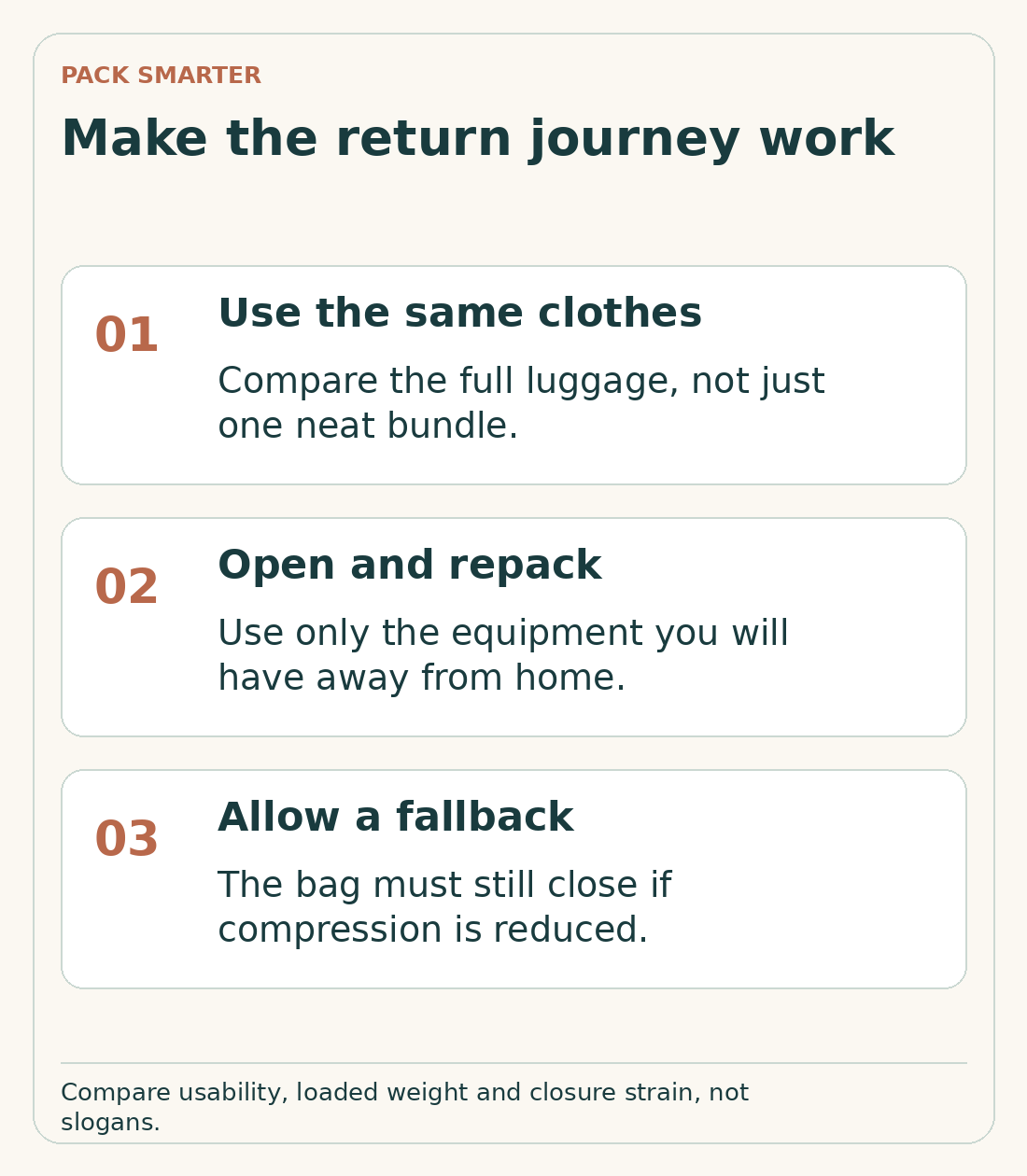
Your belongings should still fit in a workable way if the bag loses some compression, the pump is unavailable or a security inspection requires opening the bundle. That may mean leaving spare room, reducing the clothing list or choosing a no-pump roll bag instead.
Integrated products such as TORRO’s vacuum travel backpack illustrate another version of the idea. Assess the entire backpack’s dimensions, empty weight and pump arrangements separately rather than assuming built-in compression makes it suitable for your airline. [12]
A return flight with the same restrictive allowance is the point at which this planning matters most. Saving space on the outward journey does not help when used clothing, a failed seal or missing equipment leaves no realistic way to close the bag for home.
Match the system to a backpack, a suitcase or a moving itinerary
In a compact backpack, shape and access often matter more than the maximum compression of one garment. Try a small cube or roll bag that fits the opening without forcing the sidewalls outward. Keep rigid equipment separate and preserve the bag’s normal external outline.
A larger suitcase offers more freedom to arrange broad bundles, but still has wheel housings, dividers or a particular opening shape to work around. A compressed slab that leaves large unused corners may not be an improvement over two smaller groups.
Let the unpacking routine guide the choice
For a single hotel stay, a bulky garment can remain in a roll bag until you unpack. For repeated one-night stops, easy access and simple resealing may favour a cube. On a trip combining both, one of each may be reasonable if each serves a clear role.
Outdoor equipment needs its own manufacturer-led packing and storage approach. A general travel clothing comparison should not override instructions for a sleeping bag, insulated item or specialist kit. The appropriate compression system is the one that respects those requirements as well as your luggage space.
Check airline size, weight and any pump battery separately
Compression changes the clothing bundle, not the airline’s rules. A backpack can remain too tall or too deep after its contents become flatter. Measure the complete bag with all pockets filled, and weigh it after adding the organisers and any pump.
Ryanair’s current small personal bag allowance is 40 x 30 x 20cm, while easyJet’s small under-seat bag is 45 x 36 x 20cm. Those measurements are separate from a manufacturer’s litre claim or a description such as travel approved. [9][10]
A rechargeable pump is not automatically a power bank
Check the battery type, rating and airline rules for the actual device. Rules for equipment containing a battery can differ from rules for a spare battery or a power bank. Do not apply a familiar power-bank allowance to an unlabelled pump without checking its specification.
Current CAA guidance places specific restrictions on power banks, including cabin carriage, individual protection and a maximum of two per person. It also prohibits recharging a power bank onboard; airlines may be stricter. Use the current guidance and carrier policy for the equipment you actually intend to carry. [11]
Keep anything that must remain in the cabin accessible if another bag is sent to the hold. A deeply buried pump, battery or power bank creates an avoidable repacking problem at the gate. Compression should not make essential checks harder to complete.
Keep damp clothing and long-term storage out of the wrong system
A tightly sealed bag can contain damp clothing temporarily, but it does not dry it. Separate wet items from clean garments and electronics, then open the containment and dry them as soon as practical. Do not treat a used-clothing divider as a guarantee that moisture cannot affect adjacent contents.
Clean and dry the organisers according to their manufacturers’ instructions after the trip. Inspect seals, valves and zips before the next use. A damaged closure discovered at home is easier to deal with than one discovered while preparing for an early flight.
Unpack items that need space between trips
Rab’s guidance for sleeping-bag storage emphasises keeping down dry and lofted without prolonged compression. Follow the relevant maker’s instructions for your own insulated equipment, and distinguish transport compression from storage for weeks or months. [8]
For delicate or structured clothing, use a packing method that preserves the required shape and finish. Do not assume a garment is suitable for strong compression simply because it is soft enough to fit inside the bag. A brief trial with ordinary replaceable clothing is a better starting point than experimenting on an important outfit immediately before travel.
Store the empty packing products in a way that does not trap residual moisture or place stress on a folded valve. The most sustainable system is usually the one you can maintain and reuse, not the one with the largest set count.
Pros and cons of each approach
Travel roll and vacuum bags
Useful for suitable bulky soft items and for keeping a defined group together. No-pump roll versions are practical away from home. The drawbacks are repeated resealing, changing bundle shape and dependence on a sound closure; pump-operated versions add equipment requirements.
Zip-compression cubes
Convenient for frequent access, clear clothing groups and ordinary repacking. Their outline is relatively easy to plan around. The drawbacks are organiser weight, the temptation to overfill and the possibility that a domed compressed cube uses space poorly.
An ordinary packing cube or simple folded load remains a valid third choice. If the luggage already holds the required items comfortably, compression may add little beyond another closure to manage. Keep organisation when it helps, but do not add pressure merely because the product offers it.
Choose the compromise that matches the recurring part of your journey, not the feature that looks most impressive in a demonstration.
Avoid the mistakes that erase the space you saved
The first mistake is filling the newly available space with more clothing without reweighing the bag. Compression has not increased the weight allowance. It has simply made room for a denser load, which may be less comfortable to carry and more difficult to manage.
A second mistake is comparing different garment piles. A cube packed with light tops cannot be fairly compared with a vacuum bag packed with a bulky fleece. Use the same clean, dry contents and assess the full luggage after each method.
Do not hide an unsuitable fit with more pressure
If a compressed bundle forces the bag’s front outward or presses against a laptop, change the bundle size or layout. A smaller-looking clothing packet is not a success when it creates a harder object in the wrong place.
Avoid using every piece in a multi-pack by default. Take the few pieces with a clear purpose and leave the rest at home. Likewise, do not assume every item in a set has the same compression function simply because the overall product title mentions it.
Finally, test the return process. Open the bundle, remove one garment and repack it using only the equipment you will have during the trip. That simple rehearsal exposes many weaknesses that are invisible in a neatly packed departure photograph.
Frequently asked questions
Do vacuum bags make luggage lighter?
They do not remove the weight of the clothes. Organisers and pumps add their own weight, while the saved volume can encourage you to pack more. Weigh the complete finished luggage rather than assuming a smaller bundle creates a lighter bag. The benefit being sought is usable space, not a new baggage-weight allowance.
Are roll-up travel bags genuinely vacuum bags?
They belong to the wider air-removal category, but the practical distinction is that rolling pressure expels air through a one-way valve without a separate pump. Check the product instructions. Do not assume a bag described as a vacuum storage product supports that method unless the manufacturer says it does. [1]
Which option is better for a small personal-item backpack?
Start by comparing the finished footprint. A small compression cube may be easier to retrieve and position, while a small roll bag can help with a suitable bulky layer. Neither is automatically best. Keep the laptop and rigid items protected, and ensure the complete backpack remains within the booked dimensions.
Can I put a compression cube inside a vacuum bag?
It may be physically possible, but it adds layers and can create an awkward rigid bundle. Try the simpler system first. Combining products is worthwhile only when it solves a defined problem and still allows comfortable closure, straightforward access and repeatable repacking.
Will compression prevent creases?
Do not rely on that. The result depends on the garment, fabric, folds and pressure. For clothing that must arrive looking a particular way, prioritise an appropriate garment-packing method and follow care advice rather than pursuing maximum volume reduction.
Can I keep dirty laundry in a compression bag?
Dry used clothing can be kept separate in a suitable organiser. Damp or wet clothing needs a different plan: temporary containment followed by opening and drying, not prolonged sealed storage. A clean-and-used divider makes organisation easier but does not automatically provide waterproof separation or remove moisture.
What happens if a vacuum bag loses its seal abroad?
Check for trapped fabric, an incompletely closed seal or damage, following the maker’s instructions. More importantly, have enough packing flexibility that reduced compression does not make the journey impossible. Leave spare room or reduce the load before departure rather than relying on a perfect seal for the whole trip.
Do I need a pump for Eagle Creek Compression Sacks?
The Pack-It Compression Sack Set M/L described here uses a one-way pressure valve and does not require a pump. That answer applies to the named product, not every bag with compression in its title. Check the exact model before buying accessories. [3]
Is a large set better value than one good cube?
Only when you will use the relevant pieces. A set can make sense across family luggage or several bag sizes, but it may be wasteful for one compact backpack. Measure the required footprint, identify the clothing groups and compare the cost of the pieces that actually solve those needs.
What is the fairest home comparison?
Use identical clothes, the same luggage and the same essential non-clothing items. Compare normal closure, access, full-bag dimensions, loaded weight and the ability to repack. Do not perform damage tests or force zips. The winner is the system that improves the complete journey, not the one that produces the thinnest isolated packet.
The recommendation: favour the system you can repeat easily
For regular clothing access and uncomplicated repacking, begin with one or two appropriately sized compression cubes. For a specific bulky soft item that can stay packed during transit, trial a suitable no-pump travel roll bag. Use pump-operated vacuum systems only when the equipment, battery arrangements and return process are understood.
The product shortlist offers different footprints and organisational features rather than a universal winner. Packmate’s smaller roll bags address compact groups, Eagle Creek’s larger valve bags address bulkier loads, and the cube options offer different ways to separate clothing. Choose the feature that solves your actual problem.
Keep a fallback for reduced compression and weigh the finished luggage. When ordinary folding already provides enough room, no compression product is necessary. The best system is the one that leaves your bag easy to close, comfortable to carry and straightforward to repack when the trip is nearly over.
Sources and fact-checking notes
Mechanism descriptions and product measurements come from the named manufacturers. The illustrative space calculation is arithmetic, not a product test. No advertised percentage saving is adopted as a predicted real-world result. Verify selected set contents and any pump or battery requirements. Sources reviewed on 15 October 2026.
- Packmate: Medium Travel Roll Storage Bags, 40 x 50cm
- Packmate: Small Travel Roll Storage Bags, 25 x 38cm
- Eagle Creek: Pack-It Compression Sack Set M/L
- Peak Design: Packing Cube range and compression design
- Thule: Compression Packing Cube Small, TCPC201 size specifications
- BAGSMART UK: Compression Packing Cubes 6 PCS
- Eagle Creek: Pack-It Isolate Compression Cube Set S/M
- Rab: uncompressed sleeping-bag storage and loft
- Ryanair: current bag policy
- easyJet: cabin bags
- UK Civil Aviation Authority: lithium battery and power-bank rule changes effective 27 March 2026
- TORRO: Travel Backpack with rechargeable vacuum pump
- Lifeventure: Ultralight 10L Compression Sack, a strap-compression alternative
Illustrations in this article were created for Taylor’s Trailblazing Travel Gear. Third-party photographs, where used, are credited beside the image or in the source list.


