40L vs 45L Carry-On Backpack
Five extra litres only help when the packed bag still meets every limit.
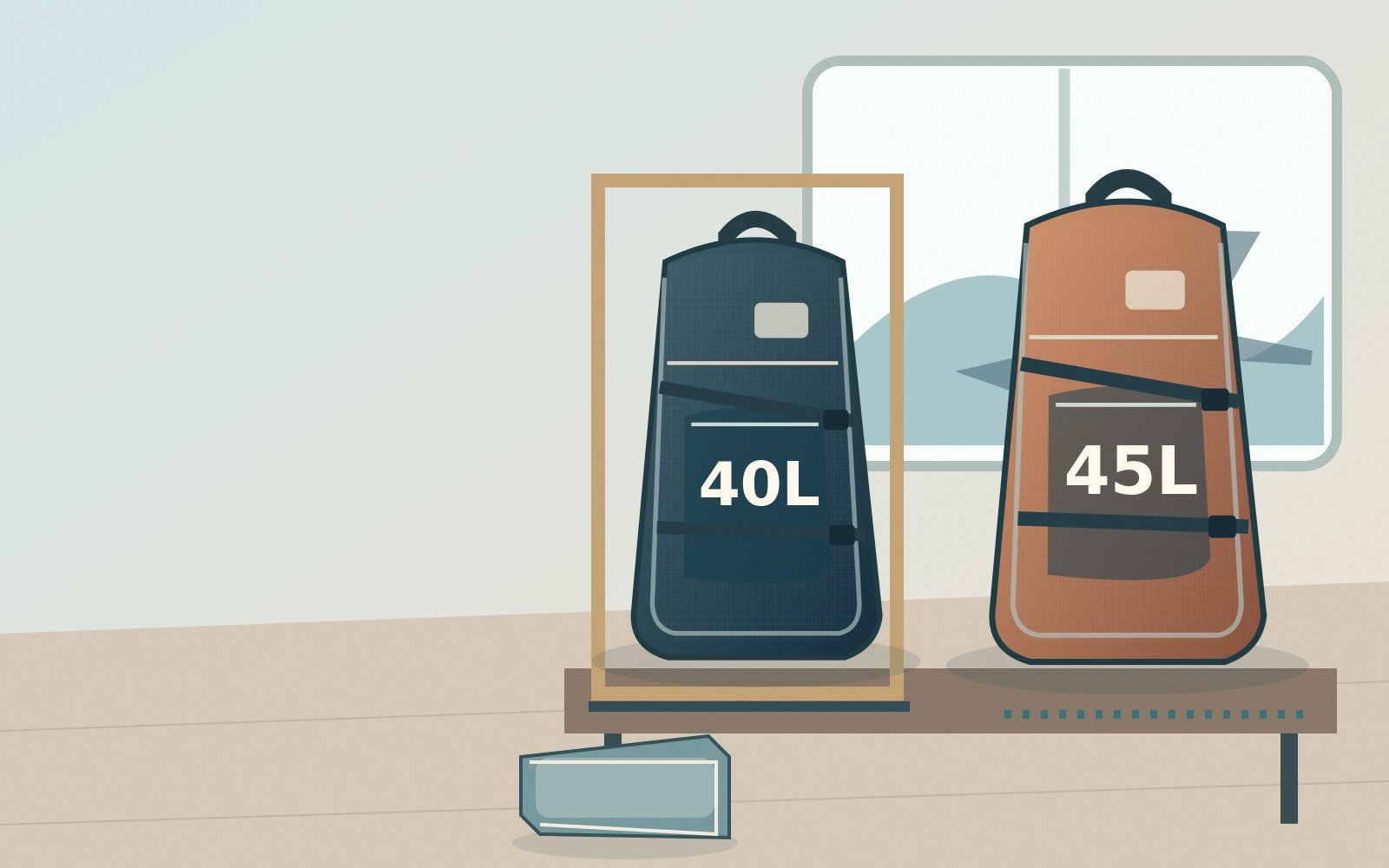
Concept scene: a larger capacity does not create a larger airline allowance.
The 40L vs 45L carry-on backpack choice is less about five litres than about the outside of the finished bag. Extra capacity can make a clothing system easier to live with, but a deeper front panel or an expanded compartment may cross an airline limit. A bag can be marketed for cabin travel and still be unsuitable for the particular allowance on your booking.
Begin with the strictest flight you expect to take, then work inward: external dimensions, total weight, protected equipment, clothing and finally discretionary extras. That order prevents a common disappointment: choosing a beautifully organised backpack and discovering that the useful version of it is the version you cannot take into the cabin.
This is a research-led comparison, not a packing contest or a claim of product testing. Named examples were checked on 11 October 2026 and illustrate specific trade-offs. We separate published measurements, straightforward calculations and practical judgement so you can see which parts need confirmation with the actual bag.
Five litres
45L is 12.5% above 40L, not a promise of proportionally more usable packing space.
Measure packed depth
A 24cm-deep bag and a 20cm limit remain incompatible on paper.
Larger can weigh less
Compare exact models instead of treating litres as an empty-weight scale.
Start with the ticket
Separate personal-item allowance from entitled overhead baggage.
40L vs 45L carry-on backpack: what five litres buy
A modest increment with potentially large consequences
Forty-five litres is 12.5% more nominal capacity than forty. Moving back from 45L to 40L is an 11.1% reduction relative to the larger number. Neither calculation tells you exactly how many garments will fit, because capacity measurement and internal construction differ. The useful question is where the additional room appears: a deeper main compartment, a taller body, more external pockets or an expansion section.
Extra room at the front may accommodate a jacket without changing the bag’s width or height, but depth is itself a controlled dimension on many flights. Extra height may suit long items while making the pack more awkward on a shorter torso. Do not describe all five-litre increases as equivalent. Compare the actual shape and identify the item or packing problem that the additional space is supposed to solve.
Do not confuse capacity with a right to board
Carry-on is a use category, not one universal size standard. A large-cabin allowance and a free personal-item allowance are separate entitlements. The backpack must meet the conditions of the one you have, including the number of pieces permitted. A bag that fits an overhead locker physically may still be outside the allowance included with your fare. [1] [2]
When a product description makes a broad airline claim, treat it as a prompt to investigate. The carrier’s own current rules, your operating flight and the bag’s completed measurements provide the useful answer. Leave out sales language when making your comparison sheet. Capacity, empty mass, measured depth and the relevant ticket entitlement are much easier to evaluate than phrases such as maximum cabin capacity.
Compare exact examples rather than average sizes
These examples have been chosen for their different layouts and specification issues, not ranked from best to worst. The 44L Transporter is included deliberately as a nearby-capacity warning, not relabelled as a 45L bag. Figures below are published values, not measurements taken for this article.
| Backpack | Published dimensions | Published empty mass | What to investigate |
|---|---|---|---|
| Osprey Farpoint 40, S26 | 55 x 35 x 23cm | 1.48kg | Adjustable harness and zip-away carrying system; depth exceeds a 20cm rule. [3] |
| Antler Discovery 45L, Black | 55 x 35 x 24cm | 1.47kg | Only 1cm more listed depth than the Farpoint, but still a different internal design. [4] View Discovery 45L Black |
| BAGSMART Blast Pro 40L | Conflicting 45 x 33 x 22cm / 45 x 32 x 21.5cm blocks | Conflicting 1.3kg / 1.5kg blocks | Get current-version confirmation before using it in a close-limit comparison. [5] Check Blast Pro details |
| Osprey Transporter 44 Travel Backpack, S25 | 54 x 42 x 32cm | 1.54kg | Published 32cm depth is a substantial cabin-size issue despite the marketing. [6] [7] Inspect Transporter 44 listing |
The larger label is not necessarily the heavier shell
The Black Discovery 45L is listed one hundredth of a kilogram below the current Farpoint 40. That tiny published difference is not a meaningful comfort verdict, but it disproves the idea that capacity alone determines empty weight. Materials, padding, hardware and suspension matter. Do not choose one of these packs because a ten-gram catalogue difference seems decisive; compare the whole carrying system and confirm the exact colour and edition. [4] [3]
A contradictory page deserves a question, not an average
For the Blast Pro, averaging the two weights would create a number the manufacturer has not supplied. Choosing the smaller dimensions would be equally unjustified. Ask which figures apply to the selected product and whether they describe an empty or packed state. Until clarified, keep the backpack out of any recommendation that depends on millimetres of spare room or a very tight mass allowance. [5]
Start with the cabin allowance you actually have
Three examples of different entitlements
The table is a dated screening guide, not a substitute for checking the booking. Dimensions refer to the relevant bag category, not to a capacity measured in litres. Airline rules can change, and partner-operated services may have their own conditions. Avoid using a retailer’s automatic airline tick as the final authority.
| Carrier and bag category | Published maximum dimensions | Key distinction |
|---|---|---|
| Ryanair small personal bag | 40 x 30 x 20cm | Included small bag; must fit under the seat. [1] |
| Ryanair Priority second cabin bag | 55 x 40 x 20cm | 10kg overhead bag with the relevant entitlement. [1] |
| easyJet small cabin bag | 45 x 36 x 20cm | Underseat category; 15kg limit and self-lifting requirement. [2] |
| easyJet large cabin bag | 56 x 45 x 25cm | Appropriate booking or membership/fare entitlement required. [2] |
| British Airways cabin bag | 56 x 45 x 25cm | Distinct from its smaller underseat handbag allowance; check your flight. [8] |
What this means for the named bags
The Farpoint and Black Discovery fit inside the easyJet large-bag dimension box on their published measurements. Neither fits inside a 20cm-deep box as listed. That is a comparison of numbers, not a guarantee of acceptance when stuffed, fitted with accessories or carried on a different entitlement. The Transporter’s 32cm stated depth is outside even the 25cm examples in this table. [3] [4] [6]
Do not assume that the smaller 40L category is automatically the safer choice. It might be, but only after comparing the actual dimensions. A carefully chosen 45L design can be shallower than a different 40L design, while an unusually wide 44L pack can be a poor match for your route. The label is a starting filter; the external shape is the useful evidence.
Depth is often the decisive measurement
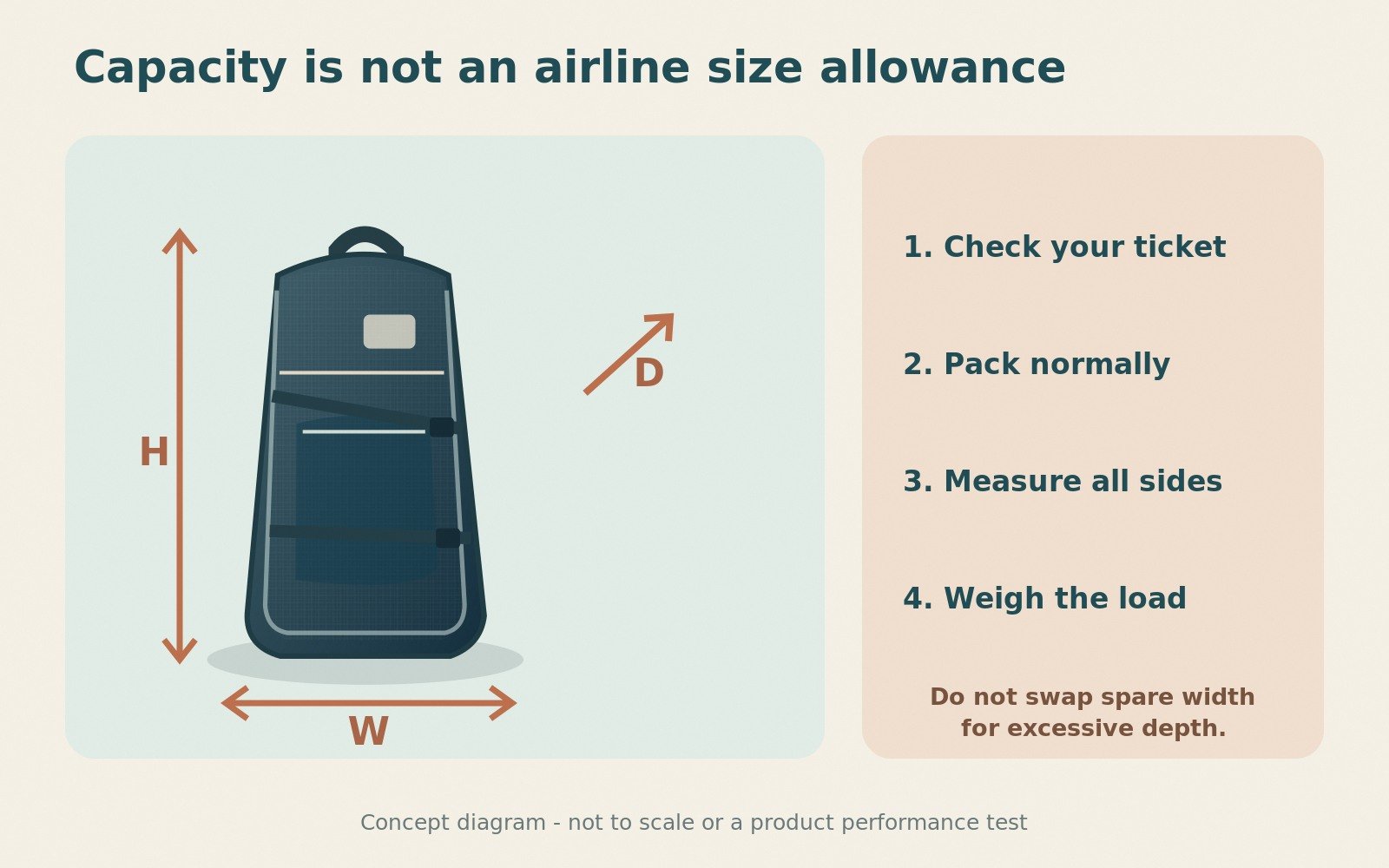
Measure bulges, not the seam-to-seam outline
Load the front organiser, laptop sleeve and internal compartment as you will use them. Put the bag on a stable surface without deliberately flattening it, then measure its furthest points. A pair of flat boards or books can help identify the front and back boundaries. Do not measure only the sewn side panel while ignoring a filled front pocket protruding beyond it.
Check the bag in the orientation used for the comparison. A strap, handle or pocket can create a different maximum depending on how the pack settles. Repeat the measurement rather than relying on a single flattering reading. The purpose is to understand whether your ordinary packing routine produces a compliant shape, not to discover a pose that makes the bag look smaller for a photograph.
Treat a close fit as a reason to test more carefully
A nominal 24cm depth leaves only a centimetre against a 25cm limit. That is not much room for an overfilled pocket or an item pushed towards the front. The Antler Discovery 45L Black listing is a relevant example to measure rather than simply approve from its capacity. Check its loaded shape and your entitlement before buying on the basis of that small margin. [4]
A soft body may compress when lightly packed, but that does not create a general exemption. You need to know which parts are flexible and which are fixed. A laptop, frame or densely packed cube may prevent the reduction you expected. If compliance requires constant force or removing essential contents, choose a different shape or a different baggage allowance rather than relying on luck.
Weight limits can make five extra litres irrelevant
Reserve mass for the things that cannot be edited away
Build a weight budget around your fixed equipment first. A work laptop, prescribed items, camera or essential footwear may leave less flexibility than the clothing pile suggests. Add the empty backpack, then weigh the remaining categories. Do not assume a generous-looking main compartment can be filled simply because there is still room beside the packing cubes.
As an illustration, a 1.5kg backpack and a 2kg technology kit consume half of a hypothetical 7kg total budget. The remaining 3.5kg must cover clothing, toiletries, documents, food and anything else counted in that allowance. This is invented planning arithmetic, not a measured load or a rule for all airlines. It shows why the capacity increase can have little practical value on a weight-constrained journey.
Use scales to make decisions, not to chase the last gram
Weigh categories separately to find the real cause of a heavy bag. The answer may be a second charger or large liquid containers rather than the backpack itself. Then weigh everything together, because small omitted items accumulate. Keep the measurement method consistent and avoid comparing a fully packed departure bag with an incomplete trial load.
The Go Travel Digital Pro Scale is one option for this task; its listed features include a tape measure. Use any suitable scale sensibly and allow a margin for different readings. A home scale does not certify what an airport scale will display, and the pack still has to meet dimensional requirements even when its weight is below the limit. [9]
Use the extra space for a specific module
Identify the item that makes 40L fail
Lay out the smallest complete version of your kit, then add the item that creates the difficulty. It could be formal shoes, a fleece, a gift or a change of clothing for a dependent traveller. Place it into the candidate bags in the position it will actually occupy. This prevents a vague statement such as needing more room from turning into an unnecessarily large purchase.
A module does not have to be another pouch. It can be a defined group of clothes that stay together or a protected item with a stable place in the pack. The useful test is whether you can remove the group and put it back without disturbing everything else. A little space retained around that module may be worth more than packing the smaller bag perfectly to its limit.
Match organisers to the internal shape
BAGSMART’s Blast Packing Cubes provide several different footprints, while the Thule small/medium compression set is a two-piece alternative. Compare their actual dimensions rather than assuming a set will fit because its advertising mentions carry-on luggage. Compression changes the shape of soft clothing; it does not remove the mass of the contents or enlarge the bag’s opening. [10] [11]
Do not compress delicate meeting clothes simply to make the five-litre difference disappear. Nor should you fill every module if the bag becomes too deep. Test a smaller number of organisers and leave the rest at home. The best arrangement often combines a few stable modules with flexible space for a layer you remove during the day or clothing that is no longer folded neatly.
Keep a deliberate plan for return-day growth
Outbound packing is not the hardest version
The first packing session often benefits from freshly folded clothes, carefully selected toiletries and time to rearrange things. The last morning may involve an early checkout, a damp-weather layer and a small purchase. Rehearse that less orderly version before deciding that 40L is comfortably sufficient or that 45L is genuinely necessary.
Include the jacket you might no longer be wearing and any reusable shopping bag you expect to carry. If you plan to move items into a second bag, confirm that the ticket permits it. The existence of a separate personal-item allowance is not permission to carry unlimited additional pieces, and a bag used at the destination may need to be folded inside the main backpack for the flight.
Reserve space without turning it into a souvenir target
Some unused room can support a calmer trip. The mistake is treating it as a quota that must be filled before returning. Decide in advance whether you have a small, specific allowance for purchases and keep the weight budget alongside the space budget. Bulky but light items and small but heavy items create different problems.
For a journey involving many changes of accommodation, compare how quickly the bag returns to a tidy, stable shape. A slightly larger compartment can help if it prevents repeated repacking. However, a 45L pack that tempts you to accumulate extras may be less manageable than a 40L pack with a clear clothing cycle. Evaluate the routine you expect to maintain, not an idealised version of yourself.
Carry comfort: a bigger bag is not automatically a better harness
Separate suspension quality from volume
The carrying system includes shoulder straps, backpanel, torso length, sternum adjustment and any hipbelt or frame. Two packs with the same capacity can distribute a load very differently. A model with a substantial harness may be worthwhile when you regularly walk between stations and accommodation, while a simpler system might suit mostly short transfers. Try the actual load before deciding which is appropriate.
Do not regard a thick shoulder pad as proof of comfort. Its shape and position matter, as does how the rest of the bag sits against you. Similarly, a hipbelt that does not reach the right position cannot be expected to provide the benefit implied by a photograph. Stop a fitting trial if it causes discomfort rather than interpreting that as something to tolerate until the bag breaks in.
Consider sitting, lifting and the bag beside you
Capacity becomes noticeable when you are not wearing the pack as well. A larger body can obstruct your legs on a train or occupy more floor space in a small room. Check the quality and positioning of grab handles because you will use them during these transitions. Do not lift a heavily loaded pack to an unsafe height to simulate an overhead locker; use a manageable load and a stable surface.
Our travel backpack trial guide helps organise those checks. Record which configuration feels stable, whether access remains simple and whether loose straps get in the way. A 45L bag that genuinely improves packing and handles well can be the sensible choice. A 40L bag that meets the flight requirements but feels awkward on your body is not automatically the correct compromise.
Three shortlist decisions to make carefully
Antler Discovery 45L: assess the Black version as listed
The Black Discovery has a full side opening, recycled-polyester construction and strap-stowage provision in the retailer description. It is a candidate when you want suitcase-like access in a backpack and your route permits its completed size. Its 45L label should not be mistaken for a guarantee of more useful room than every 40L competitor, because internal organisation affects how your kit sits. [4] [12]
Use the specific Black Discovery listing to check the current offer, not a different colour with potentially different published information. Then ask yourself whether the front and side pockets are useful in your normal routine. If they are likely to remain empty because filling them makes the pack too deep, their presence should not be treated as a major packing advantage.
Transporter 44: a clear example of why dimensions win
Osprey’s Transporter 44 combines split-case access and a tuckaway backpanel, but the manufacturer and retailer both publish 54 x 42 x 32cm. That stated depth is the problem to resolve before treating it as a cabin-only purchase. Do not infer that a maximum-carry-on description supersedes those figures or that 44L must be safer than 45L. [6] [7]
The Transporter product page remains useful for examining its layout or for a journey without the same cabin constraints. It is not the default recommendation for a strict 20-25cm depth allowance. Ask the seller for the actual packed profile and whether the published dimensions are correct. Until there is clear evidence, plan from the stated numbers rather than from a hoped-for correction.
Blast Pro 40L: resolve the two specification blocks
The Blast Pro 40L listing describes a laptop-focused travel layout and tuckable hipbelt, but provides inconsistent size and mass information. That makes it unsuitable for an unqualified tight-fit recommendation. Identify the version, request current external dimensions and check whether the features shown belong to that version rather than a related model in the same product family. [5]
This does not prove the bag is poor. It means the evidence is not clear enough for the precise decision being made. The sensible response is to ask before ordering, or choose a candidate with confirmed figures. A research-led shortlist should make uncertainty visible instead of converting the most attractive number into an apparently authoritative specification.
When 40L is the more useful choice
An already stable packing system
Choose around 40L when your normal kit fits, you have a realistic clothing cycle and the bag’s shape meets the relevant limits. In that situation, the extra five litres may offer little more than the possibility of carrying more. Prioritise easier access, better fit or reduced empty mass if those are the things your existing system lacks.
The smaller option can also make sense when you want a clear boundary around purchases and spare outfits. However, that boundary should not require fragile items to lose protection or essential clothing to be omitted. A disciplined packing system is one that reliably serves the trip, not one that wins an arbitrary capacity contest at the expense of comfort or practicality.
Frequent use on several different airlines
A pack with confirmed dimensions comfortably inside your strictest recurring allowance can reduce repeated uncertainty. Choose the external shape first and let the litre label be secondary. A nominal 40L design is not automatically compliant, as the Farpoint example demonstrates against a 20cm depth limit. You may need a shallower model, less capacity or a different baggage product. [3] [1]
Keep a small record of the bag’s packed measurements and the kit used to achieve them. Update it when adding equipment or changing packing organisers. This is more useful than remembering that the bag flew successfully last year, because your load and the airline’s rules may both have changed. The purchase should support your recurring route, not a generic online definition of cabin luggage.
When 45L genuinely earns the extra room
Necessary bulky items with an adequate allowance
Choose 45L when the larger pack accommodates a defined essential load more easily, its outside measurements are acceptable and its carrying system suits you. A mixed-climate trip or an event outfit can make that additional room valuable. Look for the least restrictive way to pack those items rather than assuming they must be compressed into the smaller bag to count as efficient travel.
The benefit may be easier repacking rather than more possessions. That is a legitimate improvement if it does not lead to excessive size or weight. An organised 45L pack with a little flexible space may serve you better than a 40L bag that requires every pocket to be filled in a particular order. Test that difference with ordinary packing, not a deliberately perfected arrangement.
Enough restraint to leave capacity unused
Buying 45L does not mean filling it to the maximum for every trip. Use internal compression and a sensible arrangement to keep a smaller load from shifting. Check that the bag remains comfortable when partially filled, because some designs rely on a fuller shape to support their organisation. An adaptable larger bag is useful only when its less-full configuration works as well as its fully loaded one.
Avoid adding bulky external attachments as a workaround. They can change measurements, interfere with handling and complicate the number of items you are carrying. Place flight-day essentials where they are accessible inside a compliant arrangement. The extra capacity should simplify the journey, not turn the backpack into the centre of a collection of dangling accessories.
Prepare for the possibility of a cabin-bag hand-off
Keep essential items removable
Even an acceptable cabin bag may need a different handling arrangement when space is limited. Keep passports, medication and important valuables accessible rather than buried underneath clothing. Know what you would remove before handing the bag over. This is a packing workflow, not a prediction that a particular airline will take your bag at the gate.
The Civil Aviation Authority says power banks and spare batteries belong in the cabin, and advises removing batteries or lithium-powered devices when a cabin bag is taken for the hold. Follow the airline and crew’s instructions for the particular items you carry. A larger backpack makes this access plan more important, because a full clamshell repack at the gate is inconvenient. [13]
Strap stowage helps handling but does not change allowance
A covered harness can create a tidier exterior for a hand-off, yet it does not make an oversized bag compliant. Check that the stowage system works when the pack is full and that a clear carry handle remains available. Do not assume that a decorative strap pocket covers every buckle or that a tuckable hipbelt means the shoulder straps disappear too.
Keep the distinction between prevention and preparation. Choosing a bag that meets the allowance reduces avoidable problems; knowing how to remove essentials prepares for an operational change. Neither step replaces the other. Carry-on planning is stronger when it accounts for what the bag must do before, during and after the flight rather than focusing only on the boarding photograph.
Use capacity arithmetic as a warning light, not a verdict
External-box volume is not internal capacity
Multiplying height, width and depth gives the volume of an imaginary rectangular box around the bag. It does not measure the internal compartment. Curved surfaces, rounded corners, padding and protrusions make that distinction important. Do not replace a manufacturer’s capacity claim with your calculation and present the result as a measured correction. The calculation can help identify a question to ask, but it cannot establish the answer by itself.
For example, the Farpoint’s published 55 x 35 x 23cm dimensions describe an enclosing rectangular volume of 44.275 litres. That is not evidence that the bag is secretly a 44L model. It is simply the arithmetic of the external dimension box. A capacity label and an outside measurement serve different purposes: one describes storage, while the other helps screen a bag against baggage limits. Keep them separate in your buying notes. [3]
Expansion creates multiple products within one name
An expandable pack should be evaluated in each configuration you intend to use. Record whether the advertised litres refer to the expanded state, the normal state or a range. Then identify which external dimensions belong to that state. Without that information, a comparison of 40L and 45L can accidentally compare one bag’s ordinary capacity with another bag’s maximum expansion.
Do not assume that leaving an expansion zip closed will always solve a fit problem. The rest of the bag still has its own shape and the contents can create bulges elsewhere. Equally, the expanded setting may be useful for a rail journey or at the destination even when unsuitable for a flight. An adaptable bag can be worthwhile, provided you have a realistic place for the extra contents when you return to the smaller configuration.
A decision worksheet that avoids false precision
Use rejection gates before preferences
Begin with three yes-or-no questions. Does the packed bag meet the relevant external limits? Does the completed load fit the weight allowance? Can you carry and handle it comfortably? A failure on one of these should not be cancelled by attractive colours, a better laptop pocket or an extra organiser. Those benefits matter only after the fundamental requirements have been met.
Once both candidates pass, compare the points that affect your routine: access to essentials, ease of repacking, quality of grab handles and the usefulness of the additional room. Write a sentence describing the difference instead of assigning arbitrary scores. Easier to replace the laptop when packed is more informative than giving one bag eight out of ten for organisation without explaining what that number measures.
Make the keep-or-return decision while the evidence is fresh
After the indoor trial, note the exact kit, configuration and measurements. Keep the photographs of any specification labels and the seller’s version details. This helps distinguish the bag you actually examined from another size or edition appearing in a later search. Check return conditions and deadlines directly rather than assuming the same policy applies to every retailer or discounted product.
Do not keep a poor fit because the return process feels inconvenient. Equally, do not return a suitable bag merely because another model claims one more pocket or a slightly larger capacity. Decide whether the backpack solves the requirements you wrote down at the beginning. A stable, understandable system is worth more than continuously chasing a theoretically perfect collection of features.
Consider the parts of the journey without a luggage sizer
Trains, buses and everyday storage still matter
A bag selected close to an airline’s maximum size may feel large in other parts of the journey. Think about storing it beside your legs, lifting it onto a rail luggage rack or keeping it near you in a small vehicle. These situations do not have one universal rule in this guide. Check the operator where necessary and consider whether you can manage the bag without blocking access or separating yourself from important belongings.
The extra capacity may help by eliminating a loose shopping bag or second clothing pouch. It may hurt by making the main bag unwieldy. Compare the completed system, including every item carried separately. A 45L backpack plus several attachments is a different proposition from a tidy 45L backpack that contains everything, even though both begin with the same capacity label.
Storage at the destination is part of the purchase
A full-opening backpack needs room to open, and a thickly packed body may not fit a small locker. Consider whether the bag will live on a floor, shelf or luggage stand and whether you need daily access to its compartments. A large bag that stays unpacked in one room may be perfectly manageable; the same bag used as a daily carry can be unnecessarily cumbersome.
Before paying for more capacity, ask whether the extra space will be useful for most of the trip or only during the flight. A modest separate day bag may sometimes help, but it also adds another item and must fit your flight-day plan. The most useful forty-or-forty-five decision accounts for those trade-offs rather than treating the airport as the only place where the backpack has to work.
Do not move weight into an imaginary second allowance
Some packing plans make the main bag look compliant by moving a laptop or heavy pouch into a second bag without checking whether that second piece is permitted. Keep a complete inventory of what will be carried at boarding. A smaller main pack plus an overloaded personal item is not automatically a better system than one properly packed larger bag. The rules and handling requirements still apply to the whole arrangement.
Where separate pieces are permitted, decide deliberately which items belong in each. Keep essentials accessible and check the secondary bag’s own dimensions and any combined-weight condition. Do not assume that a familiar airline applies the same arrangement on a partner-operated flight. Verify the booking rather than constructing a packing plan around the most generous rule you have seen elsewhere.
The same discipline helps when travelling with someone else. Allocate shared equipment before weighing either pack, and do not presume that spare allowance can always be pooled between cabin bags or passengers. This guide does not establish such a right. Ask the airline when the rule is unclear, then test the arrangement you are actually entitled to carry. Five extra litres are useful only within a valid and manageable overall baggage plan.
Pros and cons: a balanced decision
Why 40L can be enough
A good 40L pack can provide a clear limit on the kit and may be easier to keep compact during repeated travel. It makes most sense when it already accommodates the clothes and fixed equipment you need. The disadvantage is less room for bulky necessary items and less tolerance for disorderly repacking. A poor-fitting or overly deep 40L design is not rescued by its smaller number.
Why 45L can be worthwhile
The larger option can improve access and make a demanding kit less tightly packed. It may even have a similar empty mass to a smaller alternative. Its disadvantages are potential depth problems, temptation to overfill and a more intrusive body during everyday use. These are model-dependent trade-offs, so compare actual candidates rather than treating either size as inherently sensible or excessive.
Common mistakes in the five-litre comparison
Relying on a sizer story rather than measurements
An account of someone squeezing a pack into a frame is not a specification for your bag, packing list or flight. Nor does a successful gate experience prove that the bag meets the written allowance. Use current official rules and your own completed measurements. A retailer’s broad list of compatible airlines is not a replacement for checking the exact baggage product you booked. [1] [2]
Forgetting the expansion and the return journey
Record which configuration each quoted dimension describes. A product name can refer to a family of sizes or an expandable design, and the deepest state may be the one you need to carry the advertised load. Also rehearse the journey home with souvenirs, removed outerwear and a less orderly clothing pile. Buying five extra litres is unhelpful if using them makes the bag fail the only flight that matters.
Frequently asked questions
Is 45L always too large for carry-on?
No. Some 45L models have published dimensions within particular overhead-bag limits, while others do not. A litre figure is not an airline measurement. Check height, width and depth with all compartments filled, then confirm the entitlement and weight limit on the booking. The correct conclusion is specific to the bag and flight, not to the entire 45L category.
Is 40L guaranteed to fit Ryanair Priority?
No. Ryanair’s second cabin bag under Priority has a 55 x 40 x 20cm limit and a 10kg weight limit. A 40L bag with a published depth of 23cm is outside that dimension on paper. Underpacking may reduce flexible sections, but it is not a guarantee and cannot alter every fixed component. Measure the actual bag and choose a compliant configuration. [1]
How much more clothing can I pack in five litres?
There is no reliable universal garment count. Clothing size, fabric thickness, folding method and organiser layout all matter. Put the extra clothes into a defined module and compare the real bags. You may find that five nominal litres make repacking easier without increasing the number of outfits, or that a bulky essential item still does not fit the shape of the added compartment.
Can a 45L backpack be lighter than a 40L backpack?
Yes, when the designs use different materials, padding and hardware. Compare published empty weights for the exact versions, then weigh the final load. A lighter shell does not necessarily mean better comfort because suspension and fit matter too. The ten-gram published difference between the Black Discovery 45L and current Farpoint 40 is an illustration, not a reason by itself to prefer one. [4] [3]
Should I buy a larger bag and leave it partly empty?
That can work when the bag compresses or organises a smaller load effectively, remains comfortable and meets your flight limits. Test the partly filled state rather than assuming it will behave well. The strategy fails when unused room encourages extra possessions or the larger frame remains cumbersome. Choose adaptability only when it improves the trips you actually take.
Is a backpack plus a small sling still one-bag travel?
The label one-bag travel is less important than the airline’s permitted number of pieces. A sling may need to fit inside the main pack during boarding unless your allowance permits it separately. Plan where it will go without overfilling the backpack. Keep essential items accessible, but do not assume an additional small bag is exempt from the booking’s baggage conditions.
Which is better for a laptop and meeting clothes?
The better bag is the one with a suitable protected device compartment, room for the clothing arrangement and access that does not require unpacking everything. That may be 40L or 45L. Measure the laptop with any sleeve, trial the actual shirts or trousers and keep hard accessories away from vulnerable surfaces. See our business packing guide for a system-based comparison.
Final recommendation: choose the compliant shape first
Choose 40L when your complete kit already works without strain. Choose 45L when five extra litres solve a specific packing problem and the completed bag still meets the route’s dimensional and weight limits. Neither capacity should be selected before checking your ticket, and neither excuses an uncomfortable harness or difficult access.
For a 45L candidate with clearly listed Black-version dimensions, inspect the Antler Discovery and test its loaded depth carefully. Use a scale alongside the dimensional check rather than treating volume as a weight allowance. The Transporter and Blast Pro examples show why a useful shortlist sometimes includes a warning or an unresolved specification instead of an unconditional recommendation. [4] [6] [5]
Check the Discovery 45L Black View a scale for your packing trial
A successful purchase leaves you with fewer decisions at the airport, not more. The right five litres are the ones that make ordinary packing and repacking easier while preserving comfortable carrying and a clear margin within the rules. When they cannot do that, a different shape is more useful than a bigger number.
Sources and fact-checking notes
Product details and linked pages were reviewed on 11 October 2026. Published specifications are distinguished from illustrative calculations and planning advice. No hands-on product testing or independently measured performance results are claimed.
Some pages include conflicting version details or both purchase and stock-notification controls. Recheck product availability, delivery estimates, the selected variant and the operating airline before purchase and travel.
- Ryanair: baggage policy Small personal bag 40 x 30 x 20cm; Priority second cabin bag 55 x 40 x 20cm and 10kg. Check the booked allowance.
- easyJet: cabin bags Small bag 45 x 36 x 20cm; large bag 56 x 45 x 25cm with appropriate entitlement. Published 15kg limit and self-lifting requirement.
- Osprey UK: Farpoint 40, S26 Current UK 40L specification and zip-away harness. The checked Black page showed stock-notification controls; no available offer is assumed.
- Antler UK: Discovery 45L, Black Black listing specifies 55 x 35 x 24cm and 1.47kg. Other colours/editions must be checked independently.
- BAGSMART UK: Blast Pro 40L Travel Backpack Conflicting size/weight blocks: 45 x 33 x 22cm and 1.3kg versus 45 x 32 x 21.5cm and 1.5kg. Obtain confirmation for the selected version.
- Osprey UK: Transporter 44 Travel Backpack, S25 Published 54 x 42 x 32cm, 1.54kg and tuckaway system. Despite carry-on marketing, the stated depth exceeds several cabin limits.
- Case Luggage: Osprey Transporter 44, model 10006375 Retailer confirms the same dimensions. A nearby-capacity comparison, not an exact 45L backpack.
- British Airways: baggage essentials Cabin bag dimensions and the distinction between underseat essentials and larger cabin baggage. Check operating-carrier rules.
- Case Luggage: Go Travel Digital Pro Scale, 2004.101 Retailer description of the scale and tape measure; no independent accuracy test is claimed.
- BAGSMART UK: Blast Packing Cubes Current destination of the older six-piece URL. Set comprises five packing cubes and a shoe bag; dimension ranges are not guaranteed filled thicknesses.
- Thule UK: compression cube set 3204860 Small/medium set, compressed and expanded dimensions, 0.2kg advertised mass and care instructions.
- Case Luggage: Antler Discovery 45L, Black Selected Black listing and strap-stowage description; retailer airline widgets are not used as baggage authority.
- UK Civil Aviation Authority: Pack right. Safe flight. Cabin-only power banks/spare batteries and removal of battery-powered items when cabin baggage is taken for the hold.
Illustrations in this article were created for Taylor’s Trailblazing Travel Gear. Third-party photographs, where used, are credited beside the image or in the source list.