Away Carry-On Review: Size, Weight, Warranty and Who It Suits
Away Carry-On Review: Size, Weight, Warranty and Who It Suits
Two generations, two weights and a warranty change that older reviews can miss.
Original editorial concept of a minimalist hard-shell cabin case; not a photograph or an exact Away product rendering.
This Away Carry-On review is for a UK buyer trying to decide what the case will actually do, rather than whether it looks good in an airport photograph. The important details are its outside dimensions, the amount of weight it uses before packing, the differences between generations and the support attached to a new purchase.
There is a complication: the Classic Carry-On and the newer Carry-On 3 are not interchangeable names. Away’s current pages also contain some inconsistent legacy figures alongside their detailed specifications. This guide identifies the versions used for comparison and does not quietly combine the lightest number from one passage with the largest capacity from another.
The recommendations are based on published specifications and policy research, not ownership or hands-on testing. No wheel-noise test, impact trial or timed packing exercise has been performed. The aim is to help you decide whether either version fits your routes and habits, including the less glamorous business of returns and repairs.
Classic: 3.4kg
The simpler choice when the new hardware does not solve a problem.
Carry-On 3: 56.1cm
A very small height excess is still an excess on a strict 56cm rule.
500g difference
New features reduce the remaining contents allowance by half a kilo.
Warranty changed
Purchase date determines which coverage terms apply.
Away Carry-On review: identify the generation first
The baseline used in this guide
For the Classic Carry-On in Jet Black, the detailed UK size block lists 55.9 x 36.6 x 23.1cm, 3.4kg and 41 litres. The Carry-On 3 page in Navy Blue lists 56.1 x 36.8 x 23.1cm and 3.9kg. Treat them as separate products, not one specification with an optional cosmetic refresh. [13][14]
On smaller screens, scroll this table sideways for all columns.
| Version | Exterior, including protrusions | Listed empty weight | Buying distinction |
|---|---|---|---|
| Classic Carry-On | 55.9 x 36.6 x 23.1cm | 3.4kg | Simpler and 500g lighter than the reviewed new generation. |
| Carry-On 3 | 56.1 x 36.8 x 23.1cm | 3.9kg | New hardware; nominally 1mm above a strict 56cm height limit. |
The product name should travel with the numbers whenever you compare a retailer, review or saved screenshot. A previous review may still be helpful about a general packing preference, but it cannot establish the dimensions, accessories or warranty of a newly released version.
Why conflicting page text matters
The Classic page’s descriptive and FAQ text includes figures that do not perfectly match the dedicated size block. This review uses the detailed block as its working baseline and flags the conflict instead of claiming the page is completely consistent. Get written confirmation when a few millimetres determine whether the purchase works for your airline. [13]
Do not solve that uncertainty by rounding down. A label such as international carry-on is not a substitute for a measurement, and a retailer’s broad airline list is not permission from the airline operating your flight.
The size question: a few millimetres can change the decision
Measure the exterior rather than the packing compartment
The outside of the suitcase is the space an airline must accommodate. Interior measurements help you organise belongings, but cannot be used to prove a fit in a baggage sizer. Wheels, fixed handles and other protrusions belong in the exterior check. Away’s detailed Classic specification explicitly includes handles and wheels. [13]
When measuring at home, stand the case squarely against a wall and use a rigid reference at its highest point. Repeat for width and depth without pressing the shell inward. A soft tape wrapped around a curved case is measuring a path over the surface, not necessarily the straight outside distance.
The Carry-On 3 needs particular care around 56cm limits
Its stated 56.1cm height is 1mm more than 56cm. That is a very small difference, but this review cannot convert it into a guaranteed fit. Manufacturing variation, the precise measurement method and the airline’s enforcement are not reasons to promise that an excess will be ignored. [14]
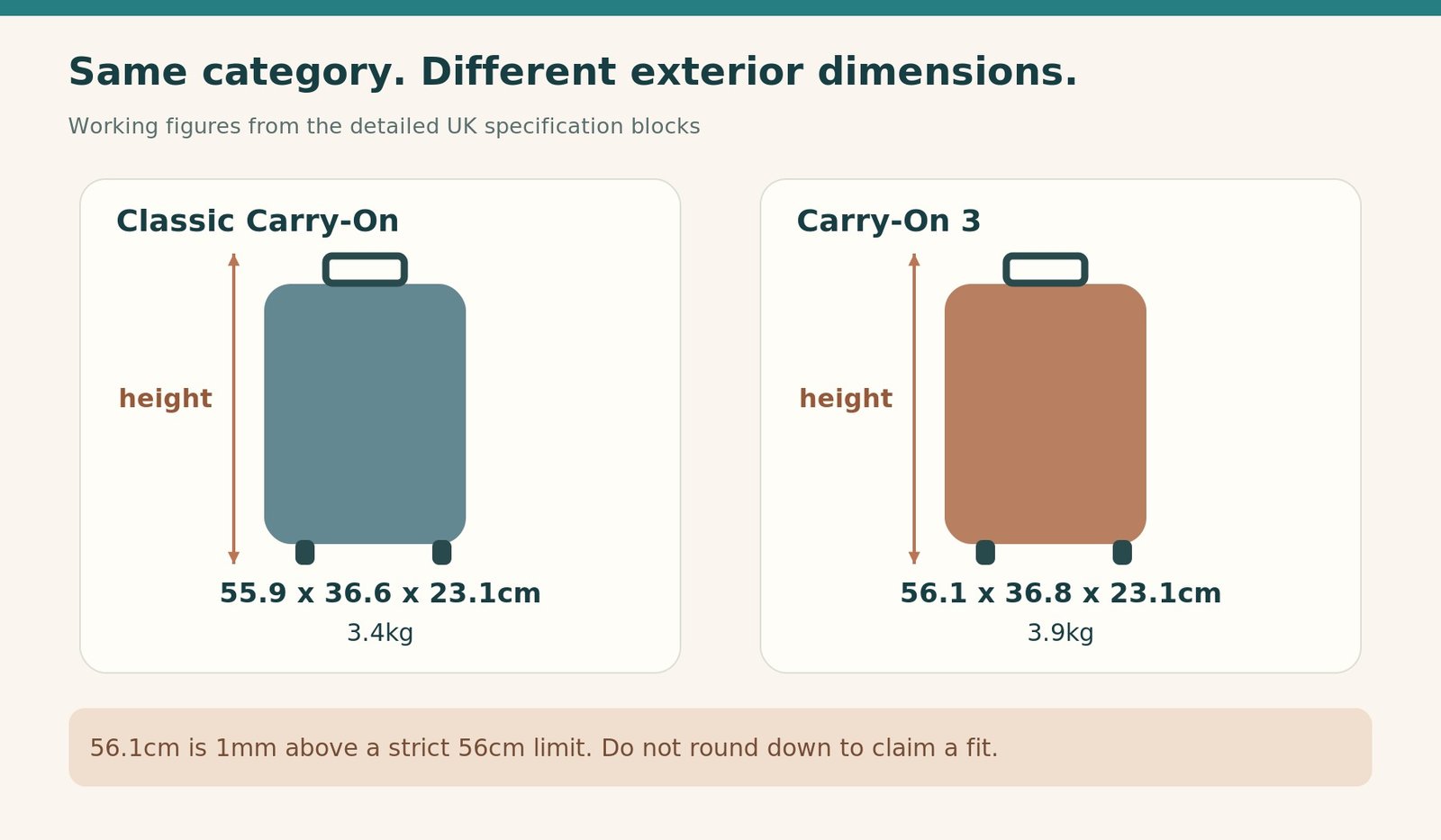
For a traveller who needs certainty, a case with a comfortable stated margin is easier to recommend than one already nominally beyond the limit. A different colour cannot be assumed to alter the moulded dimensions unless Away provides an explicit model-specific specification.
Airline compatibility for UK departures
Start with the allowance you actually bought
Ryanair’s larger cabin-bag limit is 55 x 40 x 20cm. Both researched Away versions exceed the 20cm depth, and their listed heights also exceed 55cm. Neither is a straightforward recommendation for that allowance, even before considering the smaller free personal item. [1][13][14]
The Classic sits within the published 56 x 45 x 25cm box used for easyJet’s large cabin bag and British Airways’ cabin bag. The Carry-On 3 needs the height qualification already explained. These are comparisons of published dimensions, not results from placing a sample in either airline’s physical sizer. [2][3]
On smaller screens, scroll this table sideways for all columns.
| Airline / bag category | Maximum exterior size | Research-led fit judgement |
|---|---|---|
| Ryanair larger cabin bag | 55 x 40 x 20cm | Neither researched version matches the depth or height. [1] |
| easyJet large cabin bag | 56 x 45 x 25cm | Classic fits on paper; Carry-On 3 height needs clarification. [2] |
| British Airways cabin bag | 56 x 45 x 25cm | Classic fits on paper; 56.1cm is nominally oversized. [3] |
| Qatar cabin bag | 50 x 37 x 25cm | Both researched cases exceed the length limit. [4] |
Do not borrow another passenger’s permission
A report that somebody boarded successfully with an oversized bag tells you what happened once. It does not establish the policy for your fare, aircraft or operating carrier. Likewise, paying for priority boarding does not necessarily mean every other airline’s cabin-bag dimensions become available to you.
Qatar’s published 50 x 37 x 25cm maximum creates a different problem: both Away cases are longer than the stated limit. If that is a regular route, start with a smaller physical case instead of trying to justify your preferred model after purchase. [4]
Weight: what do the new features cost in packing allowance?
Half a kilo is a useful comparison
The detailed published weights differ by 500g. Under a hypothetical 10kg total allowance, the Classic leaves 6.6kg for contents and the Carry-On 3 leaves 6.1kg. Under 8kg, the corresponding budgets are 4.6kg and 4.1kg. These calculations do not imply either case meets the dimensions of an airline with those limits.
The difference is not inherently unacceptable. It simply belongs in the decision. A traveller who packs lightly and wants the new hardware may prefer the heavier model; someone already removing toiletries to meet a limit has a more obvious reason to stay lighter.
Include every small addition
A packing cube, luggage scale, tech pouch and extra set of cables each becomes part of the finished load. They may be useful, but none is weight-free. Compare a planned accessory with the problem it solves rather than adding it because the suitcase looks incomplete without a coordinated kit.
For repeat checks, a small luggage scale is an option. The Go Travel Digital Pro Scale provides one current example to investigate, although a scale you already own or can borrow may do the job. Leave room for modest measurement differences and last-minute purchases. [8]
Classic versus Carry-On 3: which features would you use?
Separate a useful improvement from a new feature list
The Carry-On 3 introduces wheel brakes, a more continuously adjustable trolley handle and hooks intended to help manage extra items. Those features can answer real frustrations, but this article has not measured their operation, reliability or convenience beside a Classic sample. [14]
Think through a typical journey. Do you often struggle to find a comfortable handle height? Do you wait on level surfaces with the case beside you while managing another item? Is there a specific feature that would make that sequence easier, or is the attraction mainly that the product is newer?
Extra hardware does not remove common-sense limits
A brake is not a reason to leave luggage unattended, balance it on an unsafe slope or block a walkway. A hook is not an unlimited load point, and an extra bag can change the stability of a small suitcase. Check the manufacturer’s instructions and any stated limits before using these additions.
The Classic has the simpler proposition: a hard-shell rolling case with internal organisation, without paying for every new mechanism. A traveller who already finds that format satisfactory does not need to manufacture a problem to justify an upgrade.
Packing layout: useful organisation without imagined capacity tests
Divide by how you unpack
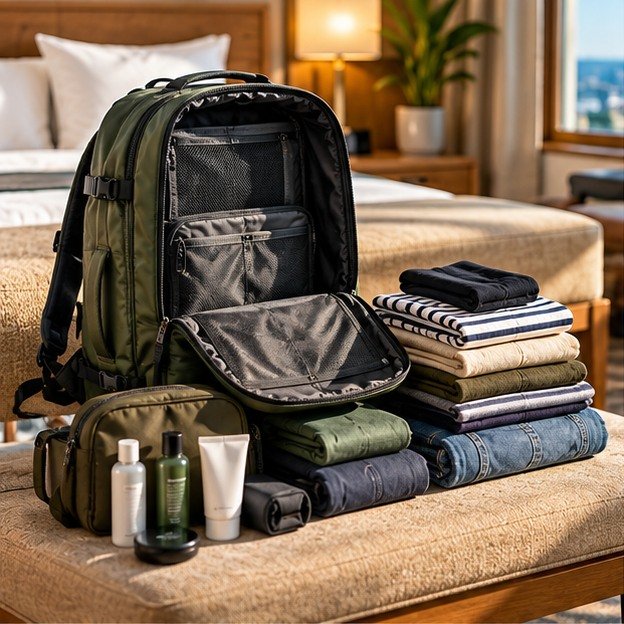
The Classic page describes internal compression, pockets and a laundry bag. These features are relevant to separating clothing and keeping the load orderly. They do not establish how many of your outfits will fit, particularly when footwear, larger clothing sizes or winter layers dominate the space. [13]
Organise one side around the things you can leave undisturbed and the other around items you will access during the trip. A work shirt may need a different position from a rolled T-shirt. A second pair of shoes should be assessed as a bulky rigid object rather than counted as another small item.
Compression cannot increase your weight entitlement
Compression can help soft clothing occupy a more manageable shape. It cannot turn an overweight case into a compliant one. Stop packing when the closure requires force or the shell bulges beyond the dimensions you planned around, even if the internal straps will still tighten.
Third-party cubes are optional. The BAGSMART compression set is worth comparing by individual cube dimensions, not merely by the fact that it is marketed for suitcases. Try a small selection of pieces first; an oversized cube can waste space around the shell’s curves. [9]
Laptop travel exposes the main access trade-off
A clean shell is not a quick-access office bag
With a standard clamshell case, repeatedly retrieving a laptop can be awkward unless your packing arrangement deliberately accommodates it. Do not confuse the standard Carry-On with a separately named pocket model. The absence of an accessible external compartment may matter more to a business traveller than a decorative finish or matching tag.
A permitted personal item can carry documents and devices you need in transit. Check the airline’s piece and weight rules rather than assuming that moving something into another bag makes it disappear from the allowance. Keep the arrangement comfortable enough to carry both items together when necessary.
Keep the cable kit proportionate
A small organiser can prevent chargers from becoming buried in clothing, but choose it around the actual kit. The BAGSMART Bubble organiser is listed at approximately 21 x 13.5 x 5.8cm and 100g. Its fabric and compartments are not a specialist protective enclosure for a hot or damaged battery. [10]
That size may work for a modest cable collection and be unnecessarily bulky for one lead. A simple existing pouch remains a valid option. The benefit to seek is predictable access, not an assumption that more compartments make every trip better.
The selected beige Bubble listing showed a stock-notification option rather than an immediate purchase on 11 October 2026. Check another available colour or use an existing pouch when departure is close. [10]
Three traveller profiles, with different answers
The occasional city-break traveller
For someone taking a few short trips with generous overhead dimensions, the Classic may already provide the desired hard-shell format. Start by trial-packing the actual clothing and checking that the loaded case is easy to lift. There is little reason to pay for added hardware that will not solve an existing frustration.
Colour can legitimately matter when you enjoy the appearance of your belongings. Just keep that preference separate from performance claims. A fashionable finish does not establish a stronger wheel mount, and a muted colour does not guarantee that scratches will be invisible.
The frequent traveller with a fixed route
Repeated use on the same airline makes its written dimensions especially valuable. A small mismatch is not a one-off nuisance if you face it on every journey. Choose a case that comfortably suits that route before weighing up the attractions of the newer generation.
Repair support may also matter more than an extra pocket. Consider how you would manage a fault between trips and whether you have a backup. Even a responsive service arrangement is not an immediate replacement at every airport.
The mixed-airline traveller
A suitcase chosen around one generous airline can be awkward on a later low-cost or long-haul connection. Make a short list of the tightest requirements you realistically encounter, not an imaginary list of every airline in the world. Then decide whether one case can serve them or whether different trips need different bags.
The warranty changed: purchase date is decisive
New purchases are not covered by the old headline
Away’s current UK LifetimeCare information separates purchases before 14 April 2026 from later purchases. Earlier cases retain the applicable limited lifetime warranty; the newer coverage describes complimentary repairs for qualifying functional damage during the first five years, with one replacement within that period when covered damage cannot be repaired. [15][16]
After that initial period, repair support continues, but some repair routes can involve a service fee. The policy distinguishes continuing support from an unlimited promise of free repairs and replacements forever. Cosmetic marks and lost or stolen luggage are not the same category as covered functional damage. [15][16]
Why that matters when comparing reviews
A review published before the change may accurately describe the warranty offered then and still be the wrong description for your purchase now. Save the terms that apply to your own order and keep the proof of purchase. The date printed on a review is not the date of your contract.
A new case bought today does not inherit an older warranty simply because it uses the Classic product name. Equally, the appearance of new terms should not lead an existing owner to assume their original coverage has silently disappeared. Ask Away to confirm the terms when your situation is unclear.
LifetimeCare Pro: value it as a service decision
More cover is not automatically necessary
The UK overview displayed a £35 LifetimeCare Pro option on 11 October 2026. It extends the initial complimentary repair period to ten years and increases the stated replacement protection to up to two replacements within that period, subject to the terms. Check the current price and eligibility when buying. [15][16]
Do not justify that extra spend by inventing the probability that a wheel will fail in year seven. This review has no reliable failure-rate data for either generation. Instead, ask how much you value a longer period of defined support and whether you expect the same suitcase to remain useful for your travel.
Read the practical conditions
Check claim evidence, exclusions, geographical service arrangements and the point at which a repair rather than a replacement is appropriate. A service plan can be worthwhile without covering every inconvenience. It is also possible to prefer the standard cover and keep the saving for other travel costs.
For a second-hand purchase, obtain explicit confirmation of what applies. A seller’s assurance that the case has a lifetime guarantee is not enough to establish your own eligibility. The same caution applies to unusual sales channels or a case with an unclear purchase history.
Returns: the 100 days are not a holiday trial
Keep the product in the required condition
Away’s UK return information states that the 100-day return and exchange period applies to unused items. Its guidance suggests gentle at-home checks, retaining packaging and leaving the lock unchanged until you decide to keep the case. Original shipping fees, final-sale items and personalised purchases have separate restrictions. [17]
That is a different proposition from taking the suitcase on two trips and deciding later whether you like it. Plan the decision before travel. If the case does not fit your route or your packing, you want to discover that while the ordinary return conditions still apply.
Use the time to answer specific questions
Measure the exterior, make a clean trial pack and check your lifting and turning movements indoors. Test the handle at the heights you would use and look for obvious wheel or closure issues. Do not subject a returnable case to a self-invented drop test to see whether the marketing is justified.
Contact support about uncertainties early, particularly when a deadline or personalisation option is involved. A clear photograph and the exact product identifier are more useful than a general message saying that your cabin bag seems too big.
UK price and delivery: distinguish an offer from availability
Compare the right pages
The UK pages viewed on 11 October 2026 displayed £258 for the Classic Jet Black and £298 for the Carry-On 3 Navy Blue. The difference in those displayed prices was £40. Stock and colour availability were not uniform, so these are dated page observations, not guaranteed offers for immediate delivery. [13][14]
The Carry-On 3 page showed pre-order information with an estimated 26 October dispatch date when checked on 11 October 2026. An estimate is not an arrival guarantee. For a near-term departure, establish the delivery position before deciding that the latest model is the best option. [14]
Add only the extras you would otherwise need
The useful total is the selected suitcase, any genuinely wanted personalisation or cover, and applicable delivery charges. A bundle is not automatically a saving when you would not independently choose the additional items. Similarly, a matching bag needs its own size and access checks.
Take particular care when reading pages that mix regional wording. Use the UK checkout and the address-specific delivery information for a UK order. Do not convert a US promotion or shipping statement into a UK promise without checking it.
Alternatives that solve a specific objection
When lower empty weight is the priority
The current Samsonite C-Lite 55cm model 159482 is a meaningful comparison at a listed 2.1kg. Its unexpanded depth is 20cm, increasing to 23cm when expanded. That changes both the available weight budget and the airline-fit calculation, although it also changes the design and purchase proposition. [5]
On smaller screens, scroll this table sideways for all columns.
| Alternative | Published baseline | Reason to compare | Current listing |
|---|---|---|---|
| Samsonite C-Lite 159482 | 55 x 40 x 20cm / 2.1kg | Lighter spinner; expanded depth is 23cm. [5] | Compare C-Lite |
| Samsonite S’Cure 55cm | 55 x 40 x 20cm / 2.9kg | Three-point closure; selected Amazon colour and offer need checking. [12][11] | Check S'Cure listing |
| Osprey Ozone 40L | 55 x 35 x 23cm / 2.1kg | Lighter two-wheel option; not a 20cm-deep case. [7] | Compare Ozone |
The choice is not simply whether Away is good or bad. It is whether you would rather carry Away’s particular layout or spend less of your allowance on the case. Compare the same journey and load, not two unrelated marketing descriptions.
When the closure is the objection
The Samsonite S’Cure 55cm uses a three-point closure and is listed at 55 x 40 x 20cm and 2.9kg. It is an alternative for someone who dislikes a perimeter zip, rather than a substitute that preserves the entire Away experience. Check the current Amazon listing’s selected variant; the returned colour metadata was inconsistent. [12][11]
When pulling on two wheels appeals more
Osprey’s Ozone 40L retail listing provides another comparison at 55 x 35 x 23cm and 2.1kg. Its two-wheel layout and soft construction address different preferences. The 23cm depth still prevents a simple fit claim for a 20cm-deep airline allowance. A lower weight does not solve every dimension. [7]
A restrained accessory plan for an Away case
Avoid replacing things already included
The Classic’s listed luggage tag and laundry bag are reasons to assess the included equipment before buying substitutes. A second tag may be a preference, but it is not an essential upgrade. Likewise, a separately purchased laundry container only makes sense when the included arrangement does not suit your routine. [13]
For organisation, start with clothing in the suitcase as delivered. Add cubes only where you repeatedly lose time unpacking or need to separate clean and worn items across several stops. The outcome should be a simpler routine, not a suitcase full of empty organisers.
Keep the in-flight items easy to remove
A compact cable pouch can be useful when the case is stored overhead and you want selected items in a permitted smaller bag. Choose one that closes securely without forcing plugs against delicate devices. Check the live listing before relying on a particular colour or delivery date. [10]
Weigh the final arrangement after adding every accessory. That last check catches the cumulative effect of small choices more reliably than estimating from individual product weights. A dedicated scale is convenient on repeat trips, but it remains optional equipment rather than part of the suitcase itself.
Evaluate handling without pretending to run a laboratory test
Make the trial relevant to your body and home
With a clean indoor floor and a sensible trial load, practise turning, stopping and changing between rolling and lifting. Check whether the handle height suits your stride and whether you can keep control without twisting awkwardly. Stop if the load is uncomfortable rather than treating a manufacturer’s capacity as a personal carrying target.
For the Carry-On 3, learn the brake operation from the supplied instructions. Confirm that the feature behaves as expected before relying on it during a trip. An at-home acceptance check can expose a problem with your particular case, but cannot establish a long-term durability ranking between generations.
Check the places where you store the bag
Measure a car boot opening, an overhead storage area you control or the shelf where the empty case will live. A handsome case that is frustrating to move into storage may be used less willingly. Include any extra bag attached to the handle when considering balance and the space needed to manoeuvre.
If your real journey involves substantial stairs, a backpack or another luggage format might solve the problem more directly. Do not make a spinner purchase solely because it is the format shown most often in travel advertising.
Protect the useful parts of the purchase
Keep condition and support records together
Save the order confirmation, model description and relevant policy terms. Photograph the case and identifying details when it arrives, especially if there is any damage to report. These records help distinguish the original condition from a later problem without relying on memory.
After a trip, inspect the wheels, handle and closure for a change in operation. Small cosmetic marks can be accepted as wear; a new wobble or damaged fitting deserves attention. Contact the appropriate support route before trying an unauthorised modification that could complicate the diagnosis.
Do not let a claim timetable become your packing plan
A service arrangement is valuable, but travel dates still create constraints. Keep enough time between discovering a fault and the next departure to obtain advice. For frequent travel, think about whether a spare bag is available without purchasing a second premium case simply as insurance against every possibility.
A repaired case can remain a useful possession. The objective is dependable function and a manageable routine, not preserving an untouched appearance indefinitely or expecting a new replacement whenever the shell acquires a mark.
Capacity is not a promise about the length of your holiday
Compare two believable packing plans
Imagine a five-night warm-weather break with one pair of walking shoes worn throughout, a light change of footwear packed and a planned laundry opportunity. The limiting issue might be organisation rather than volume. In that situation, a smaller number of versatile outfits can be more useful than a larger suitcase filled with separate clothing for every possible occasion.
Now imagine a three-night work trip with formal shoes, a structured jacket, gym clothing and a laptop kit. That shorter trip can create a more demanding packing shape. The useful comparison is not the number of nights but the rigid items, fabric bulk and access requirements you cannot easily change.
These are planning examples, not a claim that either load has been packed into a tested Away sample. Lay out your own essentials and separate what must remain crease-free from what can be compressed. Keep footwear and electronics visible until you have checked the shape they create inside the case.
Protect a small amount of flexibility
Leave a deliberate space for belongings that are harder to repack on the return journey. Worn clothing may no longer be folded as neatly, and a damp item needs appropriate separate handling rather than being forced against clean clothes. An entirely full case at home can be awkward after several hotel changes.
At the same time, avoid buying a larger version purely to carry hypothetical purchases. Decide what you reasonably expect to bring home and whether a different baggage plan would be more convenient. A bigger suitcase is not a free reserve of space when its exterior creates a different airline entitlement problem.
Price differences need a feature you can name
Put the premium beside your actual frustration
At the displayed UK prices checked on 11 October 2026, the difference between the researched Classic and Carry-On 3 pages was forty pounds. Rather than dividing that by an invented number of future trips, ask what you would receive that you expect to use. The new handle or braking arrangement may be worthwhile for one traveller and irrelevant for another. [13][14]
Write a short sentence beginning with the problem: the handle never stops at a comfortable height, for example, or managing a second item is awkward. Then check whether the new feature genuinely addresses it under the manufacturer’s intended use. If the sentence instead begins with the fact that a newer model exists, your decision is probably about preference rather than a practical deficiency.
Preference is a legitimate reason to spend money, provided it is named honestly. You do not need to invent a durability advantage or a universal airline fit to justify liking a particular suitcase. Equally, liking the current case is a good reason to continue using it.
Keep the 500g trade-off visible
The new generation’s additional listed weight has an ongoing effect on each packing session. A price difference is paid once; the extra empty weight remains part of every loaded journey. Under a generous allowance that may be inconsequential, while under a tight one it can displace something you actually need.
Compare feature value and weight cost side by side. Do not treat lower weight as the only valid priority, but do not hide it behind a long list of improvements either. The best answer depends on which compromise you encounter most often.
Buying used, buying old stock and keeping a current case
These are three different transactions
A used Classic may offer an attractive entry price, but inspect its particular condition rather than relying on the condition of the range in general. Request clear photographs of the wheels, handle attachments, closure and identifying label. Ask about repairs, missing components and the original purchase evidence.
Do not assume that a second-hand case comes with the same support as a new order placed directly with Away. Confirm eligibility and purchase-date terms before putting a value on the warranty. A product can still be useful without transferable cover, but it should be priced and assessed with that uncertainty acknowledged.
Older unused stock raises a different issue. Establish the exact generation, who is selling it, whether the return conditions differ and which warranty terms apply to the transaction. The age of a design is not necessarily the date that determines cover. A retailer’s broad description of a lifetime warranty deserves verification when current manufacturer wording has changed.
Keeping what works is part of the comparison
For an existing owner, start with function. Does the case still fit your airlines, hold a sensible load and move reliably? If so, the practical gain from replacing it may be small. The money saved by retaining it does not need to be spent on a compensating set of accessories.
If a specific component has failed, seek a diagnosis before assuming that the entire suitcase is finished. If your travel pattern has changed, however, a repair cannot make the exterior dimensions smaller or add the access arrangement you now need. Separate a condition problem from a suitability problem; they lead to different next steps.
Advantages and drawbacks of the Away proposition
Advantages
- Classic and Carry-On 3 can be compared as clearly named generations.
- The Classic offers an organised hard-shell format at the lower listed weight.
- Defined repair support is a useful part of the current purchase proposition.
Drawbacks
- Neither researched exterior matches a strict 20cm cabin depth.
- Carry-On 3 adds 500g and a nominal 56cm-height mismatch.
- Current cover and unused-item returns are narrower than casual headline summaries.
The strongest fit is a deliberate one
Away makes the most sense here for someone who wants this hard-shell organisation, can accommodate the actual dimensions and values its defined repair support. The Classic is the clearer starting point when lower weight and simpler hardware matter more than new functions.
The Carry-On 3 should be chosen for specific features, with the height and weight compromises accepted knowingly. Neither model is a good recommendation for a traveller who needs to rely on a strict 20cm cabin-bag depth. That is not a criticism of its appearance or brand; it is a mismatch between a product and a requirement.
Common mistakes to avoid
Reading a legacy warranty as today’s offer
Check the purchase date that a warranty description applies to. An old review can be accurate in context and still mislead a new buyer when quoted without that date. Keep continuing repair support distinct from unlimited free replacement cover.
Rounding dimensions in the favourable direction
Do not quietly turn 56.1cm into 56cm or 23.1cm into 20cm because other travellers report lenient checks. Make a decision based on the written requirements and the actual case. The cost of that uncertainty belongs in your buying judgement.
Buying the Bigger Carry-On because it seems better value
A larger model may offer more room, but it is a different product with another fit calculation. More litres for a small price difference are not useful when your chosen airline will not accept the exterior size. Start again with the measurements rather than carrying over a conclusion about the smaller case.
Frequently asked questions
Is the Away Carry-On worth buying in the UK?
It is worth considering when its dimensions fit your regular routes and you value its layout and aftercare. The Classic’s weight and the newer model’s added hardware create different propositions. It is less convincing for strict 20cm-deep cabin allowances. This is a research-led judgement, not a claim that either case has passed an independent durability test in this review.
Which dimensions should I trust when Away’s page differs?
This guide uses the dedicated UK size block for each named version and flags conflicting legacy wording. For a tight airline limit, ask Away to confirm the exact model in writing and measure the delivered case while preserving its return condition. Choosing the smallest number appearing anywhere on a page is not a reliable method of proving compatibility.
Does the Classic fit easyJet and British Airways?
Its detailed published exterior falls within their 56 x 45 x 25cm large-cabin-bag dimensions. However, the easyJet booking must include the relevant entitlement, and the actual packed case still needs to fit. The newer Carry-On 3 requires a separate caution because its listed height is 56.1cm. [2][3][13][14]
Will the Carry-On 3’s extra millimetre be ignored?
This review cannot promise that. A published limit and a reported case measurement are enough to identify the nominal mismatch, but not to predict every gate decision. Travellers who need certainty should seek clarification or choose a case with a comfortable stated margin rather than treating small oversize as automatic permission.
Does Away still have a lifetime warranty?
Purchase date matters. Away states that purchases before 14 April 2026 retain the applicable limited lifetime warranty. Newer purchases use LifetimeCare, with an initial defined period of complimentary covered repair and limited replacement protection, followed by continuing repair support under its conditions. Read the current UK terms for your own order. [15][16]
Can I return the case after a holiday?
The ordinary UK 100-day policy described by Away is for unused items, not a holiday trial. Personalised and final-sale items have additional restrictions. Check suitability with gentle at-home inspection and clean trial packing before travelling, and retain the required packaging. A fault claim is a different question from changing your mind about an otherwise suitable product. [17]
Do I need Away-branded packing cubes?
No requirement to use brand-matched cubes was identified. The relevant issues are fit, packed size and whether the organisers make your routine easier. Existing cubes or simple pouches may be sufficient. Compare dimensions and avoid assuming that a third-party set is a perfect fit merely because the seller says it works in cabin luggage.
Should I replace a working Classic with the Carry-On 3?
Not automatically. Identify a problem with the existing case that the newer features would solve, then weigh that benefit against the extra weight, cost and dimensions. A functional suitcase with suitable support can remain the better option. The release of another generation does not, by itself, make your existing luggage less useful.
Final recommendation: buy for your routes, not the launch cycle
Start with the Classic when you want the familiar Away format, its listed size works for your trips and you prefer a lower empty weight. Consider the Carry-On 3 only after identifying a new feature you will use and resolving the height question for your airlines. Check availability early when a departure date is approaching.
The most consequential decision may be to choose neither. For a strict 20cm allowance, a smaller-depth case is easier to recommend. For substantial walking or stairs, another luggage format may matter more than either generation’s feature list. A good purchase is a product that meets your real constraints without requiring excuses.
Finally, save the warranty terms attached to the order and use the unused-item return window carefully. Accurate sizing, a manageable trial load and clear expectations about support are more valuable than a generic claim that a suitcase is the best carry-on for everybody.
Sources and fact-checking
Research scope
The Classic and Carry-On 3 are treated separately. The detailed UK size blocks supply the working dimensions; inconsistent legacy wording on the Classic page is explicitly flagged. Current LifetimeCare and unused-item return pages are used rather than older warranty headlines. Pre-order timing and displayed prices are dated observations, not delivery or stock guarantees.
Sources reviewed on 11 October 2026. Specifications and policies are attributed above; calculations and practical packing examples are editorial analysis. Prices, selected colours and availability can change.
- Ryanair: current bag policy.
- easyJet: cabin bags and entitlements.
- British Airways: baggage essentials.
- Qatar Airways: baggage allowance.
- Samsonite UK: C-Lite 159482, 55cm expandable.
- Case Luggage: C-Lite 159482 retail listing.
- Case Luggage: Osprey Ozone 10006935, 40L two-wheel case.
- Case Luggage: Go Travel Digital Pro Scale.
- BAGSMART UK: six-piece compression packing cubes.
- BAGSMART UK: Bubble electronic organiser.
- Amazon UK: S'Cure 55cm listing; selected colour and offer require confirmation.
- Luggage Superstore: S'Cure 49539, 55cm specifications.
- Away UK: Classic Carry-On in Jet Black.
- Away UK: Carry-On 3 in Navy Blue.
- Away UK: LifetimeCare coverage overview.
- Away UK: coverage for purchases on or after 14 April 2026.
- Away UK: returns and exchanges.
Illustrations in this article were created for Taylor’s Trailblazing Travel Gear. Third-party photographs, where used, are credited beside the image or in the source list.