
Carry-On Backpack Size Guide: How to Measure the Bag That Airlines Measure
Measure the fully packed external outline – not the litre label – so handles, bulging pockets and one stubborn centimetre do not become a gate problem.
A backpack can be sold as cabin-friendly, measure 40 litres and still fail at the gate. Airlines do not judge the marketing name or the capacity printed on a label. They judge the packed object in front of them: its greatest external height, width and depth, plus any weight limit attached to the fare.
That sounds simple until a laptop straightens the back panel, a front organiser adds three centimetres, a bottle sits outside the side pocket or the top handle refuses to lie flat. A carry-on backpack size guide therefore needs to show where the tape starts, what must be included and why an empty-bag measurement is rarely enough.
This article compares official airline rules and practical measuring methods. Airline pages, examples and fee warnings were checked on 20 September 2026. Policies can change by fare, route, cabin and operating carrier, so the allowance shown in your booking remains the final authority.
Packed outer size
The seams, litre label and empty dimensions matter less than the bag’s widest loaded outline.
40 x 30 x 15 cm
This is a useful cross-airline personal-item target among several major carriers, but it is not universal.
Around 55 x 40 x 20-23 cm
Many European allowances sit near this range, while others are narrower, shorter or fare-dependent.
Packed depth
Shoes, chargers and front pockets can push a nominally slim backpack beyond the permitted depth.
The rule is about the space the bag occupies, not the category the retailer gives it. A rucksack, holdall, laptop bag and wheeled case are all cabin baggage when they use the same allowance.
The external envelope is the test
Think of the backpack as needing to fit inside an invisible rectangular box. The box has three separate limits. A bag that is short enough and narrow enough can still fail because the front pocket is too deep. Likewise, adding the three numbers together does not rescue a bag whose longest side exceeds the airline’s longest side.
Official policies support that external approach. easyJet, British Airways, Jet2 and KLM explicitly refer to handles or wheels in their published dimensions. Meanwhile, Wizz Air uses different wording for its standard dimensions and permits wheels to add no more than 5 cm. Therefore, the airline’s own wording always outranks a generic luggage chart.
Three checks, not one
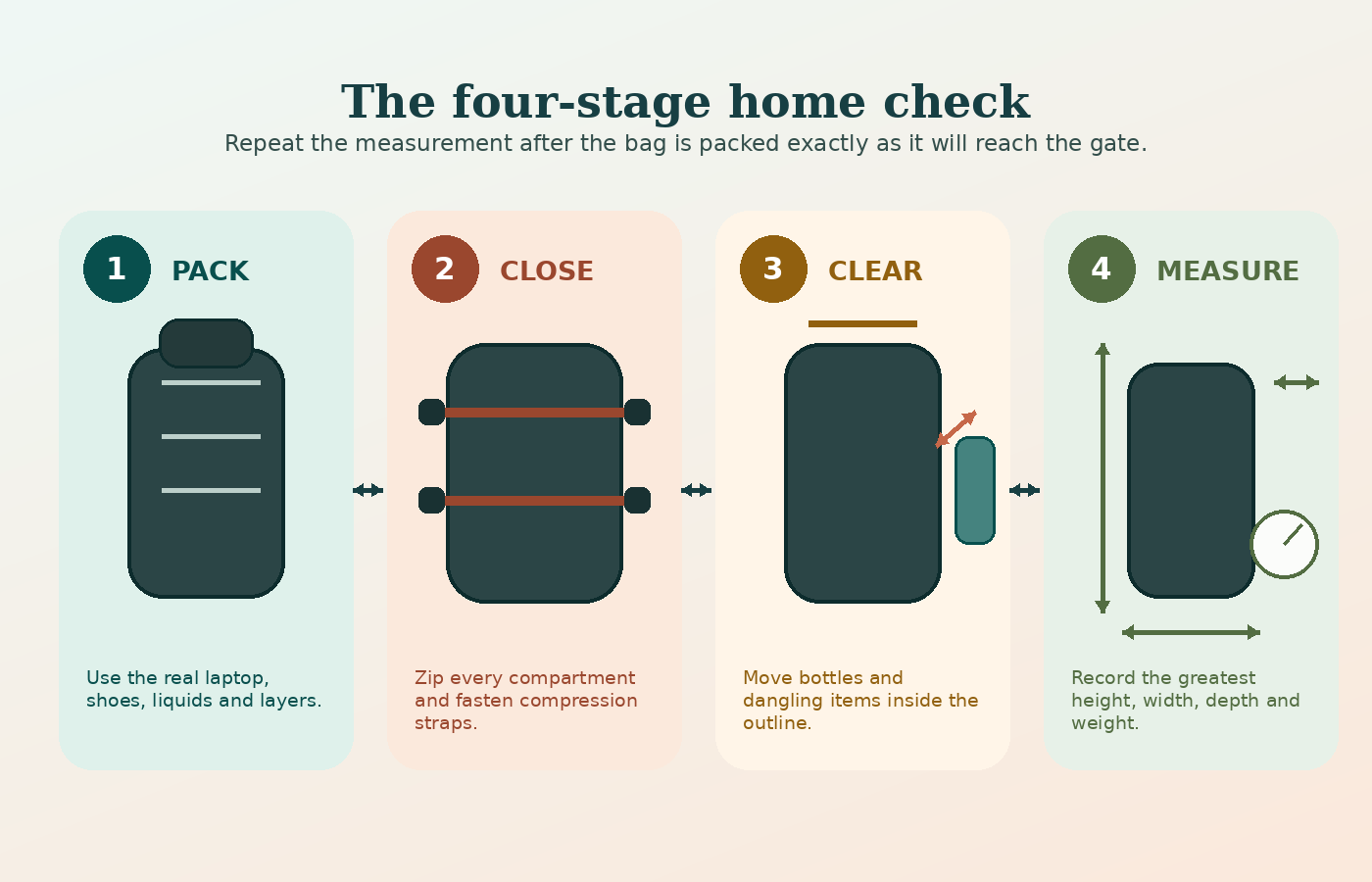
This method is arranged in the order that removes the most common measuring errors. It is a research-led home check, not a guarantee that an airline will accept a borderline bag.
Pack it
Use the real laptop, shoes, clothes, toiletries and outer layer planned for the flight.
Close it
Fasten every zip, buckle and compression strap exactly as it will be presented.
Settle it
Stand the bag on a level floor for several minutes so soft contents stop shifting.
Measure it
Take the greatest height, width and depth rather than following decorative seams.
Repeat it
Measure again after lifting and wearing the bag, then record the larger result.
Use a tape that follows the shape without stretching
A flexible dressmaker’s tape is convenient around curved panels, although a retractable metal tape gives a straighter reference across bulges. For the cleanest result, place a book, ruler or flat board against the two extreme points and measure the distance between them. This avoids pulling the tape into a hollow and recording a number that is too small.

Height: start at the floor
Stand the backpack upright on its normal base. Measure from the floor to the highest point that remains when the bag is closed. A rigid frame extension and a thick padded handle count. By contrast, a thin fabric loop can be folded flat when it will stay flat inside the sizer.
Width: look for the widest cross-section
Measure from the furthest left point to the furthest right point. The widest place may sit halfway up the bag rather than at the base. Side compression buckles, stuffed bottle pockets and a curved laptop compartment can all change the result.
Depth: measure back to front
Place the bag’s back panel against a wall without crushing the harness, then measure to the furthest front point. Depth is often the deciding dimension because front organisers, packed shoes and rolled jackets create a rounded bulge that a flat product photograph does not show.
A worked example
Suppose a packed backpack measures 54.5 x 36.5 x 21.5 cm. An airline allows 55 x 40 x 20 cm. The height and width pass, but the 21.5 cm depth does not. Spare capacity on the width cannot be transferred to depth.
| Dimension | Packed bag | Airline limit | Result |
|---|---|---|---|
| Height | 54.5 cm | 55 cm | Within limit by 0.5 cm |
| Width | 36.5 cm | 40 cm | Within limit by 3.5 cm |
| Depth | 21.5 cm | 20 cm | Over limit by 1.5 cm |
The example shows why a single overall measurement, a litre figure or a claim that the bag is “cabin size” is not enough.
Manufacturer measurements are a useful starting point. However, the airline sees your packed bag, and soft backpacks can change shape more than rigid cases.
Why an empty backpack grows
A laptop can push the back panel to its full height. Shoes or a wash bag can create a hard front bulge. Meanwhile, a tightly rolled jumper may settle sideways and increase width. Even a few small objects in the organiser pocket can make depth exceed the number shown on a product page.
Compression straps help when they run across the area that bulges. They do little when the excess comes from a rigid laptop, a full bottle pocket or an expansion zip that has been opened. Therefore, close the expansion panel before measuring and treat it as unavailable cabin capacity.
A repeatable home testing method
- Pack the heaviest realistic load, not an optimistic weekend version.
- Close the bag and leave it standing for ten minutes.
- Measure all three dimensions and take a photograph with the tape visible.
- Wear the bag for five minutes, set it down and measure again.
- Use the larger result for planning.
Handles, harnesses and frames
A padded top or side handle that stands away from the shell increases the external size. Shoulder straps can be tightened and laid flat, but a substantial harness or fixed hip belt still occupies space. Internal frame sheets also matter indirectly because they stop the bag compressing below a fixed height or depth.
Pockets and attached items
Anything in a side or front pocket becomes part of the packed outline. A water bottle, neck pillow, clipped shoes or a jacket under external shock cord can change a compliant bag into an oversized one. Vueling’s published guidance is especially clear that items such as shoes and helmets must be inside the baggage rather than attached or sticking out.
| Part | Include? | Practical treatment |
|---|---|---|
| Padded grab handle | Usually yes | Measure it if it remains raised; fold only a soft loop that stays flat. |
| Shoulder straps | External outline | Tighten and secure them; include any thick harness that cannot lie flat. |
| Hip belt | Yes when fixed or bulky | Stow it behind the back panel when designed to do so; otherwise include its widest point. |
| Water bottle | Yes if outside | Move it inside the bag before measuring if the side pocket exceeds the allowed width. |
| Front organiser | Yes | Measure the furthest bulge after chargers, cables and documents are packed. |
| Wheels or trolley handle | Often explicitly yes | Follow the airline’s wording; many carriers include both in their published limits. |
A soft backpack is not automatically exempt from the dimensions. Its advantage is controlled compression; its weakness is unpredictable bulging.
What “it fits” should mean
The bag should sit completely inside the sizer with no handle, pocket or corner above the frame. Moderate hand pressure may settle soft clothing, but the bag should not require extreme force, removal of normal contents or another person pushing it down. Once inserted, it should remain inside rather than springing back out.

Why one or two centimetres matter
Gate fees can be much higher than adding the correct allowance earlier. As dated examples checked on 20 September 2026, easyJet stated that a large cabin bag bought at the boarding gate costs £60. Vueling published €60-€75 for an oversized under-seat bag and €110-€140 for an oversized overhead item, while Lufthansa listed route-dependent charges from €60 to €110 for non-compliant carry-on baggage.
The table is organised by the two spaces travellers usually buy: an under-seat personal item and a larger overhead item. It is not a ranking. Every figure was checked against an official airline page on 20 September 2026.
| Airline | Small / personal item | Larger cabin item | Weight note | Important qualification |
|---|---|---|---|---|
| Ryanair | 40 x 30 x 20 cm | 55 x 40 x 20 cm with Priority | 10 kg for larger cabin bag | Small item under seat; fare controls second bag |
| easyJet | 45 x 36 x 20 cm | 56 x 45 x 25 cm when booked or included | Up to 15 kg; passenger must handle it | Handles and wheels included |
| British Airways | 40 x 30 x 15 cm | 56 x 45 x 25 cm | Must be lifted into locker unassisted | Larger cabin bag includes wheels and handles |
| Jet2 | 40 x 30 x 20 cm | 56 x 45 x 25 cm | 10 kg for larger hand luggage | Wheels and handles included |
| Vueling | 40 x 30 x 20 cm | 55 x 40 x 20 cm when included or bought | 10 kg for overhead item | Bundle or paid service controls overhead bag |
| Wizz Air | 40 x 30 x 20 cm | 55 x 40 x 23 cm with WIZZ Priority | 10 kg for each published cabin type | Published wording treats handles/wheels differently; wheels may add up to 5 cm |
| KLM | 40 x 30 x 15 cm | 55 x 35 x 25 cm on eligible fares | 12 kg combined in eligible Economy fares | Overhead item includes handles and wheels; Basic may exclude it |
| Lufthansa | 40 x 30 x 15 cm | 55 x 40 x 23 cm on eligible fares | 8 kg per carry-on item | Short/medium Economy Basic may include only personal item |
| Qatar Airways | No separate small item listed in the reviewed allowance | 50 x 37 x 25 cm | 7 kg in Economy on reviewed page | Booking, route and cabin class remain decisive |
| Emirates | No separate small item listed in the reviewed allowance | 55 x 38 x 22 cm | 7 kg in Economy on reviewed page | Route and cabin class can change allowance |
Dimensions are shown in the airlines’ published order. Fare, route, status, cabin, aircraft and operating carrier can change what is included. Check the exact booking before packing.
The pattern is useful, but it is not a standard
Several personal-item allowances cluster around 40 x 30 x 15-20 cm. Larger European cabin items often sit near 55 x 40 x 20-23 cm, while easyJet and British Airways publish a larger 56 x 45 x 25 cm envelope. However, KLM is narrower at 35 cm, Emirates uses 38 cm, and Qatar Airways is shorter at 50 cm.
IATA describes 56 x 45 x 25 cm as a common general reference rather than a guaranteed worldwide rule. The UK Civil Aviation Authority likewise advises passengers that the amount and size of hand baggage varies by airline and aircraft type.
Check the operating carrier for every segment
A ticket can display one airline’s code while another airline operates the aircraft. Lufthansa states that the operating airline’s carry-on rules apply to the individual flight, even when the flight carries a Lufthansa number. British Airways also warns that another airline’s policies may be different.
Consequently, a 55 x 40 x 23 cm bag that suits one leg may fail a 50 x 37 x 25 cm limit on the next. A self-transfer creates the same problem because each booking is judged separately. Through-checking a suitcase does not merge cabin-bag allowances.
Build a one-line allowance record
| Leg | Operating airline | Included item | Size and weight | Booking evidence saved |
|---|---|---|---|---|
| 1 | Record from ticket | Personal / overhead | Official limit | Screenshot or confirmation |
| 2 | Record from ticket | Personal / overhead | Official limit | Screenshot or confirmation |
| 3 | Record from ticket | Personal / overhead | Official limit | Screenshot or confirmation |
Use the most restrictive dimensions and weight unless you are prepared to check the backpack or change the packing load between legs.
The same backpack can be a personal item on one airline, a paid overhead bag on another and oversized on a third. The allowance defines the category; the word “backpack” does not.
Under-seat personal item
This is usually the smaller piece and is often included in the lowest fare. It must fit beneath the seat in front, although exit-row rules may require temporary overhead stowage. Laptop backpacks, compact travel packs and handbags all use this allowance when their external dimensions fit.
Overhead cabin bag
The larger item goes in the locker and may require a fare bundle, priority service, seat option or separate purchase. Some full-service airlines include it, while several low-cost fares do not. Even a compliant bag may be placed in the hold when lockers are full, so medicines, documents, power banks and valuables should remain easy to remove.
| Question | Personal item | Overhead item |
|---|---|---|
| Where it goes | Under the seat in front | Overhead locker |
| Typical shape | Compact laptop or daypack proportions | Larger rectangular travel backpack or trolley |
| Lowest fare | Often included | Frequently fare-dependent or paid |
| Main measurement risk | Depth and stuffed side pockets | Width, frame height and weight |
| Best packing priority | Documents, medicine and in-flight essentials | Clothing and items not needed at the seat |
Capacity and external size answer different questions
A litre is a volume. Airline dimensions are three maximum external lengths. A manufacturer may calculate capacity from an internal cavity, fill pockets with measuring media or use a design estimate. Padding, a curved back, wheel housings and tapered sides mean the usable capacity will not equal the volume of a perfect rectangular box.

The arithmetic is only a rough comparison
For a perfect box, multiply length by width by depth in centimetres and divide by 1,000. A 40 x 30 x 15 cm box is 18 litres; 40 x 30 x 20 cm is 24 litres; 45 x 36 x 20 cm is 32.4 litres; and 55 x 40 x 20 cm is 44 litres. By contrast, a 56 x 45 x 25 cm box would be 63 litres, yet a real bag within those limits cannot use every cubic centimetre.
Airlines publish maximums, not a promised tolerance. A small planning margin absorbs rounded seams, scale differences and the way soft contents settle.
Travel Gear planning margins
| Bag type | Planning margin | Reason |
|---|---|---|
| Structured clamshell with stable panels | About 1 cm per dimension | The shape is predictable, although a full pocket can still change depth. |
| Soft travel backpack | About 2 cm per dimension | Clothing and rounded pockets can expand after measuring. |
| Expandable or hiking-style pack | At least 2-3 cm, often more | Curved frames, lids, straps and soft collars are harder to keep within a box. |
These are conservative editorial planning ranges, not airline rules or guarantees.
Where to take the margin
Prioritise depth because it changes most with packing. Next protect width when the bag has bottle pockets or side compression buckles. Height is usually more stable on a boxy travel pack, although a floating lid, frame stay or raised handle can make it the critical side.
The cardboard-box method
Find a box slightly larger than the airline limit, then create an internal opening at the exact permitted height, width and depth with firm cardboard panels. Tape the edges so the opening cannot flex outward. Place the packed backpack inside without forcing it and check every corner from above and from the side.
The floor-and-wall method
When a box is unavailable, mark the permitted width and depth on the floor with low-tack tape. Add the maximum height to a wall with another strip. This method reveals obvious excess, although it is less strict than a rigid frame because soft sides can drift beyond the lines.
A five-minute stress test
- Insert the bag in the home sizer and leave it for one minute.
- Remove it, carry it by the top handle and wear it briefly.
- Reinsert it without changing the contents.
- Confirm that straps, pockets and buckles remain inside.
- Weigh it immediately after the final size check.
A backpack can fit perfectly and still exceed the fare’s weight limit. Size and weight must be checked as separate conditions.
Use the same final packing load
Attach a luggage scale to a strong grab handle, lift the bag clear of the floor and wait for the reading to stabilise. Repeat the measurement three times and use the highest sensible result. Alternatively, weigh yourself with and without the backpack on a bathroom scale, then subtract the two readings.
Leave weight margin as well. A refillable bottle, food bought after security or an extra layer placed inside can change the total. Moreover, some airlines combine the weight of a small bag and larger hand baggage, while others state a limit for each item.
Examples of different weight approaches
KLM publishes a 12 kg combined limit for the small bag and eligible hand baggage in Economy. Lufthansa lists 8 kg for a carry-on item. Ryanair and Wizz Air use 10 kg for their larger cabin options, easyJet allows up to 15 kg but requires the passenger to lift and carry it, and Qatar Airways lists 7 kg for Economy on the reviewed page.
Soft tape measure
A compact fabric tape is useful for a first check around rounded backpacks. Confirm the result with a straight edge across any hollow.
Digital luggage scale
A handheld scale lets you repeat the weight check after the final repack and again before the return flight.
Product availability and retailer listings were checked on 20 September 2026. No fixed product price is quoted because listings change.
The checklist is ordered by its effect on reliable compliance, not by brand, retailer position or commission.
Start with the smallest airline you expect to use
Write down the strictest dimensions across your likely routes before opening a retailer page. A 56 x 45 x 25 cm backpack may use British Airways or easyJet space well, yet it is too large for a 55 x 40 x 20 cm allowance. Likewise, a 55 cm pack cannot meet Qatar Airways’ reviewed 50 cm maximum simply because the total litres look similar.
Choose predictable construction
- Look for published external dimensions in centimetres, not only litres.
- Prefer a rectangular clamshell when maximum usable volume matters.
- Check that compression straps cross the main bulging area.
- Avoid relying on an expansion zip for cabin use.
- Choose stowable or tidy shoulder straps when the bag will enter a sizer.
- Inspect whether bottle pockets remain within the listed width when loaded.
- Compare the empty weight, because a heavy bag consumes the allowance before packing.
Size-based shopping searches
These links lead to broad Amazon UK searches rather than a ranked product claim. Dimensions in a listing still need to be checked against the current airline rule and verified on the delivered bag.
40 x 30 x 15 cm
Useful when BA, KLM or Lufthansa-style small-bag dimensions shape the trip.
40 x 30 x 20 cm
Matches the published small-bag envelope used by Ryanair, Vueling and Wizz Air at the review date.
55 x 35 x 20 cm
A deliberately restrained European overhead target, although it still does not fit every airline worldwide.
Neither construction is universally better. The useful choice depends on whether flexibility, predictable dimensions or walking comfort matters most.
Soft travel backpack
- Can compress around clothing and uneven loads.
- Usually lighter than a wheeled or heavily framed alternative.
- Often has useful external access and flexible pockets.
- Can fit irregular under-seat spaces more easily.
Trade-offs
- Depth and width change as pockets fill.
- Rounded fronts are harder to measure consistently.
- Loose straps and a thick harness can catch on a sizer.
- An optimistic pack can expand after compression.
Structured clamshell backpack
- Holds a more predictable rectangular outline.
- Makes it easier to use packing cubes and measure repeatedly.
- Usually keeps the laptop and main compartment from forming separate bulges.
- Can be quicker to load into a sizer.
Trade-offs
- Rigid panels cannot borrow space from an undersized dimension.
- Frames and padding add empty weight.
- A fixed height that is 1 cm too long cannot be compressed away.
- Boxy proportions may be less comfortable for long walks.
Errors made before packing
- Trusting the phrase “airline approved” without checking the dimensions.
- Buying by litre capacity before deciding which allowance the bag must meet.
- Measuring the empty shell rather than the final load.
- Following stitched seams instead of the widest external points.
- Ignoring a padded handle, frame stay or fixed hip belt.
Errors made after packing
- Stuffing the front organiser after the depth was measured.
- Leaving a bottle or neck pillow outside the measured outline.
- Opening an expansion zip because the bag still closes.
- Checking the marketing airline instead of the operating carrier.
- Assuming the outbound measurement will remain valid after shopping.
Errors made at the gate
Trying to solve an oversized bag by moving items into your hands can create a second piece. Likewise, removing a power bank or medicine may be necessary when a bag goes into the hold, but it does not erase an excess-size charge. The safer fix is to repack before leaving for the airport or buy the correct allowance online while it is still available.
These answers cover the measurement questions most likely to change whether a backpack fits the allowance.
How do airlines measure a carry-on backpack?
Airlines assess the bag as a packed three-dimensional object. Measure the greatest external height, width and depth, including rigid or padded handles, frames, wheels, bulging pockets and anything that cannot be folded securely inside the outline.
Should I measure my backpack empty or full?
Measure it fully packed with the same laptop, clothing, toiletries, shoes and accessories you expect to carry. An empty backpack can gain several centimetres of depth or width once the front pocket and main compartment are loaded.
Do shoulder straps count in the size?
Loose fabric straps can normally be tightened and laid flat, but a thick harness, fixed hip belt or rigid buckle that stands proud of the bag affects the external outline. Secure every strap before measuring and before reaching the gate.
Are handles and wheels included?
Many airlines explicitly include handles and wheels. A few publish different wording, so the operating airline page controls. For a backpack, include a padded top handle if it remains raised; fold a soft grab loop flat if it will stay flat in the sizer.
Can I squeeze a soft backpack into the airline sizer?
A soft bag may compress enough to fit, but it should go fully inside without extreme force and remain inside the frame. Do not plan around sitting on the bag, removing essential contents at the gate or leaving pockets protruding.
Is a 40-litre backpack always carry-on size?
No. Litres describe claimed internal capacity, whereas airlines use external dimensions and often a weight limit. A tall hiking pack and a boxy travel pack can both be labelled 40 litres while only one fits a particular cabin-bag sizer.
Is 55 x 40 x 20 cm a universal carry-on size?
No. It is common on some European airlines, but other carriers use 56 x 45 x 25 cm, 55 x 35 x 25 cm, 55 x 38 x 22 cm or 50 x 37 x 25 cm. Your fare and operating carrier must be checked for every flight.
Which backpack dimension is depth?
Depth is the distance from the back panel that sits against your body to the furthest point on the front of the packed bag. Front organiser pockets, shoes and curved back padding often make depth the dimension that fails first.
Can I rotate my backpack in a bag sizer?
A physical sizer tests a three-dimensional envelope, so a rectangular bag may fit in another orientation. However, you should still compare each measured extent with the three limits and avoid relying on diagonal force or an unusual orientation that staff may reject.
How much smaller should my backpack be than the airline limit?
Travel Gear planning guidance is to leave about 1 cm on a predictable structured bag and about 2 cm on a soft backpack that can bulge. Leave more when the bag has an expansion zip, rounded front pocket or bottle pockets. This margin is practical guidance, not an airline guarantee.
What happens on a codeshare flight?
Check the operating carrier shown on each flight segment, not only the marketing airline whose flight number appears first. The operating airline normally applies its cabin-baggage rules, and a connection may therefore have two different limits.
Does a laptop sleeve count in the measurement?
Yes, if the laptop changes the external shape. A suspended sleeve can push the back panel flatter or taller, while a thick device in a front sleeve can add depth. Insert the real laptop before measuring.
Do airlines weigh the personal item and carry-on together?
Some do and some do not. KLM, for example, publishes a combined allowance for the small bag and hand baggage on eligible economy fares, while other airlines state a limit per item. Read the exact fare rules rather than assuming one method.
What should I do if my backpack is exactly on the limit?
Repack until it measures below the limit at every point, or purchase the correct baggage allowance before the airport. Exact-limit bags have no tolerance for a rounded seam, a compressed jacket expanding, scale variation or a stricter operating carrier.
Use the packed outline as the single source of truth
Pack the exact load, secure every strap, measure the greatest height, width and depth, then weigh the same bag. Compare the results with the operating airline on each segment and use the smallest complete allowance across the itinerary.
For frequent personal-item travel across carriers that publish stricter small-bag limits, a genuine packed target near 40 x 30 x 15 cm offers useful flexibility at the cost of capacity. For many European overhead fares, a restrained bag around 55 x 35 x 20 cm reduces conflicts between common width and depth limits. Neither target covers every airline; Qatar Airways’ reviewed 50 cm maximum is a clear example of why the booked carrier still matters.
Finally, leave a margin rather than aiming for a perfect paper fit. One centimetre can be enough on a predictable structured pack, while a soft backpack normally deserves about two. The best cabin bag is not the one that uses every theoretical litre. It is the one that remains inside the real limit after a normal, repeatable pack.
How this guide was checked
The measurements and fare qualifications were compared with official airline baggage pages rather than retailer summaries. General advice was cross-checked with IATA, the UK Civil Aviation Authority and GOV.UK. Calculations use centimetres and simple rectangular-box volume only to explain why litre labels cannot replace external dimensions.
Airline rules remain changeable. The booking confirmation, fare conditions, operating carrier and current airline page should be reviewed together. Where an airline uses unusual wording for wheels, handles, combined weight or a Basic fare, that qualification is retained rather than forced into a false universal rule.
General reference sources
- IATA passenger baggage rules – Airline, class and aircraft variation; common reference size includes wheels and handles. Checked 20 September 2026.
- UK Civil Aviation Authority: checking baggage allowance – Airlines set different hand-baggage allowances and may charge for non-compliant bags. Checked 20 September 2026.
- GOV.UK hand luggage restrictions – Passengers should check the airline for the number and size of permitted bags. Checked 20 September 2026.
Official airline policy sources
- Ryanair bag policy – 40 x 30 x 20 cm small bag; 55 x 40 x 20 cm 10 kg cabin bag with Priority. Checked 20 September 2026.
- easyJet cabin bags – 45 x 36 x 20 cm small bag; 56 x 45 x 25 cm large bag; handles and wheels included. Checked 20 September 2026.
- British Airways baggage essentials – 40 x 30 x 15 cm hand bag; 56 x 45 x 25 cm cabin bag; wheels and handles included for the cabin bag. Checked 20 September 2026.
- Jet2 baggage policy – 40 x 30 x 20 cm under-seat bag; 56 x 45 x 25 cm hand luggage including wheels and handles. Checked 20 September 2026.
- Vueling hand luggage – 40 x 30 x 20 cm under-seat bag; 55 x 40 x 20 cm overhead bag when included or purchased. Checked 20 September 2026.
- Wizz Air baggage information – 40 x 30 x 20 cm free bag; 55 x 40 x 23 cm trolley with WIZZ Priority; special wording for wheels and handles. Checked 20 September 2026.
- KLM cabin baggage allowance – 40 x 30 x 15 cm small bag; 55 x 35 x 25 cm hand baggage including handles and wheels. Checked 20 September 2026.
- Lufthansa carry-on baggage – 40 x 30 x 15 cm personal item; 55 x 40 x 23 cm carry-on; operating-airline rules apply. Checked 20 September 2026.
- Qatar Airways baggage allowance – 50 x 37 x 25 cm maximum carry-on dimensions; economy weight commonly 7 kg subject to booking. Checked 20 September 2026.
- Emirates cabin baggage rules – 55 x 38 x 22 cm economy carry-on; 7 kg on the reviewed page. Checked 20 September 2026.
Illustrations in this article were created for Travel Gear. Third-party photographs, where used, are credited beside the image or in the source list.