How to Convert mAh to Wh for Airline Battery Rules
Read the label correctly, calculate the energy and check the airline rule that actually applies to your journey.
A power bank's packaging might advertise 20,000mAh and 65W while an airline asks for a figure in Wh. Those numbers describe different things. You do not need an electrical engineering course to make sense of them, but you do need to pair the right capacity with the right voltage.
The arithmetic is usually the easy part. The more consequential mistake is treating a correct calculation as permission to fly with a battery. Airlines can distinguish power banks from other spare batteries, restrict how many you carry and prohibit activities that the product itself is technically capable of doing.
This guide keeps those tasks separate: identify the battery, convert the rating when necessary, then check the rules for the actual journey. The calculations are worked examples unless a named manufacturer's specification is identified. Airline information was reviewed on 15 October 2026; it needs another check before travel, particularly during a period of changing power-bank policies.
mAh x V / 1,000
Use the nominal voltage belonging to that capacity figure.
USB output is different
5V, 9V and 20V ports do not define cell capacity.
Well below 100Wh
A calculation is not permission to carry or use a battery.
Your operating airline
Check battery category, quantity, stowage and onboard use.
Convert mAh to Wh with the correct formula
Divide by 1,000 because the units are different
An amp-hour is 1,000 milliamp-hours. Therefore, 10,000mAh becomes 10Ah. Multiplying those 10Ah by a nominal voltage of 3.7V gives 37Wh. IATA's passenger guidance describes this conversion using a battery's nominal voltage. [1]
You can do the division first or last. Both of these expressions produce the same result: 10,000 / 1,000 x 3.7, and 10,000 x 3.7 / 1,000. Choose the order that makes it easiest to keep track of the units.
Write down the pair before using a calculator
For a hypothetical 15,000mAh battery at 3.6V, first record 15,000mAh and 3.6V together. The calculation is 15,000 x 3.6 / 1,000 = 54Wh. That result belongs to that pair of inputs, not to every product advertising 15,000mAh.
If the label already says 54Wh, the calculation is a useful cross-check. If it says a materially different figure, stop and identify what each number describes rather than editing the label or deciding the smaller answer must be correct.

Keep a sensible amount of precision
For ordinary planning, 37Wh is clearer than 37.0000Wh. Near a limit, however, retain the actual result. A calculation of 100.1Wh should not be rounded down to make a product appear to meet a 100Wh ceiling.
This is an arithmetic check, not a method for changing the manufacturer's declared rating. A staff member may need to verify the physical marking or the official documentation, not simply trust a calculation stored on your phone.
Read the label before reading the sales headline
Find the nominal battery rating
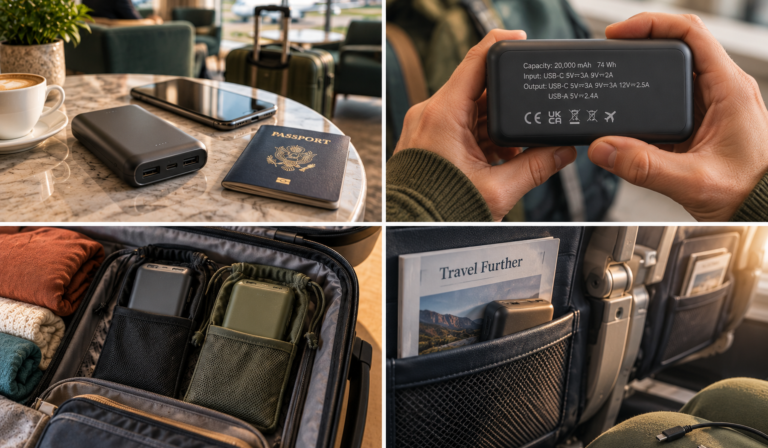
Look for a specification labelled battery capacity, cell capacity, nominal voltage or rated energy. A Wh value may be printed in smaller text than the prominent mAh number. Inspect the actual unit you own, because the product name alone may cover several sizes or generations.
Do not peel back the casing, dismantle the battery or disturb its protective wrapping. If the external information is unclear, consult the exact official model page or ask the manufacturer for a specification that identifies the product. The aim is to verify the rating without creating another safety problem.
Separate input and output information
Input describes how the bank can be charged. Output describes what it can supply through a particular port or charging mode. Those sections often list several voltages and currents, but they are not interchangeable with the internal-cell voltage used for an mAh-to-Wh calculation. [7][8]
A label might therefore show a nominal battery rating, a USB-C input range and several USB output profiles. Underline the battery pair in your notes and leave the charging profiles out of the energy calculation.
Keep the physical identification readable
A sleeve, sticker or accessory can make a useful marking difficult to inspect. Choose a storage arrangement that can be removed easily, and do not cover the model or energy rating with your own decorative label.
A clear photograph is a helpful backup for your own records, but it should not become an excuse to carry a unit whose identification can no longer be verified. IATA notes that an operator may refuse a battery when its Wh rating cannot be established. [1]
A reference table for common capacities and voltages
The voltage assumption changes the answer
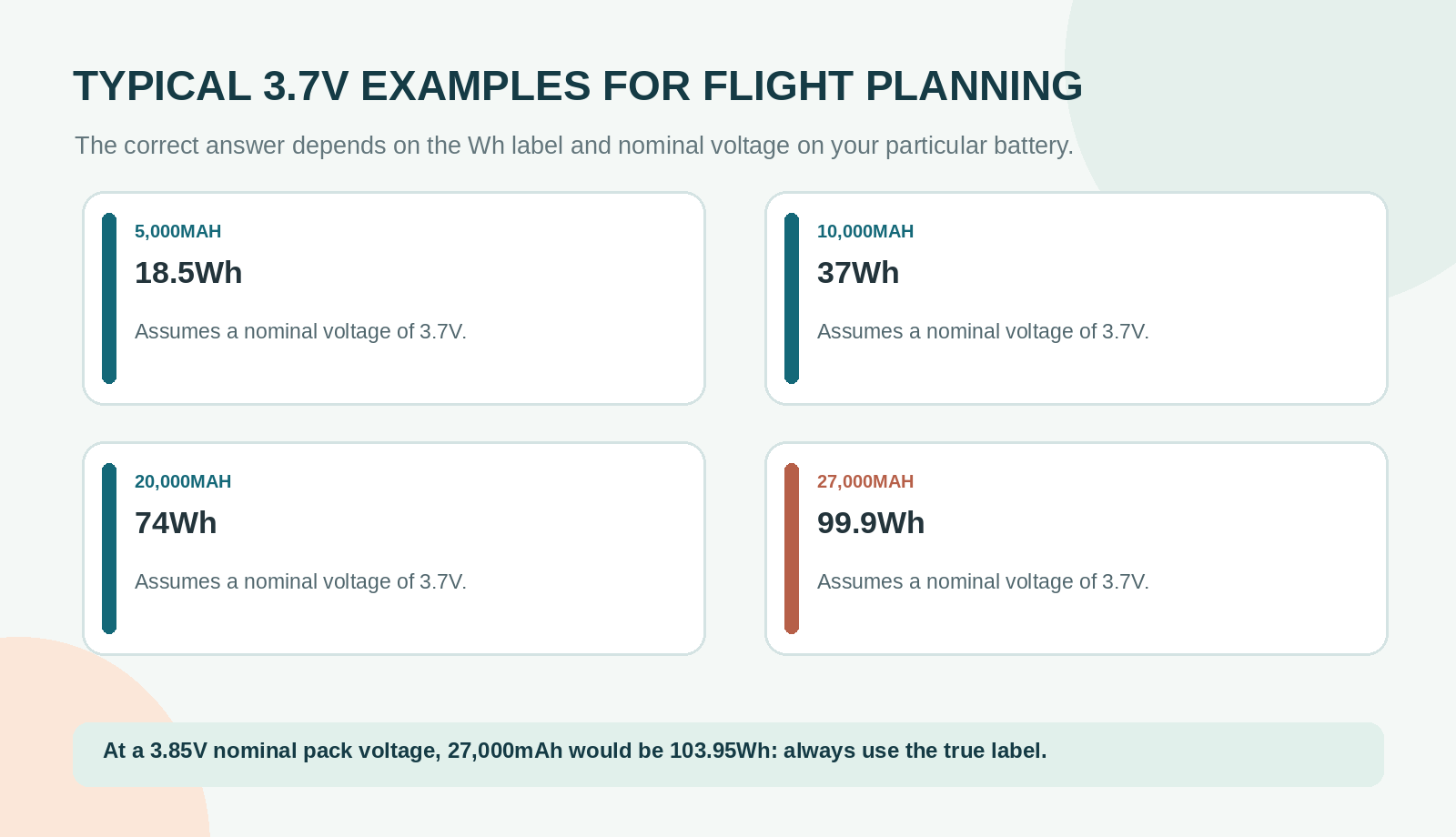
The table below is calculated, not a list of airline-approved products. Each column deliberately uses a different nominal voltage so that a familiar mAh number cannot be mistaken for a universal energy figure.
| Marked capacity | At 3.6V | At 3.7V | At 3.85V |
|---|---|---|---|
| 5,000mAh | 18Wh | 18.5Wh | 19.25Wh |
| 10,000mAh | 36Wh | 37Wh | 38.5Wh |
| 20,000mAh | 72Wh | 74Wh | 77Wh |
| 24,000mAh | 86.4Wh | 88.8Wh | 92.4Wh |
| 26,800mAh | 96.48Wh | 99.16Wh | 103.18Wh |
| 27,000mAh | 97.2Wh | 99.9Wh | 103.95Wh |
| 30,000mAh | 108Wh | 111Wh | 115.5Wh |
Notice the difference near 27,000mAh
At 3.7V, 27,000mAh calculates to 99.9Wh. At 3.85V, the same mAh number calculates to 103.95Wh. That is why a broad claim that every 27,000mAh bank falls below a 100Wh threshold is unreliable.
Likewise, 20,000mAh at 3.7V gives 74Wh, while the same capacity at 3.85V gives 77Wh. Both examples are comfortably different from the 100Wh boundary, but the correct number still comes from the actual specification.
Do not invent a missing voltage
A calculator cannot repair incomplete evidence. If the only available information is a large mAh claim with no nominal voltage or Wh rating, the honest answer is that the energy has not yet been established.
Ask the seller or manufacturer before purchase. For travel equipment, a clearly documented smaller battery can be a more sensible choice than an ambiguous larger one, even when the advertised capacity appears more generous.
Work through six label examples
Ordinary single-pair labels
A battery marked 10,000mAh and 3.7V gives 37Wh. A hypothetical 20,000mAh and 3.85V label gives 77Wh. In both cases, the calculation uses the capacity and voltage describing the same internal energy store.
The difficulty starts when a label mixes a physical battery arrangement, an equivalent cell-capacity figure and an output specification. Read the accompanying words instead of collecting the largest numbers from different lines.
| Illustrative label | Correct treatment | Result |
|---|---|---|
| 10,000mAh / 3.7V | 10,000 x 3.7 / 1,000 | 37Wh |
| 20,000mAh / 3.85V | 20,000 x 3.85 / 1,000 | 77Wh |
| 5,000mAh / 7.8V [6] | 5,000 x 7.8 / 1,000 | 39Wh |
| 10,000mAh equivalent / 3.9V [6] | 10,000 x 3.9 / 1,000 | 39Wh |
| USB output: 20V, 3A | Multiply for output power, not storage | 60W; Wh unknown |
| Rated output: 6,800mAh at 5V [6] | Delivered USB energy under stated conditions | 34Wh; not the cell rating |
A real multi-cell example
NITECORE's NB10000 Gen4 specification gives 5,000mAh at 7.8V, equivalent to 10,000mAh at 3.9V, and identifies the energy as 39Wh. Either matching pair produces 39Wh. Mixing 10,000mAh with 7.8V would incorrectly double the energy to 78Wh. [6]
This example is particularly useful because it demonstrates a label that is not based on the often-assumed 3.7V figure. The correct response is not to force the product into a familiar calculation; it is to follow the manufacturer's matching quantities.
An output figure is not a substitute for the nominal rating
The same manufacturer's rated-output example of 6,800mAh at 5V describes 34Wh delivered under the stated output conditions. It does not replace the nominal 39Wh battery rating for the purpose of describing the energy store. [6]
When an airline asks for the battery's Wh rating, do not choose the lower output figure simply because it is more convenient. Nor should you deduct charging losses to turn a near-limit battery into a supposedly acceptable smaller one.
Understand series and parallel without opening the bank
Energy is the useful common quantity
Imagine two identical illustrative cells, each 5Ah at 3.7V. Each represents 18.5Wh, so together they represent 37Wh. That total does not depend on which convenient equivalent description you use, provided the voltage and amp-hours are paired correctly.
An idealised parallel description is 10Ah at 3.7V: 37Wh. An idealised series description is 5Ah at 7.4V: also 37Wh. The mistake would be to take the 10Ah from one description and the 7.4V from the other, producing 74Wh for a system that was never specified that way.
Let the manufacturer describe the internal arrangement
This explanation is for reading specifications, not for rebuilding a battery pack. Do not assume how many cells are inside a commercial power bank or attempt to change its configuration to fit a travel limit.
For a product with a clear Wh marking, that marking is normally the most practical starting point. The series-and-parallel explanation helps you recognise why two apparently different capacity descriptions may agree rather than contradict each other.
If the numbers still fail to reconcile, collect the exact model identifier, the label photograph and the relevant specification page. Ask for clarification before flying. An unresolved mismatch is not something that improves through a confident explanation at the boarding gate.
Keep watts, watt-hours and charging profiles separate
A 100W output is not a 100Wh battery
Watts describe power, or the rate at which energy is supplied. Watt-hours describe an amount of energy. A hypothetical 20V output at 3A is a 60W charging profile; it says nothing by itself about whether the bank stores 37Wh, 74Wh or another amount.
This is why a small bank can advertise a relatively high output rate while a larger bank supplies power more slowly. Capacity and charging speed are separate design choices.
USB Power Delivery is about compatibility and rate
USB-IF describes Power Delivery as part of how compatible equipment provides and receives power. Its charging profiles should not be mistaken for the nominal voltage of every internal battery connected to a USB-C port. [8]
For travel planning, record the two useful answers separately: the battery's Wh rating for the capacity check, and the supported charging arrangement for your device. You need both when selecting equipment, but only one belongs in the stored-energy calculation.
A 60W-rated cable similarly does not contain 60Wh. It is an accessory with a power-handling specification, not another battery. Keeping those labels in their own categories makes a mixed charging kit much easier to assess.
Nominal energy is not the same as usable phone energy
Do not subtract efficiency losses for an airline check
Anker's capacity explanation shows why a bank's nominal cell energy and its usable USB output can differ. The output stage uses energy during conversion, and the connected device has its own charging process. [7]
Those differences matter when estimating phone refills. They do not create a legitimate discount on the battery's nominal Wh rating for a flight. A 110Wh battery does not become an 88Wh battery because someone assumes 80% charging efficiency.
State of charge is another separate number
A display showing 50% is an estimate of remaining charge, not a change to the battery's rated capacity. Do not rely on partly discharging a battery to make its printed Wh rating fall below an airline threshold.
An operator can have separate instructions about state of charge in particular circumstances. Follow an explicit requirement when applicable, but do not invent one as a workaround for an unacceptable product. [2]
The practical distinction is useful: a low battery may be inconvenient for the trip, while an excessive rated capacity may make the item unacceptable for carriage. Charging the bank or discharging it changes the first issue, not the identity of the second.
Leave margin below a limit rather than relying on rounding
Check the exact wording
Under 100Wh and not exceeding 100Wh are not identical phrases. For a product sitting right at the boundary, that difference can matter. An airline may also have additional conditions that remain relevant even when the energy is below its ceiling.
For ordinary phone backup, I would avoid purchasing right against a threshold unless the extra capacity is genuinely necessary. A clearly marked battery with a comfortable margin is easier to plan around than one whose acceptance depends on interpreting the last decimal place.
Work backwards only as a calculation aid
The inverse formula is mAh = Wh x 1,000 / V. At 3.7V, 100Wh corresponds mathematically to about 27,027mAh. At 3.85V, it corresponds to about 25,974mAh.
These figures are not shopping approvals. They do not prove that a product advertised just below either number has an accurate label, a suitable battery category, acceptable condition or permission on your airline.
Do not choose the most favourable voltage
If the manufacturer specifies 3.85V, using 3.7V because it gives a lower answer is not a conservative estimate; it is the wrong input. If the label and official page conflict, obtain clarification rather than selecting whichever one makes the bag easier to pack.
The most defensible note is a photograph of a clear rating paired with the exact model documentation. A page of arithmetic based on an unsupported assumption is much less useful.
Identify whether it is a power bank, a spare or an installed battery
The category changes which rule you need
A power bank is an external energy source for charging other devices. A camera's removable spare battery is normally designed for that particular equipment. A battery installed inside a laptop is a different configuration again. Current IATA material distinguishes these categories rather than treating every lithium battery as one interchangeable item. [1][2]
Therefore, a permission paragraph about certain larger spare batteries should not automatically be copied onto a power-bank purchase. Read the heading, the exceptions and the handling requirements together.
Smart luggage and medical equipment need their own checks
A bag with an integrated battery raises removal and storage questions that a simple loose power bank does not. Check whether the battery can be removed as intended and what the airline requires for the bag's planned location. Do not assume a suitcase's USB socket is evidence that the whole arrangement is airline-approved. [1][4]
Medical devices and mobility aids also have specific procedures. A generic power-bank table is not a substitute for the operator's assistance process. Contact the airline with the actual equipment information rather than applying a consumer-phone example to essential equipment. [1]
Lithium metal is not a milliamp-hour shortcut
Some non-rechargeable lithium batteries are regulated using lithium content rather than the same Wh framework used for rechargeable lithium-ion batteries. Do not try to convert grams of lithium into Wh with the formula in this guide. Identify the chemistry and battery type first, then use the relevant published rule. [1][3]
Why 2026 guidance and airline pages can look different
Read the scope and date, not only the number
IATA's March 2026 operator guidance explains changes separating power banks from ordinary spares, including a two-power-bank limit and a ban on recharging the bank onboard. It also discusses differences in national implementation and distinguishes a requirement from a recommendation about using a bank to charge a device. [2]
That document notes that the 2026 ICAO provisions retained an operator-approval route for 100-160Wh power banks, while IATA said that route would not be carried into its 2027 DGR edition. Its passenger-facing guidance already presents a stricter power-bank table. This is a reason to check the operating airline, not to announce one universal 2026 legal rule. [1][2]
| Policy source | Power-bank quantity and size | Onboard handling |
|---|---|---|
| Ryanair [4] | Up to two, each not exceeding 100Wh | On person or underseat; no recharging the bank; device use restrictions apply |
| Emirates [5] | One, under 100Wh | No use or recharging; seat pocket or underseat; not overhead |
| IATA passenger guidance [1] | Up to two, each up to 100Wh in its current power-bank table | Guidance is not an airline booking authorisation |
| FAA general guidance [3] | General spare-battery provisions include approval-dependent larger batteries | The page explicitly says airlines may impose stricter limits |
An approval route is not a promise of approval
The FAA's general passenger guidance describes approval-dependent larger-battery cases and explicitly warns that airlines may apply stricter quantity and capacity limits. A broad regulator page does not compel an airline to accept a specific power bank. [3]
For a normal phone-charging purchase, the practical approach is to select a clearly rated modest-capacity model and check the current carrier conditions. For specialist equipment near or above a limit, obtain a specific answer before booking assumptions harden into a packing problem.
The table is a dated comparison of published information, not an exhaustive global rulebook. Do not use it instead of checking a different airline, a later departure date or a connecting itinerary.
Separate permission to carry from permission to use
A battery can be accepted but unavailable for onboard charging
Emirates' published policy allows one power bank under 100Wh, prohibits using or recharging it onboard, and requires it to be kept in the seat pocket or an underseat bag rather than overhead. Ryanair's published rules differ: they prohibit recharging the bank and restrict when it may charge another device. [4][5]
This distinction matters when deciding how much phone charge to have before boarding. A bank that is permitted in your bag may be a reserve for after landing, not something you can depend on throughout the flight.
Read storage instructions as part of the rule
Do not stop at cabin baggage permitted. An airline can require a power bank to remain accessible instead of being stored in an overhead compartment. Follow the crew's instructions for the actual aircraft and journey. [4][5]
A product's pass-through charging feature does not override these conditions. The fact that equipment can refill itself while supplying a phone is a technical capability, not permission to do so in the cabin.
Prepare for a gate-checked cabin bag
Put the battery where you can remove it without emptying the entire suitcase. If the bag is taken for hold carriage, the power bank needs to remain with you in the cabin in accordance with the applicable rules. [1][3]
That small organisational decision is often more useful than buying another accessory. A clear place for the battery reduces the chance of overlooking it during a rushed change of baggage arrangements.
Check every operating carrier on the journey
Build a simple journey record
Write down each flight, its operating airline and the power-bank policy link. Include connections and the return journey, rather than assuming that the airline selling the ticket supplies the rules for every aircraft you will board.
Then record the exact battery model, its marked Wh rating, how many units you intend to carry and where they will be stored. This produces a concrete question when anything is unclear, instead of an ambiguous request about whether chargers are allowed.
Keep baggage allowance and battery rules in separate columns
A bank can meet a battery-energy limit but still need to fit inside your permitted personal item. Conversely, a generous luggage allowance does not permit a battery that the airline excludes.
For a small-bag fare, trial-pack the protected bank where it remains accessible. Do not rely on moving it into a separate unapproved extra bag at the gate. The best arrangement works with both the electrical-item rules and the baggage allowance.
Recheck close to travel
A saved screenshot is useful for your records, but a policy can change after you make a purchase. Revisit the official carrier page before departure and retain the date of that check.
If a page is ambiguous, seek written clarification through the airline's appropriate channel. A confident forum comment or a retailer's generic flight-friendly badge cannot settle a rule that the operator itself needs to interpret for your circumstances.
Choose a battery with readable information and a useful form factor
Do not shop for a fictitious universal approval badge
The products below are examples of different travel formats, not a list of batteries approved by every airline. Product references identify the model; the unit's own marking and the airline's current rules still need checking. No hands-on capacity or safety testing is claimed here.
Anker Nano A1259 for an integrated-cable kit
The A1259 is a 10,000mAh model with a built-in USB-C lead and up to 30W single-port output. [10] It is a useful candidate when fewer loose pieces make the kit easier to manage. Its output wattage is not the number to enter in a Wh calculation.
Belkin BPB021 for straightforward phone backup
Belkin's BPB021 pairs a 10K capacity class with an integrated USB-C cable and up to 20W output. [11] Choose it for compatible phone charging, then verify the rating on the received unit before travelling. The product's compact format does not exempt it from battery rules.
NITECORE NB10000 Gen4 for a documented 39Wh example
The Gen4's specification explicitly identifies 39Wh and provides the matching battery arrangement. [6] That transparency is valuable when checking a label. Select the exact generation rather than borrowing a specification from another NB10000 listing.
Anker MagGo Slim A1664 for compatible magnetic charging
The A1664 offers a magnetic Qi2 arrangement alongside a wired option. [12] It belongs in the same power-bank checking process as other external batteries. Wireless operation does not make it an ordinary passive phone case or remove restrictions on onboard use.
Belkin BPB028 20K with Display for a larger reserve
The BPB028 20K model provides a larger advertised capacity class, a display and a detachable USB-C cable. [13] It is worth considering when one small bank is insufficient, but this guide does not invent a Wh rating absent from the specification checked here. Inspect the exact unit's energy label before flying.
The choice should follow the charging job, the information you can verify and the space you will carry it in. A larger reserve is only an improvement when it remains useful and acceptable throughout the journey.
Pack batteries so the markings and terminals remain protected
Give each loose battery an appropriate place
The FAA describes protection against short circuits and damage, including suitable individual cases, bags or pouches and protection of exposed terminals. [3] Keep loose metal objects away from battery contacts and do not leave a bank moving freely among keys or coins.
For a removable camera battery, choose a case that suits the exact shape and contact arrangement. A generic pouch large enough to contain it is not automatically a good terminal-protection solution if the battery can move against other objects inside.
Make removal easy without adding a second bag
A small electronics organiser inside the permitted underseat bag can keep the bank accessible. It should not become an excuse to carry all your charging accessories in a separate extra item that the fare does not include.
Use storage accessories for storage. When using or charging equipment where permitted, follow the manufacturer and airline instructions and keep the setup observable. A pouch marketed with reassuring language is not a substitute for handling a damaged battery correctly.
Inspect before packing, not in the security queue
Look for swelling, a damaged casing, loose parts or other visible deterioration. Check the model and serial number against relevant recall information; Anker's official checker is one example of why the exact identifier matters. [14]
Do not take an affected unit merely because it previously travelled without incident. Resolve the recall or condition issue before relying on the energy calculation.
Plan charging around the flight rather than against the rules
A mains charger can be more useful than extra capacity
Consider where you can legitimately recharge your equipment before departure or after arrival. A suitable mains charger lets you start the travel day with a replenished phone and bank instead of relying on an onboard arrangement that may be prohibited.
The charger and cable still need to suit the equipment. USB-C is a connector type, not a guarantee that every combination supports the same power profile. [8] Test the exact kit at home, especially when replacing a cable with a shorter travel version.
Keep essential functions available
Save essential booking information in an accessible form and avoid consuming your whole phone reserve before boarding. GOV.UK notes that electronic devices may need to be switched on for security inspection. [9]
A modest backup plan is more robust than assuming a power bank can solve every charging problem at every stage of the journey. The available energy, permission to use it and the ability to access the required document all need to line up.
This is also a reason not to optimise solely for the largest battery below a threshold. A slightly smaller, well-documented bank and a sensible charging routine may serve the trip better than a heavier unit whose rules remain uncertain.
Ask the airline a question it can actually answer
Include the identifying details
For an unusual battery or an unclear policy, provide the exact manufacturer and model, the printed Wh rating, battery category and quantity. Include the route, travel date and whether the battery is installed in equipment or carried separately.
A useful message might say: I intend to carry one external power bank, model X, marked YWh, in my underseat cabin bag on these operating flights. Is it permitted, and what storage and use conditions apply? Add a clear label photograph when the airline's process allows it.
Keep the answer connected to the actual request
A reply about a laptop battery does not necessarily answer a question about a universal external power bank. Likewise, an answer for one flight does not establish acceptance by another carrier on a connection.
If approval is required and granted, retain it in the form the airline specifies. Do not treat silence, an automated acknowledgement or a generic customer-service article as a specific approval.
Change the plan before travel when the answer is no
For ordinary phone backup, another clearly rated product may be the simplest solution. For specialist equipment, discuss the appropriate transport route with the operator rather than trying to relabel the item as something else.
Never modify the marking, hide the battery or select a lower number from an unrelated output specification. The purpose of checking is to make the journey workable, not to produce a persuasive but inaccurate explanation.
Pros, cons and mistakes worth avoiding
Pros
- Watt-hours let you compare batteries that use different voltages.
- A legible label makes the airport conversation much simpler.
- Checking the exact airline prevents reliance on generic capacity slogans.
Cons
- A correct sum cannot prove a damaged or unlabelled battery is acceptable.
- Regulator guidance and airline conditions are not always identical.
- Round-number mAh claims can conceal how close a battery is to a limit.
Four mistakes account for much of the confusion
Mixing mAh with the wrong voltage produces the wrong energy. Using watts instead of watt-hours confuses charging rate with storage. Deducting efficiency losses understates the nominal battery rating. Applying a spare-battery exception to a power bank can select the wrong rule altogether.
A fifth mistake is assuming that passing the calculation finishes the job. Condition, identification, quantity, cabin storage and onboard use remain relevant. Treat each as a separate check instead of squeezing all of them into a single flight-safe label.
Frequently asked questions
Can I calculate Wh from mAh without knowing the voltage?
Not uniquely. The same mAh figure represents different energy at different voltages. Obtain the matching nominal voltage or a reliable Wh rating from the manufacturer. Using 3.7V can illustrate a hypothetical example, but it should not be presented as the verified rating of a battery with incomplete information.
Is a 27,000mAh power bank below 100Wh?
It depends on the actual nominal voltage and declared rating. At 3.7V the arithmetic is 99.9Wh; at 3.85V it is 103.95Wh. Even the lower result is not universal airline permission. Read the actual energy marking and the operating carrier's exact capacity and handling conditions.
Can I use the 5V figure beside the USB port?
Only if the mAh quantity you are converting is explicitly specified at that 5V output and you are calculating that output energy. It is not the correct pairing for an internal-cell capacity specified at another voltage. For an airline battery-rating check, use the nominal battery energy rather than a lower delivered-output quantity. [7]
Does a half-charged bank count as half its Wh rating?
No. The state of charge and the rated energy describe different things. A 74Wh bank showing 50% remains a bank rated at 74Wh. Follow any separately stated state-of-charge requirement, but do not use discharge level as a way to evade a rating limit or to replace the physical identification.
Can two smaller banks be added together and compared with 100Wh?
A per-battery threshold is checked against each battery, while a quantity rule is checked separately. Two 37Wh units do not become one 74Wh unit for counting purposes. This is why a packing plan needs both each unit's rating and the number of power banks, followed by the specific carrier's conditions.
Does a manufacturer's travel-friendly claim guarantee acceptance?
No. A manufacturer can describe a product's intended use, but it does not control every airline's policy or inspect the condition of your individual unit. Use the specification to identify the battery, then verify the operating carrier's rule. Keep the difference between product marketing and carriage permission clear.
What should I do when the Wh marking has worn away?
Consult the manufacturer and airline before travel rather than inventing a replacement label. Official documentation for the exact model may help establish the rating, but acceptance is not guaranteed when identification is unclear. A photograph taken when the label was legible is useful supporting information, not an automatic exemption from verification. [1]
Final recommendation: label first, calculation second, airline third
The most reliable way to convert mAh to Wh is to keep the capacity and nominal voltage together. Use the formula when necessary, but prefer a clear official energy rating and investigate mismatches before packing.
Then move to the separate travel decision: what kind of battery is it, how many are you carrying, where will they be stored and what does the operating airline permit? A correct 37Wh calculation cannot answer all those questions by itself.
For normal phone backup, choose a well-documented model with a comfortable capacity margin and a form factor you can keep accessible. The aim is a straightforward journey with equipment you understand, not the largest number that can be argued just under a limit.
Sources and fact-checking
Editorial review: 15 October 2026. Numbered references identify the source supporting the adjacent claim. Manufacturer specifications are not independent performance tests. Calculations and trial-packing suggestions are labelled examples; check the exact product and your journey’s current rules before buying or travelling.
- IATA – Passenger lithium-battery guidance, 31 March 2026
- IATA – Power-bank guidance for operators, 31 March 2026
- FAA – PackSafe lithium batteries
- Ryanair – Permitted items and power banks
- Emirates – Power-bank rules effective 1 October 2025
- NITECORE – NB10000 Gen4 battery and rated-output specifications
- Anker Support – Cell capacity and rated output capacity
- USB-IF – USB Power Delivery information
- GOV.UK – Electronic devices in hand luggage
- Anker – Nano Power Bank A1259
- Belkin – BoostCharge Power Bank 10K, BPB021hqBK
- Anker – MagGo Slim A1664
- Belkin – BoostCharge Power Bank 20K with Display, BPB028hqBL
- Anker – Voluntary recall model and serial-number checker
Stock, prices, retailer variants and airline policies can change. A manufacturer’s specification does not confirm availability from another seller, and a permitted battery capacity does not by itself establish permission to use it on board.
Illustrations in this article were created for Taylor’s Trailblazing Travel Gear. Third-party photographs, where used, are credited beside the image or in the source list.