Top 10 Personal-Item Backpacks for Ryanair
Ten fit-first choices for clothes, laptops and light essentials, without confusing the free bag with paid overhead luggage.
The best personal-item backpacks for Ryanair are the ones that suit both the small-bag rule and the things you genuinely carry. A large litre label, a long feature list or a familiar airline logo on a shop page cannot replace those two checks. This guide starts with the permitted exterior, then compares ten different packing roles.
Some travellers need a clamshell bag for a short wardrobe; others need separate laptop access or only a small essentials bag beside checked luggage. Those are different jobs. The shortlist includes each deliberately, rather than presenting every compact backpack as an equally spacious weekend option.
The recommendations are research-led. No bag was boarded, filled with a standard test load or measured in an official sizer for this article. Published dimensions are linked, conflicting details are retained as questions and the packing examples are planning suggestions. Use them to narrow the choice, then measure the exact bag with your belongings before travelling.
Metz 24L
A straightforward place to start for an uncomplicated clothing load.
Classic Tech 28L
Compare the actual compartment with your device and sleeve.
Escape 500 16L
A restrained travel-and-daypack role rather than maximum clothing capacity.
Measure it packed
Pockets, pouches and contents share the same external allowance.
01Personal-item backpacks for Ryanair: the rule behind the shortlist
Buy for the included small bag, not the overhead category
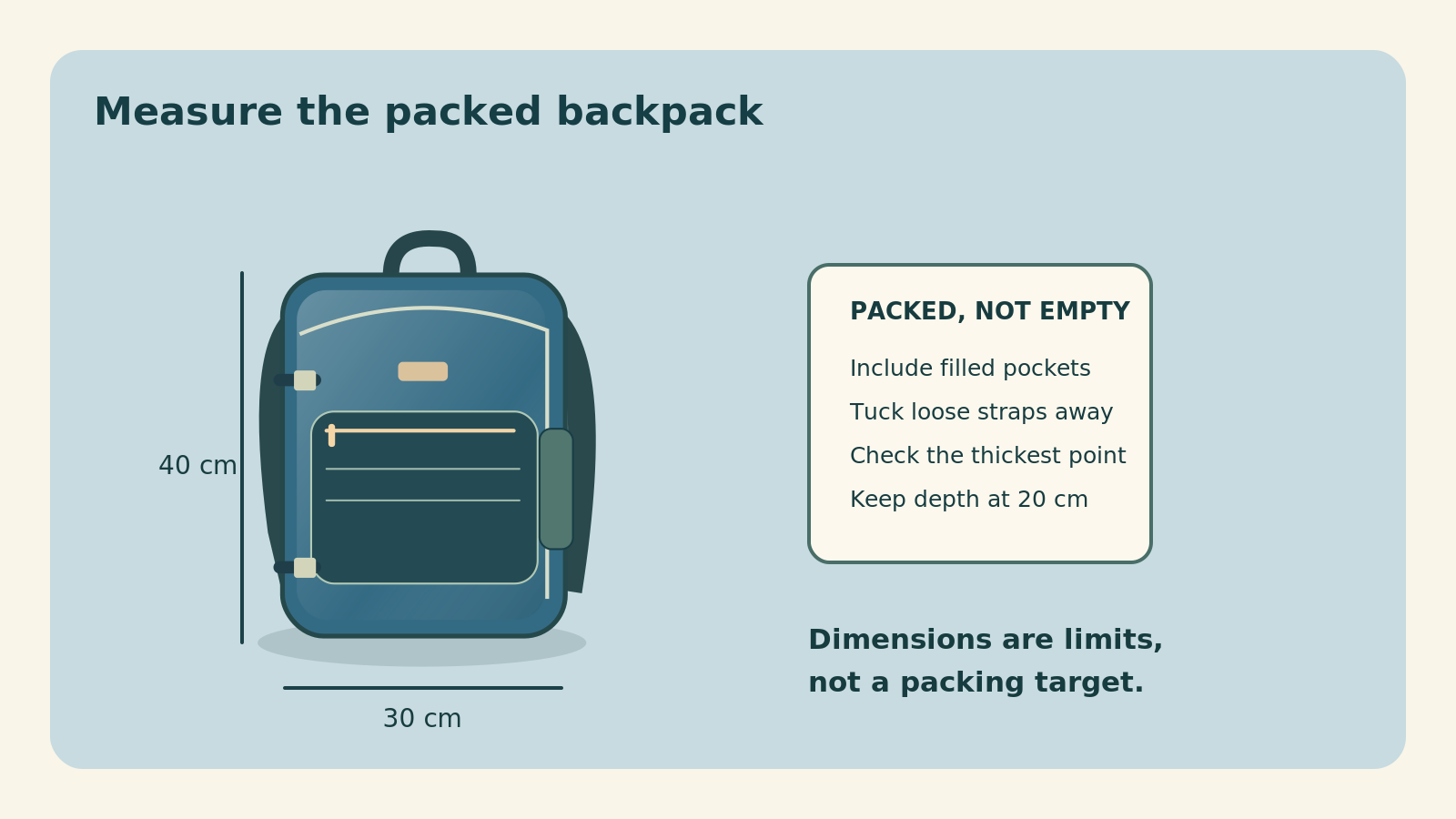
Ryanair’s current policy includes one small personal bag measuring no more than 40 x 30 x 20cm, to fit under the seat. Priority and two cabin bags adds a separate 10kg overhead bag with different dimensions. This shortlist concerns the small included item, not that paid larger bag. The policy was checked on 09 October 2026. [1]
A shop’s airline-compatible badge is not enough to establish compliance. Compare the external measurements of the exact size, then measure the bag with the items you will actually carry. A soft backpack can become wider when a bottle pocket is filled or deeper when shoes press against the front. The empty catalogue shape is only the first check.
A backpack does not create a second allowance
Plan to consolidate the items you normally carry separately. A handbag, laptop sleeve or small crossbody may need to fit inside the permitted bag rather than travel alongside it as an assumed extra. Check the airline’s own rules for any special allowance that applies to you; do not infer one from the presence of an accessory strap or detachable pouch.
This is also why a bag with many compartments is not automatically the easiest choice. It may encourage you to fill every pocket independently. Instead, think of the backpack as one measured container with different access points. All the pockets share the same external size limit.
Underseat storage is part of the travel experience
Maximum permitted dimensions are not a requirement to fill the entire available envelope. A slightly smaller bag can be easier to handle and leave more flexibility around your feet. Conversely, a very small daypack may not hold the clothing needed for a cabin-only break. Decide whether this is your only luggage or the essentials bag alongside separately booked checked baggage.
That distinction shapes the ranking below. The first choices emphasise short-trip packing and useful organisation. The smaller final options deliberately serve lighter loads and travellers who already own them. They are not presented as magical substitutes for a full weekend wardrobe.
02How the ten backpacks were chosen
Fit first, then a clearly different use case
The shortlist starts with published dimensions that fall within the current small-bag envelope. It then considers opening style, equipment access, empty weight where reliably specified and the practical role of the bag. Multiple colours are not counted as separate recommendations. Different models from the same brand appear only when they offer a meaningful difference in layout or use.
This is an editorial order, not the result of laboratory scoring. No sample was carried on a Ryanair flight or measured in an airport sizer for this article. The ranking is intended to narrow a buying decision, not to award an unsupported universal winner or claim that a bag is officially endorsed by the airline.
Treat uncertain details as questions, not advantages
Some manufacturers revise products while retaining familiar names. Consequently, an older photograph, review or weight figure may describe a different version. Where a detail was inconsistent or not firmly verified, the table says so. It is better to request the selected variant’s weight than to publish a neat but unreliable number.
Capacity labels also need caution. They are reproduced as model descriptions, not certified usable volume inside an airline sizer. For comparison, the rectangular 40 x 30 x 20cm envelope is 24 litres geometrically. That calculation does not tell you how much useful space remains after padding, curves and pockets.
Two starting points for different travellers
For a straightforward clothing-led short break, begin with the Metz 24L. For frequent laptop access, examine the Classic Tech 28L instead. Those are research-led starting points, not guarantees of comfort. A smaller bag already in your cupboard may still be the best choice when it holds your actual load without exceeding the limit.
03The ten options at a glance
| Candidate | Exterior, height x width x depth | Empty weight | Main role |
|---|---|---|---|
| 1. Metz 24L | 40 x 30 x 20cm | 600g | Clothes-first short breaks [2] |
| 2. Classic Tech 28L | 39 x 29.5 x 20cm | 713g | Separate laptop access [3] |
| 3. Classic 28L | 39 x 29.5 x 20cm | 600g, current version | Simpler clamshell packing [4] |
| 4. Manhattan 24L | 40 x 30 x 20cm | 500g | Compact-device organisation [5] |
| 5. Memphis 24L | 40 x 30 x 20cm | Confirm variant | Internal compression [6] |
| 6. Escape 500 16L | 40 x 28 x 20cm | 700g | Smaller travel-and-daypack role [7] |
| 7. Aerolite 24L | 40 x 30 x 20cm | 710g | Pouch useful after arrival [8] |
| 8. Kanken classic | 36 x 27.5 x 12cm on checked UK page | 300g | Light loads; verify exact version [9] |
| 9. Kanken Laptop 13 | 35 x 25 x 16cm | Source weights differ | Small laptop and essentials [10] |
| 10. Arpenaz NH100 10L | 39 x 21 x 12cm | 145g, documented version | Small essentials; check current colour availability [11] |
Read the table as a shortlist, not a boarding guarantee
The dimensions are manufacturer or retailer specifications for the named versions, presented as height, width and depth. They do not replace measuring a delivered bag. Stated empty weights exclude the contents and may differ with a revised design. Check the selected model, colour and seller’s description before paying.
Amazon search buttons intentionally open searches where a reliable exact product destination was not established. Match the complete name and size rather than choosing the first result. The Aerolite button opens its store, so select the described backpack there. None of those links promises a particular current price, seller or immediate stock level.
041. Cabin Max Metz 24L: the straightforward packing choice
Why it earns the first look
The Metz 24L has a published 40 x 30 x 20cm exterior and a 600g empty weight. Its suitcase-style opening and relatively uncomplicated main area make it a sensible place to start for clothing-led travel. Cabin Max lists different fabric descriptions across colourways, so check the exact version rather than assuming every finish is identical. [2]
A large opening is useful when you want to see the whole clothing load rather than dig from the top. However, simple space still needs restraint. Pack shoes and other rigid objects so they do not create a rounded bulge at the front. The most useful result is a bag that keeps its intended shape without requiring force.
Who should choose something else
A traveller repeatedly removing a laptop may prefer a dedicated separate access area. Likewise, someone expecting long daily walks with a heavy load should assess the harness carefully rather than buying solely around airline dimensions. The first-place position reflects a straightforward short-trip brief, not a claim of superior all-day carrying performance.
Before keeping it, pack one realistic weekend and retrieve your journey essentials with the bag upright. If you have to unpack clothing every time you want a charger, adjust the layout or choose a more organised model. The best simple bag is one that remains simple in use.
052. CabinZero Classic Tech 28L: for separate laptop access
The important distinction is the tech layout
CabinZero lists 39 x 29.5 x 20cm and 713g for the Classic Tech 28L, with a separate laptop compartment and trolley sleeve. The dimensions leave a small nominal margin in height and width, but no extra depth allowance. Its 28L name should not be treated as a physical guarantee of 28 litres inside a 24-litre rectangular sizer. [3]
Separate equipment access can be useful on work trips, because a laptop does not have to share the same opening sequence as folded clothes. Nevertheless, device compatibility depends on the laptop’s actual dimensions and protective sleeve, not just its screen diagonal. Check the opening and the space available around the zip.
The trade-off to consider
More organisation can reduce the freedom of the main packing area and adds material. That may be worthwhile when you regularly travel with a computer, but less useful for a phone-only holiday. Compare it with the simpler Classic rather than assuming Tech must be the better option for everyone.
Keep dense electronics close to the back and avoid packing a bulky plug against the laptop compartment. Then check the complete depth with your ordinary load. A dedicated pocket improves access; it does not exempt that equipment from the overall size constraint.
063. CabinZero Classic 28L: for a simpler clamshell interior
A familiar model that has changed over time
The current Classic 28L page lists 39 x 29.5 x 20cm and 600g, with a suspended laptop sleeve, compression straps and clamshell opening. Do not automatically reuse older weight figures or assume every used example has the latest feature set. Confirm the details of the version being sold. [4]
The appeal is a relatively direct packing arrangement with enough access to organise clothing without opening several nested compartments. Use the compression straps to stabilise the load rather than as an excuse to pack beyond the intended outline. A hard object that is too long will not become shorter when the side straps are tightened.
When the simpler layout is preferable
This makes sense when clothing occupies most of the bag and you only occasionally carry a computer. A separate removable sleeve can be sufficient, provided it fits within the bag and gives the device appropriate protection. Conversely, frequent laptop removal may justify the different access arrangement of the Classic Tech.
A short home rehearsal should include carrying the full load, not just opening the empty bag. Check whether the corners of your packing cubes create pressure points against your back. When the bag is comfortable only after removing essential items, a different packing plan is needed.
074. Cabin Max Manhattan 24L: lighter organisation for a compact device
A different balance from the Metz
The Manhattan 24L is listed at 40 x 30 x 20cm and 500g, with storage described for a laptop up to 13 inches. Its organised approach is worth comparing when your essentials are a small computer or tablet, clothing and a few travel documents. Do not assume a larger laptop fits because the exterior is rectangular. [5]
Measure the device including any case, then check the internal compartment rather than its advertising label alone. An awkward zip opening can matter even when the nominal sleeve dimensions look adequate. Avoid forcing a tight device into a pocket, because a successful fit should allow straightforward removal as well as insertion.
The packing question
The lighter listed weight is attractive, but it should not outweigh whether the main area holds your particular clothing load. Give shoes and toiletries deliberate positions before filling small pockets. Otherwise, an apparently organised bag can end up with empty narrow compartments and a crowded central area.
For a short work-and-leisure trip, this may be a better compromise than a minimal daypack. However, someone carrying a substantial equipment load should compare both device protection and loaded comfort. Neither is established merely by the backpack meeting the airline’s external dimensions.
085. Cabin Max Memphis 24L: for controlled packing rather than loose stuffing
Why compression needs a clear purpose
The Memphis 24L is another 40 x 30 x 20cm option, with internal compression and a stated 13-inch laptop arrangement. It is included for travellers who want more control over a clothing-led load. A dependable selected-variant weight was not established in the reviewed material, so the table does not invent one. [6]
Internal compression can help stop belongings shifting and keep the outline tidy. However, it should not be confused with a reduction in mass. A tightly packed block of clothing, toiletries and electronics still weighs the same, and can feel less forgiving against the body than a looser arrangement.
Where it can become the wrong choice
Avoid treating compression as permission to add another outfit whenever the bag appears to close. That approach often transfers the problem from space to weight or access. Instead, set the packing list first and use the internal system to keep that list manageable.
It is particularly useful to test the return journey with this type of bag. Repack worn clothes and check whether the same arrangement still works without careful showroom folding. When the system requires too much effort, a simpler main compartment may be a more convenient travel companion.
096. Quechua Escape 500 16L: a smaller travel-and-daypack compromise
Less volume can be a deliberate advantage
Decathlon lists the Escape 500 16L at 40 x 28 x 20cm and 700g. Its detailed text distinguishes the main capacity from an additional figure including bottle pockets. We use the 16L model name rather than blending those figures into a promised airline capacity. Some promotional device-size wording is inconsistent, so measure your equipment directly. [7]
This is a useful option when the bag will continue as a daypack after the flight, rather than spend the whole trip packed with spare clothes. A smaller load can be easier to manage on public transport and while sightseeing. It also provides a natural limit on the temptation to carry every possible extra.
The compromise for one-bag weekends
A compact main area gives less freedom for shoes and bulky layers than the larger box-shaped choices. Therefore, rehearse the full trip load rather than assuming a well-organised pocket layout creates extra capacity. The bottle pockets are useful, but a filled bottle must remain within the measured width for boarding.
This choice suits someone who values a smaller everyday bag and can travel with a restrained wardrobe. For a clothing-heavy break, the Metz or a CabinZero clamshell may be simpler. The Decathlon manufacturer link in the sources provides the exact model; no affiliate purchase destination is implied for it.
107. Aerolite 24L with removable pouch: useful access, with a boundary
Keep the pouch inside the allowance
The documented Aerolite backpack is 40 x 30 x 20cm, weighs 710g and includes a removable shoulder-carry pouch. That can be convenient after arrival, allowing a smaller set of essentials to travel separately from the main bag. During boarding, however, the full arrangement still needs to satisfy your permitted baggage allowance. [8][1]
Do not assume detaching a pouch makes it an extra free item. Plan where it fits and whether the attached configuration changes the external depth. Equally, a large filled side pocket can affect width even when the main body seems correctly sized. Measure the complete setup rather than the main compartment alone.
A useful choice for two stages of the trip
The idea works best when you genuinely want a smaller carry option at the destination. For example, you may leave spare clothing at accommodation while keeping a few essentials together for an evening out. Otherwise, the extra pouch may be another component to pack and maintain without adding much practical value.
The buying link opens Aerolite’s store rather than a verified product-specific tracking destination. Select the named 24L backpack and confirm its measurements there. Other Aerolite products, including wheeled or metal cases, do not inherit this backpack’s underseat suitability.
118. Fjallraven Kanken classic: for a light load or a bag you already own
A smaller square pack can be sufficient
The checked UK Kanken page lists a 300g classic model with a compact square shape. Current and older versions can show different measurements, so the table preserves the reviewed UK specification and asks you to check your actual item. The ordinary classic should not be confused with a larger laptop or different Kanken variant. [9]
This is not a recommendation to buy a style-led daypack solely to maximise the Ryanair allowance. Its value is stronger when you already use it and your flight load is modest. A bag that holds a spare layer, compact essentials and a restrained clothing change may be entirely adequate for the trip you have planned.
Keep expectations proportionate
Do not expect a small everyday backpack to carry a dense, heavily compressed weekend load like a larger travel-specific design. Pack it lightly and assess the straps with your own belongings. When you need to add thick aftermarket padding or multiple external attachments, reconsider whether the bag is serving the intended purpose.
For travel with a separately booked checked case, this can be a practical essentials bag. For a clothes-heavy cabin-only break, it is more restrictive. The distinction is about the packing job, not whether the bag is fashionable or widely recognised.
129. Fjallraven Kanken Laptop 13: compact-device travel
Check the compartment rather than just the number thirteen
The Kanken Laptop 13 is listed at 35 x 25 x 16cm, with a laptop compartment measuring 32 x 22 x 2cm. That gives a more useful device check than screen size alone. The reviewed colour pages disagree on empty weight, so no single weight is presented as settled here. [10]
Measure the computer with any protective cover you intend to use. A device that technically slides inside but leaves the zip strained is not a good fit. Also check where the charger will sit, because keeping a compact computer safe does not mean pressing a hard plug against it in another tightly filled pocket.
Best for essentials rather than maximum clothing
This makes sense when a small laptop is central to the trip and you prefer a compact daily bag. It is not a high-capacity replacement for a full travel backpack. A spare outfit, modest toiletry pouch and light layer may be realistic for some users, but bulky shoes or thick winter clothing change the calculation quickly.
Choose it around the actual equipment and daily use after arrival. When the only reason to buy it is airline compatibility, compare less expensive simple bags too. Passing the size check is necessary, but does not establish that the premium answers your needs.
1310. Quechua Arpenaz NH100 10L: the small-essentials option
Deliberately not a full weekend bag
The documented NH100 10L version measures 39 x 21 x 12cm and weighs 145g. It is included as a minimal essentials bag, not as a claim that every ten-litre pack can replace a suitcase. Check current colour and version availability, because the referenced retailer page includes variants that may be unavailable. [11]
A traveller with separate checked luggage may only need documents, a light layer, reading material and a few journey items. In that situation, buying a maximum-size travel backpack can add unnecessary bulk. A small bag already owned can be the more sensible answer, provided the load is suitable and the bag remains in sound condition.
Know when to rule it out
It is a poor starting point for a laptop-heavy work trip or several days of spare clothing. Do not compensate by attaching a collection of external pouches and then assuming the original small measurements still apply. The point of this choice is simplicity, not turning a minimal daypack into a makeshift larger bag.
For a child or a particularly light adult load, test the straps and fit personally rather than relying on the low empty weight. The recommendation remains limited to the role described. Larger requirements belong with the more substantial travel options above or a different baggage plan.
14Backpacks deliberately left off the strict shortlist
A small excess is still an excess on paper
The Osprey Daylite Expandable 26+6 is a useful travel design, but its published 43 x 33 x 16cm dimensions exceed Ryanair’s small-bag height and width. CabinZero’s Military 28L is also taller than the current 40cm limit, despite sharing a capacity label with the Classic. Neither belongs in a strict fit-first Ryanair personal-item list. [12][13][1]
Similarly, the checked TORRO travel backpack is larger than this allowance. A travel-oriented name or retailer category is not evidence that it is suitable for the included personal item. Those products may make sense under other baggage arrangements; leaving them off this list is not a judgement that they are poor bags. [14]
Do not build a plan around compressing a rigid dimension
A soft empty top may fold down, but a laptop panel, base or densely packed load may not. We have not tested those larger bags in Ryanair sizers, and do not recommend assuming they will be accepted. Choose a documented smaller model when avoiding the uncertainty is the purpose of the purchase.
The same caution applies to an expandable bag. Its smaller mode needs a published measurement of its own; the fact that a zip can close does not establish the resulting dimensions. Compare the mode you will actually use on the flight, not the most flattering number in the listing.
15Pack within the shape rather than merely closing the zip
Make three practical zones
Place a compact clothing bundle in the largest area, keep dense equipment close to the back and reserve one accessible location for journey essentials. This is a packing method, not a requirement to buy three new pouches. Start with what you already have and use the bag’s built-in organisation where it helps.
A shoe placed sideways near the top can become the widest part of a soft pack. Move it within the main outline or reconsider whether you need it. Equally, keep a filled bottle inside the measured envelope instead of treating an elastic pocket as extra space outside the allowance.

Compression changes shape, not weight
Use a small organiser to control soft clothing only when its filled dimensions suit the bag. BAGSMART’s cube options are a comparison route, but a whole set is rarely necessary inside a personal item. One light cube can be enough, and a heavy structured organiser may create more bulk than it saves.
After packing, check the external depth at its thickest point. A compressed cube can create a rigid block that pushes out the front even when the surrounding fabric is soft. Removing one non-essential item is often more effective than tightening every available strap.
Use a realistic carrying load
Ryanair’s cited small-bag policy does not state a separate numerical weight limit for the included personal item, so this article does not invent one. That is not a reason to make the pack as heavy as possible. Carry it around your home with the planned load and judge whether the setup remains practical. [1]
A luggage scale can still be useful for comparing two packing arrangements, particularly when a laptop and chargers dominate the weight. Treat the result as information, not a challenge to maximise. Your route may involve longer walks or more standing than you expect.
16Three concrete packing plans for the same small-bag allowance
A two-night clothes-led city break
For a planning rehearsal, wear the trousers, shoes and outer layer you expect to use most. Pack two changes of underwear, two pairs of socks, one spare top, sleepwear and a light additional layer only when the forecast and your activities justify it. Add the toiletries you actually use, a phone charger and essential documents. These are example quantities, not a universal list for every traveller.
Put the clothing into one loose bundle before introducing an organiser. That shows whether a cube improves the shape or simply adds another layer of fabric and zips. Position a compact toiletry pouch away from any unprotected electronics. Keep journey essentials together where they can be reached without removing the spare clothes.
A Metz, Classic or another box-shaped travel pack is a logical place to rehearse this load. The test is not whether an online reviewer fitted more items. It is whether your clothes, in your size and fabrics, close without strain and leave enough flexibility for the return. Remove an optional item before buying a more elaborate compression system.
An overnight trip with a small work computer
Begin with the laptop in the sleeve or compartment you will actually use, then add its necessary charging equipment. Place a compact change of clothing around that fixed equipment load. A shirt that must arrive presentable may need a different folding arrangement from a soft leisure top, so include the actual garment in the rehearsal rather than a convenient substitute.
Separate items needed at the first meeting from objects you will leave at accommodation. That makes access more useful than a raw capacity figure. The Classic Tech’s separate opening or a suitably sized compact laptop model may save disruption, but only when the device passes a genuine compartment check.
Do not pack several alternative cables and chargers merely because work feels important. Identify the equipment required for the actual devices and journey, while keeping any genuinely necessary backup proportionate. A duplicated bulky power supply can occupy the space that would otherwise allow the clothing to lie flat. The aim is a dependable working kit, not every accessory from the office drawer.
An essentials bag beside separately booked checked luggage
This role is different from cabin-only travel. The small bag may contain medication in its appropriate packaging, travel documents, valuables, a light layer, reading material and a modest change of clothes useful during disruption. Your main wardrobe remains in the checked case. A smaller Kanken or light Quechua may therefore be sufficient without using every centimetre of the allowance.
Keep the items you would need if the main case were delayed together, but do not assume that means carrying a second full wardrobe. Think through a realistic first evening and the next morning. The resulting small kit should remain easy to supervise and carry rather than become as inconvenient as the luggage it is meant to supplement.
For family travel, decide who carries shared documents and small essentials without concentrating everything in one place unnecessarily. The physical bag still needs to suit the person wearing it. A small backpack that feels easy for an adult with a light load may be uncomfortable for a child or for someone carrying it much longer than expected.
17Buying decisions that the dimension table cannot settle
A clearance price versus a current model
A reduced older bag can be good value when its condition, measurements and features meet the need. However, compare the actual generation. Changes to laptop sleeves, trolley straps and weight can make a familiar name a poor guide to what is in the parcel. Save the listing and selected variation when ordering so you can check the delivered item accurately.
Ask about the return conditions before using the bag outside. An indoor packing rehearsal with clean belongings is different from a weekend trial. Keep tags and packaging until the decision is made, and contact the seller promptly about an obvious fault. A little preparation preserves your options without treating a return window as permission for unrestricted use.
Everyday usefulness versus maximum flight capacity
A backpack bought for two flights may spend far more days commuting, shopping or carrying a light day-trip kit. Give that ordinary use some weight in the decision. A slightly smaller bag that you use frequently may be better value than a maximum-size rectangle that feels cumbersome whenever it is not full of clothes.
Conversely, do not compromise the actual flight load just to buy a style you prefer. When the essentials only fit through external attachments or a distorted closure, the design is not solving the travel problem. Separate an everyday-bag purchase from a travel-bag purchase when one genuinely cannot do both jobs well.
Repair questions before a long-term purchase
Examine likely wear points: shoulder-strap attachments, main zip, base fabric and frequently used handles. Ask the brand about a repair or replacement route when long-term service matters to you. A warranty headline alone does not establish spare-part availability or the cost of resolving ordinary wear.
Keep proof of purchase and follow the care instructions for the exact model. Do not assume machine washing is suitable because an unrelated marketplace description says so. Cleaning, storage and repairs should follow the manufacturer’s guidance, particularly when a bag has coated fabric, padding or structured equipment compartments. The goal is to preserve a useful bag, not to make unsupported claims about its lifespan.
18The home fit check that matters before departure
Measure the backpack after the last item goes in
Pack it fully, close all zips and tuck loose straps into their travel position. Use a wall and a straight edge to identify the longest, widest and deepest points. Do not press the bag smaller while reading the measurement unless it will naturally remain that shape during travel.
A home-made rectangular space can help visualise the allowance, provided you measure its interior accurately. It is a rehearsal, not an official airline test. The goal is to identify an obvious bulge or oversized rigid panel before you leave, rather than depend on forcing a bag into a sizer at the gate.
Rehearse access without disturbing the whole load
Take out the items you expect to need during the journey, then put them back. Watch whether the bag becomes deeper or harder to close after a quick repack. A packing system that works only when every garment is carefully arranged on a bed may be inconvenient in a terminal.
Also try the return arrangement, allowing for laundry and any expected purchase. When a bag is already at the limit before departure, even a small addition can create a problem. Reserve some flexibility or choose a different baggage arrangement before the trip begins.
19Pros, cons and the cost of the whole travel system
What a well-chosen personal-item backpack does well
It keeps your hands available, can simplify stairs and lets a modest packing list travel within the included small-bag allowance. The best result is a bag you also enjoy using after landing. A model selected for your actual device and clothing load is more useful than one chosen solely because it claims the largest capacity.
What it cannot do
It cannot make an oversized load compliant, provide unlimited comfort or create extra room for separate bags. A compact pack also places the carried weight on your body. When the trip genuinely needs more equipment, paying for the appropriate luggage arrangement may be a better decision than buying progressively more compression accessories.
Compare cost against the trips you really take
A hypothetical £30 bag and a £90 bag differ by £60; these are planning examples dated 09 October 2026, not quoted shop prices. Over twelve trips, that is £5 per trip before repairs. The comparison is useful only if the dearer bag provides something you need, such as better access for your particular device.
Do not calculate guaranteed savings from avoiding hypothetical gate charges. Charges depend on the actual booking and circumstances, and a correctly sized bag can still be overfilled. Compare purchase cost, everyday usefulness and your intended baggage plan without assuming that a product automatically pays for itself.

20Common mistakes with Ryanair personal-item bags
Buying the correct model name in the wrong size
Metz, Manhattan and CabinZero ranges contain multiple capacities. Confirm the dimensions again after changing a colour or clicking a marketplace variation. Older smaller versions may still fit, but they are not the same packing proposition as the current size described here.
Filling every external pocket
Bottle holders, front pouches and accessory straps are useful at the destination. They do not sit outside the airline’s measurement. Check the total outline with those features in use, or leave them empty for boarding when that is necessary to remain within the limit.
Choosing a tiny bag for a large packing job
The compact Kanken and ten-litre Quechua options are included for specific light-load roles. Do not assume they will hold everything simply because they easily pass the size comparison. The packing list still has to fit comfortably, with essential items protected and accessible.
21Frequently asked questions
What size backpack is included with a Ryanair ticket?
The cited policy allows one small personal bag up to 40 x 30 x 20cm that fits under the seat. Measure the packed exterior and check the booking again before travel. A bag described as cabin luggage may instead refer to the larger overhead category, which is a different allowance. [1]
Is a bag labelled 28L automatically too big?
No. Capacity names and measured exterior dimensions are different information. The CabinZero Classic and Classic Tech 28L have documented dimensions within this shortlist’s envelope, while the Military 28L is taller. Compare the exact model rather than deciding from the litre number alone. [4][3][13]
Can I use a backpack that is a little taller if I leave it half empty?
This guide does not guarantee acceptance of an oversized published design. An empty soft section may compress, but rigid panels and the actual contents can prevent that. For a purchase intended to minimise uncertainty, choose a documented smaller model and measure the packed result instead of relying on an untested exception.
Which choice makes most sense for a laptop?
Start by checking the Classic Tech 28L’s compartment against the actual device, or consider the Kanken Laptop 13 for a much smaller equipment-and-essentials load. The Manhattan and Memphis describe smaller laptop arrangements. Screen size alone is not sufficient; include any sleeve and check the opening as well. [3][10][5][6]
Do older 40 x 25 x 20cm bags need replacing?
Not simply because the allowance is now wider. A sound bag that stays within the current limits and holds your belongings can remain useful. The reason to change would be a real packing, access or comfort problem, not the availability of an extra few centimetres you do not need. [1]
Can a detachable pouch travel separately?
Do not assume so. Plan for the ordinary items to be consolidated within your permitted bag unless the airline’s rules give you a specific additional allowance. A removable pouch is useful after arrival, but its separate strap or zip does not create an extra entitlement at boarding.
Is the cheapest backpack the best way to save money?
Only when it suits the load and you will use it. A cheaper bag that does not fit your laptop or becomes awkward when packed is poor value. Equally, an expensive bag cannot solve a packing list that exceeds the allowance. Start with the necessary items and the dimensions, then compare prices for suitable designs.
22Final recommendation: choose the packing job before the brand
For a simple short break, start with the Metz 24L and compare its loaded shape with your actual wardrobe. For regular laptop access, the Classic Tech 28L deserves a closer look. Smaller options make more sense when the job is limited to essentials or when you already own a suitable bag.
Whichever model you choose, check the exact version, measure it packed and leave room for the journey home. The strongest recommendation is not the largest advertised litre number. It is the bag that holds what you need, remains within the allowance and is still convenient after you leave the airport.
23Sources and fact-checking
Research reviewed on 09 October 2026. Manufacturer specifications and airline allowances are kept separate from our buying judgement. Prices, colour availability, product revisions and delivery terms can change. No durability, comfort, security or airline-acceptance testing was performed for this article.
- Ryanair: baggage policy. Small personal bag and Priority overhead allowance; airline rules take precedence over retailer labels.
- Cabin Max: Metz 24L. 40 x 30 x 20cm and 600g; fabric varies by colourway.
- CabinZero: Classic Tech Backpack 28L. 39 x 29.5 x 20cm; 713g; separate laptop compartment and trolley sleeve.
- CabinZero: Classic Cabin Backpack 28L. 39 x 29.5 x 20cm; 600g on the current listing. Marketing litre labels are not measured sizer capacity.
- Cabin Max: Manhattan 24L. 40 x 30 x 20cm, 500g and a stated 13-inch laptop compartment.
- Cabin Max: Memphis 24L. 40 x 30 x 20cm; internal compression and stated 13-inch laptop storage. Confirm variant weight before buying.
- Decathlon: Quechua Escape 500 16L. 40 x 28 x 20cm; 700g. Detailed copy distinguishes 16L main volume from 17L including bottle pockets. Conflicting laptop promotional copy is not treated as proof of 17-inch compatibility.
- Aerolite: 24L backpack with removable pouch. 40 x 30 x 20cm; 710g. Attached pouch and filled bottle pocket must remain inside the permitted envelope.
- Fjallraven: Kanken classic. Current UK technical text lists 36 x 27.5 x 12cm and 300g; older/other versions may use different measurements. Check the actual item.
- Fjallraven: Kanken Laptop 13. 35 x 25 x 16cm; listed laptop compartment 32 x 22 x 2cm. Indexed colour pages disagree on empty weight, so no single weight is used.
- Decathlon: Quechua Arpenaz NH100 10L. 39 x 21 x 12cm and 145g in the documented version. Some colourways are unavailable; no current price or immediate availability is assumed.
- Osprey: Daylite Expandable Travel Pack 26+6. Manufacturer metric dimensions 43 x 33 x 16cm, 840g and 5cm expansion. UK price/stock are not inferred from this US page.
- CabinZero: Military Backpack 28L. 43 x 30 x 16cm; 905g in current specification. Do not confuse with Classic 28L.
- TORRO: travel backpack. Checked specification is 51 x 32 x 23cm; not included among strict free-underseat matches.
Buying links are optional comparison routes, with search and collection destinations identified in the article. No discount code or current stock promise is implied. Original images depict unbranded equipment and planning ideas, not the products reviewed or evidence of hands-on testing.
Illustrations in this article were created for Taylor’s Trailblazing Travel Gear. Third-party photographs, where used, are credited beside the image or in the source list.