Top 10 Personal-Item Backpacks for easyJet
Use the small-bag allowance intelligently, with ten different layouts and no assumption that expansion stays within the limit.
Choosing personal-item backpacks for easyJet is not simply a matter of buying the biggest soft bag you can find. The useful choice needs to stay within the small-bag dimensions when packed, carry comfortably enough for your route and remain convenient after you leave the aircraft.
This guide compares ten options with different strengths: open clothing space, equipment organisation, a closed expandable design and smaller everyday bags. It also explains why a seemingly minor depth excess keeps some popular travel backpacks off a strict shortlist. A travel label is not a substitute for the exact external measurements.
All recommendations are based on published information and practical analysis, not a claimed flight test. Product revisions, filled pockets and your belongings can change the outcome. Read the dimensions and caveats together, then use the home rehearsal to decide which bag actually works for the trip you are taking.
Metz 30L
A simple rectangular main area close to the permitted envelope.
Daylite 26+6, closed
Keep the expansion closed for the small-bag depth limit.
Discovery 28L
Compare organisation benefits with the extra empty weight.
Choose the smaller limit
A deliberately smaller bag may simplify the whole itinerary.
01Personal-item backpacks for easyJet: understand the small-bag allowance
The relevant dimensions are not the large-cabin dimensions
easyJet includes one small underseat cabin bag up to 45 x 36 x 20cm, including handles and wheels. Its published maximum weight is 15kg, and you must be able to lift and carry the bag yourself. This guide compares backpacks for that small-bag role, not the separate large cabin category. The airline policy was checked on 09 October 2026. [1]
Do not read the weight limit as a target. A pack can satisfy an airline rule while being unpleasant to carry through a station or around a city. Select enough capacity for the trip, then keep the load manageable for you. A larger allowance is useful flexibility, not an instruction to fill every centimetre.
The bag must work as a packed object
Measure the longest, widest and deepest points after adding your belongings. A bottle holder, rounded front compartment or bulky shoe can change a soft bag’s outline. Likewise, expansion is a separate configuration, not an invisible reserve of capacity. The correct comparison is the shape you intend to board with.
A retailer’s compatibility badge can help identify candidates, but the airline’s own rule is the reference. Check the exact size selector and the final product description. Some ranges contain several capacities with very similar photographs, and a larger variation does not inherit the smaller bag’s suitability.
Consider the journey after you leave the aircraft
A maximum-size rectangular bag is attractive for a clothes-only weekend, yet it may feel cumbersome as your daily sightseeing backpack. A smaller organised daypack can be the better choice when most of the trip is spent carrying it. Decide whether you will empty it at accommodation or keep the full load with you between stops.
For a mixed trip, a moderate bag with a useful opening can be more convenient than either extreme. However, no single design is best for every traveller. The shortlist gives each model a practical role so you can choose around your own equipment, clothing and carrying preferences.
02How this shortlist was built
Published fit, useful differences and transparent limits
Each named option has a documented unexpanded exterior within the small-bag envelope, or a clearly identified closed mode that does. We compared access, organisation, nominal weight where consistently specified and the type of traveller the design is likely to suit. The order is editorial judgement, not a laboratory score or a claim of airline endorsement.
No backpack was taken on an easyJet flight or tested in a physical airport sizer for this article. Manufacturer measurements are therefore a screening tool, not a boarding guarantee. Measure the actual bag and confirm the current allowance before departure, especially if the selected model has changed since the referenced page was published.
Capacity labels do not decide the winner
A 45 x 36 x 20cm rectangular envelope is 32.4 litres by calculation. Padding, tapered corners and hardware reduce the useful space within that exterior. A model name containing 36L should not be read as proof that you can place 36 litres of belongings inside a strict sizer of that size.
Instead, compare how the interior accepts the objects you need. A simple box-shaped compartment may hold a clothing bundle efficiently, while a smaller-looking organised pack may work better for electronics. The useful bag is the one that fits your actual packing system, not necessarily the one with the largest number on the label.
Buying links are labelled by what they open
Some buttons open Amazon UK searches because exact current product availability could not be established reliably enough for a direct item recommendation. Match the complete model and size in those results. The Antler link opens a retailer range where you should select Discovery 28L specifically. None of these routes guarantees a price, stock level or delivery date.
The list includes suitable non-affiliate options as well. Commission availability did not determine whether a model passed the dimensions check. Products with an unresolved or excessive depth are discussed separately rather than quietly being counted among strict matches.
03Comparison table: ten different ways to use the allowance
| Candidate | Exterior, height x width x depth | Empty weight | Main distinction |
|---|---|---|---|
| 1. Metz 30L | 45 x 36 x 20cm | 600g | Simple clothing-led packing [3] |
| 2. Daylite 26+6 | 43 x 33 x 16cm closed | 840g | Closed mode only; expansion adds 5cm depth [2] |
| 3. Classic 36L | 45 x 31 x 20cm | 700g | Clamshell, narrower-front shape [4] |
| 4. Discovery 28L | 45 x 31 x 20cm | 1.17kg | Equipment-led organisation [5] |
| 5. Manhattan 30L | 45 x 36 x 20cm headline | Conflicting 820g / 600g copy | Verify selected version and details [6] |
| 6. Military 28L | 43 x 30 x 16cm | 905g | More structured compact option [7] |
| 7. Raven 20 | 42 x 28 x 18cm | 650g | Everyday equipment and essentials [8] |
| 8. High Coast Totepack | 40 x 31 x 14cm | 400g | Light loads and multiple carry modes [9] |
| 9. Classic Tech 28L | 39 x 29.5 x 20cm | 713g | Smaller mixed-airline outline [10] |
| 10. Escape 500 16L | 40 x 28 x 20cm | 700g | Compact daypack crossover [11] |
Read the dimensions and the mode together
Measurements are presented as height, width and depth for the documented versions. In particular, the Osprey’s closed and expanded configurations are different propositions. Manufacturer updates and selected colours can also alter details, so compare the precise item being sold rather than relying on an older review of a similarly named bag.
Where the source did not provide a consistent empty weight, the table marks that uncertainty. A missing or conflicting figure should prompt a question to the seller, not a guessed average. For airline fit, the fully packed exterior still matters more than any neat table entry.
041. Cabin Max Metz 30L: the simple clothes-first choice
A useful starting point for a short break
The Metz 30L is listed at 45 x 36 x 20cm and 600g, with a suitcase-style opening and a largely open packing area. Those dimensions use the small-bag envelope closely. It is a sensible first comparison for someone travelling mainly with clothing and a compact essentials kit. [3]
The open interior should be treated as freedom to arrange your belongings, not permission to overfill. Put awkward items where they do not push out the front, and keep the quick-access pocket modestly loaded. A full-height bag can become deeper than intended when a compressed clothing bundle presses against a charger or spare shoe.
Who may prefer another option
A frequent laptop user may benefit from more deliberate separation, while someone using the bag all day should assess the harness carefully. This first-place recommendation reflects a simple weekend brief, not a claim of the best carrying comfort across all loads. Try your actual contents before deciding that the uncomplicated design is enough.
Also confirm that the listing is for the backpack rather than a trolley or hybrid in a related range. Wheels and a frame change both the weight and the interior. The model name and capacity need to match the exact product you expect to receive.
052. Osprey Daylite Expandable Travel Pack 26+6: adaptable only in the correct mode
The closed mode is the relevant comparison
Osprey publishes 43 x 33 x 16cm and 840g for the referenced Daylite 26+6. Its stated expansion adds 5cm of depth, taking the nominal depth to 21cm by calculation. Therefore, the expanded configuration is not a strict match to easyJet’s 20cm small-bag depth. Plan to use it closed for this allowance. [2][1]
That can still be useful. You may want extra room after arriving by air, during a rail segment or on a trip with different luggage arrangements. However, do not pack the expanded bag and assume the compression zip will make a rigid or dense load conform. Rehearse the closed configuration with all flight-day essentials inside.
A travel system rather than free extra capacity
Choose this option when the two modes genuinely serve different parts of your travel. For a single flight-only weekend, the extra complexity may be unnecessary. A simpler fixed-size bag could meet the same need without requiring you to remember which shape is compliant.
The referenced manufacturer specifications and UK product route are distinct from a promise of current UK colour availability. Check the selected version and do not confuse it with another Osprey 26+6 range. The shared capacity wording does not establish identical dimensions or features. [12]
063. CabinZero Classic 36L: a narrow-front clamshell option
More height than the smaller Classic
CabinZero lists the Classic 36L at 45 x 31 x 20cm and 700g. That is taller than the Classic 28L, so it should not be substituted in a smaller-airline personal-item comparison merely because both are Classic backpacks. For easyJet’s documented envelope, its published dimensions are a plausible starting point. [4][1]
The narrower front may suit a traveller who prefers that shape to a wider rectangular pack. Yet a more compact-looking profile does not automatically mean better comfort. Pack dense items close to the back, then check whether the bag pulls away from you or creates pressure when walking with the load.
Choose it around the packing style
A clamshell layout is useful when you want to organise a short-trip wardrobe in one visible area. It can also make unpacking in a small room straightforward. Conversely, someone who repeatedly needs a computer without exposing the clothing may prefer a more distinct tech-access design.
Do not convert the 36L name into a guarantee of usable airline-sized capacity. Compare the physical arrangement of your possessions instead. A cube that fits neatly in another backpack may waste space or press against the closure here, so test the combination rather than buying a matching set on assumption.
074. Antler Discovery 28L: organisation for an equipment-led trip
The weight trade-off is visible in the specification
The Discovery 28L is listed at 45 x 31 x 20cm and 1.17kg, with separate technology storage and travel-oriented organisation. It is heavier empty than several simple packs in this shortlist. That is not automatically a disadvantage, provided the structure and access solve a real problem for your journey. [5]
For a work trip, start with the laptop, charger and other unavoidable equipment before adding clothing. Check the device compartment using actual measurements and include any sleeve you normally use. A screen-size claim alone does not establish comfortable access through a zip or room for an unusually thick laptop.
Avoid paying for unused organisation
The design makes more sense for someone who regularly carries equipment than for a traveller who only needs a phone and a change of clothes. Extra pockets can become unused material when the packing list is simple. Conversely, a well-chosen layout can reduce repeated rummaging for a frequent work traveller.
The retailer link is a route to compare the current Antler range, not a promise that every Discovery capacity qualifies. Select 28L and recheck the exterior; larger Discovery versions serve a different role. Likewise, confirm current availability and delivery rather than assuming the model shown first is the correct one.
085. Cabin Max Manhattan 30L: a more organised rectangular bag
The headline size is clear; some secondary details conflict
Cabin Max markets the Manhattan 30L around a 45 x 36 x 20cm exterior. Its page contains differing width and weight descriptions in different sections, so this guide uses the larger advertised width conservatively and does not present a single settled empty weight. Ask for the selected variant’s details before buying. [6]
The practical interest is its combination of a travel-shaped compartment and additional organisation. That can help when the bag carries documents, a device and clothing rather than clothes alone. However, more pockets still share the same total outline. Keep the front compartment from becoming a separate bulging load.
Compare the access sequence with the Metz
Pack the two designs conceptually around the items you retrieve most often. When a charger, small device and paperwork are central to the journey, an organised layout may save time. When you mainly want an unobstructed clothing space, the simpler Metz could be a better fit.
Do not settle the comparison by assuming the model with more features must be more comfortable or durable. This review has no hands-on evidence to support that claim. Use the specification to shortlist, then make the keep-or-return decision through a careful indoor load and access check.
096. CabinZero Military 28L: a compact, more structured alternative
Same capacity label, different dimensions
The Military 28L is listed at 43 x 30 x 16cm and 905g. Those dimensions differ from the Classic 28L, despite the shared capacity label. The documented design includes additional harness and exterior features, so it is worth considering when you prefer that arrangement rather than simply seeking the lightest empty bag. [7]
Its shallower nominal depth offers some packing flexibility within easyJet’s small-bag limit. Nevertheless, external attachments and filled pockets still count towards the measured outline. Use the exterior webbing for needs at the destination, not as an assumption that objects attached outside the bag escape airline measurement.
The name is not a performance test
The Military label does not establish a tested security or durability advantage for this review. Assess the actual fabric, closures, organisation and loaded fit. Similarly, extra straps are useful only when they help stabilise your particular load. A complicated-looking harness should not replace trying the bag on with realistic contents.
This can suit someone who wants a more substantial everyday-and-travel pack without using the full width allowance. For a minimal clothes-only break, the additional structure may be unnecessary. Choose it because the layout works for you, rather than because its styling suggests it must be tougher than every alternative.
107. Fjallraven Raven 20: an everyday laptop-and-essentials role
Smaller than the maximum, useful beyond the flight
The Raven 20 is listed at 42 x 28 x 18cm and 650g. This is the 20L version, not the larger Raven 28. Its everyday organisation makes it worth considering when you want the same bag for commuting and travel rather than a suitcase-shaped pack used only for flights. [8]
The smaller size also creates a clearer packing boundary. A compact wardrobe and electronics may work for a restrained trip, whereas spare footwear and thick layers can crowd it quickly. Rehearse the load before treating everyday convenience as a substitute for the space your particular journey requires.
Keep the flight and daily roles balanced
A backpack that works well at a desk may not be the best choice for carrying a full weekend wardrobe. Equally, a maximum-size travel bag may feel unwieldy when nearly empty during the day. The Raven’s attraction is the potential middle ground, provided your real list fits comfortably.
Check the laptop pocket with the actual device and any protective cover. Then remove the computer while the clothing remains packed. That simple test shows whether the bag supports your travel routine or merely accommodates the equipment when everything else is taken out.
118. Fjallraven High Coast Totepack: several carry modes for a light load
A smaller outline with everyday flexibility
Fjallraven lists the High Coast Totepack at 40 x 31 x 14cm and 400g, with backpack straps and alternative carrying options. The manufacturer also distinguishes the fabric’s weather resistance from a fully waterproof construction. Treat it as a light everyday travel option rather than a sealed protective container. [9]
Multiple carry modes can be convenient for moving between a station, a short walk and a cafe. However, the feature is valuable only when the packed load remains suitable for those modes. Carrying a dense equipment load by one handle may quickly make a theoretically versatile bag less pleasant in practice.
Best when modest capacity is enough
This option makes sense for light clothing, a few essentials or travel alongside separately booked checked luggage. It is less compelling when you need rigid organisation and substantial protection for equipment. A dedicated sleeve may help with a device, but it also occupies some of the available space.
Try the bag with the items you would carry after landing, not just the flight load. When the daily use is the main purpose, choosing a smaller model can be worthwhile. Nevertheless, do not mistake the light empty weight for a guarantee that every heavily packed configuration will be comfortable.
129. CabinZero Classic Tech 28L: useful for a stricter second airline
Smaller dimensions can simplify a mixed itinerary
The Classic Tech 28L is listed at 39 x 29.5 x 20cm and 713g, with separate laptop access. Its nominal exterior also falls inside Ryanair’s current small-bag envelope. That makes it worth considering when your trip combines easyJet with a more restrictive personal-item allowance, rather than buying around easyJet alone. [10][13]
The trade-off is choosing a smaller shape than easyJet permits. That may reduce clothing flexibility, but it can also avoid repacking or carrying a second specialist bag. Compare the benefit across the whole itinerary, including the return and any separately booked flight.
Keep the device and clothing priorities honest
For a short work trip, the separate equipment compartment may matter more than maximum clothing capacity. For a holiday without a laptop, the same feature may be redundant. Start with what you carry on most journeys and choose the bag that serves that pattern.
A strict depth limit still applies even when the nominal height and width leave a margin. Check the bag with the charger and all front-pocket items inside. Do not treat the smaller-looking outline as permission to overfill the area furthest from your back.
1310. Quechua Escape 500 16L: for a compact load and a useful daypack
A restrained alternative to maximum-size luggage
The Escape 500 16L is listed at 40 x 28 x 20cm and 700g. It offers a smaller main capacity than the rectangular travel packs here, with several pockets for everyday use. The manufacturer’s main-volume and bottle-pocket descriptions are kept separate rather than combined into an inflated packing promise. [11]
This can be a good choice when the flight bag becomes your daypack and you can travel with limited spare clothing. It is also worth trying when you already own one. A new bag is unnecessary if a sound existing backpack fits the allowance and handles the planned load comfortably.
Rule it out when the load is too ambitious
A smaller organised bag cannot make bulky equipment disappear. Lay out footwear, warm layers and toiletries before deciding it will replace a larger travel pack. If everything fits only through aggressive compression, a different luggage arrangement may be more practical.
Check device fit directly because the reviewed product material contains inconsistent laptop-size messaging. Do not rely on the broadest promotional claim. The manufacturer source below identifies the exact 16L model; it is included on its merits without an affiliate buying button.
14Near-misses: why some travel backpacks are not on this list
A 20.5cm depth is not the same as 20cm
The checked BAGSMART Blast 28L/38L mesh travel backpack gives a 20.5cm unexpanded depth in its specification. That exceeds easyJet’s published small-bag depth on paper, even before considering expansion or filled pockets. It is therefore not counted among the strict matches, despite being a relevant travel backpack. [14][1]
Likewise, the checked TORRO travel backpack has a larger exterior than this allowance. A useful bag can still be unsuitable for a particular fare’s small item. These exclusions concern dimensions, not a judgement that the brands are poor choices for other baggage arrangements. [15]
Do not rely on unofficial compression stories
Someone may report taking a larger soft bag on a flight without difficulty. That experience does not establish a general entitlement, nor does it tell you whether their bag contained a rigid laptop or a full clothing load. For a purchase intended to reduce uncertainty, choose a documented fit rather than an untested workaround.
The same applies to expanded modes. Put the bag into the intended flight configuration before packing it. If the necessary items only fit after opening the expansion zip, the smaller configuration does not solve your travel requirement.
15Build a packing system around a 20cm depth
Pack flat objects deliberately
Put a laptop or tablet close to the back in its appropriate compartment, then avoid placing a bulky charger directly against it. Arrange shoes and toiletry containers so they do not create a single deep bulge. The outside of a soft backpack often reflects the least cooperative object inside it.
A clothes-only traveller can use a flatter bundle and keep journey essentials accessible near the opening. However, do not assume a tightly compressed cube will always pack more efficiently. A rigid block can waste the curved corners of a bag and push out a front pocket.

Choose organisers after the bag, not before it
Measure the usable interior and compare the filled dimensions of any cube you already own. One light organiser may be enough for a short trip. The BAGSMART link is for comparing options, not a requirement to buy an entire set or a claim that all its organisers fit every shortlisted bag.
Keep toiletries contained, but avoid carrying a large bathroom organiser with mostly empty compartments. A small, familiar kit is often easier to position within the depth limit. Similarly, separate laundry with an existing light pouch when that is sufficient instead of adding a bulky specialist product.
Make access part of the rehearsal
Take out your travel documents, charger and any items needed for the journey, then put them back without laying everything on a bed. A bag that only closes after careful initial folding may become inconvenient after the first access stop. Adjust the arrangement until it remains manageable when repacked quickly.
Finally, add the filled water bottle and any layer that will be inside the bag for boarding. Re-measure the thickest point rather than assuming the earlier empty check remains valid. The goal is a stable travel configuration, not a bag that looks compliant only before the last few essentials are added.

16A practical home test for comfort and value
Check carrying comfort before committing to the load
Use clean indoor surfaces and retain the seller’s required packaging and tags while deciding whether to keep the bag. Put in a representative load and walk around, try a short set of stairs if suitable for you, and practise lifting the bag from the floor. Stop when the load feels inappropriate rather than treating the exercise as a test to endure.
Notice whether the straps rub, the load pulls backwards or a rigid object presses against your back. The solution may be rearrangement, reducing the contents or choosing another design. A permitted airline weight does not make a poor carrying setup more practical.
Compare the correct costs
Check the delivered price, the return arrangements and the selected model before comparing offers. A marketplace search may show several capacities and sellers, so the lowest visible number may not refer to the backpack discussed here. Do not let a colour discount silently select a larger version.
A bag you use for ordinary days as well as travel may justify a higher price than one that leaves the cupboard twice a year. However, that is a personal value judgement, not a predicted lifespan. Buy the features you will use, and keep a suitable existing bag when it already meets the brief.

17Two sample trips that point towards different backpacks
A three-night break without work equipment
A useful starting list might include three changes of underwear, spare socks, two tops, sleepwear and a compact layer, with your main shoes and travel outfit worn. Add only the toiletries and charging equipment you will use. This is a rehearsal list rather than a promise of what every traveller needs; clothing size, season and activities change the result.
For this load, the simple Metz 30L or Classic 36L may make more sense than a heavier equipment-focused bag. The useful advantage is an open area that accepts clothing without many small partitions. Keep enough room to repack worn items less neatly and avoid adding a spare pair of shoes unless the trip genuinely requires it.
Two flights with a workday between them
For a work-led journey, place the computer and necessary power supply first. Add the clothing required for the meeting and a compact overnight kit, then test the access sequence while the bag remains upright. The important question is whether you can retrieve the device without exposing the rest of the contents in a public space.
An organised Discovery or Classic Tech may suit that sequence, even when it offers less unrestricted clothing space. However, a laptop compartment that is too tight for your actual device cannot be rescued by an attractive feature list. Measure the equipment and try the opening with the sleeve you intend to use.
The decision when a second airline is involved
Suppose the outward leg is with easyJet but the return uses another carrier. Start with the smaller booked personal-item envelope and build both packing trials around it. A backpack selected only to fill easyJet’s allowance may create an avoidable problem for the other flight, even when the trip is only a few nights long.
The smaller Classic Tech or Escape model may then be the more convenient compromise. Alternatively, choose the appropriate larger baggage entitlement when the required equipment does not fit a restrained load. The better solution is the one you understand before booking, not a last-minute attempt to make a different bag look smaller.
18Pros and cons of travelling with only the small backpack
The useful advantages
A well-chosen backpack keeps your hands available and can make stairs and public transport easier than a wheeled case. It can also serve as the everyday bag at your destination. For a restrained list, using the included small-bag allowance may simplify the booking and packing routine.
The limitations to accept
All the carried weight sits on your body, and a compact wardrobe requires choices. Spare shoes, formal clothing and substantial work equipment can make the system less convenient. When the essentials exceed a sensible load, a larger baggage arrangement can be the more comfortable and honest answer.
The most useful compromise
Choose a bag around the trip you take most often, not an imaginary journey where you need every feature at once. A simpler fixed-size pack can be easier for occasional breaks, while organised equipment access or a smaller mixed-airline outline may justify a different model for frequent travel.
19Common mistakes with easyJet personal-item backpacks
Assuming 15kg is a desirable packing weight
The airline’s maximum does not describe your comfort. Dense electronics and unnecessary accessories can make even a well-designed small bag tiring. Weighing or carrying the full setup at home is more useful than celebrating how much it can theoretically hold. [1]
Forgetting which mode was measured
An expandable backpack may qualify when closed and exceed the limit when expanded. Keep the flight configuration clear during packing and check the full outline afterwards. The Osprey option above is specifically recommended for assessment in its closed mode, not with the additional depth deployed.
Buying only for easyJet on a mixed-airline trip
Another carrier may allow a smaller personal item. Check every booked segment rather than assuming one airline-compatible backpack suits them all. A deliberately smaller model can be a more convenient compromise than repeatedly changing bags or relying on underfilling a larger design.
20Frequently asked questions
What backpack size is included with easyJet?
The cited policy permits one small underseat cabin bag up to 45 x 36 x 20cm, including handles and wheels, with a 15kg maximum and a requirement that you can lift and carry it yourself. Measure your packed bag and check the current policy before travel. [1]
Can I take a 30L backpack as the free small bag?
Possibly, but the litre label is not the deciding factor. Check the external dimensions of the exact model and the packed result. The Metz 30L is a documented candidate in this guide, whereas a different 30L backpack may be taller, wider or deeper. Capacity names are not standard airline permissions. [3]
Does the Daylite 26+6 fit when expanded?
Its published closed depth is 16cm and the stated expansion adds 5cm, producing a nominal 21cm depth. That is beyond the 20cm small-bag limit. This guide therefore treats the closed mode as the relevant option and recommends checking that your necessary flight load fits in that configuration. [2][1]
Is a smaller Ryanair-sized backpack also useful on easyJet?
A bag within Ryanair’s current small-item dimensions is dimensionally within easyJet’s larger small-bag envelope as well, provided its packed shape remains compliant. You may sacrifice some clothing space, but a smaller bag can simplify a mixed itinerary and remain useful for daily carrying. [13][1]
Which backpack should I start with for business travel?
Compare the Antler Discovery 28L when you value substantial organisation, or the Classic Tech 28L when a smaller outline and separate laptop access are priorities. Measure your actual device and test access with clothing still packed. The choice depends on equipment size and your routine, not merely the presence of a laptop symbol. [5][10]
Will a bag advertised as airline approved definitely be accepted?
No general guarantee follows from that marketing phrase. The airline’s rules, your booking and the actual packed bag determine the relevant checks. A listed dimension is useful evidence, but filled pockets, changed product versions or expansion can alter the result. Measure rather than relying solely on the label.
Should I buy a larger backpack and leave it partly empty?
For a purchase intended to minimise sizing uncertainty, a documented fit is preferable. A larger design may contain rigid panels or hold a shape that does not compress as expected. Underfilling can change some soft bags, but this review has not tested oversized models in official sizers and does not promise acceptance.
21Final recommendation: use easyJet's allowance without making the bag awkward
Start with the Metz 30L for a simple clothing-led break, the closed Daylite 26+6 when its two modes genuinely serve different parts of your travel, or a more organised model when equipment drives the packing list. Smaller everyday bags make sense when you will carry them throughout the trip rather than leave them at accommodation.
The essential final step is the same whichever design you prefer: pack the real contents, check the complete exterior and try carrying it. A bag that works comfortably before the flight and remains useful after landing is a better purchase than one chosen only to occupy the largest possible rectangle.
22Sources and fact-checking
Research reviewed on 09 October 2026. Manufacturer specifications and airline allowances are kept separate from our buying judgement. Prices, colour availability, product revisions and delivery terms can change. No durability, comfort, security or airline-acceptance testing was performed for this article.
- easyJet: cabin bags. Small and large cabin dimensions, weight limits, booking conditions and measuring guidance.
- Osprey: Daylite Expandable Travel Pack 26+6. Manufacturer metric dimensions 43 x 33 x 16cm, 840g and 5cm expansion. UK price/stock are not inferred from this US page.
- Cabin Max: Metz 30L. 45 x 36 x 20cm; 600g on the checked listing. Not the trolley/hybrid.
- CabinZero: Classic Backpack 36L. 45 x 31 x 20cm; 700g. The model name is not a geometric internal-volume measurement.
- Antler: Discovery 28L Backpack. 45 x 31 x 20cm; 1.17kg and separate tech storage. Not the 45L or 60L versions.
- Cabin Max: Manhattan 30L. Headline size 45 x 36 x 20cm; specifications and FAQ differ on width and weight. Use 36cm width conservatively; request variant weight.
- CabinZero: Military Backpack 28L. 43 x 30 x 16cm; 905g in current specification. Do not confuse with Classic 28L.
- Fjallraven: Raven 20. 42 x 28 x 18cm; 650g; 20L version, not Raven 28.
- Fjallraven: High Coast Totepack. 40 x 31 x 14cm and 400g; backpack straps and other carry modes; not fully waterproof.
- CabinZero: Classic Tech Backpack 28L. 39 x 29.5 x 20cm; 713g; separate laptop compartment and trolley sleeve.
- Decathlon: Quechua Escape 500 16L. 40 x 28 x 20cm; 700g. Detailed copy distinguishes 16L main volume from 17L including bottle pockets. Conflicting laptop promotional copy is not treated as proof of 17-inch compatibility.
- Osprey UK: Daylite 26+6 travel backpack. UK product route; colour availability can differ. The Transporter 26+6 is a separate model.
- Ryanair: baggage policy. Small personal bag and Priority overhead allowance; airline rules take precedence over retailer labels.
- BAGSMART UK: Blast 28L/38L mesh travel backpack. 42 x 31 x 20.5cm before expansion in the checked specification; not shortlisted as a strict 20cm-depth match.
- TORRO: travel backpack. Checked specification is 51 x 32 x 23cm; not included among strict free-underseat matches.
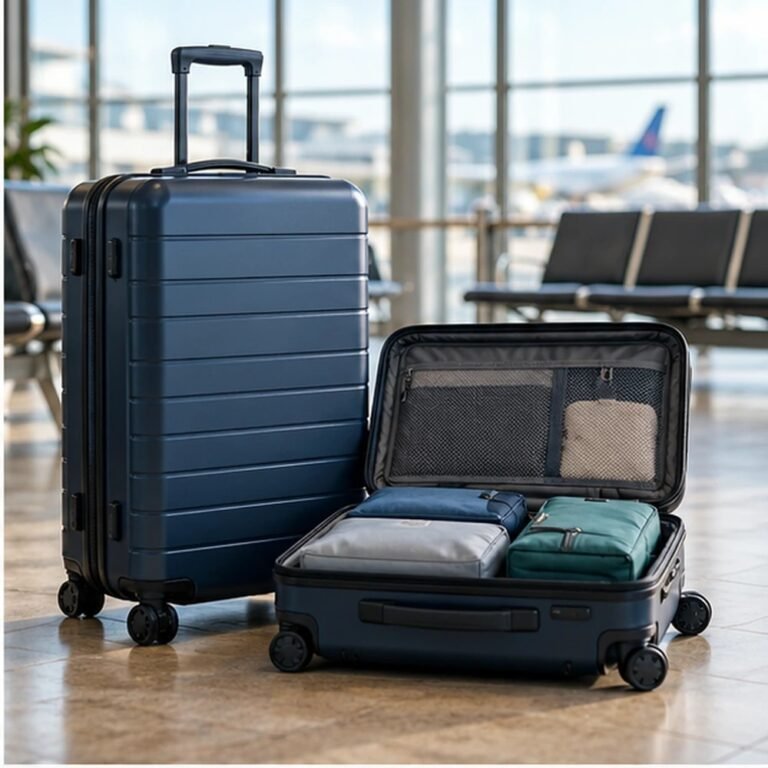
Buying links are optional comparison routes, with search and collection destinations identified in the article. No discount code or current stock promise is implied. Original images depict unbranded equipment and planning ideas, not the products reviewed or evidence of hands-on testing.
Illustrations in this article were created for Taylor’s Trailblazing Travel Gear. Third-party photographs, where used, are credited beside the image or in the source list.