Expandable vs Non-Expandable Suitcases: When Expansion Helps and Hurts
Extra room is useful only when the packed case still fits the journey.
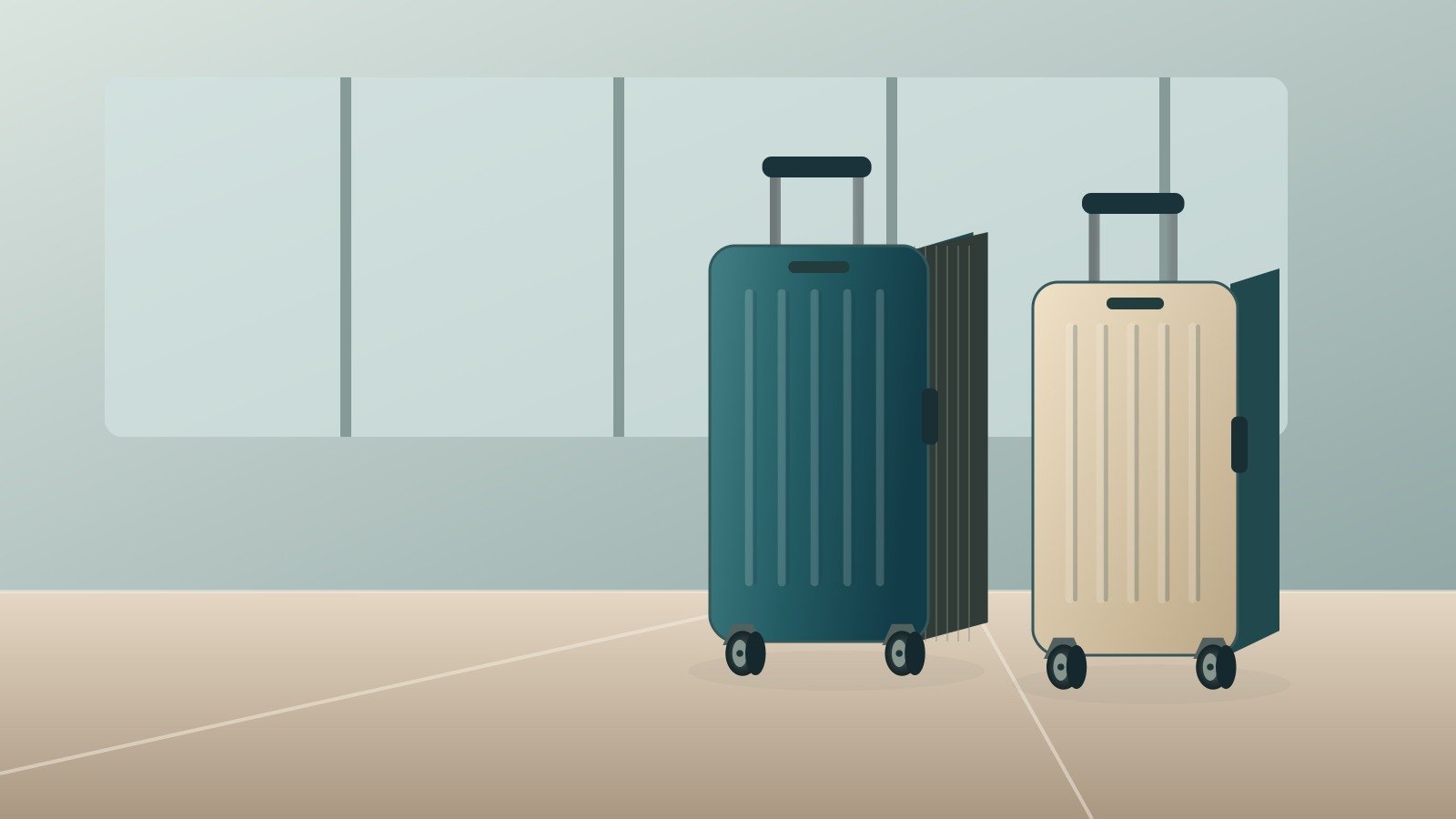
Original design illustration: expansion changes the packed footprint. These generic cases are not product photographs or a durability test.
Expandable vs non-expandable suitcases is really a choice between occasional flexibility and a reliable packing boundary. Extra room can rescue a return journey with a bulky jumper, but it can also turn a carefully chosen cabin case into luggage that no longer fits the allowance you bought.
The useful question is not whether expansion is a good feature in isolation. Ask when you would use it, what would go into the extra space and which part of the journey imposes the tightest restriction. A train, a small hire-car boot and an aircraft overhead allowance can each produce a different answer.
This guide compares construction, published dimensions and practical packing decisions. It is research-led rather than a report of hands-on product testing. The named cases illustrate particular designs; they are not ranked by invented durability scores. Measurements and policies were reviewed on 11 October 2026, and your booking and exact product version should be checked again before travel.
Some buying links may earn this website a commission at no extra cost to you. Recommendations are based on the stated research and practical suitability, not a claim of hands-on testing.
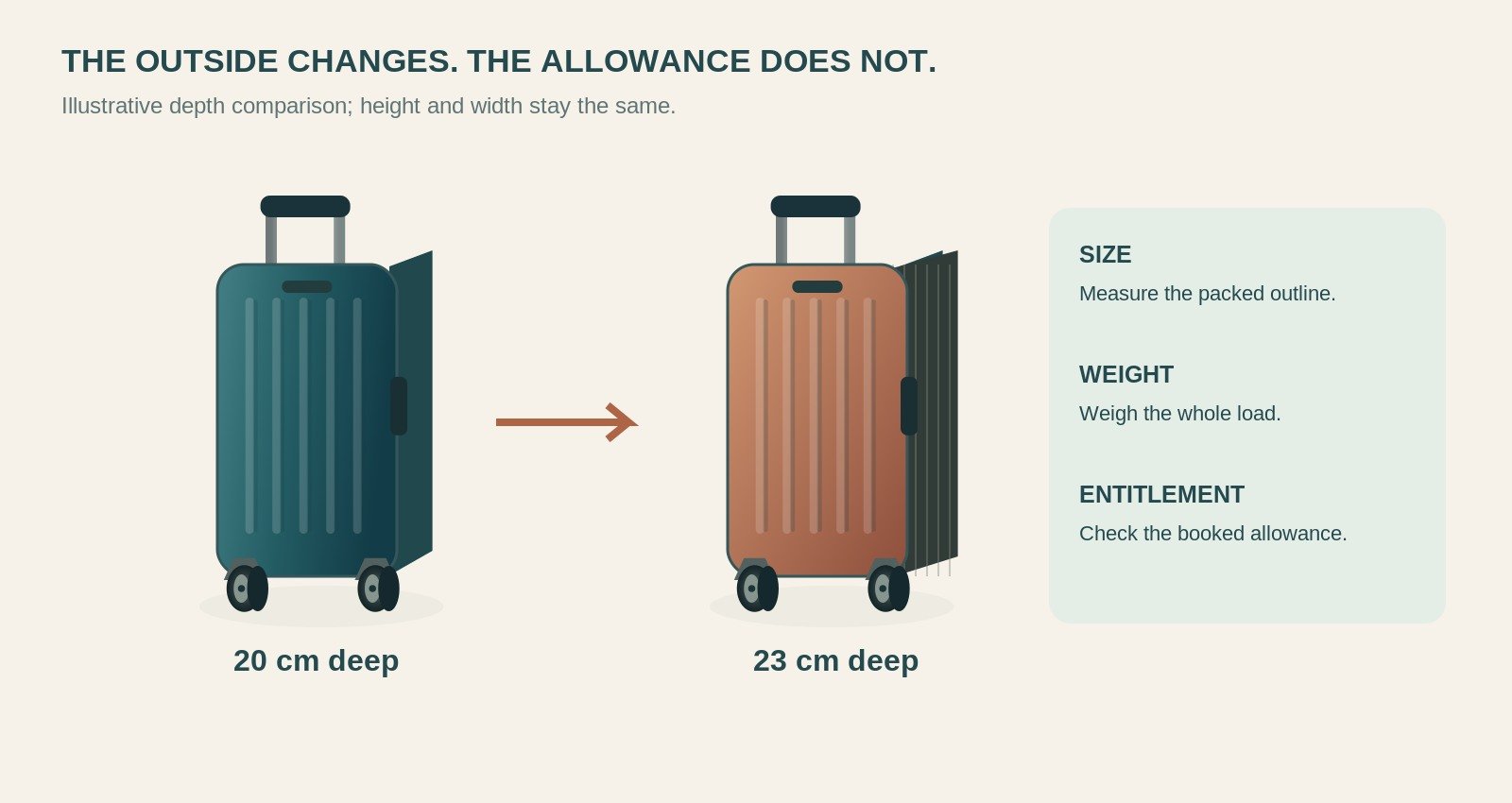
Expandable
Useful for a light jacket or return-trip purchases when the journey permits extra depth.
Fixed size
A defined shape can make it easier to maintain a repeatable packing routine.
Expanded depth
A 55 cm label alone cannot establish whether a packed case fits.
Loaded weight
More litres do not increase the allowance you booked.
Expandable vs non-expandable suitcases: understand what changes
The extra zip is not the main opening
A conventional expandable suitcase has a separate perimeter zip that releases a fabric gusset between sections of the case. Opening it increases the space available while the main closure remains shut. However, the precise mechanism varies, so identify both zip paths before packing rather than assuming every second zip is an expansion control.
A non-expandable case has no deliberate enlargement mechanism. That does not mean every part is completely rigid: a soft-sided model can still bulge, and an overfilled pocket can protrude. Treat the advertised dimensions as a starting point, not a promise that careless packing cannot change the external shape.
Expansion and compression are different jobs
Expansion makes the luggage envelope larger. Compression reduces empty space within clothing or within a purpose-built packing system. These are not interchangeable benefits. Compressing a fleece may help you close a case at its normal depth, whereas opening the expansion zip provides more depth without necessarily compressing anything.
Some premium designs allow packing in an enlarged position followed by compression. Follow the instructions for that exact mechanism. Do not assume that an ordinary expandable case can be forced back to its original dimensions after filling every available corner. If closing requires body weight, remove or rearrange contents instead.
There is no universal expansion percentage
Use the stated normal and expanded measurements for the model you are buying. A centimetre increase is not a standard feature across a collection. Different sizes, front-pocket versions and older editions can have different depths even when their names look almost identical. The current Upscape 55 example in this guide is model 159400, not every suitcase bearing the Upscape name. [1]
The comparison that matters at a glance
The following is a decision framework, not a claim that all cases in either group behave alike. Compare complete products at similar sizes and price levels. A well-designed expandable case can be lighter than a heavier fixed case, and a poorly packed fixed case can be less stable than a sensibly packed expandable one.
Swipe or scroll within the table to see every column.
| Question | Expandable case | Non-expandable case | Your useful check |
|---|---|---|---|
| Occasional extra volume | Offers a deliberate second size | Requires spare space or a different bag | What exactly would occupy the extra room? |
| Cabin dimensions | Must be checked in both modes | Still needs a packed measurement | Include wheels, handles and bulging pockets |
| Packing discipline | Can tempt last-minute additions | Creates a firmer stopping point | Can your normal kit fit comfortably? |
| Weight | Depends on the complete design | Not automatically lighter | Compare actual empty and loaded weight |
| Closure | Adds a mechanism to inspect | Simpler feature set, but not fault-proof | Check alignment and easy closing |
| Storage and transfers | May occupy more room when expanded | More predictable packed footprint | Measure the boot, shelf or cupboard |
Start with the normal mode
Buy a suitcase whose ordinary configuration suits your regular trips. Expansion should answer an occasional need, not compensate for a case that is consistently too small. Otherwise, you will spend most journeys carrying the larger footprint while thinking of the purchase as a compact case.
Before browsing, lay out a realistic packing list. Include shoes, wash kit, chargers and the outerwear you normally remove during travel. A case that fits only the neatly folded clothing in a product photograph may not fit your complete travelling kit. This simple exercise also makes two apparently similar cases easier to compare.
When expansion genuinely helps
Light but bulky return-trip items
Expansion is most persuasive when volume, rather than weight, is your problem. A soft scarf or a light layer can occupy awkward space without adding much mass. Even then, check the total load: several individually light purchases can become a substantial addition once their packaging is included.
Plan the return mode before leaving. For example, you might travel out with the case unexpanded and return with it checked, provided the checked allowance and dimensions permit that. This is a planned change of baggage use, not a loophole allowing a larger cabin bag through a smaller sizer.
A road trip with variable packing
On a car journey, expansion can help separate clothing that is no longer folded as tightly after several stops. However, the boot remains a fixed space. Test the actual loaded footprint against the other bags, pushchair or equipment that must travel alongside it. The car’s capacity is shared by the whole group.
It may be easier to leave the case unexpanded and use a small, already-owned day bag for a jacket. That can also make essentials more accessible during stops. Choose the arrangement that simplifies loading and unloading, rather than automatically using the largest configuration because it is available.
Different packing needs within one household
An expandable checked case can serve trips with different volumes if the user can lift and manoeuvre it comfortably in either mode. This may reduce the need for another size, but only when the normal configuration is not unnecessarily large for shorter journeys. The feature has value when it replaces a genuine need, not merely a hypothetical future purchase.
For a larger expandable reference, compare the Upscape 75 model and current stock. Its extra space is useful only within the limits of the itinerary and your own handling ability. The model’s presence here is not a recommendation to fill a large case to its maximum volume. [2]
When expansion hurts cabin-bag compatibility
A small depth change can be decisive
As reviewed on 11 October 2026, Ryanair’s Priority & 2 Cabin Bags overhead allowance is 55 x 40 x 20 cm and 10 kg. easyJet’s booked large cabin bag has a different maximum of 56 x 45 x 25 cm and 15 kg, including handles and wheels. Those are different entitlements, not interchangeable definitions of cabin size. [3] [4]
Check the tightest leg, not just the first flight
An outbound allowance does not establish the rules for a connecting carrier or the flight home. Make a small itinerary note for each segment, including the bag entitlement actually included or purchased. Then pack to the smallest relevant envelope unless you have planned to check the bag for another leg.
Avoid relying on a retailer’s airline tick list. It may describe the case unexpanded, a different fare option or an earlier policy. The reliable comparison is your packed external dimensions against the current operating airline’s rules. A nominal size match still requires suitable weight and the correct booking allowance.
Do not plan to fix everything at the gate
Closing the expansion zip is useful only when the contents can return to the smaller footprint without force. A compressed-looking gusset does not prove that the shell or front pocket is within the limit. Practise repacking at home while you still have alternatives, not in a queue with documents and clothing spread around you.
The current Upscape 55 listing is included for the dimension comparison, but its displayed Black variant was sold out when checked. Confirm availability and the model number. Do not substitute a different 55 cm version solely because the photographs look similar. [5]
Extra litres do not create extra weight allowance
Keep volume and mass on separate lines
A suitcase can have room left and still be too heavy. Books, shoes and liquids behave differently from fleece or lightweight clothing. Therefore, do not convert spare litres into a permitted number of extra items. Weigh the actual contents and include the suitcase itself, attached accessories and anything you will add later.
For an illustrative calculation, a 10 kg allowance minus a 2.3 kg empty case leaves 7.7 kg for everything packed in or attached to it. That is arithmetic, not a recommended load for every traveller. The same allowance does not become larger when you open an expansion zip.
Do not overinterpret exterior-box calculations
A rectangular box measuring 55 x 40 x 20 cm has a mathematical volume of 44 litres; at 23 cm deep it is 50.6 litres. This calculation illustrates the outer envelope only. Rounded corners, wheels, handles, lining, shell thickness and internal structures mean it is not a measurement of usable packing space.
Likewise, a manufacturer’s quoted capacity may use a different measurement method from another brand. Use litre claims to narrow the choice, then assess whether your own kit fits the opening and internal layout. A theoretical percentage increase is much less useful than knowing whether your second pair of shoes fits without blocking the closure.
A scale is a checking tool, not a guarantee
An existing household scale may be sufficient for a rough check, provided you use it consistently and allow a sensible margin. A portable luggage scale is useful when you will need to reweigh purchases on the return journey. Neither replaces the airline’s measurement, and unexplained differences should prompt another check.
The Go Travel Digital Pro Scale is an optional example rather than essential equipment. The retailer lists a built-in tape measure, but do not confuse its maximum measuring capacity with a weight you should lift. Use help or another safe weighing method when a bag is awkward. [6]
Packing shape, balance and wheel behaviour
The gusset can change where the load sits
Opening an expansion section can let contents move further from the case’s original centre line. Whether that noticeably changes handling depends on the design and packing. Put dense items low and near the more supported parts of the interior, while keeping the load balanced from side to side.
Do not assume that every expanded case will fall over, or that a non-expandable model cannot tip. A heavy bag perched on the handle, uneven shoes or a sloping floor can all affect balance. Compare your intended arrangement instead of drawing a conclusion from an empty showroom case.
Test the full travel arrangement
Consider what happens when the suitcase is paired with a backpack, handbag or trolley-sleeve bag. An expanded shell may change the space available around the handle and the way another bag rests on top. Check that the upper bag does not obscure the grip or interfere with the telescopic handle.
Lift a case by its designated carrying handle rather than using the extended trolley as a lifting point. If a configuration feels unwieldy during ordinary handling, reducing the load is more useful than searching for a reassuring feature claim. Your luggage should make the repeated parts of the journey easier, not simply hold everything at home.
Leave access to essentials
A full expansion section can make the main compartment deeper but less convenient to organise. Keep documents, medication and anything you need in transit appropriately accessible in your accompanying bag. Do not bury an essential item merely because it fits an attractive pocket near the bottom.
For structured packing without deliberate expansion, the Essens 69 fixed-size model is a useful comparison. Its published size is not a recommendation for every trip; compare its opening and weight against a similar expandable checked case before deciding. [7]
Does expansion make a suitcase weaker?
Separate a plausible concern from measured evidence
An expansion mechanism adds components that can be inspected and maintained. That alone does not tell you the probability of failure. There is no controlled test in this guide establishing that expandable cases fail more often than fixed cases, and brand-wide claims should not be inferred from one anecdote.
Instead, look at how the gusset is attached, whether it catches in the zip and whether the main closure moves smoothly with a reasonable load. Check corners as well as straight runs. A neat mechanism that works only when the case is empty is not enough information for a confident purchase.
Avoid using the zip as a compression press
If you must pull the sliders hard while someone sits on the case, reduce the contents. Forced closure can disguise an inappropriate packing volume and makes it harder to distinguish poor fit from a mechanical problem. Keep fabric, straps and loose lining clear of the zip path.
A fixed-size case deserves the same restraint. Forcing a rigid rim or overstuffing a soft-sided model is not a safer alternative. The practical aim is a closure that works with ordinary hand pressure and a load that the design is intended to carry, not proof that you can make the lid meet the base.
Check repair support before it is needed
Ask whether the expansion zip, main zip and wheel assemblies can be serviced separately, and how to identify the exact model. A theoretically replaceable component is less useful when the part is unavailable in the country where you live. Keep the receipt and product identification together.
Samsonite’s repair guidance describes model-specific spare parts and authorised repair routes, with chargeable repairs assessed where appropriate. Its standard warranty distinguishes manufacturing defects from exclusions such as normal wear or transport damage. Neither statement guarantees a free repair for every closure problem. [8] [9]
Five product examples that clarify the choice
These examples were chosen to show different sizes and constructions, not to award a universal winner. The table uses identified manufacturer or retailer references. Offers change, and the buying pages are there to check current model details rather than promise the displayed variant is available.
Swipe or scroll within the table to see every column.
| Identified example | Normal to expanded dimensions | Stated empty weight | Why compare it? | Details |
|---|---|---|---|---|
| Upscape 55, 159400 | 55 x 40 x 20 to 23 cm | 2.3 kg | Compact example where expansion changes a cabin-depth match | View model and stock |
| Essens 55, 146909 | 55 x 40 x 20 cm; fixed | 2.8 kg | Shows that fixed-size does not automatically mean lighter | View fixed-size model |
| Re-Lite 67, 154967 | 67 x 44 x 30 to 33 cm | 2.9 kg | Soft-sided checked alternative | View Re-Lite details |
| Upscape 75, 143110 | 75 x 51 x 30 to 33 cm | 3.4 kg | Larger expandable checked example | View larger Upscape |
| Essens 69, 146911 | 69 x 49 x 30 cm; fixed | 3.8 kg | A different fixed-size checked format, not a like-sized weight test | View medium Essens |
The Re-Lite figures above are the retailer’s stated specifications. The other model figures use the linked manufacturer references. Do not compare the 69 cm and 75 cm cases as if they were controlled tests of one feature: their dimensions, interiors and construction differ. [10] [1] [11] [2] [7]
Availability changes the shortlist
At the check date, the displayed Black Upscape 55 and Radiant Yellow Essens 55 retailer pages showed sold out. Other colours or future stock may differ. A product can remain a useful design example without being the right purchase for a trip next week. [5] [12]
Do not let an attractive alternative colour move you into another model unintentionally. Verify the product number, dimensions in both modes, wheel layout and return conditions on the actual item selected in the basket. A matching collection name is not enough to establish that two listings describe identical luggage.
Internal layout: what the extra space can actually hold
A deeper compartment is not a larger opening
Expansion may increase depth without making the access opening wider. A bulky item can therefore fit the theoretical internal volume but remain awkward to insert or remove. Check the opening itself, particularly where a fixed divider, front compartment or handle channel interrupts the usable area.
Consider a pair of shoes packed in a protective bag. Extra depth might allow them to sit above clothing, but that position could make the case less balanced or block access to another compartment. The useful result is a workable arrangement, not simply finding a way to close the main zip around everything once.
Dividers and straps must work in the chosen mode
Look at how the interior retains contents when the expansion section is open. A divider that fitted neatly in normal mode may not hold a deeper pile of clothing in the same way. Adjustable straps can help only if they reach the load and keep it from shifting without excessive tension.
Try opening the case in the position you normally use at accommodation. Will clothing spill from the upper half, or can you retrieve one item without disturbing the rest? These questions help establish whether expansion provides usable space throughout the trip rather than a temporary solution during the initial packing session.
Leave the closure path clear
Small items can migrate towards the gusset or zip as the case changes position. Keep loose straps and thin fabric away from the closing path, and use existing pouches for items that otherwise disappear into corners. This is about controlling the contents, not adding more packing accessories automatically.
Check the case after standing it upright, not only while it lies flat. The load can settle differently, leaving an apparently easy closure under pressure elsewhere. If you repeatedly need to reopen and rearrange the same section, the packing layout needs adjustment before another journey makes the problem more inconvenient.
Expansion versus other ways to solve a space shortage
Remove the item that causes the problem
Identify what actually prevents normal closure. One rigid shoe box or an unnecessary second pair of shoes can occupy more awkward space than several light garments. Removing avoidable retail packaging may help, provided you retain anything needed for protection, instructions or a return. Do not discard packaging merely to force a fragile object into the case.
This diagnosis can prevent buying the wrong luggage. If the same essential rigid item must travel regularly, a differently shaped case may be more suitable than an expansion section. The important feature could be a wider opening or an unobstructed compartment rather than more litres in the existing shape.
A second bag brings its own conditions
A packable bag can be useful on some journeys, but it is not automatically a free extra cabin item. Check the permitted number of pieces, their dimensions and any combined weight conditions. Moving contents into another bag does not remove a baggage rule; it changes the arrangement you must check.
Also consider control during transfers. Carrying a loosely packed extra bag may be more awkward than using permitted expansion in the main case. Conversely, a small accessible bag for a jacket may simplify a car journey. Compare the complete arrangement, including hands available and storage, instead of treating any one workaround as universally better.
A different case can be better than more case
A front-opening or soft-sided layout may use space differently from a divided clamshell. That can make your particular kit easier to pack without increasing the outer dimensions. However, pockets and compartments also occupy space, so assess them against real items rather than counting them as automatic benefits.
Use the bag you already own as the baseline. Make one practical change at a time and see whether the need for expansion remains. This keeps the purchase decision grounded in the actual problem, rather than assuming that another feature is necessary because packing felt frustrating on one previous trip.
A return-day sequence that prevents last-minute surprises
Confirm the mode before the final shopping stop
Decide whether the main bag will travel unexpanded in the cabin, expanded within a suitable allowance, or checked under a separate entitlement. Make that decision before buying anything that relies on extra space. A purchase should fit the plan rather than force an unplanned change to it.
Keep a note of the tightest dimension and the remaining weight margin. These figures are separate constraints, so do not let spare volume disguise a nearly full weight budget. If the rules for a later leg differ, plan around that leg as well as the journey to the airport.
Repack before leaving accommodation
Arrange purchases where they are protected and where their weight does not upset the balance. Check the main closure, interior divider and expansion zip separately. Then stand the case upright, move it gently and inspect the packed outline again. The arrangement should remain workable after the contents settle.
Allow enough time to remove packaging appropriately, move non-essential items or change the baggage plan through the proper channel. Do not postpone the decision because the case can technically be zipped shut. A bag that closes is not necessarily a bag that meets the booking or can be lifted comfortably.
Keep one final measurement separate from the memory
Record the bag as packed for this particular departure. Your note from an earlier trip may describe a lighter load or the other expansion mode. A quick measurement and weight check now are more useful than confidence based on how the same suitcase travelled last year.
Finally, leave the case in the configuration you have checked. Adding a jacket, an airport purchase or another person’s belongings afterwards changes the result. The benefit of a deliberate return-day routine is that it removes guesswork without requiring an elaborate packing system or unnecessary new equipment.
A sensible home comparison before committing
Preserve your return options
Keep the packaging clean and store small accessories together. Ask the seller before a longer or realistically loaded trial, especially where its policy stresses unused condition. Do not personalise the case until you are satisfied it is the right purchase. Personalisation can affect ordinary cancellation rights.
Compare the same contents in both modes
Use the same clean items, folded in the same way, and note what changes. Can the main zip move freely? Does the interior divider still close? Are the items that required expansion actually necessary? This produces a practical comparison without pretending to measure long-term durability.
Avoid choosing a test that creates wear. Do not drag the case over pavement, bump it down steps or load it to an arbitrary maximum. A shopping decision needs enough information to judge suitability, not a home obstacle course that makes a return more complicated.
Measure after the final adjustment
Once the contents are arranged, check the widest external points in each direction. Measure front-pocket bulges and fixed handles rather than drawing an imaginary straight line around only the shell. A soft tape pulled tightly around curved material can conceal the depth that a rigid sizer would encounter.
Record normal mode and expanded mode separately. This simple note helps avoid confusing the two when preparing for a later trip. Keep it with your packing list, not as a permanent assurance of airline compatibility: the relevant rules and the amount you pack can both change.
Three travel situations with different answers
A cabin-only weekend with a strict depth limit
Suppose your booked bag must stay within a 20 cm depth allowance and your ordinary kit already fits. Expansion is a reserve feature you cannot use for that flight, not a reason to carry more. Choose between cases on empty weight, access, comfort and reliable closing at the permitted size.
A non-expandable case may suit a traveller who wants a firm boundary. An expandable one can still be perfectly sensible when it is the better complete product and remains shut in normal mode. The feature is optional; owning it does not require using it on every journey.
A holiday with checked luggage on the return
Here, expansion can make sense for purchases that are genuinely planned and permitted. Nevertheless, leave room for protective packing and keep the total weight under the allowance. A case that closes around a fragile souvenir does not necessarily protect it adequately from handling.
Before buying the item, consider whether the enlarged case still fits the transfer vehicle and hotel storage. You may need to carry it up steps or lift it into a boot after the flight. The baggage allowance is only one of the practical constraints that remain after expansion is allowed.
Several short stays with frequent repacking
For repeated hotel changes, access may be more valuable than maximum capacity. A case that opens conveniently on a luggage rack and keeps an overnight kit accessible can save more effort than extra litres. Expansion is useful only if it does not turn each departure into a struggle to regain the original shape.
One approach is to leave a modest amount of space from the start and use small organisers you already own. Then keep tomorrow’s clothing together instead of repeatedly disturbing the entire load. This is a packing decision rather than a reason to buy another accessory or a larger case.
Pros, cons and the mistakes worth avoiding
Expansion can earn its place
It offers a second packing size within one case. It can accommodate occasional bulky additions and may suit travellers whose outbound and return arrangements differ. The benefit is strongest when the normal configuration already works well and the extra space has a defined purpose.
A fixed boundary can be more useful
Extra depth may invalidate a cabin-size match, complicate shared storage or encourage unnecessary packing. A fixed-size case can make repeated trips more predictable, although it still needs sensible loading and a packed measurement. Neither choice removes the need to assess the complete design.
The most expensive mistake is solving the wrong problem
Do not buy expansion when the real issue is a poor packing list, inaccessible organisation or an uncomfortable handle. Extra room cannot fix a case that is awkward to carry. Likewise, replacing a serviceable fixed case merely because another model expands may deliver little practical improvement.
Avoid treating a manufacturer’s suggested packing weight as an airline allowance. It is not your ticket entitlement. Check the actual booking, and remember that adding weight to fill newly available volume may make the case harder to manage even when a carrier would accept it.
Small habits prevent predictable confusion
Identify the expansion slider before a trip, store its normal and expanded dimensions in your notes and reweigh after purchases. Do not use a luggage strap to force an overfilled case into apparent compliance. A strap can change the outline or add loose ends without solving the underlying size problem.
Finally, do not base a decision on a single word such as lightweight, cabin or durable. Replace those labels with the questions that matter to you: how much does it weigh, which allowance does it fit and what repair route exists? Those answers make expansion much easier to evaluate.
Frequently asked questions
Is an expandable suitcase allowed as cabin luggage?
It can be, provided its actual packed dimensions and weight fit the relevant allowance and you have that bag entitlement. Expansion is not automatically prohibited, but using it can make a previously suitable case too deep. Check both modes and the rules for every operating carrier rather than relying on a cabin-size product label. [3] [4]
Should I choose non-expandable luggage for durability?
Not on that feature alone. A fixed design has fewer expansion-specific components, but that does not establish a lower overall failure rate. Wheel construction, handles, shell or fabric, closure quality and service support also matter. This guide has not performed comparative durability testing, so the recommendation is to inspect the complete case rather than infer reliability from its expansion label.
Can packing cubes replace expansion?
They can improve organisation and sometimes help use space more consistently, but ordinary cubes do not create additional external volume. Compression designs can reduce some clothing bulk, not the weight of the contents. First try organisers you already own and remove unnecessary items. Whether that avoids expansion depends on the shape and material of what you pack.
Does opening the expansion zip make a case waterproof or less waterproof?
Neither conclusion follows automatically. Weather resistance depends on fabric, seams, zip paths and the complete design. Unless a manufacturer provides a suitable whole-product claim, do not treat a suitcase as protection against immersion or prolonged exposure. Keep vulnerable contents appropriately protected and avoid making a water-resistance comparison that the available specifications do not support.
Should I leave expansion open for storage at home?
Follow the manufacturer’s instructions and store the case clean and dry. The practical objective is to avoid trapping fabric, stressing the closure or compressing the bag awkwardly inside another case. Do not force nested luggage to fit. Opening an expansion section is not a substitute for checking that the storage arrangement protects the wheels, handles and lining.
Is a larger non-expandable case better than a smaller expandable one?
Only when the larger footprint fits your usual journeys. Compare their normal usable layouts, not just the maximum litre claims. A bigger fixed case may be unnecessary on short trips, while a smaller expandable case may be too restrictive in normal mode. Choose around the kit and handling you repeat most often, then treat occasional extra space as a secondary benefit.
The recommendation: buy for your normal trip first
Choose an expandable suitcase when you can describe the extra-space problem it solves and can accommodate the enlarged bag throughout the journey. A non-expandable case makes more sense when maintaining a known packing limit gives you more value than a second size. Neither is automatically the lighter, tougher or more economical purchase.
Before paying, complete four checks: your regular kit fits without force; the packed dimensions suit the booking; the loaded bag is manageable; and the seller’s return and aftercare arrangements are clear. If those checks favour one complete case, an unused feature on the other should not overrule them.
Sources and fact-checking notes
- Samsonite Upscape 55, model 159400Current manufacturer reference: 55 x 40 x 20/23 cm, 39/45 L and 2.3 kg. Do not confuse with older 143108 or other 55 cm variants.
- Samsonite Upscape collectionDisplayed catalogue examples checked 11 October 2026: set GBP424, 55 cm GBP195 and 75 cm GBP229, before any checkout offer. Not a confirmed basket quotation.
- Ryanair baggage policyChecked 11 October 2026: Priority & 2 Cabin Bags includes a 55 x 40 x 20 cm, 10 kg overhead bag; the free personal bag is a separate allowance.
- easyJet cabin bagsChecked 11 October 2026: booked large cabin bag up to 56 x 45 x 25 cm, including handles and wheels, up to 15 kg; entitlement and self-lifting conditions apply.
- Case Luggage: Upscape 55 (159400)Black 159400 page showed sold out when checked. Used as a model comparison, not an in-stock promise.
- Case Luggage: Go Travel Digital Pro Scale (2004.101)Retailer lists a 50 kg measuring capacity and 1 m tape measure. Neither is a recommended lifting load or a calibration certificate.
- Samsonite Essens 69, model 146911Manufacturer reference for the 69 x 49 x 30 cm, 88 L, 3.8 kg case. Not an airline allowance.
- Samsonite repair FAQModel-specific spare parts, authorised repair routes, proof of purchase and chargeable repair estimates. Not permission to dismantle a new purchase during a return inspection.
- Samsonite warranty FAQManufacturer warranty scope, exclusions, proof-of-purchase requirements and service arrangements; not a substitute for rights against a seller.
- Case Luggage: Re-Lite 67 (154967)Retailer specifies 67 x 44 x 30/33 cm, 79/88 L and 2.9 kg. Selected stock and delivery remain subject to confirmation.
- Samsonite Essens 55, model 146909Fixed-size three-point-closure model, including manufacturer wheel-repair information; the collection also contains a different expandable zip model.
- Case Luggage: Essens 55 (146909)Radiant Yellow page showed sold out. Check other colours and confirm that the fixed-size 146909 is selected.
- GOV.UK: accepting returns and giving refundsUK consumer guidance distinguishing distance-selling cancellation, shop purchases, sale goods and faulty goods. The article provides general information, not individual legal advice.
- Consumer Contracts Regulations 2013, regulation 34Reimbursement and diminished value where handling goes beyond what is necessary to establish the nature, characteristics and functioning of goods.
- Case Luggage: Upscape 75 (143110)Black page displayed Add to bag when checked. Current price, colour and dispatch must be confirmed before ordering.
- Case Luggage: Essens 69 (146911)Retailer listing for the fixed-size medium case; check selected colour and current offer.
Illustrations in this article were created for Taylor’s Trailblazing Travel Gear. Third-party photographs, where used, are credited beside the image or in the source list.