
Packing Cubes vs Compression Cubes: What Actually Changes?
Both systems organise clothing, but only one deliberately changes the thickness and density of the packed bundle.
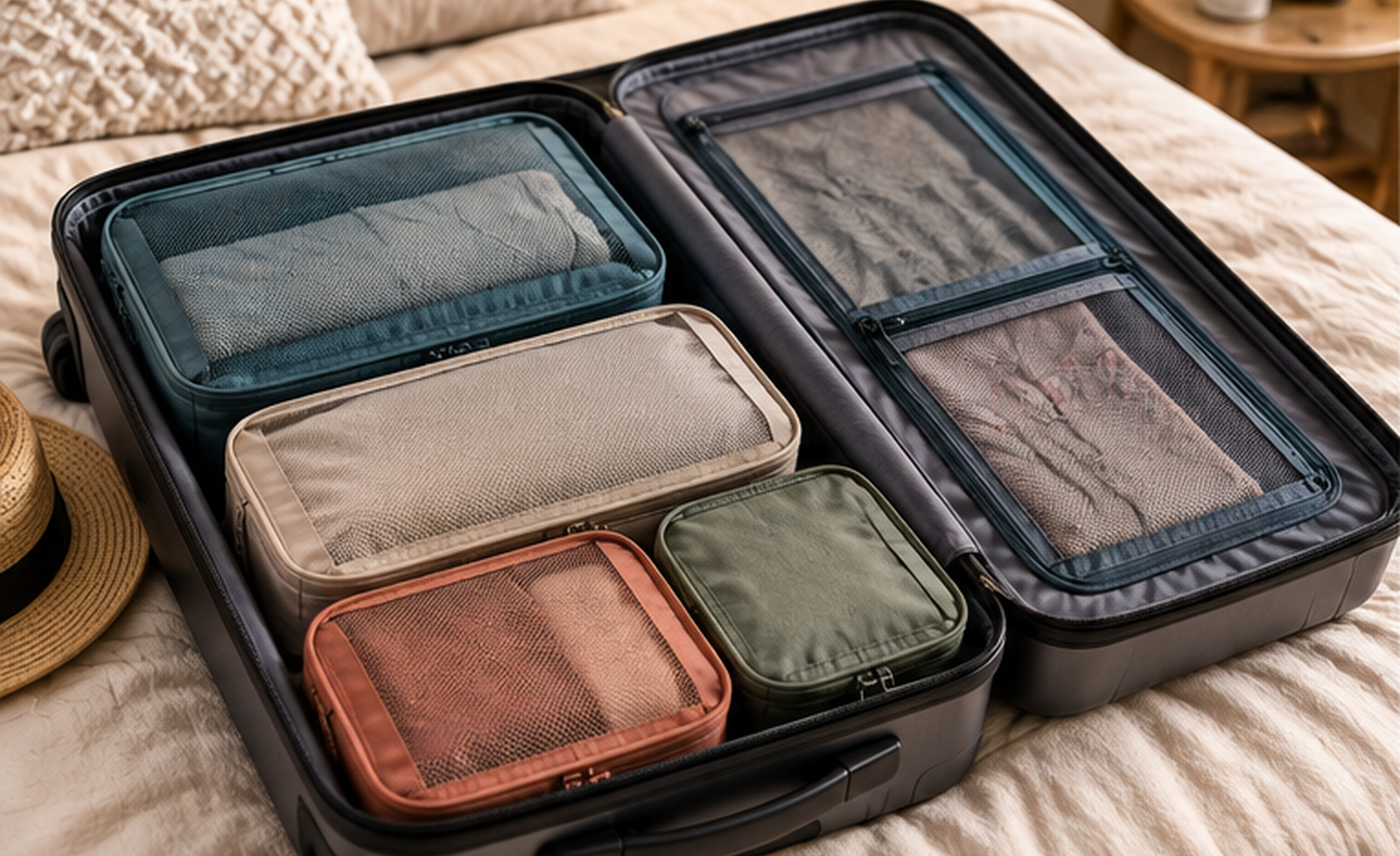
Packing cubes and compression cubes can look almost identical in product photographs, yet they solve slightly different problems. A standard cube turns loose clothing into a tidy, removable module. A compression cube adds a second zip or comparable mechanism that squeezes the module thinner after it has been packed.
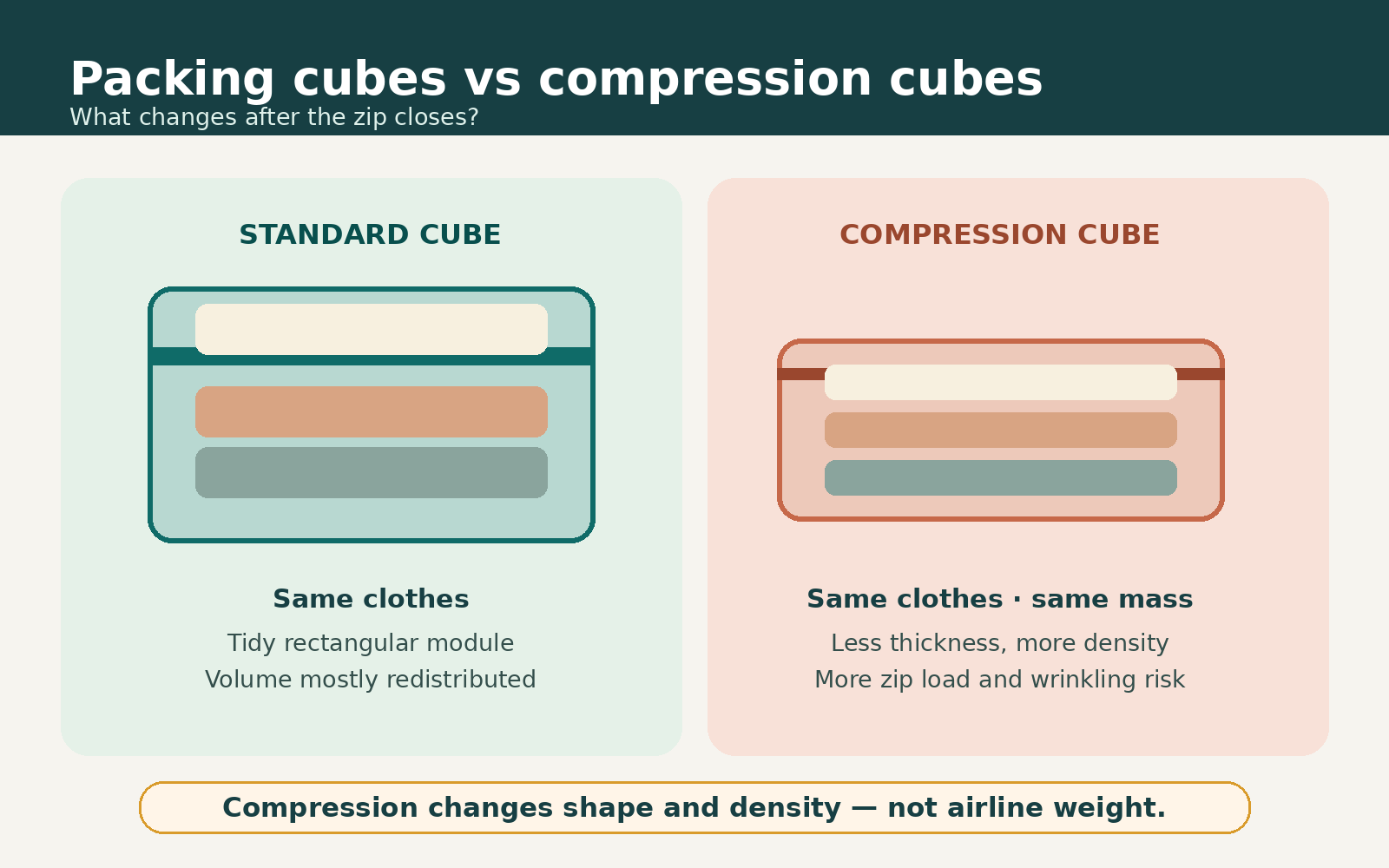
The useful distinction is organisation versus shape control. Standard cubes make categories easier to find, keep a suitcase orderly and stop small garments migrating into gaps. Compression cubes can also do those jobs, but their extra zip pushes air and spare fabric out of the packed bundle. That may reduce thickness; it does not reduce the weight of the clothes, and it can make the bundle denser, firmer and more prone to creasing.
This guide compares packing cubes vs compression cubes by real use case, not marketing language. Manufacturer specifications and example prices were checked on 20 September 2026. Soft-goods dimensions, prices, colours and stock can change, so treat the examples as dated buying references rather than guaranteed performance.
Standard cube
Light, simple and easy to open repeatedly without recompressing the entire bundle.
Compression cube
A second zip removes spare depth from soft clothing and creates a denser slab.
Ultralight standard set
Fewer zips and less structure normally mean a lower empty weight.
Mixed system
Compress soft basics, leave frequent-use and crease-sensitive items easier to access.
Both products divide a bag into manageable modules. The compression model adds a deliberate second stage: pack the main compartment, close it, then run a perimeter zip that narrows the depth.
| Feature | Standard packing cube | Compression cube | What it means in practice | Better choice when |
|---|---|---|---|---|
| Main purpose | Organisation and separation | Organisation plus reduced thickness | Compression creates a firmer, denser parcel | Your limiting factor is bag depth |
| Empty weight | Usually lower | Usually higher because of the second zip and extra fabric | The difference is small per cube but grows across a set | Your airline weighs cabin bags strictly |
| Access | Open, remove an item and close | Opening may require recompressing later | Frequent-use items are less convenient in a tightly compressed cube | You unpack once at the destination |
| Wrinkle risk | Depends mainly on folding and fill level | Higher when clothes are heavily squeezed | Pressure can set folds and bunch fabric at the edges | You pack casual, resilient clothing |
| Overpacking risk | Visible sooner | Easy to create extra room and then refill it | Bag volume falls but total mass stays the same | You weigh the final bag before travel |
They create predictable modules
Loose clothing uses space irregularly. Sleeves slide into corners, socks disappear beneath larger pieces and a bag becomes harder to repack after the first overnight stop. A standard cube replaces that loose pile with a defined rectangle. The total clothing volume may not fall dramatically, but the suitcase becomes easier to plan because each module has a known footprint.
That predictability is especially useful on multi-stop trips. One cube can hold sleepwear and underwear, another can hold tops, and a third can remain closed until later in the journey. Removing one category no longer disturbs everything above it.
They can improve access without locking you into compression
A standard cube can be packed loosely, filled firmly or partially collapsed. It remains easy to open during a train journey or hotel change because there is no second compression zip to release and reset. Breathable mesh panels, such as those used on Osprey’s Daylite cubes, also help identify contents and provide ventilation. [1][2]
They do not automatically save space
A badly filled cube can waste space by trapping rounded piles inside a rectangular shell. The benefit comes from matching the cube to the bag and packing it evenly. If the cube is half full, flatten it or choose a smaller size. If it bulges hard against the zip, move one garment elsewhere rather than treating the zip as a winch.
The second zip removes spare depth
Most travel compression cubes use two zip systems. The first closes the clothing compartment. The second runs around the side wall and draws the top and bottom panels closer together. As the zip advances, soft garments flatten, air escapes and excess fabric is pushed inward.
Official product pages describe the same mechanism in different language. Thule says its compression zip removes excess air between clothes, while Peak Design describes an expansion and compression zip that reduces the packed profile. Eagle Creek publishes separate standard and compressed dimensions for its Pack-It Isolate compression models. [3][4][5]
The result is usually thinner, not magically smaller in every direction
Compression often reduces depth while making the centre or edges firmer. A cube that began as a soft box may become a dense slab. That can be excellent when a carry-on has a shallow lid or when a backpack needs one stable clothing block. It is less helpful when the suitcase already has unused height but lacks flexible corners.
Soft-goods measurements are not rigid-box guarantees
Published dimensions help compare products, but fabric cubes deform. A manufacturer may measure an empty or evenly filled shape, while your jumpers, zips and seams create a different profile. Treat large claimed reductions as best-case geometry. Your own clothing mix determines the final thickness.
Compression changes volume, not mass
If a set of clothes weighs 3.2 kg before compression, it still weighs 3.2 kg afterwards. The cube itself adds its own weight. That sounds obvious, yet the newly empty corner of a suitcase invites more items. The final bag can become heavier even though it looks more efficient.
This matters most on routes with low cabin-bag limits. A compressed cube can help a bag close within its permitted dimensions, but it cannot solve a weight breach. Weigh the packed bag after every “space-saving” decision rather than assuming a neater case is a lighter case.
The best saving is often unused air around soft clothing
Puffer jackets, fleece, knitwear and loosely folded T-shirts contain air and spring back. Compression can reduce that spare depth efficiently. Dense jeans, shoes, chargers and toiletry bottles contain little compressible air, so forcing them into a compression cube offers limited benefit and places hard points against the fabric.
A smaller cube can be better than a more compressed cube
Two moderately filled small cubes often fit around shoes or a wash bag more effectively than one very dense medium cube. They also distribute weight and let you open one category without releasing the other. Compression is one layout tool, not a requirement to make every parcel as thin as possible.
The best match depends on resilience, bulk and how often the item must be reached. Use this table as a starting point, then adjust it to the fabrics you actually own.
| Item | Usually better in | Why | Packing note |
|---|---|---|---|
| T-shirts and casual tops | Compression cube | Soft, compressible and usually tolerant of moderate pressure | Roll or fold evenly; avoid a mound in the centre |
| Underwear and socks | Either | Small pieces fill gaps and rarely need crease protection | Use a small cube so the category remains easy to find |
| Fleece and light knitwear | Compression cube | Contains recoverable loft | Do not store compressed long term after the trip |
| Shirts and smart trousers | Standard cube | Less pressure makes deliberate folds easier to preserve | Use a folder or flat layer for high-crease fabrics |
| Denim | Standard cube or loose | Dense fabric offers less compression benefit | Place flat near the hinge or wheel end |
| Down jacket | Light compression for transit | Loft can reduce substantially | Release and air it at the destination; follow the care label |
| Swimwear and gym kit | Compression cube | Small, flexible and easy to isolate | Pack only when fully dry |
| Shoes, liquids and electronics | Neither | Hard or leak-prone items do not compress safely | Use purpose-built pouches and protect pressure points |
Compression amplifies whatever fold you start with
A compression cube does not create a wrinkle-free fold. It presses the existing arrangement more firmly. A smooth, even stack may emerge acceptably; a twisted sleeve or bunched waistband is likely to leave a more obvious mark.
Rolling works well for many casual garments because it avoids multiple sharp folds and makes the cube easy to fill evenly. However, rolled clothing can still crease, especially when rolls are wedged at different heights. For smart shirts, linen or tailored pieces, controlled folding with light pressure is usually safer than maximum compression.
Leave a deliberate pressure margin
Close the main compartment without sitting on it. Then use the compression zip until the cube is firm but not drum-tight. If you can see seams whitening, the zip track bowing or fabric being pinched, remove an item. The few millimetres gained are not worth a failed zip during the trip.
Unpack promptly at the destination
Compression is a transit state. Hang or refold clothes after arrival, particularly knitwear and insulated garments. The longer a hard crease remains under pressure, the harder it can be to relax without steaming or washing.
Hard-shell split cases
A rigid clamshell has two defined halves. Compression cubes can reduce the height of soft clothing so the divider closes without pushing against the shell. Nevertheless, a dense cube can create a single high point that makes the central zip difficult to close. Spread modules across both halves and leave space for handles, wheel housings and the curved shell edges.
Soft-sided suitcases
Soft luggage already has some give, so standard cubes often provide enough control. Compression is useful when the outer panel would otherwise bulge beyond an airline dimension limit. Measure the fully packed case, including any expansion zip, rather than trusting the empty dimensions.
Travel backpacks
A compressed cube can act like a stiff plate. Place it close to the back panel and near the vertical centre of the load, not at the outermost face where it can pull the bag away from the body. Keep hard corners away from the lumbar area and avoid one oversized cube that prevents the pack from flexing naturally.
Compression adds a loaded moving part
A standard cube’s main zip holds the lid closed. A compression cube asks a second zip to pull two fabric panels together while the contents resist. That mechanism can last well when the load is even, but it introduces more stitching, more slider travel and more opportunities to catch fabric.
Look for construction, not only denier numbers
Fabric weight matters, yet the high-stress areas are often the zip ends, corners and seams where the compression panel changes direction. Check whether the zip track is supported by binding, whether loose lining can enter the teeth and whether the handle is sewn into a reinforced panel. A reputable warranty is useful only if the brand can supply a replacement or process a claim in your region.
Use the zip in stages
Place the cube on a flat surface. Press down with an open hand, advance the slider a short distance, then rotate the cube and repeat. Keep fingers between loose fabric and the teeth. If the slider needs a hard two-handed pull, the cube is overfilled or the contents are uneven.
These examples are not a ranked list. They were selected to show how standard and compression designs differ in published capacity, weight, materials and price. Prices were checked on 20 September 2026 and may change.
| Example | Type | Published size or capacity | Weight and dated price | Useful interpretation |
|---|---|---|---|---|
| Osprey Daylite Medium | Standard | 4 L; 23 × 18 × 11 cm | 50 g; £14 | Light organiser with breathable mesh and a simple J-zip |
| Osprey Daylite Large | Standard | 9 L; 30 × 24 × 13 cm | 70 g; £15 | Large capacity for little added empty weight |
| Thule Small Compression | Compression | 26 × 18 × 11 cm expanded; 25 × 18 × 3 cm compressed | 80 g; £17.99 | Designed for smaller soft garments; dimensions show reduced depth |
| Thule Medium Compression | Compression | 36 × 25 × 15 cm expanded; 34 × 23 × 3 cm compressed | 130 g; £22.99 | More structure and hardware, with a higher empty weight |
| Peak Design Packing Cube | Compression hybrid | Expansion/compression zip; clean/dirty divider | From £34.99 on checked page | Feature-rich design; useful when access and separation justify the premium |
Sources: official Osprey, Thule and Peak Design product pages. Soft products deform, so published dimensions do not predict the exact volume of your clothing. [1][2][3][4]

This method is a comparison framework, not a claim that the editorial team physically tested the products. It lets you judge any two cube systems with your own clothes before the return window closes.
Step 1: fix the clothing list
Choose one realistic set: for example, five T-shirts, one light jumper, seven pairs of underwear and seven pairs of socks. Photograph the list so each cube receives the same contents.
Step 2: record the empty cost
Weigh each empty cube and note its maximum flat dimensions. The difference reveals how much of your allowance is consumed before clothes are added.
Step 3: pack the same way
Use the same folding or rolling method. Close the standard cube without forcing it. For the compression cube, close the main compartment, smooth the contents and run the compression zip in stages.
Step 4: measure the packed result
Measure maximum thickness at the centre and edges. Then place each cube in the intended suitcase or backpack with the rest of your real kit. A thinner cube is not automatically better if it leaves unusable gaps or creates a hard bulge.
Step 5: score access and clothing condition
Open the cube, remove one garment, close it again and repeat. Unpack after several hours and compare creases. The better system is the one that improves the complete trip, not merely the first photograph.
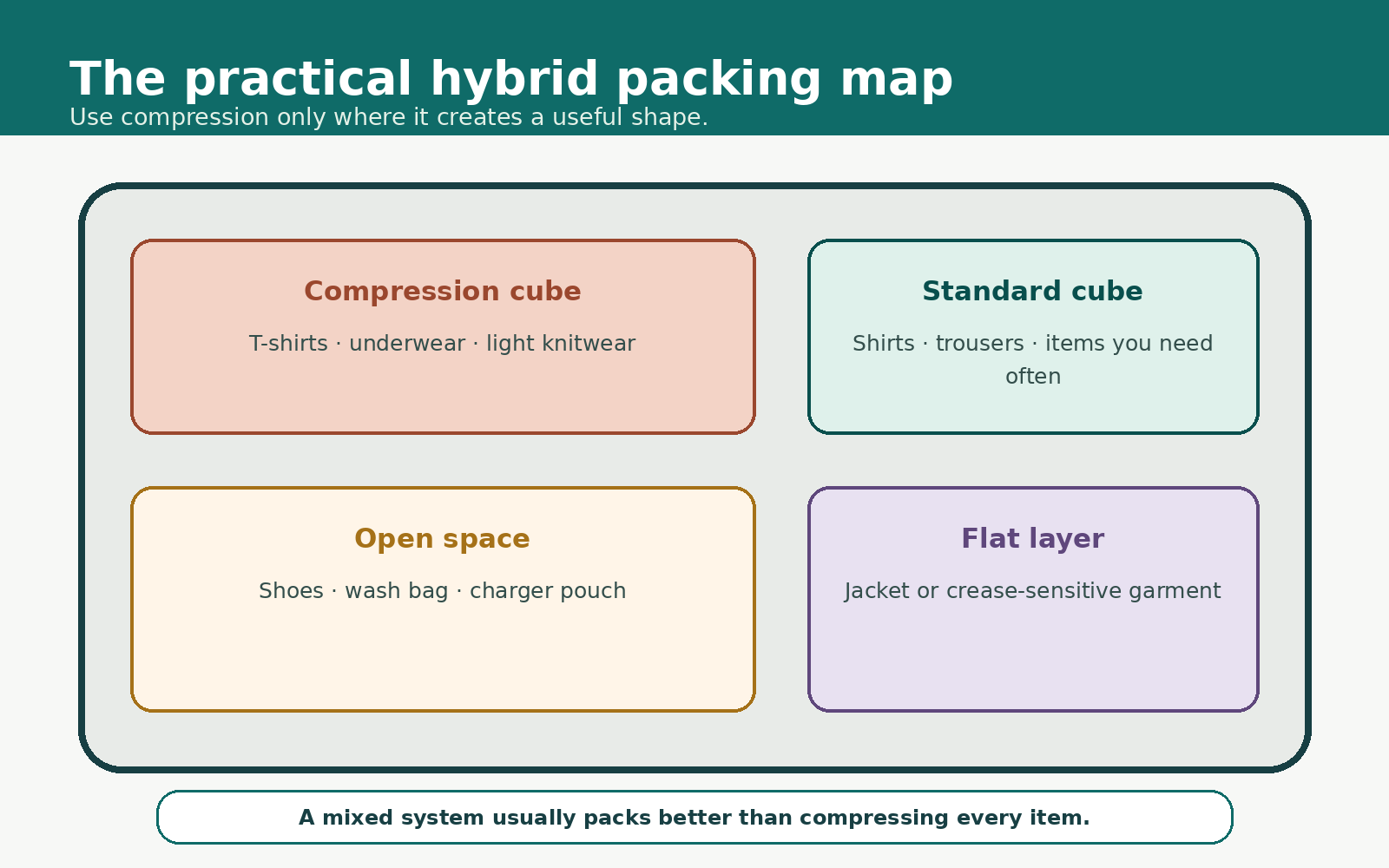
Module 1: one medium compression cube
Use it for T-shirts, underwear, socks, swimwear and one light layer. Stop compressing when the bundle is firm and flat rather than rigid.
Module 2: one standard cube
Use it for sleepwear, the first change of clothes and any item you may need before reaching the accommodation. This cube remains easy to open in transit.
Module 3: a flat or loose clothing layer
Place smart clothing, a jacket or trousers across the broadest area of the bag. This fills the lid or hinge zone without forcing every fabric into a small cube.
Leave irregular space for irregular items
Shoes, a toiletries pouch and chargers rarely fit efficiently inside a rectangular clothing cube. Position them first or reserve shaped gaps around the modules. A perfectly tiled suitcase is not useful if it puts liquids against a laptop or makes the shoes impossible to remove.
Measure the bag before choosing a set
Measure the usable internal width and height around wheel housings, handles and dividers. Compare individual cube dimensions rather than assuming a six-piece set will tile neatly into every suitcase.
Check empty weight and zip layout
A lightweight standard cube can be ideal for a strict allowance. For compression, look for a smooth perimeter zip, protected fabric beside the teeth and enough handle clearance to lift the packed module.
Choose sizes by category, not by bundle count
One small and one medium cube are often more useful than several near-duplicate sizes. Avoid buying shoe bags, laundry bags and tiny pouches simply because they increase the piece count.
Prefer visible or clearly labelled contents
Mesh, translucent fabric or colour coding reduces unnecessary opening. If privacy matters, choose opaque sides with a label area rather than relying on memory.
Browse standard and compression cube options
Check the individual dimensions, empty weight, zip arrangement and return terms before ordering. A smaller, well-matched set is usually more useful than a large bundle of arbitrary sizes.
Standard packing cubes — advantages
- Simple organisation and quick access.
- Usually lighter and less expensive.
- Lower risk of overstraining a second zip.
- Better for frequent unpacking and multi-stop travel.
- Easy to use for crease-sensitive clothing with light fill.
Standard packing cubes — disadvantages
- Do not deliberately reduce the packed depth.
- Half-filled cubes can waste space.
- Bulky soft items may spring back.
- A poorly chosen set may not match the bag footprint.
Compression cubes — advantages
- Can reduce the thickness of soft clothing.
- Create a firm, predictable slab for shallow spaces.
- Useful for knitwear, T-shirts and light insulated layers.
- Can help a soft case stay within its external shape.
Compression cubes — disadvantages
- Do not reduce weight and can encourage overpacking.
- Usually heavier, costlier and slower to access.
- More pressure can increase wrinkles.
- Extra zip and seams add possible failure points.
- Dense blocks may feel awkward in a backpack.
Buying a large set before measuring the suitcase
Piece count is not compatibility. Compare each cube with the usable internal footprint and wheel-housing shape.
Compressing dense items
Jeans, shoes, toiletries and electronics offer little useful compression and can create hard pressure points.
Using the zip as a lever
Press the contents flat and move the slider gradually. If the zip needs force, remove an item.
Filling the newly created space automatically
Compression makes room, not weight allowance. Reweigh the complete bag before adding anything.
Putting every garment in the same dense cube
One large block harms access and may not fit around irregular items. Split categories by use and fabric.
Leaving compressed clothing packed between trips
Empty, air and dry the cubes. Store insulated and knitted garments according to their care guidance.
Ignoring return terms until after travel
Run the home comparison while the item can still be returned in saleable condition.
Do compression cubes really save space?
They can reduce the thickness of soft, air-filled clothing. The benefit varies by fabric, fill level and bag shape, and the bundle may become wider or firmer at the edges.
Do compression cubes reduce luggage weight?
No. The clothes retain the same mass, and the cube adds its own weight. Compression can actually lead to a heavier final bag if the new space is refilled.
Are compression cubes the same as vacuum bags?
No. Travel compression cubes use mechanical pressure from a zip or straps. Vacuum bags remove far more air and usually create a harder parcel, but they are less convenient to reopen during a trip.
Which type is better for a carry-on?
Use compression when depth is the limiting factor and the airline size is strict. Use standard cubes when weight, access and simplicity matter more. A mixed system suits many trips.
Do compression cubes make clothes wrinkle?
They can increase wrinkling because folds are held under greater pressure. Casual knits and T-shirts usually tolerate this better than linen, shirts or tailored clothing.
Should I roll or fold clothes in packing cubes?
Either can work. Rolling often fills a cube evenly with casual garments; deliberate folding is useful for shirts and trousers. Test the method with your fabrics.
Can I use compression cubes in a backpack?
Yes, but avoid one oversized dense block. Place a moderate cube close to the back panel and keep hard edges away from pressure points.
How full should a compression cube be?
The main compartment should close without sitting on it. The compression zip should move with steady pressure after the contents are smoothed, not require a hard pull.
Are expensive cubes worth it?
Pay for dimensions that fit, reliable zips, low weight, useful access and support. Premium features are poor value when they do not solve a specific packing problem.
How many packing cubes do I need?
For a typical carry-on, one small and one medium cube are a sensible starting point. Add another only when it has a clear category and fits the bag layout.
Can packing cubes damage a suitcase?
The cubes themselves should not, but an overcompressed block can push against the shell, divider or zip. The complete case should close without sitting or kneeling on it.
How do I clean packing cubes?
Follow the maker’s care instructions. Empty crumbs, spot clean first, dry fully and protect zips. Do not machine wash a coated cube unless the label permits it.
Start with the constraint, not the product name
Choose standard packing cubes when the bag already closes comfortably and the real problem is disorder. They are lighter, faster to access and easier to live with across a multi-stop itinerary.
Choose a compression cube when soft clothing is making the bag too deep or irregular, especially in a shallow hard-shell half or a carry-on backpack. Use moderate pressure, weigh the final bag and keep wrinkle-sensitive pieces elsewhere.
For most travellers, the best answer is not one system replacing the other. Buy one small or medium compression cube and one standard cube that match the bag you already own. Pack the same clothing both ways at home. Keep the combination that improves space without sacrificing weight, access, zip reliability or garment condition.
- Osprey UK — Daylite Packing Cube MediumOfficial 4-litre standard cube specifications, materials, dimensions, weight and dated price.
- Osprey UK — Daylite Packing Cube LargeOfficial 9-litre standard cube specifications, dimensions, weight and dated price.
- Thule UK — Compression Packing Cube SmallOfficial small-cube expanded and compressed dimensions, weight, materials, intended garments and dated price.
- Thule UK — Compression Packing Cube MediumOfficial medium-cube dimensions, weight, material, use guidance and dated price.
- Eagle Creek — Pack-It Isolate Compression Cube SetOfficial mechanism, standard and compressed dimensions, calculated capacities, weights and materials.
- Thule UK — Compression Packing Cube MediumOfficial description of the compression zip, compatible luggage layouts and rolling recommendation.
- Peak Design UK — Packing CubeOfficial expansion/compression feature, divided clean-and-dirty compartment, materials, warranty and dated price.
- Eagle Creek — Pack-It Isolate Cube MediumOfficial standard-cube capacity, dimensions, weight and material for comparison with the compression range.
Illustrations in this article were created for Travel Gear. Third-party photographs, where used, are credited beside the image or in the source list.