How to Stop a Four-Wheel Suitcase Tipping Over
Separate rolling from falling, correct the packing arrangement and recognise when the wheels need attention.
Original AI-created editorial illustration; not a photograph of a tested product.
Knowing how to stop a four-wheel suitcase tipping over starts with identifying the cause. A case that falls forward under a handbag is a different problem from a spinner that rolls downhill, and both are different from luggage that leans while completely empty.
Buying another strap or a new suitcase before making that distinction can leave the original frustration untouched. The most useful first steps are usually free: remove the handle-mounted load, look at the upright packing arrangement and inspect the wheel contact on a clear level surface while keeping control of the bag.
This guide walks through those checks in a practical order. It explains the mechanics without turning your hallway into a testing laboratory, then looks at restraint, parking, repairs and the limited jobs that accessories can actually perform. There is no claim that a packing cube, trolley sleeve or wheel brake makes luggage impossible to topple.
The advice combines general mechanical reasoning with manufacturer care information and operator storage guidance. Product features are described as published claims, not as results of independent tip testing. When an empty case is visibly damaged or remains unstable, the recommendation is an appropriate repair assessment rather than a balancing trick that simply adds more weight.
Remove the top bag
A sleeve can secure an attachment without making it stable.
Low and central
Restrain dense items without adding ballast.
Rolling or tipping?
Wheel brakes address rolling, not every kind of fall.
Unstable when empty
Inspect the base and exact wheel assemblies before using it again.
How to stop a four-wheel suitcase tipping over
Start with the simplest reset: remove any bag hanging from or sitting on the pull handle, close the expansion section if possible, and repack dense items low down near the wheel end. Secure the contents so they cannot migrate, then check the case on a clear, level floor while keeping control of it.
If the suitcase still leans or rocks when empty, packing is unlikely to be the whole problem. Inspect the wheels, their mounts and the base for damage. A case with a cracked wheel housing or badly distorted shell needs an appropriate repair assessment, not a heavier object placed inside to balance it.
Identify what is actually happening
A suitcase that rolls away is not experiencing the same problem as one that falls over. A free-running spinner may move on a slight slope without being badly balanced. Conversely, a bag can tip on a level floor if its load or an attached tote places the combined weight too far towards an edge.
The practical fixes differ. Rolling calls for controlled parking and, where fitted, proper use of the manufacturer’s wheel brakes. Tipping calls for load placement, attachment checks and inspection of the case. Neither problem is solved by leaving the suitcase unattended and hoping its four wheels will hold it still.
Use this symptom table before buying anything
Observe the problem in a clear area without deliberately pushing the suitcase towards a fall. Keep a hand on the bag and stop a check as soon as it feels unstable. Do not perform experiments near children, stairs, traffic or a platform edge.
| What you notice | First thing to investigate | Sensible first action |
|---|---|---|
| It falls forward only with a tote attached | Top load and overhang | Remove the tote and carry it separately |
| It becomes unstable after expansion | Changed depth and load position | Repack without expansion if the contents permit |
| It leans even when empty | Wheel height, mounting or shell damage | Stop and arrange a repair assessment |
| It travels downhill while remaining upright | Slope and free-running wheels | Maintain control; use suitable secure storage |
| It lurches during turns | Shifted contents, obstruction or caster behaviour | Slow down and inspect the wheels and packing |
| It rocks on a flat floor | Uneven wheel contact or damaged base | Check all corner assemblies without loading more weight |
Change one variable at a time
If you remove the top bag, redistribute the contents and swap floors simultaneously, you may improve things without learning which change mattered. Start by removing the attachment, then assess the packed layout, then inspect the hardware if the problem remains.
This is a diagnostic sequence, not a safety certification. A suitcase that behaves better during a brief home check can still be upset by a sudden stop, an uneven pavement or someone bumping into it.
Understand the small footprint beneath a tall case
A standing suitcase is supported where its wheels contact the floor. In simple static terms, stability depends on the combined centre of gravity staying above the supporting area. As the weight shifts beyond an edge, it can create a turning effect that makes the case topple. Lowering the centre of gravity generally improves resistance to a given sideways disturbance. [1]
Four corners matter more than the number of little rollers
Many “four-wheel” spinners have two small rollers at each corner. That does not give them eight widely separated support points like eight legs spread around the floor. The important layout remains the group of corner assemblies and their contact positions.
A taller load and a narrower footprint can be less forgiving of disturbance, but dimensions alone do not establish that one model is safe and another unsafe. Wheel position, packing, attached bags, movement and the surface all affect the result.

This explains why an expensive case can still tip when loaded badly, and why adding a heavy tote to a previously manageable suitcase can change its behaviour. You have created a combined system with a new weight distribution.
Treat this as a way to understand the problem rather than a calculation you need to perform in the airport. The useful actions are to keep dense weight low and central, avoid unsupported overhangs and maintain control of the luggage.
Repack for the upright position, not the open suitcase photograph
When a clamshell case lies open on a bed, the wheel end may be to your left or right. After you close and stand it up, that same end becomes the bottom. Identify it before placing shoes, books or dense toiletry containers.
Arrange heavier suitable items near the lower part of the case, while keeping them protected and away from vulnerable contents. Spread the load across the available depth rather than building a dense block against one external face.
Balance front to back as well as left to right
A perfectly neat left-right arrangement can still be front-heavy. Consider which half of the clamshell will become the front when upright, and avoid filling that side with all the densest items simply because it is more convenient during packing.
Use the supplied compression straps or divider to keep the layout in place. Loose contents can change position as you open the case, lift it into a boot or pull it across a threshold. Organisation only helps stability when it restrains movement rather than creating a stack of heavy bundles high in the shell.
Peak Design’s Small Packing Cube is one option for keeping small clothing groups together. It is not a rigid internal brace or a tested anti-tip device. The practical aim is a predictable packing arrangement, which may be equally achievable with organisers you already own. [2]
The linked Sage Small cube was sold out on 15 October 2026; it remains a layout example, not a product to rely on for an imminent departure.
Do not add ballast to create the appearance of balance. Removing or relocating a problematic load is preferable to making the entire case heavier.
Remove the top bag before blaming the suitcase
A bag attached to the telescopic handle can shift the combined load upwards and towards the back or front, depending on how it sits. A loose tote that hangs away from the case creates a different effect from a light bag resting close to the shell.
The farther a load sits from a potential tipping edge, the larger its turning effect for the same weight. That is ordinary mechanics applied to the luggage arrangement, not a measured rating for a particular handle or tote. [1]
A trolley sleeve is not a stability guarantee
A pass-through sleeve can keep a bag attached to the handle, but it does not prove that the suitcase will support the combined arrangement in every direction. Nor does it establish an allowable load for the telescopic handle.
Remove the attached bag during a diagnostic check. If the problem disappears, that is useful evidence about the arrangement. Carry the smaller bag separately or reduce its contents rather than assuming the answer must be a new suitcase.
Keep the telescopic handle for guiding the case. Use the intended fixed carrying handles when lifting, and follow the manufacturer’s instructions rather than treating the extended rails as a general-purpose lifting frame.
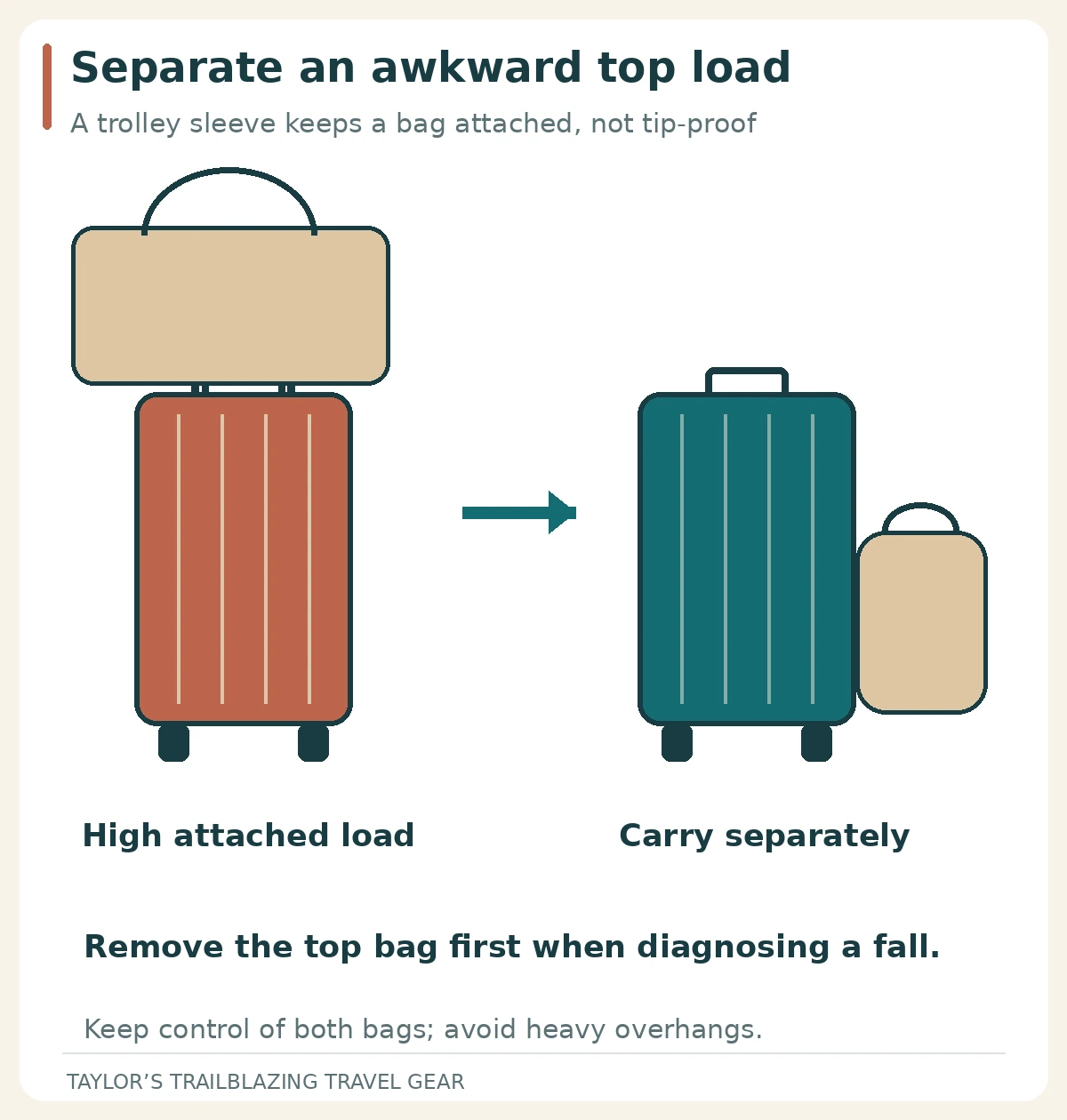
Avoid hanging shopping bags, handbags or a full bottle from one side of the handle. Even when the case remains upright, the uneven attachment can make steering and sudden stops less predictable. A tidy-looking stack is not necessarily an easy one to manage.
Check front pockets and expansion before changing the wheels
A large front compartment can be useful, but filling it with dense items changes the weight distribution. If the case becomes unstable only after you pack that pocket, move non-essential dense contents closer to the centre of the main compartment and reassess the arrangement.
Expansion also changes the packed shape. It does not automatically make every case unstable, but an expanded section may let you place more weight farther from the original central area. The effect depends on the design and what you put inside.
Separate space pressure from weight pressure
If the case only closes when expanded, ask whether the contents actually need that volume. Removing a duplicate layer or an unnecessary pair of shoes may solve both the packing difficulty and part of the handling problem.
Do not force an overfilled shell shut to avoid using expansion. That trades one problem for stress on the closure and a distorted shape. Edit the load or use a suitable case rather than choosing between a strained zip and an unstable arrangement.
A neatly packed front panel should not become a storage shelf for the heaviest last-minute items. Keep convenient access for things you need, while considering the bag’s upright orientation and any separate carriage requirements.
The best configuration is one you can maintain throughout the trip. If you need an exact, delicate distribution to make the case stand, the arrangement is too fragile for ordinary travel interruptions.
Slow down at turns, thresholds and changes of surface
A spinner that rolls pleasantly along a smooth straight corridor may behave differently when a wheel catches at a threshold or the bag changes direction sharply. Keep it close enough to guide without stretching your arm out behind you, and reduce speed before the obstacle.
Do not drag a stuck wheel harder while the top of the case continues moving. Stop, check the obstruction and use the intended lifting handles when an appropriate lift is necessary and manageable. If not, use a different route or seek suitable assistance.
Match the movement to the surface
Some suitcases can also be pulled in a tilted position, but do not assume that every wheel arrangement is designed for prolonged rough-ground dragging. Follow the product’s guidance and avoid promising that a change in pulling angle will cure damaged wheels.
Stairs and escalators are not places to test stability. Use a lift or an appropriate alternative route when that gives you safer control of the load. Keep the case and any loose straps out of moving mechanisms and follow the site’s instructions.
Practise ordinary starts, gentle turns and stops at home with a representative, comfortably manageable load. Maintain control throughout. The point is to notice steering or wheel problems early, not to see how far the suitcase can lean before it falls.
If it lurches repeatedly during calm movement on a clear level floor, investigate further before travelling. A sudden new behaviour deserves attention even if the suitcase still stands when parked.
Park deliberately: rolling resistance is not a brake
Do not expect a free-running four-wheel case to remain still on a sloping floor. Hold it while queuing, and use appropriate luggage storage when you need both hands free. A suitcase resting on its wheels beside you is still an object you need to control.
When the case is designed to rest on its side or back, that can be a more controlled storage position in a suitable clear space. Avoid placing pressure on vulnerable handles, locks or protruding parts, and do not create a trip hazard.
Keep exits and walking routes clear
A stable bag in the wrong place can still obstruct other people. Use designated racks and follow local directions rather than wedging luggage into doorways, against emergency equipment or between seats where it does not belong.
On a slope, a wall may prevent movement in one direction without protecting against movement or tipping in another. Do not treat casual leaning as secure storage, especially around children or crowded waiting areas.
If the case has a manufacturer-provided wheel brake, use it as instructed. A brake can limit rolling; it does not guarantee that the load cannot topple. Keep the distinction between those two problems throughout the journey.
Do not improvise a brake with loose tape, a cord or an object jammed into the wheels. A homemade fix can interfere with steering or detach when you begin moving again.
Use train and bus luggage spaces rather than balancing a case beside you
Moving vehicles add starts, stops and turns to the problem. A suitcase that stands without trouble on your hallway floor should not be expected to remain secure upright in an aisle or beside a seat during a journey.
LNER advises placing heavy and large luggage in the appropriate racks and storing large items on their sides to use the space. That is operator-specific guidance, not a universal rule for every train layout; follow the directions for the service you actually use. [3]
Plan the stowage before the vehicle starts moving
Look for a suitable luggage area and keep the case clear of doors, aisles and other passengers’ seating. If the designated space is full or the case does not fit, ask staff for guidance rather than constructing a precarious stack.
Keep essential items you need during the journey accessible in a separately manageable bag. That reduces the temptation to retrieve a large case repeatedly or leave it balanced upright for convenience.
For buses and coaches, follow the operator’s instructions about overhead storage and luggage holds. Do not put a heavy case overhead simply because a space appears available. Its size and handling need to be appropriate for the designated storage.
The same principle applies at the airport: use a suitable trolley when the combined load is difficult to control. Arrange the luggage securely on it and follow its usage instructions instead of relying on a high stack supported by a single pull handle.
Inspect the wheels without creating a new problem
Empty the case and place it securely in a position that gives you access to the wheel assemblies. Look for trapped thread, hair, grit, a damaged tyre surface, a bent-looking mounting or a crack around the attachment area.
Compare the corners visually. A wheel that appears noticeably lower, tilted or loose may explain why the case rocks. Do not assume that every visible difference is a defect, because some designs use different parts at different positions; consult the model information when uncertain.
Clean conservatively and follow the manufacturer
Remove loose surface debris with a suitable soft brush or cloth where you can do so safely. Avoid forcing sharp tools into bearings or dismantling the assembly without instructions. Follow the manufacturer’s cleaning guidance and allow the case to dry before storage. [4]
Do not spray an unspecified lubricant over the wheels in the hope that it will cure every noise or wobble. The correct treatment depends on the component and material, and a crack or worn mounting is not a lubrication problem.
Once a visibly damaged part is found, stop using that fault as a packing experiment. A different arrangement might disguise the symptom briefly while leaving the damaged component in service.
Photograph the affected corner, the complete base and the product label. Those images can make a repair enquiry more precise than describing the case only as a blue four-wheel suitcase.
Match replacement parts to the exact case
Replacement wheel kits are not interchangeable simply because the rollers look similar. The assembly height, mounting pattern, shape and orientation affect how the case stands and how the wheels move.
Samsonite’s spare-parts process asks owners to identify the product so compatible parts can be selected. Use that principle with any brand: record the exact model and follow the manufacturer’s parts information rather than ordering from a photograph alone. [5]
A cheap approximate wheel can be an expensive detour
An incorrectly matched assembly can leave one corner at a different height or create clearance problems. It may also fail to address damage in the shell beneath the original mount. Ask whether the fault involves the wheel alone or the supporting structure.
If the case is still within a relevant warranty period, speak to the seller or manufacturer before attempting an improvised repair. Keep the receipt and describe what happened. Warranty coverage depends on the actual terms and cause; a long duration does not mean every travel impact is covered.
Use an appropriate repair service when the work exceeds your confidence or the available instructions. Samsonite provides repair routes for assessment; other brands have their own arrangements. No universal home repair is suitable for every spinner design. [6]
If a replacement is fitted, check the case empty and then with a manageable representative load before the next journey. Keep control of it and look for the return of the original symptom rather than assuming the new part automatically resolves everything.
Choose organisers for restraint, not an anti-tip promise
The following tools address particular packing or handling tasks. None is presented as a tested device that makes a suitcase impossible to topple. Try the free adjustment first, then buy only what fills a genuine gap in your existing equipment.
| Tool | Useful job | What it cannot do |
|---|---|---|
| Peak Design Small Packing Cube | Keep a small clothing group together | Repair an uneven wheel mount [2] |
| Peak Design Medium Packing Cube | Maintain a larger clothing compartment | Remove the weight of its contents [2] |
| BAGSMART 6PCS Compression Packing Cubes | Separate categories and reduce loose packing | Guarantee balance when overfilled [7] |
| Go Travel Digital Scale Pro | Monitor the complete load | Diagnose centre-of-gravity position [8] |
| BAGSMART Blast 28L backpack | Carry a small bag separately on your shoulders | Make an overloaded suitcase handle safe [9] |
| Go Travel TSA Combi Lock Strap | Help keep a suitable closed case contained | Serve as a wheel brake or stabilising outrigger [10] |
Keep the supporting equipment proportionate
The small cube link appears in the packing section above because its main use here is maintaining a repeatable layout. Do not assume that purchasing both cube sizes is necessary. Existing pouches or the suitcase’s own straps may be sufficient.
If you use an external closure strap, secure the loose end and keep it clear of wheels and moving mechanisms. Its role is containment, not a reason to continue using a case that falls over while empty.
Reduce the complete load when the arrangement remains awkward
Even a reasonably balanced case can become unpleasant to guide when it is more than you want to manage. Reduce non-essential items before making the suitcase heavier with additional accessories or trying to counterweight a top-mounted bag.
Group the contents by function and weigh each group. That reveals whether footwear, toiletries or duplicated equipment is responsible for the mass, rather than relying on how bulky each group looks.
Measure weight without confusing it with balance
Go Travel’s Digital Scale Pro can help track the total. It does not tell you whether that weight sits low, high, centrally or beyond the footprint. Use the number alongside the packing inspection, not as a substitute for it. [8]
Removing a handle-mounted bag is often the simplest way to separate an awkward combined load. The BAGSMART Blast 28L is listed at 0.9kg and has shoulder straps, making it one example of a bag that can be carried independently. Use an existing suitable backpack first, and check any airline limits separately. [9]
Do not turn a difficult suitcase problem into an uncomfortable backpack problem by transferring too much weight. The goal is a manageable overall system with clear places for the items you need, not simply making one bag look more stable.
For a long journey with several transfers, the number of objects matters too. A lighter case plus several loose shopping bags can be less controlled than one edited, well-organised load.
When a different suitcase is worth considering
Replacement makes sense when the existing case has an unresolved structural fault, lacks a workable packing arrangement or is fundamentally wrong for your route. It should not be the first response to a heavy tote hung from the handle.
These examples illustrate features to inspect, not independently proven anti-tip performance. No stability ranking is claimed.
Essens 69cm: investigate the internal restraint
The Samsonite Essens uses removable packing containers and a three-point closure. Those features may suit a traveller who wants the contents grouped and held in a repeatable layout. Its published 88-litre capacity also means you need to avoid treating every available space as a reason to add weight. [11]
Try the case with the sort of load you actually carry, where a retailer permits that assessment. A packing system you find convenient matters more than assuming any latch-closing suitcase is inherently stable.
Nuon 69cm: compare shape and steering together
The Nuon 134400 is a conventional zip-opening checked-case example with a boxier interior. The retailer lists 79/86 litres, so assess both the unexpanded layout and what happens to your packing when you use the extra room. Its appearance alone does not prove a wider effective wheel support area. [12]
Tripp Holiday 8 Medium: a smaller-volume alternative
Tripp’s 65cm medium offers 66 litres before expansion. A traveller whose ordinary list fits that space may prefer the more contained format to carrying a much larger lightly filled shell. The choice is about appropriate capacity and handling, not a guarantee that smaller luggage cannot tip. [13]
Inspect the fixed handles, the wheel contact and how each candidate behaves during calm turns. Keep control of the test load throughout, and do not attempt deliberate tipping demonstrations in a shop.
Understand what wheel brakes and tapered expansion actually claim
Some designs address specific parts of the problem. Aerolite’s M-Lite Aluminium Frame 55 x 40 x 20cm model describes Hinomoto STOP wheels with an integrated brake. This is a separate product from the full-aluminium 55 x 38 x 23cm M-Lite. Read the exact model information rather than assuming every case in the range has brakes. [14]
A brake addresses movement along the floor
Stopping a wheel from turning does not prevent the whole suitcase rotating over an edge if the load or an external force is sufficient. A brake may be a useful feature for controlled parking, but should not be described as making the suitcase tip-proof.
Travelpro describes tip-resistant expansion on its Crew Classic Medium Check-in Expandable Spinner. That is a manufacturer design claim worth investigating when expansion is important to you, but it is not a guarantee against every packing arrangement or surface. No independent comparative tip test was conducted for this article. [15]
Compare such features in the context of your actual problem. Buying brakes to solve an uneven wheel mount, or buying a different expansion system while continuing to hang a heavy tote from the handle, may leave the main cause untouched.
Reassess the layout after you unpack during the trip
A suitcase can become less predictable after you remove the items that originally held the lower packing in place. For example, taking shoes out at the hotel may leave a gap beneath a dense wash bag, while clean clothing moves into a separate laundry pouch higher in the shell.
Before the next transfer, rebuild the arrangement around what remains rather than assuming the outbound layout still exists. Close the internal dividers, tighten the intended restraints appropriately and make sure a heavy item cannot drop into a newly empty space as the case stands upright.
Keep a small first-night group accessible when moving between several hotels. That reduces the amount of unpacking needed at each stop and makes it easier to maintain the rest of the load. It is a practical organisation choice, not a reason to add another heavy organiser if a simple existing pouch works.
If the bag’s behaviour changes after repacking, return to the diagnostic sequence: attachments first, then load position, then wheel and base checks. Record what changed instead of assuming the case has suddenly developed a fault. However, stop the inspection and seek help when you find visible damage or the case remains unstable empty.
Keep a useful fault record before seeking help
Write down when the symptom occurs: empty or packed, expanded or closed, with or without an attached bag, and on what kind of surface. A short factual description is more useful than simply saying that the suitcase is unstable.
Photograph the product identification, affected wheel assemblies and any visible cracking or distortion. Keep a record of the packing arrangement only if it helps explain the issue. Do not repeat a risky manoeuvre just to produce a dramatic video.
Describe the sequence rather than diagnosing beyond the evidence
For example, “the front-right corner rocks on a flat floor after a wheel was replaced” gives a repairer something concrete to investigate. “The whole design is defective” is a conclusion you may not yet be able to support.
If the problem follows a journey, report it promptly through the appropriate airline, seller or manufacturer process and preserve the relevant documents. Different claims have different conditions and deadlines, so check the correct process rather than assuming a general warranty is the only route.
Do not discard the damaged component or attempt a permanent alteration before asking what evidence is needed. A repairer may need to assess the original assembly and its mounting point.
Until the problem is resolved, use other suitable luggage rather than relying on a temporary balancing trick. The cost and inconvenience of substituting a bag may be less than discovering the same fault during a crowded transfer.
Benefits, limits and the fixes to avoid
Why repacking is worth trying first
It is free, reversible and directly addresses a top-heavy or uneven load. Removing a handle-mounted bag and restraining loose contents can make the system easier to manage without buying another suitcase. A controlled sequence also helps distinguish a packing issue from a hardware fault.
When repacking is not enough
It cannot repair a cracked base, mismatched replacement wheel or damaged mounting. Nor can it make an unattended spinner reliable on every slope or in a moving vehicle. Better balance reduces a problem; it does not create a guarantee against falls.
Avoid fixes that disguise the symptom
Do not add books or other ballast solely to hold the case upright. Do not tape wheels into one position, tie the suitcase to unsuitable fixtures or wedge objects into the wheel assemblies. Keep loose straps away from anything that moves.
Avoid tightening unfamiliar hardware indiscriminately. The correct fixing method and adjustment depend on the model. A loose-looking part may need a specified repair, while excessive force can create another fault.
Finally, do not keep using a case that repeatedly collapses or leans while empty simply because it can be balanced against your leg. That is a reason to investigate the hardware, not a normal operating technique.
Frequently asked questions
Why does my suitcase fall forward when I attach a handbag?
The attached bag changes the combined weight distribution and may project beyond the suitcase’s support area. Remove it and carry it separately during a controlled check. A trolley sleeve keeps a bag attached but does not guarantee stability or establish the handle’s permitted load.
Will heavier items at the bottom always solve it?
They can help with a top-heavy arrangement, but “always” would be too strong. Front-to-back balance, shifting contents, wheel condition, external attachments and ground slope still matter. A case that is unstable empty needs a hardware check rather than progressively heavier packing at the base.
Is a four-wheel suitcase supposed to stand unattended?
Do not rely on it doing so in every situation. Free-running wheels can move on a slope, and bumps or vehicle motion can upset a standing case. Maintain control or use appropriate designated storage. Follow the manufacturer’s guidance for any fitted brake or intended resting position.
Are double spinner wheels more stable than single wheels?
The number of individual rollers is not enough to answer that. The support footprint, wheel positions, assembly condition and packed centre of gravity all matter. Double wheels can be part of a useful design, but their presence does not establish a universal anti-tip advantage.
Can packing cubes stop a suitcase tipping?
They can help keep contents organised and reduce movement when used with the case’s restraints. They cannot correct a damaged wheel or make a poorly positioned top load safe. Use cubes as part of a balanced layout, not as a product with a guaranteed stability effect.
Should I replace all four wheels if one is damaged?
That depends on the model, the fault and the manufacturer’s repair instructions. Do not assume either a single replacement or a complete set is automatically correct. Identify the exact case and obtain compatible parts or a repair assessment, especially when the mounting or shell is also damaged.
Will a suitcase strap act as a stabiliser?
An ordinary closure strap is intended to help contain a suitable closed case. It does not widen the wheel footprint, lower the load or brake the wheels. Keep it fitted correctly and its loose end controlled; do not use it as a workaround for an unresolved structural fault.
Does an integrated wheel brake make the suitcase tip-proof?
No. A brake can address rolling, while tipping is rotation of the whole case over a support edge. Those are different mechanisms. A braked case still needs sensible packing and appropriate storage, and should not be treated as an immovable object on every surface.
What should I do if it starts falling in a busy area?
Prioritise people and move out of the path rather than attempting a difficult twisting catch of a heavy load. Once it is safe, clear the obstruction and inspect the case and contents. Reduce or separate the load before continuing, and stop using the suitcase if damage or instability remains.
The best fix is usually a better arrangement, not more equipment
Begin with a controlled reset: remove the top bag, keep dense items low and central, secure the contents and check the wheels on a clear level surface. Then distinguish a fall from simple rolling, because the two need different responses.
Use organisers only when they make the layout more predictable. Carry an awkward second bag separately, park the suitcase deliberately and use proper luggage storage on vehicles. If it remains unstable when empty, seek a model-specific repair assessment rather than adding weight to mask the problem.
A new case is worth considering when the old one is damaged beyond a sensible repair or fundamentally mismatched to your needs. Choose it by packing layout, handling and support, not a promise that four wheels can never tip.
For small items that keep migrating inside an otherwise sound case, the Peak Design Small Packing Cube is one practical option. The useful outcome is the organised load, not ownership of a particular accessory.
Sources and fact-checking notes
Source review: 15 October 2026. Product information comes from the linked manufacturer or retailer pages. Airline conditions depend on the actual booking. Calculated budgets and practical judgements are identified in the text; no personal product testing is claimed.
- OpenStax College Physics 2e: Stability. Centre of gravity, support area and stable equilibrium. Luggage applications here are editorial reasoning.
- Peak Design: Packing Cube. Compression zip and movable clean/dirty division; no claim of reducing contents mass.
- LNER: luggage information. Storage, handling and luggage-rack guidance for LNER services.
- Samsonite: product care. Mild cleaning, drying and storage; avoid unsupported treatments.
- Samsonite: spare parts. Identify model before ordering wheels or other parts; follow model-specific fitting instructions.
- Samsonite: repairs. Repair pathways and assessment by an authorised service centre.
- BAGSMART UK: 6PCS Compression Travel Packing Cubes for Suitcases. Named six-piece set, compression construction and included shoe bag.
- Go Travel: Digital Scale Pro, 2004.101. 50kg maximum, 91g listed product weight, spirit level and built-in tape measure.
- BAGSMART UK: Blast 28L Travel Backpack. 28L; 0.9kg; shoulder straps. Airline suitability must be checked separately.
- Case Luggage: Go Travel TSA Combi Lock Strap, 342.101. Adjustable closure strap; not a wheel brake or anti-tip device.
- Samsonite: Essens Spinner 69cm, 146911-1549. 69 x 49 x 30cm; 88L; 3.8kg; three-point closure and removable packing containers.
- Case Luggage: Samsonite Nuon 69cm, 134400. Exact retailer model listing. Treat colour availability and quoted specifications as variant-specific.
- Tripp: Holiday 8 Slate Medium Expandable, item 46370. 65 x 45 x 28/32cm; 66/75L; 3.6kg. Manufacturer capacity takes precedence over conflicting marketplace fields.
- Aerolite: M-Lite Aluminium Frame Cabin Suitcase, Charcoal. Manufacturer description of the separate 55 x 40 x 20cm STOP-wheel model. Brakes address rolling, not guaranteed tip prevention.
- Travelpro Europe: Crew Classic Medium Expandable Spinner. Manufacturer describes tip-resistant expansion and self-aligning wheels; not independent tip-testing evidence.
Illustrations in this article were created for Taylor’s Trailblazing Travel Gear. Third-party photographs, where used, are credited beside the image or in the source list.