
Tripp Holiday 8 Cabin Suitcase Review: Research-Led Fit and Value Check
A straightforward cabin case, assessed by the trips it fits and the compromises it asks you to make.
A sensible suitcase purchase starts with the journey, not the discount. This Tripp Holiday 8 Cabin Suitcase Review looks at the exact cabin version and asks whether its shape, packing layout and purchase terms make it a useful choice for your trips. It is a research-led assessment, with published facts separated from practical judgement rather than an invented hands-on score.
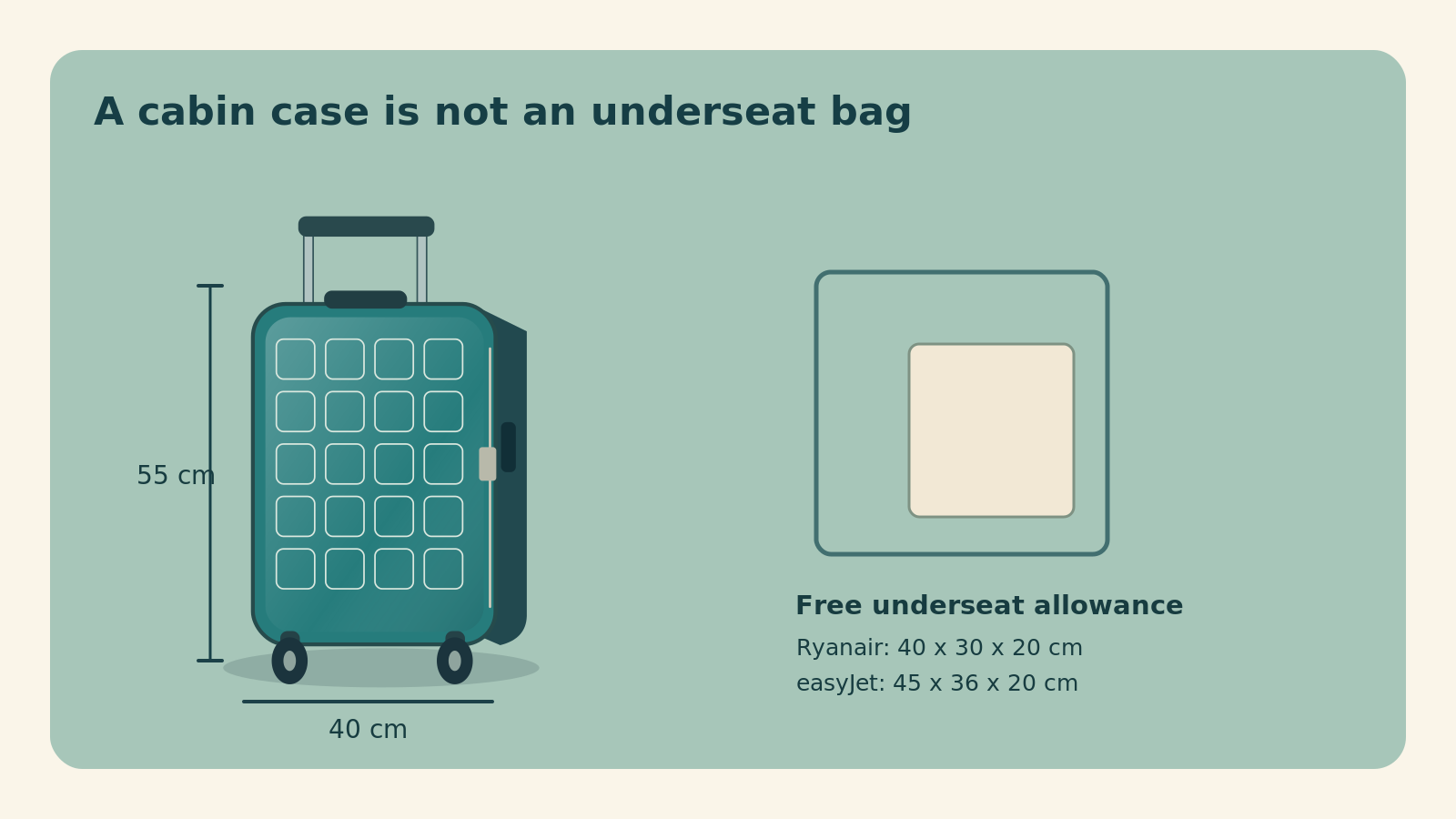
The key distinction is between a case that fits an overhead allowance and a bag included under the seat. Confusing those categories can make a seemingly inexpensive purchase less useful. Below, the airline table, packing rehearsal and alternative comparisons help you decide what the case would actually do for you. [1][2]
Think about the awkward parts of the route too: lifting the packed case, accessing essentials and repacking before coming home. Those details often matter more than a small difference in stated capacity. The illustrations are original planning scenes, not photographs of a Tripp test sample.
Simple overhead travel
Most convincing for clothing-led trips and mostly smooth transfers.
Not a free personal item
An overhead-sized case needs the appropriate baggage entitlement.
Compare delivered totals
A sale label is not a substitute for the correct size and format.
Pack, measure and handle
Use your own belongings for a return-safe indoor check.
01Tripp Holiday 8 Cabin Suitcase Review: what this assessment covers
The version matters more than the colour
This review concerns the Holiday 8 cabin case sold with a 55 x 40 x 20cm exterior. It does not cover the medium expandable suitcase, the large checked case or an older Holiday model that happens to look similar. Tripp publishes a polypropylene shell, four dual wheels, a TSA-compatible combination lock, packing straps and a mesh divider for this cabin version. Those are specifications, not evidence of how a particular suitcase will survive your journeys. [3]
Before comparing prices, open the size selector and read the final basket description. A photograph may remain almost unchanged when the selected size changes. Equally, a retailer may group reviews from several colours or generations. Match the cabin dimensions and product name first; then treat finish, colour and delivery as separate buying decisions.
What the research can and cannot establish
The assessment uses manufacturer information, the airline rules linked below and practical comparisons with other documented cabin cases. No sample was bought, packed, wheeled through an airport or subjected to a drop test for this article. Consequently, there is no invented durability score, measured rolling-noise result or claim that the handle feels comfortable in the hand.
Instead, the recommendation asks a narrower question: does the published design make sense for a traveller who wants a straightforward wheeled cabin case at an accessible price? Dimensions can answer much of the airline question. They cannot establish wheel longevity, manufacturing consistency or your willingness to carry the loaded case upstairs. Those points remain part of the checks to perform before keeping it.
The traveller it is most likely to suit
The clearest use case is a short break with an overhead baggage allowance, mostly smooth transfers and a modest clothing load. A traveller moving from car to terminal to hotel has less reason to pay for a sophisticated carrying system than someone navigating repeated station stairs. However, a low purchase price becomes less persuasive when the journey itself is poorly matched to wheels.
Choose by the least convenient part of the route, rather than the easiest. For example, one long walk across uneven paving may matter more than several kilometres inside polished terminals. Likewise, a small accommodation room may make access to a clamshell case more awkward than its tidy product photographs suggest.
02The published specification, translated into practical questions
| Item | Published detail | What to check |
|---|---|---|
| Exterior | 55 x 40 x 20cm | Measure wheels and fixed handles as part of the whole case. |
| Empty weight | 2.7kg | Contents and organisers add to the total. |
| Capacity | 35L | Not a guaranteed outfit or trip-duration count. |
| Shell | 100% polypropylene | Material is not a complete durability test. |
| Wheels and access | Four dual wheels; conventional clamshell | Consider lifting, stairs and essentials access. |
| Interior and closure | Packing straps, mesh divider, combination lock | Check the delivered hardware and supplied instructions. [3] |
Empty weight is only the starting point
The listed empty weight is 2.7kg. Under a 10kg total allowance, subtraction leaves 7.3kg for the contents; that is a calculation, not a packing recommendation. It includes everything added to the suitcase, such as organisers, toiletries, spare shoes and a luggage strap. A case that appears light when empty can therefore become inconvenient after a few dense extras. [3][1]
Use the figure to compare like with like. A slightly lighter suitcase does not automatically justify a substantial premium, particularly for infrequent trips. Conversely, someone repeatedly travelling close to a strict weight limit may value a few hundred grams more than a decorative finish. Your actual packing list decides whether the difference is meaningful.
Volume is not a promise of a week’s clothing
Tripp lists 35 litres of capacity. That number is useful context, but it cannot specify how many outfits you will fit. Shoe size, fabric thickness, the need for a jacket and your approach to laundry all change the result. Internal curves and handle channels also mean that a theoretical rectangular block is not the same as usable packing space. [3]
A better question is whether your existing compact wardrobe fits without pressure on the closure. Lay out the items for one real trip, not an idealised photograph. Then identify which objects create the greatest bulk. Removing a second pair of bulky shoes may matter more than buying a larger collection of compression accessories.
03Airline fit: overhead luggage, not the free personal item
| Allowance | Published maximum | 55 x 40 x 20cm case | Booking implication |
|---|---|---|---|
| Ryanair small personal bag | 40 x 30 x 20cm | Too large | Not the included underseat item. [1] |
| Ryanair Priority overhead bag | 55 x 40 x 20cm; 10kg | Nominal match | Correct entitlement and actual measurement required. [1] |
| easyJet small underseat bag | 45 x 36 x 20cm; 15kg | Too large | Not the free small cabin bag. [2] |
| easyJet large cabin bag | 56 x 45 x 25cm; 15kg | Within nominal dimensions | Correct large-bag entitlement required. [2] |
Separate size permission from baggage entitlement
The case’s published exterior matches Ryanair’s 55 x 40 x 20cm Priority overhead limit. It is too large for Ryanair’s included small personal bag. For easyJet, its dimensions fall within the large cabin category, not the smaller free underseat category. The booking still needs the appropriate large-bag entitlement. These comparisons were checked against airline rules on 09 October 2026. [1][2]
This distinction prevents a common purchasing mistake. A shop can reasonably describe a suitcase as cabin-sized without promising that your lowest fare includes it. Adding a case to a booking and buying a case are separate transactions. Before ordering, inspect the baggage line for each flight, including the return journey and any separately booked connection.
Measure the delivered case as a complete object
Stand the suitcase beside a wall and include its wheels, feet and fixed handles. Measure the longest, widest and deepest points, rather than following the shell with a flexible tape. Close it with your intended contents and repeat the depth measurement. A bulging closure or an accessory strapped around the exterior can change the practical outline.
Because this model sits at the published Ryanair overhead dimensions, there is little room to treat additional bulk casually. Do not rely on somebody else’s successful boarding story as permission to exceed the limit. Staff practices, the exact bag and the contents may differ. A correct measurement is more useful than an anecdote about a previous flight.
When a smaller bag would solve the problem better
Someone taking two nights of light clothing may not need a wheeled case at all. A correctly sized personal-item backpack can eliminate the overhead-bag purchase when the fare includes only an underseat item. However, that choice transfers the load to your shoulders and reduces packing freedom. It is an alternative system, not an automatic improvement.
For mixed-airline travel, use the tightest booked allowance rather than averaging several limits. A suitcase that works for one segment may still force a different arrangement elsewhere. Decide the complete route first, then select luggage that works throughout it or budget explicitly for the necessary baggage options.
04Packing the Holiday 8 for a realistic short break
Start with a two-night rehearsal
A useful rehearsal contains the clothes you would genuinely wear: two changes of underwear, spare socks, a second top, sleepwear and a compact layer, with the travel outfit worn rather than packed. Add your actual toiletry kit and charging items. This is a planning example, not a guarantee that every traveller needs exactly those quantities.
Next, introduce the difficult items one at a time. A hair appliance, smart shoes or a thick jumper can transform a neat clothing load into a crowded suitcase. Seeing the change is more informative than describing the bag as suitable for a particular number of days. Keep the rehearsal tied to your size, season and activities.
Use the two halves deliberately
Place compressible clothing in one area and awkward objects in the other, rather than spreading everything evenly because the case opens symmetrically. Small gaps beside wheel housings can accommodate socks or soft accessories. Meanwhile, keep hard corners away from delicate objects. An organiser helps only when its shape works with the actual interior.
Avoid building one very tall stack beneath the divider. It may close on the floor but move when the case stands upright. Instead, test the packed arrangement vertically before deciding that it works. The straps should keep items in place without needing to be pulled so tightly that the contents or fixing points become stressed.
Leave an exit route for the items you need
A hard case without a front access pocket is inconvenient for repeatedly retrieving a laptop, liquids pouch or charger. Arrange the journey so those essentials are accessible elsewhere within your permitted baggage. Alternatively, position the small items together near the opening and accept that you will need room to open the case.
The aim is not to create extra bags beyond the allowance. A compact internal pouch can move from suitcase to hand when required, then return inside before boarding. Practise that sequence at home. Discovering that your wash bag is trapped under shoes is a nuisance in a queue, even when the suitcase itself is perfectly adequate.
Reserve space for the return journey
Packing every gap on departure creates a fragile system. Worn clothing rarely folds as neatly, and a purchase or damp swimming item may need separate space. Therefore, leave a little flexibility rather than planning around maximum compression. A bag that shuts easily at home is preferable to one that needs your body weight on the lid.
For a longer trip, a laundry plan may be more useful than extra capacity. Decide where you can wash and dry a small set of clothes, allowing for slower drying in cool weather. However, do not design the trip around washing every evening unless that is genuinely how you like travelling.

05Wheels, handles and the parts of a journey that specifications miss
Smooth floors favour the spinner format
Four-wheel cases can be guided beside you on suitable flat surfaces, which is attractive during long terminal walks. However, that advantage depends on how freely the wheels move under the load you pack. A specification naming dual wheels does not provide an independent comparison of bearings, noise or resistance on different floors. [3]
At home, try gentle turns with a representative load on a clean surface, without scuffing a case you might return. Notice whether you need to correct its direction constantly and whether it becomes tiring to steer. This does not reproduce every airport, but it can expose an obvious mismatch between your expectations and the handling.
Stairs and rough ground change the calculation
Imagine the suitcase at its packed weight at the bottom of a station staircase. Can you comfortably lift it using the intended carry handle? A trolley handle should not be treated as a substitute lifting handle unless the manufacturer explicitly permits it. Similarly, pulling small wheels across persistent rough ground may be more work than carrying a suitable backpack.
For a city break, examine the transfer from station to accommodation rather than assuming a taxi will always be available. A route with long pavements, kerbs and stairs creates a different requirement from a direct hotel transfer. Nevertheless, occasional short carries may be a sensible compromise for someone who strongly prefers not to wear a backpack.
Check the handle with your own stride
During the indoor check, extend the handle to its available positions and walk normally. Watch for heel contact and an awkward wrist angle. A handle that suits one traveller’s height may feel less natural to another, so review photographs cannot settle this point. Some movement in telescopic hardware is not automatically a fault; persistent catching or failure to lock deserves attention.
Also think about where the case will stand while you wait. Do not leave a loaded spinner unattended on a slope. Hold it securely or place it in a stable position without blocking an aisle. That simple habit matters more to everyday usability than an ambitious claim that the suitcase will glide everywhere.
06Shell protection, finish and realistic durability expectations
A hard shell is not a protective equipment case
The polypropylene exterior creates a structured boundary around the contents, but the complete suitcase includes a zip, lining, wheels and handle assemblies. Material alone cannot prove overall impact resistance. Avoid treating the case as a substitute for dedicated protection around fragile equipment. For example, a camera should not sit loose between shoes simply because the exterior is hard. [3]
Likewise, clothes inside provide some separation only when packed thoughtfully. A rigid plug pressed against a screen remains a poor arrangement. Protect individual objects according to their vulnerability, then prevent movement. This approach is more reliable than assuming an entire class of suitcase can make careless packing harmless.
Cosmetic wear and functional failure are different
A visible mark is not necessarily a structural problem, while a damaged wheel can be disruptive even if the shell looks pristine. Consider which outcome would actually spoil your trip. A traveller who dislikes every scuff may be disappointed with almost any regularly used case; someone focused on function may care more about service and replacement parts.
Colour is therefore a practical preference as well as a style choice. Choose a finish you will tolerate after ordinary use, rather than relying on a photograph of a new suitcase. We have not tested which Holiday 8 colours hide marks best, so there is no evidence-based claim that one shade will remain smarter for longer.
07Locks and access: convenience without a false sense of security
What the integrated lock does not establish
The published combination lock provides a convenient way to secure the zip pulls. Its TSA-compatible description concerns an inspection-access system; it is not an independent strength rating. Do not use it as a reason to leave valuable equipment unattended. Nor should a lock be used to pull an overfilled suitcase shut when the zip is already under tension. [3]
Set the code using the instructions supplied with the exact case, then test it repeatedly while the suitcase is open. Record it somewhere appropriate before travelling. Avoid guessing a reset method from a similar-looking lock: small hardware differences can make an apparently simple demonstration unsuitable for your version.
Make a removal plan before an unexpected hold transfer
Even when you intend to keep a case in the cabin, prepare for the possibility that it needs to travel in the hold. Put essential documents, medication and high-value items where they can be removed quickly. Check the airline’s rules for batteries and restricted objects rather than assuming everything suitable for the cabin can stay in checked luggage.
For easyJet, a removable power bank in smart luggage must be disconnected and removed if the bag goes in the hold; the airline also sets conditions for carrying it in the cabin. A USB socket by itself is not a battery, and this article does not suggest that the Holiday 8 includes one. The point is to organise any separate electronics you pack. [2]
08Value: compare the price you will actually pay
Use a dated checkout comparison, not a headline saving
On 09 October 2026, Tripp’s Slate cabin listing showed an item price of £52.00. Its listed standard home-delivery charge below the free-delivery threshold was £4.49, giving an illustrative delivered total of £56.49 where those terms apply. Check the postcode and basket; prices and colours move frequently. We are deliberately not treating a struck-through reference price as a measure of value. Compare the delivered total for the exact cabin case with the alternatives on the day you buy, including any return cost that matters to you. [3][4]
A useful comparison separates three decisions: whether the dimensions work, whether the design suits the trip and whether the current total is attractive. A discount only affects the third. It cannot turn an overhead suitcase into a free underseat bag, add a front laptop pocket or make a wheeled format comfortable on your least suitable transfer.
A simple cost-per-trip example
Suppose two cases cost £60 and £150 delivered. These are hypothetical planning figures dated 09 October 2026, not observed prices. Spread over twenty trips, the purchase amounts are £3 and £7.50 per trip before repairs or baggage charges. That calculation helps frame a premium, but it does not predict that either case will survive twenty journeys.
For an occasional traveller, retaining money for useful baggage allowance may be the better decision. Conversely, someone travelling regularly might reasonably pay more for a clearly documented service route or a handling feature they have personally checked. The sensible choice depends on the benefit purchased, not on whether the larger price looks more impressive.
The cost of buying the wrong format
A bargain becomes less useful when it repeatedly causes repacking, uncomfortable carries or unexpected baggage purchases. Write those consequences beside the item price. However, do not assume that buying an expensive suitcase prevents fees; entitlement and measurements remain the deciding factors. The strongest value argument is a case that fits both the trip and your existing habits.
Also consider keeping a functional suitcase you already own. Measure it, inspect the moving parts and rehearse the packing before replacing it. A new colour or an appealing offer does not necessarily solve a problem. This review supports a purchase when the Holiday 8 fills a genuine gap, not simply because it is available.
09Alternatives that solve different problems
Samsonite Essens: a different closure system
The documented Essens 55cm has the same nominal exterior size, but uses a three-point closure and removable interior packing units. That makes it worth comparing when your interest is organisation or avoiding a conventional main zip, rather than merely changing brands. It is not automatically better: check access, weight, price and how easily you can replace or service the parts. [5]
Try the closure with a realistic load before treating the alternative design as a benefit. A packing system that looks elegant in an empty case may be less convenient with an unusually shaped item. Similarly, removable organisers are useful only when they fit the way you unpack at your destination.
Samsonite Nexis: assess the premium carefully
The Nexis 55cm is listed at 2.5kg, with a closed depth of 20cm and an expanded depth of 23cm. The distinction is more important than the word expandable: expansion would take it beyond Ryanair’s Priority depth limit. Compare it closed when that is the allowance you need. [6][1]
Its lower stated weight alone should not decide the purchase. Ask what the complete design offers you and whether those benefits justify the delivered difference. We have not carried out comparative wheel or shell testing between these models, so the recommendation does not imply that a higher price proves a longer working life.
Aerolite: compare the exact range, not the name alone
Aerolite offers several different luggage formats. Use its store as another comparison route, but filter by complete dimensions and empty weight rather than choosing the first case labelled cabin. A metal case, a lightweight plastic case and a compact underseat bag answer different questions. Their names should not be treated as interchangeable specifications.
The linked destination here is the general Aerolite store, not a claim that a particular alternative matches this review. Check the selected product and variant before purchasing. Where a cheaper case has a different depth, include the effect on airline fit in the price comparison instead of judging the headline amount in isolation.
When the alternative is a different travel system
A front-pocket case may be more convenient for frequent laptop access, while a backpack can simplify stairs and uneven streets. Neither change is free of compromises. Front pockets add structure and sometimes depth; backpacks put the load on your body. Choose the problem you most want to remove, then accept the trade-off deliberately.
For travellers who prefer a latch closure, keep the Essens on the shortlist rather than comparing only similar-looking zip cases. Conversely, for simple holiday clothing and smooth transfers, the Holiday 8 may already meet the requirement. More features should earn their place through use, not become a checklist to complete.
10Accessories: add only what improves this suitcase
One or two organisers can be enough
Begin with the suitcase’s own divider and straps. Add a clothing cube only when it makes packing or unpacking easier. A full multi-piece set may contain items you will never use, so examine individual dimensions before choosing it. An organiser that fits the interior badly can waste the space it was supposed to improve.
Compression should reduce loose clothing volume, not disguise a suitcase that is too small for the trip. It does not make belongings lighter. After compressing, weigh the complete case again and check that the resulting rigid bundle does not push against the closure or occupy an awkward corner.
Identification and weight checks have specific jobs
A luggage identifier can make a plain case easier to recognise, but it need not display your full home address openly. Choose the amount of information you are comfortable exposing and keep a second identifier inside. The optional TORRO accessory collection is a place to compare travel organisers and identifiers, not a necessary purchase to make the case usable.
A small luggage scale is useful when your packed load often approaches a limit. However, weigh consistently, check its instructions and allow a margin for differences between scales. An extra gadget is less useful when a reliable household scale already gives you the information you need before departure.
11Returns, warranty and a sensible arrival-day inspection
Read the coverage before relying on the guarantee
Tripp’s published five-year guarantee concerns manufacturing faults. Its returns information excludes circumstances such as wear, accidents and transport damage, and describes evidence needed for a claim. This is not a promise that any wheel or shell problem will lead to a free replacement. Keep the receipt and the product details somewhere you can find them later. [4]
Before buying, ask about the practical service route for a failed wheel or handle. Is there an available replacement part, an assessed repair or another remedy? The answer may depend on the model and the fault. We have not confirmed a permanent supply of Holiday 8 spare parts, so repairability should remain a question rather than an advertised benefit here.
Inspect while a return is still practical
Open the delivery carefully and retain the packaging until you have decided to keep the case. Look for damaged seams, uneven closure, cracked fittings and wheels that do not rotate freely. Then operate the handle and lock according to the supplied instructions. An obvious problem is easier to document before the suitcase has travelled.
Rehearse your packing indoors using clean belongings and surfaces. Do not interpret a return window as permission for a real trip trial. Check the seller’s conditions before removing tags or doing anything that changes the item’s condition. This practical caution is particularly useful when comparing a direct purchase with a marketplace seller’s terms.
Store it ready for the next journey
After a trip, empty all pockets and allow the interior to dry before closing the case for storage. Remove visible debris from accessible wheel areas without dismantling hardware or applying unsuitable chemicals. Follow Tripp’s care advice for any cleaning product, rather than assuming a household solvent is harmless to every component.
Keep the next trip’s basic checks short: inspect the closure, turn the wheels, extend the handle and confirm the code. A small fault discovered early is easier to address than one noticed while leaving home. Nevertheless, inspection cannot guarantee future reliability; it simply reduces the chance of overlooking a visible problem.

12Three trip profiles that make the value decision clearer
A two-night hotel break with a direct transfer
Picture a traveller wearing their main shoes and jacket, packing a small clothing change and taking a direct transfer to accommodation. The suitcase mainly moves over terminal floors and a short hotel approach. In this scenario, a simple cabin case can meet the brief without a front laptop pocket or a specialised carrying system.
The important checks are the booked overhead allowance, manageable loaded weight and an interior that closes comfortably. Paying substantially more only for an elaborate organiser would have a weak practical justification. However, the buyer should still try the handle and wheels indoors, because a modest price does not excuse an obvious fault or an uncomfortable grip.
A work trip with several device-access stops
Now add a laptop that needs to come out on the train, at the terminal and before the first meeting. The same suitcase may still hold the equipment, but the access sequence becomes less convenient. A separate permitted personal bag might solve it; a front-pocket case is another option when its dimensions work.
This does not make the Holiday 8 a bad case. It shows that packing capacity and travel convenience answer different questions. When repeated access is central to the trip, compare the time and effort involved rather than assuming that anything which fits inside is equally practical.
A short break with stairs and a long final walk
Finally, imagine a station without a convenient lift and accommodation reached over uneven streets. The low item price now competes with repeated carrying. Rehearse lifting the packed case and decide whether those transfers are acceptable. A suitable backpack may be the better format even if the suitcase is more comfortable inside the terminal.
Do not choose from the easiest five minutes of the journey. Select around the awkward section you cannot avoid, then consider whether an occasional taxi or a lighter packing list changes the answer. The right decision can differ between two trips taken by the same person.
13Pros and cons for the intended traveller
Reasons to shortlist it
The Holiday 8 makes sense as a straightforward overhead case when the published dimensions match your booking and you do not need frequent exterior access. Its uncomplicated packing layout can suit holiday clothing without requiring a complicated organiser system. The strongest argument is the combination of an appropriate format and an attractive delivered price on your purchase date.
Reasons to choose something else
It is not an included underseat bag, and it cannot remove the need for an overhead allowance. A front-opening alternative may suit laptop-heavy travel better, while a backpack may be more convenient on stairs. In addition, this research does not establish exceptional wheel life, repairability or measured impact performance. Treat those as open questions, not assumed advantages.
14Common buying and packing mistakes
Do not borrow the medium model’s features
The medium Holiday 8 is advertised as expandable, but that does not establish expansion on the cabin version. Keep the exact cabin specification beside your comparison notes. Similarly, reviews of a checked case may describe stresses and capacities that do not apply to a small overhead suitcase. [3]
Avoid a departure-only fit check
A case that closes with precise folding on the outbound journey may be awkward after clothing has been worn. Pack a realistic return configuration during the rehearsal, including any expected purchases or laundry separation. Also check both flight bookings rather than assuming the return has the same allowance.
Do not let optional extras become the main expense
Buying several organisers, a strap, a cover and a new toiletry bag can erase the saving that attracted you to a budget case. Start with what you own and add only the missing function. The suitcase should support your trip; building an elaborate accessory collection should not become a condition of using it.
15Frequently asked questions
Is the Holiday 8 cabin suitcase free to take on Ryanair?
Not under the ordinary small-personal-bag allowance. This is an overhead-sized case, and the booking needs the appropriate entitlement. Its listed exterior matches the published Priority size, but you must also stay within the applicable packed weight. Check the booking and the delivered case rather than relying on the word cabin. [1]
Does it qualify as easyJet’s free underseat bag?
No. It belongs in the larger cabin category, subject to the relevant booking conditions. The free underseat allowance is a different, smaller envelope. A suitcase fitting an overhead locker does not mean that it can be taken on every fare without an extra baggage arrangement. [2]
Can I pack for a week in it?
Possibly, but no capacity figure can answer that for everyone. A warm-weather wardrobe with laundry is a different proposition from bulky winter layers, spare shoes and work equipment. Rehearse your own list first. When the case closes only through force, reducing the load or changing the baggage plan is better than relying on another compression pouch.
Is a TSA-compatible lock enough for valuable equipment?
Do not treat the lock as a guarantee against theft or impact. Keep high-consequence items under appropriate supervision and protect them individually. The integrated lock is a convenient closure feature; this review has not tested its resistance to attack. It also cannot make an unsuitable unattended storage situation safe.
Should I buy the cheapest colour?
That can be sensible when the exact specification, seller terms and delivery timing are otherwise equal. However, check that the lower price has not selected another size or an older version. A preferred colour is a legitimate choice, but compare the additional cost with things that may matter more, such as the necessary baggage allowance.
Is the five-year guarantee a reason to ignore repairability?
No. Coverage and practical aftercare are related but different. A fault may need evidence and assessment, while wear or transport damage may fall outside the guarantee. Ask how the likely problem would be handled and retain proof of purchase. A clearly understood service route is more useful than assuming that a long headline period covers everything. [4]
16Final recommendation: a sensible case when the fit is right
Shortlist the Holiday 8 when you want a simple hard-shell overhead case, your trip mostly suits wheels and the current delivered price is competitive. The cabin dimensions are a useful starting point, while the arrival-day packing and handling check should decide whether the design works for you. Do not buy it primarily on an advertised saving or a promise of effortless travel.
Choose another format when free-underseat travel, rapid laptop access or repeated carrying is the main requirement. Meanwhile, keep a functioning existing suitcase when it already solves the problem. The best-value purchase is the one that removes a genuine inconvenience without creating a new baggage or packing mismatch.
17Sources and fact-checking
Research reviewed on 09 October 2026. Manufacturer specifications and airline allowances are kept separate from our buying judgement. Prices, colour availability, product revisions and delivery terms can change. No durability, comfort, security or airline-acceptance testing was performed for this article.
- Ryanair: baggage policy. Small personal bag and Priority overhead allowance; airline rules take precedence over retailer labels.
- easyJet: cabin bags. Small and large cabin dimensions, weight limits, booking conditions and measuring guidance.
- Tripp: Holiday 8 Slate cabin suitcase. Exact 55 x 40 x 20cm cabin model; not medium, large or an older Holiday generation.
- Tripp: returns and refunds. Unused-return process and manufacturing-fault guarantee exclusions.
- Case Luggage: Samsonite Essens 55cm. Retailer specification for the 55cm case: 55 x 40 x 20cm, 2.8kg, 39L and three-point closure.
- Case Luggage: Samsonite Nexis 55cm. 55 x 40 x 20cm closed; 23cm expanded depth. This is an alternative, not a Clifton variant.
Buying links are optional comparison routes, with search and collection destinations identified in the article. No discount code or current stock promise is implied. Original images depict unbranded equipment and planning ideas, not the products reviewed or evidence of hands-on testing.
Illustrations in this article were created for Taylor’s Trailblazing Travel Gear. Third-party photographs, where used, are credited beside the image or in the source list.