Osprey Farpoint 40 Review: Research-Led Airline Fit and Spec Check
Osprey Farpoint 40 Review: Research-Led Airline Fit and Spec Check
A proper carrying system in a cabin-oriented pack, with no promise that every airline will accept it.
Original editorial concept of a framed travel backpack; not a photograph or an exact Osprey product rendering.
This Osprey Farpoint 40 review starts with the reason to choose a travel backpack at all: carrying your main luggage when wheels are inconvenient. A useful frame and hipbelt can matter far more on station stairs or a walk to accommodation than another small pocket or a slightly larger capacity claim.
However, the Farpoint name alone does not settle the buying decision. This guide uses the current S26 model on Osprey’s UK website, keeps other editions separate and checks its published dimensions against airline rules. A 40-litre label is not a guarantee that the bag will be accepted on every flight.
The assessment is research-led rather than a claim of ownership or a long-distance carrying test. Manufacturer specifications and official policies establish the facts; packing and route examples show how to apply them. Your torso fit, actual load and travel routine still need a practical check before the pack becomes a sensible purchase.
S26 / 1.48kg
Use the model-specific page rather than combining different generations.
Frame and hipbelt
The main attraction is carrying support, not merely more pockets.
23cm packed depth
A soft bag is not automatically a 20cm bag.
30-year AMG wording
Read UK terms, not a US lifetime-policy summary.
Osprey Farpoint 40 review: the S26 specification
Keep the model identity beside the numbers
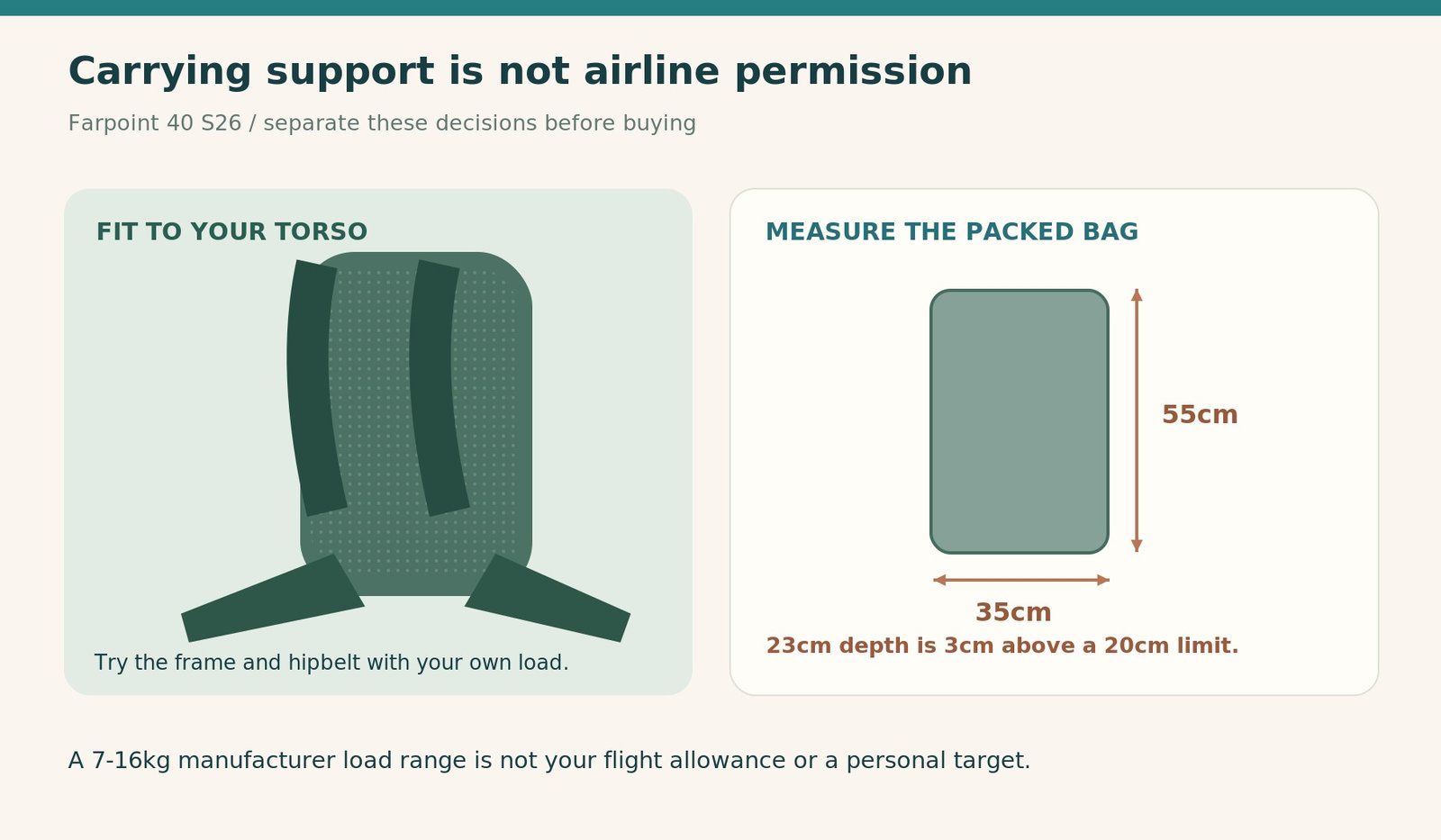
Osprey’s current UK S26 page lists 40 litres, 55 x 35 x 23cm and 1.48kg. It describes an adjustable torso system, a peripheral frame, a zip-away harness and direct access to a laptop sleeve. These figures belong to the named current model, not every Farpoint 40 sold over the years. [13]
On smaller screens, scroll this table sideways for all columns.
| Specification | Current S26 detail | Important qualification |
|---|---|---|
| Volume / weight | 40L / 1.48kg | Do not copy these numbers to a different generation. |
| Exterior | 55 x 35 x 23cm | The packed depth is not automatically 20cm. |
| Manufacturer load range | 7-16kg | Not a flight allowance or a personal carrying target. |
| Laptop access | Direct-zip sleeve; most laptops up to 16 inches | Compare the actual computer and any additional sleeve. |
| Main / base fabric | Recycled 200D / 420D nylon | Water-repellent treatment does not make a waterproof bag. |
The same page lists recycled 200D nylon for the main and accent fabrics and 420D nylon for the base, with a water-repellent treatment made without PFAS. That is not a waterproof rating. Do not merge a previous generation’s fabric description with the current weight and call it one verified specification. [13]
Editions and collaborations need their own check
Osprey also sells a separately named Danner collaboration. Its existence is another reason to confirm the whole title, not simply the capacity. An older retailer listing, a collaboration and the standard S26 may look related while requiring different details in a comparison. [18]
For a used or discounted pack, request its identifying information and compare that particular version with the requirements you have. A well-priced older model can be useful, but it should not be represented as a current S26 solely because the front logo is familiar.
Who should consider carrying their main luggage?
The strongest use case involves meaningful walking
The Farpoint is worth investigating when your journey includes stairs, several transport changes or streets where pulling a case is awkward. A backpack keeps both hands available when properly worn, but also puts the load on your body. It is a different compromise, not an automatic improvement for every traveller.
Think about the longest unavoidable carrying section rather than the total holiday length. A short city break can involve a difficult station transfer, while a two-week stay with direct taxis may require very little carrying. The pack should suit those real movements.
A suitcase can still be the better tool
If you strongly prefer rolling luggage and most of the route has suitable surfaces, do not choose a backpack simply because one-bag travel looks efficient. A loaded pack that is uncomfortable for you is not made sensible by a popular model name.
Likewise, a smaller daypack can be preferable when the main load is already handled separately. Forty litres is a main-luggage category for many trips, not a requirement for a few daytime essentials. Choose the transport role before choosing the model.
Harness fit: torso length comes before height labels
Measure what the manufacturer asks for
Osprey’s sizing guidance uses torso length rather than overall height as the main backpack-fit measurement. Its method runs from the prominent vertebra at the base of the neck to the level of the top of the hip bones. Product-specific fit information should take priority over the general chart. [14]
The practical reason is that two people of the same height can have different torso proportions. A general tall or short description is not enough to identify where the hipbelt should sit or how the shoulder straps will wrap.
Trial the load, not an empty shop display
Adjust the pack with a sensible trial load and follow the manufacturer’s fit instructions. Check whether the hipbelt sits securely, the shoulder straps make comfortable contact and the pack feels stable without having to overtighten everything. Walk, turn and sit carefully to see whether the arrangement suits your movements.
Do not treat discomfort as a challenge to be endured until the pack breaks in. If the harness cannot be adjusted into a comfortable position, try another fit profile or model. A good carrying system only has value when it matches the person using it.
What the frame and hipbelt add
More than padded shoulder straps
The S26 specification describes a LightWire frame and framesheet that transfer and distribute load towards the hipbelt. Its AirScape backpanel uses mesh-covered ridged foam. These are meaningful design features to investigate, although this review has not measured pressure distribution or compared comfort on a long walk. [13]
A frameless bag can be lighter and simpler. The reason to accept the Farpoint’s structure is the support it may offer with a realistic main-luggage load. If you carry only a few light items, that trade-off may be less important to you.
Support does not make weight disappear
Osprey publishes a 7-16kg load range for this model. That is not an airline allowance, and it is not a recommendation that every user should carry 16kg. Your comfortable load and your flight’s restrictions are separate limits. [13]
Use the lowest load that meets your needs. Reducing unnecessary clothing or duplicate electronics can improve the experience more than tightening a strap further. The pack is a way to carry chosen belongings, not a reason to add enough equipment to fill every compartment.
Airline fit: compare dimensions before capacity
Where the current model fits on paper
At its published 55 x 35 x 23cm, the Farpoint sits within the larger 56 x 45 x 25cm cabin-bag boxes published by easyJet and British Airways. The correct fare entitlement and the actual packed dimensions still matter. It is not a recommendation for either airline’s smaller personal-item category. [13][2][3]
On smaller screens, scroll this table sideways for all columns.
| Airline / bag category | Maximum exterior size | Research-led fit judgement |
|---|---|---|
| Ryanair larger cabin bag | 55 x 40 x 20cm | Published S26 depth exceeds the limit by 3cm. [1] |
| easyJet large cabin bag | 56 x 45 x 25cm | Fits the published size box, with the correct entitlement. [2] |
| British Airways cabin bag | 56 x 45 x 25cm | Fits on paper; check the actual packed shape. [3] |
| Qatar cabin bag | 50 x 37 x 25cm | Published length exceeds the limit by 5cm. [4] |
For Ryanair’s 55 x 40 x 20cm larger cabin bag, the published depth is 3cm too great. Qatar’s 50 x 37 x 25cm maximum creates a 5cm length mismatch. A product page describing domestic carry-on suitability does not override those operating-carrier rules. [1][4]
A soft bag is not automatically a smaller bag
Packing less may reduce a soft bulge, but the frame and the way items sit inside the pack constrain its final shape. This review has not tested a Farpoint in a Ryanair sizer and cannot guarantee that careful underpacking will make it compliant.
Measure the loaded bag, including filled exterior areas, and avoid attaching extra items before checking the allowance. A published 40L capacity is irrelevant if the particular loaded shape exceeds one of the maximum sides.
Compression and the honest sizer check
Use straps to control the load
The S26 model includes external compression and internal holding straps. Their useful role is to stabilise and organise the packed shape. They should not be described as a guaranteed mechanism for shrinking the rigid dimensions to fit an airline the bag does not nominally match. [13]
Pack a realistic amount, close all compartments normally and tighten the straps without forcing the contents. Then measure the largest outside dimensions on a flat surface. Repeat after placing the laptop, toiletries and any last-minute items in their intended pockets.
Plan for the strictest relevant sector
A return journey can involve a different carrier or a different entitlement. Identify those constraints before departure rather than treating the outward boarding experience as approval for the whole trip. Where a strict 20cm depth is non-negotiable, a pack designed around that size is the more straightforward choice.
Do not use another traveller’s successful boarding story as a substitute for this check. It may describe a lightly packed older version, a different fare or a lenient decision. None of those details establishes what your current loaded S26 will be allowed to do.
Weight budgeting for a one-bag load
Start with the published 1.48kg, then weigh your own pack
Under a hypothetical 7kg total allowance, the listed empty weight leaves 5.52kg for contents. At 8kg it leaves 6.52kg; at 10kg it leaves 8.52kg. These are arithmetic planning examples, not claims that the Farpoint meets every airline using those limits.
Separate your load into clothing, footwear, toiletries and electronics. The largest avoidable contribution may be a second pair of shoes or a heavy charger, not the packing cube you were about to remove. A category-based check makes that visible.
Include the items added at the door
The filled bottle, jacket pushed into an outside space and pouch clipped to a strap can change both weight and dimensions. Check the pack as it will actually be carried, not as it looked halfway through packing.
A luggage scale is useful when you need to repeat the check away from home. The Go Travel Digital Pro Scale is one available retail design to consider; it does not remove the need for a little margin below the limit or for a separate size check. [9]
Packing layout: panel access is the central convenience
Pack for the sequence of the journey
A large front opening gives access to the main compartment, while the current design adds direct access to the toiletry pocket and laptop sleeve. The practical aim is to reduce the need to disturb the whole load whenever one item is needed. [13]
Put the things you will not need until accommodation in the least frequently accessed area. Keep a modest in-transit kit reachable. Do not make the pack unstable by placing all dense items far from your back or high in an external space simply because they fit there.
Use modules without overcomplicating the interior
A clothing cube and a small toiletries container may be enough. More organisers can add friction when every object has to be removed in a particular order to reach another. Test the arrangement by taking out the item you expect to need at security or immediately after arrival.
The BAGSMART compression set offers one modular approach, but the individual pieces need checking against the available shape. Use the relevant sizes rather than assuming the whole set belongs in a 40-litre pack. Compression changes bulk, not mass. [10]
Laptop and toiletries access: useful, with limits
Most laptops is not every laptop
Osprey describes the current direct-access sleeve as fitting most laptops up to 16 inches. Screen size alone does not establish the outside dimensions or thickness of your computer, especially with a protective sleeve fitted. Check the device and the available compartment before making it a work-travel requirement. [13]
Also consider how you will use it. A pack that opens conveniently on a hotel floor may be less convenient when wedged between seats. Trial the access pattern with your normal load and keep the device protected from hard accessories.
A compact cable kit is easier to move
A small organiser can keep chargers and leads together when the main pack is stored. The BAGSMART Bubble example is listed at about 21 x 13.5 x 5.8cm and 100g; that can be useful for a modest kit and excessive for one cable. It is not specialist impact or battery-fire protection. [11]
The beige variant returned by the linked page was awaiting availability on 11 October 2026. Treat it as a size and organisation example until stock is confirmed, rather than a necessary addition before your trip. [11]
For toiletries, follow the actual airport’s current screening rules and contain leaks appropriately. A convenient pocket does not change what security permits. Choose containers and a packing arrangement that can be removed without emptying the main compartment when required.
Stowing the harness for transit
Understand what folds away
The current specification describes a zip-away backpanel, harness and hipbelt. That can make the pack neater for handling and storage, but it is not a hard protective shell around the entire bag. Close the cover and secure loose straps as instructed rather than leaving parts partly exposed. [13]
Practise the change between carrying and stowed modes before a rushed connection. Check that the cover does not trap buckles or strain the zip. If the pack is overfilled, resolve that problem rather than forcing a closure designed for another part of the bag.
Prepare a small removable essentials set
If an airline requires the pack to be checked, know which items must remain with you. In particular, power banks belong in cabin baggage under the current CAA guidance. Keep identification, travel documents and other essential items accessible without relying on a hurried full unpack. [5]
A small sling can serve as an optional daytime or in-transit bag when your allowance permits. The Daylite 6L sling at Case Luggage is a separate product, not a claim that it attaches to the Farpoint like the dedicated compatible daypack. [12]
Rain, heat and the outdoor appearance
Water repellency is not waterproofing
The fabric treatment does not establish sealed seams, a waterproof zip system or a submersion rating. Protect items that must remain dry with an appropriate separate solution. Do not choose the Farpoint as a dry bag merely because its styling and carrying system come from a backpack specialist. [13]
If rain exposure is part of the route, consider how you will shelter, access the bag and keep wet layers away from dry clothing. A cover may help with some exposure, but cannot automatically seal every harness opening or protect the pack when it is put down in water.
Ventilation has realistic limits
The mesh and foam backpanel are intended to support a stable carry with ventilation. That is not a promise of a dry back in hot weather. Clothing, humidity, walking effort and load all affect the experience, and no comparative heat or sweat test was performed for this review. [13]
For a hot-weather trip, reducing unnecessary weight and planning sensible carrying stages can be more useful than expecting a named backpanel technology to solve the climate. The pack remains a travel tool with trade-offs, not an expedition specification for every environment.
Daypack attachments and the one-bag idea
Compatible does not mean included
Osprey says the Farpoint 40 is compatible with the Farpoint/Fairview Travel Daypack, which is sold separately. That is a clear distinction for price and packing. Do not assume a photographed second bag comes with the main pack or that any small backpack uses the same attachment arrangement. [13]
An attached daypack also changes the loaded dimensions and weight. The main bag’s cabin-oriented specification should not be carried over to the combined arrangement. Check the packed system and airline piece rules rather than treating modular luggage as invisible extra capacity.
Choose the day bag around the actual day
Some travellers need a laptop-capable daypack, while others only need a phone, a small bottle and a light layer. Bringing a substantial second bag for the latter can undermine the reason for choosing a manageable one-bag load.
A simple fold-flat bag or separate sling may be sufficient, but each still occupies space or an allowance when carried. Decide how it will be transported on the flight before judging whether it is convenient at the destination. Convenience in one stage should not create a problem in another.
Farpoint versus Fairview: choose the fit profile
Do not let the label replace a fitting
Osprey describes the Farpoint as its men’s-fit version and the Fairview as the corresponding women’s-fit travel pack. The Fairview S26 also has an adjustable torso system and related travel features. Those labels describe design profiles, not a rule about who is allowed to use each bag. [13][16]
The practical test is how the harness, shoulder straps and hipbelt fit your body. Try the relevant profiles with a comparable load and follow product-specific sizing advice. A suitable fit should not require you to justify ignoring an uncomfortable pressure point simply because a product label seems intended for you.
Compare like for like
Use current model information on both sides. Do not compare an old Fairview size chart with the latest Farpoint weight and then attribute every difference to fit profile. Keep the generation, capacity and selected version visible throughout the comparison.
Alternatives for a different carrying priority
A lighter, simpler travel backpack
Case Luggage’s Daylite 35L travel-backpack listing describes a 0.92kg bag at 49 x 37 x 26cm. It provides a useful comparison when lower empty weight matters more than the Farpoint’s particular carrying system. Its 26cm depth still requires a careful airline check. Smaller capacity does not guarantee a shallower exterior. [6]
On smaller screens, scroll this table sideways for all columns.
| Alternative | Published baseline | Reason to compare | Current listing |
|---|---|---|---|
| Osprey Daylite 35L | 49 x 37 x 26cm / 0.92kg | Lighter alternative; depth is not a match for a strict 25cm limit. [6] | View Daylite 35L |
| Osprey Transporter 44L | 54 x 42 x 32cm / 1.54kg | For a different transport or baggage plan; not a compliant cabin substitute in this table. [7] | Check Transporter size |
| Osprey Ozone 40L | 55 x 35 x 23cm / 2.1kg | Two wheels instead of a wearing-based main-luggage system. [8] | View Ozone 40L |
A boxier bag for another travel pattern
The Transporter 44L listing used here states 54 x 42 x 32cm and 1.54kg. Those dimensions are too deep for the 25cm airline boxes in this guide when treated literally. It is therefore a comparison for other transport or an appropriate checked-bag plan, not a compliant cabin replacement hidden inside an alternatives list. [7]
A rolling option when carrying is the objection
The Ozone 40L two-wheel case provides a different answer at a listed 2.1kg and 55 x 35 x 23cm. It may suit somebody who wants to roll a main bag on suitable surfaces rather than wear it. The published depth still does not match a strict 20cm allowance. [8]
UK price and guarantee: use the right region
A current price is not a stock guarantee
On 11 October 2026, the S26 Farpoint page displayed £170. The returned page also showed availability prompts, so confirm the selected colour, actual stock and delivery date rather than assuming that a visible price means immediate dispatch. A near-term trip needs time for fitting and an exchange if necessary. [13]
The main buying reference in this guide goes to Osprey’s current UK model page. It is better to use that clear model reference than to direct a buyer to a poorly identified older version solely because another selling route is available.
The current UK wording is 30 years
Osprey’s UK All Mighty Guarantee page now describes 30-year support, including repair where possible and replacement when it cannot repair the pack, subject to the declaration and exclusions. Do not replace that with a generic summary of a US lifetime policy. Region-specific terms matter. [15]
Check the practical claim process, identifying information and any applicable conditions before relying on support. A long guarantee is a valuable service promise, but it does not demonstrate that no part will wear or that a repair can be completed before your next departure.
A useful first fitting and packing session
Rehearse a realistic transfer
Load clean items representing your actual clothing, footwear and electronics, then adjust the harness using Osprey’s instructions. Walk indoors, use a safe short staircase if appropriate and practise taking the pack off without swinging it into furniture or another person. Stop if the load is not manageable.
The purpose is to identify suitability, not to prove toughness. You do not need to fill the stated maximum load range or conduct a long outdoor test that compromises the seller’s return conditions. Keep packaging and follow the specific return policy while deciding.
Check access and balance together
Take out the laptop or toiletry kit you expect to need first, then put it back without reconstructing the whole load. If one dense item makes the bag pull awkwardly, adjust its position before blaming the harness. A poor arrangement can undermine a carrying system that otherwise fits well.
Packing cubes can assist with that rehearsal when used sparingly. The aim is to create stable modules that are easy to remove, not to compress the bag into a shape it was never specified to achieve. [10]
Cleaning and keeping the pack serviceable
Use the manufacturer’s method
Osprey’s cleaning guide recommends gentle washing with mild soapy warm water and a sponge or soft brush, thorough rinsing and drying in ventilation away from direct sunlight. It advises against machine washing. Follow the guidance appropriate to the exact pack and do not remove components that are not intended to detach. [17]
Empty every pocket before cleaning and allow concealed areas to dry properly. A pack put into storage while damp can become unpleasant even when the outer fabric feels dry. Avoid strong chemicals or an improvised machine cycle simply because the trip left it looking dirty.
Inspect the parts that control the load
After travel, check zips, buckles, straps and attachment points for damage or changed operation. Photograph a developing problem and obtain advice before it becomes a failure during a transfer. Keep the pack’s identifying label and purchase information available for service conversations.
Repairability is a reason to care for the bag, not a reason to ignore damage. Equally, a cosmetic mark need not end the useful life of an otherwise functional pack. Judge the condition of the components that carry and contain the load.
A seven-kilo planning example without wishful packing
Build a budget before filling the pockets
As an illustration, allow 3kg for clothing, 500g for toiletries, 800g for electronics, 600g for packed footwear and 200g for small organisers. These are constructed planning figures, not a tested Farpoint packing list. They total 5.1kg; with the listed 1.48kg pack, the example reaches 6.58kg.
That leaves 420g beneath a hypothetical 7kg limit. It may look comfortable on paper, but a filled bottle or several purchases can consume the margin quickly. The calculation should therefore be repeated for the return journey rather than treated as a permanent approval of the bag.
The example also shows why cutting a cable while adding another pair of shoes may achieve very little. Identify the largest contribution you can realistically change. Do not reduce essential items merely to preserve unnecessary duplicates or an organiser that is larger than the kit it contains.
Keep the mass and shape tests independent
A 6.58kg pack could still be too deep for a particular cabin allowance. Conversely, a bag that fits a sizer could still exceed the airline’s weight limit. Completing one check does not make the other optional, and the frame’s published load range cannot override either requirement.
For a generous airline, you may choose to carry a little more. The relevant question then becomes comfort rather than permission alone. Add items gradually and repeat the fitting instead of assuming that the harness will remain equally comfortable at every load.
Buying a used Farpoint or discounted earlier generation
Condition and version need separate evidence
Request photographs of the identifying label, backpanel, main zips, shoulder-strap attachments and hipbelt. Ask whether any parts have been repaired or modified. A seller’s description of a forty-litre Osprey pack is not enough to establish the generation or the state of the carrying system.
An older version can still be a useful purchase when it fits your body and routes. The mistake is borrowing the newest model’s dimensions, weight, laptop description or fabric specification to make that older listing look more attractive. Keep the available evidence attached to the actual bag being sold.
Assess the repair before valuing the saving
A missing buckle or damaged zip may be repairable, but the possibility of support is not a completed repair or a delivery date. Ask Osprey about the exact problem and applicable conditions before relying on it for an imminent trip. Do not assume that a generic replacement part has the right strength, dimensions or attachment arrangement.
For discounted unused stock, check the seller’s return conditions and leave time for a proper fitting. A saving on the wrong harness profile is not a saving if you avoid wearing the pack. Similarly, a newer product is not automatically a reason to replace a correctly fitted older one that remains serviceable.
Moving through a station or boarding queue
Change the carrying mode deliberately
A substantial backpack occupies space behind you that is easy to forget when turning. In a narrow queue or carriage, take care not to swing it into another person or a fixed obstacle. Use the intended grab handles when a short controlled move is more appropriate than wearing the full pack.
Before moving away, check that the main opening is closed and that loose straps are managed. The convenience of a stowable harness depends on actually using it when needed. A partly tucked hipbelt can be more awkward than either the fully worn or properly stowed arrangement.
Keep the first-needed items separate
Prepare a small, permitted essentials set so that a ticket or cable does not require spreading the main load across a station seat. At the same time, avoid carrying several loosely attached pouches simply to make every item instantly reachable. Each attachment adds another thing to control and another change to the bag’s exterior shape.
Advantages and drawbacks for the right traveller
Advantages
- A frame, hipbelt and adjustable torso system for main-luggage carrying.
- Panel access and a zip-away harness suit varied transport stages.
- The current S26 baseline is clear enough for a model-specific comparison.
Drawbacks
- Harness comfort depends on the individual and the actual packed load.
- The listed depth and length do not meet every cabin allowance.
- The fabric treatment is not a waterproof rating, and the compatible daypack is extra.
The recommendation depends on wearing it
For a traveller carrying a manageable main-luggage load, the strongest reasons to choose the Farpoint are its frame, hipbelt and adjustable fit. Its panel opening and stowable harness support that role. Those features matter less to somebody who mainly wants a light sack for a taxi-to-hotel journey.
The main restrictions are equally clear: body fit is personal, published dimensions do not match every cabin allowance and the bag is not waterproof luggage. A good review should make those limits visible rather than trying to rescue an all-purpose recommendation after the fact.
Common mistakes with a 40-litre travel pack
Packing to capacity before checking the allowance
A full bag can be both too heavy and too deep. Begin with the items you need, establish a mass budget and then inspect the packed outside dimensions. Do not take the litre rating as an invitation to fill every available pocket.
Confusing load range with flight permission
Osprey’s carrying range describes the pack, not your ticket. The comfortable load for your body is another separate question. Use the most restrictive relevant limit rather than assuming the largest number printed anywhere gives permission to carry that amount.
Buying by height or gender label alone
Torso proportions and harness contact are more useful than a general assumption about who should use which version. A careful fitting can reveal a mismatch early, while an attractive deal cannot make the wrong harness comfortable. Compare the appropriate current model profiles before committing.
Frequently asked questions
Is the Osprey Farpoint 40 worth buying?
It is worth considering when you will genuinely carry main luggage and can benefit from a frame, hipbelt and adjustable torso system. It is a less obvious choice when rolling luggage suits the route or a smaller day bag would be enough. This review provides a specification-led assessment, not a measured comfort or durability result from a personal trial.
What does the current S26 Farpoint 40 weigh?
Osprey’s current UK page lists 1.48kg. Other generations and separately named editions should be checked independently. Weigh the actual pack and final contents rather than assuming that every listing carrying the Farpoint 40 name refers to that same configuration. [13]
Does it fit Ryanair Priority?
The published 55 x 35 x 23cm exterior exceeds Ryanair’s 20cm depth allowance for its larger cabin bag. Some soft bulge may depend on packing, but this review cannot guarantee that underpacking will produce compliance. Choose a bag specified for the limit when certainty matters. It is also much larger than the free personal-item allowance. [13][1]
Can it be a free underseat bag?
It should not be bought on that assumption. The main comparison here is with larger overhead cabin allowances. Check the exact personal-item dimensions on your ticket; the 40L name and soft fabric do not make the framed pack fit a smaller underseat box. Filling exterior areas can make the overall shape larger still.
Will a 16-inch laptop fit?
Osprey says the current sleeve fits most laptops up to 16 inches. Check the outside dimensions and thickness of your actual device, including any protective sleeve. A screen-diagonal description alone does not establish a fit, and this review has not tested a specific laptop in a physical sample. [13]
Is the Farpoint 40 waterproof?
The current fabric has a water-repellent treatment, but no waterproof or submersion rating was verified for the pack. Protect sensitive contents appropriately and consider the exposure expected on your route. A hiking-inspired carrying system should not be confused with the sealed construction of a dry bag. [13]
Does it include the smaller travel daypack?
No. Osprey describes the compatible Farpoint/Fairview Travel Daypack as sold separately. Adding one changes the combined weight and dimensions, so reassess the airline allowance for the whole arrangement. Do not assume another small bag uses the dedicated attachment system simply because it is also made by Osprey. [13]
Should I choose Farpoint or Fairview?
Compare the current fit profiles and choose the harness arrangement that suits your torso and load. Osprey describes them as men’s and women’s fit respectively, but the useful decision is the actual contact and adjustment. Try the relevant versions rather than relying on a label or overall height alone. [14][16]
Does Osprey still offer a lifetime guarantee in the UK?
The current UK page used for this review describes a 30-year All Mighty Guarantee, with its detailed declaration and exclusions. Do not substitute wording from another region or an old retailer summary. Confirm the applicable terms and service process for the pack you buy. [15]
Final recommendation: a carrying-system purchase, not an airline shortcut
Choose the current Farpoint 40 when a proper harness and hipbelt solve a real part of your journey, the fit works for your body and the packed dimensions suit your flights. Its value is in the complete carrying and access arrangement, not simply in being a popular 40-litre backpack.
For repeated strict 20cm-depth flights, look for a more clearly compliant design rather than relying on squeezing. For people who dislike carrying their main load, compare a roller instead. A good alternative does not have to mimic the Farpoint’s features when your actual requirement is different.
Finally, identify the S26 model, confirm UK stock, complete a careful fitting and retain the purchase and guarantee details. A manageable, correctly fitted load is a better outcome than maximising capacity and hoping the pack or the airline will absorb the compromise.
Sources and fact-checking
Research scope
The UK S26 page is the specification baseline, not an older Farpoint or a collaboration edition. Airline comparisons use published exterior limits rather than retailer fit tick-boxes. The current UK 30-year guarantee wording is kept distinct from policies in other regions. No personal harness fitting, carrying-distance or waterproof test is claimed.
Sources reviewed on 11 October 2026. Specifications and policies are attributed above; calculations and practical packing examples are editorial analysis. Prices, selected colours and availability can change.
- Ryanair: current bag policy.
- easyJet: cabin bags and entitlements.
- British Airways: baggage essentials.
- Qatar Airways: baggage allowance.
- UK CAA: power-bank rules effective 27 March 2026.
- Case Luggage: Daylite 10006136 travel backpack, 35L.
- Case Luggage: Transporter 10006375 travel backpack, 44L.
- Case Luggage: Osprey Ozone 10006935, 40L two-wheel case.
- Case Luggage: Go Travel Digital Pro Scale.
- BAGSMART UK: six-piece compression packing cubes.
- BAGSMART UK: Bubble electronic organiser.
- Case Luggage: Daylite 10006018 sling, 6L.
- Osprey UK: Farpoint 40 S26 specifications.
- Osprey UK: torso measuring and size guide.
- Osprey UK: 30-year All Mighty Guarantee.
- Osprey UK: Fairview 40 S26.
- Osprey Europe: backpack cleaning guidance.
- Osprey UK: separate Danner collaboration model.
Illustrations in this article were created for Taylor’s Trailblazing Travel Gear. Third-party photographs, where used, are credited beside the image or in the source list.