
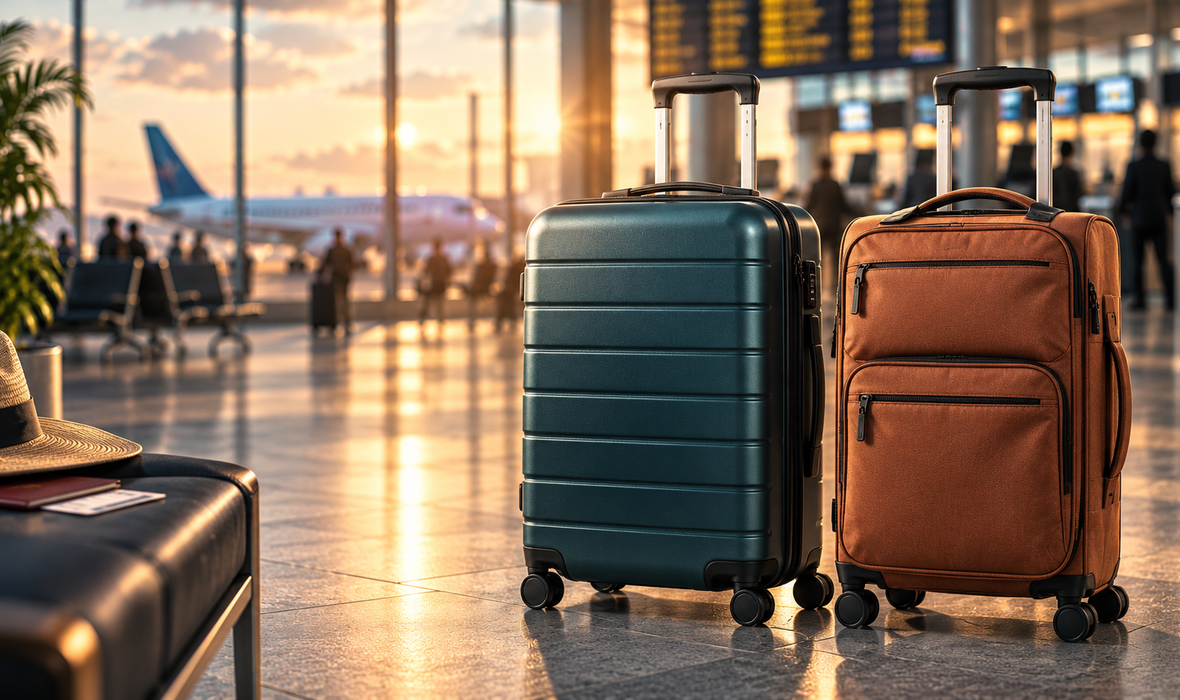
Hard-Shell vs Soft-Sided Luggage: Which Fits Your Trips?
Choose by handling, access and trip type – not by which shell looks toughest in a product photograph.
The hard-shell vs soft-sided luggage decision is often presented as protection versus weight. Real trips are less tidy. A rigid case can be lighter than a feature-heavy fabric model, a soft case can survive years of flying, and either can become frustrating when the wheels, handle or dimensions are wrong.
The most useful distinction is structure. Hard-shell luggage keeps a defined outline and normally opens into two clamshell halves. Soft-sided luggage flexes around the load, often opens from one side and usually adds external pockets. That changes how the case fits a cabin sizer, a car boot, a train rack and a small hotel room.
This guide uses official airline rules, current manufacturer specifications, warranty information and UK battery-safety guidance. The aim is not to declare one universal winner, but to show which construction is the better starting point for the trips you take.
Hard-shell
Strong starting choice for checked flying, wipe-clean surfaces and a fixed packing outline.
Soft-sided
Useful for rail, road and frequent hotel changes where access and flexibility matter.
Hard plus cushioning
The shell helps with broad pressure, but central placement and internal padding remain essential.
Structure versus access
Hard cases hold shape; soft cases usually open more conveniently and offer outer pockets.
No shell type wins every journey. Start with the transport mix, then use the case dimensions, empty weight and component quality to break the tie.
| Trip pattern | Start with | Why | What can change the answer |
|---|---|---|---|
| Fly, transfer, hotel, fly home | Hard-shell | Fixed shape, easy cleaning and a more protective outer barrier for checked handling. | A very light soft case with stronger wheels and a better warranty can still be the smarter purchase. |
| Rail, bus and city-hopping | Soft-sided | External pockets, flexible packing and a lid that can open in less floor space. | A compact hard cabin case works well when stations have lifts and streets are smooth. |
| Self-drive or camper trip | Soft-sided | It compresses around an awkward boot, and a two-wheel or duffel format copes well with loading. | Hard cases stack neatly when the boot is large and rectangular. |
| Fragile souvenirs or structured clothing | Hard-shell | The case keeps a defined outline and resists broad pressure better. | Internal cushioning still matters; the shell alone does not make glass or electronics safe. |
| Business cabin-only travel | Soft-sided or hybrid | Front access can make a laptop and documents easier to reach. | A hard front-opening case can offer the same access without a fabric body. |
| Family checked luggage | Hard-shell | Split compartments and wipe-clean surfaces are practical around mixed clothing, shoes and spills. | Weight limits may favour a lighter soft-sided model. |
Hard-shell luggage is a shaped container
A hard case uses moulded panels to hold its dimensions whether it is empty or packed. Most modern versions open as a clamshell, creating two shallow halves with a zip divider or compression panel. That format is orderly and stable, although it needs enough floor or bed space to lie fully open.
The shell may flex under pressure, particularly when it is polycarbonate or polypropylene, but it is still designed to return to a defined shape. Therefore, it is less forgiving when the traveller tries to force in one more pair of shoes or expand beyond an airline limit.
Soft-sided luggage is a framed fabric bag
A soft case normally uses woven polyester or nylon around a light internal frame. Many open from one side into a single deep compartment, while the front carries document or laptop pockets. The body can flex into a car boot or luggage rack, yet that same flexibility allows the case to bulge when overfilled.
This structural difference explains most of the practical trade-offs. Hard-shell prioritises a fixed outline and broad surface protection. Soft-sided prioritises access, adaptable packing and the ability to compress slightly around other luggage.

It keeps a predictable outline
A rigid case does not rely on the contents to hold its shape. That is useful at check-in, on conveyor systems and when several bags are stacked in a transfer vehicle. It also makes it easier to separate shoes, toiletries and laundry across two closed halves.
It gives broad pressure resistance
The shell spreads broad pressure across a larger area instead of letting another bag press directly into clothing or a boxed item. For bottles, ceramics or structured garments, that barrier is helpful. However, fragile pieces still need padding and should sit away from corners and wheel housings.
It is straightforward to wipe clean
Rain splashes, dust and luggage-belt marks usually wipe from a smooth panel more easily than from woven fabric. Even so, the zip, lock, handle recesses and shell joints are not automatically waterproof.
Front pockets solve real travel problems
A well-designed outer pocket keeps a jacket, paperwork or charging cable accessible without opening the main compartment. On a cabin case, that can be more valuable than a few extra litres. Never place a passport or other high-value item in an exposed pocket when the bag is out of sight.
It uses awkward spaces efficiently
A soft bag can give slightly around a train rack, wardrobe shelf or car boot. The advantage is modest rather than magical: wheels, frame rails and the telescopic handle remain rigid, so the case cannot collapse like an unstructured duffel.
Expansion is often more usable
Many soft cases add a zipped expansion panel. This is useful for a road trip or a checked bag with spare weight allowance. In the cabin, expansion can push the depth beyond the airline limit, so close and measure the packed case before leaving home.
Protection depends on where the force lands. A broad squeeze, a sharp corner impact and a leaking toiletry bottle are different problems.
| Packed item | Hard-shell advantage | Soft-sided advantage | Safer packing method |
|---|---|---|---|
| Clothing | Split compartments keep the load organised. | One deep cavity suits bulky layers and odd shapes. | Use compression straps and fill empty corners without overpacking. |
| Glass bottles | Broad outer pressure is less likely to reach the item directly. | Fabric can absorb a light local knock rather than transferring it across a stiff panel. | Seal, wrap and place centrally inside clothing; do not rely on the shell alone. |
| Electronics | A cabin hard case gives a defined barrier from other cabin bags. | A padded front compartment offers quick access at security. | Keep valuable electronics in the cabin and protect them in a padded sleeve. |
| Shoes and sports kit | Easy-to-clean interior dividers contain dirt. | Flexible walls accommodate irregular shapes. | Use separate bags and keep hard objects away from the outer fabric. |
| Formal clothing | Flat divider panels can hold folded garments in place. | A lid-style case may provide a deeper, uninterrupted packing area. | Use a garment folder and avoid compressing the collar and shoulders. |
The most vulnerable zones are still the components
Wheel housings, exposed corners, zip tracks and telescopic handle rails concentrate stress. A strong shell with weak wheels is a poor travel tool. Likewise, abrasion-resistant fabric cannot compensate for a loose handle or a zip that snags under moderate load.
For checked luggage, pack as though the case may be laid flat, upright and upside down. Fill voids so contents cannot gather at one end, and keep anything breakable away from the perimeter.
Common hard-shell materials
| Material | Typical character | Useful for | Check closely |
|---|---|---|---|
| Polycarbonate | Flexible moulded plastic used across many mid-range and premium cases. | Travellers who want a resilient hard case without aluminium weight. | Shell thickness, corner design, empty weight and warranty. |
| Polypropylene | Light, resilient plastic often used in textured or latch-closure designs. | Frequent checked travel where low case weight matters. | Hinge construction, latch alignment and interior fittings. |
| ABS or ABS blends | Common in lower-cost shells; stiffness and finish vary widely. | Occasional travel on a tighter budget. | Very thin corners, brittle-feeling edges and weak wheel mounts. |
| Aluminium | Highly rigid, premium and visibly marked by dents and scratches. | Travellers who value a frame closure and long-term repairable hardware. | High empty weight, price and whether dents affect closure. |
Common soft-sided materials
Polyester is widely used because it balances cost, weight and coating options. Nylon, including dense woven variants often marketed as ballistic nylon, is common in premium soft luggage where abrasion resistance is a priority. Denier can help compare yarn thickness within similar materials, but a higher number does not guarantee better stitching, coating or frame construction.
Recycled content is useful environmental information, not a durability score. For example, current manufacturer pages describe recycled interior fabrics in some products, while the outer shell or fabric remains a different material. Read the exact component claim rather than assuming the whole case is recycled. [8] [11]

The assumption that every soft case is lighter is too simple. In four current medium-size examples, the two soft products weigh 3.11 kg and 3.3 kg, while the two hard products weigh 3.8 kg and 3.99 kg. That is a useful pattern, not a universal rule. Frame design, wheels, expansion hardware and interior fittings can reverse it.
The examples below were selected because official manufacturer pages publish dimensions, weight, volume and price. They are reference points rather than a ranked list. Prices and availability were checked on 20 September 2026 and may change.
| Model | Construction | Outside size | Weight | Volume | Listed price |
|---|---|---|---|---|---|
| Samsonite Image Spinner Expandable 69 cm | Hard; polycarbonate | 69 x 45 x 28/31 cm | 3.8 kg | 79/86 L | £289 |
| Antler Stamford 2.0 Medium | Hard; polycarbonate | 68.3 x 48 x 29.5 cm | 3.99 kg | 81-95 L | £245 |
| Eastpak Tranverz M | Soft; polyester | 67 x 35.5 x 30 cm | 3.11 kg | 78 L | £165 |
| Travelpro Maxlite 5 Medium 69 cm | Soft; polyester | 69 x 47 x 29 cm | 3.3 kg | 91 L | £161 sale; £190 regular |
Manufacturers do not all measure usable volume in the same way, and expanded capacity is not automatically airline-compliant. Treat litres as a guide, then inspect the actual interior shape.
Use empty weight as a packing allowance
A 23 kg checked allowance leaves 19 kg for contents when the case weighs 4 kg. A lighter 3.1 kg case leaves almost another kilogram. That difference matters on a long trip, although it should not tempt you to buy a case with poor wheels or weak handle rails.
Clamshell packing rewards organisation
Hard cases normally open into two equal or near-equal halves. Packing cubes fit neatly, and a zipped divider can isolate shoes or laundry. The compromise appears in a small hotel room: the case often needs to lie fully open across the floor or bed.
A lid-style soft case opens in less space
Many soft-sided cases have one deep base and a hinged lid. You can stand the case against a wall, lift the lid and reach the top layer without spreading two loaded halves across the room. This is useful on a cruise, rail trip or frequent overnight itinerary.
External pockets are not free capacity
A front pocket improves access, yet anything inside increases the total depth. Pack flat items there and measure the case after loading. A rigid laptop, book or toiletry pouch can create a visible bulge that fails a cabin sizer even when the nominal product dimensions appear correct.
Hard-shell panels resist surface moisture
A plastic or aluminium panel will not soak up a short shower. However, water can enter through an ordinary zip, around a recessed handle or where the two halves meet. Frame-closure cases reduce the exposed zip area, but they are not automatically certified waterproof.
Soft-sided protection depends on the coating
Some fabric cases are described as water-resistant, including current Eastpak and Travelpro examples. That means the material is designed to resist limited moisture; it does not promise that the complete case can sit in heavy rain without water entering through seams and zips. [10] [11]
Dry both constructions properly
Wipe hard shells with a soft damp cloth and inspect scratches rather than using abrasive cleaners. Brush dry dirt from fabric before spot-cleaning, follow the manufacturer’s care instructions and let the case air-dry fully before storage. Damp linings, closed pockets and wheel housings can retain odour and grit even when the exterior looks clean.
No suitcase is theft-proof
A lock is useful for preventing a zip from opening accidentally and discouraging casual interference. It does not turn a soft case, zippered hard case or aluminium frame case into a safe. Keep passports, medication, valuables and essential electronics in the cabin, as UK passenger guidance recommends. [7]
Closure design matters more than shell appearance
A hard case with a frame and latches exposes less zip than a conventional zip-around shell. A soft case may use robust coil zips and lockable pulls, but its fabric can still be cut. For ordinary travel, look for smooth zip alignment, covered seams and a lock that does not distort the closure when the case is full.
Check batteries before buying smart luggage
UK Civil Aviation Authority guidance says power banks must be carried in cabin baggage and limits passengers to two. IATA guidance also states that a removable battery in smart luggage must be taken into the cabin if the bag is checked. Therefore, avoid a case with a battery you cannot remove easily and verify the airline rule before departure. [4] [5] [6]
Four-wheel spinners favour smooth terminals
Spinner cases move easily beside the traveller and turn in tight queues. Their wheels sit outside the main body, which adds to the measured height and leaves the wheel housings exposed. Test whether the case tracks straight when loaded rather than judging an empty showroom glide.
Two-wheel cases favour rougher surfaces
Larger recessed wheels can roll more confidently over cobbles, kerbs and platform gaps. The case must be tilted and pulled, so it carries more weight through the arm. This format is common in wheeled duffels and some soft-sided luggage.
Inspect the parts a repair centre can replace
Look for screwed rather than permanently moulded wheel assemblies, accessible handle rails, clearly branded replacement parts and a warranty that explains airline damage exclusions. Samsonite states that it offers repair services in many countries, Antler advertises a lifetime warranty on its Stamford line, Eastpak lists a 30-year manufacturing-defect warranty for the Tranverz, and Travelpro describes repair or replacement routes for covered faults. The terms differ, so keep proof of purchase and read the exclusions. [8] [9] [10] [11]
What airlines actually measure
Airlines measure the outside of the packed bag. Wheels, handles and stuffed pockets count. A soft case may compress slightly in a sizer, but that is not permission to exceed the published dimensions, and a rigid case is not compliant merely because the retailer calls it cabin size.
Current cabin-size examples
| Allowance | Published maximum | Position | What it means for luggage choice |
|---|---|---|---|
| Ryanair free personal bag | 40 x 30 x 20 cm | Under the seat | A soft bag may use the space efficiently, but only when it is not packed beyond the stated outline. |
| Ryanair Priority cabin bag | 55 x 40 x 20 cm; up to 10 kg | Overhead locker | A rigid cabin case is predictable to measure; a bulging soft case can exceed the 20 cm depth. |
| easyJet small cabin bag | 45 x 36 x 20 cm; up to 15 kg | Under the seat | Wheels and handles count, so measure the complete bag rather than the fabric panel or shell body. |
| easyJet large cabin bag | 56 x 45 x 25 cm; up to 15 kg | Overhead locker | Either construction works if the outside size is compliant and the traveller can lift it unassisted. |
| British Airways cabin bag | 56 x 45 x 25 cm | Overhead locker | BA states that wheels and handles are included; the individual booking remains the final check. |
Ryanair currently includes a 40 x 30 x 20 cm personal bag and sells a 55 x 40 x 20 cm cabin option with Priority. easyJet lists 45 x 36 x 20 cm for its free under-seat bag and 56 x 45 x 25 cm for a paid or included large cabin bag. British Airways lists a 56 x 45 x 25 cm cabin bag and states that handles and wheels are included. Always use the allowance shown in your own booking because fares and rules can change. [1] [2] [3]
Hard-shell is the simpler default for airport-heavy trips
When the case will be checked on several flights and carried directly to hotels, a well-made hard shell is a sensible starting point. It holds its outline, wipes clean and provides a clear barrier around the packed load. Choose a matte or textured finish if visible scratches will bother you.
Soft-sided remains a strong checked option
A quality soft case can be lighter and easier to overpack sensibly for ground travel. It is particularly useful when the same case will move through rail stations, coach holds and car boots after the flight. Pack internal hard objects away from the fabric and use compression straps so the load does not sag.
Checked dimensions are not universal
British Airways currently lists a maximum checked size of 90 x 75 x 43 cm for standard bags, while many airlines use a combined linear measurement. Travelpro’s current medium example is designed around a 157-158 cm convention. Neither figure should be treated as a worldwide rule; check the operating airline and fare. [3] [11]
The matrix is based on the practical constraint most likely to affect each journey: handling, access, storage shape, weather or packing style. It is not a universal ranking.
| Trip | Start with | Why it fits | Priority features |
|---|---|---|---|
| One-week fly-and-flop holiday | Hard-shell spinner | Simple airport handling, wipe-clean exterior and divided packing. | Low empty weight, matte shell, strong wheels, 20-23 kg packing margin. |
| Multi-city European rail trip | Soft two-wheel or compact spinner | Front access and easier opening in small rooms; flexible body suits racks. | Large wheels, side handle, stable base, restrained expansion. |
| Road trip | Soft case or duffel | Uses irregular boot space and can be opened from the top. | Compression straps, grab handles and durable fabric. |
| Cruise | Soft lid-style case | Opens in less cabin floor space and can slide under some beds. | Low profile, smooth wheels and easy-to-identify exterior. |
| Business cabin-only | Soft-sided or front-opening hard case | Quick laptop and document access reduces full-case opening. | Exact airline dimensions, padded device sleeve and quiet wheels. |
| Family resort trip | Hard checked case plus soft personal bags | Structured main packing with flexible access to in-flight essentials. | Separate compartments, light case weight and easy cleaning. |
| Adventure lodge or rough transfer | Wheeled soft duffel | Grab handles and flexible body cope with vehicle roofs, boats and uneven storage. | Reinforced fabric, covered zips and replaceable wheels. |
| Fragile shopping trip | Hard-shell | A fixed perimeter is easier to pad and organise around boxed items. | Strong divider, compression, low shell weight and no overpacking. |

Spend first on movement and structure
Prioritise wheels that remain stable under load, a telescopic handle that locks at a comfortable height, strong carry handles and a closure that runs smoothly around the corners. Decorative trim and extra pockets are less useful when the case wobbles or tips.
Then compare empty weight and warranty
A lighter case increases packing allowance, but extremely low weight can mean fewer reinforcements. Read the warranty before paying a premium: some cover manufacturing defects but exclude normal wear and airline damage. A repair network and replacement parts may be more valuable than a long warranty headline.
Compare hard-shell luggage
Use the airline dimensions first, then compare shell material, empty weight, wheel design and closure. Current retail prices can move quickly.
Compare soft-sided luggage
Check the packed depth, pocket bulge, wheel size, fabric coating and whether the expansion can stay closed during cabin travel.
Retail and manufacturer prices referenced in this guide were checked on 20 September 2026. Availability, discounts and delivery charges can change.
- Measure the complete outside height, width and depth, including wheels, handles, feet and loaded pockets.
- Weigh the empty case on a reliable luggage scale and compare that figure with the listing.
- Load it to the weight you normally carry: roughly 8-10 kg for many cabin trips or 15-20 kg for a checked test.
- Roll it across tile, carpet and a rough outdoor surface. Listen for rattles and check whether it tracks straight.
- Extend the handle fully, turn the loaded case and look for excessive twisting at the rails.
- Lift it using every carry handle. The attachment points should stay flat without sharp edges or stretching fabric.
- Open and close the zip or latches around a full load. Never force the closure to compensate for overpacking.
- Stand the case upright on a slight slope and check whether the load makes it tip.
- Pack the room layout you expect to use. A clamshell may be awkward in a narrow cabin; a deep soft case may hide small items.
- Read the warranty, returns period and airline-damage exclusions before throwing away packaging.
A practical 100-point scorecard
This scorecard is a buying method, not a product ranking. Change the weights when your trip has a different priority.
| Criterion | Suggested weight | How to test | Weak result |
|---|---|---|---|
| Dimensions and weight | 25 points | Measure and weigh the complete packed case. | Little margin under airline limits. |
| Wheels and handle | 25 points | Roll and turn under a realistic load. | Wobble, drag, rattle or unstable rails. |
| Closure and structure | 20 points | Close it without pressure and inspect corners. | Snagging zip, distorted latches or weak wheel mounts. |
| Packing layout | 15 points | Pack a real trip and access one item. | Wasted corners or full unpacking for essentials. |
| Warranty and repair | 10 points | Find the claim route and parts policy. | Vague exclusions or no repair route. |
| Finish and cleaning | 5 points | Check care instructions and surface marks. | High-maintenance finish for your trip type. |
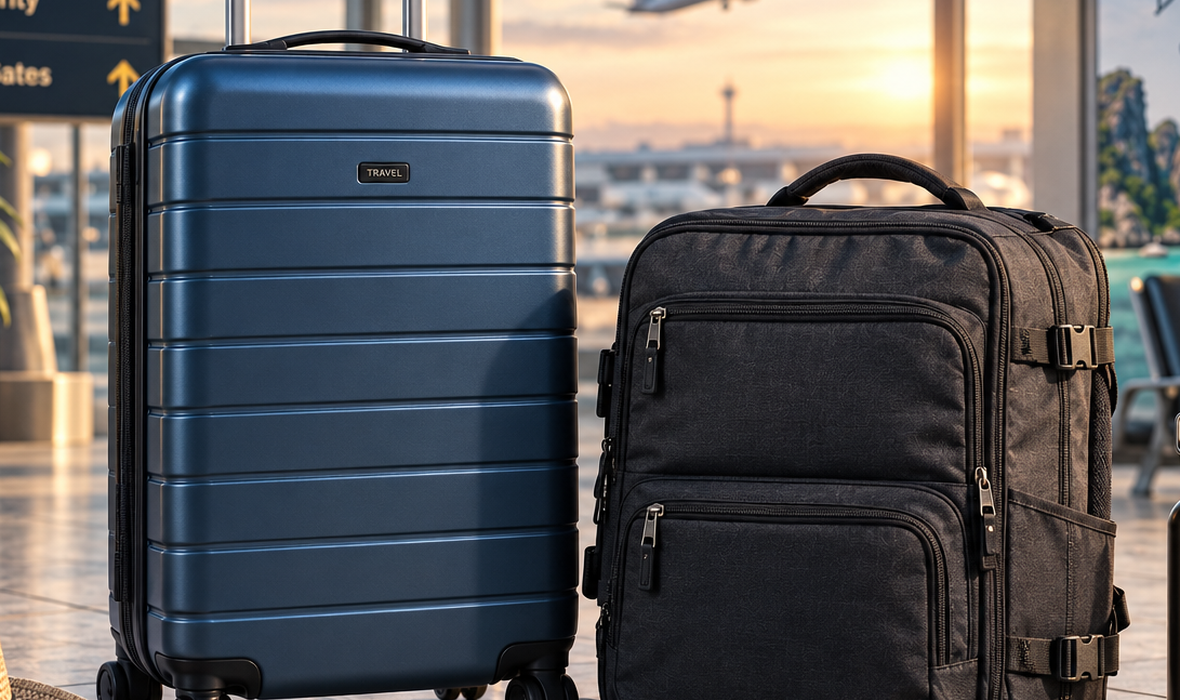
The points below compare the constructions themselves. Individual products can overcome or worsen several of these traits.
Hard-shell advantages
- Keeps a defined outside shape.
- Gives broad pressure resistance around the load.
- Usually wipes clean easily.
- Clamshell dividers organise two sides.
- Frame-closure versions can reduce exposed zip.
Hard-shell disadvantages
- Needs more space to open fully.
- Few or no external pockets on many designs.
- Glossy finishes show marks.
- Poor shells can crack or deform.
- Fixed shape is awkward in tight storage.
Soft-sided advantages
- External access for documents and layers.
- Flexible body suits mixed transport.
- Often lighter in comparable medium cases.
- Expansion can be practical for checked or road travel.
- Lid-style opening works in smaller rooms.
Soft-sided disadvantages
- Can bulge beyond stated dimensions.
- Fabric may abrade, stain or absorb moisture.
- Less fixed protection around crush-sensitive items.
- External pockets invite overpacking.
- Cleaning depends on fabric and coating.
The mistakes are ordered by how often they create a practical travel problem rather than by how expensive the case is.
Choosing the shell before checking the airline
Start with the packed outside dimensions and weight. A beautiful case that does not fit the fare allowance is the wrong case.
Assuming hard-shell means waterproof
Panels resist surface moisture, but ordinary zips, seams and handle recesses can leak.
Assuming soft-sided always means lighter
Compare the actual model. Heavy frames, pockets and expansion hardware can erase the expected saving.
Buying an expandable cabin case without measuring it expanded
The extra depth can create a gate fee. Keep expansion for journeys where the allowance permits it.
Testing wheels only when the case is empty
A smooth showroom roll says little about tracking, tipping and handle flex under a realistic load.
Packing fragile items against the shell
Keep them central, wrapped and separated from corners, wheels and heavy objects.
Checking power banks or a non-removable smart-luggage battery
Battery rules can prevent the bag from travelling in the hold. Follow current airline and CAA guidance.
Ignoring how the case opens in the room
A clamshell can dominate a small hotel floor, while a deep soft case may be harder to organise.
Buying a full luggage set before testing one size
The same wheel and handle design may feel different on a cabin case and a heavily loaded large case.
Discarding the receipt and packaging immediately
Keep them until the case has passed a loaded home test and the return period is secure.
Which lasts longer: hard-shell or soft-sided luggage?
Construction quality matters more than the category. A well-supported soft case with reinforced fabric and replaceable wheels can outlast a cheap brittle shell, while a quality polycarbonate or polypropylene case can handle frequent airport use for years. Compare wheels, handle rails, closures, warranty and repair support.
Which type is lighter?
Soft-sided medium cases are often lighter, and the current examples in this guide support that pattern, but it is not guaranteed. Compare the published empty weight of the exact size because frames, pockets, locks and wheel systems change the result.
Is hard-shell better for checked luggage?
It is a strong starting point for airport-heavy trips because it keeps a fixed shape, wipes clean and provides a broad barrier around the contents. A quality soft case can be equally practical when low weight, mixed transport and repairable fabric matter more.
Is soft-sided luggage better for cabin travel?
It can be, particularly when front access and under-seat flexibility matter. However, soft pockets can bulge. The complete packed bag must stay within the airline dimensions, including wheels, handles and pockets.
Do hard-shell suitcases crack?
They can. Risk depends on material, thickness, temperature, impact location, overpacking and corner design. Flexible polycarbonate and polypropylene constructions are common, while very thin low-cost shells deserve close inspection.
Can soft-sided luggage protect fragile items?
Yes, when the items are wrapped, placed centrally and separated from the perimeter. The fabric itself does not provide a fixed crush barrier, so internal packing technique is more important.
Which type is waterproof?
Neither category should be assumed waterproof. Hard panels resist surface moisture, but zips and joints can leak. Coated fabrics may be water-resistant, yet seams and closures remain vulnerable. Use inner waterproof pouches for critical items.
Are four wheels better than two?
Four-wheel spinners are easier in smooth terminals and tight queues. Two larger recessed wheels can be better on cobbles, kerbs and uneven platforms. Choose for the surfaces you will actually cross.
Which type fits more?
Capacity depends on the internal shape, handle channels, dividers and expansion. Soft cases often provide one deep cavity, while hard cases divide the load into two halves. Manufacturer litre figures are useful but are not always measured consistently.
Is polycarbonate better than ABS?
Polycarbonate is commonly chosen for flexible, resilient mid-range and premium shells. ABS is common at lower prices and can work for occasional travel, but products vary. Inspect the finished case rather than relying on the material name alone.
Is aluminium luggage worth the price?
It suits travellers who value high rigidity, frame closures and premium repairable hardware, and who accept high empty weight, visible dents and cost. It is usually unnecessary for ordinary holidays.
Can hard-shell luggage expand?
Yes. Many zippered hard cases include an expansion panel. Expansion increases depth and may push a cabin or checked case beyond an airline size limit, so measure it after packing.
Which luggage is best for train travel?
A lighter soft-sided case with accessible pockets and larger wheels is often easiest for station steps, platforms and small rooms. A compact hard case remains suitable when the route has smooth surfaces, lifts and generous racks.
How much should I spend on luggage?
Spend enough to secure reliable wheels, a stable handle, compliant dimensions and useful repair support. Current medium examples in this guide range from £161 sale pricing to £289, checked on 20 September 2026, but lower and higher options exist.
Can smart luggage go in the hold?
Only when it meets the applicable battery rules. A removable power bank or battery generally needs to be removed and carried in the cabin when the bag is checked. Confirm the battery rating and airline policy before travel.
Choose hard-shell when flights dominate
Buy a hard case when the journey is mainly airport, transfer and hotel; when the luggage will be checked repeatedly; or when a fixed packing structure makes you calmer and more organised. Look for polycarbonate or polypropylene, a sensible empty weight, protected wheel housings and a finish you can accept after it acquires marks.
Choose soft-sided when the trip keeps changing shape
Buy a soft case when trains, coaches, car boots and small rooms matter as much as the flight. Prioritise controlled expansion, accessible pockets, reinforced fabric, larger wheels and a stable base. Pack it to its measured outline rather than its maximum bulge.
For one suitcase to cover most trips
If most holidays involve checking one medium case and taking a taxi to a hotel, a light textured hard-shell spinner is the easiest all-round starting point. If your travel is more often rail-based, self-drive or multi-stop, a well-built soft-sided case is likely to be more convenient. In either category, a dependable handle, wheels and repair route should outrank colour and shell marketing.
This article was fact-checked against official airline baggage pages, UK aviation safety guidance and current manufacturer specifications. Allowances, prices and product availability were reviewed on 20 September 2026. Airline rules shown in the booking and the specification supplied with the exact product remain controlling.
- Ryanair Help Centre, Ryanair bag policy: 40 x 30 x 20 cm included personal bag and 55 x 40 x 20 cm Priority cabin bag.
- easyJet, cabin bag guidance: 45 x 36 x 20 cm small cabin bag and 56 x 45 x 25 cm large cabin bag.
- British Airways, baggage essentials: cabin and checked dimensions, including wheels and handles.
- UK Civil Aviation Authority, Pack right. Safe flight.: cabin carriage of power banks and battery safety.
- UK Civil Aviation Authority, 2026 lithium battery and power bank changes: rules effective from 27 March 2026.
- IATA, passenger lithium-battery guidance: smart luggage and removable battery handling.
- GOV.UK, Air passenger travel guide: checking airline allowances and keeping essential medication in hand luggage.
- Samsonite UK, Image Spinner Expandable 69 cm specification and price.
- Antler UK, Stamford 2.0 Medium specification and price.
- Eastpak, Tranverz M specification, fabric and warranty information.
- Travelpro UK, Maxlite 5 Medium specification, price and warranty information.
Illustrations in this article were created for Travel Gear. Third-party photographs, where used, are credited beside the image or in the source list.


