Best Personal-Item Bag Criteria for Budget Airlines
A practical framework for choosing an underseat bag that remains useful when the fare is cheap but the baggage rules are strict.
A personal-item bag can look tiny on a product page and still fail at the gate. The reason is simple: airlines judge the packed outer shape, while retailers often promote nominal litres, an empty-bag measurement or a broad claim that a backpack is “airline friendly”. Those are not the same test.
The most useful personal-item bag criteria for budget airlines begin with the strictest carrier on your itinerary. For many European low-cost routes, 40 × 30 × 20 cm is the practical mainstream ceiling. Norse Economy is slimmer at 40 × 30 × 15 cm, while easyJet gives substantially more room at 45 × 36 × 20 cm. A bag that works brilliantly for one network can therefore be awkward on another.
This guide turns those differences into a buying method. It compares current airline allowances, explains which features preserve usable capacity, and shows how to test a candidate bag at home. Airline policies and example gate charges were checked on 20 September 2026; the allowance displayed in your own booking remains the final authority.
39 × 29 × 19 cm packed
A one-centimetre planning margin beneath the common 40 × 30 × 20 cm limit makes home testing more realistic.
39 × 29 × 14 cm packed
This conservative depth suits Norse Economy and reduces reliance on squeezing a soft bag into a strict frame.
Soft rectangular shell
Light structure, flat pockets and internal compression preserve more useful space than wheels, frames or bulky organisers.
Packed size beats stated litres
Airlines measure external points. A 20-litre label cannot tell you whether the bottle pocket, handle or laptop creates a bulge.
Use the scorecard to compare bags consistently rather than being pulled towards whichever listing has the most confident marketing language.
This is not a product ranking. The weighting below is a research-led buying framework based on two priorities: first, the risk of an airline rejecting the bag; second, how well the bag works once it is within the permitted box. Dimensions receive the largest share because a comfortable, durable bag is still the wrong choice when it exceeds the allowance.
| Criterion | Weight | What earns a high score | What should trigger caution |
|---|---|---|---|
| Packed external dimensions | 30 | Below the strictest allowance with a small practical margin | Dimensions quoted only for the empty bag, or exactly at the limit |
| Empty weight and space efficiency | 20 | Under about 1 kg, simple lining, limited structural bulk | Heavy frame, wheels, excessive padding or duplicated compartments |
| Depth control | 15 | Internal compression or low-profile straps that genuinely flatten the load | Expandable zip left open, stuffed front pocket or elastic bottle bulge |
| Shape and structure | 10 | Rectangular profile with enough softness to pack efficiently | Rounded top, rigid corners or tapered fashion shape |
| Carry comfort | 10 | Comfortable shoulder straps and a stable back panel without a bulky harness | Thin tote handles for long airport walks or a large hip belt that protrudes |
| Access and device protection | 10 | Clamshell access, one flat quick pocket and a correctly sized device sleeve | Too many small pockets, thick laptop padding or a sleeve that distorts the shell |
| Durability and weather resistance | 5 | Reinforced base, sound stitching, reliable zips and a water-resistant outer | Unprotected base fabric, exposed seams or vague waterproof claims |
A 40 × 30 × 20 cm bag covers many mainstream European low-cost carriers, but it is not universal.
Airlines use different names for essentially the same underseat allowance: personal item, small cabin bag, carry-on bag or hand luggage. The label matters less than the measurements and whether the item must fit beneath the seat. The comparison below uses the free underseat allowance shown on official airline pages at the review date.
| Airline | Maximum size | Weight rule | Important wording |
|---|---|---|---|
| Ryanair1 | 40 × 30 × 20 cm | No separate small-bag weight stated on the current policy page | Must fit under the seat |
| easyJet2 | 45 × 36 × 20 cm | Up to 15 kg; passenger must carry it | Handles and wheels included |
| Wizz Air3 | 40 × 30 × 20 cm | 10 kg | Handles/wheels excluded in its wording; wheels may add no more than 5 cm |
| Vueling4 | 40 × 30 × 20 cm | No separate underseat weight shown on the current allowance page | Everything must fit under the seat; external attachments are not allowed to protrude |
| Transavia5 | 40 × 30 × 20 cm | 10 kg | Measurements include wheels and handles |
| Eurowings6 | 40 × 30 × 25 cm | No weight stated for the small underseat item | Small bag included in every fare |
| Norwegian LowFare7 | 30 × 40 × 20 cm | 10 kg | One underseat bag; airline lists dimensions in a different order |
| Norse Economy8 | 40 × 30 × 15 cm | No weight restriction shown | Dimensions include wheels, handles and external pockets |
| Jet29 | 40 × 30 × 20 cm | No separate small-bag weight stated | Small underseat bag is additional to the 10 kg cabin bag |
| TUI Airways10 | 40 × 30 × 20 cm | No separate personal-item weight stated | Personal item is additional to the 10 kg hand-luggage allowance |
Dimensions are shown as height × width × depth for comparison, even where an airline presents them in another order. Your booking confirmation and fare conditions take priority.
Start with the strictest flight in the itinerary rather than the airline you use most often.
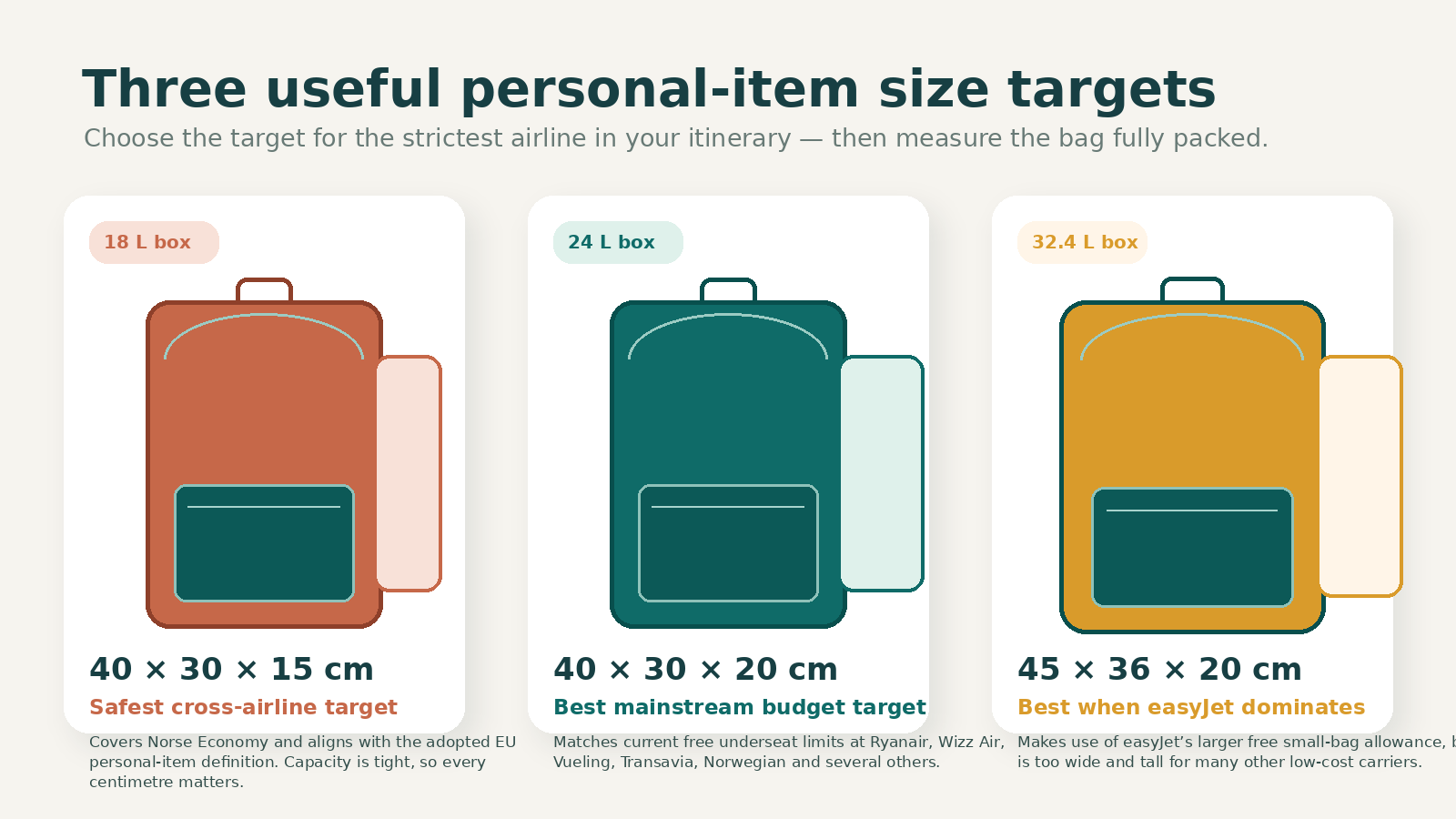
40 × 30 × 15 cm: the conservative target
This 18-litre outer box is the safer choice when Norse Economy appears in the itinerary, or when one bag needs to remain useful across the widest range of European carriers. It also matches the personal-item definition in the EU passenger-rights reform given final Council clearance in July 2026. The Council says the updated rules enter into force 12 months and 20 days after publication in the Official Journal, so current airline policies still need to be checked for travel now.11
The trade-off is packing freedom. Five centimetres less depth removes six litres from the theoretical rectangular volume compared with a 40 × 30 × 20 cm box. Consequently, thick shoes, large wash bags and bulky electronics become much harder to accommodate.
40 × 30 × 20 cm: the mainstream budget target
For travellers who mainly use Ryanair, Wizz Air, Vueling, Transavia, Norwegian, Jet2 or TUI, this is the most useful common limit. However, a bag sold at exactly 40 × 30 × 20 cm gives no allowance for a top handle, a loaded outer pocket or measurement variation. A planning target of roughly 39 × 29 × 19 cm when fully packed is more forgiving.
45 × 36 × 20 cm: the easyJet-specific opportunity
easyJet’s free small-bag allowance creates a theoretical 32.4-litre box, which is substantially larger than the 24-litre 40 × 30 × 20 cm box. A bag designed to exploit that space can be excellent for easyJet-only trips. By contrast, it is too tall and wide for many rival low-cost airlines, so it should not be treated as a universal personal item.
Retail dimensions are useful only when they describe the same fully packed outer points that a gate sizer will test.
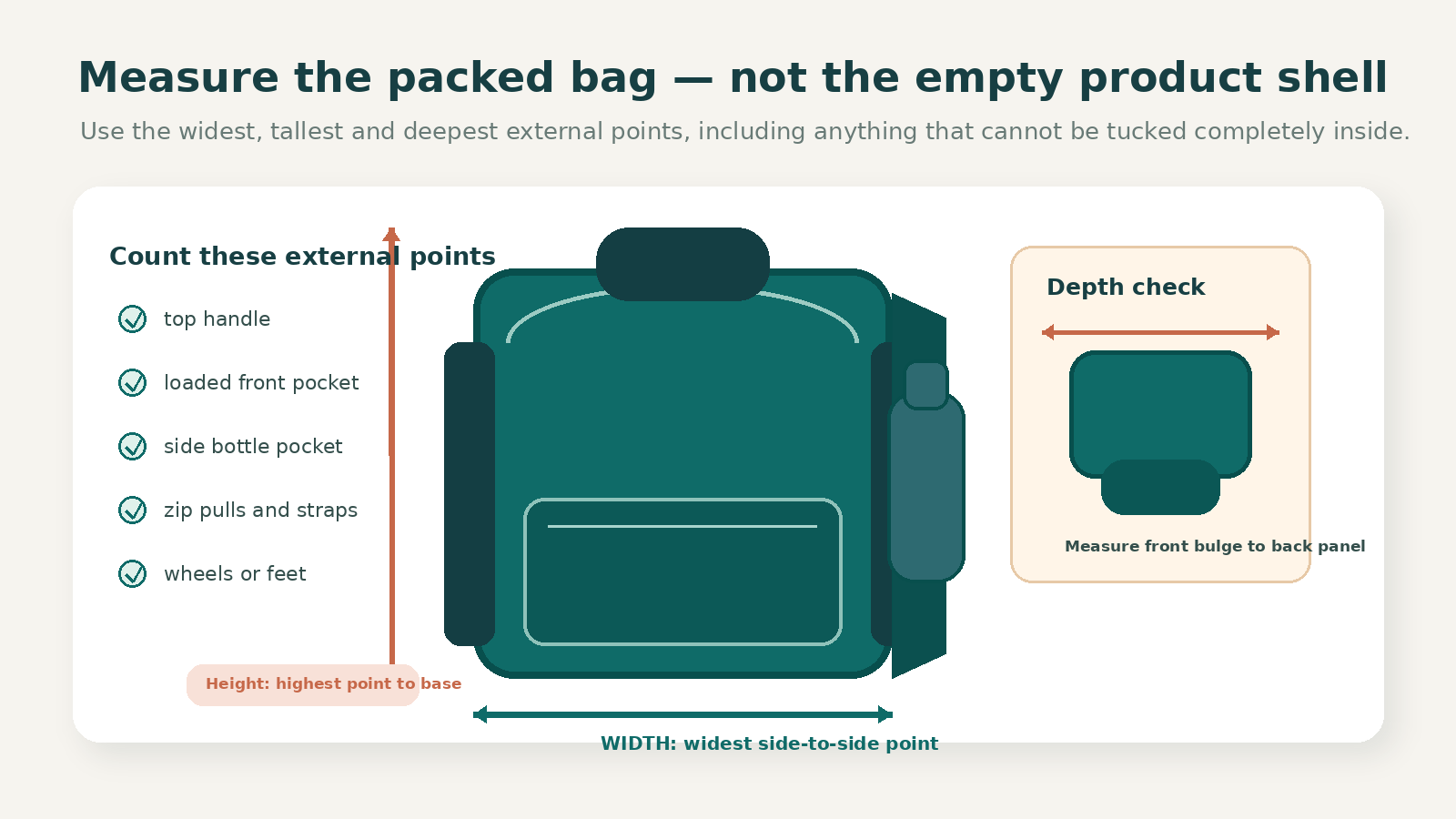
Pack first, then measure three directions
Load the bag with a realistic trip rather than towels used only to create a neat shape. Close every zip, tighten any compression system, tuck straps as they would be at the gate and leave the bag for several minutes so the contents settle. Next, measure the highest point to the base, the widest side-to-side point and the deepest front-to-back point.
A flexible tailor’s tape is useful for following curves, although a rigid ruler or straight edge gives a more honest reading across a bulge. Place one straight edge against each extreme point and measure the distance between them. This prevents a soft tape from dipping into a hollow panel and understating the true external box.
Count everything that cannot disappear
- Top and side handles
- Loaded front organiser
- Bottle or umbrella pocket
- Zip pulls and dangling webbing
- Wheels, feet or rigid base
- Laptop-induced back-panel bulge
Wizz Air’s current wording excludes handles and wheels from its stated dimensions, with a limited wheel allowance. Nevertheless, a cross-airline bag should be selected on the safer assumption that every protrusion counts. easyJet, Transavia, Norse and Jet2 explicitly include some or all of those external features in their published measurements.2589
The best structure protects the contents while allowing the bag to use a strict rectangular allowance efficiently.
Why a rectangular profile wins
A personal-item allowance is a rectangular box, so a similarly shaped bag converts more of that box into useful space. Rounded daypacks lose capacity near the top, while heavily tapered commuter bags can be wide at the shoulders and narrow where clothing needs to sit. A boxy shell also makes measurement easier because the widest points are obvious.
Soft-sided, semi-structured or rigid?
| Construction | Advantages | Disadvantages | Best use |
|---|---|---|---|
| Soft-sided | Light, efficient and able to accommodate awkward contents | Can balloon when overpacked; may sag without a good back panel | Weight-conscious travellers who pack carefully |
| Semi-structured | Holds a rectangular shape and protects devices better | Padding and panels consume some capacity | Most travellers, especially when carrying a laptop |
| Rigid or wheeled | Protects contents and keeps a predictable shell | Heavy, unforgiving and inefficient beneath a seat | Rarely the best choice for strict personal-item travel |
The strongest general choice is a lightly structured backpack: enough stiffness to stop collapse, but no fixed frame, trolley handle or hard wheel housing. Soft fabric is not permission to exceed the limit. It helps only when the packed bag remains inside the box without force.
A light bag leaves more of the allowance for the things you actually need, but durability still has to survive repeated travel.
Set an empty-weight target
A bag weighing 1.5 kg consumes 15% of a 10 kg allowance before anything is packed. A 750 g bag uses 7.5%. Therefore, an empty weight below about 1 kg is a sensible target for a personal-item backpack, while 600–900 g is especially attractive when the construction still feels sound.
Very low weight can also hide compromises. Thin shoulder straps, weak base fabric and poor zip stitching are not good savings. Instead, look for weight removed from features that do not earn their space: trolley sleeves with thick padding, duplicated laptop compartments, metal frames, oversized buckles and many small organiser pockets.
Do not compare bags by litres alone
Litres can be measured in different ways and may refer to an unexpanded or expanded configuration. In addition, two bags with the same nominal capacity can have different external dimensions. A rounded 24-litre daypack may be too tall, while a rectangular 20-litre underseat bag can use the permitted footprint more effectively.
Use those figures only as upper-bound geometry. The deciding specification remains the packed external size.
Good compression controls the packed shell; it should not be a last-minute attempt to force an oversized load into the sizer.
Depth is usually the failure point
Travellers often stay within height and width yet exceed depth because clothing expands towards the front panel. External organisers, bottle pockets and a convex laptop compartment then add another few centimetres. Since many budget-airline limits allow only 15 or 20 cm of depth, that third dimension deserves the most attention.
Prefer compression inside the outline
An internal compression panel, cross-straps or a zipped divider can hold clothing against the back without creating loose hardware outside. External side straps can also work when they lie flat and pull the entire shell evenly. However, decorative straps that squeeze only the middle may create bulges above and below the buckle.
An expansion zip is useful on the ground but risky for the flight. If the bag is compliant only when the expansion is closed, treat the expanded mode as a different bag and test both configurations separately.
The opening should help you build a controlled rectangular load rather than merely provide more pockets.
Clamshell access is easiest to control
A clamshell or suitcase-style opening exposes the full packing area and makes it easier to keep weight spread across a rectangular footprint. Clothing cubes can sit flat, while a slim wash bag and electronics pouch can fill predictable gaps. As a result, the front panel is less likely to be distorted by items dropped into a narrow opening.
Top-loading can still work
A top-loader usually weighs less and carries comfortably, but it encourages vertical stacking. Dense items can migrate to the bottom, while a jacket pushed in last can dome the top. Choose this style when simplicity matters and the bag has a broad opening, a stable base and a realistic packed-depth test.
| Opening | Best feature | Main risk | Planning verdict |
|---|---|---|---|
| Clamshell | Easy rectangular packing and quick inspection | Extra zip and divider can add weight | Best all-round choice |
| Panel loader | Good access without opening completely | Curved front panel may bulge | Good with careful packing |
| Top loader | Light and simple | Contents settle unevenly | Best for minimalists |
| Roll-top | Flexible height and weather resistance | Rolled section can exceed the height limit | Only with a fixed maximum line |
Device protection matters, but thick padding must not turn a compliant shell into a rounded one.
Measure the device, not its screen label
A laptop described as 14 or 15.6 inches is measured diagonally across the display, not by the outer chassis. Two devices with the same screen label can have different widths, bezels and thicknesses. Compare the actual device dimensions with the sleeve dimensions and the orientation inside the bag.
Put dense technology against the back
A sleeve against the back panel keeps the centre of gravity close to the body and reduces front-panel distortion. It should have enough padding to protect the device without creating a thick foam box. A suspended base is useful, although the suspension gap also consumes internal height.
Tech-heavy travellers should test the bag with the charger, plug adaptor, power bank, headphones and cable pouch included. Those small items frequently migrate into the front organiser and add more depth than the laptop itself.
Every external feature should earn its space and remain tidy when the bag is ready to board.

Keep carry hardware low profile
Shoulder straps should be comfortable enough for a long terminal walk, yet they do not need the thick harness found on trekking packs. A flexible top handle is more useful than a tall rigid loop because it can lie flat during measurement. Likewise, a removable or elasticated sternum strap is preferable to bulky hardware that hangs outside the shell.
Treat external pockets as part of the allowance
A flat document pocket is valuable. A large front organiser filled with chargers, keys and toiletries is not. Side bottle pockets deserve similar caution: an empty stretch pocket occupies little space, but a full bottle can make the bag wider or deeper than the stated specification.
Loose webbing should have keepers or elastic loops. Zip pulls need to be easy to use without being so long that they catch on a metal frame. Small details are not usually measured in isolation, but they can stop the bag sliding smoothly into a sizer.
A personal item is small, but it can still become uncomfortable when dense electronics and a full water bottle concentrate the load.
Backpack straps usually beat a tote
Budget-airline travel often involves stairs, bus gates and long walks through terminals. Two shoulder straps spread the load better than a single tote handle and leave both hands free for documents or a child. Nevertheless, the harness should remain compact because a deep lumbar pad or large hip belt can add to the measured outline.
Check how the bag behaves beneath the seat
A compliant bag still occupies legroom. A smooth rectangular base is easier to push forward than a pack with dangling straps, rubber feet or a rigid wheel housing. Dark fabric also hides scuffs, while a reinforced but flexible base tolerates repeated contact with cabin floors.
Comfort should be tested with the intended load. Walk for at least twenty minutes, climb a flight of stairs and sit with the bag at your feet. If the straps slip, the top edge digs into the back or the base tips forward, those problems will be more annoying on travel day.
The durable bag is the one whose base, seams and carry points match the way it will actually be used.
Inspect the stress points
Fabric numbers such as 600D or 900D are useful only within context because fibre, weave and coating differ. Instead, inspect the base, shoulder-strap anchors, grab handle, zip ends and the seam around the laptop compartment. Reinforcement in those areas matters more than a high denier number printed prominently on a listing.
Water-resistant is normally enough
A coated fabric and covered zip help during a wet walk from bus to terminal. Fully waterproof construction is less common, often heavier and unnecessary for normal air travel. Electronics and medication should still be placed in internal sleeves or simple waterproof pouches because water can enter through seams and openings.
Choose zips that move smoothly around loaded corners. Large, stiff waterproof zips can be durable, but they may be awkward on a small bag. Conversely, very fine coil zips save weight yet need careful stitching and sensible packing pressure.
Organisation should reduce fumbling without turning the front of the bag into a thick, overloaded toolbox.
Use one deliberate quick-access zone
A flat pocket for a passport, boarding pass and phone is more useful than several small compartments competing for depth. The pocket should close securely and remain reachable without opening the main clothing area. During boarding, however, move irreplaceable documents to an inner pocket or a close-to-body location.
Lockable zips are a limited tool
Interlocking zip pulls can deter casual opening, but they do not make soft fabric secure. A small travel lock also adds hardware and can slow security checks. For most airport use, tidy zips, awareness and keeping valuables against the back are more practical than a complex anti-theft shell.
RFID pockets, hidden compartments and cable ports may suit a particular traveller, although each layer uses space and weight. Treat them as optional features after dimensions, empty weight and carry comfort have passed.
A strong listing makes it easy to verify the packed external box; weak listings substitute slogans for measurements.
“Airline approved” without a dimension table
No bag is universally approved by every airline. A useful listing names the exact external height, width and depth, explains whether those measurements include handles or wheels, and states the empty weight. If a seller relies only on airline logos, verify every number independently.
Dimensions that exactly equal the limit
A soft 40 × 30 × 20 cm bag may exceed that box once packed. Meanwhile, a rigid bag at the same specification cannot compress at all. Look for customer photographs with a tape measure, although remember that an empty-bag image is not proof of packed compliance.
Capacity that changes between paragraphs
Some listings quote the expanded volume in the headline and the unexpanded dimensions in the specification table. Others mix internal compartment measurements with external size. Read the smallest print, find the expansion depth and treat the larger configuration as a separate baggage size.
- No empty weight stated
- No packed-depth photograph
- Only diagonal laptop size given
- Rigid handle above the shell
- Bulky bottle pocket shown full
- Returns policy unclear
The “best” criterion changes when a laptop, children’s essentials or multi-airline routing becomes the dominant constraint.
| Traveller | Size target | Prioritise | Acceptable compromise |
|---|---|---|---|
| Weekend minimalist | 39 × 29 × 19 cm | Low weight, clamshell opening, one packing cube | Limited organiser pockets |
| Cross-airline traveller | 39 × 29 × 14 cm | Strict depth control and simple rectangular shape | Less clothing capacity |
| Tech-heavy traveller | Strict airline limit with device fitted | Back-panel sleeve, cable organisation, stable straps | Slightly heavier padding, still below about 1 kg where possible |
| Family support bag | Carrier limit with easy opening | Washable lining, fast access and internal pouches | Fewer personal clothes |
| easyJet-only traveller | Up to about 44 × 35 × 19 cm packed | Use the larger footprint without adding wheels | Reduced compatibility with other airlines |
| Daypack after arrival | Compact and lightly structured | Comfort, bottle storage that flattens, understated appearance | Less suitcase-style organisation |
One bag rarely optimises every use. A cross-airline bag sacrifices easyJet capacity, while an easyJet-sized bag sacrifices flexibility. The right compromise is the one that matches the routes already being booked rather than a hypothetical maximum trip.
A personal-item bag should pass when realistically packed, not only when empty or arranged for a product photograph.

Build a simple rectangular gauge
Use a cardboard box with internal dimensions matching the airline limit, or tape a rectangle on the floor and create the depth with two upright pieces of card. The bag should slide into the space with normal hand pressure. If it needs repeated pushing, straps must be folded one at a time or the zip is under visible strain, reduce the load.
Run the same test you will face on travel day
- Pack the exact laptop, charger, toiletries, clothes and empty bottle planned for the journey.
- Close expansion zips and secure every loose strap.
- Leave the bag upright for ten minutes, then measure height, width and depth.
- Weigh it with a reliable scale and compare the correct fare rule.
- Slide it into the home gauge without leaning your body weight on it.
- Walk for twenty minutes, return it to the gauge and measure again.
The most useful purchase is not necessarily the bestselling bag; it is the one whose delivered dimensions survive your own packed test.
There is no ranked product list here because stock, dimensions and seller descriptions change. Instead, the links below open focused Amazon UK searches that make it easier to compare bags against the criteria in this guide. Re-check every listing and measure the delivered item during the return period.
40 × 30 × 20 cm underseat backpacks
Start here for the common Ryanair, Wizz Air, Vueling and Transavia-style footprint.
40 × 30 × 15 cm personal items
Use the slimmer search when Norse Economy or conservative cross-airline compatibility matters.
Measurement tools
A compact luggage scale and flexible tape make the packed-bag check repeatable.
Compare luggage scales on Amazon UK
Compare soft tape measures on Amazon UK
A purpose-built underseat bag can save money and simplify travel, but it is not automatically the best solution for every route.
Advantages
- Reduces dependence on paid overhead baggage.
- Fits the underseat footprint more efficiently than a general daypack.
- Keeps essentials close during the flight.
- Makes self-transfer and public transport easier.
- Encourages a controlled, repeatable packing list.
Disadvantages
- A universal size target sacrifices capacity on more generous airlines.
- Underseat storage reduces legroom.
- Strict depth limits make shoes and bulky winter clothing difficult.
- Heavy technology can make a small backpack uncomfortable.
- Airline rules can change after the bag is purchased.
A dedicated bag is most valuable for travellers who repeatedly book basic fares. Occasional flyers may be better served by measuring an existing backpack and paying for extra baggage only when the trip genuinely requires it.
Most failures begin with a correct bag packed in the wrong way, or a product claim that was never checked against the actual fare.
- Buying by litre capacity without checking three external dimensions.
- Measuring the bag empty and assuming soft fabric will always compress.
- Choosing exactly the published maximum with no margin for packed bulges.
- Ignoring a stricter airline on the return or connecting itinerary.
- Leaving an expansion zip open because the bag still looks small.
- Filling a bottle pocket after the main bag has been measured.
- Assuming every 14-inch or 15.6-inch laptop has the same chassis size.
- Letting loose straps, zip pulls or a rigid handle catch on the sizer.
- Using a heavy wheeled design when the fare includes a weight limit.
- Relying on an “airline approved” badge instead of the current booking conditions.
These answers apply the current airline comparison and the measurement method used throughout the guide.
What is the safest personal-item size for European budget airlines?
For broad compatibility, about 39 × 29 × 14 cm when packed is a conservative target. It sits beneath a 40 × 30 × 15 cm limit and also fits within the common 40 × 30 × 20 cm allowance. The sacrifice is capacity, so travellers who never use a 15 cm-deep limit may prefer about 39 × 29 × 19 cm.
Is 40 × 30 × 20 cm accepted by every budget airline?
No. It matches many current European low-cost allowances, including Ryanair, Wizz Air, Vueling and Transavia, but Norse Economy lists 40 × 30 × 15 cm. easyJet permits a larger 45 × 36 × 20 cm bag, while other carriers may use different figures.
Should a personal-item backpack be soft or rigid?
A lightly structured soft-sided backpack is usually the best balance. It uses the rectangular allowance efficiently and can accommodate awkward contents, while a stable back panel prevents sagging. A rigid shell is heavier and cannot recover from even a small measurement error.
How much should the empty bag weigh?
Below about 1 kg is a useful planning target for a strict personal item. Bags around 600–900 g preserve more of a 10 kg allowance, provided the base, straps and zips remain durable.
Do handles and straps count in airline measurements?
Many airlines explicitly include handles, wheels or external pockets, while wording differs elsewhere. For reliable cross-airline use, measure every part that cannot be tucked completely inside the permitted box.
Can I squeeze an oversized soft bag into the sizer?
Depending on force is risky. The safer test is a bag that slides into a matching home gauge with normal hand pressure and no visible strain. Overpacking can also make a compliant product exceed its advertised dimensions.
Are airline-approved bag labels reliable?
Only when the current external dimensions match the exact fare conditions for every flight. Airline logos and approval wording are marketing claims, not a universal standard.
Is a 20-litre bag automatically small enough?
No. Litres describe capacity, not shape. A tall rounded 20-litre daypack can exceed an airline height limit, while a rectangular bag may use the same external box more effectively.
What opening is best for a personal-item bag?
A clamshell opening is easiest for building a flat, rectangular load and checking the contents. Top-loading bags can work well for minimalists, but they need a stable base and careful control of the top and front bulges.
Where should the laptop sit?
Against the back panel is normally best because the weight stays close to the body and the front panel is less likely to bulge. Measure the actual laptop chassis and retest the bag after inserting it.
Are wheels worth having on an underseat bag?
Usually not for strict budget-airline travel. Wheels, housings and a telescopic handle add weight and consume space, while the bag still needs to fit beneath the seat.
How much spare room should I leave below the limit?
A planning margin of roughly 1 cm in each direction is sensible for a soft bag, although it is not an airline guarantee. Leave more depth margin when the bag has stretch pockets or a padded laptop compartment.
How do I test a bag before the returns period ends?
Pack the real load, close all zips, measure the three widest external points, weigh the bag, slide it into a cardboard gauge and carry it for twenty minutes. Repeat the measurement after the contents have settled.
Will the new EU personal-item rule make every bag free?
The adopted reform defines a free personal item around 40 × 30 × 15 cm or one that fits under the seat, but implementation is not immediate and the overhead cabin bag is a separate issue. For current travel, follow the allowance shown by the operating airline and your fare.
The decision becomes straightforward once the strictest route, packed size and carry method are treated as one system.
For most travellers using several European budget airlines, choose a rectangular, soft-sided backpack that stays around 39 × 29 × 19 cm when fully packed, weighs less than about 1 kg empty and has internal compression, a back-panel device sleeve and flat external pockets. That specification makes sensible use of the widespread 40 × 30 × 20 cm allowance without relying on a perfect gate measurement.
Move to roughly 39 × 29 × 14 cm when Norse Economy is part of the plan or maximum cross-airline compatibility matters more than capacity. Conversely, use a larger easyJet-specific bag only when the itinerary is genuinely dominated by easyJet and you accept that it will not transfer neatly to stricter carriers.
Most importantly, buy the bag early enough to test it. Pack the real load, measure every external point, build a home sizer and walk with it. A bag that passes those checks is far more valuable than one that merely carries an airline logo on its listing.
The current airline page and the allowance in the traveller’s own booking remain the final checks before departure.
Airline baggage rules are operational information and can change without a long notice period. The article uses official airline help pages for the comparison, while editorial recommendations such as the one-centimetre planning margin and weighted scorecard are clearly presented as Travel Gear judgement rather than airline rules.
Fees are dated examples, not guaranteed quotations. Product-search links are included for convenience; no specific retail listing has been ranked because seller dimensions, stock and specifications can change.
- Ryanair — Bag policy: free small personal bag 40 × 30 × 20 cm. Checked 20 September 2026.
- easyJet — Cabin-bag policy: free small bag 45 × 36 × 20 cm including handles and wheels, up to 15 kg. Checked 20 September 2026.
- Wizz Air — Baggage allowance: free carry-on bag 40 × 30 × 20 cm and 10 kg, with its stated handle/wheel wording. Checked 20 September 2026.
- Vueling — Hand-luggage allowance and oversized underseat-bag gate charge range. Checked 20 September 2026.
- Transavia — Free underseat bag 40 × 30 × 20 cm, 10 kg, dimensions including wheels and handles; gate charge wording. Checked 20 September 2026.
- Eurowings — Small underseat bag 40 × 30 × 25 cm in every fare. Checked 20 September 2026.
- Norwegian — LowFare underseat bag 30 × 40 × 20 cm with 10 kg limit. Checked 20 September 2026.
- Norse Atlantic Airways — Economy personal item 40 × 30 × 15 cm; dimensions include wheels, handles and external pockets. Updated 17 May 2026; checked 20 September 2026.
- Jet2 — Small underseat bag 40 × 30 × 20 cm in addition to cabin luggage. Checked 20 September 2026.
- TUI Airways — Personal item 40 × 30 × 20 cm in addition to hand luggage. Checked 20 September 2026.
- Council of the European Union — Final clearance and stated implementation timing for the 2026 air-passenger-rights reform. Published 13 July 2026.
- European Parliament and Council joint text — Definition of personal item and Article 11a wording used for the legislative context. Dated 1 July 2026.
Illustrations in this article were created for Travel Gear. Third-party photographs, where used, are credited beside the image or in the source list.