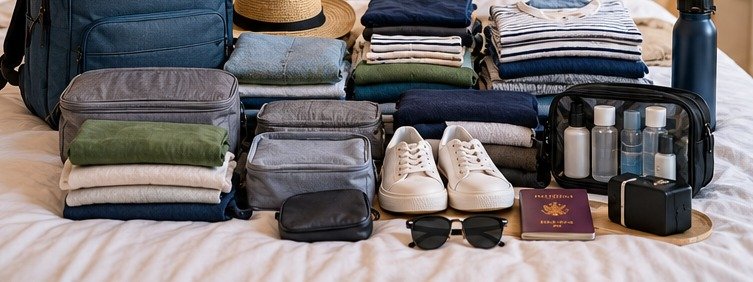
Best Packing Cubes for Backpacks

Best Packing Cubes for Backpacks
Choose around the opening, usable space and loaded shape of your pack—not its litres alone.
The best packing cubes for backpacks are not necessarily the ones that look neatest in a suitcase. A backpack may have a narrow opening, a curved back panel, a laptop sleeve and external pockets that borrow space from the main compartment. A cube can fit the published bag dimensions yet still be awkward to insert, remove or carry once everything is packed.
Start with the pack you already use. Work out how it opens, where the clothing can sit and what you need to reach during the day. Then choose organisers around those jobs. Buying a large matching set first can leave you trying to force suitcase-shaped blocks into a bag that would work better with one smaller cube and some flexible space.
This guide compares six relevant options, explains how to measure actual fit and offers trial layouts for different kinds of backpack. Recommendations combine manufacturer specifications with practical packing judgement. No hands-on testing, personal ownership or universal compatibility is claimed, and the examples are starting points to test with your own bag rather than guaranteed packing formulas.
The actual opening
A cube can fit inside yet be difficult to remove.
Osprey Ultralight Medium
Investigate the complete shape, including depth.
Sea to Summit Small
A relatively shallow option to trial in a front-opening pack.
Wear the loaded bag
Access, profile and carrying practicality all matter.
Best packing cubes for backpacks compared
Why shape comes before capacity
Litres describe a quantity of space, not the shape of the opening through which you must access it. Two bags with the same nominal capacity can therefore need different cubes. The table prioritises identifiable products, useful dimensions and access characteristics; it does not promise that a particular cube fits every backpack within a given capacity band.
The order starts with flexible, straightforward options, then includes alternatives for visibility, compression and everyday organisation. A product can be the right choice for one backpack and the wrong one for another. Read the recommendation alongside its limitation rather than interpreting the shortlist as a single numerical performance ranking.
Comparison table – scroll sideways on smaller screens
| Option | Shape and access cue | Main trade-off | Buying information |
|---|---|---|---|
| Osprey Ultralight Medium | 22 x 15 x 12.5cm; J-shaped opening [1] | Check depth in slim packs | Manufacturer details in sources |
| Eagle Creek Isolate XS/S/M | Three sizes; M footprint 36 x 25cm [2] | Do not force the whole set into one bag | Check UK set |
| Sea to Summit Ultra-Sil Small | 25 x 19 x 9cm; visible mesh top [3] | Mesh does not isolate moisture | Check Small |
| Peak Design Ultralight Mesh Small | Flexible, see-through mesh construction [4] | Filled shape can change | Check mesh Small |
| Eagle Creek Isolate Compression S/M | Extra zip for reducing a suitable clothing load’s depth [5] | A dense block may reduce flexibility | Check compression pair |
| Osprey Daylite set | 2L, 4L and 9L cubes; visible contents [6] | Use the sizes that fit, not necessarily all three | Check Daylite set |
Specifications reviewed 10 October 2026. Dimensions identify useful trial shapes, not a guarantee of fit in any named backpack.
The simplest useful test
Pack the clothes you intend to take, put the proposed cube inside the bag and retrieve it through the opening you will actually use. Then add the remaining gear and repeat the test. That final step matters: an empty backpack makes almost any reasonable organiser look convenient, while a filled laptop sleeve or side pocket can change the available space substantially.
Six options worth matching to your pack
Osprey Ultralight Medium: for a narrow clothing bundle
The Osprey Ultralight Medium is listed as a 4-litre cube measuring 22 x 15 x 12.5cm. It uses recycled 40D high-tenacity nylon and has a J-shaped opening with two zip pullers. These details make it worth investigating for a compact clothing group, while its depth means it still needs checking against a shallow backpack. [1]
The narrow face can be useful when you want clothing beside, rather than on top of, another packing category. However, rotating a cube changes which dimension runs across the pack. Check the full filled shape in the orientation you intend to use, not just the dimension that looks most convenient in the product listing.
This is a sensible option for someone who wants one small organiser rather than a comprehensive system. It can leave flexible space around it for another soft item, but it should not be expected to create access where the pack's opening prevents it. The manufacturer's page is included in the sources so you can compare the exact specification directly.
Eagle Creek Isolate XS/S/M: adaptable sizes with a version caveat
Eagle Creek's ordinary Isolate set provides three sizes rather than three matching blocks. The manufacturer lists footprints of 19 x 11cm, 25 x 18cm and 36 x 25cm for XS, S and M, with depths of 6, 8 and 8cm. That larger footprint is particularly important in a narrow backpack: a shallow cube can still be too wide. [2]
The useful approach is to select the components that fit your bag, not insist on carrying the complete set. A smaller clothing cube plus the XS for loose soft items may suit a compact pack better than filling the M. Conversely, a broad clamshell backpack may accommodate the M comfortably and make its flatter layout more convenient.
There is a weight-version issue to check before purchase. Current manufacturer component figures and a UK retailer's stated set weight differ, so this guide does not promise that every retail set has the manufacturer's calculated total. Confirm the supplied version when grams are central to your decision. Shape and access still need a separate trial regardless of that answer. [7]
Sea to Summit Ultra-Sil Small: a visible, shallow stack
Sea to Summit lists the Small Garment Mesh Bag at 25 x 19 x 9cm and 60g. The body uses Ultra-Sil nylon, while the mesh lid provides visibility and does not offer sealed protection from moisture. The linked UK listing identifies the Small Spicy Orange version; its retailer weight fields conflict, so the manufacturer's figure remains a reference rather than a verified shipped-item measurement. [3] [8]
This shape is worth considering when a clothing stack needs to lie relatively flat inside a front-opening backpack. You can see part of the contents without opening it, which may make the morning clothing choice easier in a small room. However, visibility is less useful if the mesh face is always buried against another packed layer.
Arrange the cube so that the opening and visible panel work with your backpack, not against it. Then test whether you can remove a garment without extracting the entire organiser. For a very narrow top-loader, a smaller or more flexible container may be easier to handle even when the Sea to Summit footprint technically fits inside.
Peak Design Ultralight Mesh Small: for a changing soft load
Peak Design's Ultralight range includes separate fabric and stretch-mesh constructions. Here, the relevant option is the Small mesh cube, which offers a flexible, visible container rather than the weather-resistant fabric version. The buying link selects Eclipse; changing materials or choosing a bundle changes what is being compared. [4]
A flexible cube can be useful when the clothing group changes shape through the trip. However, do not expect it to hold a precise rectangular footprint as reliably as a more structured organiser. Its benefit is accommodating the contents, not reserving a fixed amount of space in the backpack regardless of how much you put inside.
This makes it a reasonable option for a pack where soft clothing needs to fit around other items, provided those neighbouring items are not sharp or unsuitable for contact with mesh. Keep delicate electronics in appropriate protection rather than assuming the cube's organisation role includes impact protection. Choose it for flexible separation, and test the resulting shape after packing.
Eagle Creek Isolate Compression S/M: a selective bulk-control option
The current manufacturer dimensions for the compression pair are 25 x 18 x 8cm and 36 x 25 x 8cm before compression. Their stated individual weights are 54g and 82g. The additional zip is intended to reduce packed depth, but the amount achieved depends on the garments and the load rather than being a guaranteed result for every use. [5]
Use compression for a specific bulky category that otherwise prevents a workable layout. For example, one soft layer might benefit while everyday small garments remain in a simpler cube. This avoids adding a second closure to every clothing group when only one group creates a space problem.
Be careful about the resulting block. A densely compressed parcel can leave awkward gaps or press against another item if its shape does not suit the pack. Try it in several positions, close the bag normally and wear the loaded backpack. Reduced volume is helpful only when it produces a more practical bag rather than a harder, less adaptable lump.
Osprey Daylite set: straightforward organisation for everyday travel
The Daylite set contains 2-, 4- and 9-litre cubes with mesh visibility and grab handles. Osprey lists the medium cube separately at 23 x 18 x 11cm and the large at 30 x 24 x 13cm. These are useful reference dimensions for testing the main pieces, but the whole set need not travel together. [6] [9] [10]
This option makes sense when you prioritise a simple, visible system over the lowest possible organiser weight. The sizes can serve different bags within a household or different trip lengths. However, do not confuse the Daylite range with Osprey's Ultralight cubes: the names, dimensions and construction choices describe different products.
For a backpack, select the piece that gives clothing a defined home while leaving room for non-clothing essentials. A 9-litre cube could be useful in a broad travel pack yet dominate a small commuter bag. Match its filled dimensions to your intended position, especially when a laptop or other rigid item already occupies the rear of the compartment.
Match the cube to the backpack opening
Clamshell or suitcase-style openings
A full clamshell opening lets you arrange clothing in broad layers and see much of the main compartment at once. Rectangular cubes can work well here, provided they fit the actual usable width. Yet the interior may still contain a divider, compression panel or curved edge that reduces the neat rectangle shown by the external measurements.
Position frequently used clothing where it can be reached without dismantling the whole layout. Also test the bag standing upright, because you may not have room to lay it fully open during every stop. A convenient hotel-room arrangement can become less useful when the pack is squeezed beside a seat or placed in a narrow corridor.
Top-loading backpacks
A top-loader rewards organisers that pass easily through the mouth and can be identified by feel or a clear visual marker. The widest part of the main compartment is not necessarily the widest part of the opening. Therefore, the removal test is just as important as checking whether a cube can be pushed into place during packing.
Avoid burying the first item you need under several tightly fitted containers. A simple vertical order can work: next-use clothing near the top, less frequently needed items lower down, with essential daytime access handled by appropriate pockets. That order should remain flexible enough to change when the laundry bag grows or a layer comes out.
Panel openings and partial zips
Some backpacks open widely at the top but only partway down the sides. They sit between a clamshell and a classic top-loader, and may favour smaller cubes that can be removed independently. A single large cube can use the interior efficiently while making every retrieval unnecessarily difficult.
Try two modest organisers before assuming one large one is more efficient. However, include their combined empty weight and the extra zip operations in the comparison. The better option is the one that simplifies access with the actual contents, not the one with the greatest number of compartments.
Measure useful space, not marketing capacity
Start with the occupied backpack
Put the laptop, protective sleeve, footwear or other fixed-shape items into their intended positions first. Then measure the space remaining for clothing. Doing the process in reverse can leave the clothing cubes apparently fitting perfectly until the items with the least flexibility are added at the end.
Use folded towels or spare garments to make a trial block matching a cube's published dimensions. This is not an exact product simulation, but it can expose an obviously unsuitable footprint or depth before you spend money. Keep some tolerance because a filled soft cube can bulge and published dimensions are not a promise of rigid geometry.
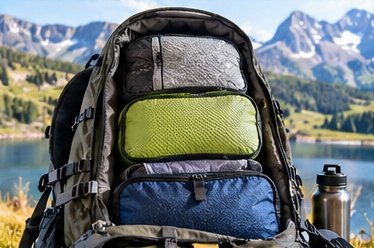
Check depth with external pockets in use
A bottle pocket, front pocket or internal organiser may occupy space that otherwise seems available to the clothing load. Fill the pockets you actually use during travel, then repeat the closing and retrieval tests. An ideal layout in an empty main compartment is not yet a realistic packing plan.
Pay particular attention to the bag's front-to-back profile. A shallow-looking cube can become noticeably thicker when garments settle or when smaller items are pushed around it. Close the bag without excessive force, set it down naturally and measure the resulting outer profile rather than pressing it temporarily flat for the measurement.
A simple packing geometry worksheet
Work from rectangles, then allow for reality
Write down the usable width, height and depth of the clothing area. Next, list the cube dimensions in the orientation you intend to use. If two cubes share a row, add the dimensions that run across the row; if they stack, add their filled depths. This simple calculation can rule out an impossible combination before the physical trial.
For instance, a hypothetical 28cm-wide area cannot comfortably hold two cubes each occupying 15cm across that width. Rotating one may help, but only if the other dimensions still fit. These are teaching measurements, not specifications for a named backpack. The arithmetic should narrow your options rather than replace checking the real bag.
Do not multiply dimensions into a packing promise
External dimensions can be multiplied to estimate a rectangular envelope, but that does not establish usable internal capacity. Flexible sides, seams, rounded corners and the closure all affect what can be inserted. Treat a calculated volume as a comparison aid, not a claim that a particular number of shirts must fit.
The same caution applies to adding manufacturers' advertised capacities. A collection of cubes totalling a certain number of litres does not necessarily occupy a backpack of that nominal capacity neatly. Their shapes and the bag's non-clothing compartments still have to work together. The filled trial remains the deciding test.
Comparison table – scroll sideways on smaller screens
| Trial question | What to check | Reason to reject the layout |
|---|---|---|
| Does the filled cube pass through the opening? | Insert and remove it with neighbouring gear present. | It fits only when forced or when the pack is emptied. |
| Do stacked depths fit? | Add the filled depths, allowing for the occupied pockets. | The bag closes only after pushing its profile artificially flat. |
| Can you reach the next needed item? | Try retrieval while the backpack is upright. | A quick clothing change requires a complete unpack. |
| Does the return load still fit? | Move a realistic clothing portion into its laundry container. | Only the perfectly folded departure arrangement works. |
An editorial fit worksheet, not a compatibility chart for named backpacks.
Four backpack layouts to try
A small personal-item backpack
Start with one compact clothing cube and reserve space for the items needed during the journey. Avoid using a large organiser simply because it fits the empty bag. In a small pack, a cube that can be removed independently may be more valuable than one that uses every possible centimetre of the main compartment.
A shallow option such as the Sea to Summit Small is worth measuring against the available space, but no fit is guaranteed. Keep the rest of the clothing flexible where that helps the bag close naturally. After adding every item, check the outer dimensions and your booked baggage allowance rather than assuming that a neat interior establishes compliance. [3] [11] [12]
A medium clamshell travel backpack
Try one main clothing cube plus a smaller organiser for items that repeatedly disappear inside the larger stack. Leave a separate area for the washbag and any rigid equipment. The arrangement should let you remove the clothing as one or two units without dragging the rest of the contents onto the floor.
The ordinary Eagle Creek Isolate set offers several footprints to investigate, but you may only need two of them for this layout. Use the manufacturer's dimensions as a starting point and confirm the supplied product version. A partly filled medium cube can be more adaptable than one packed so tightly that every edge becomes fixed. [2]
A narrow top-loader for a multi-stop trip
Keep the system vertical and understandable. A flexible clothes container near the top can provide the next change, while a separate lower area holds clothing that will not be needed until later. Practise reaching the correct container without emptying the pack; otherwise the organisation only works when you have enough floor space for a full unpack.
The Peak Design mesh option is one flexible alternative to investigate for this role. However, mesh and stretch do not guarantee an easy fit through every opening. Fill it realistically, check for snagging against neighbouring equipment and make sure you can restore the arrangement without squeezing everything harder each time. [4]
A shared household set for several backpacks
A mixed-size set can be shared across different bags rather than carried as a single system. One person may need a small clothing organiser for an overnight trip, while another uses the larger piece in a broader travel backpack. This can be more sensible than buying a complete matching set for each bag immediately.
The Daylite set is worth considering on that basis because its three capacities serve different jobs. Label the pieces if ownership would otherwise become confusing, and return them to a common storage place after trips. A household set only saves clutter when the useful pieces remain easy to find when somebody next packs. [6]
Leave room for the things cubes do not solve
Electronics need their own protection
A clothing cube can organise soft garments around equipment, but it does not become a protective electronics case. Use the protection appropriate to the item and place it where the backpack supports it safely. Then build the clothing layout around that decision rather than relying on tightly packed garments to perform an unspecified protective role.
Also allow the equipment to be removed when needed. A laptop sleeve is less useful if reaching it requires pulling out an overcompressed clothing block first. Try the relevant access sequence with the backpack fully packed, including the pockets that normally hold cables or other small essentials.
Footwear changes the remaining shape
Pack any additional footwear during the fit test, not as an afterthought. Shoes create irregular spaces that may suit loose soft items better than another rigidly filled cube. Keep cleanliness and separation in mind, but avoid adding multiple layers of bags when one appropriate cover serves the job.
The important measurement is the clothing space that remains after footwear is positioned. If the resulting layout becomes awkward, reconsider whether a different cube orientation helps before buying another organiser. Sometimes the limitation is the overall clothing and footwear selection rather than the absence of a clever storage product.
Compression and carrying comfort
Reduce bulk selectively
Compression is useful when it creates a more manageable layout with the same contents. However, it can also create a dense parcel that is difficult to position. A flexible backpack makes that trade-off especially noticeable because the contents influence its shape rather than sitting inside a completely rigid shell.
Use a compression cube for a defined clothing category and leave enough softer material around it to accommodate the pack's contours. Then check the bag on your back. If the compressed block creates an uncomfortable shape or restricts access to another item, a looser arrangement may be the better practical choice despite occupying slightly more space.
Test the loaded bag while wearing it
Walk around with the packed bag, adjust its straps normally and notice whether the load remains stable. A packing plan is not complete merely because the zip closes. The clothing should not shift into an awkward shape after a few minutes, and retrieving one item should not destroy the entire balance of the arrangement.
This is a personal fit check, not a promise that a particular cube prevents discomfort. People, backpacks and loads differ. Keep the focus on observable results with your equipment: stable placement, easy access and a profile that remains manageable after the bag has been moved, carried and set down again.
Plan for clean, worn and damp clothing
Give the laundry room to grow
As clean clothes leave the main cube, the laundry container takes over part of that volume. The overall clothing load remains present, but its shape and handling needs change. Build that transfer into the layout so that the return pack does not depend on folding worn garments exactly as neatly as the clean ones on departure.
You can reserve a flexible area for laundry or let a clearly identified organiser change roles once empty. Either approach needs a consistent distinction between clean and worn clothing. Avoid a situation in which the same unlabelled pouch means something different every day without anyone being sure which role it currently serves.
Do not seal damp items away indefinitely
An ordinary mesh cube does not isolate moisture, while a separate wet-item container is a temporary transfer solution rather than a place to forget clothing. Deal with damp garments when you reach a suitable place, following their care directions. Empty and dry the container before using it again for a different purpose.
For outdoor journeys where rain protection matters, distinguish clothing organisation from the pack's overall weather-protection system. A water-resistant cube is not automatically a substitute for an appropriate liner or other protective arrangement. Match the protection to the actual conditions and the manufacturer's instructions instead of assuming that every fabric pouch is effectively a dry bag.
Keep a quick-access layer outside the cube system
Separate journey essentials from overnight clothing
The items you need while moving should not be hidden inside the main clothing cube merely because there is spare room. Give them accessible positions in the backpack's existing pockets or another suitable container. That allows the clothing system to remain undisturbed during the day and reduces repeated unpacking in inconvenient places.
Likewise, keep the next clothing change easy to identify. For a late arrival, a small group of first-use garments near the opening can be more useful than a perfectly sorted stack by clothing type. Organisation should reflect the order in which you use things, not only how they look when arranged on the bed.
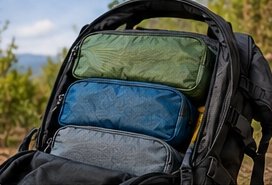
Avoid the pouch-within-pouch trap
Every added container should have a clear purpose. A tiny pouch inside a cube inside a zipped compartment may provide useful separation in a particular case, but it can also mean opening three closures to retrieve one item. Remove one layer during your trial and check whether anything actually becomes harder to manage.
Use the backpack's own organisation when it already solves the problem. Additional cubes are particularly useful for loose clothing in the main compartment; they are less obviously necessary for items that already have a well-designed dedicated pocket. A simpler setup is easier to restore after a quick search.
A pre-trip fit test you can repeat
Pack the real load
Use the clothes, footwear and non-clothing essentials intended for the journey. Substitute items only when their bulk is genuinely comparable, and note what is missing from the trial. Otherwise a layout can appear successful because the difficult objects have not yet been included.
Close the bag without pressing it artificially flat, then measure and weigh it. For air travel, compare the resulting bag with the allowance attached to your booking and the airline's current instructions. The relevant item is the loaded backpack, not the dimensions of the cubes hidden inside it. [11] [12]
Rehearse the awkward moments
Retrieve a shirt while the pack is upright, take out any item needed during transit and restore the arrangement. Then simulate the return journey by moving a realistic portion of the clothes into the laundry container. This reveals whether the system works beyond the unusually tidy departure state.
Finally, repeat the exercise after carrying the bag around. If contents have shifted, adjust their positions or reduce the number of tightly packed blocks. A few minutes of testing can identify a poor cube choice before the trip, whereas another nominal capacity figure cannot show how the contents behave together.
Care, storage and when to replace a cube
Follow product-specific cleaning instructions
Care directions differ between organisers, even within the same brand. Matador, for example, permits cold machine washing for its ordinary packing cubes and advises hanging them to dry. That does not establish the correct method for its laundry bags or for another manufacturer's lightweight fabric. Read the label on the exact product before cleaning. [13]
Empty the organiser, inspect it for trapped items and let it dry fully before storing it closed inside a backpack. This routine also gives you a chance to check whether the zip still moves normally and whether a recurring packing habit is stressing a particular area. Do not wait until departure morning to discover that the closure is unreliable.
Replace the problem, not the whole system
A single unsuitable cube does not necessarily justify replacing every organiser you own. You might need a narrower shape, a more visible panel or a simpler opening for one specific task. Keep the pieces that still fit your bags and serve their intended purposes.
Matador's standard three-piece set is another size system worth comparing when those footprints suit your pack, but it is not included as a universal upgrade. The useful principle is to compare dimensions and functions against the problem you have identified. A different brand name alone does not make an arrangement more efficient. [13]
Cubes, stuff sacks and built-in compartments
Use the container that matches the shape
A rectangular cube can make folded clothing easier to organise, whereas a simple stuff sack can suit a soft item that does not need to form a flat stack. Neither format is inherently more efficient in every backpack. Look at the remaining space and the frequency with which you need the contents before choosing the container.
For example, a loose layer that fills an irregular gap may be less awkward in a flexible sack than in a firm cube. Conversely, several small garments can become difficult to locate in one deep sack. Choose organisation where it improves retrieval, and preserve flexibility where a rigidly defined clothing block would waste the available shape.
Do not duplicate a useful internal compartment
Some backpacks already have a separate clothing area or a zipped divider that keeps a modest load together. Try using that feature directly before adding another full-size organiser inside it. A cube may still make transfers easier, but it should provide a benefit beyond repeating the same separation in a second layer.
This is particularly relevant when the compartment opening is restrictive. The added cube can make a previously accessible space harder to use because its handle or filled corners catch during removal. Test the compartment with and without it, keeping the clothing quantity unchanged, and retain the arrangement that is simpler in real use.
Questions to ask a seller when fit is uncertain
Request the size in its ordinary filled state
A product page may show flattened dimensions, maximum expanded dimensions or a compressed setting without making the distinction obvious. Ask which state the listed measurements describe. For a flexible organiser, a photograph beside a ruler can sometimes clarify the shape, although it still does not guarantee fit with your particular clothing load.
Ask separately about the mouth of the cube and the way it opens when that affects access. A nominally generous container can be inconvenient if the opening makes a neatly folded stack difficult to insert. Knowing that before ordering is more useful than discovering that the volume figure was technically correct but practically unhelpful.
Confirm the individual piece rather than the whole set
When only one component will go into your backpack, obtain its dimensions and weight rather than relying on the set description. A bundle photograph can make the relative sizes clear while omitting the measurements needed for your decision. State exactly which size, material and model you are asking about so the answer does not refer to another variant.
Keep the seller's answer alongside your own measurements. When the cube arrives, check the match before removing packaging unnecessarily or using it on a trip, and follow the retailer's current returns conditions. This approach does not eliminate uncertainty, but it turns a vague fit question into several specific points that can actually be checked.
Ask about the feature you will depend on
If you need a handle for repeated removal, a particular opening direction or a care method compatible with your routine, confirm that detail explicitly. Do not infer it from a lifestyle photograph where the relevant part of the product is hidden. A slightly less glamorous organiser with clear, suitable specifications can be the more dependable purchase for a well-defined packing job.
Check the direction of the opening as well as the size
Put the working zip where you can reach it
A cube may fit in two orientations but be convenient in only one. Position the opening towards the part of the backpack you can access, then try retrieving a single garment without taking the organiser out. A handle facing the wrong direction can similarly make removal awkward even when the dimensions are otherwise suitable.
For a top-loader, practise lifting the filled cube by its intended handle while another item remains beside it. For a front-opening pack, check whether the lid can fold back without catching under a neighbouring container. These small access details can matter more during daily use than a modest difference in nominal capacity.
Test the same arrangement after one item is removed
A layout can change when the largest garment comes out of a cube. The remaining contents may settle, the organiser may become less structured and another item can move into the space. Repeat the retrieval test with that reduced load rather than assuming the departure arrangement remains representative throughout the trip.
Some flexibility is useful, but the contents should still be identifiable and straightforward to restore. If a half-empty cube becomes difficult to handle, try a smaller size or a simpler clothing grouping before adding another container. The goal is an arrangement that works across the changing load, not just when every organiser is filled to its maximum shape.
Pros and cons inside a backpack
What a well-chosen cube adds
It can give clothing a defined home, make unpacking faster and reduce the number of loose items that shift around the main compartment. Smaller cubes can also make access through a restricted opening more predictable. When the system matches the pack, removing one clothing group need not disturb the electronics, washbag or other essentials around it.
What an unsuitable cube takes away
An overlarge footprint can waste curved spaces, a deep cube can distort the bag's profile and an overcompressed block can reduce flexibility. Additional organisers also add weight and more closures to operate. None of those drawbacks means cubes are inherently unhelpful; they mean fit and access should be tested rather than assumed from a product photograph.
Common mistakes to avoid
Shopping by litres alone
Compare all three dimensions and the bag opening, then test the filled shape. Nominal capacities are useful for narrowing a shortlist, but they cannot guarantee that two soft containers will nest neatly together. A smaller, better-shaped cube may provide more usable organisation than a larger one that is difficult to remove.
Filling every cube because it came in the set
Leave unnecessary pieces at home. A set can serve different journeys or different bags, and there is no requirement to use every component simultaneously. Extra storage should not become an invitation to add clothes that were absent from the original packing plan.
Confusing neatness with baggage compliance
A bag can look organised and still exceed its permitted outer size or weight. Check the fully packed backpack against the conditions for your particular journey, including the return leg. Do not rely on a cube being described as travel-sized or cabin-friendly as evidence that the bag containing it will be accepted. [11] [12]
Frequently asked questions
What size packing cube should I use in a 30-litre backpack?
There is no reliable answer based on capacity alone. A broad clamshell and a narrow top-loader can both be sold as 30 litres while requiring different shapes. Measure the clothing area after adding fixed-shape essentials, then test one main cube and a smaller organiser only if needed. Check removal through the actual opening as well as whether the cubes can be pushed into the interior.
Is one large cube better than several small cubes?
One large cube reduces the number of containers and closures, but it can make a restricted opening harder to use. Several smaller cubes offer more selective access, although their combined weight and complexity may increase. Compare both arrangements using the same contents. The better choice is whichever lets you retrieve and repack clothing conveniently without distorting the loaded bag.
Can suitcase packing cubes be used in a backpack?
Yes, when their filled dimensions and access arrangement suit the pack. The product's marketing category is less important than the actual shape. However, a wide, shallow suitcase cube may be awkward in a narrow top-loader, while a deep cube may overfill a slim backpack. Test existing cubes before buying replacements; rotating or partly filling one may solve the problem without another purchase.
Do I need compression cubes for one-bag travel?
Not necessarily. Compression is useful when bulk is preventing a workable layout, but it does not remove weight and may create a less flexible parcel. Start by reducing unnecessary clothing and trying an ordinary cube. Add compression selectively when a particular garment category still needs it. Carrying every item in a compressed block is not a requirement for travelling with one bag.
Will cubes protect my clothes from rain?
Normal clothing organisers should not be assumed to provide sealed rain protection. Mesh, ordinary zips and water-resistant fabrics have different limitations. Use an appropriate overall protection arrangement for the backpack and the conditions, following the relevant manufacturers' instructions. Keep the cube's organisation role separate from the decision about protecting items that must remain dry.
Should a clothing cube sit against the back panel?
Position depends on the other contents and the backpack design. A clothing cube should not obstruct a laptop compartment or create an uncomfortable shape. Place fixed-shape items in their intended locations first, then use clothing to create a stable, accessible arrangement around them. Wear the loaded bag and adjust what you observe rather than relying on a universal rule for every cube and pack.
Is mesh or solid fabric better for a hostel stay?
Mesh can help identify contents quickly, while solid fabric offers more visual privacy. Neither is automatically better for every traveller. Think about where you will open the cube and whether visibility or privacy solves the bigger problem. Keep wet clothing separate and handle it appropriately; a mesh cube buried inside a closed backpack should not be treated as a drying system.
Can I use the same cubes for a daypack and a travel backpack?
Often, yes, particularly when smaller components can be selected from a set. Test the useful sizes separately in each bag and leave the rest at home. A household collection can serve several journeys without every piece travelling together. Record which sizes fit each bag so that future packing is straightforward rather than repeating the same trial from scratch.
Why does my backpack become thicker after adding cubes?
A filled cube can turn a flexible pile of clothes into a more defined block. If its depth does not match the available space, the backpack's outer profile may grow even though the contents have not changed. Try a shallower load, a different orientation or fewer organisers. Measure the naturally closed bag afterwards; temporarily pressing it flat does not show its normal travelling shape.
The final backpack recommendation
Choose the backpack first, the access plan second and the cube third. For a narrow clothing group, investigate the Osprey Ultralight Medium. For a flatter visible stack, compare the Sea to Summit Small. Eagle Creek's ordinary Isolate sizes offer modular options, while its compression range and Peak Design's mesh cube address more specific bulk or flexibility needs. [1] [3] [2]
The best setup is the smallest collection that passes three tests: everything fits with the real load, the right item can be retrieved without a full unpack and the bag remains practical to carry. Leave enough flexibility for laundry and imperfect repacking. A tidy cube arrangement is worthwhile only when it makes the backpack easier to live with throughout the journey.
Sources and fact-checking
The product comparison uses published dimensions and explicitly notes unresolved version or retailer-weight issues. Layouts and sample calculations are editorial examples, not guaranteed compatibility. Airline sources explain why the loaded backpack, not the internal cube, must meet the booking’s conditions.
Sources accessed during the editorial review on 10 October 2026. Manufacturer pages describe specifications; the packing examples and recommendations are editorial judgement. Images illustrate packing situations and do not depict hands-on tests of the named products.
- Osprey UK: Ultralight Packing Cube Medium, size and materials
- Eagle Creek: Pack-It Isolate XS/S/M set, component specifications
- Sea to Summit: Ultra-Sil Garment Mesh Bag
- Peak Design: Ultralight Packing Cube, fabric and mesh versions
- Eagle Creek: Pack-It Isolate Compression S/M set
- Osprey UK: Daylite Packing Cube Set
- Amazon UK: Isolate XS/S/M Willow listing, differing stated set weight
- Amazon UK: Ultra-Sil Garment Mesh Small, retailer weight discrepancy
- Osprey UK: Daylite medium cube dimensions
- Osprey UK: Daylite large cube dimensions
- Ryanair: baggage policy for the loaded bag
- easyJet: cabin bag conditions and external measurements
- Matador: Packing Cube Set 3-Pack, dimensions and care
Illustrations in this article were created for Taylor’s Trailblazing Travel Gear. Third-party photographs, where used, are credited beside the image or in the source list.