14-Day Carry-On Packing List With Two Laundry Stops
14-Day Carry-On Packing List With Two Laundry Stops
Plan a fortnight around two reliable clothing resets instead of squeezing fourteen separate outfits into the cabin.
The useful question for a 14-day carry-on packing list is not how to squeeze fourteen outfits into one bag. It is how long each group of clothes must last before it becomes clean and usable again. Two well-placed laundry stops can make a fortnight’s wardrobe surprisingly similar to a shorter trip’s wardrobe.
This guide builds the full cycle rather than hiding daily sink washing inside a minimalist claim. There are two planned main laundry sessions: after day five and after day ten. Each has a protected clean change and a defined latest return point. You can therefore see exactly where the plan works and where it needs adjusting.
The baseline assumes one adult, fourteen calendar days, about thirteen nights, mild or warm conditions and ordinary daily activities. It includes the clothing worn on departure. The quantities and weight budget are transparent editorial planning examples, not a claim that we have physically packed and tested every suggested bag. Replace the assumptions when your care needs, climate, clothing size, equipment or activities differ.
Six daily changes
One is worn; five travel in the bag.
After days 5 and 10
Each wash has its own clean-change buffer.
Before days 7 and 12
A longer turnaround needs a revised plan.
Repeat the cycle
Add necessities, not fourteen separate outfits.
14-day carry-on packing list: what to take
Begin with a defined wardrobe
The core is six everyday tops, six underwear changes and six pairs of socks, counting the ones worn on departure. This supports a fresh daily set through each five-day interval and its planned laundry gap. It does not assume that anyone should rewear dirty next-to-skin clothing.
The table includes three everyday bottoms as a flexible fortnight option. Many travellers can manage with two, while others need more. Bottoms are not assigned a universal wear count because their use, fabric and the traveller’s needs vary.
| Category | Total selected | Already worn | Inside the bag |
|---|---|---|---|
| Daytime tops | 6 | 1 | 5 |
| Underwear | 6 changes | 1 | 5 |
| Socks | 6 pairs | 1 pair | 5 pairs |
| Everyday bottoms | 3, or 2 if sufficient | 1 | 2, or 1 |
| Sleepwear | 1 suitable set | 0 | 1 set |
| Useful mid-layer | 1 | As comfortable | Otherwise packed |
| Weather protection | 1 suitable layer | As comfortable | Otherwise packed |
| Walking shoes | 1 familiar pair | 1 pair | None |
| Other footwear | Only for a defined activity | Usually none | Optional light pair |
Personal categories remain personal
Add suitable bras where needed, swimwear when it will be used, and necessary personal or assistive items. The list is not a reason to reduce essential care supplies. For specialist activities, substitute appropriate garments or adjust the luggage plan.
The outfit you wear is not weightless capacity for unlimited extras. It should be comfortable for the journey, and layers removed in transit still need a sensible place to go.
The five-day interval is what controls the count
Think in intervals, not total trip length
If washing happens after day five, the first wardrobe needs to cover those five days and the period while the wash becomes usable. A sixth clean change covers one additional day. The second session follows the same logic.
Adding four days to a ten-day trip does not necessarily require four extra tops. A second reliable wash can repeat the existing cycle. However, that statement depends on the services, change frequency and drying windows actually matching the plan.
Make the longest gap visible
Mark every day on a simple calendar and identify the longest stretch without usable clean laundry. Include arrival days and the return day. A late-night arrival still uses clothing, and an overnight journey can cross dates without giving you a convenient washing opportunity.
If your route produces a seven-day first interval, the six-change plan no longer fits unchanged. Move a wash, enlarge the reserve or revise what you will wear. A packing list becomes dependable when those dependencies are explicit, not when the number of garments merely looks small.
Map the full fourteen-day clothing cycle
Two washes, two protected clean changes
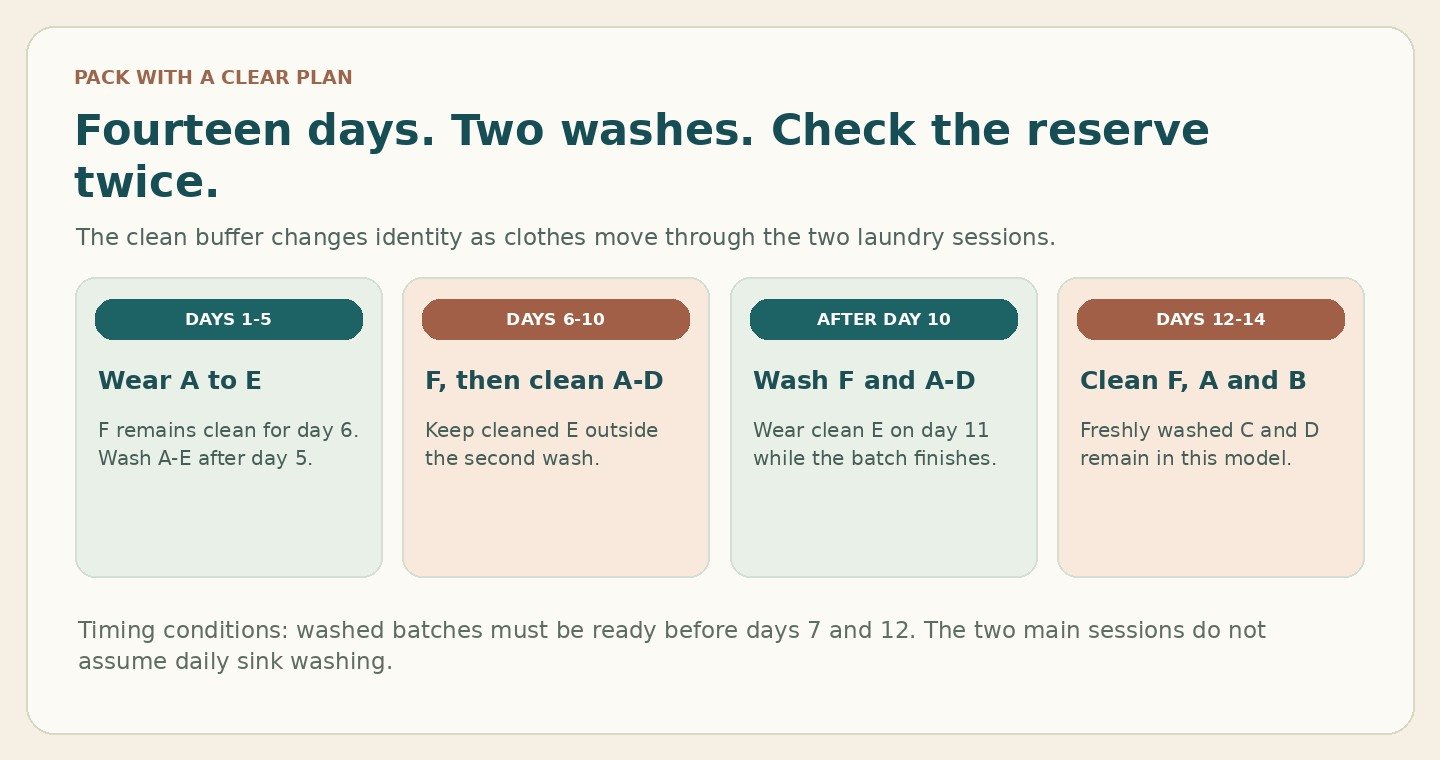
For this example, call the six daily changes A to F. Wear A to E during days one to five, wash those five, and keep F for day six. On days seven to ten, use cleaned A to D.
The clean set E from the first wash is then available for day eleven. At the second stop, wash F and the A–D changes used since the first stop. The newly cleaned batch supplies days twelve to fourteen.
| Period | What you wear | What remains available |
|---|---|---|
| Days 1–5 | A, B, C, D, E | F stays clean |
| After day 5 | Wash A–E | Retain F, sleepwear and a wearable bottom |
| Day 6 | F | A–E are being dried or returned |
| Days 7–10 | Cleaned A, B, C, D | Cleaned E is held for the next gap |
| After day 10 | Wash F and A–D | Retain clean E and necessary clothing |
| Day 11 | E | Second wash finishes |
| Days 12–14 | Cleaned F, A, B | Cleaned C and D remain available in this model |
Check the arithmetic before simplifying
This ledger is deliberately conservative about a daily clean top, underwear change and socks. Different categories can use different physical combinations; the letters are just an inventory aid.
There are unused clean items at the end in this simplified pattern. That does not make the reserve pointless: its job was to protect each laundry window. Unexpected additional changes may consume that flexibility, so do not count it again as a separate unlimited emergency allowance.
Choose laundry stops that suit the route
Place the work inside a stable stay
A stop with time to wash, dry and check the result is more useful than one that merely has a laundry symbol in the booking description. Look for a workable window around days five and ten, ideally without having to depart immediately afterwards.
Ask whether there is a machine, a dryer, a self-service laundry nearby or a staffed collection service. These are different arrangements. Establish operating hours and turnaround rather than assuming laundry access means same-day clean clothes.
Do not copy the calendar blindly
The day numbers are a model. A route may work better with washes after days four and nine, for example, provided the longest interval and drying gaps remain covered. Recount the clean changes whenever a stop moves.
Keep the article’s promise honest: two planned main sessions should not secretly depend on washing half the wardrobe every evening. An occasional emergency hand-wash is a contingency, not the routine that makes the core numbers work. If frequent washing is unavoidable, choose a plan that acknowledges that extra time.
The first wash: keep the second week in mind
Retain the clothes you need immediately
On the first wash evening, remove the five used daily changes from the luggage and keep the sixth clean one clearly separate. Also retain sleepwear and a suitable bottom. Empty pockets before washing or handing items over.
Where the service separates garments by care requirements, make sure the timetable still works for every essential item. A fast return for T-shirts does not help if the only suitable trousers remain unavailable.
Rebuild a usable clean section
When the clothes return, check the count and dryness before packing them away. Put the next clean change where it can be reached easily, then rebuild the remaining wardrobe without relying on the provider’s folding style.
Do not use the first wash as an excuse to add unnecessary garments for the rest of the trip. The purpose is to reset the existing cycle. A small note of which items remain clean can prevent a spare top from being treated as laundry simply because it has been moved to another pocket.
The second wash: protect the day-eleven reserve
The reserve changes identity
By day ten, the clean change held aside is not necessarily the same physical set used as the first reserve. In the example, F was worn on day six and needs washing; E remained clean after the first session and now covers day eleven.
This is why a state-based system is more useful than permanently labelling one pouch emergency. Track whether an item is clean, worn but reusable, or needs washing. The role can move between garments.
Avoid washing everything for a neat finish
Sending every remaining garment to the second wash may look efficient, but you still need clothing during processing and collection. Keep that practical requirement ahead of the desire to have an entirely clean bag.
After the second batch is ready, the final days become simple: use the appropriate clean changes and leave room for the laundry you will carry home. Do not schedule an unnecessary third full wash merely to make the packing photograph look like the outbound one.
Make the wardrobe compatible with both services
Match the care requirements
A compact fortnight wardrobe works more easily when the main garments can use similar wash and drying methods. Inspect care labels before choosing them. Separate any piece that requires a process your planned service cannot provide.
Use familiar garments where possible. You already know how they fit, whether colours transfer and which sections dry slowly. A new technical shirt is not automatically a better choice than something you have worn and washed comfortably many times.
Plan the exceptions explicitly
You may want one smarter top, a supportive sports bra or an item that needs hand care. Give it an individual plan rather than assuming it can join the main batch. It still counts towards bag space and weight.
The goal is not identical fabric throughout. It is avoiding a wardrobe with six incompatible washing instructions and no time to manage them. A little attention at home can make the two planned sessions ordinary practical tasks instead of lengthy sorting exercises.
Build interchangeable outfits rather than daily costumes
Start with the combinations you actually wear
Select bottoms and tops that work together with your main shoes and outer layer. For example, a restrained colour palette may let the same bottom work with several tops. This is a wardrobe-planning suggestion, not a demand to buy neutral travel clothing.
Try the combinations on. A top that only works with one special bottom and another pair of shoes has a larger real packing cost than its folded size suggests.
Repeat intentionally
A fortnight does not require fourteen visually unique outfits. Repeating a comfortable combination after laundering is a normal way to reduce luggage. However, keep enough appropriate choice for the activities and settings you genuinely expect.
Accessories can change how an outfit feels without needing a second wardrobe, but they also occupy space. Select a small number you will use rather than replacing extra clothing with a large accessories pouch. The aim is a practical personal wardrobe, not a generic formula that ignores your style or needs.
Give reusable clothing a separate wear plan
Bottoms are not governed by the top count
With three bottoms, you can rotate suitable pieces and retain one during washing. That provides flexibility, but it is not proof that every pair will remain wearable until the next stop. Heat, rain, spills and activities may require a different rotation.
With two bottoms, be more deliberate about which one stays available while the other is washed. If both require cleaning at once, your plan needs another suitable option.
Sleepwear and special items need attention too
A sleep set cannot be sent away without considering what you will wear that night. Likewise, a swimming item used late in the day needs a drying arrangement before the next transfer.
Where bras are part of the wardrobe, plan suitable support and drying time separately. Do not bury their care requirements in a generic six-pair underwear total. The main ledger simplifies daily changes, but it does not override individual clothing needs. A written note for these exceptions keeps the system realistic.
A complete non-clothing packing checklist
Include the items left out of wardrobe photographs
Documents, toiletries and technology can use as much practical space as several tops. Lay them beside the clothes before judging whether the load fits. Include cases, bottles, charging leads and any necessary supporting equipment.
| Group | Select for your actual journey | Check before leaving |
|---|---|---|
| Documents and payment | Required ID, payment methods, usable copies of key travel details | Access when the phone is unavailable |
| Personal care | Necessary medication, toiletries and personal supplies | Quantity, storage and relevant travel requirements |
| Technology | Phone, required charger and compatible cables | Actual plug, connector and battery rules |
| Laundry | Flexible sack and access to suitable washing supplies | Two workable washing and drying windows |
| Weather and day use | Appropriate shell, bottle, hat or sunglasses as needed | How wet items will be separated temporarily |
| Optional equipment | Work device, camera, reading device or activity kit | Specific benefit compared with weight and space |
Personal essentials come before optional minimalism
The checklist is a framework, not an exhaustive list for every health, accessibility or personal-care need. Carry what is necessary and check relevant travel requirements. Where an essential item is bulky, choose the luggage allowance around that reality.
At the same time, challenge optional duplication. A second reading device, a large notebook and several spare chargers may all perform tasks already covered elsewhere. Make conscious choices rather than removing necessary clothing to accommodate technology you are unlikely to use.
Pack a day bag inside the flight allowance unless the booking permits another separate item. A small backpack strapped to the outside is still part of what you carry.
Choose capacity from the actual load
Trial a manageable larger-cabin arrangement
For this mild-weather baseline, a roughly 35–40-litre packing target is a reasonable starting experiment. That is an estimate to test with your clothes, not a guaranteed fit. A smaller traveller’s clothing and a larger traveller’s clothing do not occupy identical space.
Choose a bag you can carry comfortably on the route. Wheels may help on smooth surfaces; a backpack may be easier through repeated stairs. Neither solves excess weight or an incorrect allowance.
Separate marketing from dimensions
A useful caution is the BAGSMART Blast 28L/38L backpack. The current page lists expansion as changing its depth from 20.5cm to 25.5cm. Check that configuration against your booking rather than assuming the product’s carry-on description covers every fare. [1]
When comparing other options, the site’s 40-litre travel-backpack guide provides a relevant starting point. Confirm current product specifications independently before buying. You are choosing for fourteen days of repeated use, not just the journey to the first hotel.
Check both the fare and the operating airline
Hand luggage does not always mean two bags
The included underseat bag and an additional overhead cabin bag are different entitlements. Your booking may include one, both or route-specific conditions. Check every flight, particularly when the return or connection is operated differently.
As current examples, Ryanair’s small bag is 40 × 30 × 20cm and its Priority cabin bag is 55 × 40 × 20cm, up to 10kg. easyJet allows a small 45 × 36 × 20cm bag and, when booked, a larger 56 × 45 × 25cm bag. These examples are not interchangeable allowances. [2] [3]
Measure the loaded configuration
Include wheels, handles, full outer pockets and expansion panels. Do not measure an empty flattened bag and assume the same figures remain true after packing.
If your chosen clothing cycle needs an overhead-sized bag, book that entitlement rather than depending on discretion at the gate. The laundry plan controls clothing quantity; it does not change the carrier’s size or item-count rules.
Use an illustrative weight allocation
Budget for the whole system
Here is a hypothetical 7.0kg allocation, including a margin. It is not a named product test and it is not an assertion that every airline permits seven kilograms. Replace the estimates with your own measurements.
| Part of the load | Example allocation | Boundary |
|---|---|---|
| Main bag | 1.2kg | Includes attached straps and carrying hardware |
| Packed wardrobe | 2.6kg | Excludes clothing already worn |
| Toiletries and personal supplies | 0.65kg | Include containers |
| Laundry and organisers | 0.35kg | Only the pieces actually carried |
| Technology and documents | 0.75kg | No work laptop in this example |
| Small day-use items | 0.45kg | Adapt to your route |
| Unallocated margin | 1.0kg | Not permission to exceed a lower allowance |
Respond to the largest differences
A laptop or heavy camera may change the result more than several small clothing decisions. Likewise, a heavier empty suitcase consumes capacity before anything goes inside. Identify the largest avoidable difference instead of obsessing over a few grams of soap.
Comfort remains separate from permission. An airline-compliant bag can still be too heavy for your shoulders, grip or planned walking. Adjust the load to both the rules and the person carrying it.
Organise clothing by its current state
Three simple categories are enough
Use clean, worn but reusable, and needs washing. This is more useful than insisting every cube always belongs to the same day. Clothing changes state throughout the trip, and the second clean reserve is not the same set as the first.
A flexible laundry sack can expand as the clean-clothing section shrinks. Keep wet items temporarily separate and unpack them to dry promptly. Do not confuse a tidy sealed parcel with a finished drying process.
Choose only the organisers you need
The BAGSMART Blast cubes can divide the clothing into manageable groups. A Peak Design Small cube provides a clean/dirty divider for a compact load. Neither is a reason to leave damp garments enclosed. [5] [6]
For the full moisture-aware approach, read the site's dirty-laundry guide. The fortnight routine becomes easier when the location of each clothing state is obvious, even after a rushed departure or a laundry return folded differently from your original arrangement.
Choose the wash method with the drying method
A machine is only half a solution
A property with a washing machine may not have a dryer or a suitable place to hang a full batch. Ask about both. A service may return clothes folded but still slightly damp, so check before packing them away.
Use drying methods permitted by the garment labels. Do not assume a high-temperature shortcut is harmless just because you need the clothes the next morning. The timetable should accommodate the clothing, not demand that the clothing tolerate an unsuitable process.
Hand-washing is a different commitment
A wash bag can be practical where you genuinely expect to hand-wash. Scrubba’s instructions separate washing from rinsing and hanging to dry, and include care for the bag itself. [7]
Account for batch size, water access and safe drying space. Two planned main laundry stops are normally simpler when they rely on a suitable machine or dependable service. If hand-washing is your main method, rehearse the actual workload and turnaround before reducing the wardrobe around it.
Do not carry an entire laundry cupboard
Pack around the facilities
A machine with provided detergent may require no personal detergent at all. A service may need only the clothing and clear care instructions. Establish the arrangement before buying a kit for every possible circumstance.
Where a small washing supply is useful, check suitability for the chosen garments and method. Sea to Summit describes both liquid Wilderness Wash and dry Pocket Soap for multiple washing uses. The labels remain the authority on how to use those products. [8] [9]
Keep safety and practicality together
Store detergent appropriately and away from food. Use room fixtures only as intended, and keep laundry away from electrical equipment, heaters, sprinklers and escape routes.
Do not hang a whole batch across a shared space without permission. A laundry plan that only works by inconveniencing roommates or blocking the bathroom is not dependable.
The simplest system is often a light sack plus a confirmed service. Extra washing equipment should solve a known gap, not become another source of bulk in a guide about reducing luggage.
Toiletries need a fortnight strategy
Plan quantity and replenishment
A fourteen-day supply does not require a full retail-sized bottle of every product. Estimate from your own use, consider suitable smaller containers and establish what the accommodation provides. Keep necessary personal items at the top of the list.
Replenishment can be useful for ordinary products, but it is not a reliable assumption for specialist items or anything difficult to replace. Bring enough of those according to your needs and relevant rules.
Organisers do not create a liquids allowance
The BAGSMART Blast 4.5L hanging wash bag is a storage option for travellers who value hanging access. Its capacity is unrelated to how much liquid airport security allows. A smaller pouch may be more appropriate for a restrained kit. [10]
UK rules depend on the airport, so check departure, transit and return requirements rather than applying one universal statement. A conservative set of small containers may be convenient, but the actual rules still need checking. [11] Leave room for the bag to close comfortably, not just for the bottles to squeeze inside.
Keep a small technology plan for a long trip
Fourteen days does not multiply your chargers
Start with the devices you will use, their connectors and the charging equipment needed for them. One compatible charger may cover several devices, but only when its outputs and connections actually support the combination.
A work laptop adds more than the device alone: its charger, protection and space during security checks matter too. Include the complete kit rather than claiming a light load based on a phone-only example while quietly bringing a computer.
Make batteries accessible
The CAA’s current guidance limits power banks to two per person, requires them in the cabin and prohibits recharging them on board. Follow the operator’s capacity, use and stowage instructions. The authority also recommends not using a power bank to charge other devices on board. [12]
Use a removable accessible pouch for the equipment that must stay with you if your main bag is placed in the hold. Do not bury it under the laundry section. For a longer trip, repeatable access and a clear charging routine are more useful than carrying several speculative backup gadgets.
Keep documents secure without overbuilding the system
Choose a clear home for essential items
Use one reliable place for passport, payment methods and important travel information. Know what must be accessible during checks and what can remain secured. Copies or offline information can help when the phone is unavailable.
A TORRO leather passport holder is one compact organisational reference. For more structured storage, the TORRO leather travel wallet is another, although its listed weight is 255g. [13] [14] Select for the task and your bag, not because every long trip needs a substantial document organiser.
Separate essentials from the wash cycle
Medication and required personal items should not move between clean and dirty clothing compartments. Keep them accessible and follow the relevant travel requirements. The CAA advises retaining essential medicine in cabin baggage. [15]
The longer trip may justify a larger supply of essentials, but not necessarily a more complicated storage system. A clearly labelled, dependable arrangement is often easier to check at every accommodation change than a collection of unrelated mini-pouches.
Special clothing and weather need substitutions
Replace before adding
A hotter trip may call for lighter everyday garments; a cooler one may call for a more useful mid-layer. Make substitutions before expanding every category. Select the weather protection that matches the actual exposure and activities.
For a smart meal, one appropriate top paired with an existing bottom may be enough. A formal event is different and should be planned honestly rather than forced into a casual capsule.
Compression is not a fortnight requirement
A vacuum-packing kit such as the Ekster example may help with a suitable bulky layer, but two weeks away does not automatically make one necessary. It adds a resealing dependency and does not remove weight. [16]
Keep frequently accessed clothing in a simpler arrangement. If the bag only closes after aggressive compression of every garment, revisit the load and allowance before relying on that method for fourteen days. The two-laundry strategy should reduce the need to carry excessive clothing, not encourage a more elaborate way to overpack.
Recalculate when you need extra daily changes
Add demand to the affected category
The six-change model assumes one change per day in the categories being tracked. Suppose you expect one additional top before the first wash because of a planned activity. Five normal tops, one additional top and one clean laundry-gap top make seven in total. This is a simple planning calculation, not a universal recommendation to pack seven.
Underwear and socks may need a different adjustment. Do not increase every clothing category automatically, but do not pretend a sports session has no effect when it usually means another clean change for you.
Check the second interval as well
An extra change early in the trip can consume the item that would otherwise have become the second reserve. Rebuild the ledger after each known extra use rather than counting the original clean surplus twice.
If additional changes are frequent, a larger wardrobe or different laundry timing may be more realistic than the original list. The important quantity is the longest interval multiplied by your actual use, plus the turnaround reserve. That formula is more useful than copying another traveller’s packing count without their assumptions.
A second calendar that still uses only two washes
Earlier stops can be equally sensible
An alternative route might support washing after days four and nine rather than five and ten. The travel intervals then contain four, five and five days. Six daily changes can still be a reasonable starting inventory when the drying and collection windows are covered.
For example, hold a clean change for day five while the first batch finishes, then hold another clean change for day ten while the second finishes. Check exactly which items remain clean instead of assuming the same reserve survives untouched across the entire journey.
Move the schedule for a reason
A closed laundry, a hotel change or an early departure may make the earlier stop more dependable. Moving the wash earlier is often more practical than carrying extra clothing solely to preserve an arbitrary day number.
However, do not move both sessions casually without recalculating the final interval. A wash that finishes far too early can leave a long last stretch with no usable reserve. Write the complete calendar through the return day before deciding the new dates work.
Use the same count without expecting the same volume
Garment dimensions change the packing result
Six lightweight small tops and six larger heavy cotton tops are not the same physical load. The same applies to trouser sizes, footwear and support garments. A count-based list is useful for planning clean changes, but it cannot guarantee a shared litre requirement for every reader.
Pack your own actual clothes before deciding on a bag. Avoid buying a smaller bag because someone else’s photograph makes the list look compact. Their garments, equipment and use of worn clothing may be different.
Keep fit and comfort ahead of compactness
Do not choose an uncomfortable cut or unsuitable fabric simply because it folds into a smaller parcel. Likewise, wearing several unnecessary layers through the airport is not a reliable substitute for enough luggage space.
Where your complete load requires a little more room, check whether an appropriate larger cabin allowance exists. If it does not, reconsider the optional equipment or use another luggage arrangement. The laundry cycle remains useful even when it does not produce an exceptionally small bag.
Make a fourteen-day supply check for personal items
Separate washable items from consumables
Laundry renews clothing; it does not replenish toothpaste, personal-care supplies or other consumables. Estimate those independently. A longer trip may need a larger quantity even when the number of tops stays the same.
For ordinary replaceable products, planned replenishment can be practical. For required medication, specialist care products or items difficult to obtain, follow the relevant professional and travel guidance rather than relying on a spontaneous purchase. Keep necessary supplies within the luggage plan from the start.
Count storage as part of the supply
A refillable bottle, protective case or organiser adds its own bulk. Check that the chosen container is suitable for the contents and any storage requirements. Avoid decanting an item merely to make it match the rest of the wash kit.
During the second laundry stop, make a simple supplies check as well. You are not adding another chore; you are confirming that the remaining days are covered before the last stage of the trip. Deal with an ordinary shortfall while there is still a practical opportunity, not at the final airport.
Sharing packing space requires visible ownership
Do not let one person's spare become everyone's spare
When travelling with a partner, clarify which clothing and shared supplies belong to whom. Each person’s clean-change requirement is separate. One shared charger may work, but one spare top usually cannot cover both travellers.
A consistent colour or location can help. The Sara Miller Black Botanic cube set is a fabric-organiser example, but any existing differentiated pouches may do the same practical job. Do not add a complete heavy set simply for visual matching. [17]
Share supplies only where it is appropriate
Compatible ordinary toiletries can sometimes be shared, while medication, personal-care supplies and items with different requirements should remain individually planned. Check who carries the shared item and how it stays accessible if bags are separated.
This guide’s counts are per adult, not per couple. Double or otherwise adapt the inventory according to the actual travellers before judging whether shared luggage fits. The main benefit of the laundry cycle is repeatability, not an excuse to overlook someone else’s needs.
A small role-based buying shortlist
For clothing organisation
The Blast compression-cube set is relevant for separating different clothing groups. Carry only the pieces that fit. The Peak Design Small cube is an alternative when a compact clean/dirty arrangement suits the wardrobe.
For the protected reserve, another small existing pouch may be enough. Compare the narrow pieces within the Blast set only if your current arrangement makes the clean change difficult to identify. Do not buy a new product merely to follow a diagram.
For bathroom access
The hanging Blast wash bag may be useful in rooms with limited counter space, but its storage capacity may be excessive for a deliberately small toiletry selection. Trial your actual bottles and containers first.
These are examples selected for their roles and accessible specifications. They are not a hands-on ranked test, and there is no recommendation to buy the whole group. Check the exact variant, availability and final terms with the seller. The list remains usable with suitable equipment you already own.
Plan the final flight as carefully as the first
The contents will not look the same
By the end of the trip, some clothes will be worn, toiletries may have changed and a few purchases may have joined the bag. Leave a defined margin for that change rather than assuming the same neat outbound arrangement will reappear automatically.
Pack the last worn items into their appropriate state and keep anything damp temporarily isolated until it can be dried. Do not create a sealed long-term laundry bundle just because the next stop is home.
Recheck the actual bag
A portable luggage scale can help with the final weight check, but dimensions and item count need checking separately. An expanded bag can be too large even when it is light enough.
Remove any necessary battery items and valuables if the main bag is unexpectedly sent to the hold, following the airline’s instructions. Keep the essentials accessible from the start. A fortnight’s system has succeeded when the return journey is ordinary, not when the outbound pack alone looked impressively small.
Pros and cons of a two-wash fortnight
The advantages
Two planned washes let a modest wardrobe serve a longer trip, reduce the need for duplicate outfits and make the clean-clothing cycle visible. The reserves protect each service window instead of relying on instantaneous drying.
A smaller clothing selection can also simplify daily decisions and reduce repacking work, provided the items genuinely mix and match.
The limitations
You must commit time to washing and drying, accept repeated combinations and choose clothing compatible with the available care method. Service delays, specialist garments or frequent extra changes can require more clothing or an altered schedule.
The baggage claim remains conditional. Personal equipment and bulky essentials may determine the bag size even after the wardrobe is reduced.
Choose this approach for its practical fit with the holiday. When the laundry opportunities are unreliable or the clothing needs are substantially different, a larger allowance or another schedule may be the more sensible choice.
Common mistakes that break the two-stop cycle
Counting calendar days incorrectly
Arrival and departure days still consume clothing. An overnight flight can also change when you want a fresh outfit. Count the actual period between usable laundry returns, not just the number of hotel nights.
Do not pack six daily changes and then add a seventh departure outfit by accident. Equally, do not count a clean reserve that has already been worn.
Treating both washes as identical
The first protected set is F in the example, while the second is E. Clothing changes state, so the reserve must be checked again before the second batch is sent away.
Other common problems are washing all bottoms at once, forgetting sleepwear, relying on incompatible garment care and leaving no time to collect the laundry before moving on.
Finally, avoid assuming a bag’s litre label settles airline compliance. Two laundry stops reduce your wardrobe; they do not alter external dimensions, weight rules or the number of permitted cabin items.
Frequently asked questions
How can six daily changes cover fourteen days?
The first five are worn before the first wash, while the sixth covers the laundry gap. Cleaned items then cover the next interval, with one still-clean change held outside the second wash. The ledger shows the sequence explicitly. It works only when change frequency and usable laundry-return times match the stated assumptions.
Are days five and ten compulsory laundry dates?
No. They are the dates used in this model. Other dates can work when the longest interval and drying buffer remain covered by the clothes you carry. Recount the sequence whenever a stop moves; changing a wash date without checking the clean reserve can quietly break the plan.
Does this plan rely on washing clothes every evening?
No. It has two planned main washing sessions. Occasional emergency hand-washing may be a fallback, but it is not hidden inside the baseline. If your activities require frequent additional washing, acknowledge that extra work and change the wardrobe or schedule accordingly.
Should I take more underwear than tops?
You can give different categories different counts. The baseline uses six of each daily-change category to make the cycle easy to audit, not because every traveller’s needs are identical. Add necessary underwear changes without assuming tops must increase equally, and check that both categories remain covered through the laundry windows.
What should I do when the second service is delayed?
Check the clean reserve and the latest point when the washed batch is needed. In this model, day eleven is protected and the batch is needed by day twelve. A longer delay calls for a faster suitable option, another necessary change or a revised schedule. The existing reserve is not unlimited insurance.
Can I take three pairs of shoes and still use this plan?
The clothing cycle can remain valid, but the bag’s space and weight may no longer suit the suggested target. Count every pair and its storage honestly. A second or third pair should serve a specific need that the main pair cannot cover, rather than appearing simply because the holiday lasts a fortnight.
Is a 40-litre bag always allowed as carry-on?
No. Airlines regulate dimensions, weight and item count, not just a litre label. Two bags advertised as forty litres can have different external shapes. Check the loaded bag against your exact booking and every operating carrier involved, including expansion and full outside pockets.
Can this work for colder weather?
The laundry principle can still work, but bulky layers, longer drying times and different footwear can change the volume required. Substitute suitable garments and reassess the care method. Do not assume the mild-weather bag target remains valid after adding a winter wardrobe.
The final fortnight recommendation
Use the six-change wardrobe as a transparent starting point, with the main washes after days five and ten and a clean change protected outside each batch. Have the returned clothing ready before days seven and twelve. Adjust those dates only after recounting the longest interval.
Select reusable bottoms, appropriate layers, familiar shoes and the personal essentials your trip actually requires. Keep the organisers simple and the state of each clothing group obvious.
Then test the whole bag: the loaded dimensions, complete weight, access to essentials and a less-perfect return packing arrangement. A successful fourteen-day carry-on plan is not fourteen outfits compressed into a clever container. It is a repeatable clothing cycle inside a bag you can comfortably and legitimately carry.
Sources and fact-checking notes
Research checked on 12 October 2026. Airline and authority pages support the rules; manufacturer and retailer pages support the named product features. Clothing counts, schedules, volume targets and weight budgets are editorial planning examples, not measurements from hands-on testing. Product availability and terms can change. Buying destinations are not evidence that every variant suits every traveller.
- 01BAGSMART: Blast Travel Backpack, current size and expansion specification
Checked 12 October 2026. Confirm current details before purchase or travel.
- 02Ryanair: current cabin baggage allowances
Checked 12 October 2026. Confirm current details before purchase or travel.
- 03easyJet: current cabin bag sizes and entitlements
Checked 12 October 2026. Confirm current details before purchase or travel.
- 04Case Luggage: Go Travel Digital Pro Scale, measuring functions
Checked 12 October 2026. Confirm current details before purchase or travel.
- 05BAGSMART: Blast Packing Cubes, construction and six-piece composition
Checked 12 October 2026. Confirm current details before purchase or travel.
- 06Case Luggage: Peak Design Small Packing Cube, Sage, exact variant
Checked 12 October 2026. Confirm current details before purchase or travel.
- 07Scrubba: washing, drying and wash-bag care instructions
Checked 12 October 2026. Confirm current details before purchase or travel.
- 08Sea to Summit: Wilderness Wash, use and care information
Checked 12 October 2026. Confirm current details before purchase or travel.
- 09Sea to Summit: Wilderness Wash Pocket Soap, 50 dry leaves
Checked 12 October 2026. Confirm current details before purchase or travel.
- 10BAGSMART: Blast 4.5L Hanging Toiletry Bag
Checked 12 October 2026. Confirm current details before purchase or travel.
- 11GOV.UK: liquids in hand luggage and airport-specific rules
Checked 12 October 2026. Confirm current details before purchase or travel.
- 12UK Civil Aviation Authority: power-bank rule changes effective 27 March 2026
Checked 12 October 2026. Confirm current details before purchase or travel.
- 13TORRO: Leather Passport Holder, Black, storage and weight
Checked 12 October 2026. Confirm current details before purchase or travel.
- 14TORRO: Leather Travel Wallet, storage and weight
Checked 12 October 2026. Confirm current details before purchase or travel.
- 15UK Civil Aviation Authority: Pack Right, Safe Flight
Checked 12 October 2026. Confirm current details before purchase or travel.
- 16Case Luggage: Ekster TravelPack Vacuum Kit 2 Pack, exact retailer listing
Checked 12 October 2026. Confirm current details before purchase or travel.
- 17Case Luggage: Sara Miller London Black Botanic Packing Cube Set
Checked 12 October 2026. Confirm current details before purchase or travel.
Illustrations in this article were created for Taylor’s Trailblazing Travel Gear. Third-party photographs, where used, are credited beside the image or in the source list.