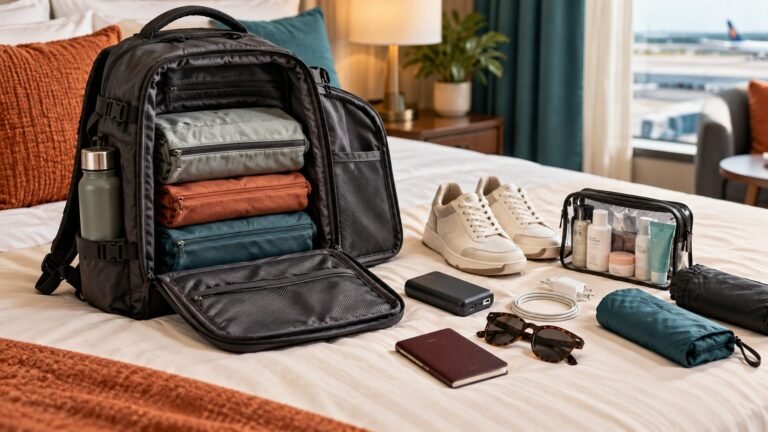
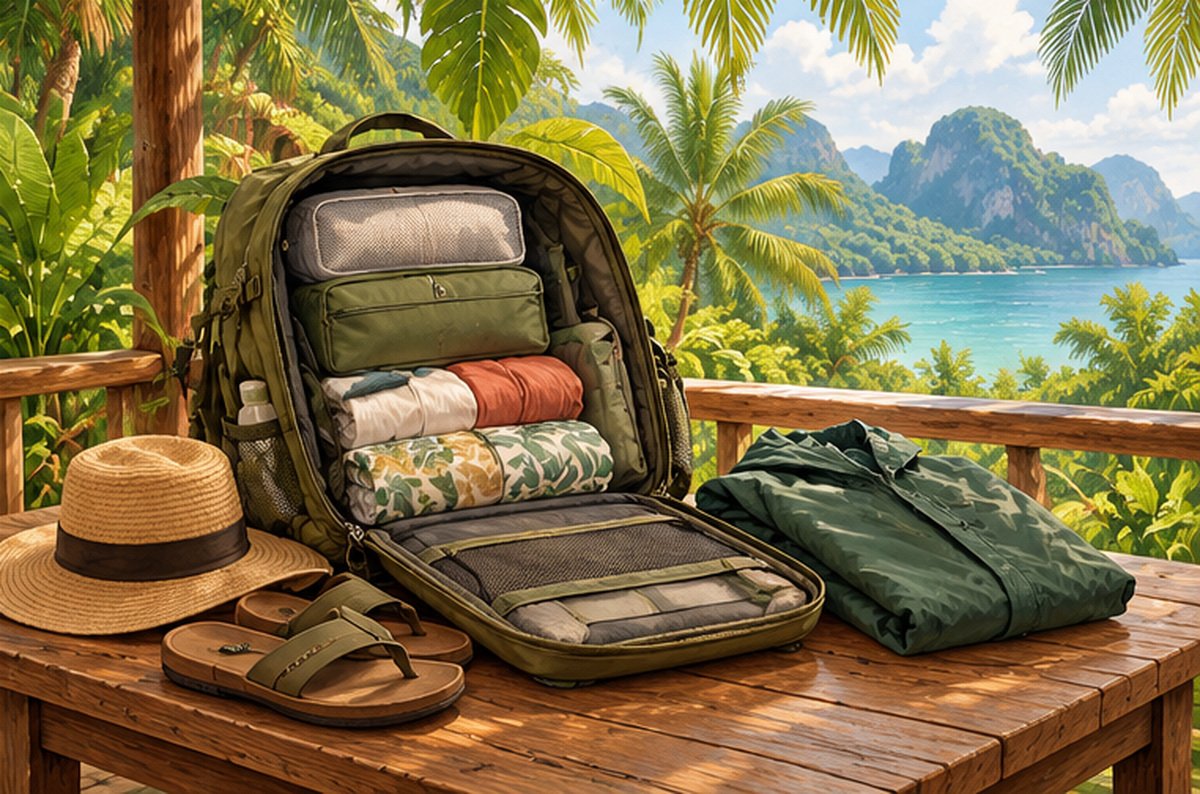
Southeast Asia One-Bag Packing List for Hot and Humid Weather
A repeatable wardrobe, a realistic laundry plan and enough margin for life beyond the packing photograph.
A Southeast Asia one-bag packing list works best when it plans for the untidy middle of a trip: clothes waiting to dry, a refilled bottle and a backpack that still has to fit the next flight. Starting with a very small bag can look efficient, but it is only useful when the contents support the actual journey.
This guide builds the kit from transport limits, personal needs and a realistic washing routine. It covers bag weight, clothing rotation, rain and moisture protection, a modest electronics setup and the items that should remain accessible if the main bag is stowed away.
The weight table is an illustrative planning budget, not a weighed collection of tested products. Gear examples come from published information, and no personal field testing is claimed. Adapt the list for your destinations, season, activities and any essential supplies. A different luggage arrangement is the right choice when it serves those needs better than forcing the trip into one bag.
Your actual allowance
Regional tickets can be tighter than the international flight.
Repeat clothing
A credible washing and drying plan supports a smaller wardrobe.
5.5kg example, not a rule
Weigh your own contents; never cut necessary supplies to fit a model.
Separate, then dry
Temporary wet storage is not a long-term solution.
Southeast Asia one-bag packing list: define the limits first
Pack for the journey you are actually taking
A Southeast Asia one-bag packing list should not assume that every journey is a beach holiday or that all regional airlines allow the same luggage. Begin with the places, transport and activities already planned. A mainly urban trip with regular laundry differs from a journey involving specialist equipment, cooler upland stays or long periods away from convenient supplies.
The aim here is one manageable main bag containing a removable personal module, not a rigid rule that forbids necessary equipment. Some travellers will need more space for medical supplies, clothing requirements or work gear. Keep those needs visible from the beginning. The right solution may be a slightly larger allowance rather than cutting essentials to satisfy an arbitrary minimalist target.
Use this hot-weather starting kit
| Module | Pack for a defined job | Keep in mind |
|---|---|---|
| Clothing | A repeatable mix of tops, underwear, suitable bottoms, sleepwear and relevant coverage or layers. | Quantities depend on realistic washing and drying. |
| Wash and care | Personal toiletries, appropriate sun and insect protection, and necessary supplies. | Retain labels and follow professional advice for individual needs. |
| Technology | The devices actually needed, tested chargers and cables, and any compliant power bank. | A laptop sleeve is not a reason to bring a laptop. |
| Personal kit | Required documents, payment methods, glasses and accessible personal essentials. | Make the module removable before the main bag is stowed. |
| Moisture control | Appropriate protection for critical contents and temporary isolation for wet items. | Separate wet storage from clean dry clothing. |
| Small extras | Suitable bottle, limited footwear and an outing pouch or day bag only when useful. | Include their weight and any operator item-count rules. |
The list is built around repeatable clothing, moisture management and straightforward transfers. It is research-led planning advice, not a report of personally testing the bags or wearing the clothing in every destination. Product examples are included where their published design helps explain a choice. They are not a requirement to replace equipment that already works for you.
Before selecting a new bag, put the proposed kit into something you own. Notice which items are bulky, heavy or difficult to access. A smaller wardrobe, fewer duplicate electronics and a realistic laundry plan often solve the problem more effectively than a backpack with another five litres of capacity.
Check airline size and combined weight
Start with the tightest booked allowance
For AirAsia's standard cabin allowance, two items must together weigh no more than 7kg. The main bag can be up to 56 x 36 x 23cm, including protruding parts, while the smaller item is limited to 40 x 30 x 10cm. Scoot Economy permits two cabin items with a combined 10kg limit, with different main-bag dimensions. These are operator examples, not a regional standard. [1][2]
| Carrier / fare | Weight and quantity | Size check |
|---|---|---|
| AirAsia standard | 2 items; 7kg combined. [1] | Main: 56 x 36 x 23cm. Small: 40 x 30 x 10cm. |
| Scoot Economy | 2 items; 10kg combined. [2] | Main: 54 x 38 x 23cm; small: 40 x 30 x 10cm. Check the current diagram and your booking. |
Check the actual booking, operating carrier and any purchased allowance before packing. Special routes or local restrictions may affect particular items. Do not assume a generous international flight allowance carries over to a separate regional ticket. Save the relevant policy information alongside the booking so that the final check uses the right rules.
Count the small things as the operator requires
A sling, laptop pouch or airport purchase can affect the total. AirAsia specifically warns that separate items tied or strapped together do not become a single piece of baggage. [1] One-bag organisation is useful, but it is not an exemption from the airline's item count or weight rules.
Measure the backpack with its normal load, not flattened on a retailer's product photograph. A filled front pocket or expanded compartment can change the shape substantially. Likewise, weigh the travel configuration with the necessary electronics and personal supplies inside. Do not leave essential items out of the test merely to produce a more appealing result.
Choose a backpack for weight and access
A light bag gives you room for useful contents
Empty-bag weight matters when the total allowance is modest. However, the lightest available design is not automatically the most comfortable or practical. Check the opening, straps, back contact, adjustment and how the bag behaves with your actual load. A bag that is pleasant empty may feel very different after toiletries and electronics are added.
The Osprey Daylite Expandable Travel Pack 26+6 is a useful compact benchmark. Osprey lists 43 x 33 x 16cm unexpanded dimensions and an empty weight of 0.84kg. Expansion adds capacity, but check the packed dimensions again rather than assuming the original measurements still apply. [3] Compare the Osprey Daylite 26+6 at Case Luggage.
Do not buy by capacity alone. Two bags with the same stated litres can have very different openings and shapes. Test whether clothing modules, a wash kit and the personal pouch fit without creating a hard lump against your back. Easy retrieval and a sensible packed shape are more useful than an ambitious capacity label.
A 20L option is a deliberate compromise
A smaller bag may suit a very pared-back wardrobe and frequent laundry, but it gives less room for personal requirements or a weather layer. BAGSMART's Faro Light Backpack is listed at 20L, 28 x 16 x 46cm and approximately 0.43kg. It should not be assumed to meet a 40 x 30 x 10cm small-item limit. [4] View the BAGSMART Faro Light Backpack.
Try a smaller option only after laying out the complete kit. Buying the smallest bag first can create pressure to remove useful clothing or necessary care items later. The sensible sequence is needs, contents, carrying test and then bag choice, with a little room left for normal changes during the trip.
| Model | Published unexpanded figures | Main compromise |
|---|---|---|
| Osprey Daylite 26+6 | 26L; 43 x 33 x 16cm; 0.84kg. [3] | Expandable capacity needs a fresh size check when used. |
| BAGSMART Faro Light 0.4 | 20L; 28 x 16 x 46cm; about 0.43kg. [4] | Less wardrobe space; not within a 40 x 30 x 10cm small-item limit. |
Use a weight budget with a real margin
Treat the numbers as planning targets
The following 5.5kg example is a set of category budgets, not measured weights for a tested product bundle. It includes the main bag and the objects listed, but your own supplies may weigh more. The remaining margin beneath a 7kg allowance must absorb changes such as water, food, extra items and differences between scales; it is not automatically shopping space.
| Category | Planning allocation | What to check |
|---|---|---|
| Main bag | 0.90kg | Empty bag, straps and any included accessories. |
| Packed clothing | 1.60kg | The clothing actually inside the bag. |
| Spare footwear | 0.45kg | Only a useful additional pair. |
| Wash and care supplies | 0.65kg | Include appropriate protection and personal supplies. |
| Electronics | 0.85kg | Phone, charger, cables and any compliant power bank. |
| Organisers and moisture protection | 0.30kg | All pouches and liners count. |
| Documents and personal essentials | 0.35kg | Increase for individual requirements; do not cut necessities. |
| Light extra layer | 0.30kg | Separate from the packed-clothing allocation above. |
| Empty bottle | 0.10kg | Water and other additions use the remaining margin. |
| Total example | 5.50kg | 1.50kg below a 7kg allowance before later additions. |
Keep essential medication and necessary equipment at the quantities appropriate to your needs, even when that exceeds the illustrative allocation. Reduce optional clothing or electronics first, or book a more suitable baggage arrangement. A packing target is useful only when it supports a realistic trip rather than encouraging inadequate supplies.
Weigh modules as well as the complete bag
Weighing the wash kit, electronics and clothing separately shows where changes would actually help. Replacing a modest pouch may save little compared with removing an unnecessary charger or extra pair of shoes. Make the change that preserves usefulness while reducing the biggest avoidable load.
The Go Travel Digital Pro Scale is one option for checking the complete bag and its modules. Treat any reading as a planning measurement and keep a margin beneath the applicable allowance. [5] Check the Go Travel Digital Pro Scale at Case Luggage. Repeat the check after adding supplies during the trip, not only before leaving home.
Build clothing around drying and repetition
Choose a small wardrobe that works together
Start with the clothes you travel in, then add a modest rotation of tops, underwear and bottoms suitable for the activities planned. Include clothing that provides the coverage you need for particular venues or personal preferences. The example below assumes regular access to washing; it is not suitable unchanged for every itinerary or traveller.
| Item | Illustrative starting point | Reason to change it |
|---|---|---|
| Tops | 3 packed plus 1 worn for travel. | Washing frequency, coverage and individual comfort. |
| Bottoms | 2 packed options plus what you wear. | Include useful longer coverage where needed. |
| Underwear | 4-5 packed as a starting rotation. | Add enough for personal needs and realistic laundry delays. |
| Socks | A small rotation suited to the shoes used. | Footwear and activity matter more than a fixed count. |
| Sleep / swim | One appropriate sleep option; swimwear only when relevant. | Personal routine and the activities actually planned. |
| Layer / outerwear | A purposeful light layer and suitable rain plan. | Adjust for destinations and season rather than assuming uniform heat. |
Wear-test the garments before departure, particularly in conditions where you can judge comfort and drying at home. A fabric description alone does not tell you whether the cut, seams or feel will work for you. Avoid taking unfamiliar clothing simply because it is marketed as tropical travel equipment.
Lightweight layers can be more versatile than several very different outfits. One longer garment may provide useful coverage in more than one setting, while a light extra layer can help during cooler indoor conditions. However, check your actual destinations and season before excluding warmer clothing entirely. Southeast Asia is too varied for one climate assumption.
Keep clothing organised without sealing in dampness
Use a small number of cubes that match your wardrobe. BAGSMART's Blast Packing Cubes offer separate sizes, but the full set need not travel in a one-bag setup. [6] Compare the BAGSMART Blast Packing Cubes. Keep room to reorganise clothes after washing rather than filling every compartment to its limit on day one.
The Peak Design Small Packing Cube provides another option, with a divider for clean and worn clothing. That divider is an organisational feature, not a drying system or an assurance against odours. [7] View the Peak Design Small Packing Cube. Never confuse a neatly closed cube with clothing being ready for storage.
Make the laundry plan credible
Plan washing before the last clean outfit
Choose a likely laundry opportunity with enough time for washing, drying and collection. Ask about the actual turnaround and handling of delicate items rather than assuming that a nearby sign means everything will be ready when you need it. Keep a usable outfit available while other clothes are away, and allow for a service being closed or slower than expected.
A useful planning exercise is to imagine that washing takes a day longer than hoped. Do you still have suitable underwear, a top and something appropriate to wear outside? Adjust the clothing rotation until the answer is yes without requiring emergency shopping. That small buffer is more valuable than a wardrobe that works only when every wash happens exactly on schedule.
Drying is a separate stage
After handwashing, follow garment care instructions and use an appropriate place to dry items fully. Humid conditions can make your preferred routine less predictable, so check the fabric rather than assuming that hanging overnight guarantees a dry garment. Keep damp clothing away from clean items during transport and unpack it promptly afterwards.
A hotel room is not permission to improvise a clothesline across a walkway or emergency route. Use suitable facilities and respect the accommodation's rules. Avoid drying directly on electrical equipment or heat sources not designed for the task. A simpler wardrobe is helpful, but it should not depend on unsafe drying methods.
Use compression selectively
A compression cube can tidy dry clothing, particularly when changing accommodation often. BAGSMART's six-piece compression set is one comparison option, but choose only the pieces needed rather than carrying the complete set by default. [8] See the BAGSMART Compression Packing Cubes. Compression changes volume, not the weight of the contents.
Before the next transfer, separate dry clean clothes, rewearable clothes and items still awaiting washing. Then return each to its intended place. This prevents the entire backpack gradually becoming an unstructured laundry bag and makes it easier to judge how much clean clothing remains.
Keep toiletries small without cutting protection
Pack useful quantities, not an attractive tiny collection
Lay out the products you actually use and decide which must travel from home. Check bottle sizes, closures and product instructions before decanting. Keep enough identification to know what each container holds. A collection of identical unlabelled bottles can be confusing, especially when personal care products and washing liquids look similar.
The BAGSMART Paz 2L Dopp Kit is a compact option for comparing the wash arrangement, with a published empty weight of 150g. The bag's size does not establish whether its contents meet airport screening rules. [9] View the BAGSMART Paz 2L Dopp Kit. Use an existing lighter pouch when it already provides suitable organisation.
For flights, check the restrictions at the departure and transfer airports. UK airport liquid rules vary, while essential medicines and some special supplies have separate provisions. Do not assume a return airport uses the same screening rules as the one you left. [10][11]
Do not minimise away sun and insect protection
Include suitable sun protection and clothing for the activities planned. NHS advice recommends at least SPF30 with appropriate UVA protection, alongside shade and suitable clothing rather than sunscreen alone. Choose products appropriate to your needs and follow their directions. [12] Do not reduce necessary protection simply to achieve a smaller toiletries photograph.
For insect protection, use destination-specific advice and suitable repellent according to its label. TravelHealthPro recommends combining protective measures and notes that relevant insects can bite by day or night. Check whether your itinerary also requires professional travel-health advice; repellent and clothing are not substitutes for any recommended vaccination or malaria prevention. [13]
A light long-sleeved garment can have a practical role, but its suitability depends on fabric, coverage and the activity. Keep medical decisions separate from gear marketing. An advertised travel shirt or wristband should not be treated as a complete protective strategy merely because it adds little weight.
Protect against rain, splashes and trapped moisture
Treat water resistance as a limited property
Read the actual protection claimed for a bag and the limits of that claim. Water-resistant fabric does not necessarily make seams, zips and openings waterproof. Even a useful rain cover is not the same as a tested submersible container. Match protection to the exposure expected, and keep critical documents and electronics separately protected where necessary.
Use a simple inner barrier appropriate to your contents and journey. Check its closure before departure and test it with something harmless rather than valuable electronics. Keep the protected items accessible enough that reaching a document does not require exposing every other item in the bag during rain.
Give wet gear a temporary travel location
A wet outer layer or swimwear needs a place where it will not soak clean clothes. A separate suitable bag can provide temporary isolation, but unpack the wet item at the next opportunity. Storing it closed for days turns a useful separation measure into another problem. Keep the dry-storage and wet-storage roles distinct.
After exposure to rain or splashes, inspect the bag and its contents instead of assuming everything is fine because the outer fabric looks intact. Dry the equipment according to the manufacturer's care guidance. In particular, do not connect damp electronics or chargers; follow the product instructions before using them again.
Choose footwear for the real surfaces
One pair of comfortable everyday shoes plus a genuinely useful lighter alternative can be enough for some trips. Other activities need different footwear. Decide from the planned use rather than automatically adding hiking boots, trainers, sandals and flip-flops. Bulky duplicate shoes can overwhelm a small backpack quickly.
Keep muddy or wet soles separate from clothing during transfers, then dry and clean the footwear appropriately. A separate shoe compartment still occupies space in the bag. It does not remove the need to consider whether the extra pair is necessary or whether the packed shape remains comfortable against your back.

Pack electronics around actual work and communication
A phone-only trip needs a different kit from remote work
Decide what you genuinely need to do: communicate, manage bookings, take photographs or carry out work that requires a computer. Do not bring a laptop simply because the backpack has a laptop sleeve. Conversely, do not pretend essential work can be done comfortably on a phone without trying the relevant tasks first.
Gather the necessary cables and compatible charging equipment, then remove duplicates without making the system unusable. Check input specifications and plug requirements for the destinations you will visit. Follow each device and charger's instructions; do not assume a travel adapter changes voltage or that every USB connection supplies the same charging capability.
Keep power banks accessible and within current rules
AirAsia currently limits passengers to two power banks of no more than 100Wh each and prohibits their use or charging onboard. Its rules also prohibit overhead storage, with permitted accessible storage specified in the policy. Check the exact flight and local requirements before travelling. [14] A general claim that larger batteries can travel with airline approval is not a substitute for this carrier's rule.
Use a removable personal module so that cabin-only items do not accidentally go into the hold if the main bag is taken from you. Protect batteries against damage and short circuits, and do not carry damaged or swollen equipment. The CAA's guidance reinforces cabin carriage for power banks and spare batteries and the need to follow the airline's restrictions. [15]
Do not buy a larger organiser than the electronics need
A large padded technology case can become heavy and bulky before anything is inside it. Start with the smallest suitable pouch that protects the actual items and keeps connectors from being crushed. Keep the frequently used cable in an accessible place rather than making every charging task a complete unpacking exercise.
During accommodation changes, perform a socket check before closing the bag. Return each cable to its place immediately after use and inspect anything that has become damp or damaged. A dependable small kit maintained consistently is more useful than a large collection of backup accessories that nobody has tested together.
Plan connectivity without another device by default
Compare roaming, local services and eSIMs
Check the terms of your existing mobile plan before buying additional connectivity. An eSIM can simplify some journeys, but device support, coverage and the specific plan's activation policy matter. Airalo requires a compatible, network-unlocked phone and a stable connection for installation. [16] Compare Airalo plans for your Southeast Asia destinations.
For travel across several countries, check the actual country list rather than relying on a regional plan's name. Also confirm whether the service meets your needs for calls, messages or data; do not assume those are interchangeable. Keep essential bookings available through an appropriate offline backup even after mobile data is arranged.
Keep setup details available before departure
Read the installation and activation instructions while you have a reliable connection and enough time to follow them. Avoid assuming every eSIM should be activated at exactly the same stage of the journey. The terms for the selected plan should determine that decision, especially where installation or network connection starts the validity period.
A second connectivity purchase is only useful when it solves a defined gap. Before buying, compare the plan against your route and existing service again. Check the current Airalo plan details. The aim is a working phone and understandable settings, not collecting multiple plans or another gadget because travel technology sounds reassuring.
Separate documents and personal supplies
Use a small module that can leave the main bag
Keep the documents and personal essentials needed during travel in a removable pouch. That makes checks and bag handovers easier without requiring a second large bag. Choose a location you can access without exposing all the contents of the backpack, and return items to it immediately after use.
A BAGSMART Paz 2.5L Belt Bag can serve as a small adult personal module when its fit and capacity suit you. Check whether it must be packed inside the main bag or counted separately under the airline's policy. [17] View the BAGSMART Paz 2.5L Belt Bag. It is an organisation option, not an anti-theft guarantee.
A zipped document wallet is another possibility for travellers who prefer paper organisation. The TORRO Leather Travel Wallet provides compartments, but its published 255g weight is substantial compared with a thin pouch in a strict one-bag budget. [18] Compare the TORRO travel wallet. Choose it only when that organisation is genuinely worth the space and weight to you.
Give medical requirements their own allowance
Keep necessary personal supplies identifiable, with relevant instructions and documentation. Check destination rules for medicines and consult an appropriate healthcare professional about individual needs. Do not decant medication into unmarked containers or reduce the quantity simply to meet the sample weight table. Special storage requirements need a suitable plan before departure.
For UK airport screening, GOV.UK explains the provisions for essential medicines and medical equipment, including when prescription evidence is needed for larger liquid containers. Other countries can have different requirements. [11] Treat airport screening permission, import rules and medical suitability as separate checks rather than assuming one approval settles all three.
Rehearse packing after a wet laundry day
Test the least convenient version of the kit
An ideal packing photograph shows clean dry clothes and empty accessory pockets. A realistic transfer may include a damp layer, a refilled bottle and a pouch of worn clothing. Rehearse that configuration before leaving: can you isolate the damp item, protect the documents and still close the main bag without forcing the zip?
Then remove the personal module as though the main bag must be stowed away. Confirm that documents, essential supplies and relevant cabin-only electronics remain accessible. Return the module and check that the combined shape still meets the applicable limits. One-bag travel should remain workable when the contents are not arranged perfectly.
Review the bag after the first few nights
Notice what is actually being used. A cube may be unnecessarily large, an item may belong nearer the opening or the day kit may work better as a simple pouch. Change the arrangement deliberately, then keep the new location consistent. Do not let every accommodation move create a completely different packing scheme.
For travellers deciding between compact pack shapes, return to the measurements and loaded handling rather than the marketing category. Recheck the Osprey Daylite 26+6 specifications. A slightly different bag can help, but first determine whether the problem is its design or avoidable contents that would overload any similar model.

Pros and cons of one-bag travel in humid weather
Where the approach earns its place
A manageable bag can simplify repeated transfers and make it easier to keep track of belongings. Repeating a small wardrobe also reduces the number of loose clothes spread around a room. Moreover, a small electronics kit and deliberate personal module make it easier to identify what must remain accessible during travel.
The system works best when laundry is realistic and the traveller is comfortable repeating clothing. Keeping some unused capacity helps accommodate everyday changes without attaching loose extras to the bag. These benefits come from thoughtful contents and routine, not from buying a backpack advertised as the ultimate one-bag solution.
The limits worth accepting
A small bag offers less flexibility when clothes remain damp, laundry is unavailable or specialist equipment is required. Some travellers need more personal supplies than a sample checklist allows. Others prefer wheels or cannot comfortably carry a backpack. Those are valid reasons to change the luggage arrangement rather than force the trip into a minimalist ideal.
One-bag travel can also become unnecessarily expensive when every ordinary object is replaced with a specialist lightweight version. Use the equipment you have, weigh it and identify the actual constraint. A new pouch that saves a small amount may be less useful than removing an unneeded device or choosing a realistic baggage allowance.
Common one-bag packing mistakes
Treating hot weather as permission to omit useful clothing
A wardrobe of only minimal beachwear can be impractical for varied activities, coverage requirements or cooler conditions. Pack for the actual journey and personal preferences. Similarly, do not remove sun or insect protection to make the toiletries pouch smaller; choose appropriate products and quantities, following relevant advice and labels. [12][13]
Another mistake is depending on daily washing without testing whether the garments and accommodation make that realistic. Keep a modest buffer and a plan for items that are not dry by departure. A smaller bag is not useful when its contents only work under ideal conditions.
Believing labels instead of checking the loaded kit
A backpack described as cabin-friendly can still exceed a particular airline's small-item rule. An expanded bag can differ from its advertised unexpanded measurements. Weigh and measure the exact arrangement, including items the operator counts together. [1][2]
Finally, avoid closing wet clothing away and forgetting it. Keep damp items isolated temporarily, then unpack and dry them appropriately. Protect electronics separately and maintain a consistent personal-pouch routine. Moisture management is an ongoing part of the trip, not a single accessory purchased before departure.
Southeast Asia one-bag packing FAQs
Is 30L enough for Southeast Asia?
It can be enough for a compact wardrobe with realistic laundry access, but capacity alone is not the deciding factor. Personal supplies, electronics and the activities planned may need more room. Lay out the full kit and test the bag before buying. Keep the airline's size and weight limits separate from a general claim that a certain number of litres is sufficient.
Can I manage with a 7kg cabin allowance?
Some travellers can, particularly with a light bag and limited electronics, but it is not a suitable target for everyone. Use the weight table as an illustrative budget and measure your own supplies. Keep necessary equipment and personal care items, reducing optional duplicates first. When essential contents exceed the limit, choose a more suitable baggage arrangement rather than trying to hide the excess.
How many clothes should I bring for two weeks?
Plan around the interval between reliable washes, not fourteen independent outfits. Include a workable rotation and a buffer for delayed laundry or slow drying. The clothing example assumes regular washing and should be adapted to your needs. Travellers with fewer laundry opportunities, particular clothing requirements or specialist activities may need more than the suggested starting kit.
Are packing cubes useful in a small backpack?
They can keep a repeatable wardrobe organised, especially when you remove only a few items at each stop. Use a limited number that fit the bag rather than carrying every cube in a purchased set. Compression does not reduce weight, and sealed organisation does not dry damp clothes. A simple existing fabric pouch may be sufficient for a small kit.
Should I bring a second day bag?
Only when it has a clear job. A small personal pouch may be enough for many outings, while a proper day bag is useful when carrying water and layers. Plan how it travels between places and how the airline counts it. An empty pack that fits inside the main bag can be more manageable than carrying two fully loaded backpacks.
Is a waterproof backpack necessary?
The required protection depends on the expected exposure and the contents. Read the product's actual limits rather than assuming water-resistant fabric protects every opening. Separate protection for documents and electronics may be useful, but it must be appropriate and correctly closed. Do not treat a generic backpack or ordinary rain cover as a submersible container.
Can I use a power bank on an AirAsia flight?
AirAsia's current policy prohibits using or charging power banks onboard and applies specific carriage and storage limits. Check the official policy for your flight and any local conditions before departure. Keep a compliant device accessible as instructed, not in checked baggage or an overhead compartment, and do not rely on a generic battery allowance copied from another airline. [14]
What is the easiest first step towards packing less?
Lay out the complete kit and identify the biggest avoidable duplicates. Extra shoes, unnecessary electronics and a wardrobe without a laundry plan can matter more than tiny accessories. Use your existing bag for a loaded rehearsal, then change only what creates a real problem. The aim is a comfortable, workable journey, not the smallest possible number on a packing list.
A one-bag setup that works beyond departure day
Start with your actual transport limits, personal requirements and laundry opportunities. Build a repeatable wardrobe, keep documents and cabin-only items removable, and allow a practical margin for moisture and daily changes. Then measure, weigh and carry the complete kit before committing to the bag.
For many straightforward hot-weather journeys, a modest backpack with carefully chosen contents is a useful starting point. However, more space or a different carrying method can be the right decision when the trip requires it. Keep what genuinely supports the journey, remove optional duplication and maintain the system as you travel. That is more valuable than achieving a one-bag label at the expense of comfort or essential supplies.
Sources and fact-checking notes
Editorial review: 12 October 2026. Operator rules and product specifications were checked against the sources below. Packing quantities, scenarios and selection advice are planning judgement, not measured test results. Prices, stock, colours and delivery terms can change; confirm the exact item before ordering. Images are concept illustrations, not product photographs.
- AirAsia: cabin baggage policy
- Scoot: cabin and checked baggage allowances
- Osprey: Daylite Expandable Travel Pack 26+6 specifications
- BAGSMART Faro Light Backpack 0.4: published product information
- Go Travel Digital Pro Scale at Case Luggage: published product information
- BAGSMART Blast Packing Cubes: published product information
- Peak Design Small Packing Cube at Case Luggage: published product information
- BAGSMART Compression Packing Cubes 6 PCS: published product information
- BAGSMART Paz 2L Dopp Kit: published product information
- GOV.UK: UK airport liquid restrictions
- GOV.UK: medicines and medical equipment in hand luggage
- NHS: sunscreen and sun safety
- TravelHealthPro / NaTHNaC: insect and tick bite avoidance
- AirAsia: portable electronic devices and power-bank restrictions
- UK Civil Aviation Authority: Pack right. Safe flight.
- Airalo: installing and setting up an Android eSIM
- BAGSMART Paz 2.5L Belt Bag: published product information
- TORRO Leather Travel Wallet: published product information
Illustrations in this article were created for Taylor’s Trailblazing Travel Gear. Third-party photographs, where used, are credited beside the image or in the source list.