
Packing Cubes vs Rolling Clothes: Which Saves More Space?
Separate neat organisation from genuine usable space, then test the combination that works in your bag.
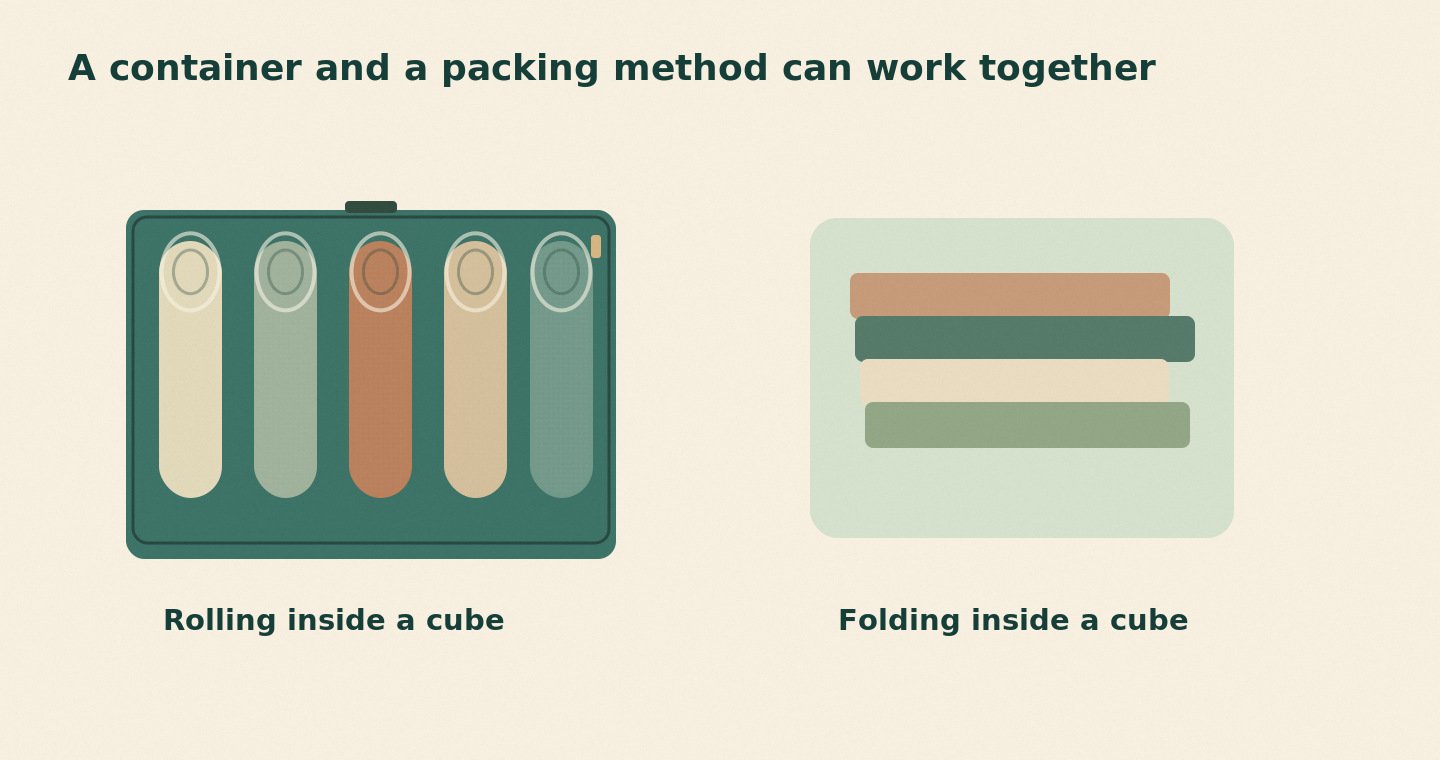
Packing cubes and rolling clothes are often presented as rival techniques, but they are not the same kind of choice. A cube is a container. Rolling is a way of arranging a garment. You can put rolled clothes inside a cube, fold clothes inside one or use no organiser at all. That distinction matters before anyone promises a dramatic reduction in suitcase size.
For maximum usable space, the winner depends on the clothing, the bag’s shape and how well the packed groups fit together. Standard cubes mainly provide organisation. Compression cubes may reduce the bulk of suitable soft clothing, but they also add fabric, zips and a defined footprint. Loose rolling can fill awkward gaps, while flat folding may suit a rectangular case particularly well. None of these methods reduces the weight of the clothes.
This packing cubes vs rolling clothes guide separates space from convenience and gives you a fair home comparison using the same wardrobe. It includes a published independent packing test, product specifications and clearly labelled hypothetical examples. We have not performed an undisclosed laboratory test, and there is no universal percentage saving claimed for either method. The useful outcome is a bag that closes easily and stays practical throughout the trip.
Some buying links may earn us a commission, at no extra cost to you. As an Amazon Associate I earn from qualifying purchases. Recommendations are research-led; we do not claim hands-on testing of the products shown.
Container vs technique
Rolled or folded clothes can both go inside a cube.
Organisation first
Grouped access can be worthwhile without a space-saving promise.
Judge the filled shape
A thinner parcel can still waste space around its edges.
Same wardrobe, same bag
Compare closure, access and weight, not photographs alone.
No automatic percentage saving
Compression does not reduce the mass of clothing. A method that fits more can make the final bag heavier, and organisers add their own weight.
Packing cubes vs rolling clothes: compare the right things
Separate the container from the garment arrangement
A standard packing cube holds a group of items together. Its main benefit is that the group can be lifted out without disturbing everything around it. Rolling changes the shape of individual garments. You can combine the two, so asking which is better without defining the setup leaves out an important part of the comparison.
Compression cubes add a second operation: after the contents are enclosed, another zip reduces the available depth or draws the fabric around the load. That may help with appropriate soft clothing, but the result still has to fit the suitcase. A smaller-looking parcel on the bed is not automatically a more efficient parcel inside the bag.
Define what you want to improve
Decide whether the problem is a case that will not close, a strict weight limit, difficulty finding clothes or messy repacking. These problems need different solutions. Buying cubes to solve a weight problem may add weight, while carefully rolling everything may not help you find one item quickly. Start with the problem, then choose the method that addresses it.
| Method | Main role | Space-saving limitation |
|---|---|---|
| Standard cube | Groups contents for access. | Adds material and a footprint; no automatic compression saving. |
| Compression cube | Groups and compresses suitable soft clothing. | The filled shape still has to use the bag efficiently. |
| Loose rolling | Changes each garment into a flexible bundle. | Rounded shapes can also leave gaps. |
| Folding | Creates flat or upright garment groups. | Results depend on the garment and bag opening. |
What an independent packing test found
Folding won on garment count in this particular comparison
Which? compared folding, rolling, compression cubes and vacuum packing across four bags. Its published results recorded 129 garments for folding, 121 for rolling, 118 for compression cubes and 113 for vacuum packing. Socks were counted separately, and the compression-cube arrangement accommodated more pairs than the other methods. That is a useful warning against a universal claim that cubes or rolling always wins. [1]
Understand the limits before applying the result
The result belongs to those bags, garments and methods; it does not prove every cube is ineffective or every folded wardrobe is optimal. Nor is a garment count identical to your holiday packing list. Use it as a reason to test your own setup rather than accept a space-saving slogan. The comparison in this guide remains research-led rather than a repetition of that experiment. [1]
| Method | Garments | Pairs of socks (separate count) |
|---|---|---|
| Folding | 129 | 47 |
| Rolling | 121 | 41 |
| Compression cubes | 118 | 66 |
| Vacuum packing | 113 | 38 |
Why a neat parcel can waste space in the suitcase
The footprint matters as much as the thickness
Imagine a suitcase compartment with a clear width of 34cm. Two cubes that are each 20cm wide will not sit alongside one another across that width, even if both are compressed very flat. Turning them or using one different size may help, but the product’s compression claim does not solve the footprint mismatch. This is a hypothetical geometry example, not a measured suitcase test.
Now consider curved corners, wheel housings and handle channels. A rigidly packed rectangle may bridge over those features and leave unusable pockets. Loose soft items can sometimes occupy the spaces more naturally. However, a well-sized slim organiser may also work. The right question is how the complete arrangement uses the actual interior, not which pile looks smallest outside it.
Do not multiply exterior dimensions into a promise
A cube’s listed length, width and maximum depth describe its approximate shape, not guaranteed space savings. Fabric can bulge, compression can change dimensions and neighbouring objects influence the final arrangement. Use measurements to rule out obvious mismatches, then make the decision with a loaded trial. A diagram is useful for planning; the bag itself provides the practical answer.
| Measurement | Example | What it tells you |
|---|---|---|
| Clear internal bag width | 34cm | Measure after allowing for obstructions. |
| Width of each filled cube | 20cm | Two need 40cm to sit side by side in that orientation. |
| Compression reduces depth | Not width automatically | A flatter cube does not solve that width mismatch. |
| Alternative arrangement | Turn or mix sizes | Retest the complete bag rather than assume a fit. |
Standard packing cubes: organisation is a real benefit
Keep clothing groups together
A standard cube can make it easier to lift out underwear or tops without disturbing footwear and toiletries. That is especially useful when a suitcase is opened repeatedly in a small room or when a backpack has a deep main compartment. The benefit does not need an exaggerated space-saving claim to be worthwhile.
The London Zoo packing cube set at Case Luggage is one example of a conventional organiser set. Its listed medium cube measures 10 x 32 x 26cm. Compare that footprint with your bag before deciding it suits the layout. The product is included as a size-and-organisation example, not as proof that a themed set packs better than an unbranded alternative. [2]
Accept the small amount of material it adds
The cube occupies some room and has its own weight. That may be an entirely reasonable trade for clarity and easier repacking. However, use the minimum number of organisers that improves your routine. An almost empty cube can be less efficient than grouping its few contents with another category or leaving a suitable soft item loose.
Compression cubes: where the extra zip helps and where it does not
Match compression to suitable clothing
A compression cube may reduce the thickness of a group containing soft, compressible garments. It cannot make a rigid shoe, glasses case or charger meaningfully smaller. Therefore, the result depends on what you put inside. A demonstration using fluffy clothing should not be transferred to a suitcase dominated by dense or rigid objects.
The BAGSMART Blast set uses compression zips and includes several differently shaped clothing cubes plus a shoe bag. That offers ways to group items, but it does not establish a saving for your wardrobe. Use the listed dimensions and your own trial rather than assuming the complete six-piece set belongs in every bag. [3]
Watch the shape after compression
A compressed cube can become rounded or firmer at the centre while retaining broad edges. If it no longer sits neatly beside the next item, some apparent saving may be lost elsewhere. Do not keep tightening until the zip or seams are under obvious strain. Compression should improve the arrangement without turning access and closure into a repeated struggle.
Loose rolling: flexible packing without buying a container
Use rolling where the garment behaves well
Rolling can create small, easy-to-place bundles from suitable soft clothing. That may help around an irregular compartment or beside shoes. It also lets you adjust the width of the bundle to the space available. However, the result depends on the garment’s thickness, cut and the way it is rolled, so there is no universal roll that suits everything.
Begin with a flat garment, smooth obvious bunching and create a reasonably even shape before rolling gently. Avoid turning every item into the tightest possible cylinder. A dense, lumpy roll can be harder to place than a simple fold, and pressure does not guarantee that a garment will arrive without creases.
Keep the loose system manageable
Rows of rolls can look orderly until the first item is removed. Consider whether the remaining clothing stays in place and whether you can identify similar garments. A small organiser for one category may help even when most clothes remain loose. There is no need to choose an all-or-nothing system if a mixed approach is easier to use.
Folding deserves a place in the comparison
Flat garments can fit flat spaces well
A suitcase with a broad rectangular compartment may suit folded layers or upright folded clothing. The available width and depth can be used without introducing several rounded bundles. Nevertheless, the best fold depends on the item and the bag. Do not assume that a method is old-fashioned merely because it does not require an accessory.
Structured shirts, certain trousers and clothing with details you want to protect may also be easier to arrange with deliberate folds. Keep the garment’s care needs in mind and avoid compressing shaped areas. The objective is usable clothing on arrival, not only a tightly filled case.
Combine folding and rolling within one cube
You can fold larger items to the cube’s footprint and use small rolls alongside them. That gives the container an organisational role without forcing every garment into the same form. A Miffy compression cube set provides a different size range to inspect, but the clothing arrangement remains your decision. Matching the cube to the wardrobe matters more than copying a product photograph. [4]
Make a fair home test with the same clothes
Keep the contents fixed
Choose the complete clothing group for the trip and do not change it between attempts. Include the same underwear, socks, sleepwear and accessories each time. Otherwise, a method can appear to save room simply because a bulky item was left out of its photograph. Keep footwear and toiletries in their intended positions so the clothing is tested within the whole bag.
Start with your ordinary packing method, whether that is folding or loose rolling. Then test a standard cube or compression arrangement using exactly the same garments. Keep the case unexpanded for each attempt unless expansion itself is the variable you are investigating. A consistent starting point makes the result more informative.
Record practical observations rather than a dramatic claim
Note whether the case closes without force, how many awkward gaps remain and whether the next outfit is easy to reach. A simple photograph from the same angle can help compare layouts. You do not need to convert the result into a percentage unless you have actually measured a meaningful, repeatable volume. A clear yes-or-no improvement is enough to guide a purchase.
| Keep fixed | Observe | Useful result |
|---|---|---|
| Same complete wardrobe | Closure without force | The same load fits more comfortably. |
| Same bag configuration | Remaining awkward gaps | The filled shapes use the interior better. |
| Shoes and toiletries included | One-item retrieval | The method remains convenient in use. |
| All accessories counted | Final packed weight | The system stays within the booked allowance. |
| An ordinary imperfect repack | Repeatable closure | The benefit survives beyond the first photograph. |
Measure the whole bag, not just the cube
Compression can move the problem elsewhere
A cube may be thinner after its second zip closes, while the suitcase remains the same external size because another object is now the limiting item. Equally, moving one rigid object can allow a looser clothing arrangement to fit. Judge the final bag in travel configuration, with dividers, pockets and straps arranged as they will be on the journey.
Compare the filled bag’s outside measurements with your actual allowance. A soft bag can bulge beyond its nominal dimensions, and an expanded suitcase can exceed a limit even when the clothes inside are carefully organised. The method used to pack it does not change what the operator measures.
Keep the weight comparison honest
Use the Go Travel Digital Pro Scale or another suitable weighing method for the full load. The garments weigh the same whether folded or rolled, while organisers add their own weight. If a method makes more clothes fit, the final bag may become heavier. That can turn an apparent space saving into a new baggage problem rather than a genuine improvement.
Understand the weight cost of a complete organiser set
Weigh only the pieces you will carry
A product may be sold as a large set, but you are not obliged to use every component. Weigh the chosen pieces rather than assuming the whole purchase must accompany you. If two cubes provide all the organisation you need, the rest can remain at home. This makes the packing system easier to evaluate and reduces unnecessary hardware in the bag.
For example, Case Luggage lists the Miffy compression packing cube set at 0.61kg. That is a published set weight, not a claim about each individual cube or the weight you must carry. It illustrates why organiser weight deserves attention when the allowance is tight. Confirm the current specification for the exact set before buying. [4]
Calculate the trade in your own allowance
In a hypothetical 10kg allowance, 0.6kg of organisers uses six per cent of the total before clothing is added. That arithmetic does not prove the organisers are unsuitable; convenience may justify the weight. It simply makes the cost visible. Compare it with the benefit you actually obtain rather than treating organisation as weight-free.
Match cube dimensions to the inside of your luggage
Measure the clear space, not the shell
Open the case and measure the space available after allowing for handle channels, wheel housings and fixed dividers. Then compare the cube’s footprint, including its likely filled shape. Product dimensions are useful screening information, but soft goods can vary when loaded. Leave enough flexibility for the cube to sit naturally instead of forcing it under a rigid panel.
The Blast packing cubes include a large footprint of approximately 38 x 26cm, converted from the manufacturer’s listed inches. Its medium and slim pieces differ, so a mixed layout may be more practical than simply using the largest cube first. These converted dimensions are rounded planning references, not a guarantee of exact loaded measurements. [3]
Try orientation before buying another size
Turn the organiser, swap the location of shoes or use a smaller cube for a dense group. A simple rearrangement may solve the mismatch. However, do not create a system that works only when several soft items are pushed beneath a strained zip. The bag should retain easy closure after an ordinary repack, not only the initial careful arrangement.
Pack different garment types in different ways
T-shirts and soft basics
Try smooth folds or moderate rolls depending on the bag’s shape. Keep similar items visible enough that you can identify them without emptying the group. A cube can help lift the whole category out, while loose rolls may suit smaller gaps. Choose the arrangement that keeps the items usable rather than one that looks most impressive in a photograph.
Avoid creating several hard knots of fabric by rolling too tightly or leaving sleeves bunched inside. A more even shape is easier to compare and place. Repeat the test with the clothes you actually own, since fabric thickness and size can change the result substantially even within the same category.
Shirts, trousers and structured clothing
Use deliberate folds when they better support the garment’s shape. Do not force collars, shaped areas or delicate details into a small compression parcel. A dedicated garment arrangement may be worthwhile for an event, but it should be assessed as part of the whole load. Preserving clothing for its intended use can justify more room than an extreme space-saving method.
Knitwear and insulated items
Some items compress readily, but follow their care and storage guidance rather than treating maximum compression as a default. Consider how long they will remain packed and whether the material needs a less restrictive arrangement. The same principle applies to anything whose shape or performance matters: the packing method should serve the item, not override it.
Choose the system according to the bag opening
Clamshell suitcase or travel backpack
A broad opening lets you see and arrange several groups at once. In that layout, one or two well-matched cubes can act like removable drawers while loose folded items use the remaining space. You may find that a full set adds little benefit because the case already provides dividers or organised halves.
A standard packing cube set is worth considering when the main need is keeping categories together. Nevertheless, compare its filled depth with the case’s divider arrangement. An organiser that presses against the lid may make the case harder to close even though the same clothing fits when spread across a wider area.
Top-loading or narrow-opening backpack
A cube can be valuable when it allows an entire clothing group to be removed through a small opening. However, the cube must fit through that opening when full, not only fit the nominal internal volume. Test retrieval and replacement with the bag loaded. A perfect geometric fit deep inside the pack is of little use when the parcel becomes difficult to remove.
Use a hybrid arrangement when neither extreme works
Give organisers the jobs they do best
Keep small clothing in one cube, fold a structured item separately and let a few soft pieces occupy the remaining shape. This can preserve organisation without dividing every inch into rigid groups. The arrangement need not be aesthetically identical each time. It only needs to keep important items accessible and allow reliable closure.
Try the BAGSMART Blast compression option on a specific soft-clothing group rather than applying compression to the entire wardrobe. Compare that one change with your ordinary method. A limited trial makes it easier to identify what helps and avoids buying a second set because the first was used in an unsuitable configuration.
Let an existing pouch prove the organisational benefit
Before buying new cubes, use a suitable lightweight pouch you already own to group one category. This will not reproduce a specialist compression mechanism, but it can reveal whether grouped access is valuable to you. If you dislike managing the extra container, a more expensive version may not solve the underlying preference. Purchase to improve a proven routine, not to create one you will resent.
Packing for one stop is different from packing for several
A single room reduces the need for repeated sorting
If you unpack once and stay in the same place, maximum organisation inside the case may matter less. A simple folding or rolling arrangement can be enough for the two main packing sessions. However, a cube may still help with underwear, shared luggage or keeping clothing separate from footwear. Choose according to the actual use rather than the length of the trip alone.
Do not buy a large set merely because a fourteen-night holiday sounds substantial. The frequency of packing and unpacking can be more relevant than the number of nights. One suitcase opened once at a resort has a different job from a smaller bag opened at several short stops.
Several stops reward clear groups
For frequent moves, being able to lift out the next outfit or one clothing category may outweigh a small amount of extra material. The London Zoo organiser set illustrates the ordinary cube approach, while other simple organisers can do the same job. Check retrieval with your bag and keep the groupings broad enough that repacking remains straightforward. [2]
Family packing needs ownership as well as space
Make the groups easy to recognise
A colour, position or simple label can distinguish one person’s clothing from another’s. That may be more useful than compressing everything into a single dense parcel. Agree the system before departure so that each person knows where items belong. Otherwise, the cubes can become additional places to search rather than an improvement.
Keep the organisational scheme modest. One cube per person may work for a small shared load, while larger wardrobes may need a different division. A cube per person per day can quickly become complicated. Test the number of containers against the actual routine rather than assuming more categories always mean greater clarity.
Avoid assigning spare room twice
Shared luggage often fails when several people each assume the remaining corner is available for their extras. Lay out the complete shared load before evaluating the packing method. Cubes can make the allocation visible, but they do not create additional allowance. The same space and weight checks still apply to the finished case.
Product examples chosen for different organisational jobs
Standard grouping: London Zoo packing cubes
The London Zoo set provides conventional clothing organisers and a laundry bag, with individual sizes listed by the retailer. It is useful as an example of category separation rather than extra-zip compression. Check the dimensions of the pieces you intend to use; a set’s main display measurement may not describe every component. Current colour, stock and purchase terms remain separate checks. [2]
Compression and mixed shapes: BAGSMART Blast
The Blast six-piece set combines a large cube, two medium cubes, two slim cubes and a shoe bag in the manufacturer’s listing. Its compression zips and mesh panels support a different arrangement from ordinary loose rolling. However, no guaranteed percentage saving follows from that feature list. Compare the actual filled pieces with the suitcase footprint before deciding the set is useful. [3]
Larger compression pieces: Miffy
The Miffy compression set includes one small, one medium and two large clothing cubes plus a drawstring bag. The retailer lists two depths for each compression cube and a complete-set weight. This makes it a useful reminder to inspect both size and mass, not simply the number of pieces. It may be more organisation than a light cabin packer needs. [4]
| Set | Published reference | Question before buying |
|---|---|---|
| London Zoo standard cubes [2] | Medium piece: 10 x 32 x 26cm | Does grouped access justify the footprint? |
| BAGSMART Blast [3] | Large, 2 medium, 2 slim, shoe bag | Which pieces genuinely help this particular load? |
| Miffy compression set [4] | Small, medium, 2 large, drawstring bag; 0.61kg set | Do the filled sizes and additional mass fit the plan? |
Avoid mistaking visibility, ventilation and waterproofness
Mesh helps you see the contents
A mesh panel can make it easier to identify a clothing group without opening the cube. However, visibility is not a measure of space savings. Nor does mesh make a cube suitable for containing a leak. Treat an ordinary clothing organiser as an organiser unless the complete product has a supported protective specification for a different purpose.
Manufacturer ranges distinguish standard cubes, compression cubes, garment folders, shoe sacks and other organisers because they have different jobs. Eagle Creek’s Pack-It range makes that distinction explicit. Use the product category to narrow your search, then check the actual materials, closures and intended use rather than assuming all zipped pouches behave alike. [5]
Do not leave damp clothes sealed for convenience
Dry used clothing can be separated for organisation. Wet swimwear or a damp towel needs an appropriate temporary arrangement followed by drying, not permanent compression into the smallest space. Plan where these items go on the return journey. A packing method should still work when the wardrobe is no longer clean, dry and perfectly folded.
Vacuum bags are a separate choice, not a stronger packing cube
Consider the return-trip process
A vacuum or air-expulsion bag uses a different mechanism from a zipped clothing organiser. Before treating it as the answer to a crowded suitcase, consider how you will recreate the arrangement at the destination. A method that depends on equipment you will not have for the return journey may be inconvenient even when the outbound parcel is compact.
Check the product’s intended contents and method rather than using it for anything that can be pushed inside. Some items need protection from excessive compression or prolonged restrictive storage. The bag’s own closure and shape also take space, while the mass of the clothing remains unchanged. Compare the complete luggage result, not only the visibly flattened package.
Do not confuse sealing with a universal protection claim
A storage bag, dry bag and compression organiser can look superficially similar while having different intended uses. Read the complete product specification for any claim about water, leakage or storage. A closed zip alone does not establish protective performance. For ordinary clothing organisation, a simpler method may be easier to use and sufficient for the trip without adding another type of specialist container.
Read your home-test result carefully
The cube is smaller but the suitcase looks unchanged
Something else may be setting the final shape: shoes, a rigid toiletry kit, a laptop compartment or a poorly used corner. Identify that limiting object before buying another compression product. The cube may still improve organisation, but the test has not shown a meaningful improvement in the finished case’s space. Keep those two benefits separate when deciding whether the extra material is worthwhile.
More fits, but the bag is harder to use
A dense arrangement can make one-item retrieval awkward or require repeated force when replacing the cube. Try leaving that organiser less full and moving a soft item into another suitable space. If access improves without affecting closure, maximum compression was not the useful feature. Your preferred arrangement can be slightly looser while being a better travel system overall.
The case closes easily, but only after a wardrobe change
Repeat the comparison with the original clothes before crediting the method. Replacing a thick jumper with a thin layer or removing a pair of shoes can have a larger effect than the organiser. That may still be a sensible packing decision, but it is a different decision. Record both changes honestly so that the result remains useful for the next trip.
The organiser helps, but the full set does not
Keep the successful part of the system. You may need one cube for small clothing and no others, or a single compression piece for a specific group. There is no obligation to use a matching set throughout the case. A selective arrangement can preserve the convenience you noticed without carrying pieces that did not improve the trial.
Wrinkles depend on more than rolling or folding
Start with the garment and pressure
Fabric, construction, moisture and the pressure applied during packing all affect the result. Rolling is not a guarantee of wrinkle-free clothing, and folding is not an automatic recipe for creases. Smooth the garment, avoid unnecessary bunching and choose an arrangement that respects structured details. Then assess the result with an item similar to what you intend to wear.
Do not judge only the moment when the case closes. Consider how long clothes remain packed and what happens when other items press against them. A tightly compressed cube can transfer pressure through its contents. If a particular outfit needs a more careful arrangement, give it that space rather than treating the outfit as a failure of your packing technique.
Unpack according to the next use
When you reach a suitable place, remove clothing that benefits from being hung or arranged before use, following its care guidance. The best method at home cannot remove every need for attention on arrival. Build that step into the routine rather than expecting one accessory to guarantee a ready-to-wear wardrobe under all conditions.
Consider how the organiser feels to use, not just how it fits
Zip access can outweigh a small space gain
Try opening the cube in the position where you will actually use it, such as a shallow luggage stand or inside a partially opened backpack. Small zip pulls, a tightly packed compression seam or two similar zip paths can make a product frustrating even when its dimensions look ideal. Choose an arrangement you can operate comfortably without excessive grip or repeated repositioning.
There is no need to justify a preference for a simpler opening. Someone who values clear, easy access may prefer a standard cube with a generous opening over a tightly compressed parcel. Another traveller may prefer loose folded clothes and one pouch for small items. The relevant test is your own handling routine, not how quickly a demonstrator closes a new product.
Trial the system when retrieving only one thing
Remove a single top, replace it and close the organiser again while the rest of the case remains packed. Then try the same task without the cube. This small exercise reveals whether the extra container helps or hinders the moments that occur repeatedly during travel. A modest loss of theoretical capacity can be worthwhile for easier access, but the benefit should be real and noticeable.
The return journey is the real test of the system
Repeat the method with less perfect folds
Take several items out during your home trial, mix them as used laundry and repack. You do not need to make the clothes dirty; the purpose is to test a less controlled arrangement. A method that only works with exact original folds may become frustrating after several days. Prefer a setup with enough flexibility to absorb ordinary changes.
Also test the case with the jacket that was worn outbound and any realistic additional item. This reveals whether the space saving was genuine spare capacity or merely an arrangement that depended on carrying something elsewhere. Keep the comparison honest across the entire luggage system, including any personal bag.
Weigh after the extras return
A compact luggage scale is useful only if the final load is what you measure. Add the last-use charger, toiletries and souvenir before checking. Do not assume that compression has preserved a weight margin just because the case closes more easily. Space and kilograms remain separate throughout the trip.

Look at durability and care before choosing a set
Inspect the construction you will repeatedly handle
Check zip movement, stitching and the way the fabric behaves when normally filled. A cube that needs force during the first trial is unlikely to become easier because it is new or expensive. Prefer a size that accommodates the intended group without stress. The main compartment and compression zip should each have a clear role rather than both being used to restrain an overfilled parcel.
Keep proof of purchase and read the actual warranty or returns terms for the retailer and product. A short marketing label does not describe every exclusion or return condition. Test new organisers on a clean indoor surface before using them with worn clothing, shoes or toiletries that may affect whether they can be returned.
Clean each item according to its label
A packing cube’s care instructions may differ from the suitcase or backpack that carries it. Do not assume a machine-washable organiser makes the entire bag washable. Dry components fully before storage and inspect zips for trapped fabric. Maintaining the organisers should remain a small task; avoid a system that adds more care work than convenience.
Pros and cons: choose the trade-off you will notice
Loose rolling or folding
The main advantages are flexibility and no organiser purchase or additional organiser weight. You can change the arrangement to suit the bag’s corners and the individual garments. The drawback is that removing one item may disturb the rest, particularly in a deep backpack. This approach suits people whose bag is already easy to organise or who unpack fully at the destination.
Standard cubes
The advantage is grouped access and a clearer division of belongings. They can simplify shared luggage, small clothing and repeated moves. Their drawback is the material and footprint they add, which may leave gaps in a tightly packed case. Choose them when that organisational improvement is worth the trade rather than demanding a guaranteed capacity increase.
Compression cubes
The additional zip may help reduce the thickness of suitable soft clothing while retaining grouped access. However, the compressed shape can become awkward, the hardware adds weight and excessive filling strains the construction. They are a targeted tool, not a universal upgrade. A fair comparison uses the same garments and judges the finished bag rather than the compressed cube alone.
Common mistakes when trying to save space
Comparing different wardrobes
A smaller-looking pile proves little when the garments changed between photographs. Keep the same items, including socks and underwear, and use the same bag configuration. Also count any clothing moved into another bag. Otherwise, the apparent saving may simply be a change in what was packed rather than an effect of the method.
Using every cube in the box
A set is a collection of options, not a compulsory packing layout. Remove pieces that add little benefit and try a different combination before deciding the whole concept fails. Conversely, do not keep buying sizes to solve a problem created by excessive grouping. A few useful containers usually provide a clearer comparison than a suitcase full of nearly empty pouches.
Treating a strained zip as a successful result
If the case closes only with heavy pressure, the arrangement has not passed a practical test. Reduce or reposition the load and check again. Saving space should make travel easier, not transfer the problem into stressed fabric, awkward access or a return journey that needs two people to close the bag.
Frequently asked questions
Should I roll clothes before putting them in packing cubes?
You can, but it is not required. Try moderate rolls for suitable soft clothing and folds for items that fit the cube’s footprint better. The cube provides grouping, while the garment arrangement determines how the contents sit inside it. Keep the same clothing in your comparison and stop when tighter packing makes the parcel less usable rather than assuming rolling is always superior.
Do standard packing cubes actually compress clothes?
Some restraint occurs when any container is filled and closed, but standard cubes generally do not provide the dedicated second-zip mechanism of compression cubes. Judge the specific construction rather than the word cube. Their organisational value can still justify using them even when the same clothes occupy similar or slightly less space when packed directly into the suitcase.
Which method is best for a very small personal-item bag?
Start with the actual bag dimensions and a minimal, complete contents list. Loose folds or rolls can use irregular spaces without extra organiser material, while one small cube may improve access. Test both. An organiser that fits the nominal capacity but blocks the opening or causes the bag to bulge is not a good match for that particular allowance.
Do compression cubes reduce baggage weight?
No. They change the arrangement of the contents, not their mass, and the cube itself adds weight. If compression allows more clothing to fit, the finished bag becomes heavier. Weigh the complete travel configuration and compare it with the booking. A suitcase that closes more easily is not evidence that it remains within the permitted kilograms.
Can cubes help when sharing a suitcase?
Yes, separating clothing by person or category can make a shared case easier to use. The benefit is clarity rather than guaranteed space savings. Agree the allocation before packing and include everyone’s complete load in the test. Keep necessary journey items accessible elsewhere as appropriate, and do not assume spare capacity or weight can be claimed independently by several travellers.
Are expensive cubes more space-efficient?
Price alone does not establish that. Dimensions, construction, empty weight and the shape of the filled parcel matter more to the fit in your particular bag. A more expensive product may offer features you value, but those need to solve a real problem. Compare the complete system rather than expecting a premium price to guarantee additional usable litres.
Can I put shoes or toiletries in clothing cubes?
Only when the organiser is suitable for that use and you are comfortable with the separation and protection it provides. An ordinary mesh cube is not leakproof, and shoes may soil a container intended for clean clothing. Choose around the item being carried rather than forcing every object into the same set. Dedicated pieces are useful only when their purpose is genuinely needed.
Final recommendation: combine the methods rather than join a side
Start with no new equipment
Pack your real wardrobe using sensible folds and moderate rolls, then test the complete bag for closure, access and weight. Add one or two organisers only where grouped access or compatible compression improves the result. This gives every accessory a clear job and avoids paying for an assumed saving that never appears inside your suitcase.
Use standard cubes for organisation, compression cubes selectively for suitable soft clothing and loose items where the bag’s shape makes them more efficient. Retain folds for garments that benefit from them. The strongest packing system is usually a practical combination rather than strict loyalty to a single technique.
Buy only after the arrangement proves its value
The Blast compression set is one option to inspect when a tested clothing group benefits from that style of organiser. Otherwise, your existing pouches or no cubes at all may be the better choice. What matters is that the same contents fit comfortably, remain accessible and can be repacked without strain throughout the trip. That is a more useful saving than an unsupported percentage.
Sources and fact-checking notes
The Which? figures describe its published four-bag comparison, not a test performed by this website. Our geometry and weight scenarios are explicitly hypothetical. Product details were checked on 12 October 2026. No universal compression percentage, wrinkle-free result or capacity increase is claimed.
- Which? – space-efficient suitcase-packing comparison
Published four-bag test; garments and pairs of socks counted separately.
- Case Luggage – London Zoo packing cube set
Conventional set composition and individual measurements.
- BAGSMART UK – Blast packing cubes
Set composition, zip design and individual dimensions.
- Case Luggage – Miffy compression cube set
Set components, compression dimensions and stated total weight.
- Eagle Creek – Pack-It organiser categories
Distinguishes cubes, compression, folders, shoe sacks and other organisers.
Illustrations in this article were created for Taylor’s Trailblazing Travel Gear. Third-party photographs, where used, are credited beside the image or in the source list.