30L vs 40L Backpack for Travel
Choose the space you will use, not the biggest number you can carry.
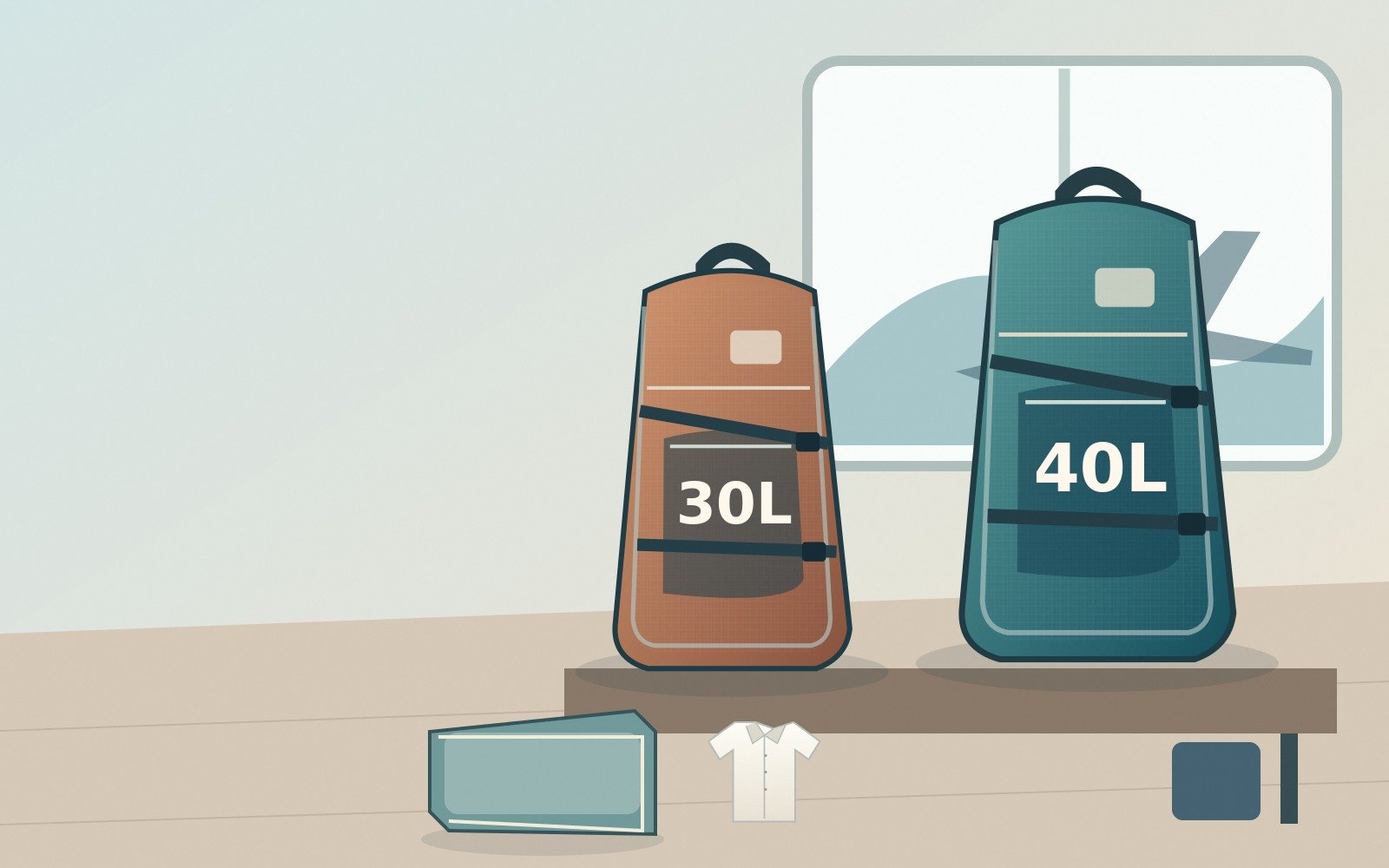
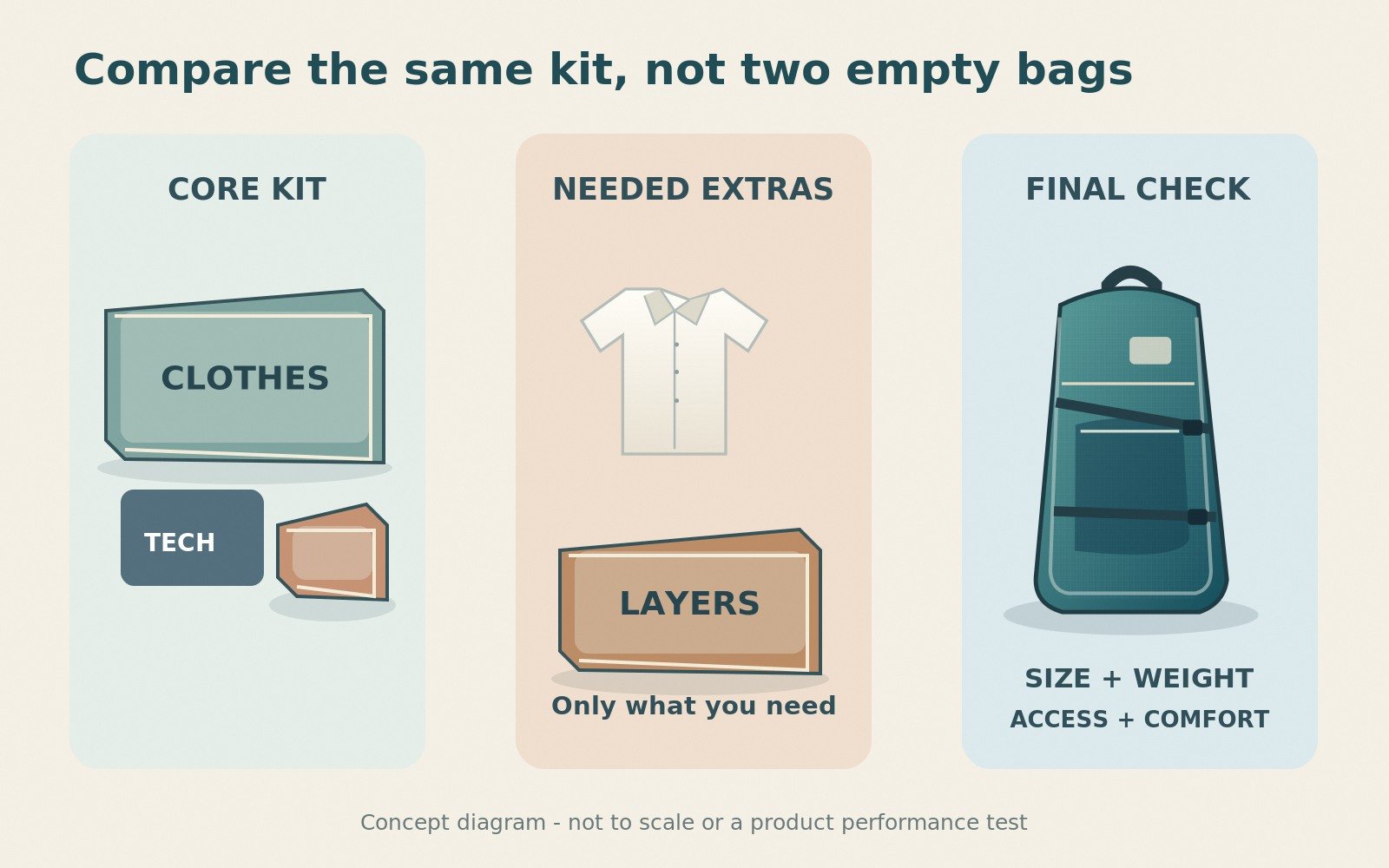
Concept scene: compare your core kit with the extras that genuinely need more room.
A 30L vs 40L backpack for travel decision often starts with the wrong question: how many days will each bag hold? The more useful question is what you actually need between laundry opportunities, and whether that load remains easy to carry, open and repack. Ten extra litres can be valuable space for a second pair of shoes or a warm layer. They can also become a permanent invitation to pack things you will not use.
Start with the contents of your normal trip, not the most demanding holiday you can imagine. A compact kit that works comfortably in a smaller bag should not need a larger backpack simply because the journey lasts longer. Conversely, squeezing essential equipment into an undersized bag is not efficient packing if every checkpoint or overnight stop becomes a struggle.
This comparison uses published specifications and practical planning judgement, not hands-on product testing. The named bags illustrate different approaches rather than a universal ranking. Dimensions and features were checked on 11 October 2026; any unclear specification is identified instead of being treated as a measured result.
30L for an edited kit
Start smaller when your usual clothes, tech and toiletries fit without a packing struggle.
40L for specific extras
Choose more room for necessary layers, footwear or work kit, not unspecified possibilities.
Litres are not dimensions
Capacity does not establish underseat or overhead eligibility.
Pack the same kit twice
Compare closure, access, carried weight and the return-day packing problem.
30L vs 40L backpack for travel: the real difference
Ten litres are meaningful, but not a packing guarantee
Forty litres is one-third more nominal capacity than thirty. That arithmetic describes the labels, not a promise of one-third more usable clothing space. A thick backpanel, several padded sleeves, curved corners and an unusually narrow opening can all change how your particular belongings fit. Compare the interior arrangement as well as the capacity claim. A broad, accessible compartment may accommodate your packing modules more conveniently than a larger compartment divided into awkward pockets.
Treat the extra space as a named allowance. Write down what it is supposed to hold: a pair of trainers, a work outfit, an insulated layer or children’s essentials. Then put those items together and see how much of the larger bag they occupy. This makes the trade-off visible. Without that exercise, the extra ten litres tend to remain an abstract benefit while the inconvenience of carrying a bigger bag is very concrete.
The smaller bag should not require a daily packing performance
A bag is too small for your routine when it closes only after you remove the laptop, arrange every sock precisely and kneel on the lid. That is different from sensible editing. Your packing system should work with ordinary folds, the shoes you actually wear and toiletries in their normal containers. Leave enough flexibility to put away yesterday’s clothing without recreating the entire arrangement.
Equally, do not buy a larger pack solely to avoid making any choices. Removing duplicate chargers or an unused outfit is a more permanent improvement than carrying them in a roomier bag. A good starting rule is to choose the smallest bag that carries your real kit without pressure on closures, blocked access or an uncomfortable fit. It is a decision rule, not an instruction to minimise litres at any cost.
Four real bags that expose the limits of the label
The following examples are selected to show differences in shape, carry system and specification clarity. They are not directly equivalent products. Published external dimensions are useful screening information, but must be checked again with the exact bag packed for departure. Manufacturer descriptions such as carry-on do not decide what your ticket includes.
| Example | Published capacity and dimensions | Empty weight | Useful distinction |
|---|---|---|---|
| Patagonia Black Hole Mini MLC, style 49266 | 30L; 51 x 31 x 18cm | 1.29kg | Convertible carry, with a relatively shallow listed profile. [1] |
| Peak Design Travel Backpack 30L, Sage | Retailer describes 27L compressed / 33L expanded; displays 53 x 33 x 18cm | 1.44kg | The name is not its only capacity state. Check expanded depth. [2] View the Sage 30L listing |
| Osprey Farpoint 40, S26 | 40L; 55 x 35 x 23cm | 1.48kg | Adjustable harness and load-transferring frame; not a personal-item claim. [3] |
| BAGSMART Blast Pro 40L | Page shows conflicting dimensions: 45 x 33 x 22cm and 45 x 32 x 21.5cm | Conflicting 1.3kg / 1.5kg blocks | Confirm the exact version before relying on a size or weight figure. [4] Check the Blast Pro version |
Read the model details, not just the category
The contrast between the Mini MLC and Farpoint is useful: more advertised capacity does not require a dramatic increase in empty weight. However, the packs also have different shapes and carrying systems. You cannot attribute their entire difference to the extra ten litres. Use them to form questions for your shortlist, not to claim that every 40L bag carries like a Farpoint or every 30L bag packs like a Mini MLC.
The Blast Pro is a reminder to ask questions before buying. Neither of its displayed dimension blocks should be silently chosen because it looks more convenient. Ask the retailer to identify the current version and provide external measurements, including its packed depth. A lower advertised price would not resolve a specification conflict, and an airline badge cannot substitute for that missing clarity.
Build the clothing cycle before choosing capacity
Count wears between washes, not nights away
Lay out the clothes you expect to wear between realistic laundry opportunities. Include a dry change for the period while washed clothes are unavailable. The practical constraint is not just finding a washing machine; it is having enough drying time and a place to manage the clothing. A plan that depends on overnight drying should be reconsidered when you expect late arrivals, early departures or no suitable drying space.
For a simple city break, the same shoes and a small group of compatible garments may cover most activities. A trip combining work meetings, exercise and a formal meal creates different demands. Those demands can justify 40L even when the trip is short. Conversely, a longer leisure trip with a reliable clothing cycle can favour 30L. These are planning patterns, not guaranteed outfit counts for either capacity.
Separate useful variety from duplicate function
Group clothing by what it does. A second warm top that performs exactly the same role as the first is a candidate for removal. A required uniform or a second pair of shoes that serves a genuinely different activity is not automatically excess. The aim is to recognise the difference rather than apply a rigid minimalist rule to every traveller.
Our seven-day packing and laundry guide gives a useful structure for this exercise. Use your own garments, however, because fabric thickness, personal size and preferred fit affect the result. Someone packing larger clothes should not be judged against a list illustrated with much smaller garments. The right bag is the one that supports your wardrobe and activities without making the journey needlessly cumbersome.
Check weight before celebrating the extra room
Empty mass is only the opening balance
Subtract the bag’s empty mass from the allowance you actually have. Then account for the items that are heavy relative to their size: laptop, charger, camera, toiletries and water. An illustrative 7kg total budget would leave 5.71kg after a 1.29kg bag, or 5.52kg after a 1.48kg bag. Those figures are simple subtraction using the Mini MLC and current Farpoint specifications, not a statement that either meets a particular airline’s complete rules. [1] [3]
| Illustrative packing budget | Example allocation |
|---|---|
| Backpack | 1.5kg |
| Clothing and footwear | 2.3kg |
| Laptop, charging and small electronics | 1.8kg |
| Toiletries, documents and other essentials | 0.7kg |
| Remaining allowance within a hypothetical 7kg total | 0.7kg |
Leave an operational margin
In that example, the remaining weight has to absorb anything not already counted. It is not automatically available for ten litres of extra clothes. A bottle filled after security or a purchase made during the trip can change the balance. Weigh the actual departure load rather than treating the example as a recommended allowance or a measured packing list.
A luggage scale is useful when you need repeatable checks, but it is not a way to dispute an airport reading down to the last gram. The Go Travel Digital Pro Scale is one relevant option; the retailer also lists a tape measure. No independent accuracy result is claimed here. Keep a sensible margin and avoid holding a heavy load aloft longer than necessary when measuring it. [5]
Pack for access as well as volume
Make the first-open items easy to reach
Identify what you will remove while the bag is still otherwise packed. That might be a laptop, a liquids pouch, a rain layer or a meal. Put those items somewhere they can be reached without lifting out the clothing stack. A 30L bag with good access may be more convenient than a 40L bag whose extra space sits behind the things you need most often.
Try the reverse operation as well. Removing a laptop is easy to demonstrate with an empty sleeve; reinserting it beside a tightly packed main compartment is more revealing. Check that the device does not need to be forced past bulky clothing. Allow for any protective sleeve you normally use, and do not treat a published screen-size claim as confirmation that every device with that diagonal measurement will fit.
Use fewer organisers than the set contains
Packing cubes should support a routine, not become another packing obligation. One clothing cube and a smaller underwear module may be enough. The BAGSMART Blast set includes five cubes and a shoe bag; the Faro six-piece listing uses a different size mix. Do not assume that products with the same piece count occupy the same footprint. [6] [7]
Compare Blast cube dimensions Compare Faro cube dimensions
Test the organisers inside the bag before filling them completely. A rigidly stuffed cube can bridge curved corners and leave unusable pockets of space. Sometimes two smaller modules work better; sometimes loosely folded clothes are simpler. The useful measure is whether the system makes unpacking and repacking easier, not how many matching containers fit into a photograph.
Carry comfort can outweigh the capacity difference
Compare the same load on your own body
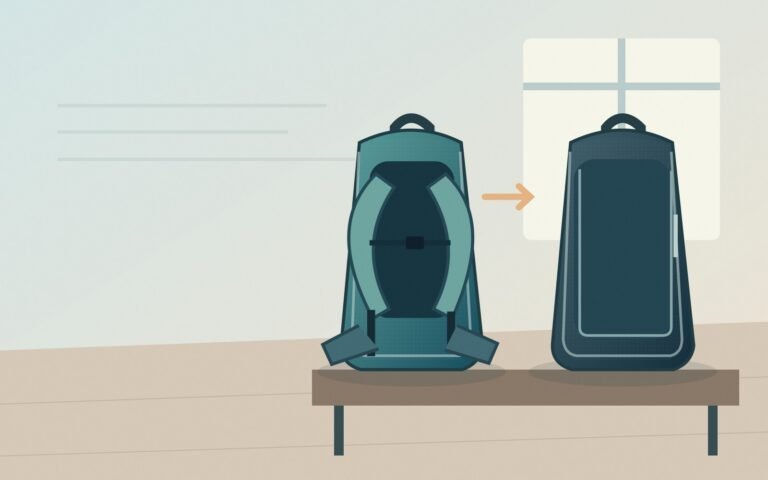
A meaningful fitting comparison uses the same belongings in both bags. Otherwise, a nearly empty 30L pack will predictably feel different from a fully loaded 40L pack without telling you anything about the harnesses. Begin with a manageable load and stop if you feel pain, numbness or instability. A home comparison is not an endurance test and should not be used to justify a bag that already feels wrong.
Observe where the bag sits rather than relying on a photograph of someone else wearing it. Shoulder straps should not require extreme tightening to keep the pack stable. A hipbelt is useful only when it reaches an appropriate position and works with the rest of the suspension. Osprey specifically describes an adjustable torso and load transfer through the Farpoint’s frame; that is a model feature, not an automatic property of all 40L backpacks. [3]
Think about the awkward transitions
Walking across a room is only one part of travel. Try sitting down with the bag beside your legs, turning through an ordinary doorway and lifting it onto a stable surface at a comfortable height. Keep the exercise gentle and indoors. Notice whether you can use the grab handles without catching loose straps or pressing fragile contents against the furniture.
A larger bag may suit a direct airport-to-hotel journey yet feel unnecessarily intrusive on crowded public transport. On the other hand, a well-adjusted larger harness can be preferable to a compact bag that concentrates all the load uncomfortably. Treat capacity, fit and loaded behaviour as three separate decisions. The home backpack test provides a more detailed sequence without requiring outdoor wear.
Airline rules: neither label means a free bag
Start with the entitlement on the booking
Ryanair currently distinguishes its 40 x 30 x 20cm small personal bag from the 55 x 40 x 20cm, 10kg second cabin bag included with Priority and 2 Cabin Bags. easyJet’s small bag is 45 x 36 x 20cm, while its larger entitled bag can be 56 x 45 x 25cm. These are different products and allowances, not interchangeable meanings of carry-on. [8] [9]
A 30L bag can therefore be too tall for a small-bag entitlement even when its depth looks modest. Similarly, the Farpoint’s published 23cm depth exceeds a 20cm depth limit on paper. Do not convert nominal litres into a promise that a soft bag will squash into a sizing frame. Underpacking can reduce some fabric bulges, but frames, padded sleeves and fixed seams place limits on what changes.
Measure the configuration you will actually take
Close the bag with all pockets loaded, including the things you normally add at the last minute. Measure the greatest external dimensions rather than following the curve of the fabric with a flexible tape. Check protruding handles, filled bottle pockets and any expansion section. Then compare each dimension with the appropriate allowance; spare width does not cancel excessive depth.
Repeat the check for the return journey, particularly when the original packing arrangement included clothes worn rather than carried. A bulky jacket that was on your body outbound may end up inside the backpack later. Plan that possibility before choosing capacity. Buying a roomier bag is not a solution when the extra room makes it exceed the strictest baggage limit on your itinerary.
Shoes, technology and specialist items change the answer
Footwear is a shape problem as well as a volume problem
Place any spare shoes in the bag early in your trial. Their shape determines what can sit around them, and a neat rectangular cube may not reflect the space they actually need. Protect clean clothing from soles, but avoid adding a heavy shoe container automatically. Use a lightweight separator that suits the footwear and remove damp shoes to dry as soon as practical.
When shoes are the only reason 30L fails, ask whether the second pair is essential for the activities planned. That is a more useful question than trying ever more forceful compression. Required footwear may justify 40L. A spare pair packed because it might be useful is a different decision. Do not compromise essential equipment or suitable clothing solely to make the smaller option win.
Work and camera equipment need protected room
A laptop, camera or medical device cannot be compressed like a jumper. Preserve its protection and access first, then arrange clothing around it. Avoid placing hard plugs or chargers where they press against screens or other vulnerable surfaces. A large volume figure is of limited use when the bag’s opening or protected compartment cannot accommodate the equipment safely.
For work trips, compare the entire system: device, sleeve, charger, cables and any documents that must stay flat. Our one-bag business travel guide explores that arrangement. A 40L bag may be justified by this fixed equipment even when the clothing load is modest, while a traveller without electronics may comfortably use 30L for a more varied wardrobe.
Three trip patterns, three different decisions
Frequent moves with a compact clothing cycle
A traveller changing accommodation regularly may value a bag that is easy to manoeuvre and quick to repack. Start with 30L when the kit fits without squeezing and the harness is comfortable. Do not choose it merely because smaller sounds more adventurous. The practical benefit disappears when toiletries, laundry and food have to be carried separately in several loose bags.
Make an arrival routine: remove the clothing module, put toiletries where they belong and keep the transit essentials together. Then reverse that routine before leaving. The fewer loose pieces you have to remember, the easier it is to maintain. This is where a modestly sized bag with a simple opening can be more useful than a larger design with numerous small compartments.
Mixed activities or fewer laundry opportunities
Forty litres becomes more attractive when the extra contents are predictable and necessary. Examples include work clothing alongside casual clothes, a warm layer for a second climate or footwear for a booked activity. Allocate the additional space to those items before considering discretionary extras. This keeps the larger bag from expanding beyond the weight you intended to carry.
The Blast Pro 40L can be investigated as an organisation-focused candidate, but its conflicting specification blocks need resolving first. The current Farpoint is a different route where an adjustable carrying system is important. Neither is a universal answer: compare access, actual mass and the precise baggage allowance before treating capacity as the deciding factor. [4] [3]
A bag that also works during the day
Using the same backpack for sightseeing after unpacking introduces another trade-off. A large travel pack may still feel cumbersome with little inside it. By contrast, a smaller design with effective compression could be more practical, but an expandable bag has to be assessed in both states. However, a travel pack is not automatically a pleasant daypack simply because it can be partially emptied.
The Peak Design 30L in Sage illustrates this variable-capacity approach. Its retailer description gives compressed and expanded capacities, plus tuck-away straps. Those features may support different uses, but they do not prove that its shape suits your daily routine. Consider the size of lockers, the items carried during the day and whether a separate lightweight day bag would actually simplify things. [2]
Run a realistic comparison before the return deadline
Keep the trial controlled and reversible
Read the seller’s return conditions before removing labels or taking the bag outside. Protect the packaging and use clean clothing for an indoor trial. A practical routine can reveal whether the pack meets your needs without deliberately stressing seams, flooding fabric or making durability claims from a few minutes of handling. Ask the seller when the permitted extent of a trial is unclear.
Pack both candidates from the same list. Record what fails to fit, which pocket becomes difficult to use and whether the bag retains a manageable shape. Photograph the arrangement for your own reference. A few short notes are more reliable than remembering which bag felt slightly easier after several repacks, especially when you are comparing different opening styles or organiser layouts.
Repeat after disturbing the contents
Remove one outfit, the toiletries and the charger, then put them back in a normal way. This simulates ordinary use more realistically than keeping the display-perfect first arrangement untouched. Include dry used clothing in a separate lightweight bag and see whether it disrupts the fit. Do not put damp items into a new pack simply to test a travel scenario.
Check the weight again with your own scale or a dedicated travel scale. Compare the result with both the travel allowance and the load you found comfortable. A pack that technically closes but becomes unpleasant after an ordinary indoor carry has not passed your personal test. The aim is a repeatable routine, not a single successful photograph of the zip shut. [5]
Avoid paying twice for the wrong compromise
Decide what improvement you are buying
Price comparisons are more useful after the requirements are settled. Identify the feature that would genuinely improve the journey: better torso adjustment, less empty weight, a shallower profile or easier laptop access. Paying for a larger capacity does not necessarily buy that feature. Equally, a cheaper bag that forces you to buy a different baggage allowance or an additional daypack may not be the economical choice for your routine.
Use actual checkout totals and the terms for your address rather than assuming every retailer offers the same delivery and return service. This guide does not rank temporary prices or promotions. The linked pages were checked for product identity, but stock and offers can change. The important comparison is between exact versions that you can obtain and return under terms you understand.
Consider repair and future use without buying for every possibility
Inspect the likely wear points: main zip, strap attachments, grab handles and any expansion mechanism. Ask whether repairs or replacement parts are available rather than assuming a broad warranty slogan covers every type of damage. A simple bag that serves your repeated trips may be a better long-term choice than a specialised design chosen for one hypothetical journey.
However, do not make future-proofing an excuse to buy the largest pack. Write down the trips you already take and those you have genuinely planned. When a rare equipment-heavy journey is very different from the rest, borrowing a larger bag may be more sensible. Your everyday travel system should not be permanently shaped by a trip that might never happen.
Read packing demonstrations critically
Check what the demonstration leaves outside
An online packing display can help you understand an opening or pocket arrangement, but it rarely represents your exact trip. Look for the items that are absent: a full charger, footwear, a glasses case, essential medication or the layer worn by the demonstrator. Ask whether the laptop compartment remains usable after the main section is packed. A bag looking spacious in one carefully arranged demonstration does not establish what it will hold for you.
Also distinguish an empty pocket from genuinely spare capacity. Filling a front pocket can push into the main compartment or increase external depth. The same physical space cannot necessarily be used twice simply because there are two zips. Trial the combinations you will need simultaneously rather than adding together every advertised compartment as though each had an independent volume allowance.
Look for a complete repack, not just an impressive first pack
The most informative demonstration shows ordinary access: removing a shirt, returning the laptop and closing the bag again without a complete rebuild. You can recreate that with your own belongings at home. A system that works only when every garment is compressed perfectly may be unsuitable for a trip with frequent moves, limited surfaces or an early departure.
Avoid interpreting another person’s packing style as a standard you must meet. Their clothing size, tolerance for repeating outfits and need for specialist equipment may differ from yours. Use demonstrations to learn where the zips and compartments are, then base the purchase on your own kit. The thirty-versus-forty question becomes much clearer when you stop comparing yourself with someone else’s edited packing photograph.
Account for shared equipment and changing needs
Shared items need an owner and a place
Travelling with someone else can reduce duplicated equipment, but it also requires an explicit plan. Decide who carries shared toiletries, charging equipment or a first-aid kit, then include those items in that person’s trial load. Do not assume the other bag will absorb anything that fails to fit yours. Two individually sensible packing lists can become an impractical combined system when the shared items are added at the last minute.
Consider what happens when you separate during the day. A shared charger may be convenient in the room but less useful when only one person has access to it elsewhere. The answer is not necessarily to duplicate everything; it is to recognise which essentials need to remain independently available. This can change whether 30L is adequate for each traveller or whether one genuinely needs more room.
Leave room for requirements, not for social pressure
Some travellers need equipment, clothing or personal-care items that do not appear in standard minimalist lists. Put those requirements into the kit before choosing a backpack. Do not remove important items to satisfy a capacity target, and do not assume an airline will automatically exempt them from a baggage allowance. Where a special provision may apply, confirm it directly with the carrier before planning around it.
The same principle applies when your needs change between trips. Recheck the packing list after taking on new work equipment, travelling with a child or changing activities. A previously useful 30L pack may no longer suit the load, while a 40L bag bought for a particular assignment may be unnecessarily large later. Keep the decision tied to present requirements rather than treating the first purchase as a permanent statement about how you travel.
Keep the bag stable with the smaller load
When testing a larger backpack with fewer belongings, check whether the load settles at the bottom or shifts as you turn. Use the internal restraints supplied for that purpose, and keep denser equipment in an appropriate protected position. Extra volume is not automatically a comfort problem, but uncontrolled contents can make a promising larger bag feel awkward. A partly filled trial is useful even when the bag will sometimes be packed more heavily.
Also consider whether a smaller bag would need less supporting equipment. An organiser, extra sleeve or separate pouch can be useful, yet several additions made only to compensate for the wrong layout may erase the benefit of choosing that bag. Compare the whole packed system at the end of the trial. The decision is not between two empty shells; it is between two ways of carrying the belongings you actually need.
Pros and cons of choosing each size
The case for 30L
Thirty litres encourages a deliberate kit and can produce a more manageable package for frequent moves. It is particularly appealing when clothes are versatile, electronics are limited and the bag will remain in use after you unpack. A smaller main compartment can also make a modest organiser system easy to locate without searching around unused space.
The disadvantage is reduced tolerance for bulky essentials and imperfect repacking. Larger clothing sizes, required footwear or a substantial work kit may use the available room quickly. A 30L choice is successful only when it works for your belongings without relying on constant pressure, unnecessary separate bags or leaving behind things that matter.
The case for 40L
Forty litres offers useful room for defined extras and a more relaxed packing routine. It can be a good one-bag option when a smaller pack fails for clear reasons, especially when the chosen model also has an appropriate carrying system. You can choose not to fill every corner, provided the load remains stable and the external dimensions comply.
Its weakness is the temptation to fill spare space and the potential for more bulk during everyday travel. It can also be too deep for stricter overhead rules despite a carry-on label. The additional capacity should solve a documented problem; it should not be bought as a substitute for checking fit, weight or the booked entitlement.
Common mistakes that make either size feel wrong
Buying capacity before seeing the kit
Do not order a pack and then search for belongings to fill it. That reverses the decision and makes it harder to distinguish essential items from convenient extras. Put the core kit together first, including the less photogenic pieces such as cables, spare glasses and the clothing you will wash. Those items still occupy real space even when a packing demonstration leaves them out.
Another mistake is packing every organiser from a matching set. Empty fabric, handles and zips have weight too. Use only the modules that make your routine clearer. Similarly, avoid assuming that compression produces free capacity: it may reduce bulk while leaving a denser, heavier package that is no easier to carry or fit into a prescribed external shape.
Treating one successful flight as universal approval
A bag accepted on one flight has not acquired permanent approval for every airline, fare or aircraft. Keep using the published rules and the measurements of your actual packed bag. Also distinguish a bag that physically fits under a seat from one that complies with the small-bag allowance. Those are related questions, but they are not the same question. [8] [9]
Frequently asked questions
Is 30L enough for a week of travel?
It can be, but the result depends on your clothing cycle, equipment and activities rather than the number seven. Try packing the garments you will use between washes, a dry change, toiletries and electronics. Thirty litres is a reasonable candidate when that kit closes easily and remains accessible. A week involving formal clothes, bulky layers or specialist shoes can require more room without reflecting poor packing.
Is 40L too big for a weekend?
Not necessarily. A weekend can involve a laptop, an event outfit or sports equipment that occupies more room than a longer simple holiday. The question is whether the larger bag solves a real need and stays manageable. When the same weekend kit fits comfortably in a smaller pack, carrying an almost empty 40L design may add bulk without improving the trip.
Does a 30L backpack count as a personal item?
Not by capacity alone. The airline specifies external dimensions and the relevant entitlement on your booking. A 30L model can be too tall, too deep or too wide even when another bag with a similar capacity fits. Measure the complete packed bag, including filled pockets, and compare each dimension with the exact small-bag rule. Do not rely on the capacity label or another traveller’s experience. [8] [9]
Will compression cubes make a 30L bag work like 40L?
They may reduce the bulk of compressible clothing, but they cannot enlarge the bag’s frame, opening or permitted dimensions. Shoes, electronics and many toiletries do not shrink meaningfully. Compression also leaves the contents’ weight largely unchanged while adding the organiser itself. Use it selectively when it improves a known packing problem, not as a guaranteed way to gain ten usable litres.
Is a hipbelt necessary at these sizes?
That depends on the load, duration of carrying and the design of the harness. A hipbelt needs to sit and function appropriately; its presence alone does not establish comfort. Some travel bags provide substantial load transfer while others use a simpler stabilising strap. Try the actual load and compare how the complete system behaves rather than choosing a capacity because a belt appears in the product photographs.
Which size is the safer starting point for a first one-bag trip?
Start by testing your existing bag with a realistic kit. Choose around 30L when the contents fit comfortably and you are happy with the clothing cycle. Move towards 40L when essential items make the smaller option impractical. In either case, the first checks are the booked baggage rules and your loaded comfort. A bag can be a good travel size without being suitable for your particular flight.
Final recommendation: let ten litres earn their place
Choose 30L when it carries your normal kit without a struggle, suits the way you move and gives you the access you need. Choose 40L when you can name the necessary items that use the extra room and the completed load remains comfortable and compliant. Neither decision should depend on a universal number of days per litre.
For a variable-capacity candidate, investigate the Peak Design 30L’s compressed and expanded configurations. For an organisation-led 40L candidate, ask BAGSMART to resolve the Blast Pro’s current dimension and weight differences before buying. The Mini MLC and Farpoint remain useful specification benchmarks, but their published figures do not replace a personal fitting trial. Keep the shortlist small enough that you can compare it carefully. [2] [4] [1] [3]
Review the 30L option Review the 40L option
The best result is a bag you can pack normally on the last morning of the trip, carry without resentment and put away without an argument over its size. A spare ten litres are worthwhile when they support that routine. They are unnecessary when they merely postpone the decision about what to leave at home.
Sources and fact-checking notes
Product details and linked pages were reviewed on 11 October 2026. Published specifications are distinguished from illustrative calculations and planning advice. No hands-on product testing or independently measured performance results are claimed.
Some pages include conflicting version details or both purchase and stock-notification controls. Recheck product availability, delivery estimates, the selected variant and the operating airline before purchase and travel.
- Patagonia UK: Black Hole Mini MLC 30L, style 49266 Published dimensions, mass and convertible carry system; these do not override airline limits.
- Case Luggage: Peak Design Travel Backpack 30L, Sage BTR-30-SG-2 Retailer specifies 27L compressed and 33L expanded; the displayed 18cm depth must not be assumed to cover both states.
- Osprey UK: Farpoint 40, S26 Current UK 40L specification and zip-away harness. The checked Black page showed stock-notification controls; no available offer is assumed.
- BAGSMART UK: Blast Pro 40L Travel Backpack Conflicting size/weight blocks: 45 x 33 x 22cm and 1.3kg versus 45 x 32 x 21.5cm and 1.5kg. Obtain confirmation for the selected version.
- Case Luggage: Go Travel Digital Pro Scale, 2004.101 Retailer description of the scale and tape measure; no independent accuracy test is claimed.
- BAGSMART UK: Blast Packing Cubes Current destination of the older six-piece URL. Set comprises five packing cubes and a shoe bag; dimension ranges are not guaranteed filled thicknesses.
- BAGSMART UK: Faro Packing Cubes 6PCS Current six-piece listing, individual dimensions and advertised 0.75kg total; weigh only the pieces you carry.
- Ryanair: baggage policy Small personal bag 40 x 30 x 20cm; Priority second cabin bag 55 x 40 x 20cm and 10kg. Check the booked allowance.
- easyJet: cabin bags Small bag 45 x 36 x 20cm; large bag 56 x 45 x 25cm with appropriate entitlement. Published 15kg limit and self-lifting requirement.
Illustrations in this article were created for Taylor’s Trailblazing Travel Gear. Third-party photographs, where used, are credited beside the image or in the source list.