Power Banks for Flights: A Rule-Checking Checklist
The safest routine is to choose a clearly labelled bank under 100Wh, carry it accessibly in the cabin and verify the operating airline before departure.
Power banks for flights are useful during delays and long connections, but the rules around them are changing faster than most packing lists. In March 2026, international guidance introduced specific limits on number, use and recharging in flight.
The core routine is simple: check watt-hours, pack the bank in the cabin, protect it from short circuits and read the operating airline’s policy. Capacity alone is not enough, and a rule remembered from last year may no longer apply.
This checklist was reviewed on 20 September 2026 against IATA, UK CAA, FAA and airline sources. Re-check before every journey because carriers can impose stricter conditions.
Stay at or below 100Wh
This avoids the changing approval rules for larger banks.
Cabin baggage only
Remove the bank if a cabin bag is gate-checked.
No more than two under IATA
Airline and national rules may be stricter or different.
Check before charging
Many carriers prohibit using or recharging power banks in flight.
Power-bank rules changed materially in 2026. IATA guidance issued after the 27 March 2026 ICAO addendum separates power banks from ordinary spare batteries. It says they must travel in carry-on baggage, must not be recharged on board, should not be used to charge another portable device on board, must be protected against short circuit and are limited to no more than two per person under the new framework.
National implementation and airline policy can differ, and some carriers are stricter. The practical routine is therefore to check three layers: the international or national baseline, the operating airline’s dangerous-goods page and any route-specific message shown during check-in. A codeshare flight is governed operationally by the airline actually flying the sector.
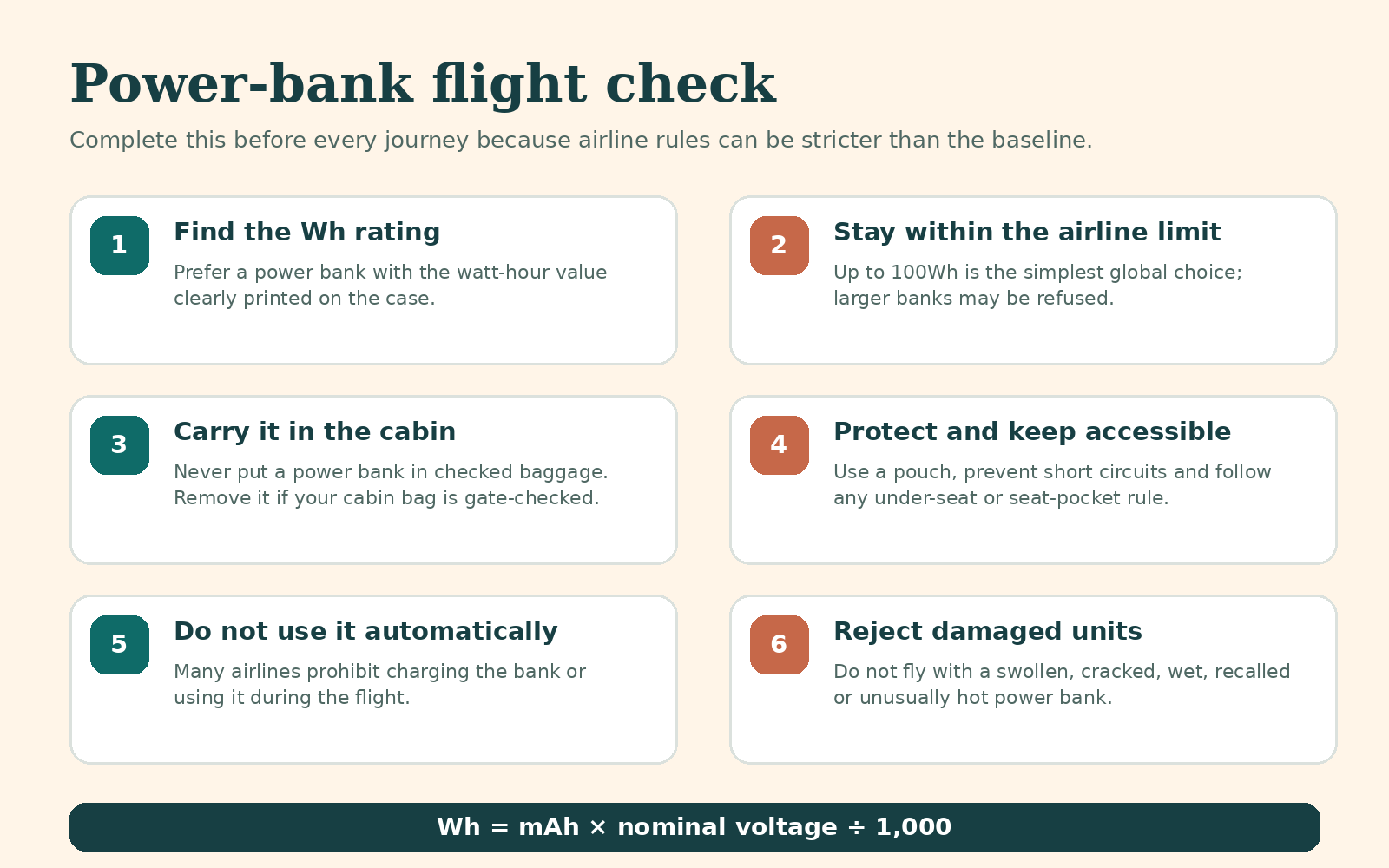
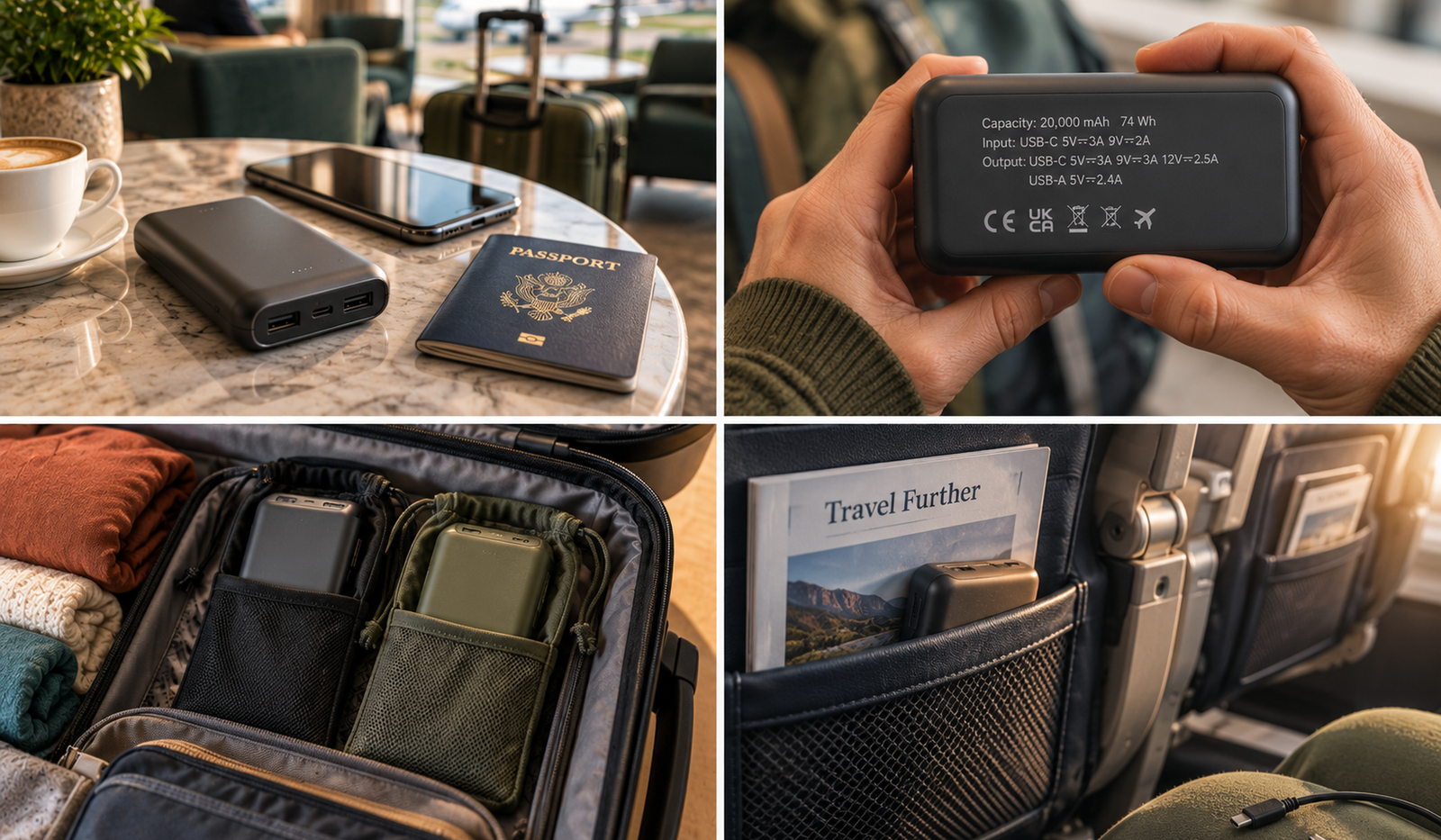
Air rules are written in watt-hours because Wh reflects stored energy. Marketing often leads with milliamp-hours, which cannot be converted to Wh without the battery’s nominal voltage. The formula is Wh = mAh × nominal voltage ÷ 1,000. A 20,000mAh bank rated at 3.6V is 72Wh; a 10,000mAh bank at 3.9V is 39Wh.
Use the Wh value printed by the manufacturer whenever possible. A clear case marking lets check-in and cabin staff assess the bank quickly. If the label is missing, worn away or inconsistent with the manual, an airline may refuse it because capacity cannot be verified.
| Nominal cell figure | Calculation | Approximate Wh | Position against 100Wh |
|---|---|---|---|
| 10,000mAh at 3.7V | 10,000 × 3.7 ÷ 1,000 | 37Wh | Well below. |
| 20,000mAh at 3.6V | 20,000 × 3.6 ÷ 1,000 | 72Wh | Below. |
| 26,800mAh at 3.7V | 26,800 × 3.7 ÷ 1,000 | 99.16Wh | Just below; label clarity matters. |
| 30,000mAh at 3.7V | 30,000 × 3.7 ÷ 1,000 | 111Wh | Above; may require approval or be prohibited. |
Up to 100Wh remains the simplest capacity for ordinary passenger travel. UK CAA guidance published after the March 2026 change states that power banks up to 100Wh are allowed without operator approval. Its page also describes approval for 100–160Wh under the current addendum. IATA’s operator guidance, however, says the 100–160Wh power-bank provision will not be carried into the 68th edition of the Dangerous Goods Regulations from 1 January 2027.
That transition is a strong reason not to buy a 120Wh or 150Wh bank for routine air travel. Even where approval is theoretically available in 2026, an airline can refuse it, limit it or require advance contact. A bank under 100Wh with a readable rating is more portable across carriers and future rule changes.
A power bank is treated as a spare lithium battery and must not remain in checked baggage. If cabin baggage is taken at the gate because the overhead bins are full, remove every power bank before handing the bag over. Keep it in a smaller personal item or follow crew instructions.
The FAA gives the same practical direction: power banks must be carried in the cabin, and any spare batteries must be removed from a carry-on that is checked at the gate or planeside. This is not merely a paperwork rule. A battery incident can be detected and managed more quickly in the cabin than inside the cargo hold.
The 2026 IATA framework prohibits recharging a power bank in flight and recommends that passengers should not use it to charge another portable device. Individual airlines have already adopted stronger bans. Singapore Airlines has prohibited both charging the bank from the aircraft and using it to charge personal devices since April 2025. Emirates has prohibited use from 1 October 2025 and allows only one bank under 100Wh.
Treat the bank as reserve energy for the airport and destination unless the operating carrier explicitly allows onboard use. Charge the phone, tablet and bank before leaving home. Where seat power is available, use the aircraft outlet only in accordance with crew and airline instructions, and never use it to recharge the power bank when the airline prohibits that action.

Under the 2026 IATA addendum, the new limit is two power banks per person. A charging case designed primarily to recharge another device can also be treated as a power bank. Built-in battery luggage, camera batteries and batteries installed in phones or laptops sit in related but distinct categories, so do not assume every battery shares the same quantity rule.
The FAA baseline still describes different quantity treatment for batteries under US rules, while warning that airlines may impose stricter limits. On an international itinerary, the conservative choice is to follow the strictest rule encountered: no more than two clearly labelled banks, unless every operating airline confirms a different allowance.
| Item | Typical classification | Cabin approach |
|---|---|---|
| Portable USB power bank | Power bank / spare lithium battery | Carry on, protect, count against airline power-bank limit. |
| Phone battery case | Often treated as a power bank | Carry on and check airline wording. |
| Battery installed in phone | Portable electronic device | Usually permitted in cabin; separate device rules apply. |
| Loose camera battery | Spare lithium battery | Carry on with terminals protected. |
| Smart luggage battery | Installed or removable luggage battery | Must meet specific removable-battery and capacity rules. |
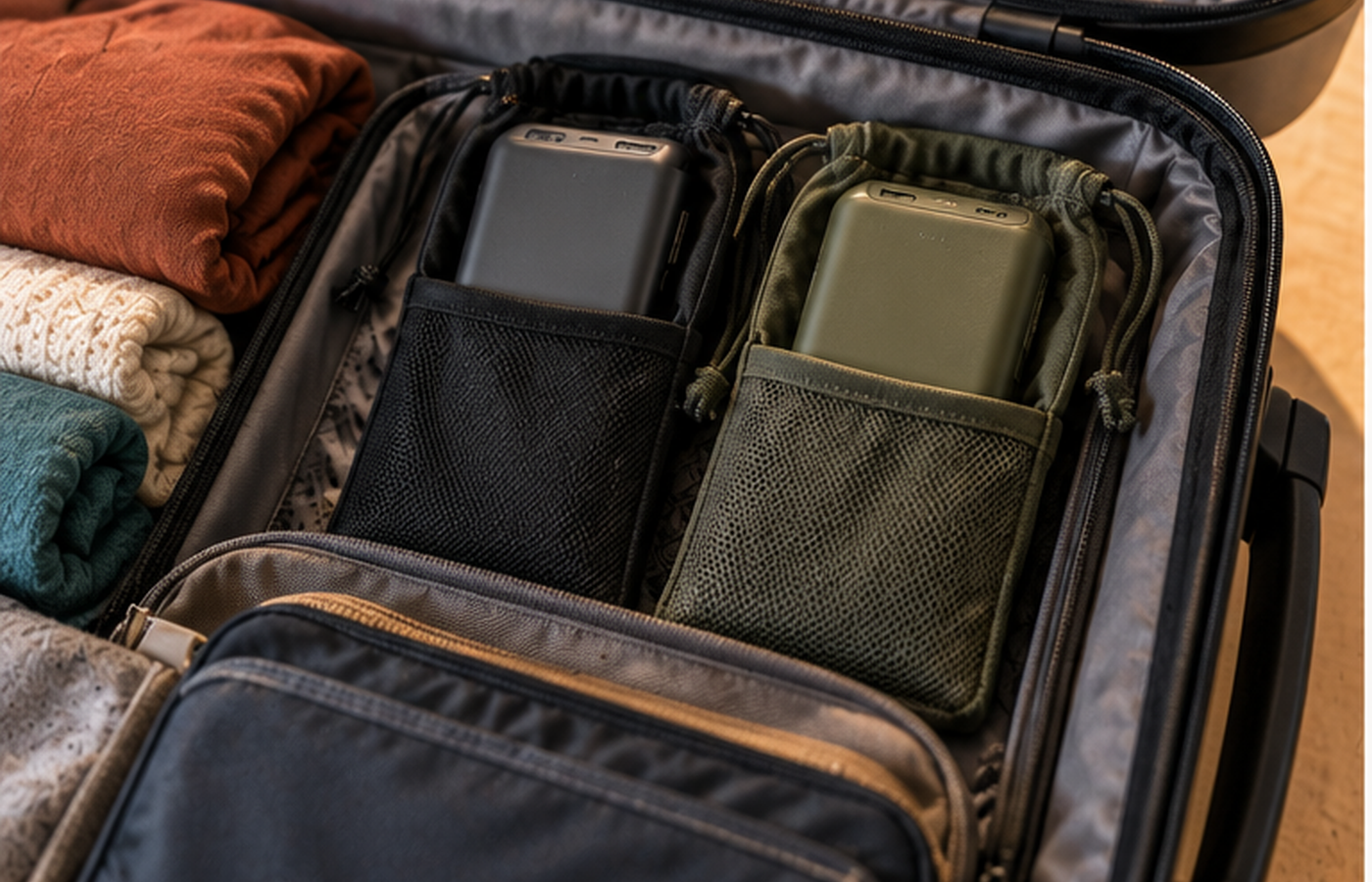
IATA and the UK CAA require individual protection when a bank is not in use. A dedicated pouch or original packaging prevents USB ports and exposed terminals from contacting coins, keys or other metal objects. Do not throw two banks and loose cables into a pocket with jewellery or tools.
Inspect the casing before each journey. Swelling, cracks, punctures, water exposure, a loose port, unusual heat, chemical smell or a product recall are reasons not to fly with the bank. The FAA says damaged or recalled batteries likely to create sparks or dangerous heat must not be carried unless made safe under specific instructions.
Look for traceable specifications
The product should identify the manufacturer or responsible seller, model, capacity, Wh rating, input and output. IATA’s 2026 operator guidance highlights concerns about non-conforming and counterfeit power banks and references UN 38.3 testing. A low price and high capacity claim are not substitutes for traceable documentation.
A 10,000mAh bank is often enough for a phone-focused day and is easier to carry, cool and keep accessible. A 20,000mAh bank adds useful reserve for a tablet, long connections or a small USB-C laptop, but it is heavier and takes longer to recharge. Near-100Wh banks suit specialist needs, yet their labels need to be especially clear and the product may attract more scrutiny.
| Traveller | Practical capacity | Useful output | Why |
|---|---|---|---|
| Phone-only city break | 5,000–10,000mAh | 20–30W USB-C PD | Lightweight reserve for one or two phone charges. |
| Phone + tablet | 10,000–20,000mAh | 30–45W | Enough energy and speed for two mobile devices. |
| Ultrabook emergency top-up | 20,000mAh around 72Wh | 65–100W USB-C PD | Can provide a meaningful laptop boost while staying below 100Wh. |
| Remote or creator work | Two compliant banks rather than one oversized unit | Model-specific | Redundancy while respecting quantity and Wh limits. |
Search the dangerous-goods or restricted-items page for the operating airline, not only the booking brand. Repeat the check for every sector. Save a screenshot or PDF of the relevant page with the date, because policies can change between purchase and travel.
- Identify the operating carrier for each flight, including codeshares.
- Find the airline’s current power-bank or lithium-battery page.
- Confirm the maximum Wh and number of banks.
- Confirm whether 100–160Wh banks are accepted with advance approval.
- Read whether onboard use, charging or overhead-bin storage is prohibited.
- Look for any requirement that capacity be printed on the case.
- Re-check 48 hours before departure and again during online check-in.
| Example airline rule checked | Capacity / quantity | Onboard use | Storage note |
|---|---|---|---|
| Emirates | One bank under 100Wh | Use and recharging prohibited | Seat pocket or under-seat bag; not overhead. |
| Singapore Airlines | Up to 100Wh without approval; 100–160Wh stated as requiring approval on its advisory | Use and recharging prohibited | Cabin baggage only. |
| General IATA 2026 framework | No more than two; ordinarily at or below 100Wh | Do not recharge; should not charge devices | Carry on and protect individually. |
These examples were checked on 20 September 2026. They illustrate capacity, Wh labelling and price differences; they are not a substitute for checking the airline and exact unit before travel.
| Example | Official checked price | Capacity marking | Travel lesson |
|---|---|---|---|
| UGREEN Nexode 20,000mAh 100W | £59.99 list price; promotional prices may vary | 20,000mAh at 3.6V, 72Wh | A laptop-capable bank can remain comfortably below 100Wh. |
| Nitecore NB10000 Gen 4 | £71.95 | 10,000mAh at 3.9V, 39Wh | Low weight and a clearly published Wh rating can justify a higher price. |
| Anker 20K 87W built-in-cable model | £49.99 | 20,000mAh; verify Wh on the exact case before flying | Capacity alone is not enough for an airport check. |
| Belkin 20K with display | £39.99 | 20,000mAh; verify the printed Wh on the exact unit | A display is convenient but does not replace a permanent Wh label. |
- Read and photograph the Wh rating on each bank.
- Confirm the operating airline’s maximum capacity, number and onboard-use rule.
- Inspect for swelling, cracks, heat damage, water exposure or recall notices.
- Charge at home, then switch off any always-on display or accidental wireless mode if the design permits.
- Place each bank in its own pouch or original packaging away from metal objects.
- Pack it in the personal item or cabin bag, never checked baggage.
- Keep it easy to remove if the cabin bag is gate-checked.
- Do not place it in the overhead bin when the airline requires under-seat or seat-pocket storage.
- Tell cabin crew immediately if it becomes hot, swells, smokes or smells unusual.
Stop using it and alert airline or airport staff immediately. Do not place a hot or smoking bank inside another bag, cover it with clothing or carry it into a confined toilet. Cabin crew are trained for battery incidents and need to know early. Follow their instructions rather than attempting a personal firefighting method.
After a non-flight incident at home, disconnect the bank only if it is safe to do so, move away from combustible material without handling a dangerous unit and follow local fire-service, manufacturer and battery-disposal guidance. A swollen lithium battery should not be punctured, compressed, mailed casually or placed in ordinary household waste.
Advantages
- Provides reserve power during delays, long transfers and destinations with unreliable sockets.
- A 65–100W model can support some USB-C laptops as well as phones and tablets.
- Two smaller compliant banks can provide useful redundancy.
- A clearly labelled unit is straightforward for staff to assess.
Limitations
- Adds a regulated lithium battery that must remain in the cabin and accessible.
- Airline limits and onboard-use policies vary and can change quickly.
- Large-capacity models add weight and may approach the 100Wh threshold.
- A damaged, counterfeit or poorly documented bank presents a serious fire risk.
The best flight power bank is not the largest allowed. It is the smallest reputable model that covers the real journey, carries a permanent Wh label and fits the strictest airline on the itinerary.
- Packing the bank in checked baggage or forgetting to remove it during gate checking.
- Reading only mAh and assuming the Wh value.
- Carrying a bank with a worn-off or missing capacity label.
- Buying above 100Wh with the assumption that airline approval will be automatic.
- Using or recharging the bank on board when the carrier prohibits it.
- Putting it in an overhead locker despite an accessibility rule.
- Leaving exposed ports beside keys, coins or loose metal objects.
- Flying with a swollen, cracked, wet, recalled or unusually hot battery.
- Checking the ticketing airline instead of the operating carrier on a codeshare.
Can a power bank go in checked luggage?
No. Power banks are spare lithium batteries and must be carried in cabin baggage. Remove them if a cabin bag is gate-checked.
How many power banks can I take in 2026?
The 2026 IATA framework limits passengers to no more than two. Airlines and national rules can differ, so verify every operating carrier.
Can I use a power bank during the flight?
Do not assume so. IATA says it should not be used to charge devices on board, and several airlines prohibit use completely.
Can I recharge the power bank from the seat socket?
The 2026 IATA change says power banks must not be recharged on board. Follow the operating airline and crew instructions.
Is 20,000mAh allowed?
Often yes because many 20,000mAh banks are around 72–74Wh, but the printed Wh rating and airline rule decide.
What happens above 100Wh?
Some 2026 rules still describe operator approval up to 160Wh, while IATA says that provision will not continue into 2027. Approval is not guaranteed.
Do wireless magnetic banks follow the same rules?
Yes. They are power banks, and wireless use can create additional heat. The airline’s no-use rule still applies.
What if the Wh label has rubbed off?
Carry manufacturer documentation if the airline accepts it, but a clearly and permanently labelled replacement is safer and less likely to be refused.
For routine flying in late 2026, choose a reputable bank under 100Wh with the Wh value printed clearly on the case. Carry one or two only, place each in a separate protective pouch and keep them in the cabin where they can be removed quickly if the bag is checked. A 10,000mAh model is the simplest phone reserve; a 20,000mAh model around 72Wh is a practical upper-middle choice for tablets and compatible laptops.
Check the operating airline shortly before every departure. Assume the bank cannot be used or recharged on board until the carrier says otherwise, and follow any under-seat or seat-pocket storage rule. That checklist is more durable than memorising a single global limit because the number, use and storage rules are actively changing.
The article was checked against the following authoritative and manufacturer sources. Product prices and availability are dated examples rather than permanent claims.
- IATA — 2026 guidance for operators on power banks — accessed 20 September 2026.
- UK Civil Aviation Authority — 2026 lithium battery and power-bank changes — accessed 20 September 2026.
- FAA PackSafe — lithium batteries and power banks — accessed 20 September 2026.
- Emirates — onboard power-bank rules effective October 2025 — accessed 20 September 2026.
- Singapore Airlines — portable power-bank advisory — accessed 20 September 2026.
- UGREEN UK — Nexode 20,000mAh 100W power bank — accessed 20 September 2026.
- Nitecore UK — NB10000 Gen 4 specifications — accessed 20 September 2026.