How to Check Repairability Before Buying Luggage
Look beyond a lifetime-warranty headline and check parts, fasteners, service routes and model support before the suitcase is damaged.
Original Travel Gear image
Suitcases are sold with durability claims, test videos and long warranties, yet the first real failure is often a small component: a wheel that binds, a telescopic handle that will not lock, a zip slider that separates, a grab handle that tears away or a shell corner that cracks. Whether that fault ends the suitcase depends as much on the repair route as on the original construction.
A warranty can promise a repair, a replacement, store credit or only cover manufacturing defects. Those outcomes are not equivalent. A genuinely repairable case has identifiable parts, accessible fasteners, a current service route, support for the exact model and a process that remains useful after the free warranty period. The buyer should be able to find most of that evidence before paying.
This guide provides a practical inspection and evidence method rather than a durability ranking. Brand examples are included to show different repair systems, not to declare a winner. Prices and policies were checked on 21 September 2026 and can change.
Visible fasteners
Screwed, accessible wheel and handle assemblies are easier to service than hidden or permanently fixed parts.
Exact-model answer
A written response confirming parts and repair route for the precise model is stronger than a general sustainability promise.
Read exclusions
Manufacturing defects, airline damage, wear, cosmetic damage, postage and proof requirements may be treated differently.
Save identifiers
Receipt, serial number, model page and support response make a future claim or paid repair easier.
A long warranty can still lead directly to replacement, while a short warranty can coexist with excellent paid repairs and parts.
Separate four different promises
Durability describes how well the luggage resists failure. Repairability describes whether a failure can be corrected. Warranty coverage describes who pays under defined conditions. Replacement policy describes what happens when repair is unavailable or uneconomic. Marketing often blends these ideas, so buyers should identify the exact promise being made.
A “lifetime” warranty may refer to the expected life of the product, cover only manufacturing defects or require registration and proof of purchase. It may exclude airline mishandling, ordinary wear, cosmetic dents and unauthorised repairs. None of those exclusions is automatically unreasonable, but they change the value of the promise and should be visible before purchase.
Repair first is a stronger signal than replace first
A policy that explains assessment, spare parts, do-it-yourself kits, authorised centres and paid out-of-warranty work provides more useful evidence than a policy that simply offers a new case. Replacement can be appropriate when structural damage is unsafe, but routine wheel, handle or zip faults should not automatically retire the whole suitcase.
| Claim | What it means | Question to ask |
|---|---|---|
| Durable | Designed or tested to resist use and impact | Which components and test conditions are described? |
| Repairable | A fault can be corrected without replacing the whole case | Are parts, fasteners, instructions and a service route available? |
| Under warranty | The brand may pay when the stated terms are met | What damage, time period, proof, postage and exclusions apply? |
| Replaceable | The brand may supply another product | Is replacement the last resort, and what happens to the damaged case? |
Moving components and impact-loaded edges deserve the closest pre-purchase look.

Wheels and wheel housings
Spin every wheel, listen for rough bearings and look at how the wheel housing attaches to the shell or frame. Screws that can be reached from inside the lining or through a service flap are generally more promising than a housing that appears permanently riveted or moulded into the case. Ask whether left and right assemblies differ and whether replacement kits include the axle, housing and fasteners or only the tyre.
Telescopic and grab handles
Extend the trolley handle fully, load it lightly in different directions and operate the release several times. Movement between tubes can be normal, but binding, asymmetrical extension or a release button that catches deserves attention. Check whether the internal mounting points can be reached. For grab handles, inspect stitching or screws at the anchors and confirm the handle returns without trapping fingers.
Zip, lock and closure
For zipped cases, inspect the chain size, slider movement, corner path and the point where the pull enters the lock. A replaceable slider is a smaller problem than damaged chain tape sewn behind a sealed lining. Frame cases avoid a long zip but depend on hinges, latches and alignment. Ask whether the lock is a separate module and whether a failed lock can be replaced without drilling the frame.
Shell, fabric and lining access
Polycarbonate cracks can sometimes be repaired but the result depends on location and access. Aluminium can dent and be re-shaped by specialists, while soft luggage may allow panel, seam or patch repair. The lining matters because a removable or zipped service panel can expose wheel and handle mounts. A permanently glued lining may turn a small mechanical repair into a labour-heavy job.
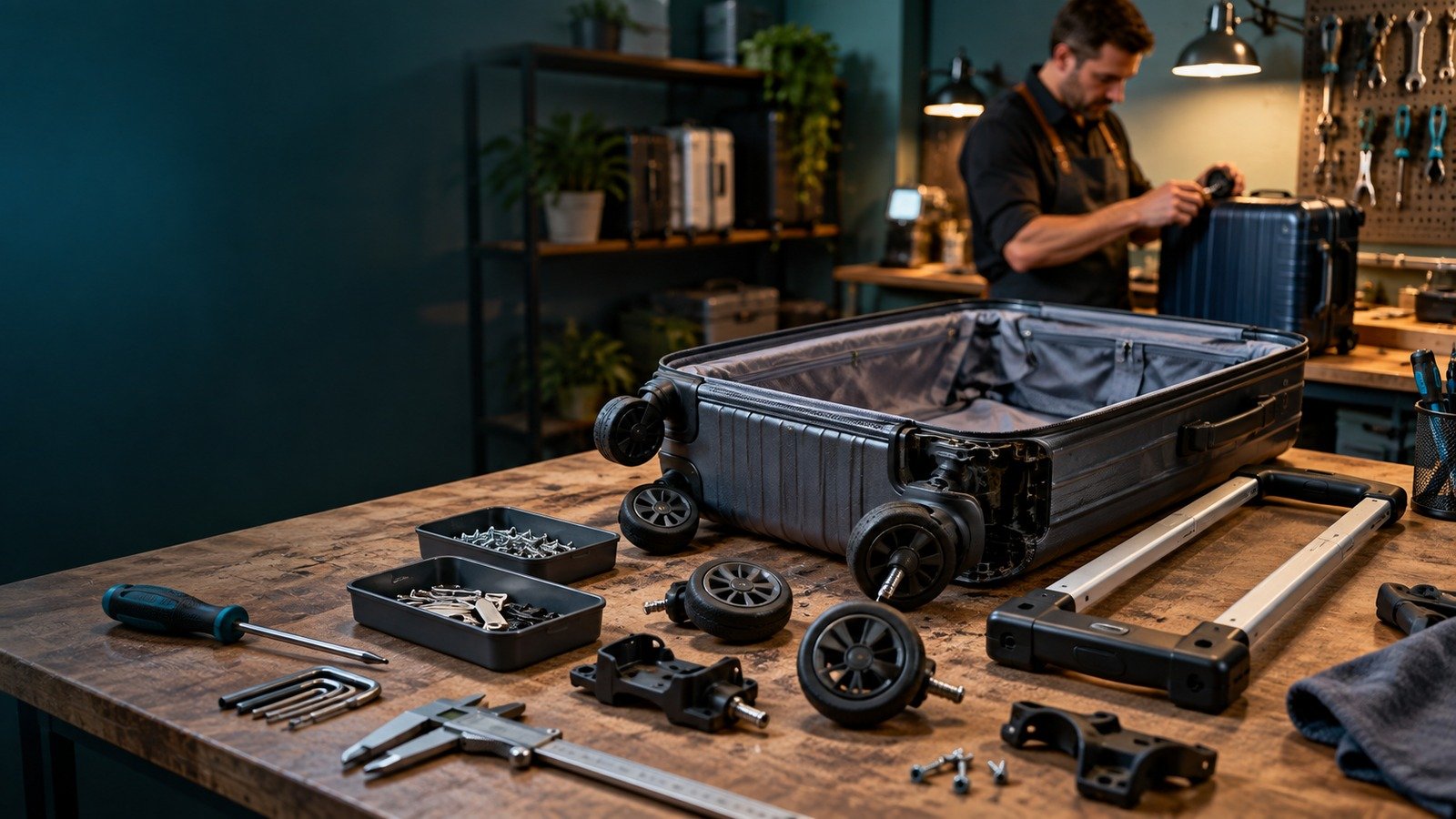
No single fastener proves repairability, but several visible choices create a more credible path.
Prefer accessible, identifiable assemblies
A replaceable component should have a clear boundary: a complete wheel housing, a handle unit, a lock module or a zip slider. Standard screws and retained nuts are easier to work with than fasteners hidden behind glued trim. The part should also be identifiable. A wheel kit that fits only “selected models” is not useful until the exact suitcase is confirmed.
Check whether ordinary tools are enough
A do-it-yourself repair should not require drilling out structural rivets, removing bonded panels or rebuilding the frame. Brands that supply a kit normally specify the tool needed, often a screwdriver. That does not mean every owner should repair luggage personally; it means the design has been considered as a replaceable assembly rather than an inseparable object.
Do not confuse easy disassembly with safe repair
The strongest structure may still use rivets, adhesives or specialised fixtures. The useful question is whether an authorised technician can access the part and whether the brand supports that work. Attempting an unauthorised repair can affect coverage or worsen structural damage, so verify the route before opening the lining.
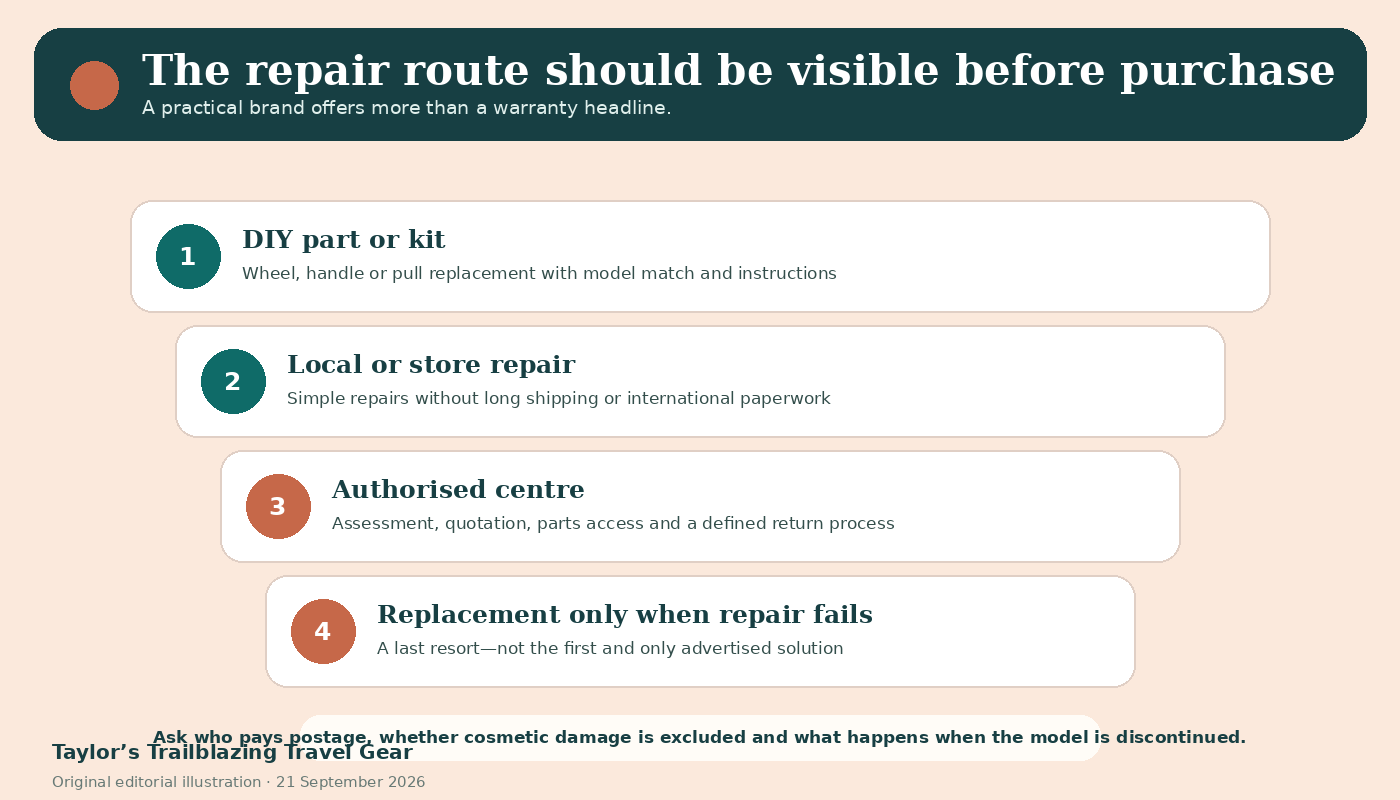
A policy page should answer where the case goes, who pays and what happens outside the free warranty.
Look for more than a contact form
A useful repair page names the country route, authorised partner or store service, documents required and whether non-warranty work is accepted. It should explain how a quote is approved and whether the case is returned when repair is declined. A generic “contact us” link can still lead to good service, but it leaves more uncertainty at the buying stage.
Ask about postage and timing
The repair itself may be free while the owner pays to send the case. International shipping, customs or a long central-repair queue can make a simple wheel replacement impractical before the next trip. Ask for the current UK process and an indicative turnaround rather than assuming a global warranty creates a local service.
Confirm paid repair after warranty
Out-of-warranty repair is important because impact and ordinary wear are common exclusions. Samsonite UK, for example, states that chargeable repair may be available after inspection when parts exist. A brand that supports paid repair can keep a functional case in service even when the fault is not a manufacturing defect.
Repairability can change between ranges, sizes and generations sold by the same company.

Use a short written checklist
- Are replacement wheel assemblies, telescopic handles, grab handles, zip sliders or locks available for this exact model and size?
- Can the parts be fitted at home, in a store or only at an authorised centre?
- What proof of purchase, registration or serial number will be required?
- Does the warranty cover manufacturing defects only, or also functional damage from normal travel or airline handling?
- Who pays outbound and return postage, and is an assessment fee charged if the repair is declined?
- Are paid repairs offered after the warranty or when the fault is excluded?
- How long are parts normally retained after a colour or model is discontinued?
- What happens to the original suitcase if repair is not possible and replacement is offered?
Ask support to answer in writing
A precise email or chat transcript is more useful than a verbal shop-floor assurance. Include the exact product name, size, model code and country of residence. If the response is vague, that is relevant evidence: future service may depend on discretionary support rather than a stable system.
The material changes the likely failure and the repair technique; neither type is automatically more repairable.
| Construction | Common serviceable parts | Harder problems | What to inspect |
|---|---|---|---|
| Polycarbonate hard shell | Wheels, handles, locks, lining and some corner hardware | Cracks at stressed corners, bonded trim and shell deformation | Access behind lining, separate wheel housings, crack policy and shell replacement approach. |
| Aluminium frame case | Wheels, handles, locks, hinges and dividers | Deep deformation, frame misalignment and cosmetic repair | Care network, in-store capability, hinge/lock parts and lifetime terms. |
| Soft-sided nylon or polyester | Wheels, handles, sliders, pulls, seams and patches | Long zip-chain replacement, delamination and structural panel damage | Stitching access, replaceable wheel housings, fabric grade and repair centre capability. |
| Hybrid or framed soft case | Wheels, handle units, frame hardware and some panels | Complex interfaces between frame, fabric and trim | Whether components are modular and whether the lining opens for service. |
Hard cases make structural damage obvious
A crack or bent frame is easy to see, but successful repair may require brand-specific equipment. Replaceable wheels and handles can still make a hard case long-lived. Ask whether shell damage is repaired, patched, replaced or treated as a replacement claim.
Soft cases can accept local repair but hide wear
A skilled luggage or outdoor-gear repairer may patch fabric, replace a slider or reinforce stitching, yet a worn zip chain or delaminating coated fabric can be labour intensive. Inspect the base corners, wheel wells, handle anchors and zip curves because those areas combine abrasion and load.
These examples are not a ranking; they illustrate different ways brands make repair support visible.
| Brand example | Current repair evidence | Representative price context | Buyer question still to ask |
|---|---|---|---|
| Samsonite | Authorised UK centre, Oxford Street Repair Studio, paid repairs subject to parts, quote before work | Cabin spinner collection examples from £165 to £680 | Are the exact wheel and handle assemblies retained for this model and size? |
| Briggs & Riley | Functional lifetime guarantee, DIY repair kits, authorised network and UK repair route | Baseline Essential 56cm spinner £599 | Which repairs can be done at home, and what outbound shipping is paid by the owner? |
| RIMOWA | More than 100 care centres, in-store simple repairs and lifetime functional guarantee for eligible suitcases | Original Cabin £1,090 | Which cosmetic or non-covered work is chargeable, and where is the nearest practical service point? |
| Away | Repair-first LifetimeCare for post-14 April 2026 purchases, DIY kits, store repair and paid lifetime support after the initial period | The Carry-On from £258 | Which service fee applies after year five and how are older colour or model parts matched? |
Policies and prices are time-sensitive. Verify the exact model and the buyer’s country before relying on any service route.
Briggs & Riley repair kits
Official self-repair parts collection for wheels, handles and zip pulls.
Availability varies by model
Samsonite UK repairs
Official authorised repair route, document requirements and paid-repair explanation.
Quote after assessment
RIMOWA care and repair
Official repair-request process and global care network.
Estimate for non-covered work
Useful Amazon comparison searches
Use marketplace listings only after confirming the model, seller and parts route. A generic replacement wheel is not automatically a safe match for a particular suitcase.
The score does not predict durability; it measures how much repair evidence is visible now.
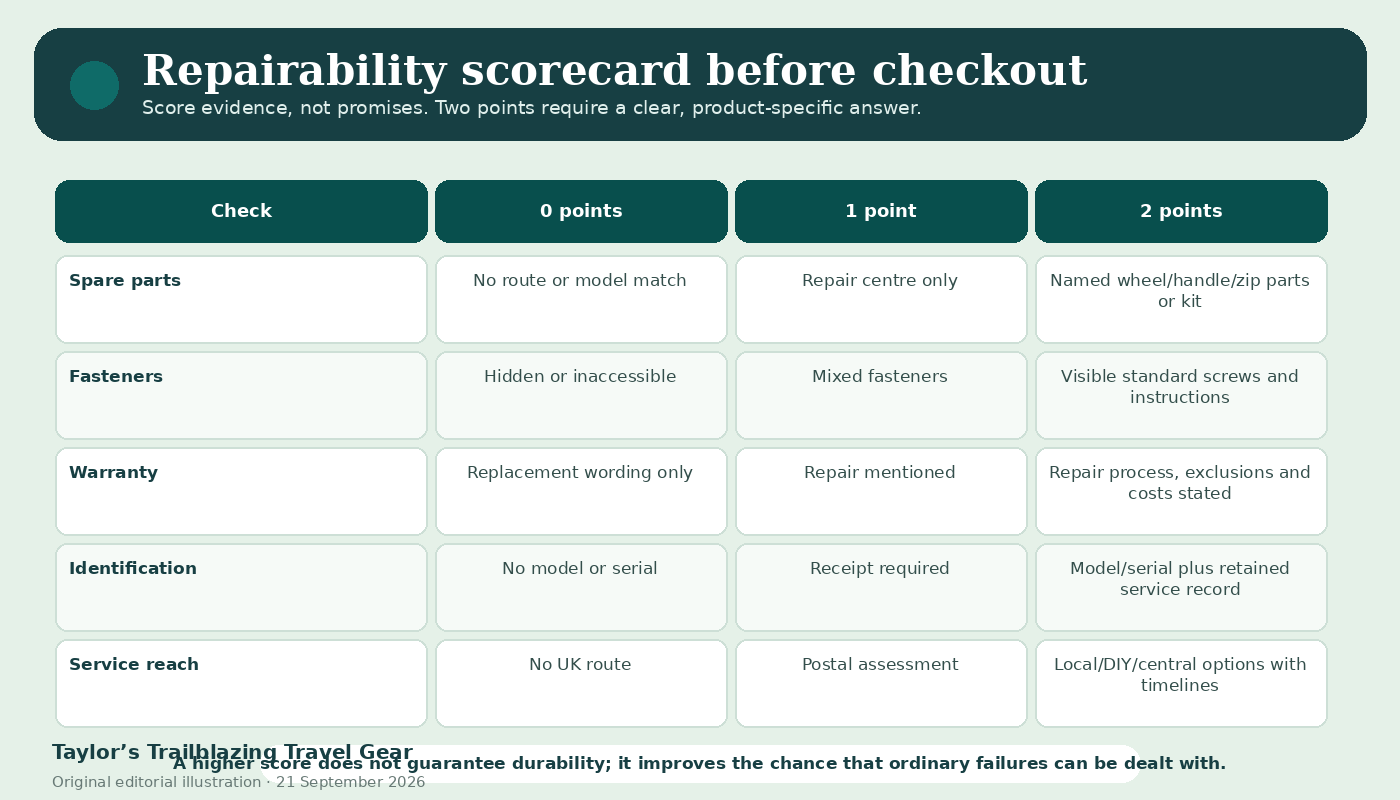
Give each row zero, one or two points. Zero means no useful evidence; one means a general repair promise; two means a specific, accessible route for the exact product. A high score does not make a weak suitcase durable, but it reduces the chance that an ordinary functional failure will become a dead end.
| Score | Interpretation | Next step |
|---|---|---|
| 0-3 | Most evidence depends on replacement or discretionary support | Ask exact-model questions or compare another product. |
| 4-6 | Some repair route exists but parts, costs or access remain unclear | Obtain written confirmation before purchase and save it. |
| 7-8 | Good evidence for service, identification and at least some replaceable parts | Check exclusions, postage and likely failure points. |
| 9-10 | Strong visible repair system across parts, process and records | Still assess durability, weight, fit and price independently. |
Repairability can extend useful life, but it introduces cost, records and service decisions.
Advantages
- Small wheel, handle or lock failures are less likely to retire the whole suitcase.
- A known service route reduces emergency replacement before a trip.
- Parts and paid repair can remain useful after free warranty coverage ends.
- Repair-first systems can preserve a familiar case and avoid unnecessary replacement.
- Saved model and serial records make ownership easier to manage.
Limitations
- Repairable construction can add fasteners, service panels or weight.
- Parts availability may still end when models or suppliers change.
- Postage and assessment can make low-cost luggage uneconomic to repair.
- Unauthorised work may affect warranty coverage.
- A repairable case can still be uncomfortable, overweight or poorly suited to the airline.
A warranty headline and a screwdriver photo are not enough.
- Assuming “lifetime warranty” means every type of damage is repaired for free.
- Checking the brand policy without confirming the exact model, size and generation.
- Ignoring who pays postage, assessment and non-covered labour.
- Buying generic wheels without verifying housing dimensions, axle, screw spacing and load rating.
- Treating replaceable wheels as proof that the shell, zip or handle system is serviceable.
- Failing to keep the receipt, serial number, model code and support response.
- Opening a lining or drilling a rivet before checking the warranty process.
- Using replacement as the only measure of good after-sales support.
- Assuming a global brand has a practical repair route in the buyer’s current country.
- Paying a premium for repairability without checking weight, airline fit and actual travel needs.
The practical answer depends on the component, policy and exact model.
What makes a suitcase repairable?
Repairable luggage has identifiable components, accessible fasteners or service panels, spare parts or a current repair network, a model or serial number and a process for both warranty and paid work.
Are screwed wheels always better than riveted wheels?
Accessible screws usually simplify replacement, but fastener type alone does not prove durability or correct parts support. A robust riveted assembly with professional service can be preferable to weak screw mounts.
Does a lifetime warranty mean free repairs for life?
Not necessarily. The terms may cover only manufacturing defects, exclude wear or airline damage, require registration, or charge postage or later service fees. Read the current policy.
Can suitcase wheels be replaced at home?
Some brands provide model-specific kits and instructions. Generic wheels require exact dimensional and load matching. Do not drill or open structural areas before checking the manufacturer’s process.
Is soft luggage easier to repair than hard luggage?
Soft fabric and stitching can sometimes be patched locally, while long zip chains or structural panels can be difficult. Hard luggage often has modular wheels and handles but shell or frame damage may need specialist work.
What proof should I keep?
Keep the receipt, order confirmation, warranty registration, serial number, model code, screenshots of the product and repair pages, and written support answers.
What should I ask about discontinued luggage?
Ask how long parts are normally retained, whether compatible later-generation parts are used and what remedy is offered when an exact component or colour is unavailable.
Can an independent repair invalidate the warranty?
It may affect coverage when the policy excludes unauthorised work or when the repair causes further damage. Ask the brand before proceeding.
Is replacement a bad outcome?
Not always. Structural damage may make repair unsafe or uneconomic. The concern is a system that replaces the entire product for routine component failures without first considering repair.
How much should repairability affect the buying decision?
It should sit beside airline fit, loaded weight, comfort, price and frequency of use. Frequent travellers may value a strong parts and service network more than occasional users, but no single feature should dominate every trip requirement.
Buy the case whose likely failures have a visible route back into service.
Before buying, inspect the wheels, telescopic handle, grab handles, closure and lining access. Prefer clear component boundaries, accessible fasteners and a model identifier. Then read the current UK repair page and ask support to confirm parts and paid service for the exact size and generation.
Save the evidence with the receipt. Give more weight to a repair-first process with do-it-yourself, local or authorised options than to a large warranty number without detail. However, do not sacrifice airline fit, loaded weight or carry comfort merely to gain replaceable wheels.
The strongest buying decision combines three things: a product suited to the journey, construction that can be serviced at its likely failure points, and an after-sales route that remains useful when the fault is excluded from free warranty coverage.
Current warranty, repair and price examples were checked against the following official sources.
- Samsonite UK – Repairs FAQs — Authorised UK repair centre, proof requirements, paid out-of-warranty repair and quotation process.
- Briggs & Riley UK – Lifetime Guarantee — Functional lifetime repair coverage, DIY kits, authorised repair network and UK shipping responsibility.
- Briggs & Riley UK – Self-Repair Kits — Current official availability of replacement wheels, handles and zip-pull kits.
- RIMOWA UK – Care and Repair — Current repair request route, care network and lifetime functional coverage for eligible luggage.
- Antler UK – Warranty — Current lifetime warranty conditions for eligible purchases, registration, exclusions and repair-centre process.
- Away UK – LifetimeCare — Repair-first coverage introduced for luggage bought from 14 April 2026, DIY kits and later paid support.
- Away UK – Claims and warranty — Current claim route, processing guidance and exact purchase-date distinctions.
- Samsonite UK – Spinner cabin luggage — Current official UK range and dated price context.
- Briggs & Riley UK – Baseline Essential 56cm Carry-On Spinner — Current official price and product context.
- RIMOWA UK – Original Cabin — Current official price, dimensions and lifetime-guarantee reference.
- Away UK – Carry-On luggage collection — Current official price context for The Carry-On.
Manufacturer and retailer pages support current specifications, prices and stated features; they are commercial sources and do not independently prove durability, comfort or environmental superiority. Government, standards and industry-body sources support the relevant rules and definitions. Practical recommendations are editorial comparisons and not invented first-hand testing.
Illustrations in this article were created for Travel Gear. Third-party photographs, where used, are credited beside the image or in the source list.