
Thailand Packing List: Gear Decisions for Heat, Rain and Internal Flights
Pack for humidity, sudden rain and low cabin-weight limits without carrying a second holiday in your suitcase.
Original Travel Gear image
A Thailand packing list works best when it begins with the journey rather than a generic holiday checklist. Bangkok heat, northern evenings, island rain and a seven-kilogram domestic cabin allowance can all appear in one itinerary. The practical challenge is not finding more products to buy; it is choosing a small group of items that continue to work when the weather, transport and dress expectations change.
The base system should be light, washable and quick to reorganise. Clothes need to release heat, dry after hand washing and cover shoulders or knees when required. Rain protection should keep phones, documents and a change of clothing usable without turning every warm shower into a full waterproof expedition. The bag itself must remain comfortable when carried through stations and piers, yet small and light enough for the strictest booked flight.
This guide is research-led. It uses current official climate, airline and aviation guidance and does not claim personal testing or ownership of the products mentioned. Prices are dated examples checked on 21 September 2026 and can change with stock, size and promotion.
Protect the 7kg margin
Choose the lightest bag that carries comfortably. A heavy shell can use a large share of a domestic cabin allowance before anything is packed.
Plan laundry, not outfits
Pack a repeatable capsule for five to seven days and wash basics. Heat and humidity reward quick-drying fabrics more than wardrobe variety.
Keep essentials dry first
A small dry pouch for documents and electronics is more reliable than assuming one backpack rain cover will protect every opening.
Check the operating aircraft
Bangkok Airways publishes a shorter 50 cm cabin limit on ATR72 flights, so the same airline can have different practical envelopes.
The strictest flight, wettest transfer and most formal stop should shape the base list.
Mark the pressure points
Write the trip as a sequence of environments: long-haul arrival, internal flight, city hotel, island transfer, temple visit, overnight train, scooter taxi or walking day. Each environment creates a small number of genuine gear requirements. An island boat transfer justifies a waterproof document pouch. A northern mountain stop may justify one thin warm layer. A formal hotel or restaurant may justify one smarter shirt. Packing becomes excessive when each requirement is answered with a separate bag, shoe or outfit.
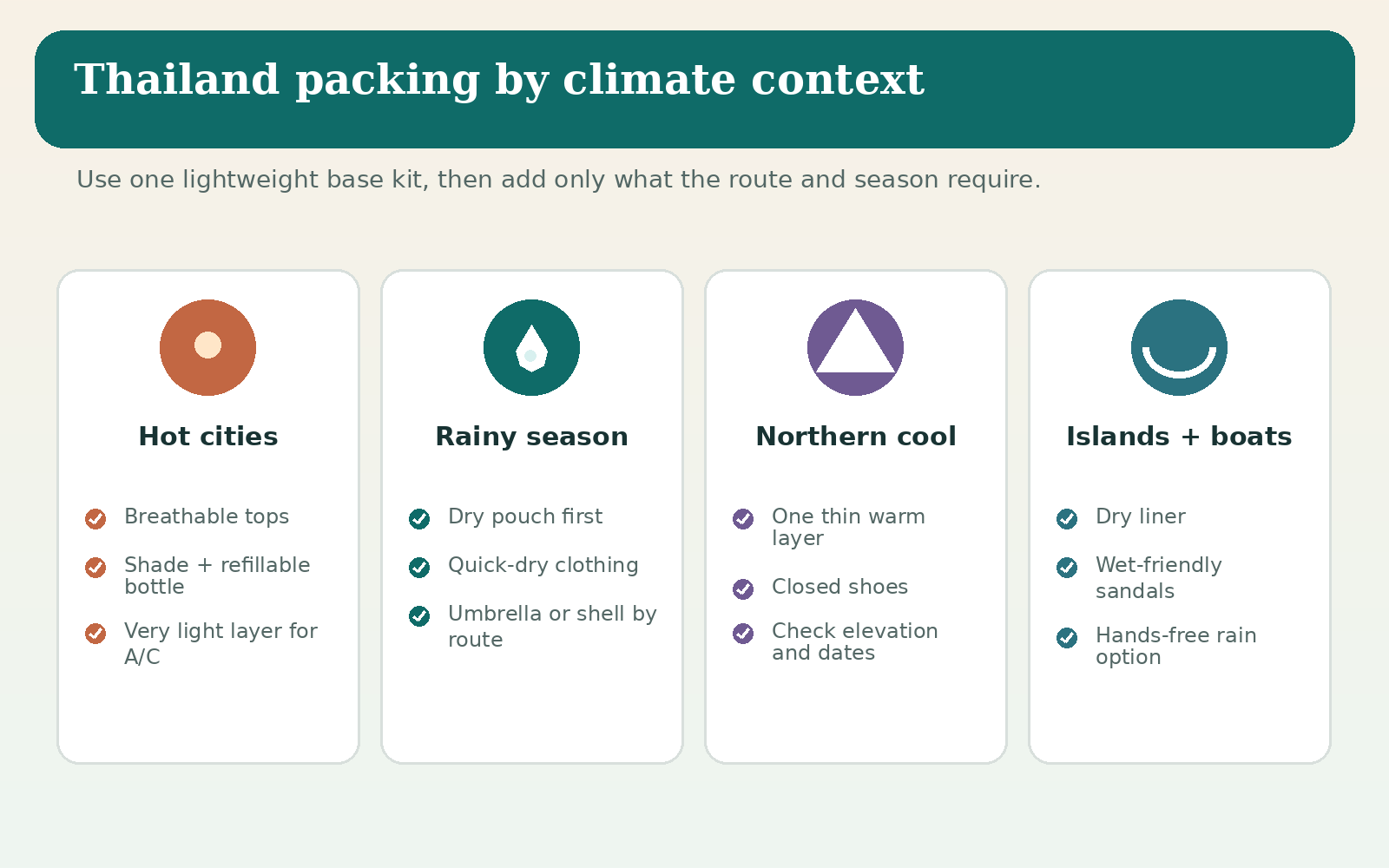
Next, identify the least flexible rule. On many Thailand itineraries that is the cabin weight of a domestic flight rather than the long-haul allowance. AirAsia currently permits one cabin bag and one small personal item with a combined 7 kg limit. Bangkok Airways currently allows one cabin bag at 7 kg, with a 50 x 36 x 23 cm limit on ATR72 aircraft and 56 x 36 x 23 cm on Airbus aircraft. Thai Airways publishes 56 x 45 x 25 cm and 7 kg. These rules can change, so the operating airline and aircraft should be checked again shortly before travel.
Nominal litres matter less than empty weight, packed dimensions and the way the bag behaves in transit.
Backpack or wheeled cabin case?
A light travel backpack is usually easier across stairs, uneven pavements, ferries and hotel approaches. It also avoids wheel and handle hardware, so more of the allowance can be used for contents. However, a poorly fitted 40 litre backpack can be unpleasant in heat. Look for a shaped back panel, usable shoulder straps, a sternum strap and a hip belt only if it genuinely transfers load rather than adding decorative webbing.
A wheeled case suits travellers who stay mostly in airports, taxis and lift-served hotels. It protects crush-sensitive items and keeps weight off the back. The trade-off is empty weight and poor performance on broken paving, steps and piers. A 2.7 kg cabin case leaves only 4.3 kg for contents under a 7 kg rule; a 1.0 kg travel backpack leaves roughly 6 kg. That difference can equal a second pair of shoes, toiletries and electronics.
Use the packed measurement
Measure height, width and depth after the external pockets are loaded and the compression straps are closed. Wheels, handles and bulging front pockets count. Leave a small safety margin rather than packing to the millimetre. Soft bags can exceed a depth limit when overfilled even if the product page lists a compliant size.
| Bag style | Useful when | Main drawback | Practical target |
|---|---|---|---|
| Light travel backpack | Multi-stop routes, stairs, ferries and walking transfers | Back comfort and sweat management depend on fit | About 0.8-1.3 kg empty; 35-40 L only if the booked limit allows |
| Compact hard-shell spinner | Airport-to-taxi trips and fragile contents | Empty weight consumes the cabin allowance | Prefer 55 x 40 x 20 cm or smaller for broad compatibility |
| Soft wheeled bag | Travellers who want wheels plus some squeeze and external access | Depth can bulge and fabric is less crush-resistant | Measure it fully packed, including pockets |
| Underseat-only bag | Short trips and fares without an overhead allowance | Small dimensions force aggressive editing | Build around the airline’s exact personal-item size |
Compare light cabin backpacks
A cabin backpack is useful only when the empty weight, harness and dimensions match the strictest flight in the itinerary.
The goal is not the fewest garments; it is the smallest wardrobe that remains comfortable, respectful and washable.
Choose fabrics by drying behaviour
Light woven shirts, breathable technical knits and thin natural-fibre blends generally manage tropical use better than thick cotton jersey or denim. Cotton can feel comfortable when dry but becomes heavy and slow to dry after rain or hand washing. Pure synthetics usually dry quickly but can retain odour. Blends often offer a practical middle ground. Test a garment at home: wash it in a sink, press it in a towel and hang it overnight in a warm room. If it is still wet in the morning, it is a poor foundation for a small travel capsule.
Pack a repeatable capsule
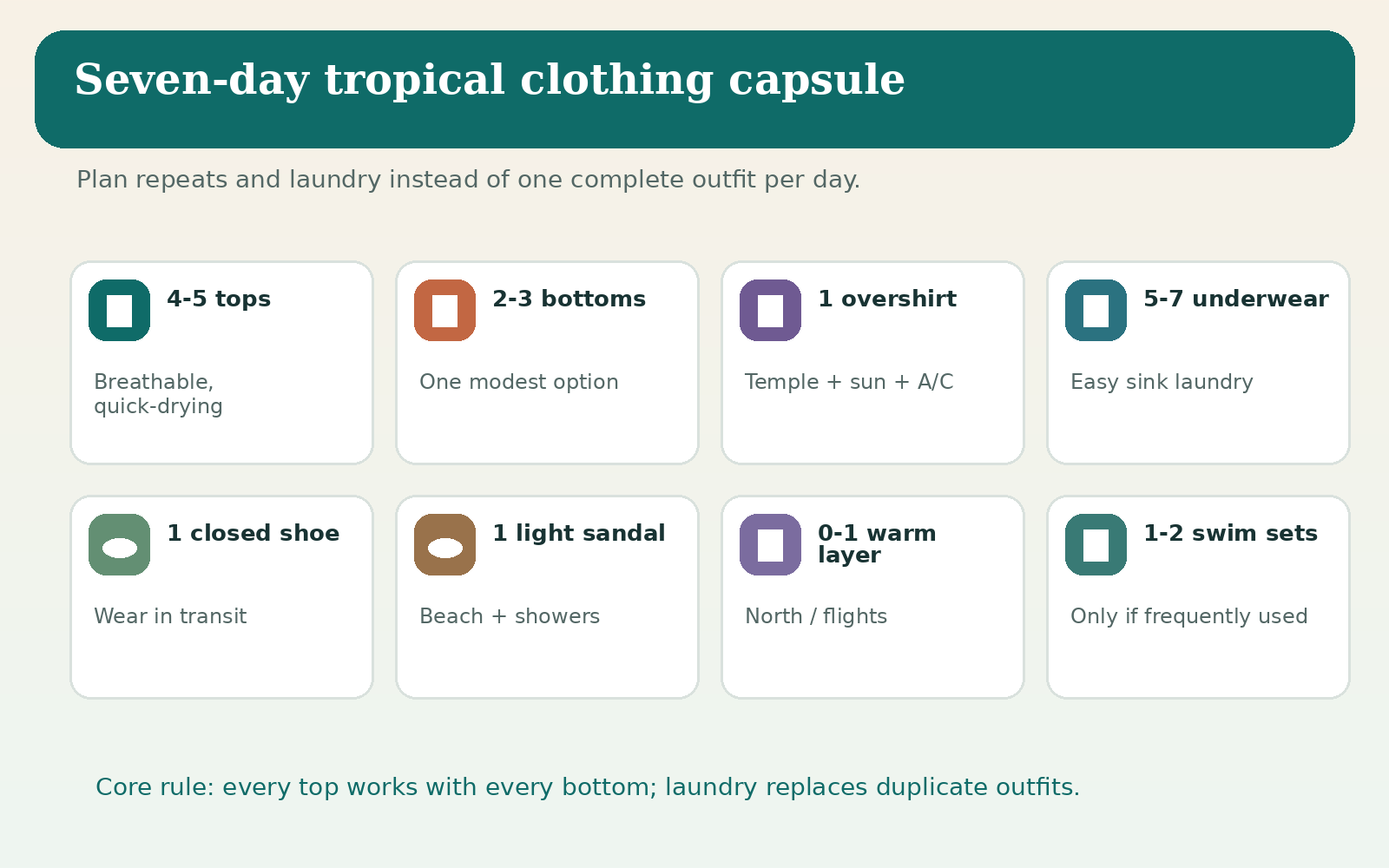
For a typical seven-to-ten-day trip with laundry, start with four or five lightweight tops, two lower garments, one modest layer that covers shoulders and knees, sleepwear, underwear for five to seven days and one thin warm layer only when the itinerary justifies it. Wear the bulkiest shoe and garment on the flight. Neutral colours make re-wearing easier, but the most important rule is that every top should work with every lower garment.
| Item | Suggested starting quantity | Why it earns space |
|---|---|---|
| Breathable tops | 4-5 | Enough rotation for sweat and laundry without one-per-day packing |
| Light trousers/skirts/shorts | 2-3 total | One modest option plus casual options; all should share the same tops |
| Temple/modesty layer | 1 | A loose overshirt or wrap is easier than carrying a separate formal outfit |
| Underwear and socks | 5-7 sets | Small items are easy to wash; pack fewer when laundry is frequent |
| Thin warm layer | 0-1 | Useful for aircraft, strong air-conditioning and cool northern mornings |
| Swimwear | 1-2 | Two only when frequent swimming makes drying time a real issue |
Rain protection should preserve essential functions rather than promise that the traveller never gets wet.
Umbrella, shell and dry pouch do different jobs
A compact umbrella creates ventilation in hot rain and can provide shade, but it performs poorly in wind, on scooters and during hands-busy transfers. A light hooded shell works during walking, boat boarding and windy weather, but even breathable fabrics feel warm in tropical humidity. A backpack rain cover shields the main fabric yet leaves the harness, back panel and water running towards openings. None of these replaces a sealed pouch for passports, phones, chargers or medication.
A practical system is one small waterproof document pouch, one roll-top dry bag or liner for a change of clothing, and either a compact blunt-ended umbrella or a light shell depending on the itinerary. For urban wet-season travel, an umbrella plus sealed essentials is often enough. For island ferries, hiking or exposed transfers, add the shell and a proper dry liner.
| Rain tool | Best use | Does not solve |
|---|---|---|
| Compact umbrella | Urban walking, shade and warm showers | Wind, scooters, hands-busy transfers or waterproof storage |
| Light rain shell | Windy rain, boats, hiking and moving with both hands free | Heat build-up and protection for an open bag |
| Backpack rain cover | Reduces direct rain on the bag body | Water through seams, harness side or pooled openings |
| Waterproof pouch/dry bag | Documents, electronics and one dry clothing set | Whole-body comfort or easy access to frequently used items |
Compare compact rain protection
Look for a lightweight shell or umbrella that earns space in the conditions you will actually meet, then keep critical items in a separate sealed pouch.
Shoes are one of the fastest ways to break a seven-kilogram plan.
Use a two-shoe rule
For most itineraries, wear one supportive closed shoe and pack one light sandal or flip-flop. The closed shoe should cope with long urban days, uneven paths and travel days. The sandal should handle showers, beaches and casual evenings. Add a third pair only for a specific activity that the other two cannot safely cover, such as technical hiking or a formal event. Pack footwear heel-to-toe in a washable sack and use the internal space for socks or small items.
Build modesty into ordinary clothing
Temple visits and some formal settings are easier when the capsule already contains a loose shoulder-covering top and a lower garment that reaches the knee or below. A thin overshirt, wrap skirt or light trousers can serve as sun protection, an air-conditioning layer and modest dress. This is more efficient than carrying a single-purpose outfit that remains unused for most of the trip.
Small protective items usually deliver more value than extra clothing.
A broad-brimmed hat or cap, sunglasses, a refillable bottle and a compact sunscreen container deserve easy access. Sunscreen can be bought locally, but sensitive-skin users may prefer to bring a known product in compliant container sizes. Carry necessary prescription medicine in original packaging with supporting documentation where appropriate, and keep essential doses in cabin baggage.
Dengue is transmitted by day-biting Aedes mosquitoes, so mosquito protection is not only an evening concern. The World Health Organization advises protective clothing and repellents containing recognised active ingredients such as DEET or icaridin. A small bottle used consistently is more useful than a large emergency kit buried at the bottom of a case. Follow the product instructions and seek destination-specific health advice before travel.
- Keep repellent, sunscreen and hand sanitiser in the same quick-access pouch, each within the applicable liquids rules.
- Use loose long sleeves and trousers as part of the ordinary clothing capsule rather than carrying specialised insect clothing for every day.
- Pack a small personal first-aid kit based on known needs; do not use a generic kit as a substitute for medical advice or travel insurance.
- Carry a photocopy or secure digital copy of key prescriptions and insurance details separately from the originals.
Electronics are dense, regulated and easy to duplicate without noticing.
Start with the devices, then choose one charging tree
List the phone, watch, camera, tablet, laptop and any medical device. Remove items that duplicate a function without a clear need. Then choose one reputable multi-port charger that supports the voltage and charging standards required by the remaining devices. A universal travel adaptor changes plug shape; it does not automatically convert voltage. Most modern phone and laptop chargers accept 100-240V, but the label must be checked.
Apply current Thailand power-bank rules
Current Civil Aviation Authority of Thailand rules require power banks to travel in cabin baggage, prohibit their use or charging onboard and limit passengers to no more than two. Units up to 100 Wh are normally within the stated limit; 100-160 Wh require operator approval. Terminals must be protected against short circuit. Individual airlines may impose tighter conditions, so the exact operating carrier must be checked.

A 10,000 mAh power bank is usually enough for ordinary phone use and is lighter than a larger unit. The watt-hour marking should be legible. Pack the power bank in an accessible protective pouch rather than under clothing where it cannot be reached if the bag is gate-checked.
Compare compact travel chargers
Buy only from a reputable manufacturer, check the device input requirements and avoid carrying a high-output charger that the actual equipment cannot use.
The toiletry kit should be a controlled module, not the densest unexplained object in the bag.
Bangkok Airways publishes the familiar cabin rule of containers no larger than 100 ml inside a transparent resealable bag with a maximum one-litre capacity. Security implementation can vary by airport and screening technology, so packing within the conservative rule remains the simplest approach. Decant only products that are safe and identifiable, and label reusable bottles. Do not fill a large container halfway and assume it counts as 100 ml; the container’s marked capacity matters.
Use hotel-supplied basics where suitable, buy bulky inexpensive items after arrival and share common products between travellers. Solid deodorant, soap or shampoo can reduce liquids, but only when the solid product works for the traveller. A travel system fails if aggressive downsizing causes skin irritation or the immediate purchase of full-size replacements.
| Keep in the cabin liquids bag | Can sit elsewhere | Often better bought locally |
|---|---|---|
| Sunscreen, repellent, hand sanitiser, contact-lens liquids and essential small cosmetics | Toothbrush, solid deodorant, comb, dry medicine and non-liquid first-aid items | Large shampoo, body wash, after-sun and inexpensive laundry detergent |
A good packing layout lets the traveller separate valuables in seconds.
Use four functional zones: documents and money; electronics and batteries; clothing; wet or dirty items. Avoid a dozen tiny pouches that hide weight and make security slower. The passport, phone, power bank, medication and one charger should fit in a small personal item or removable organiser if the main bag is unexpectedly gate-checked.
Keep one dry change of clothes near the top or inside a liner. On boat days, place the document pouch and electronics pouch inside the dry liner rather than trusting an external backpack pocket. A laundry bag should be washable and breathable enough that damp clothes are not sealed for days. If an item becomes wet, air it at the first opportunity rather than treating a waterproof bag as long-term storage.
This is a starting system for laundry-enabled travel, not a universal prescription.
| Zone | Suggested contents | Adjustment questions |
|---|---|---|
| Worn in transit | Closed walking shoes, light trousers, breathable top, thin layer | Will the arrival be hot enough that the layer must fit inside the bag? |
| Clothing | 4-5 tops, 2-3 lower garments, temple layer, sleepwear, underwear, swimwear | Where and when will laundry happen? Is a northern cool-season layer required? |
| Rain | Compact umbrella or light shell, document pouch, small dry liner | Is the trip urban, island-based, hiking-focused or during a wet-season peak? |
| Footwear | One light sandal or flip-flop packed | Does the itinerary genuinely require technical hiking or formal shoes? |
| Health and sun | Hat, sunglasses, sunscreen, repellent, medicine, small first-aid items | Which products are personal necessities and which are easily bought locally? |
| Electronics | Phone, compact charger, required cables, up to two compliant power banks | Can any device be removed? Is every cable known and labelled? |
| Documents | Passport, insurance, bookings, emergency contacts, secure copies | Can the essential set move to the personal item in 60 seconds? |
| Organisation | One clothing cube, one toiletry pouch, electronics pouch, laundry bag | Does each organiser reduce friction, or only add weight? |
Example weight budget
A light 1.0 kg backpack, 2.5 kg of clothing and footwear, 1.2 kg of electronics, 0.8 kg of toiletries and health items, and 0.5 kg of documents, organisers and rain protection totals about 6.0 kg. That leaves roughly 1.0 kg of margin under a 7 kg rule. The exact numbers vary, but the exercise exposes whether a 2.7 kg suitcase or a heavy laptop makes the plan unrealistic before departure.
Thailand’s broad seasonal pattern does not produce identical conditions everywhere.
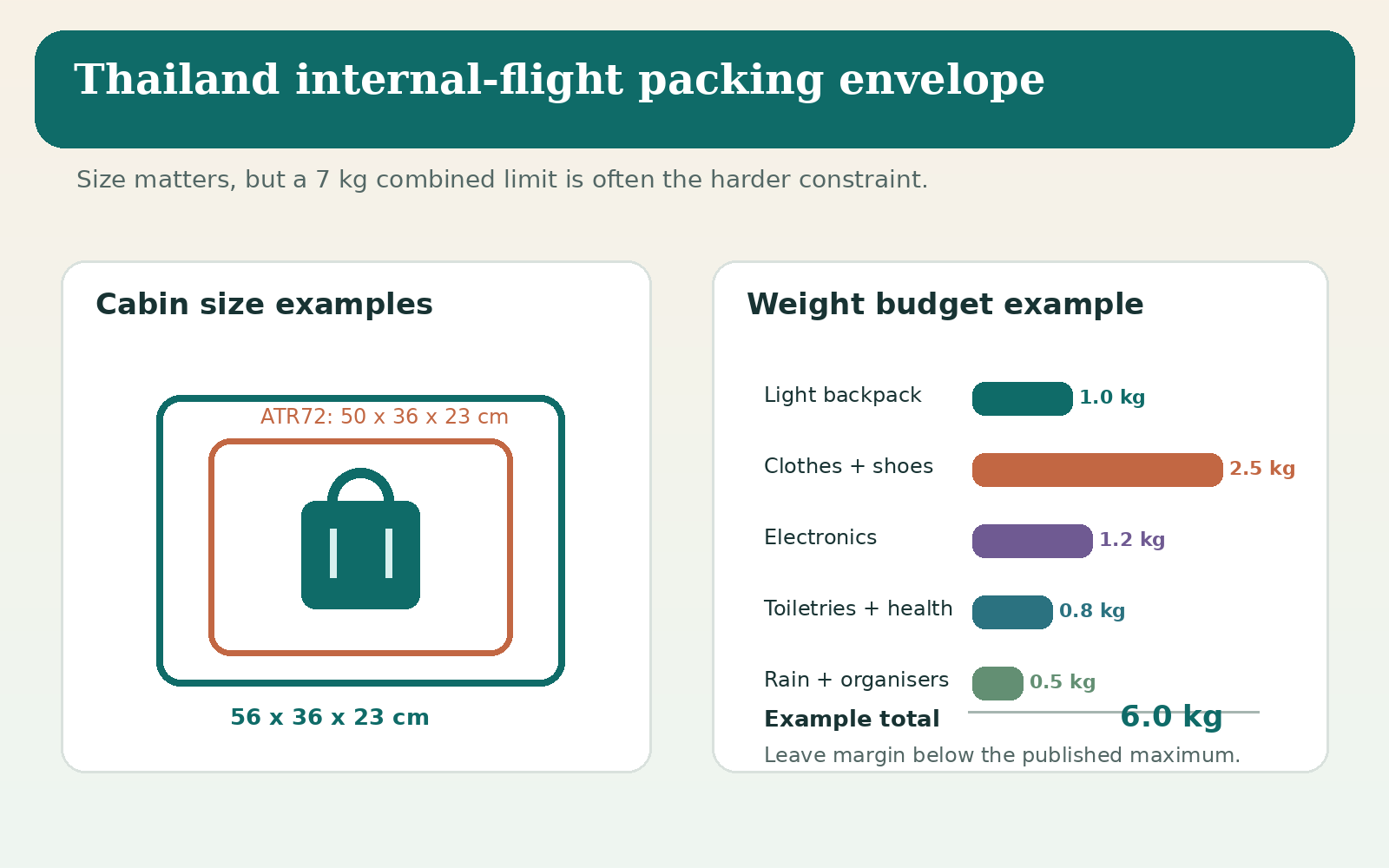
Hot season and cities
Prioritise shade, breathable clothing, frequent washing and a small bottle that can be refilled. Reduce heavy layers and thick footwear. Air-conditioning can be strong, so retain one very light layer rather than a bulky jumper.
Rainy season and islands
Increase waterproof organisation rather than adding many clothes. One dry change, a sealed document pouch and footwear that can get wet are more useful than a heavy waterproof jacket. Drying time matters: pack fewer cotton items and do not seal damp clothing for long journeys.
Northern cool season
Chiang Mai, Chiang Rai and higher elevations can feel cool in early mornings and at night. Add one thin fleece or insulated layer only after checking the specific dates and elevations. A layer that also works on aircraft and in air-conditioned transport earns its space.
Mixed beach and city itinerary
Keep the same capsule but choose one lower garment and one top that work for a smarter evening. A sarong or lightweight wrap can serve as beach cover, modest layer and emergency towel, although it should not be treated as full rain protection.
Packing light improves mobility, but it creates obligations as well as benefits.
Pros
- Easier movement through airports, stations, piers and hotel approaches.
- A realistic chance of staying within a low domestic cabin-weight limit.
- Less clothing trapped damp in a suitcase and faster reorganisation after rain.
- Fewer valuables and duplicated electronics to track.
- A small wardrobe encourages useful laundry rather than carrying unused outfits.
Cons
- Laundry must be planned rather than treated as an emergency.
- A small capsule exposes poor fabric choices quickly.
- Strict weight limits may still make a laptop-heavy carry-on impossible.
- Travellers with medical, accessibility or specialist activity needs may require more equipment.
- Weather and airline rules must be checked again before travel.
Most failures come from untested assumptions rather than missing gadgets.
- Choosing a heavy cabin case before calculating the 7 kg contents allowance.
- Packing one complete outfit for every day despite easy laundry access.
- Using only a backpack rain cover and leaving documents or electronics unsealed.
- Taking three or four pairs of shoes for activities that overlap.
- Packing thick cotton and denim without testing drying time.
- Assuming a universal adaptor converts voltage.
- Putting a power bank in checked baggage or trying to use it onboard a Thai flight.
- Buying a high-capacity power bank without a legible watt-hour rating.
- Ignoring the shorter cabin dimensions used on Bangkok Airways ATR72 aircraft.
- Packing to exactly the stated weight with no margin for water, food or purchases.
- Treating a generic first-aid kit as a substitute for personal medical planning.
- Hiding every item in a separate pouch until the organisers weigh more than the rain protection.
Detailed answers to the practical questions readers are most likely to ask.
How many clothes should I pack for two weeks in Thailand?
Pack for five to seven days and plan laundry. A useful starting point is four or five tops, two or three lower garments, one modest layer, sleepwear, underwear for five to seven days, one or two swim options and a thin warm layer only when the route requires it.
Is a 40 litre backpack too big for Thailand domestic flights?
Not automatically, but the packed dimensions and weight matter more than the stated volume. Many domestic carriers publish a 7 kg limit. A soft 40 litre bag can also exceed its listed depth when overfilled.
Should I take a suitcase or backpack to Thailand?
A backpack is often easier for multi-stop trips, ferries and stairs, while a spinner suits airport-to-taxi travel and travellers who should not carry weight on their back. Choose according to the route, physical needs and strictest flight allowance.
Do I need a rain jacket for Thailand?
A light shell is useful for windy rain, hiking, boats and hands-free transfers. In hot urban rain, a compact umbrella plus waterproof storage may be more comfortable. A sealed pouch for documents and electronics is useful either way.
Can I take a power bank on domestic flights in Thailand?
Yes, within current limits, but it must stay in cabin baggage. Current CAAT rules prohibit using or charging power banks onboard and limit passengers to no more than two. Check the operating airline before travel.
What shoes should I pack for Thailand?
Most travellers can use one supportive closed walking shoe and one light sandal or flip-flop. Add technical hiking or formal footwear only when a specific booked activity genuinely requires it.
What should I wear at temples in Thailand?
Carry clothing that covers shoulders and reaches the knee or below, and follow signs and local instructions. A loose overshirt and light trousers or a suitable wrap can be integrated into the ordinary capsule.
Are packing cubes worth using in Thailand?
One clothing cube and one laundry or wet-item bag can make transfers easier. Many small cubes add weight and make it harder to adapt the load. Use organisers only when they create a clear functional zone.
How much cabin-weight margin should I leave?
A margin of around 0.5-1.0 kg is sensible when possible because scales differ and water, food or last-minute items appear. Do not plan to arrive at the airport exactly on the published maximum.
Can I buy toiletries in Thailand instead of packing them?
Yes, many ordinary products are widely available. Bring items that are medically necessary, difficult for your skin or hair, or needed immediately, and buy bulky inexpensive basics locally when that suits the itinerary.
Use the evidence that matches the decision and keep the limitations visible.
For most multi-stop Thailand trips, build a light five-to-seven-day clothing capsule around laundry, wear the heaviest footwear and choose a bag whose empty weight protects the strictest flight allowance. Keep the capsule breathable, quick to dry and capable of modest dress without a separate formal wardrobe.
Use a layered rain plan: sealed storage for documents and electronics, one dry change of clothing, and either a compact umbrella or light shell chosen for the actual route. Treat power banks as regulated cabin equipment, not ordinary accessories. Keep them accessible, protect the terminals and re-check the airline before departure.
Finally, pack the whole system, weigh it and walk with it. If the bag is uncomfortable, over the smallest booked dimension or dependent on exactly 7.0 kg, edit before travel. The strongest Thailand packing list is the one that remains easy to carry after rain, laundry and an internal-flight check.
Current rules, specifications and editorial guidance were checked against the following primary or official sources.
- Tourism Authority of Thailand – Thailand Climate and Weather – Official overview of Thailand’s tropical seasons and broad temperature range.
- Thai Meteorological Department – three-month climate prediction – Official seasonal rainfall context and regional variation for August to October 2026.
- AirAsia – cabin baggage policy – Current two-piece combined 7 kg cabin limit, dimensions and 2026 Xtra Carry-On information.
- Bangkok Airways – baggage allowance – Official 7 kg cabin allowance, ATR72 and Airbus dimensions, and liquids rules.
- Thai Airways – restricted baggage – Official cabin dimensions, 7 kg allowance and smart-baggage conditions.
- Civil Aviation Authority of Thailand – lithium battery and power-bank rules – Official 2026 rules for cabin-only power banks, watt-hour limits, maximum quantity and onboard-use restrictions.
- World Health Organization – dengue information for travellers – Official traveller information on day-biting mosquitoes and bite-prevention measures.
- Amazon UK – lightweight cabin backpack search – Affiliate search link used only as a buying aid; specifications must be checked on the selected listing.
- Amazon UK – packable rain gear search – Affiliate search link used only as a comparison starting point.
- Amazon UK – compact USB-C charger search – Affiliate search link used only as a buying aid; device compatibility must be confirmed.
Commercial manufacturer pages support current specifications, prices and stated policies; they do not independently prove comfort, durability or performance. Government, regulator and standards pages support rules and definitions. Practical recommendations are editorial analysis, not invented first-hand testing.
Illustrations in this article were created for Travel Gear. Third-party photographs, where used, are credited beside the image or in the source list.