25L vs 30L Backpack for Travel
Five litres can help, but the shape, weight and access route often make the bigger difference.
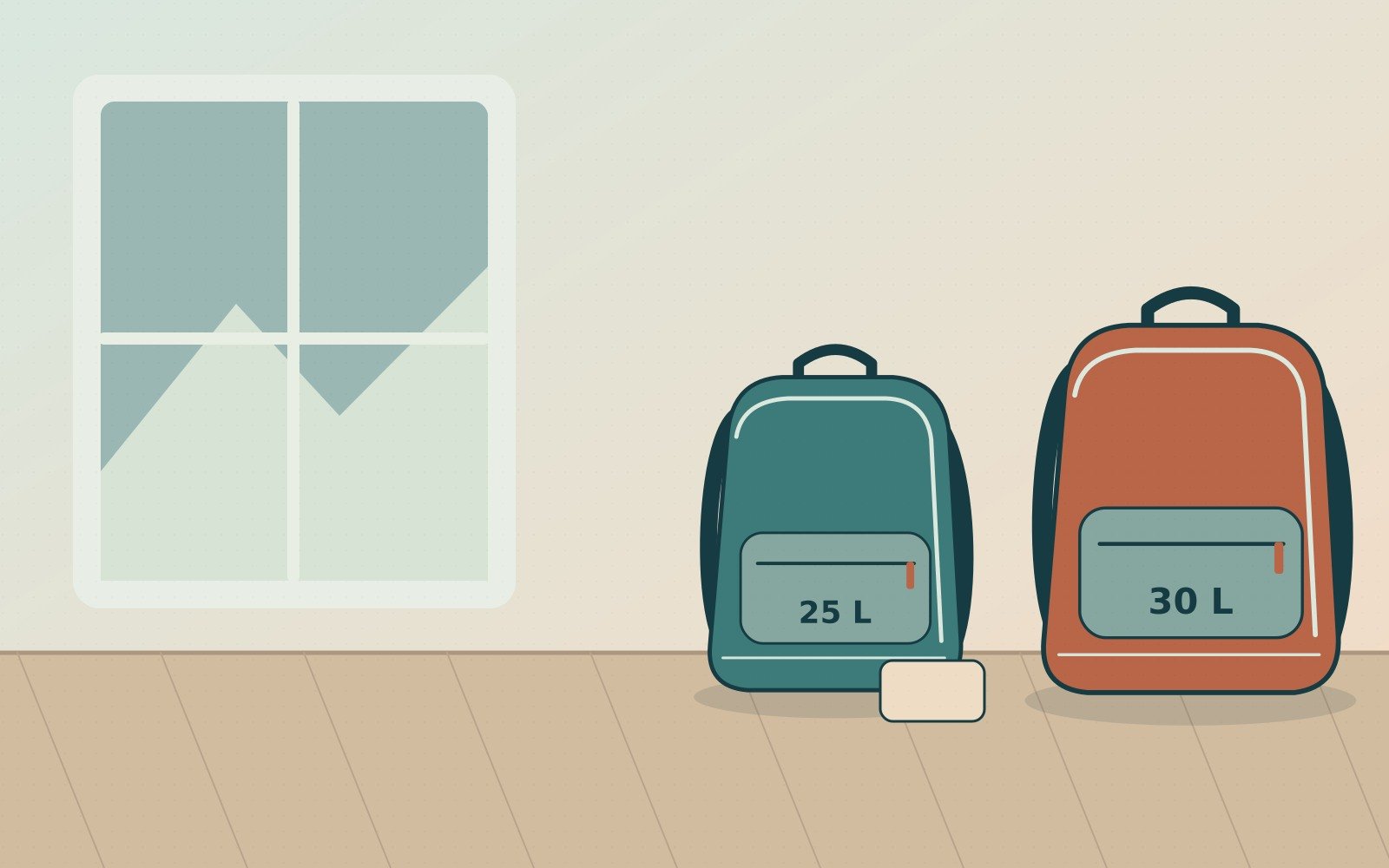
Original capacity concept. The drawings are not scaled representations of any named backpack.
The useful question in a 25L vs 30L backpack for travel comparison is not how many days each label promises. It is what the extra five litres would do for your particular kit. A light layer that otherwise blocks the opening is a worthwhile use of space. Three unnecessary backup items added because the bag looks empty are a different matter.
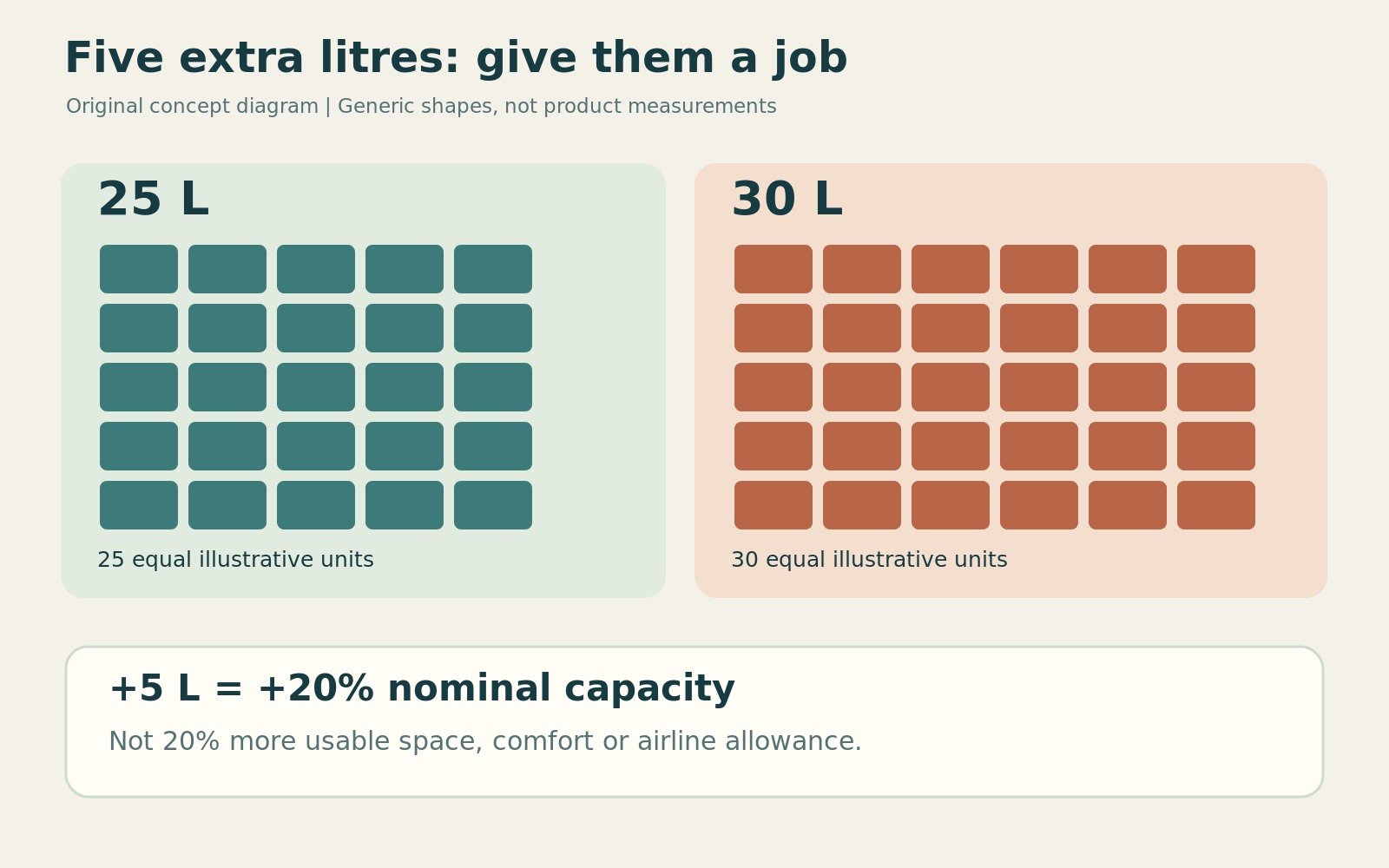
Thirty litres is 20% more nominal capacity than twenty-five litres. That calculation is straightforward; turning it into a buying decision is less so. Shape, compartment layout, empty weight and carrying fit can matter more than the difference on the label. A tall 25L hiking pack may be less suitable for a small airline allowance than a flatter 30L travel design, although neither is automatically acceptable.
This guide uses current published product examples to explain those trade-offs. It does not claim hands-on testing or assign a universal number of travel days to a capacity. Packing scenarios and suggested checks are editorial planning examples. Product measurements are attributed to their sources, and airline rules are dated to 11 October 2026 so you know what to recheck before travel.
This article contains affiliate links. If you buy through them, Taylor’s Trailblazing Travel Gear may earn a commission at no extra cost to you. Recommendations and practical comparisons are research-led; no hands-on product testing is claimed.
Five litres
30L is 20% more than 25L; it is not automatically 20% more useful space.
Try 25L first
A smaller bag can discourage unnecessary extras without ruling out comfort.
Consider 30L
Extra space is useful when it has a named job rather than filling itself.
Measure the packed bag
A tall 25L hiking pack can be less suitable than a flatter 30L travel design.
25L vs 30L backpack for travel: what five litres really changes
The difference is meaningful but not magical
Five litres is one-fifth of a 25L capacity. Moving from 25L to 30L therefore adds 20% relative to the smaller label. Looking in the other direction, moving from 30L down to 25L removes about 16.7% of the larger figure. Neither percentage tells you how many shirts, shoes or electronics will fit, because those objects and the bags themselves are not uniform blocks.
Use the difference as a prompt to identify a job. Perhaps you need room for a weather layer, a particular camera insert or a change of clothing that otherwise obstructs access. When the extra capacity has a specific purpose, it is easier to judge whether the larger bag is worthwhile.
Extra space can improve access without adding more belongings
A slightly larger chamber may let you remove a pouch without unpacking everything around it. That is a legitimate benefit even if you carry the same contents. The alternative is a smaller pack so tightly filled that every security check or clothing change becomes a repacking exercise.
However, unused room is not automatically useful. A much looser load can shift unless the bag provides a sensible way to control it. The aim is enough space for manageable access and normal changes during the journey, not a requirement to fill the bigger bag simply because you bought it.
Understand what a capacity label does not tell you
Different shapes can carry the same nominal volume
A broad, shallow travel pack and a tall, narrow daypack can have similar capacity labels while accepting very different objects. One may fit a laptop and flat clothing groups comfortably; another may suit a vertically layered outdoor kit. The number alone does not describe the opening, the device sleeve or the space around a curved back panel.
Do not turn exterior height times width times depth into a precise interior measurement. That multiplication describes a rectangular bounding box. Real bags taper, curve, contain padding and divide space into compartments. It is useful for understanding shape, but not sufficient to establish the actual accessible volume of every pocket.
Check whether expansion or included accessories complicate the label
A name such as 26+6 describes an expandable arrangement, not a single permanent 32L size. Likewise, a backpack set may include a separate toiletry bag without giving you that volume on top of the main compartment in every packing situation. Read how the manufacturer defines the product and what the dimensions refer to.
With the BAGSMART Soar, for example, the published main capacity is 25L and the detachable toiletry bag is separately described as 1L. Do not simply advertise the system as a 26L backpack. When that pouch sits inside the pack, it uses some of the space you would otherwise arrange yourself. [1]
A same-family example shows why design still matters
Compare the current Sportlite 25 and Sportlite 30
Osprey’s S26 specifications provide a useful comparison because both products belong to the same current family. The 25L model is panel-loading, while the 30L model uses a top-loading cinch closure and lid. The difference is not just five litres added to an otherwise identical bag. [2] [3]
| Current model | Published capacity | Published dimensions | Published weight | Access difference |
|---|---|---|---|---|
| Osprey Sportlite 25 S26 | 25L | 55 x 30 x 25cm | 1.02kg | Wide dual-zip panel access |
| Osprey Sportlite 30 S26 | 30L | 55 x 30 x 28cm | 1.02kg | Top-loading mouth, cinch and lid |
These are the 2026 one-size figures, not dimensions from an older Sportlite manual. The kilogram weights round to the same published value. That does not establish that every individual sample is identical in weight, nor that all 25L and 30L packs weigh the same. Availability should be checked for the selected size and colour.
Read the example as a buying lesson
The larger model is deeper in the stated dimensions, while the height remains unchanged. A traveller seeking a shorter bag would therefore not solve that problem by choosing the 25L model from this pair. Someone seeking panel access might prefer the smaller version for an entirely different reason.
Ask which physical difference helps your trip: a shallower profile, a more suitable opening or a harness arrangement. The capacity label is one part of that description. It should not replace the measurements and access details that actually determine whether your kit and routine will work.
Compare travel-shaped examples separately
Similar capacity does not mean similar external size
The following products illustrate alternative layouts around this capacity range. They were selected as design references, not ranked by testing. The different dimensions, weights and access systems make them useful comparisons, but they are not equivalent offers or a guarantee of cabin acceptance.
| Product | Stated capacity | Published dimensions and empty weight | What to examine | Reference |
|---|---|---|---|---|
| BAGSMART Soar Set | 25L | 43 x 26 x 23cm; 550g | Main opening and usable device space | View Soar 25L |
| Patagonia Black Hole Mini MLC, style 49266 | 30L | 51 x 31 x 18cm; 1290g | Travel compartment layout and carrying options | Official source below |
| BAGSMART Blast | 28L | 42 x 31 x 20.5cm; 900g | Whether the divisions suit your kit | View Blast 28L |
| Osprey Daylite 26+6, black Case Luggage listing | 26L plus 6L expansion | 43 x 33 x 16cm; 840g, unexpanded | Expansion and access with the same kit | Check Daylite reference and stock |
The selected Mini MLC variant and the black Daylite retailer listing were unavailable when checked on 11 October 2026. Confirm current offers rather than assuming those exact variants can be delivered immediately. Figures above come from the named manufacturer or retailer pages, not from weighing or measuring samples ourselves. [4] [5] [6] [7]
Use intermediate sizes when they solve the actual problem
You do not have to choose exactly 25L or exactly 30L if a 28L shape works better. The Blast 28L is a comparison point for a compartmentalised travel load, while the Soar 25L is a lighter published-weight example with a different depth. Neither label overrides the dimensional checks for your route.
An expandable design such as the Daylite 26+6 reference can offer flexibility, but the extra capacity creates a different packed configuration. The identified listing was sold out, and its unexpanded measurements should not be reused as the size of the expanded bag. Compare the actual configuration you intend to carry.
Start airline planning with dimensions, not litres
Underseat allowances are not general capacity limits
At the date checked, Ryanair’s included small-bag dimensions were 40 x 30 x 20cm and easyJet’s were 45 x 36 x 20cm. Those rules do not create an official 25L or 30L category. A bag must meet the relevant shape and other conditions in its packed state, regardless of the number in its name. [8] [9]
This is why the Sportlite examples are not simple free-personal-item solutions: their stated 55cm height exceeds both small-bag limits. The Soar’s published 23cm depth also needs attention. A backpack can be entirely suitable for a different allowance or a train journey without being a good match for a particular included underseat entitlement.
Check the overhead option only when it is included or booked
A larger cabin-bag allowance may change your shortlist, but verify the booking conditions rather than assuming it comes with every ticket. Recheck the final packed dimensions after expansion and account for rigid frames, filled pockets and items attached outside. A bottle clipped to the exterior is not invisible to the size and handling problem.
Do not buy a bag that depends on a lenient gate decision. Choose a suitable configuration or arrange the allowance you actually need. The convenience of five extra litres disappears quickly if the bag no longer matches the travel plan that motivated the purchase.
Build a fixed essentials list before comparing capacity
Keep the non-negotiable items visible
Start with items that genuinely must come: your required travel documents, necessary medication and supplies, essential technology and appropriate clothing for the trip. Follow any relevant storage or carriage instructions for those items. Do not remove something necessary merely to achieve an attractive small-bag photograph.
Then identify optional items separately. A second large charger, spare footwear without a clear purpose or several overlapping clothing layers may be negotiable. The useful distinction is between something you need for the trip and something included only because there is spare room. A 30L purchase should not make that distinction disappear.
Group the list by the way you access it
Separate the seat-side kit, overnight clothing, toiletries and any specialist equipment. Those groups need not become four bulky pouches. The exercise simply makes it clear which items should stay accessible and which can sit deeper inside the bag.
Now compare the groups with the candidate’s layout. If the laptop compartment consumes more depth than expected, the clothing area may be smaller than the capacity label suggests. If a top pocket occupies the upper chamber when filled, account for that too. The goal is a usable arrangement of the fixed list, not a theoretical volume contest.
Give the extra five litres a specific job
Name what does not fit comfortably in the smaller bag
Pack the essentials into a suitable 25L candidate, subject to any trial conditions, and identify the actual difficulty. Is a weather layer blocking the opening? Are shoes forcing the laptop sleeve to bulge? Can you close the bag but not remove a toiletry pouch without unpacking everything? Each is a more useful observation than ’25L seems small’.
A 30L candidate may solve one of those problems, but check where its extra space sits. More height does not necessarily help a wide camera insert. More depth may improve clothing capacity while making the bag unsuitable for your allowance. The location of the additional room matters.
Do not allocate the same space twice
An expandable bottle pocket, a front organiser and the main chamber may interact when full. Check the loaded result rather than counting each advertised feature as completely independent space. Similarly, an internal shoe section may project into the main compartment once footwear is inserted.
Reserve some practical flexibility for the journey. You may take off a layer, repack a cable less neatly or carry used clothing differently on the return. That does not mean leaving an arbitrary fixed percentage empty. It means ensuring the arrangement remains workable after normal changes, rather than only at the first carefully staged packing session.
Clothing needs depend on bulk and routine
A weekend is not a standard volume
Two travellers spending the same number of nights away may carry very different clothing. Climate, dress requirements, garment size and fabric bulk all matter. A compact warm-weather outfit and a substantial cold-weather layer do not use the same space. Avoid a universal claim that 25L equals a particular number of days.
Lay out the actual clothing rather than a generic count. Check which items can be worn for the journey and which genuinely need to be packed. Do not make the plan depend on wearing an uncomfortable amount of clothing through the airport merely to keep the bag within its shape.
Longer trips can use a repeatable clothing cycle
A longer journey does not always require proportionately more luggage if you have a realistic way to wash and dry clothing. However, laundry access and drying time should be planned rather than assumed. A bag that works only when every item dries overnight can be inconvenient when the weather or accommodation does not cooperate.
Leave a method for separating used or damp items from clean clothing and electronics. That method also occupies space. Compare the 25L and 30L arrangements after a simulated clothing change, not only when every garment is clean and neatly folded at home. The return packing is part of the same trip.
Footwear can dominate the decision
Start with the shoes you actually need
Spare footwear is a common reason a small travel pack becomes difficult to use. Measure the pair in the condition in which you will pack it, including any protective or separating bag. Do not assume that the same shoe compartment suits every shoe size and shape.
If one appropriate pair can serve the trip, the smaller pack may become viable without giving up anything important. However, some work, activity or weather plans genuinely call for different footwear. In that case, acknowledge the need instead of forcing the smaller bag to win by omitting a necessary item.
Inspect where the footwear sits relative to the rest
A dedicated section can separate dirt, but it can also consume the space needed for clothing or push against a device compartment. Try the actual layout. You should not need to bend a laptop sleeve around a rigid shoe bundle or strain the bag’s closure to make the arrangement look tidy.
A 30L pack may offer a better solution, or a differently shaped 25L pack may accommodate the same pair more sensibly. This is another case where the access route and chamber geometry matter more than a numerical comparison. Fit the awkward item first and build the softer clothing around a sensible arrangement.
Technology changes both volume and weight
Include the device’s protective arrangement
Measure a laptop or tablet with the sleeve you intend to use. Check the entry opening and the compartment dimensions, not only a supported screen diagonal. A thin computer can become a much less flexible packing object once it is inside a protective case with accessories.
Keep chargers and power accessories controlled so they do not press against the screen or create a hard point at your back. Only take the equipment the trip requires, but do not assume that a smaller bag automatically justifies leaving behind a necessary adapter or cable. The kit should support your actual work or travel needs.
Avoid trading a volume problem for a weight problem
Technology can fit into a surprisingly compact area while contributing substantially to the load. A 30L pack does not solve excessive weight merely because there is room around the equipment. Likewise, a 25L pack filled with dense items can be more demanding to carry than a larger bag holding mainly clothing.
For planning, weigh the complete kit and the bag together. An optional Go Travel Digital Pro Scale can help when used according to its instructions with a safe carrying point. It is not a reason to suspend an awkward load or exceed your comfortable lifting ability. An appropriate scale already at home may be sufficient. [10]
Toiletries and organisers need their own restraint
Build a useful kit, not a miniature bathroom shelf
Take the toiletries and personal items appropriate to the trip, keeping relevant transport and storage requirements in mind. Do not assume that every hotel will provide exactly what you use, but avoid carrying full-size duplicates without a reason. The relevant question is what you need and how it will be contained safely.
A hanging toiletry bag designed for a large suitcase can be disproportionate inside a 25L backpack. A smaller pouch may work better, provided it holds the items securely and makes access manageable. Measure it when filled rather than relying on the soft empty shape.
Carry only the organiser pieces that earn their space
A BAGSMART compression cube set is an optional grouping system, not a requirement to use every piece. Select sizes that fit the chamber and pass through the opening once packed. A large cube can make a bag look orderly while blocking the very pouch you need during the journey. [11]
On 11 October 2026, the selected Light Blue cube set offered an availability notification rather than immediate ordering. No current delivery promise is implied.
Compression can reduce some trapped air in suitable clothing, but it does not reduce the mass or rigid dimensions of your kit. Avoid forcing compressed blocks into a smaller backpack until it bulges. The objective is predictable organisation and normal closure, not a tightly packed shape that can only be recreated at home.
Compare empty weight and carrying structure
A larger bag is not automatically heavier
The current Sportlite example shows identical rounded kilogram figures for the 25L and 30L versions. Elsewhere, a smaller highly structured travel pack may weigh more than a larger simple bag. Read the actual specification for the exact version, then include detachable belts, straps or accessories you intend to carry. [2] [3]
Do not compare one brand’s stripped bag weight with another’s complete carrying system as though they describe the same configuration. Where the source is unclear, keep that uncertainty in the shortlist. An unexplained weight difference should not become a confident claim about which bag is lighter in real use.
Structure can be worth carrying when it solves a problem
A useful back panel, appropriate harness or protected device compartment may justify extra empty weight. Equally, extensive padding and dividers are not automatically beneficial for a light clothing-based kit. The right balance depends on what the structure does for your actual load.
Try the bag’s intended adjustments during a suitable trial. A greater capacity does not compensate for a back panel that is too long, straps that rub or a belt that serves no useful purpose for you. Choose the size that carries appropriately, rather than assuming the smaller one will always be easier simply because it has less nominal volume.
Assess the bag after you remove the clothing
One-bag travel can involve two very different loads
A pack may carry all your belongings between stops, then become a day bag once clothing is left at accommodation. Check whether it remains manageable with only a layer, bottle and small essentials. A larger structured body may retain its footprint; a softer one may collapse. Those behaviours affect access and control, not just appearance.
Do not treat a partly empty bag as a failure merely because it does not look full. The important question is whether the remaining contents stay secure and easy to find. Use adjustment features as intended, without folding frames or distorting the bag to make it appear smaller.
Consider whether a second tiny bag is genuinely useful
A small packable day bag can be useful for some trips, but it also adds weight and takes space in the main pack. Count it as part of the system. You may not need it if the main bag works well with a reduced load and suits the activities planned after arrival.
Conversely, insisting that a highly structured travel pack serve every day-trip purpose can be inconvenient. Decide whether the small additional bag solves a frequent task or is merely another just-in-case item. A 25L main bag plus an unnecessary collection of secondary bags is not automatically a simpler arrangement than one well-chosen 30L pack.
Work through three packing scenarios
A light short break with no specialist equipment
Imagine a traveller carrying a modest clothing change, small toiletries pouch, phone accessories and a light layer, with no spare footwear or laptop. A suitable 25L pack is a sensible first candidate. The focus is retaining easy access rather than adding more items to fill every corner.
Try the outfit-change routine and the return arrangement for used clothing. If everything closes normally and the next-needed layer remains reachable, the extra five litres may not solve a meaningful problem. A 30L model could still be preferable for comfort or shape, but capacity alone is not a reason to move up.
A work trip with a laptop and presentation clothing
Now add a laptop, its necessary accessories and clothing that you prefer not to compress tightly. A 30L travel-oriented layout may provide easier access and less pressure on the packing arrangement. However, inspect how the device compartment interacts with the clothing chamber. The larger label does not guarantee a useful separation.
Choose the model that allows the work equipment to be removed without disrupting everything else. Check the exact loaded dimensions and carry weight. A shallower 30L travel shape may be more relevant than a tall 25L hiking shape, but the actual airline allowance and your own carrying comfort remain independent requirements.
A mixed city-and-walking journey
A traveller who needs a meaningful weather layer, water and activity-specific items may value a suitable harness more than a flat clothing layout. A top-loading 30L daypack could make sense, especially when most of the day is spent carrying the outdoor kit rather than opening clothing cubes at accommodation.
Keep the travel requirements honest. A useful hiking pack may need a larger cabin allowance or another transport plan. Do not choose it for the trail and then assume its small-sounding capacity automatically resolves the airport leg. One part of the journey should not be allowed to hide a problem in another.
Carry out a same-kit comparison at home
Use the same essentials but arrange them sensibly
When the seller permits an appropriate trial, place the same belongings in both candidate bags. You need not force an identical organiser pattern into two different shapes, but you should not remove difficult items from the bag you hope will win. Make the comparison reflect the actual kit.
Close each bag normally, measure the packed outline and try the relevant access tasks. Record what needs to move when you retrieve the laptop, layer or toiletries. Then consider whether you could recreate the arrangement after a busy morning without carefully rebuilding every centimetre of space.
Keep the routine short and non-destructive
Preserve labels and packaging, use clean surfaces and ask before a prolonged loaded trial. A home fit check and extended travel use are different things, and the applicable return conditions matter. If you discover a defect, record it and contact the seller instead of modifying the bag while you are still deciding whether to keep it. [12]
A useful result is specific: one bag closes comfortably, another blocks the device opening, or both work but one carries better for you. Avoid an invented overall score that disguises those details. The observation should help you make the next decision, not create the appearance of a laboratory test.
Check the second-day and return-trip arrangement
Allow for clothing that is no longer neatly folded
The original packing layout will change. You may remove a layer, carry a small purchase or separate used clothing in a different way. Practise one realistic change before deciding that a tightly packed 25L arrangement is sufficient. Do not count on the return bag being as carefully arranged as the departure bag.
This does not require buying extra capacity for every possible event. It means recognising predictable changes and keeping a workable place for them. If one added light layer blocks the main opening completely, a different arrangement or a little more space may be useful.
Keep access to the next-needed item
After the clothing change, check whether your cable, documents and weather layer remain easy to reach. A larger bag can help by creating access room, but it can also encourage you to bury things in a deeper pile. Use the opening and pockets deliberately rather than expecting capacity to create organisation by itself.
When the smaller bag works only with an elaborate arrangement that you dislike maintaining, acknowledge that cost. A slightly larger, well-controlled load may be a more realistic choice. Equally, a simple 25L kit that remains accessible can be preferable to carrying optional extras in a bigger bag all day.
Decide whether you really need one bag for every trip
Avoid oversizing for an occasional exception
Consider the journeys you actually take most often. A bag that is comfortable and appropriate for those trips may be better value than a larger compromise purchased for a rare occasion. For the unusual trip, a different bag already in the household or an adjusted luggage plan may be sufficient.
However, do not buy a narrowly suitable bag that creates a known problem on the next booked journey. The balance is between real recurring needs and hypothetical possibilities. Write down which trip the purchase must serve first, then decide how much versatility matters after that requirement is met.
Do not undersize to make a packing identity work
There is no prize for choosing 25L when the result excludes necessary clothing, makes equipment unsafe or leaves you uncomfortable. A compact setup is useful when it simplifies travel. It is not useful when it turns every ordinary task into a struggle to preserve a particular litre figure.
Likewise, a 30L label does not justify overpacking. Keep the essential list and the practical access requirements in view regardless of size. The better bag is the one that supports the journey with a manageable complete load, not the one that makes the most impressive minimalist or maximum-capacity photograph.
Make product and retailer checks before purchase
Confirm the exact edition and offer
Products can retain similar names while their dimensions, materials or carrying systems change. The Sportlite examples in this guide use S26 information deliberately; older specifications should not be merged into them. For the other products, check the selected colour, size and current page before treating an earlier offer as available.
A product shown in a comparison may be unavailable in the linked variant. That is the case for the identified black Daylite retailer listing and the selected Mini MLC variant at the time of checking. A useful design reference is not a promise of delivery. Keep a time-sensitive purchase shortlist limited to offers you can actually confirm.
Ask about the detail that determines your choice
If the decision depends on device fit, ask for the compartment opening and usable measurements. When expansion matters, ask which published depth applies to each configuration. For a home trial, ask what inspection is permitted while preserving the relevant return options.
Do not fill missing information with the most favourable assumption. A vague ‘cabin approved’ line does not resolve a specific carrier limit, and a capacity figure does not establish a sleeve size. Clear answers to a few targeted questions are more useful than a long list of generic features.
Pros, cons and common mistakes
Practical strengths
- 25L can work for a carefully chosen compact kit.
- 30L can add access room without adding more belongings.
- Intermediate sizes may provide a better physical shape.
Limits to keep in mind
- Litres do not establish dimensions or airline acceptance.
- Extra space can encourage unnecessary weight.
- A smaller bag may create a difficult tightly packed arrangement.
What 25L can do well
A suitable 25L bag can encourage a focused kit, remain useful as a daypack and avoid carrying unnecessary spare room. It can work well when your belongings are compact and the layout preserves access. The limitation is that bulky necessities can quickly create a tight arrangement, particularly once a laptop or spare footwear shapes the available space.
Common mistakes include treating 25L as automatic underseat approval, counting a detachable pouch as extra internal capacity and assuming the smaller label guarantees lower weight. Another is testing only the neatly packed departure kit and ignoring what happens after the first clothing change.
What 30L can do well
A suitable 30L pack can provide breathing room around the same kit, accommodate a named bulky necessity or offer a more appropriate travel layout. It does not have to be filled. Its limitations arise when added dimensions conflict with the allowance, when the structure is excessive for your needs or when spare room encourages a heavier load.
Avoid assuming the larger bag always carries worse or always solves the problem. Fit, shape and access can favour either size. Make the choice from the complete configuration rather than giving the capacity number responsibility for every advantage and disadvantage.
A simple decision process
Start with the smaller candidate, not a smaller list of essentials
Keep the actual essential list fixed and try a suitable 25L shape first. If it closes normally, retains convenient access and fits your transport plan, there may be no reason to move up. Record why it works so you do not later add extras simply because the first test was successful.
Compare the larger candidate with the same discipline
Check packed dimensions, total weight, access and comfort again. Do not stop evaluating merely because all the belongings fit. A bag that holds everything but is unpleasant to carry or unsuitable for the booking has not completed the job.
Frequently asked questions
Is 30L much bigger than 25L?
It is five litres larger in nominal capacity, or 20% relative to 25L. The visible difference and practical benefit depend on where the extra space is added and how the compartments are arranged. More depth, more height and a different internal division can produce very different results. Use the same kit to compare the actual bags rather than assuming the percentage predicts usable packing space.
Can a 25L backpack fit under an aircraft seat?
Some can meet a particular small-bag allowance and others cannot. The litre label does not establish dimensions. The current Sportlite 25 example is 55cm high in its published specification, which exceeds the cited Ryanair and easyJet small-bag heights. Check your own packed bag against the current rule and booking conditions instead of treating 25L as an official airline category. [2]
Is 30L enough for a week?
It can be for some kits, but a week is not a fixed volume. Clothing bulk, specialist equipment, laundry plans and personal needs make a large difference. Build the essential list and test the actual items rather than adopting a universal number-of-days claim. Do not leave out necessary supplies or rely on unrealistic drying arrangements simply to make the bag size work.
Is a 25L bag always lighter than a 30L bag?
No. Materials, padding, frames, device protection and accessories all influence empty weight. The S26 Sportlite pair lists the same rounded kilogram weight despite different capacities, while other designs can differ much more. Compare the exact current configuration and add the items you will carry. The weight of the complete system is what you will manage during the journey.
Can packing cubes make a 25L bag perform like 30L?
Organisers can group items and compression may reduce some trapped air in suitable clothing, but they do not create guaranteed extra capacity. They also occupy space and have their own weight. Rigid equipment does not shrink. Use cubes that fit the opening and chamber, then check normal closure and packed dimensions. Do not force a dense block into a smaller bag to achieve a target label.
Is an expandable backpack the safest compromise?
It can be useful when you need different configurations for different parts of the trip, but expansion must be measured separately. The unexpanded size is not the expanded size, and the larger arrangement may no longer match the allowance you booked. Check whether the extra space sits where your kit needs it and whether the bag remains comfortable with both loads.
What should I choose when both bags work?
Prefer the one with the more useful complete routine: comfortable carry, straightforward access, appropriate dimensions and a sensible empty weight. A partly empty 30L bag can be a good choice if it controls the load well; a compact 25L can be ideal when nothing essential is squeezed out. Choose the compromise that occurs least often on your real journeys, not the most appealing capacity slogan.
The recommendation: choose useful space, not a bigger number
Begin with 25L when the kit is compact and the candidate’s shape fits your transport plan. Move towards 30L when a necessary bulky item, an access problem or a better carrying layout justifies it. Keep the essentials constant, and do not assume that a larger label needs to be filled or that a smaller one is automatically easier.
The current examples show that size decisions are multidimensional. Two capacities within one family can use different openings, while similar capacities across brands can have very different heights, depths and empty weights. Check those details before turning a litre comparison into a purchase.
A successful bag lets you close it normally, retrieve what you need, carry the complete load comfortably and meet the relevant travel rules. When both sizes can do that, choose the one whose particular compromises best match your own routine. Five litres is useful only when it solves a real problem.
Sources and fact-checking notes
Sources reviewed on 11 October 2026. Product dimensions and features are published specifications, not measurements from samples tested for this guide. Practical routines, comparisons and scenarios are editorial judgement. Check the selected product version, current offer and relevant travel rules before buying or travelling.
- BAGSMART UK: Soar 25L Backpack SetCurrent destination after the old product URL redirected. Stated 43 x 26 x 23cm, 550g and 180-degree opening; includes a separate 1L toiletry bag.
- Osprey UK: Sportlite 25, S262026 one-size panel-loading edition: 55 x 30 x 25cm, 1.02kg. Do not substitute dimensions from the older S23 manual. Availability was not reliably resolved by the dynamic selector.
- Osprey UK: Sportlite 30, S262026 one-size top-loading edition: 55 x 30 x 28cm, 1.02kg. Rounded kilogram weights are identical in the published table.
- Patagonia UK: Black Hole Mini MLC 30L, style 49266Travel-layout comparison: 51 x 31 x 18cm, 1290g. The selected UK variant was out of stock; other colours and offers are not implied.
- BAGSMART UK: Blast 28L Travel BackpackManufacturer dimensions reordered as height x width x depth: 42 x 31 x 20.5cm; 0.9kg. Generic underseat marketing is not airline-specific approval.
- Osprey UK: Daylite 26+6 Expandable Travel BackpackSuitcase-style main opening, expansion and carry-system reference. Inspect the centimetre specification and the precise edition before buying.
- Case Luggage: Daylite 26+6, black 10006130Retailer lists 43 x 33 x 16cm and 0.84kg unexpanded. Black was sold out when checked; this is a comparison listing, not a confirmed immediate offer.
- Ryanair Help Centre: bag policySmall personal bag 40 x 30 x 20cm; Priority and 2 Cabin Bags includes an additional 55 x 40 x 20cm, 10kg cabin bag. Recheck the actual booking before travel.
- easyJet: cabin bagsSmall underseat allowance 45 x 36 x 20cm; larger paid/included allowance 56 x 45 x 25cm, subject to booking conditions. Published maximum 15kg per cabin bag and self-lifting requirement.
- Case Luggage: Go Travel Digital Pro Scale 2004.101Product existence and intended luggage-weighing function. Its stated capacity is not a safe lifting target or a telescopic-handle test load.
- BAGSMART UK: six-piece compression packing cubesExact supplied-style UK product destination; compare the currently selected set and dimensions. The selected Light Blue set was notification-only on the review date. No claimed percentage saving is adopted.
- GOV.UK: accepting returns and giving refundsUK trader guidance on cancellation, necessary handling and faulty goods. General information, not a decision on an individual dispute.
Illustrations in this article were created for Taylor’s Trailblazing Travel Gear. Third-party photographs, where used, are credited beside the image or in the source list.