What Size Suitcase Do You Need for a One-Week Holiday?
Choose the case around your wardrobe, your booked allowance and the journey beyond the airport.
A week away sounds like a simple suitcase question, until seven nights turn into beach clothes, trainers, evening outfits and a jacket for the flight. The useful starting point is not the number of days alone. It is the wardrobe you actually intend to wear, the baggage you have booked and how much handling you want to do between home and your room.
For a light warm-weather holiday, a roughly 35-45-litre cabin case can be a sensible first trial. For more outfit choice without routine washing, start by trying a medium checked case around 60-75 litres. These are editorial planning ranges, not an airline rule or a promise that a particular wardrobe will fit. Clothing size, fabric thickness and footwear can change the answer substantially.
This guide explains what size suitcase you need for a one-week holiday through packing decisions rather than a universal shopping formula. It separates internal capacity from external dimensions, gives a realistic practice pack and shows why an extra pair of shoes can matter more than an extra night. Product examples illustrate different sizes; they are not a hands-on ranking or evidence that everyone needs to buy something new.
Some buying links may earn us a commission, at no extra cost to you. As an Amazon Associate I earn from qualifying purchases. Recommendations are research-led; we do not claim hands-on testing of the products shown.
Try 35-45 litres
An editorial starting range for a compact warm-weather wardrobe.
Try 60-75 litres
A checked-case starting point for extra clothing and fewer washes.
Pack your actual things
Count shoes, toiletries and organisers before judging the fit.
Litres are not kilograms
Check external dimensions and packed weight independently.
Booking first, shopping second
The litre ranges are planning judgements. They do not establish airline acceptance, a universal wardrobe fit or a permitted packed weight.
Suitcase size for a one-week holiday: the useful starting ranges
Begin with your packing style
A cabin case is worth trying when most clothes are lightweight, outfits share the same shoes and you are happy to repeat combinations. In that situation, the main constraint may be toiletries or the weight of the case rather than seven days of clothing. However, cabin-only travel works poorly when it depends on leaving behind something you genuinely need.
A medium checked case gives more freedom for a second pair of shoes, fuller-size personal products where permitted and clothing that cannot be rolled into a small bundle. Nevertheless, extra capacity is useful only when you can lift, roll and store the loaded case. Buying the next size up should solve an identified packing problem rather than create an invitation to fill it.
When the large case earns its place
Consider a larger checked case for bulky winter layers, an event outfit, substantial personal equipment or shared family items. Write those additions down before shopping. A coat that you will wear throughout the journey should not also be counted as packed volume, although you need somewhere to put it when the weather changes. A generous suitcase is reasonable for a defined load; it is unnecessary insurance against every imagined possibility.
| Packing style | Trial capacity | What makes the range plausible |
|---|---|---|
| Light warm-weather packing | 35-45 L | Limited footwear, coordinated clothes and a complete practice pack. |
| More outfit choice | 60-75 L | Checked luggage, extra clothing and fewer assumptions about laundry. |
| Bulky or shared equipment | Assess the real load | Move up only for a named need; there is no universal seven-night capacity. |
Understand litres, centimetres and kilograms before comparing cases
Capacity is not the outside size
Litres describe a stated volume, while centimetres describe dimensions. Those measurements answer different questions. Your airline assesses the outside of the bag, including the parts specified in its policy; your clothes occupy the space left inside the shell, lining and hardware. A box-shaped calculation using external measurements therefore does not tell you the usable packing volume. [1][2]
For example, the manufacturer lists the Delsey ALU’R cabin case at 55 x 35 x 23cm, with an exterior volume of 44.27 litres but an interior volume of 35.57 litres. That single product demonstrates why an apparently generous litre figure can mislead when you compare unlike measurements. It is an illustration of measurement methods, not a recommendation for a light one-week load. [4]
Weight is a separate limit
There is no reliable conversion from litres to kilograms. A case full of lightweight knitwear and the same case full of books have different weights. Instead, use the actual empty case plus your actual belongings. A Go Travel Digital Pro Scale is one optional way to check the result, but a suitable scale you already own may do the job. Never treat the number on a home scale as permission to exceed an airline limit.
Check the baggage you bought, not just the airline name
Cabin-sized does not mean included
Ryanair’s published policy includes a 40 x 30 x 20cm personal bag with all fares; its Priority & 2 Cabin Bags option adds a 55 x 40 x 20cm cabin bag up to 10kg. easyJet includes a 45 x 36 x 20cm under-seat bag up to 15kg, while a larger 56 x 45 x 25cm bag needs the relevant booking entitlement. These are different products, not interchangeable meanings of hand luggage. [1][2]
Jet2 publishes a 56 x 45 x 25cm, 10kg hand-luggage allowance and a separate under-seat bag no larger than 40 x 30 x 20cm. Its policy also explains that operational circumstances can require cabin luggage to go into the hold. Consequently, keep items you must retain in the cabin accessible rather than burying them beneath a week of clothes. [3]
Check both journeys
Read the allowance for the return flight and any connecting operator. A case can fit one flight’s limits but not another’s, especially when expansion is open. Save the relevant booking details before departure and recheck close to travel. The table is a dated comparison, not a substitute for the conditions attached to your ticket.
| Carrier / entitlement | Published dimensions | Weight | Booking distinction |
|---|---|---|---|
| Ryanair personal bag [1] | 40 x 30 x 20cm | See booking | Included small under-seat bag. |
| Ryanair Priority cabin bag [1] | 55 x 40 x 20cm | 10kg | Requires Priority & 2 Cabin Bags or the relevant entitlement. |
| easyJet small cabin bag [2] | 45 x 36 x 20cm | 15kg | Included; traveller must be able to handle it. |
| easyJet large cabin bag [2] | 56 x 45 x 25cm | 15kg | Needs the relevant booking entitlement. |
| Jet2 hand luggage [3] | 56 x 45 x 25cm | 10kg | Check current conditions and the separate personal-bag rule. |
Measure the packed case rather than trusting its label
Use the configuration you will take to the airport
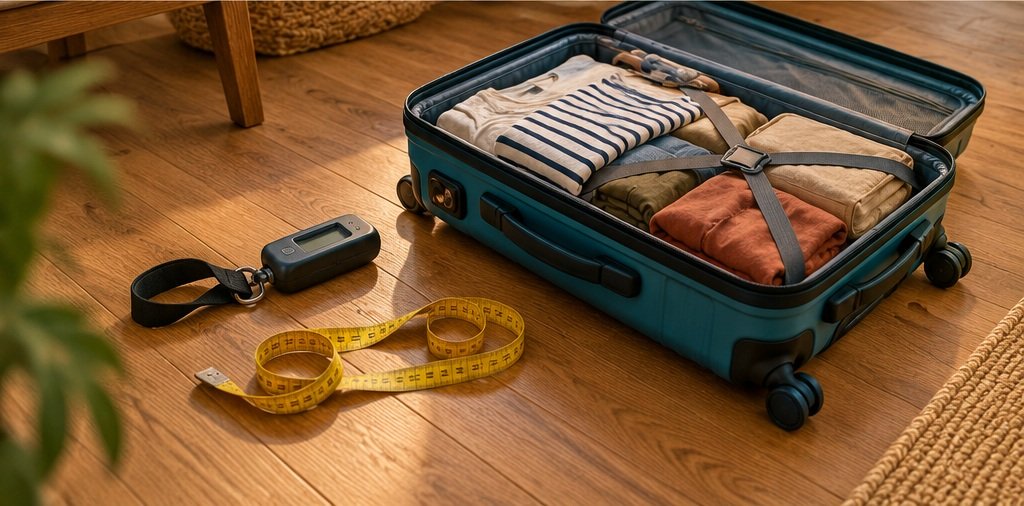
Close the case with its actual contents, retract the telescopic handle and place it on a stable surface. Measure the complete outside in the directions the carrier specifies, including wheels, fixed handles and other protrusions where required. Do not measure only the fabric or shell between those parts. A rigid handle that sits proud of the body still occupies physical space.
Check the deepest point rather than the neatest side. A full outside pocket or open expander can change the result, and a soft-sided bag may bulge when packed. Repeat the measurement after rearranging the contents instead of assuming that removing a small item reduces every dimension. The carrier’s wording defines the limit; the product label is only a starting reference. [1][2]
Keep a simple measurement record
Write down height, width, depth and packed weight together, with a note about whether expansion was open. That makes the information useful for another booking instead of leaving you with a vague memory that the suitcase was accepted once. A photograph beside the tape measure can also help when comparing a replacement online. However, past acceptance is not a guarantee for a different carrier, ticket or future policy. Recheck the booking even when you keep using the same familiar case.
Build a seven-night wardrobe before adding accessories
Choose combinations, not seven complete costumes
Lay out the clothes you expect to wear, then group them into combinations. A simple warm-weather example might include five tops, two bottoms, one dress or alternative evening outfit, seven sets of underwear, appropriate socks, sleepwear and swimwear. This is a starting exercise, not a prescription: replace the categories with clothes you actually use and add items required for your circumstances.
Now identify what you will wear on the journey. Keep that outfit separate from the packed pile so it is not counted twice. Next, check whether every top works with at least one of the selected bottoms and shoes. One attractive outfit that needs its own footwear, belt and jacket can occupy more room than several interchangeable pieces.
Use the bed as a decision surface
Make three groups: definitely needed, conditional and unnecessary duplicates. A conditional item needs a named reason, such as a booked dinner with a dress requirement, rather than a vague possibility. However, do not put essential medical or accessibility items in a discretionary group merely to meet a smaller suitcase target. Let the bag accommodate genuine needs, then edit the optional wardrobe around them.
| Group | Example starting count | Decision to make |
|---|---|---|
| Everyday tops | 5 | Do they combine with the chosen bottoms? |
| Bottoms | 2 | Can they cover the expected uses? |
| Smarter option | 1 outfit or equivalent | Does it require extra shoes or accessories? |
| Underwear | 7 sets | Adjust for washing and personal requirements. |
| Sleepwear / swimwear | As needed | Allow a suitable drying and rotation plan. |
| Journey outfit | Worn, not counted twice | Find a home for the jacket when removed. |
A beach week often needs less case than expected
Look at what the accommodation supplies
A beach towel is a substantial packing decision. Check whether an appropriate towel is supplied, available to borrow or required from home before allocating space. Similarly, a hairdryer or other bulky room item should earn its place through a real need. Removing one duplicate object is often more useful than changing how ten small items are folded.
Swimwear and casual clothes can support several combinations without creating a different outfit for every hour. Nevertheless, consider how long wet items will take to dry in your room. A plan built around a single frequently used item may become inconvenient if there is no safe, suitable drying space. Add a practical spare where necessary rather than assuming ideal conditions.
Test the journey home as well
A neat outbound case can become awkward when a towel is damp, footwear is sandy and clean clothes no longer form tidy stacks. Keep a washable separation option available and dry wet items as soon as practicable. Do not rely on compressing moisture into the smallest possible parcel. The aim is a suitcase that remains manageable on departure day, not just an attractive flat lay before leaving home.
City breaks and cooler weather change the shape of the load
Layers are not automatically compact
A thin outer layer, a fine knit and a scarf may pack more flexibly than several thick jumpers, provided they suit the expected conditions. Yet buying unfamiliar clothing solely to fit a cabin case is rarely a shortcut. Trial your own comfortable pieces first and assess their actual bulk rather than assuming all items described as travel clothing behave alike.
City holidays can also mix walking, restaurants, museums and an evening event. Choose shoes around those uses rather than around photographs. When one comfortable pair covers most days, the packed second pair can stay relatively small. Conversely, an event shoe plus walking trainers plus weather-specific footwear can make a medium case the more relaxed choice.
Plan for coats off, not only coats on
Wearing a bulky jacket to the airport saves packed volume only while you are wearing it. Consider the warmer train, security queue and transfer vehicle. If the jacket has no home when removed, you have exchanged suitcase bulk for an extra object to carry. Leave a realistic place for it or accept that it will be managed separately throughout the journey.
Shoes and toiletries deserve their own space budget
Fit footwear around the case, not around the cube set
Pack footwear in its intended protective covering during your trial. A shoe bag adds a little bulk, while an uncovered sole can mark clothing. Try shoes near the wheel end or around the edge of the main compartment, depending on the case’s shape. Small soft items may fit inside shoes, but do not distort footwear or hide something that needs quick access.
Keep the comparison fair: two small sandals are not equivalent to two pairs of trainers. When suitcase guides promise a particular number of shoes, the underlying assumptions matter. Photograph your own footwear next to the packed clothes and you will have a more useful shopping reference than a generic capacity chart.
Count the containers, not just their contents
A half-empty rigid toiletry bottle still occupies much of its original footprint. Use containers appropriate to the product and journey rules, without decanting anything that should remain labelled or in its original packaging. Then include the toiletry bag itself in the practice pack. The website’s separate carry-on toiletry guide is useful when airport-liquid screening is the deciding constraint rather than clothing volume.
Laundry can make a cabin case practical, but only with a real plan
Name the wash day
A midweek wash can reduce the number of repeat basics you need to pack. However, the plan should include where it happens, when clothes will be returned or dry, and what you will wear while the washing is underway. An apartment listing that mentions a washing machine does not automatically promise detergent, a dryer or rapid drying conditions.
For a seven-night trip, it may be simpler to pack sufficient underwear and wash only a few outer garments if needed. That avoids turning the holiday into a laundry schedule. Alternatively, a confirmed laundry service can justify a more compact wardrobe. Choose the approach that fits the holiday rather than treating light packing as a test of discipline.
Keep one small buffer
Allow for one disrupted washing day or an item that needs an unexpected change. The buffer should be deliberate and limited. Adding a spare in every category can quietly recreate the full wardrobe you were trying to avoid. A useful compromise is a small reserve of versatile basics, not a second complete collection of outfits.

Run a practice pack before deciding to buy a bigger suitcase
Use the real objects
Pack the actual clothes, footwear, toiletries, cables and accessories into the case you own. Substitute only when the replacement is genuinely similar in size and weight. A folded towel is not a reliable stand-in for a laptop, and an empty toiletry pouch gives a misleading result. Close all internal dividers and arrange the handles as they will sit during travel.
If the zip needs force, unpack rather than sit on the lid. Move rigid objects away from corners, reduce an unnecessary duplicate and try a different arrangement. This gives you a fair chance of using the existing case without overstressing it. A smaller case is not a success when every morning starts with a struggle to close it.
Judge three outcomes
Ask whether everything fits, whether you can retrieve a needed item, and whether you can repack without recreating a precise puzzle. Only then compare a new model. The Samsonite C-Lite 55cm cabin case provides a published 36-litre reference point, but the practical question is how a case of that shape handles your contents, not whether the brand’s category sounds right. [5]
Keep a weight allowance for the bag itself
Do the subtraction before filling spare space
Imagine a 10kg allowance, a 2.1kg case and 0.4kg of organisers and accessories. That leaves 7.5kg for everything else. This is an arithmetic example, not a measured holiday load. Adding a heavier case reduces the remaining allowance even if its internal space is larger. Conversely, a lightweight case does not make dense contents weightless.
Weigh the fully packed case in its final configuration, including any luggage strap, tag and last-minute charger. Repeat the measurement rather than relying on a single unstable reading. Keep a sensible personal margin below the booked limit because scales, added items and the return journey can change the result. There is no universal amount of unofficial airline tolerance to rely on.
Make the return check easy
A compact luggage scale with an easy-to-read display can be useful when shopping or repacking changes the load. Nevertheless, you still need to lift safely and use the device according to its instructions. Asking accommodation staff about a suitable weighing option may be enough for occasional travel. The purchase should remove a genuine uncertainty rather than become another unused accessory.
| Component | Weight | Remaining allowance |
|---|---|---|
| Booked allowance in this example | 10.0kg | 10.0kg |
| Example empty case | 2.1kg | 7.9kg |
| Organisers and accessories | 0.4kg | 7.5kg |
| Clothes, shoes and everything else | Actual measured weight | Keep within the total; allow a personal margin. |
Hard-shell or soft-sided: choose access as well as appearance
Think about where the case will open
A centrally split hard-shell suitcase generally opens into two halves. That arrangement can be easy to organise on a bed or large luggage stand, but it needs room. A soft-sided case with a deeper main compartment may suit a narrow room better. Check the actual opening design rather than assuming all cases in either category behave identically.
External pockets can help with a light layer or paperwork, yet filled pockets also affect packed depth and weight. Keep that in mind when a case sits close to an airline’s dimensional limit. An expandable section is similarly useful only when the expanded case is permitted on the journey where you plan to use it.
Match the wheels to your route
Four-wheel manoeuvrability is convenient on suitable smooth surfaces, while other designs may suit different ground and handling preferences. Rather than choosing from a slogan, try the loaded case on the types of surface you can safely reproduce indoors. The website’s wheel-types guide explores this trade-off in more detail. For this trip, the decisive question is whether you can manage the bag without needing help at every change of level.
Three real size references, with their limitations
A smaller cabin reference: Samsonite C-Lite 55cm
Case Luggage lists the C-Lite model 159482 at 55 x 40 x 20cm, 2.1kg and 36 litres. It illustrates the compact end of a one-week packing trial. Its expandable construction should not be treated as additional cabin allowance: compare the bag in the configuration you intend to use. Check the chosen colour, current availability and retailer terms before ordering. [5]
A medium checked reference: Samsonite Upscape 68cm
The Upscape 68cm is listed at 68 x 47 x 28cm, 3kg and 75 litres, expanding to 83 litres and 31cm deep. This is a checked-case example, not a cabin option. The selected Cloud White listing was marked sold out during review, so use the measurements as a reference and check other options rather than assuming immediate delivery. [6]
A roomier alternative: Antler Icon Stripe 66cm
The Mist Blue Icon Stripe listing gives 66 x 45 x 30cm, 3.9kg and 81.5 litres before expansion. Despite being shorter than the Upscape, it has a different shape, quoted volume and empty weight. That is precisely why height alone is a weak buying shortcut. This roomier option needs a real reason, such as bulkier clothing, rather than the assumption that medium means the same thing everywhere. [7]
| Model | Unexpanded exterior | Empty weight | Listed capacity | Role |
|---|---|---|---|---|
| Samsonite C-Lite 55cm, 159482 [5] | 55 x 40 x 20cm | 2.1kg | 36 L | Compact cabin trial |
| Samsonite Upscape 68cm [6] | 68 x 47 x 28cm | 3.0kg | 75 L | Medium checked reference |
| Antler Icon Stripe 66cm [7] | 66 x 45 x 30cm | 3.9kg | 81.5 L | Roomier checked reference |
Use packing cubes to organise, not to justify excess clothing
Start with fewer cubes than the set contains
Try one organiser for tops and one for small clothing, then leave footwear and rigid objects to occupy the remaining shape naturally. You do not have to use every piece sold in a set. A cube that only half fills a curved corner can reduce useful space, whereas a well-matched organiser can keep a group of items easy to lift out.
The BAGSMART Blast packing cubes use a separate compression zip and mesh panels. The listed six-piece set includes a shoe bag, so it is not six interchangeable clothing cubes. Use the product dimensions to compare the footprint with your suitcase before purchase; do not assume a marketing image represents your particular bag. [8]
Compression does not reduce kilograms
Squeezing air out of suitable soft clothing may help the arrangement, but the garments and organisers still weigh the same. Also, do not compress delicate structure merely because a second zip can close. A practical rule is to stop when compression starts making the parcel awkward, distorted or difficult to retrieve. Organisers should simplify the week, not turn the return pack into a strength exercise.
Sharing luggage can help a family, but changes the decision
Allocate space before combining belongings
One adult’s spare capacity may hold a child’s clothing or shared toiletries. However, make that allocation before deciding the suitcase is comfortably large enough. A case that fitted one person’s wardrobe yesterday is not suddenly a family solution because two small cubes can be pushed into the corners. Keep each traveller’s essential journey items accessible in the appropriate bag.
Use colour or position to distinguish clothing groups when that helps, without buying a different pouch for every person and day. Shared luggage also needs an agreed packing order. Otherwise, one traveller’s shoes may end up on top of another person’s light clothing each time the case is opened.
Check piece rules as well as total weight
Do not assume separate passenger allowances can always be combined into a single heavy case. Check the operator’s current pooling and per-item limits for your booking. Even when pooling is allowed, one bulky case may be harder to handle than two smaller ones. Choose around the people who will actually lift the luggage, not around the total kilogram figure on paper.
The route from airport to room can outweigh a few extra litres
Picture every lifting point
Think through the car boot, airport transport, stairs, train rack and accommodation entrance. A case that rolls easily across a showroom floor may still be uncomfortable to lift when packed. Include the other items in your hands during the trial. Managing a suitcase while carrying a shoulder bag and holding a child’s hand is a different task from testing it alone.
For frequent changes of accommodation, a slightly smaller case that closes easily may be more useful than a large suitcase with extensive spare room. By contrast, a straightforward transfer to one room can make a medium checked case perfectly practical. Neither approach is inherently more experienced or more responsible; the route and load determine the trade-off.
Consider storage at the destination
Measure the space where the case will live at home and think about its footprint in the room. The Upscape 68cm size reference is useful for checking a medium case’s outside dimensions against a storage shelf or boot opening. Yet measurements cannot replace a loaded handling trial, and the retailer’s current stock remains a separate question.
Keep a small journey reserve separate from the main wardrobe
Plan for access, not a second full suitcase
Set aside the few things you may need before reaching the room: essential documents, appropriate personal items, a light change where useful and the items your operator requires to remain in the cabin. This is a small access group, not permission to add an unbooked extra bag. Check that it fits within the complete luggage allowance you have purchased.
The reserve also helps when an otherwise permitted cabin case has to be checked for operational reasons. Jet2 explicitly describes that possibility in its baggage guidance. Pack so that you can remove the necessary cabin items without emptying seven days of clothing in a queue. A compact pouch near the opening can be more useful than several tightly packed layers over the items you need to retain. [3]
Include the reserve in the original comparison
Weigh and measure all the bags in the system, not only the suitcase. A cabin case that appears comfortably packed because half the toiletries and clothing have moved into a bulging shoulder bag has not solved the overall problem. Keep the reserve proportionate, then judge the combined handling during the home trial. This makes the size decision more honest and gives you a clearer plan for the less predictable parts of the journey.
Leave a return-trip plan rather than an empty-shopping promise
Reserve a defined patch of space
A little spare room helps when clothes no longer fold as neatly, toiletries change position or you acquire something you intend to bring home. Instead of an arbitrary percentage, identify a visible space or removable item. For example, leaving room for the light jacket you wore outbound is more concrete than hoping that the lid will stretch later.
Do not fill every gap with optional clothing simply because it exists. Empty space is not wasted when it keeps the case easy to close and allows useful access. Equally, a mostly empty large case is not automatically the best answer: the shell still occupies its full external size during transport.
Separate used clothing sensibly
Keep dry worn clothing apart from clean items where helpful, and deal with genuinely wet pieces before long storage. A separate organiser can make the final pack clearer, but it need not be elaborate. The return test is simple: can you identify what needs washing without unloading toiletries and shoes onto the same surface? An uncomplicated system is easier to repeat after a tiring week.
Buying checks that matter beyond this holiday
Inspect the parts you will use repeatedly
Look at the lift handles, wheel attachments, telescopic handle and zip movement. Check whether replacement parts or a repair route are available for the exact model. A warranty headline is not the same as cover for every type of travel damage. Save the receipt and model details, then read the actual conditions rather than relying on a retailer’s short badge.
With the Antler Icon Stripe medium case, for instance, the useful comparison is the complete specification and service information for that size and version. A familiar brand name does not erase differences between collections. Prefer a model whose handling and layout suit your normal trips, not only the largest holiday you might take once.
Keep the first trial return-friendly
Read the returns conditions before testing a new suitcase. Work indoors on a clean surface, retain packaging and avoid alterations such as monogramming until you understand their effect on returns. Do not assume a fully used holiday trial is permitted. A careful home pack can answer most size questions without treating a purchase as a free rental.
Pros and cons of the three practical approaches
Cabin case: efficient when the wardrobe is genuinely small
The advantage is a compact packing system with fewer belongings to manage. It can suit a warm-weather week with limited footwear and a realistic laundry option. However, the available space and booked weight may leave little room for bulky clothing or a generous toiletry kit. Choose it because the trial works, not because cabin-only packing is presented as a badge of competence.
Medium checked case: flexibility without automatically going enormous
A medium case can absorb extra layers, an event outfit and a more relaxed washing schedule. It also leaves room to separate items rather than squeeze everything together. The trade-off is additional handling and the need to understand the checked-baggage booking. It should still be comfortable enough for the traveller who will move it, including on the journey home.
Large checked case: justified by a specific bulky load
The benefit is space for genuine extra equipment or shared clothing. The drawback is that the size can encourage packing beyond the weight allowance or beyond what is comfortable to lift. A large case is therefore a targeted choice, not the default answer to seven nights away. Keep an explicit contents list so the reason for buying it remains visible.
Common mistakes that make the suitcase feel too small
Buying by height alone
Two cases advertised around the same height may have different depths, wheel layouts, quoted capacities and openings. Compare all external dimensions and inspect the interior. Also check whether a capacity figure refers to expansion. A short, deep checked case can hold more than a taller, slimmer design without being suitable for the cabin.
Counting outfits but forgetting hard objects
Shoes, glasses cases, toiletries and charging equipment do not disappear into a clothing allowance. Put them into the first practice pack, not the final one. Otherwise, the wardrobe appears to fit perfectly until the night before departure, when every awkward object arrives at once and creates pressure to buy a bigger bag.
Planning only for the outbound photograph
A case that closes once after careful rolling may not be convenient for repeated use. Test opening it, removing an outfit and replacing the items. Then add the light layer you wore on the journey. If that simple exercise breaks the arrangement, improve the packing plan before blaming the suitcase’s capacity.
Frequently asked questions
Is a cabin suitcase enough for seven nights?
It can be, particularly for lightweight clothing, limited footwear and a realistic washing plan. Start with your booked cabin dimensions and weight, then practise with the complete load. A nominal 40-litre bag is not a promise that every seven-night wardrobe fits. When the trial requires forced zips or unreasonable compromises, a medium checked case is the more practical answer.
What size suitcase is usually described as medium?
Retailers use the label differently, so treat it as a browsing category rather than a standard. Many useful checked-case examples sit around the mid-60s to high-60s in centimetres, but depth and internal layout can change capacity significantly. Compare the actual product measurements, then decide whether they suit your contents and route rather than relying on the label.
Is a 23kg suitcase a particular size?
No. A 23kg allowance is a weight limit associated with the relevant baggage booking, not a suitcase dimension or litre rating. The packed case, including its own weight, must remain within that allowance and any size restrictions. A large case can exceed the weight limit before it is full, while a smaller case of lightweight clothes may remain well below it.
Should I buy the bigger size for souvenirs?
Only when bringing back larger items is a realistic part of the trip and the transport limits permit them. First try leaving a defined space or reducing an optional item. Buying a much larger case for unspecified shopping adds bulk to both journeys. Also check the rules for whatever you intend to carry; spare suitcase space does not establish transport permission.
Can I use an expandable case as cabin luggage?
Only when its fully packed external dimensions, in the configuration you use, meet the booked allowance. Expansion may increase depth beyond that limit. Measure the case after packing, including protruding parts and filled pockets as applicable. Do not assume a cabin label covers the expanded version or that staff will accept a bag because it fitted a different flight previously.
Do packing cubes let me take a smaller suitcase?
Sometimes they improve the arrangement enough to help, but they are not guaranteed space savers. Their fabric, zips and shape also occupy room. Try one or two with the same clothes you previously packed loose, then compare access and closing effort. The best result is a system that remains easy to use, not merely a smaller-looking pile on the bed.
Final recommendation: size the case around the week you will actually have
Try small, then move up for a reason
For a straightforward warm-weather week, test the case you already own before shopping. Keep the wardrobe coordinated, count footwear honestly and include the whole toiletry kit. If the finished load closes comfortably within the booking limits, there is no benefit in replacing a suitable bag simply because another traveller uses a different size.
Move towards a medium checked case when bulky clothing, personal equipment or a no-laundry preference makes the smaller trial impractical. Then check handling and storage as carefully as capacity. The right suitcase should make the week easier before you leave, while you are away and when you repack to come home.
Make one final measured decision
Use the Go Travel Digital Pro Scale or another suitable weighing method for the final load, then check the outside dimensions in travel configuration. Those two checks are more useful than a promise that a case is perfect for a week. Choose the smallest option that accommodates your real requirements without forcing, guessing or depending on an airline exception.
Sources and fact-checking notes
Capacity ranges and wardrobe counts are editorial planning examples, not measured fits. Airline and product facts were checked against the linked pages on 12 October 2026. Dimensions are for the stated configurations; recheck your booking and chosen variant before purchase. No prices, discounts or delivery promises are quoted.
- Ryanair – baggage policy
Personal-bag and Priority cabin-bag allowances.
- easyJet – cabin bags
Cabin dimensions, weight and booking entitlement.
- Jet2 – baggage information
Cabin and hold allowances and handling conditions.
- Delsey – ALU'R 55cm specifications
Explicit distinction between exterior and interior volume.
- Case Luggage – Samsonite C-Lite 55cm, model 159482
Exact-size retailer specifications; not a hands-on review.
- Case Luggage – Samsonite Upscape 68cm, model 143109
Retailer dimensions and Cloud White availability at review.
- Case Luggage – Antler Icon Stripe 66cm
Mist Blue listing: size, capacity and empty weight.
- BAGSMART UK – Blast packing cubes
Set composition, zip design and individual dimensions.
Illustrations in this article were created for Taylor’s Trailblazing Travel Gear. Third-party photographs, where used, are credited beside the image or in the source list.