
Travel Towel Materials Compared: Drying, Odour and Packed Size
Compare thin and plush microfibre, linen, flat-woven cotton and terry towels using the conditions that matter in a real bathroom, hostel, beach bag or carry-on.
Original Travel Gear image
Travel towel materials are easy to compare badly. One product page measures absorbency against its own weight, another says it dries faster than cotton, and a third sells a natural fibre as automatically fresher. Those claims use different baselines and rarely describe your actual room humidity, hanging space, towel size or washing routine.
The practical trade-off is more specific. Thin microfibre usually gives the smallest packed volume and fastest route from wet to usable, but some travellers dislike the feel and synthetic fabrics can retain odour when body oils and damp storage combine. Linen is heavier than ultralight microfibre yet can feel less clingy and dries efficiently when spread open. Flat-woven cotton is familiar and versatile, while plush terry cotton offers comfort at the cost of space and slower drying.
This guide compares material families rather than inventing laboratory test results. Current specifications and prices are drawn from manufacturer and retailer pages checked on 21 September 2026. Product claims are identified as claims, and the home test uses the same towel area, water load and drying position to create a fairer personal comparison.
Thin microfibre
The strongest choice for carry-on volume and fast wringing, with the least familiar skin feel.
Lightweight linen
Moderate bulk, textured feel and efficient drying when fully opened.
Flat-woven cotton
Useful as a towel, beach layer or light cover, but heavier than ultralight synthetics.
Packing damp
Material claims cannot overcome a warm, sealed pouch and repeated use without drying.
Drying speed changes with the towel and the room.
Surface area and fabric mass matter together
A large towel can contain more total water even when its fabric is light. A smaller plush towel can hold water deep in its pile. Compare towels at the same usable coverage, not merely by the weight of the product or the word compact.
Wringing changes the starting point
Microfibre can often be wrung aggressively without losing shape, removing a large proportion of the water before hanging. A thick cotton towel may retain more water after the same hand pressure. That difference is part of travel performance because many rooms provide limited airflow and no heated rail.
Humidity and airflow can reverse expectations
A towel spread across a rail in moving, dry air behaves differently from one folded over a chair in a humid bathroom. Even a very light towel dries slowly when it is doubled, pressed against a wall or returned to its pouch. A hanging loop is useful only if it lets the fabric open rather than bunch.
Usable-dry and bone-dry are different thresholds
For a morning shower, the useful threshold may be “dry enough to use again without feeling cold”. Before packing, the threshold should be fully dry throughout, including hems, corners and labels. Record both points in a home test; the second matters for odour and luggage moisture.
Fibre, weave and thickness create the actual product.
Thin microfibre
Usually made from polyester or a polyester–polyamide blend, thin microfibre has high surface area, low fabric mass and a very small packed profile. It absorbs by capillary action and surface interaction, then releases water readily when wrung. The trade-off is a smooth or suede-like feel that some people find clingy on damp skin.
Plush microfibre
A deeper loop or terry-like synthetic fabric feels more like a domestic towel and can hold more water, but the extra mass increases packed size and slows the final stage of drying. It sits between ultralight travel cloths and cotton terry.
Linen
Lightweight woven linen is breathable, durable and generally less clingy than thin microfibre. It starts textured and softens through use and washing. The same surface area normally weighs more and packs larger than the lightest synthetic towel, though a flat weave remains much smaller than thick cotton terry.
Flat-woven cotton or peshtemal
A flat cotton towel provides full coverage without deep pile. It can double as a wrap, beach layer or light blanket and often feels familiar against the skin. Cotton absorbs into the fibre, so total drying time depends strongly on fabric weight and airflow.
Terry or waffle cotton
Loops and cellular texture increase surface area and comfort, yet they also add fabric and places for water to remain. A light waffle towel can be more travel-friendly than hotel terry, but both usually require more room than thin microfibre.
“Bamboo towel” is not a complete material description. Many products use regenerated viscose derived from bamboo, blends or a small proportion of bamboo-labelled fibre. Check the composition and finished weight rather than assuming the plant source predicts drying or odour performance.
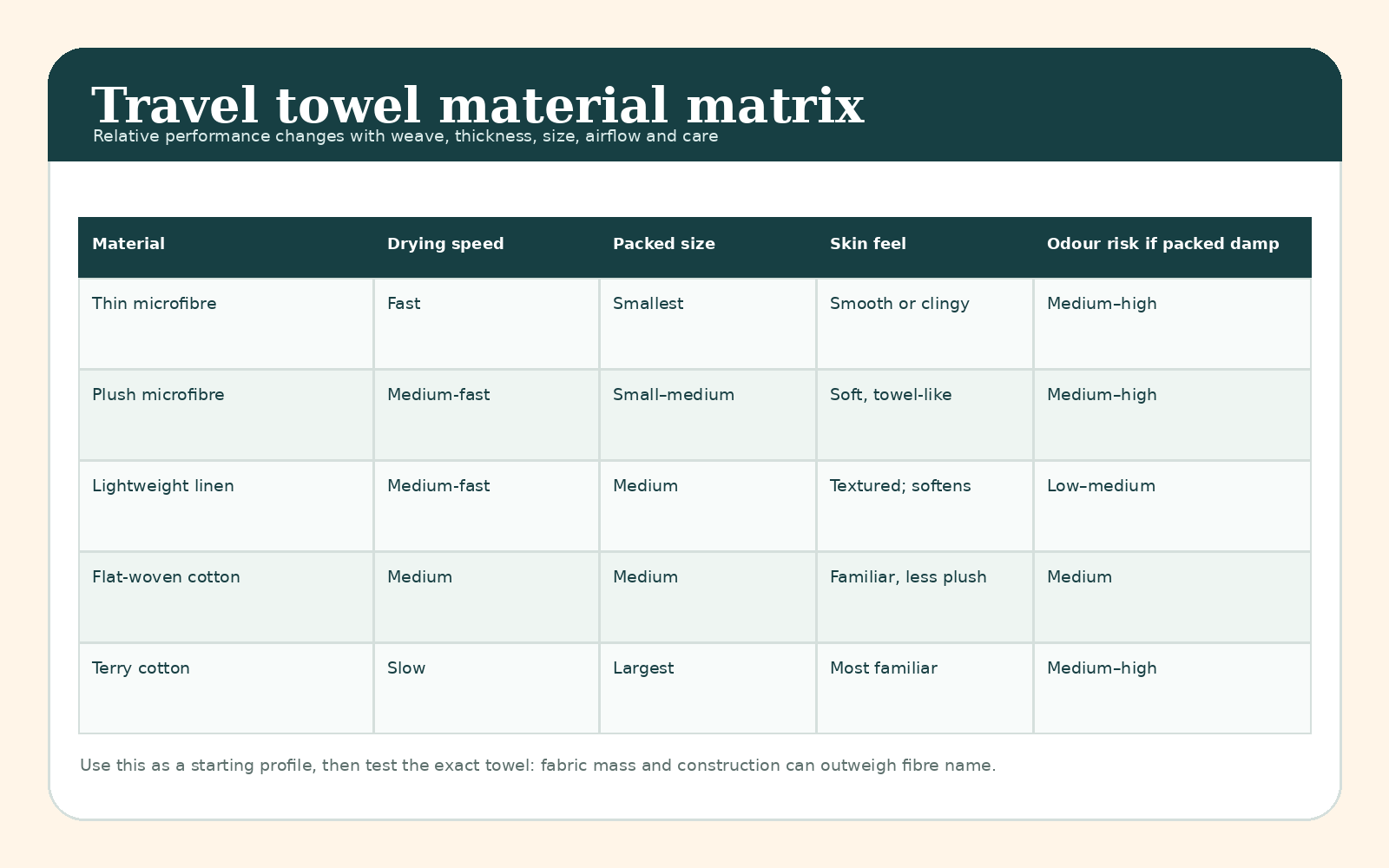
These are practical profiles, not universal laboratory scores.
| Construction | Drying profile | Odour considerations | Packed size | Best fit |
|---|---|---|---|---|
| Thin polyester microfibre | Fast after a strong wring; very fast when spread fully | Can retain body-oil odours and becomes unpleasant quickly if sealed damp | Very small | One-bag travel, hostels, gym, frequent reuse |
| Polyester–nylon plush microfibre | Faster than thick cotton but slower than ultralight cloth | More pile and moisture can extend the damp period; some products use odour-control treatments | Small to medium | Travellers who dislike the feel of thin cloth |
| Lightweight linen | Efficient in airflow; hems may dry last | No fibre eliminates odour; thorough drying and washing remain essential | Medium | Natural-fibre preference, warm climates, less clingy feel |
| Flat-woven cotton | Moderate; wringing and open hanging matter | Familiar washing routine, but damp cotton can develop musty odour | Medium | Beach, multi-use wrap, road trips |
| Cotton waffle | Moderate to slow depending on weight | Cells hold moisture if folded; dries well only when opened | Medium to large | Campervan or hotel use with more hanging space |
| Plush terry cotton | Slowest of the common travel options | High water load extends damp-storage risk | Largest | Comfort-first travel with generous baggage and reliable drying |
Odour risk is not a simple league table. Fibre chemistry, skin oils, detergent residue, microbial load, wash temperature and drying conditions interact. Research on textile malodour shows that humid drying and the wash–wear–dry cycle can reshape the textile microbiome. The practical response is consistent drying and cleaning rather than assuming a single fibre is immune.
Microfibre is the default travel choice for good reasons, but not every version feels the same.
Thin cloth prioritises speed
The lightest designs use little material for a large area. Sea to Summit’s current Airlite large towel, for example, is listed at 120 × 60 cm and 67 g, with a packed size of about 11 × 5.5 cm. The manufacturer describes it as its fastest-drying towel and states absorption of more than three times its own weight.
A blend can alter feel and absorbency
Polyamide is commonly blended with polyester to create a softer, more absorbent fabric. PackTowl’s Personal towel is listed as 80% polyester and 20% nylon; the body size is 64 × 137 cm and 180 g. Its maker claims four-times-weight absorption and drying 70% faster than comparable cotton. Those figures are product claims, useful for comparison but not a guarantee in every room.
Odour control treatments have limits
Some towels use antimicrobial or odour-control treatments, while other brands deliberately omit them. Treatments can reduce certain odour pathways but do not make damp storage safe or remove the need for washing. Check the treatment, expected lifetime and care instructions rather than treating “antimicrobial” as permanent hygiene.
Fabric softener can reduce performance
Several microfibre brands warn against fabric softener because it can coat the fine fibres and reduce absorbency. Wash separately for the first cycles if the colour-care instructions advise it, rinse thoroughly and keep the storage pouch open until the towel is completely dry.
Linen suits travellers who accept more weight for a different feel and care profile.
Weight depends strongly on weave
A current lightweight linen range lists a 70 × 140 cm bath towel at 300 g, while the waffle version of the same size is listed at 450 g. That difference shows why “linen” alone cannot predict packed size. Waffle texture adds comfort and absorbent surface but also fabric mass.
Texture changes with use
New linen can feel crisp or rougher than cotton and microfibre. Washing and use generally soften it, which may improve comfort while slightly changing dimensions and drape. Travellers with sensitive skin should handle the exact towel before committing to a long trip.
Airflow is the advantage to protect
A flat or loosely textured linen towel exposes a broad surface to the air. Fold it once over a narrow rail only when both layers remain separated; otherwise use a hanger, line or two hooks. Dense hems and loops still need extra time.
Treat antibacterial language cautiously
Retailers often describe linen as naturally antibacterial. Fibre and surface properties can influence microbial behaviour, but a travel towel still collects skin cells, oils, sunscreen and environmental dirt. Drying and laundering are the dependable controls.
Cotton ranges from travel-friendly cloth to suitcase-filling bath towel.
Flat-woven cotton is the practical travel form
A peshtemal-style towel uses a flat weave rather than deep loops. Current examples around 90 × 170 cm commonly weigh roughly 350–420 g, which is far more than an ultralight microfibre towel but still flatter than a large domestic terry towel. The broad surface makes it useful as a beach layer, wrap or picnic cloth.
Waffle cotton is a compromise
A waffle structure creates pockets and a more towel-like feel without the full depth of terry. Weight varies widely. It can dry efficiently when stretched open, but the cells and folded hems hold water if the towel is doubled over a rail.
Terry cotton is comfort-first
Dense loops feel familiar and pick up water readily, yet the same pile makes the towel bulky and slow to reach pack-dry status. It works best when luggage volume is generous and the accommodation provides a heated rail, balcony or reliable laundry.
Cotton needs a realistic wet-weight plan
A towel that feels manageable when dry may become heavy after a swim. If it must be carried wet between beach and accommodation, bring a ventilated wet bag or separate waterproof compartment and open it promptly on arrival.
The wet–pack–warm cycle is more controllable than fibre marketing.

Body oils and microbes arrive together
A towel picks up more than clean water. Skin microbes, oils, sunscreen, detergent residue and environmental material remain in the fabric. Polyester can retain certain oily odour compounds strongly, while cotton and linen hold more water within the fibre. Neither pathway makes a towel automatically fresh or smelly.
Humid drying extends the opportunity for malodour
Research on laundry-associated malodour reports that humid drying conditions support characteristic odours and microbial changes. In travel terms, a towel hanging in a closed bathroom or sealed inside a pouch stays in the risk window longer than one wrung firmly and opened in moving air.
The storage pouch is not a drying chamber
Mesh or perforated cases improve ventilation around a nearly dry towel, but the towel dries fastest outside the case. Silicone and solid pouches protect other luggage from a damp towel; they do not make moisture disappear.
Reset before odour becomes persistent
Rinse after salt water or heavy sunscreen, wash according to the care label and allow a complete dry. If odour remains after correct washing, clean the washing machine, review detergent quantity and avoid repeated low-airflow storage. Replace a towel only after the care process has been corrected; otherwise the next one may develop the same problem.
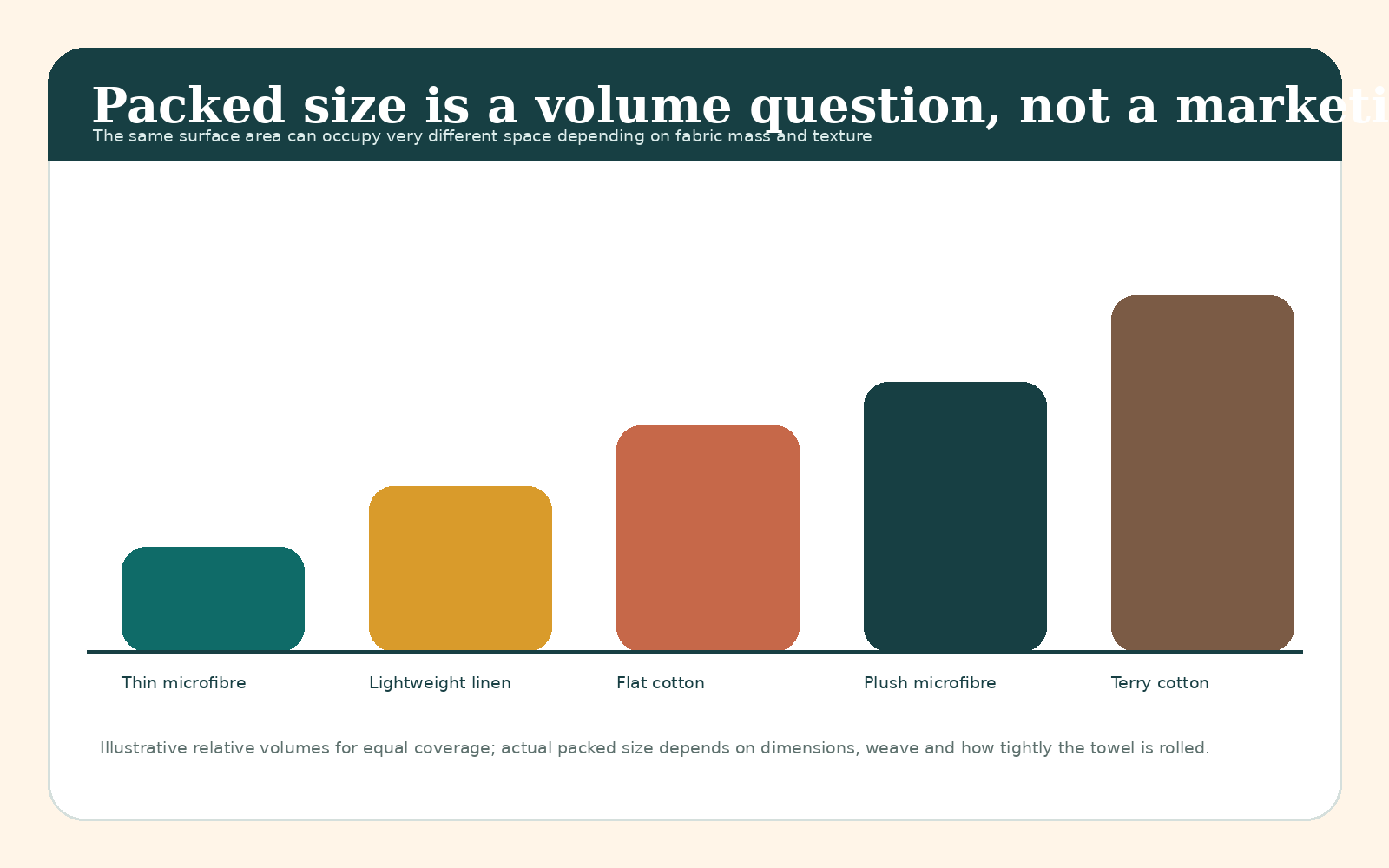
A small pouch can hide a small towel.
Measure the towel unfolded
A hand towel can look impressively compact but may not wrap around the body or cover a changing-bench surface. Decide whether you need hand, shower, beach or family coverage, then compare products within that size class.
Record dry weight and packed dimensions
Weight matters for walking and airline limits, while volume matters inside a daypack. A 300 g flat linen towel may slide neatly against a suitcase wall; a lighter plush towel may form a thicker cylinder. Test folding and rolling in the actual bag.
Leave room for an imperfect repack
A factory-folded towel rarely returns to its original shape after use. Choose a pouch that accepts a quick fold without forcing damp fabric into a compressed ball. Alternatively, discard the pouch and use a breathable packing cube that fits your routine.
A larger towel can be more efficient when it replaces two items
A broad flat-woven towel may serve as beach mat, wrap and light cover. Count the items it genuinely replaces rather than assuming every multi-use claim will apply to your trip. A towel used on sand still needs cleaning before it becomes a clean blanket.
The examples illustrate different design priorities rather than a ranked winner.
Prices and availability checked 21 September 2026. Final prices vary by size and stock.
Sea to Summit Airlite
The UK range was listed from £12. The large version is 120 × 60 cm, 67 g and packs to roughly 11 × 5.5 cm. It prioritises low mass and fast drying.
Sea to Summit Tek Towel
Listed from £15 on the current page, with a 70% polyester and 30% nylon blend, terry-like feel and a heavier construction than the Airlite.
Matador NanoDry Beach Towel
The UK listing showed £36.95, 153 × 76 cm, 155 g and packed dimensions of about 15 × 13 × 5 cm, plus a storage pocket.
Hitch and Roam lightweight linen towel
The range started at £5.95, with the 70 × 140 cm bath size listed at 300 g. The waffle version of that size is heavier.
PackTowl’s current Personal body towel is listed at 64 × 137 cm and 180 g in an 80% polyester, 20% nylon blend. The maker claims four-times-weight absorption, faster drying than comparable cotton and an odour-control treatment. Use those figures to shortlist, then apply the same home test to the exact towel.
Compare like with like
Filter by unfolded dimensions, fabric composition, dry weight, packed dimensions, hanging method and care instructions. Ignore a tiny pouch if the towel does not provide the coverage you need.
A kitchen scale and consistent routine reveal more than a generic review.

Prepare
- Wash and dry each towel according to its label before testing.
- Record unfolded dimensions, dry weight and your normal packed dimensions.
- Use the same room, hanger and start time, and avoid direct heat for one towel only.
Wet and wring
- Soak the same usable area or the whole towel if products have similar coverage.
- Lift it for a fixed drain time, then wring each towel with the same number of turns and effort.
- Weigh immediately after wringing to record retained water.
Dry and record
- Hang each towel fully open with the same exposure to airflow.
- Record weight and touch observations after one, two and four hours, then at pack-dry.
- Note cold or damp hems separately from the main panel.
Repeat-use odour check
Use the towel normally for two or three cycles only if it can be dried safely between uses. Record odour before washing without sealing it wet to manufacture a bad result. The aim is to compare your routine, not create a microbiology experiment.
A good towel can perform badly after the wrong wash or storage routine.
- Follow the product label for temperature, detergent, tumble drying and bleaching.
- Avoid fabric softener when the manufacturer says it reduces microfibre absorbency.
- Rinse salt, chlorine, sunscreen and heavy soil rather than letting them dry into the fabric.
- Use the hanging loop to spread the towel, not to suspend a tight wet bundle.
- Open the storage pouch during drying and clean the pouch itself.
- Do not iron or expose synthetic towels to high heat unless the label permits it.
- Wash new dark colours separately when the brand warns that dye may transfer.
- Check hems and labels before packing; they are often the last parts to dry.
A spare lightweight towel can be useful on trips with daily swimming and poor drying conditions. Rotate only when each towel gets enough time open; two damp towels packed together are not an odour solution.
Choose the compromise you will notice least.
Advantages
- Thin microfibre provides the best weight and volume efficiency.
- Linen offers a natural fibre and less clingy hand feel.
- Flat cotton can replace a wrap or beach layer as well as drying the body.
- Plush microfibre bridges travel performance and domestic-towel comfort.
- Most specialist towels include a hanging point or compact storage solution.
Disadvantages
- Ultralight microfibre can feel synthetic, drag on skin or retain odour if cared for poorly.
- Linen is heavier than the lightest synthetics and starts more textured.
- Flat cotton carries more water and needs longer drying than ultralight cloth.
- Terry cotton uses the most luggage volume and reaches pack-dry slowly.
- Product claims use different test methods, so headline absorption figures are hard to compare directly.
Most disappointments are visible before the trip.
- Comparing a hand towel with a full shower towel because the smaller pouch looks impressive.
- Assuming every microfibre towel has the same texture, weight or odour treatment.
- Buying linen without checking whether it is a lightweight flat weave or heavier waffle construction.
- Using fabric softener despite the care warning.
- Packing any towel while hems and corners remain damp.
- Leaving the towel folded over a wide rail with no airflow between layers.
- Treating an antimicrobial finish as a substitute for washing.
- Carrying a thick cotton towel on a trip with no heated rail or outdoor drying.
- Ignoring wet weight on beach walks or travel days.
- Keeping a damp towel inside the manufacturer’s pouch because the pouch looks ventilated.
Material names need context.
What is the fastest-drying travel towel material?
A thin, low-mass microfibre towel usually dries fastest after a firm wring, provided it is hung fully open. Construction and room conditions can outweigh the fibre label.
Do microfibre towels smell more than cotton?
Polyester can retain oily odour compounds, while cotton stays damp longer. Either can smell when repeatedly used and packed wet. Drying, washing and detergent control are decisive.
Is linen better than microfibre for travel?
Linen is preferable when natural fibre, a less clingy feel and durability matter more than the lightest weight. Microfibre wins when pack size and rapid repeat use dominate.
Are Turkish towels good for backpacking?
Flat-woven cotton towels are much slimmer than thick terry and useful as wraps, but full-size versions are usually several times heavier than ultralight microfibre.
What towel size is enough for a shower?
Around 60–70 cm wide and 120–140 cm long suits many adults, but body size and wrapping preference vary. Check the unfolded dimensions rather than the label “large”.
Should I buy a towel with an antimicrobial treatment?
It can be a useful secondary feature, but it does not make damp storage safe. Check what the treatment is, how long it lasts and whether the care routine preserves it.
Can I use fabric softener on a travel towel?
Only when the care label permits it. Many microfibre makers advise against softener because coatings can reduce absorbency.
Why does my towel still feel damp after the centre is dry?
Hems, labels and folded corners contain more material and lose water more slowly. Check them before packing.
Is a silicone case good for a wet towel?
It protects the rest of the bag during short transport but does not dry the towel. Remove and hang the towel as soon as possible.
How should I compare packed size at home?
Wash the towels first, fold or roll them using a realistic rushed routine, then place them in the actual bag. Factory-packed dimensions are not always repeatable.
Let the drying opportunity choose the material.
For carry-on travel, hostels and frequent reuse, choose a full-coverage thin microfibre towel with a reliable hanging loop and care instructions you will follow. It provides the largest reduction in weight and packed volume.
Choose lightweight linen when you strongly prefer natural fibre and a less synthetic skin feel, especially in warm accommodation with decent airflow. Choose flat-woven cotton for beach and road trips where its wrap and blanket functions genuinely replace another item.
Avoid thick terry cotton when you must repack daily or dry indoors without heat. Regardless of material, build the trip around wringing, open hanging and complete drying. A slightly larger towel that you enjoy using and can dry properly is a better purchase than an ultralight one that stays sealed damp because you dislike its feel.
Specifications, rules and prices were checked against the following sources.
- Sea to Summit Airlite Towel — Current UK composition, sizes, weights, packed dimensions, care guidance and price.
- Sea to Summit Tek Towel — Current UK plush microfibre specifications and price.
- PackTowl Personal Towel — Current material, size, weight and manufacturer drying/odour claims.
- Matador NanoDry Beach Towel — Current UK size, weight, packed dimensions and price.
- Hitch and Roam lightweight linen towel — Current linen sizes, weights and price range.
- Microbial Odor Profile of Polyester and Cotton Clothes — Peer-reviewed study on fibre type, microbes and odour after exercise.
- Unravelling the hidden side of laundry — Open-access research on malodour, textile microbiome and humid drying.
- Biological and Chemical Processes that Lead to Textile Malodour — Review of textile odour formation, washing and drying factors.
Manufacturer and retailer pages support current specifications, prices and stated features; they are commercial sources and do not independently prove comfort or durability. Government, standards and research sources support the relevant rules or evidence. Practical recommendations are editorial comparisons and not invented first-hand testing.
Illustrations in this article were created for Travel Gear. Third-party photographs, where used, are credited beside the image or in the source list.