Research-Led vs Hands-On Travel Gear Reviews: How to Tell the Difference
Read the evidence, not the confidence: what each review method can prove, what it cannot and how honest publishers should label the difference.
Original Travel Gear image
A travel gear article can be useful without the writer having physically used every product. Airline-size comparisons, warranty analysis, material definitions, repair policies and current prices can all be researched well. Problems begin when a research-led comparison is written as if it were a personal test, or when a few minutes with a product are presented as proof of comfort, durability or waterproofing.
Readers need two separate questions answered. First, what method was used? Second, does that method support the specific claim being made? A hands-on review can establish handling, access and observed performance under its test conditions. A research-led review can compare documented specifications, policies and trade-offs across a much wider market. Neither method is automatically trustworthy; transparency and evidence determine the value.
This guide explains how to identify the difference, how affiliate links and free products should be disclosed, and how to judge rankings without assuming that a confident tone equals experience. It is an editorial-method explainer and contains no ranked product recommendations.
Specific test conditions
The review names the exact load, route, duration, weather, surfaces and measurement method rather than saying only that the bag was ‘put through its paces’.
Named primary sources
Specifications and policies link to current manufacturer, airline, standards or regulator pages, with conflicts and missing data stated.
Experience without evidence
First-person language, precise scores or ‘best overall’ claims appear without original photos, test notes, dates or a disclosed method.
Disclose before persuasion
Affiliate commission, free products, loans, payment and brand relationships should be clear where the reader encounters the recommendation.
A useful label describes the evidence base, not the prestige of the publisher.
What research-led means
A research-led review or comparison is built from documented evidence: official dimensions, weight, material descriptions, warranty terms, repair information, safety rules, retailer availability, verified price checks and clearly attributed third-party testing. The writer may make editorial judgements, but those judgements should be tied to transparent criteria. For example, a 760 g backpack can reasonably be identified as light relative to a 2.7 kg cabin case. It cannot be declared comfortable for a six-hour carry unless someone has actually used it that way.
What hands-on means
Hands-on means the reviewer physically handled or used the named product. That description alone is still incomplete. A ten-minute shop inspection can support comments about opening style, pocket access and observed finish. It cannot support a long-term durability verdict. A four-week trip may reveal real comfort, wheel and organisation behaviour, but only for the user’s body, load and surfaces. The review should state the conditions so readers can judge transferability.
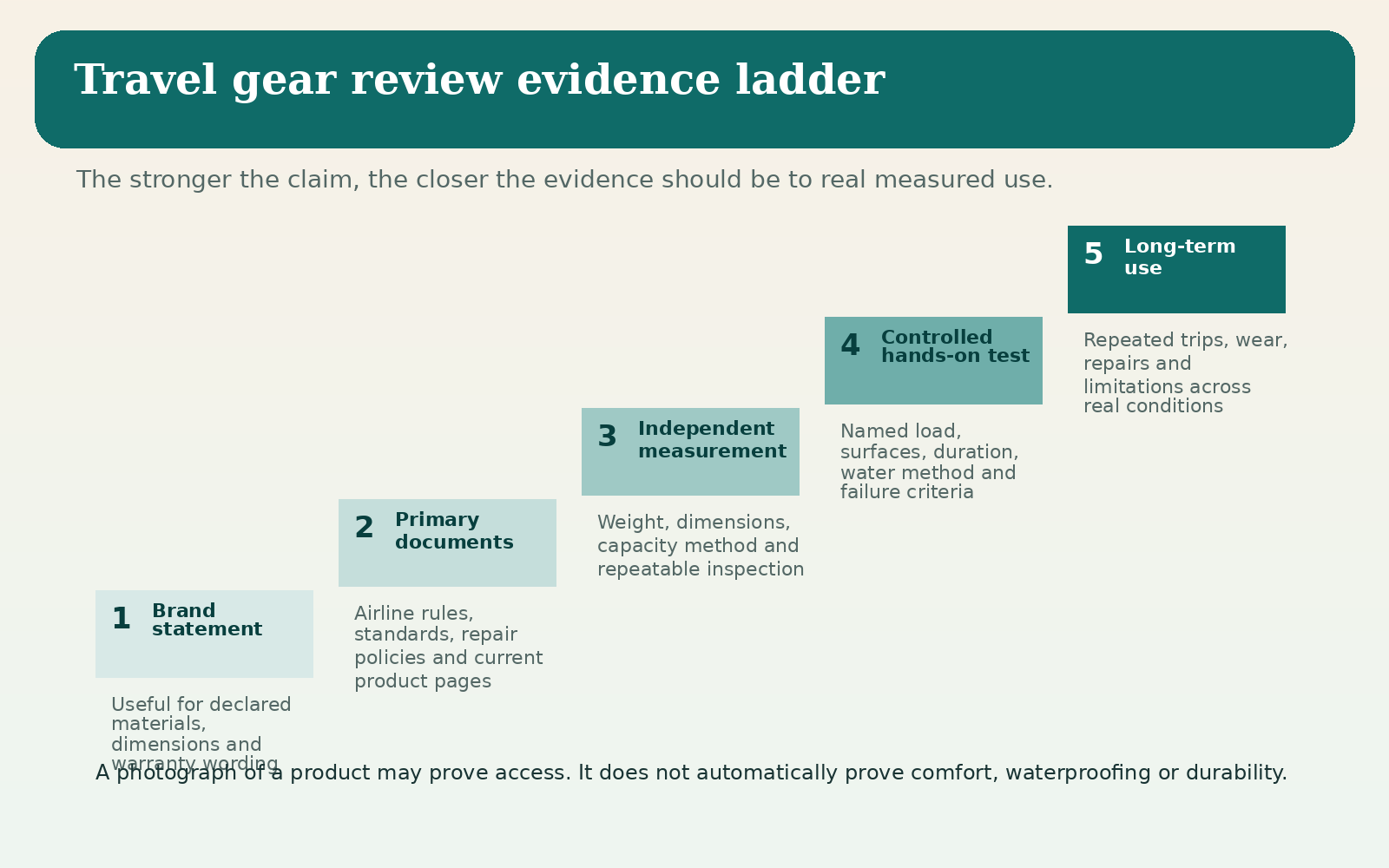
The method is credible only when it can support the sentence being written.
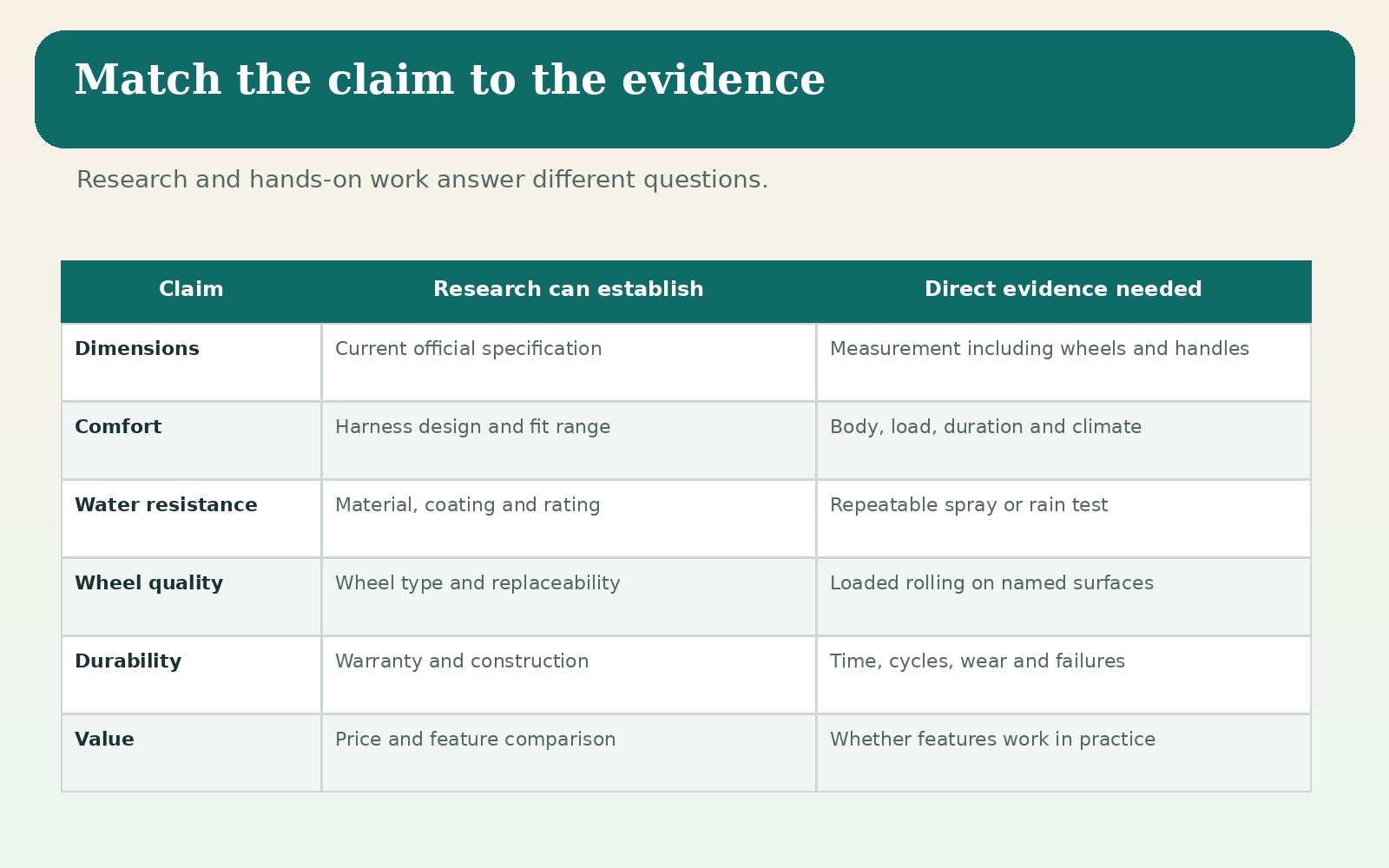
| Claim | Research can establish | Hands-on evidence needed |
|---|---|---|
| Dimensions and empty weight | Current official specification, ideally checked against more than one source | Direct measurement can confirm the sample and reveal whether handles or pockets were excluded |
| Comfort | Harness design, padding thickness and stated fit range | Actual carry with disclosed load, duration, body size and climate |
| Water resistance | Material, coating, seam and zip descriptions | A repeatable spray or rain test with duration and inspection method |
| Wheel quality | Wheel count, diameter, replaceability and manufacturer claims | Rolling on named surfaces, loaded turning and threshold behaviour |
| Durability | Warranty, materials, construction and repair support | Repeated use, abrasion or drop methods, plus time and failure observations |
| Value | Price, warranty, features and competing specifications | Hands-on experience can inform whether features are genuinely usable |
| Airline compatibility | Published packed dimensions compared with current airline rules | A sizer check is useful, but one successful boarding does not guarantee every route |
A trustworthy review does not use one kind of evidence to imply another. Reading the manufacturer’s material page does not prove waterproof performance. Photographing the product on a desk does not prove it was carried. One airline accepting a bag does not prove universal cabin compatibility. The specific verb matters: ‘the brand states’, ‘we measured’, ‘we carried’, ‘we observed’ and ‘we infer’ communicate different levels of knowledge.
Original experience should leave a trail of details that are difficult to invent consistently.
The exact sample
The review should name the size, colour or configuration when those details affect materials or weight. It should say whether the product was bought, borrowed, loaned by the brand or supplied free. A sample may differ from later production, so the test date matters. If a review discusses a family of bags but handled only one size, that limitation should be clear.
The load and duration
Comfort claims should include the carried weight, approximate duration, body size or fit context, and whether the bag was adjusted. Wheel claims should name surfaces such as smooth terminal floors, paving, cobbles and kerbs. A luggage review should say whether the case travelled in the cabin, was checked, or was tested at home. The details need not be theatrical; they need to be relevant.
The failure criteria
Good testing defines what would count as failure. In a rain test, was moisture checked with tissue behind seams after ten minutes? In a wheel test, did the case tip, jam or track sideways under a known load? In a zip test, was the zip cycled a stated number of times? Without a method, the phrase ‘passed our test’ tells the reader very little.
- Original images show the exact sample, not only brand-supplied studio photographs.
- Measurements state the tool, units and whether wheels, handles and protruding pockets were included.
- Negative observations are specific and proportionate rather than hidden behind an overall score.
- The article distinguishes initial impressions from findings after repeated use.
- The writer explains where the test does not represent every traveller or climate.
A transparent desk-based comparison can answer broad market questions that one sample cannot.
Research-led work is particularly strong when the buying problem depends on rules and documentation. Comparing thirty airline size limits, checking whether a warranty covers airline damage, identifying countries with repair centres or mapping luggage weight against a seven-kilogram allowance all benefit from current primary sources. A writer can also compare multiple models that would be impractical to purchase and test at once.
The best research-led articles expose uncertainty. They record the date a price was checked, flag when a capacity is manufacturer-stated rather than independently measured, and avoid converting material names into performance claims. When official sources conflict, the article should show the conflict and prefer the most current source rather than quietly selecting the convenient number.
Useful research-led outputs
- Specification tables with source dates and consistent inclusion of wheels and handles.
- Warranty and repair comparisons based on the actual policy wording.
- Airline-compatibility screening against named carriers and fares.
- Price-per-feature or weight-budget comparisons that show the calculation.
- Shortlists based on declared criteria such as strict dimensions, low empty weight or available spare parts.
- Questions a buyer should verify in person because the evidence cannot answer them.
Vague first-person phrasing often blurs a thin inspection into a full travel test.
| Phrase | Question to ask | Better wording |
|---|---|---|
| ‘We tested dozens of bags’ | Where, for how long, with what load and which exact models? | ‘We compared official specifications for 28 models and carried three finalists for two weeks.’ |
| ‘Built to last’ | Is this an observed result, a warranty inference or a brand claim? | ‘The shell is polycarbonate and the brand provides a ten-year warranty; long-term durability was not tested.’ |
| ‘Waterproof’ | Was there a standard, IP rating or repeatable water test? | ‘The fabric is water-resistant; seams and zips are not claimed as submersible.’ |
| ‘Fits every airline’ | Which airlines, fares and measurement date? | ‘Its 55 x 40 x 20 cm dimensions fit the published limits of the carriers listed, checked on this date.’ |
| ‘Best overall’ | Which criteria were weighted and what evidence supports the winner? | ‘Best for strict 55 x 40 x 20 cm limits in this research-led comparison.’ |
Watch for a method that changes mid-article. A review may begin with a clear research disclaimer, then drift into phrases such as ‘we loved the wheel feel’ or ‘our test trip’ without explaining who used the item. Conversely, a hands-on review may quote official specifications responsibly. Mixing methods is not wrong; hiding the boundary is.
Original images can support experience, but they are not proof of every performance claim.
A useful hands-on photo shows the reviewed sample in a context connected to the claim: a bag beside a measuring tape, a packed interior, a worn point after use, a wheel crossing a threshold or tissue placed behind a seam test. A polished photograph of the product in an airport may be original yet still provide no evidence that the writer carried it for hours or checked it on a flight.
Reverse-image search can reveal whether photographs came from a brand page or another publisher, but absence from search does not prove the experience described. Captions should tell readers what the image demonstrates. Cropped screenshots of specification pages should include a date and source. Measurement photos should show the start and end points rather than a tape floating near the product.
Commercial relationships do not automatically invalidate a review, but concealed relationships change how readers assess it.
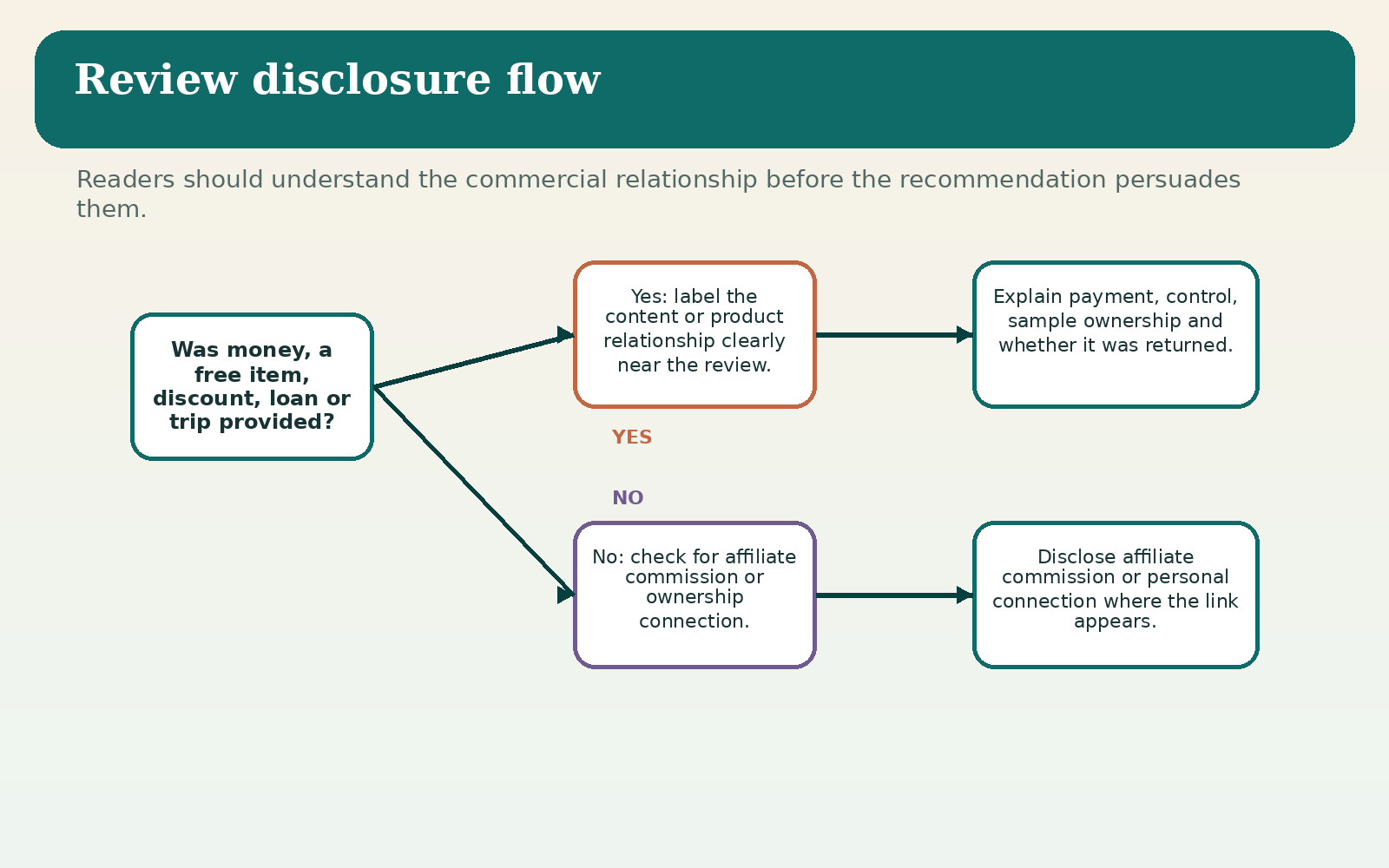
UK guidance treats free products and other incentives as relevant commercial relationships. The fact that a brand supplied a sample should be obvious where readers encounter the review, not buried on a distant policy page. Affiliate links also create a financial incentive because the publisher may earn commission after a purchase. Clear disclosure helps readers interpret the recommendation; it does not excuse inaccurate claims.
A useful disclosure answers practical questions: Was the product free, discounted, loaned or purchased? Did the brand pay for the article, travel or production? Did the brand see the copy before publication? Does the publisher earn commission? Was the product returned? An independent review can still use affiliate links, but the ranking method should not quietly favour the products with the highest commission or easiest stock feed.
| Relationship | Minimum reader-facing clarity |
|---|---|
| Product bought by publisher | State this when the method or independence benefits from the information |
| Free sample or gift | Label the free product or incentive clearly and near the review |
| Temporary loan | State that the item was loaned and whether it was returned |
| Paid campaign or brand control | Identify the content as advertising before the recommendation |
| Affiliate commission | Use a clear affiliate disclosure and mark commercial links appropriately |
| No commercial product links | Say so when the article is specifically about editorial independence |
A number is useful only when the reader can reconstruct how it was produced.
A score should define its categories, weighting and evidence. A 9.2/10 bag score is meaningless when comfort, durability, weight and value are blended without explanation. A strict-airline traveller may value dimensions and empty weight more than wheel luxury; a weekly business traveller may accept extra weight for repair support and a garment system. One overall score hides those conflicts.
For a research-led ranking, the publisher should explain the shortlist, exclusion rules and source date. For a hands-on ranking, the same base test should be applied to each finalist. A bag tested for three months should not be compared directly with a bag handled for ten minutes without an explicit confidence adjustment. Products supplied by brands should not receive hidden bonus points for availability or presentation.
Minimum information for a ‘best’ claim
- The defined user and use case.
- The shortlist and meaningful alternatives considered.
- The decision factors and their relative importance.
- The evidence used for each factor.
- The main reason a close alternative may be better for another reader.
- The review date and what could change after publication.
Large volumes of owner feedback can reveal patterns, but they also contain selection bias, hidden incentives and inconsistent use.
Read the newest critical and mid-range reviews, not only the average star score. Look for repeated failure modes such as handle wobble, wheel damage, zip separation, colour transfer or warranty friction. Then ask whether the reviews refer to the same model generation and size. A brand may reuse one listing across variants with different materials.
Give more weight to reviews that include duration, travel frequency, carried load, route or photographs of the claimed issue. A single dramatic failure is not a failure rate. Conversely, hundreds of vague five-star reviews posted immediately after delivery do not prove durability. The UK rules introduced under the Digital Markets, Competition and Consumers Act prohibit fake reviews and concealed incentivised reviews, but readers should still evaluate the evidence in each contribution.
One warning sign may be harmless; several together justify caution.
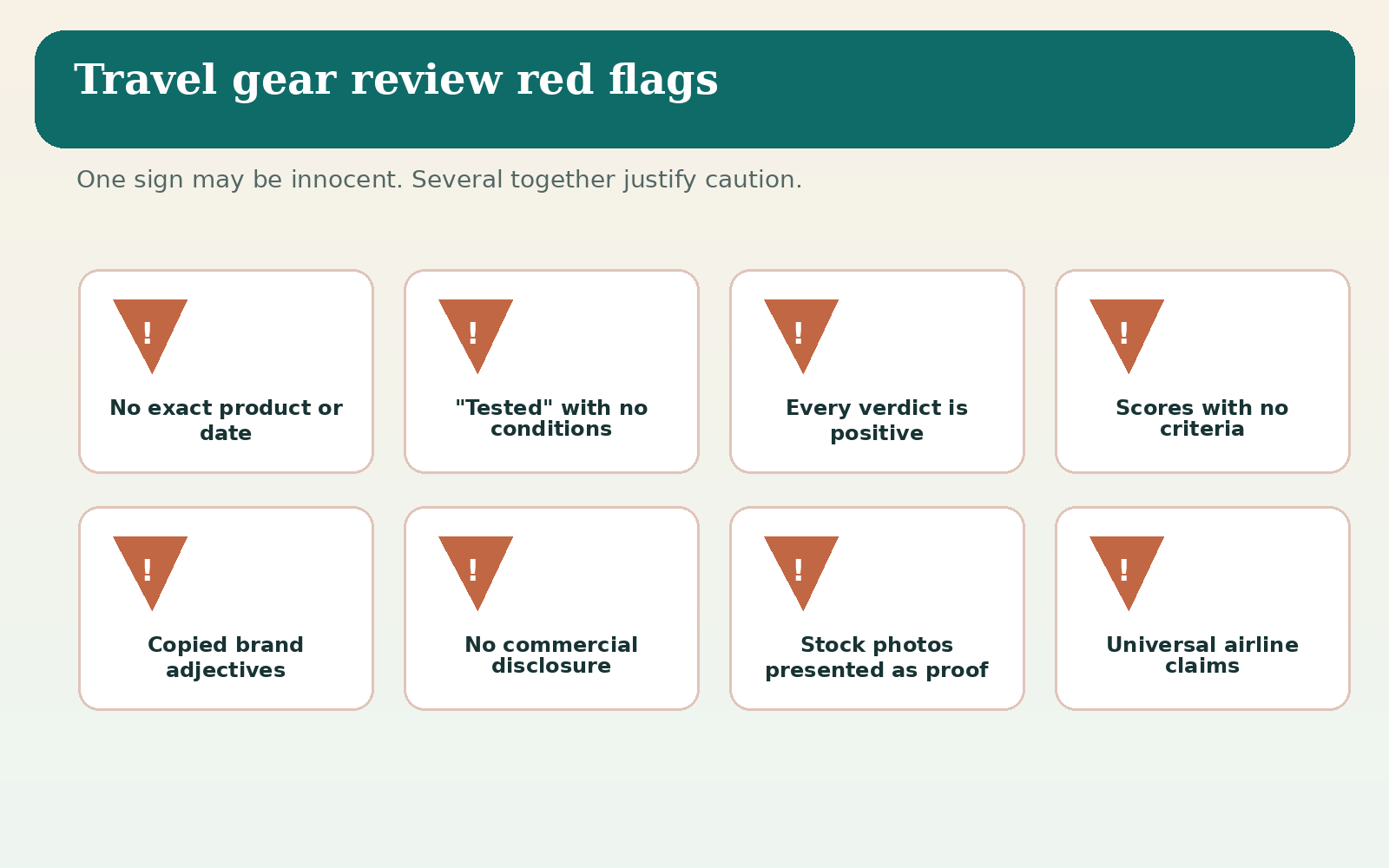
- The article uses first-person testing language but provides no exact product, date, load, duration or original evidence.
- Every product receives a positive verdict and every purchase button is affiliate-linked.
- Manufacturer adjectives are repeated as facts without attribution.
- Specifications conflict with the linked official page or exclude wheels and handles without saying so.
- The same generic paragraph appears under several products with only the model name changed.
- Scores use decimal precision despite no published criteria or measurements.
- A brand-supplied image is labelled as if it documents the publisher’s test.
- Free products, loans, paid travel or commission are disclosed only in terms and conditions.
- The article claims universal airline compatibility without naming carriers, fares or a check date.
- The publisher cannot explain how a ‘best’ product beat a close alternative.
Readers do not need to audit every sentence; a short sequence finds most weaknesses.
- Find the methodology or disclosure. Identify whether the article is research-led, hands-on or mixed.
- Choose the claim that matters most to you, such as comfort, strict dimensions or repairability.
- Trace that claim to its evidence. Is it a source, a measurement or described direct use?
- Check the publication or update date and open at least one primary source.
- Read the main limitation and a close alternative rather than only the top pick.
- Confirm the commercial relationship and whether the purchase link affects the recommendation.
- Re-check the decisive specification on the seller or manufacturer page before paying.
A good article makes this process easy. Source links are current, the method is near the top, limitations sit beside the recommendation and the conclusion does not overreach the evidence. Trust should come from the structure, not from the publisher asking for it.
Each method answers a different part of the buying decision.
| Method | Strengths | Limitations |
|---|---|---|
| Research-led | Broad market coverage; current rules, policies and prices; consistent specification comparison; easier conflict checking | Cannot prove sensory comfort, handling, water performance or long-term durability without direct evidence |
| Hands-on | Can show access, fit, handling, measured behaviour and observed failure under stated conditions | Usually covers fewer products; findings depend on tester, load, duration and conditions; short tests can be overgeneralised |
| Mixed method | Combines broad screening with direct finalist testing and can explain why a shortlist changed | Requires careful labels so sourced claims, measurements and impressions do not blur together |
Pros
- Transparent research can compare far more models than a small publisher can purchase.
- Hands-on evidence can expose usability problems hidden by specification tables.
- Mixed methods can screen widely and test the most important finalists deeply.
- Clear limitations help readers map evidence to their own use.
Cons
- Research language can sound authoritative even when it cannot support the performance claim.
- A single tester’s body, route or load may not represent the reader.
- Commercial sample access can distort which products receive hands-on coverage.
- Scores and rankings can conceal uncertainty instead of communicating it.
Transparency fails when method, evidence and commercial context are treated as separate afterthoughts.
- Assuming ‘review’ always means the writer physically used the product.
- Treating a short showroom inspection as a long-term travel test.
- Using official specifications to make untested comfort or durability claims.
- Quoting customer reviews as if they were controlled measurements.
- Publishing a ranking without defining the intended traveller.
- Hiding affiliate disclosure below the recommendation or on a separate policy page.
- Calling a brand-supplied sample ‘independent’ without explaining the relationship.
- Using one successful flight as proof that a bag fits every airline.
- Showing original photographs that are unrelated to the performance claim.
- Failing to date prices, airline rules, warranties and model generations.
- Removing negative findings to protect a relationship or conversion rate.
- Writing personal-sounding advice that invents ownership, trips or tests.
Detailed answers to the practical questions readers are most likely to ask.
Can a research-led gear review still be trustworthy?
Yes. It can be very useful when it clearly states that products were not physically tested, uses current primary sources, explains the comparison method and limits claims to what the evidence supports.
Does hands-on always mean the product was used on a trip?
No. Hands-on may mean a shop inspection, studio test, home packing exercise or travel use. The review should state the duration and conditions so readers know what the phrase covers.
What evidence proves a reviewer really tested a bag?
No single item proves everything. Useful evidence includes original images of the exact sample, dated measurements, loads, test notes, routes, surfaces, observed wear and a method that connects directly to the claim.
Can a free product receive an honest review?
Yes, but the free product or loan should be disclosed clearly. The review should explain whether the brand had editorial control and should include specific negative findings where they exist.
Are affiliate reviews automatically biased?
No, but affiliate commission creates a commercial incentive that should be clear. Readers should check whether the method includes non-affiliate alternatives and whether the ranking criteria were set before links were chosen.
Why are original photos not enough?
A photograph can prove access to a product at one moment. It does not prove the stated test duration, comfort, waterproofing or long-term durability unless it is paired with relevant notes and method.
Should research-led articles use the word ‘best’?
They can, but the claim should be narrow, criteria-based and clearly labelled as research-led. The article should explain why the choice suits the named use case and which alternative suits a different priority.
How should a publisher describe manufacturer claims?
Use attribution such as ‘the manufacturer states’ and avoid converting a material or warranty claim into independent proof of performance. Link the current source and record the check date.
What is the fastest way to check a review?
Find the method, disclosure and update date, then trace the single claim that matters most to its evidence. If the article makes that difficult, treat the verdict cautiously.
Can customer reviews replace hands-on editorial testing?
No. They can reveal recurring themes and long-term issues, but the conditions are uncontrolled and may include different variants, incentives and user expectations. Use them as signals rather than measurements.
Use the evidence that matches the decision and keep the limitations visible.
Use research-led and hands-on reviews for different questions. Research-led comparisons are strong for current dimensions, weight, policies, prices, repair support and market coverage. Hands-on reviews are stronger for access, carry, handling and observed performance, but only within the disclosed load, duration and conditions.
Before trusting a verdict, identify the method and trace the decisive claim to its evidence. Look for the exact sample, source date, test conditions, commercial relationship and limitation. A confident score without those foundations should carry less weight than a careful article that admits what it could not establish.
Publishers should label research, measurement, direct experience and inference separately. Readers should reward that honesty. The most trustworthy travel gear review is not the one that sounds certain about everything; it is the one that makes the boundary of its knowledge easy to see.
Current rules, specifications and editorial guidance were checked against the following primary or official sources.
- Competition and Markets Authority – fake reviews guidance – Official UK guidance on fake reviews, concealed incentivised reviews and publisher responsibilities under the Digital Markets, Competition and Consumers Act.
- CMA – short guide for businesses publishing reviews – Official summary of policies, risk assessment and reasonable steps expected from review publishers.
- ASA and CAP – influencer marketing resources – Official UK advertising guidance covering clear ad, affiliate and commercial-relationship disclosure.
- ASA and CAP – online affiliate marketing – Official explanation of affiliate content as advertising and the need for obvious identification.
- Google Search Central – write high quality reviews – Official review-quality guidance on evidence, measurements, original research, benefits, drawbacks and best claims.
- Google Search Central – reviews system – Official description of the system’s focus on insightful analysis and original research rather than thin summaries.
- Federal Trade Commission – endorsement guides – US official guidance used as an additional international reference for honest experience and clear material-connection disclosure.
Commercial manufacturer pages support current specifications, prices and stated policies; they do not independently prove comfort, durability or performance. Government, regulator and standards pages support rules and definitions. Practical recommendations are editorial analysis, not invented first-hand testing.
Illustrations in this article were created for Travel Gear. Third-party photographs, where used, are credited beside the image or in the source list.