Matador FlatPak Soap Bar Case Review: Is It Worth the Space?
Matador FlatPak Soap Bar Case Review: Is It Worth the Space?
A compact answer to wet soap in transit, rather than a promise that every bar will dry on schedule.
Original soap-carrying concept, not a product photograph, exact Matador rendering or leak test.
This Matador FlatPak Soap Bar Case review is about a very small product with a surprisingly specific job: carrying a used bar of soap without giving it a rigid box of permanent dimensions. Its usefulness depends less on the size of your suitcase than on whether you regularly travel with a bar and need to pack it shortly after use.
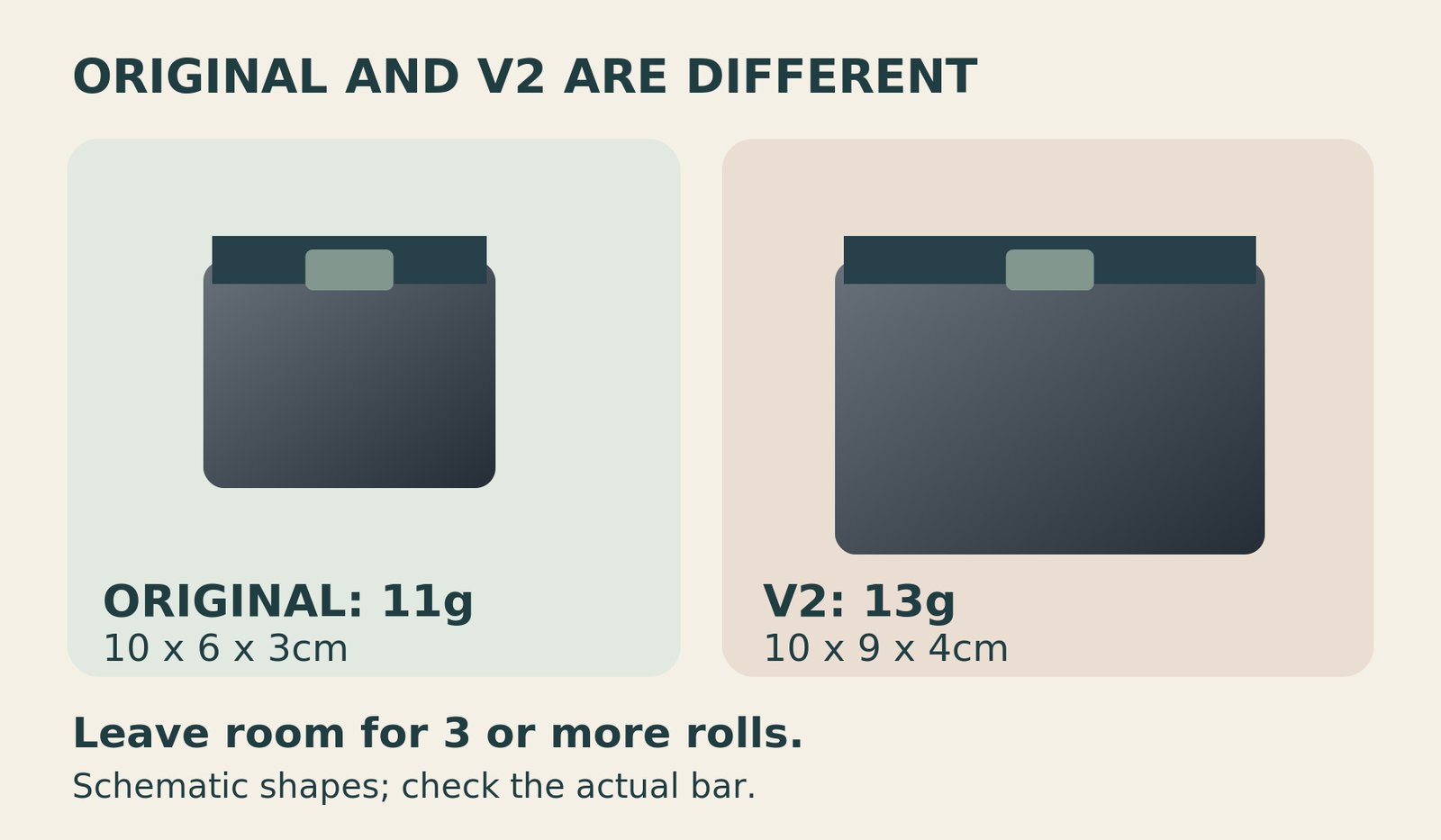
There is also a version change to understand. Matador’s current product page describes a larger V2, while older UK references and marketplace listings can still point towards the original. The figures and warranty wording differ, so a current review should not quietly combine them. [1] [2]
The assessment here is research-led. No soap bar was weighed, dried or leak-tested for this article. Manufacturer claims are identified as such, and the routines below are practical ways to evaluate the product with your own toiletries before relying on it during a trip.
13g published
A different construction from the original 11g reference.
Vapour can escape
That does not promise an overnight result in every bag.
Three or more rolls
Leave enough clear material above the soap.
For regular bar users
Less useful when hotel toiletries already meet your needs.
Matador FlatPak Soap Bar Case review: the problem it solves
A transit container rather than another bathroom accessory
The strongest use case is an early departure after washing, when the bar must travel before it has fully dried in the room. A flexible container can be easier to accommodate than a rigid box, particularly as the bar becomes smaller. That is a practical packing advantage to evaluate, not a reason every traveller needs one.
Consider what currently goes wrong. Is the bar left in a puddle, difficult to pack, or always carried in a container much larger than it? A product decision becomes clearer when it responds to one of those recurring problems. Without that problem, the case may simply be another small item to buy and remember.
The no-purchase option remains valid
Someone who uses provided toiletries or already has a compact container that works may gain little. There is no need to adopt bar soap merely to justify a travel accessory. Similarly, a traveller staying in one place can often give a familiar bar more time outside its transit container.
The Matador soap-case listing on Amazon UK is included for comparison, not as proof that the selected option is the newest generation. Read the current size, edition, seller and offer. The page’s family and child identifiers were not consistent enough to present it as a verified V2 offer. [4]
Original versus V2: keep the numbers separate
What the current manufacturer page describes
On a small screen, scroll this table sideways to see every column.
| Reference | Published weight | Published dimensions | Material and warranty reference |
|---|---|---|---|
| Current V2 | 13g | 10 x 9 x 4cm | 70D ripstop nylon; one-year wording |
| Earlier original UK reference | 11g | 10 x 6 x 3cm | 30D Cordura; two-year wording |
| Marketplace purchase | Confirm the selected item | Confirm the selected item | Do not infer the edition from the family title |
Why the older UK information still matters
The earlier UK reference described an 11g original with a narrower shape and different material and warranty information. The base UK address now redirects to the newer manufacturer page. Therefore, an older indexed UK price or specification should not be presented as a current local V2 offer. [2]
A two-gram difference is rarely the most important buying factor. Usable shape, closure room and the item actually delivered matter more. However, keeping the figures separate prevents a misleading review that claims the original’s lower weight alongside the V2’s larger dimensions and whichever warranty period looks most attractive.
Dry-Through: understand the mechanism without expecting magic
Vapour movement is different from liquid leakage
Matador explains its Dry-Through concept as allowing water vapour through the material while retaining liquid. That is the manufacturer’s account of how a damp bar can dry inside a closed case. It is not evidence from an independent drying experiment performed for this review. [3]
The practical implication is that the case is not intended to behave like a completely impermeable plastic bag. Nevertheless, that does not establish an identical result for every soap formulation, temperature, humidity level or packing arrangement. A useful mechanism can still have conditions that affect how quickly it works.
Avoid converting an example into a promise
Matador’s older explanation says drying depends on humidity and gives contrasting environmental examples. Treat those as explanatory examples for the original product, not a timetable guaranteed for V2. A fixed claim that your bar will be dry by morning would go beyond what this review has tested. [3]
Instead, observe what happens with your own bar during an ordinary home routine. Use the case in conditions resembling your travel pattern and check before placing it beside vulnerable belongings. The goal is to understand a useful accessory’s limits, rather than assuming a brand term eliminates the need for practical judgement.
Bar fit: leave room for the closure
Measure more than the broad face of the soap
A broad square bar can use the available space differently from a narrow rectangular one of similar mass. Similarly, two small bars together can create an awkward ridge. Do not select the case from a soap-weight label alone; check the actual geometry of what you intend to carry.
Three or more rolls is the manufacturer’s instruction
Matador says to roll the top at least three times and buckle it. A bar that fills the pouch so high that this cannot be done is not a suitable fit in that arrangement. Do not treat one tight fold as equivalent simply because the buckle can still reach. [1]
Ask the seller to confirm the selected generation where size is critical. The Matador listing is a starting point, but it should not replace that confirmation. Keep the bar and pouch comfortably matched rather than relying on stretching or an improvised closure for a crowded travel kit. [4]
A departure-morning routine that does not add unnecessary steps
Start with the ordinary wash routine
Check the case opening for residue or anything that could interfere with folding. Place the bar inside and follow the closure instructions. This should be a short repeatable sequence rather than a delicate operation that works only when you have plenty of time and a completely clear bathroom counter.
Know where it goes next
Choose a location in the wash kit before departure morning. It should be easy to retrieve at the next stop and separate enough from vulnerable contents that you can inspect an unfamiliar setup. Do not bury a newly adopted soap arrangement beneath electronics and hope the product description has removed every possible failure mode.
After arrival, inspect the bar and case before deciding how to use them for the rest of the stay. A transit routine and a bathroom-storage routine need not be identical. The accessory earns its place when it makes that transition straightforward without creating more tiny containers to manage.
Humid journeys: make the plan tolerant of slower drying
The surrounding conditions still matter
The manufacturer’s explanation explicitly links drying time to humidity. Therefore, a routine that works in a dry home may not give the same result during a humid coastal trip. That difference is a reason to build flexibility into the plan, not to label the product either perfect or useless after one observation. [3]
Leave opportunities to inspect and air the bar where appropriate during a longer stay. Avoid planning around a precise overnight drying result that has not been demonstrated with your soap and conditions. A travel kit should remain manageable even when the contents are not completely dry at the next packing moment.
Avoid a second container that defeats the intended arrangement
Putting a vapour-permeable case inside another tightly closed, impermeable container changes the surrounding conditions. As a practical inference, it may limit the advantage you were hoping to obtain from vapour movement. This article does not quantify that effect, but it is a sensible reason to test the complete arrangement rather than only the soap case by itself.
Choose secondary protection according to the consequences of a leak and your experience with the setup. During an initial trial, caution may be more important than maximising drying. Once you understand the routine, keep it as simple as appropriate rather than nesting several containers without a clear reason for each.
Space savings depend on the bar and the comparison
A flexible case follows a changing load
A rigid box keeps much the same external size as its contents shrink. A flexible soap carrier can potentially occupy a smaller shape around a partly used bar. That makes the concept particularly relevant to a long trip with one bar rather than repeated replacement with a large fresh one.
However, the benefit is relative. Compare against the container you actually use, not an unusually oversized box chosen to make the new product look impressive. A small existing case may already fit your kit neatly, while a new flexible pouch could create little meaningful change.
Do not confuse empty weight with packed size
The current V2’s 13g reference is small, but the bar still contributes most of the carried material. For a hypothetical 90g bar, adding a 13g container produces a 103g subtotal before the rest of the wash kit. That is illustrative arithmetic, not a measured sample or a reason to carry a bigger bar. [1]
Compare the complete toiletry arrangement after adding toothbrush, toothpaste and any liquids you still need. One efficient soap container cannot compensate for several unnecessary full-size products. The carry-on toiletry system guide is a useful companion when the broader kit, rather than the individual bar, is the real problem.
Soap, shampoo and conditioner bars are not one packing assumption
Shape and behaviour differ
A product sold as a bar can be firm, soft, irregularly shaped or prone to leaving residue after use. This review does not test particular formulations or claim that they all behave identically inside the case. Follow the product maker’s storage advice and observe the result with the item you actually use.
A shampoo bar that fits when new may become softer around its edges during a trip. A thin remnant can also be harder to retrieve from a flexible container than a full bar. Those are practical handling questions to explore before departure, not reasons to assume a single storage method suits every solid toiletry.
Decide whether one case should contain one product
Putting two bars together may seem space-efficient, but it can make identification and separation awkward. Consider whether they touch, whether one product’s residue transfers to the other, and whether you can remove only the item needed. A modest saving is not worthwhile if it complicates every wash.
Use clearly distinguishable products or separate appropriate containers when necessary. Do not add cases merely for a matching collection, but do not force several incompatible items into one pouch to prove that a minimalist system is possible. The useful minimum is the arrangement that works reliably for your routine.
Choose solid toiletries for the right reason
The case should support an existing preference
A regular bar user may find a dedicated carrier worthwhile because the problem recurs. Somebody satisfied with liquid toiletries should not assume a switch will automatically improve the trip. Product suitability, comfort and familiarity matter more than achieving a particular packing aesthetic.
Try any new toiletry at home well before travel. This is not a recommendation about which formulation to use; it is a planning precaution against making the journey depend on an unfamiliar product. The container decision comes after the routine is understood, not before.
Do not duplicate the old and new system indefinitely
A common transitional mistake is adding a bar and case while retaining every liquid it was intended to replace. For a short trial, carrying a familiar alternative may be sensible. Over repeated trips, however, review whether both are still needed rather than allowing an experiment to become permanent duplication.
The FlatPak bottle three-pack remains an option for products you genuinely need in liquid form. It is not a necessary companion purchase to the soap case, and it has its own compatibility and cleaning requirements. Choose the appropriate container for each remaining product rather than trying to make the whole kit belong to one range. [10] [9]
Flights: keep solid-product decisions separate from liquids rules
A soap case does not set airport policy
A solid bar and a liquid toiletry are different items, but the rest of your kit may still contain creams, pastes or gels. GOV.UK’s guidance explains that airport rules vary, with many using a 100mL container limit and some allowing larger liquid containers. Check the airports involved rather than relying on a travel accessory’s approval language. [7]
Do not assume that adding one solid product removes the need to prepare the remaining liquids correctly. A washbag can contain several different screening categories. Keep the required items accessible and follow the airport’s instructions on separate transparent bags and presentation at security.
The bottle’s marking is more useful than loose copy
The specific Amazon bottle three-pack is described as 90mL, while Matador’s current bottle page mixes a 90mL introduction with a 100mL feature line. That inconsistency should not be silently reconciled into a new specification. Use the marking and documentation for the purchased item, together with the applicable airport limit. [10] [8]
For a minimal trip, removing an unnecessary product may be simpler than buying another container for it. The purpose of a compact wash kit is to carry what you need in a manageable form, not to turn every toiletry into a separate gear purchase.
Alternative: Lifeventure Soap Pouch
A similar form does not prove an identical mechanism
Lifeventure’s Soap Pouch uses a roll-top closure and buckle, with a published 11g weight and 150 x 120mm dimensions. Its manufacturer page describes a secure, mess-managing travel pouch, but does not establish equivalence to Matador’s Dry-Through mechanism. Do not add that claim merely because the silhouette is similar. [5]
The Lifeventure Soap Pouch listing is a relevant alternative to compare for simple transport containment. Read its exact instructions and decide whether you need the claimed drying-through-fabric function or mainly a compact way to keep soap separate during a transfer. [6]
Compare the actual question you are trying to answer
For someone who dries the bar outside the carrier at every stop, a simpler pouch may be entirely adequate. Someone routinely packing a damp bar immediately may place more value on Matador’s stated mechanism. Neither situation can be decided by comparing empty grams alone.
Lifeventure’s UK page displayed £9.99 when checked on 11 October 2026. That is a dated manufacturer-store observation, not an Amazon price or a permanent saving against Matador. Include delivery and the exact item in any cost comparison, especially when buying only one inexpensive accessory. [5]
Alternative: an existing rigid box or simple bag
A rigid box has a different advantage
A box may provide a convenient place to rest the bar during the stay, depending on its design. It can also be easy to open and inspect. Those handling benefits may matter more to some travellers than shrinking around a partly used bar, so do not dismiss a working box solely because it is less fashionable.
Its drawback is the space it continues to occupy and the need to manage water appropriately. Assess your actual box rather than assuming every rigid design behaves the same way. If it already fits, closes and supports your routine, replacing it may offer only a minor convenience.
A temporary bag is a baseline, not a drying claim
A suitable simple bag can keep a bar separate for a short period, but it should not be credited with a specialised vapour-permeable mechanism unless that is documented. The important distinction is what happens after transport: will you remember to remove or inspect the soap at the next opportunity?
A low-cost baseline helps you decide whether the more specialised case solves a worthwhile problem. Compare retrieval, residue handling, packed shape and the number of steps involved. The best answer may remain the equipment you already own, provided it meets the needs of the trip.
Alternative: changing the outer washbag instead
Sometimes the soap case is not the main problem
If toiletries spill out of an overfilled pouch whenever you open it, changing one tiny container will not solve the access issue. Reconsider the outer kit’s size and layout first. A slightly different organiser may make every item easier to reach, while leaving your existing soap carrier perfectly usable.
The BAGSMART Blast 4.5L washbag is one different layout to examine, with its own upright dimensions, hook and pockets. That does not establish compatibility with every soap-case configuration, but it provides a concrete alternative when room organisation is the underlying need. [12]
Avoid building an unnecessarily large nested system
A compact bar case inside a large organiser inside another protective pouch may remove the simplicity you hoped to achieve. Name the job of each layer and remove those that merely duplicate another. Keep protective layers where the consequences justify them, but do not assume more containers always improve the arrangement.
The BAGSMART Space Saver and Crush Toiletry Bag are contrasting alternatives, not automatic additions. The former is a fold-out hanging reference; the latter has a different countertop-style shape. Choose an outer routine first, then see whether a specialised soap case still adds value. [13] [14]
Cost: small accessories still deserve a purchase test
Calculate use, not just shelf price
Suppose a hypothetical soap carrier costs £15 and is used for thirty trips. The purchase cost spread across those trips is fifty pence per trip, before any delivery charge. That is an illustrative calculation dated 11 October 2026, not a current Matador price. It helps make regular use part of the decision.
By contrast, buying several containers for one uncertain holiday can create more cost and clutter than benefit. Start with one real packing problem and one appropriate solution. Do not treat low individual prices as a reason to accumulate accessories that have overlapping jobs.
Include the cost of inconvenience
A working soap routine can be worth paying for even when the absolute space saving is modest. Equally, an accessory that adds an awkward closing process or makes the bar difficult to retrieve may not suit you despite an appealing weight figure. Handling is part of value, not an afterthought.
Compare the Lifeventure pouch option alongside the Matador case and your existing container. Consider what changes in the actual routine, not which marketing description sounds most specialised. The cheapest useful solution may be different for a frequent traveller and an occasional hotel guest. [6]
Care, inspection and a sensible first trial
Avoid inventing a washing method
Follow the current instructions supplied with the soap case. Do not assume the cleaning rules for FlatPak liquid bottles apply to the case simply because both use the same family name. Different closures and construction can require different care, so ask the manufacturer when the guidance is unclear.
After use, inspect the opening, seams and buckle for residue or damage. Keep any cleaning process gentle and within the product instructions, rather than trying an aggressive solvent or heat treatment to remove stubborn material. This review does not establish a tested stain-removal or machine-washing method.
Test the complete setup before departure
Use the case with your usual bar at home and place it in the intended washbag with a suitable precautionary barrier during the initial trial. Check how the closure behaves and how easily the soap can be removed later. The objective is familiarity, not deliberately pushing the product beyond its instructions.
If the result is inconvenient, change the arrangement before travel. A different bar shape, less crowded pouch or separate outer kit may be enough. Do not assume that every disappointing trial means the product is defective, but do not ignore a recurring practical problem merely because the design is widely praised.
Buying the right version in the UK
A marketplace family page can change its selection
The checked Matador Amazon page used one identifier in its address and another child identifier in its page data. Accordingly, this review does not promise that following the link selects a particular V2 item. Read the actual title, size, photographs and seller information at the point of purchase. The checked page also displayed no featured offer, so this is not a promise of immediate UK availability. [4]
The Matador soap-case listing can still be useful for comparing offers, provided that distinction stays clear. Ask the seller to confirm original or V2 when the dimensions matter. A vague assurance that it is the latest version is less useful than a complete item description.
Keep warranty wording with the purchase
The current V2 manufacturer page and the earlier original UK reference show different warranty periods. Do not transfer the older wording to the newer product automatically, or assume a marketplace seller provides identical service conditions. Retain the receipt and the terms actually offered with the item. [1] [2]
For an urgent trip, buy from a clear available listing rather than relying on a redirect or an older indexed price. This article does not establish a live UK V2 delivered price. The specific version and a workable seller relationship are more important than filling that gap with an attractive but unsupported number.
Small remnants and changing bar shapes
A half-used bar can change the handling decision
A smaller bar may leave more free material in a flexible case, but it can also move around more. Check whether you can retrieve it comfortably without repeatedly turning the pouch inside out or digging through residue. This is a usability question to observe with your own product, not a measured criticism of the design.
For a short journey, taking a suitable partly used bar may reduce bulk compared with opening a large new one. However, do not make the piece so small that handling becomes impractical. The useful size balances the amount needed, the remaining shape and the way you prefer to wash.
Keep the case identifiable within the kit
When several small containers look similar, reaching for the right one can become harder than the packing photograph suggests. Use a consistent location or another appropriate way to distinguish the soap container. The method does not need to be elaborate, and it should not alter or damage the case.
This matters particularly when different bar products are kept separately. A clear routine avoids opening every pouch to find one item. It also helps you notice when something has not been returned after use, rather than discovering the missing container during the next departure.
One night, one week or repeated room changes
A short stay may not need a specialised carrier
For a single night with familiar provided toiletries, carrying your own bar can be optional. Assess the actual preference before adding the case to the list. A useful accessory for a frequent bar user is not automatically an essential for somebody travelling differently.
A week in one room presents another pattern. The bar may spend much of the stay outside its transit container, depending on suitable storage and its own care instructions. In that situation, the case’s main contribution may be the outward and return transfers rather than daily use.
Frequent transfers make closure and retrieval more important
When changing rooms repeatedly, the case is likely to be opened and closed more often. A small handling irritation can therefore become more noticeable than on a single-stay holiday. Try the full sequence several times before departure rather than judging it from one neat dry pack.
Choose the routine that remains straightforward when the bar is partly used and the morning is rushed. The value of the product is not simply that it occupies little room while empty. It should also make a repeated transition between bathroom and bag easier to complete without extra sorting or uncertainty.
Advantages and drawbacks
Where the case is most convincing
A regular bar-soap user who often moves before the bar has dried has a clear reason to consider the FlatPak concept. Flexibility and a compact closure can support a small wash kit, while the manufacturer’s vapour-permeable design addresses a problem that a simple sealed bag does not claim to solve.
Its usefulness also changes during a trip as the bar becomes smaller. However, the important benefit is a convenient complete routine, not an isolated gram figure. You should be able to explain when the case makes packing or unpacking easier.
Where it may not earn a purchase
It offers less value when you rarely carry bar soap, already have a suitable box or can leave the bar unpacked for most of the stay. A flexible pouch is also not automatically the easiest way to retrieve a very small remnant, and every product still needs appropriate care and inspection.
The current version change adds a buying complication. Check the selected item instead of assuming every review, photo and retailer specification describes the same case. That extra attention is worthwhile when choosing a product whose appeal depends on specific size and material claims.
Common mistakes with a very small accessory
Overfilling the closure area
The top needs room to roll as instructed. Do not use an oversized bar, add another product above it and then accept a partial closure because the case is nearly shut. A smaller compatible load or a different container is a better answer than an improvised seal.
Another mistake is expecting the same drying outcome in every location. Observe the actual bar and conditions, allow a workable fallback and avoid building the whole morning routine around an unsupported promise of overnight dryness.
Buying a new system around one attractive specification
A thirteen-gram reference can look compelling, but it says little about whether you need the product. Compare it with your current arrangement and include the rest of the toiletries. Do not replace a working washbag, buy several new bars and add multiple cases merely to justify one compact accessory.
Finally, keep range names distinct. A Matador Waterproof Toiletry Case v2 is a larger wash-kit product, not the individual soap case reviewed here. It may solve another problem, but its specifications and claims should never be borrowed to fill gaps in a soap-case listing. [11]
Frequently asked questions
Is the current case the same as the original 11g version?
No. The current manufacturer page describes V2, while the earlier UK reference describes the original. Their dimensions, material and warranty wording differ. This review separates those records rather than choosing the best-looking number from each. Confirm the actual edition offered by your seller. [1] [2]
Will a wet bar definitely dry overnight inside it?
No fixed result is established here. Matador explains that drying depends on humidity, and this review has not performed a V2 drying test with particular soap formulations or bags. Try the complete arrangement at home and keep the routine workable when drying takes longer. [3]
How many times should the top be rolled?
Matador instructs three or more rolls before buckling. Leave enough clear material to do that properly with the bar inside. A case that can only be folded once around an oversized load is not being used according to that instruction. [1]
Does the case make a bar lighter?
No. It adds its own weight while changing how the bar is carried. A flexible design may fit around a shrinking bar more efficiently than some rigid containers, but that is a shape comparison. Any saving in total toiletry weight comes from what you choose to carry.
Can I put shampoo and conditioner bars together?
Only after checking fit, closure room and whether the particular products are suitable for that arrangement. This review does not test formulations or guarantee that two damp bars remain conveniently separate. One product per appropriate container may be easier when identification or residue transfer becomes a problem.
Is Lifeventure's Soap Pouch an equivalent Dry-Through product?
That equivalence is not supported by the manufacturer page reviewed here. It is a relevant roll-top transport alternative, but similar appearance does not establish the same vapour-permeable mechanism. Choose according to the documented function you actually need. [5]
Can I use the soap case for liquid shampoo instead?
This review does not recommend substituting it for a liquid bottle. It is reviewed as a carrier for a bar. Use a container designed and documented for the liquid involved, follow compatibility guidance and observe the applicable airport restrictions.
Is a bigger outer toiletry bag necessary?
Not automatically. Try the case inside the wash kit you already use. A larger organiser is justified only when the complete routine needs a different layout. Adding a bulky outer bag can remove much of the simplicity that made a small soap carrier appealing.
Should I replace a working original with V2?
Only when the newer shape or another documented difference solves a real problem with your current case. An existing original that fits the bar and works for your routine does not become unsuitable simply because a replacement version appears. Check condition and practical need before upgrading.
Final recommendation: worthwhile for a recurring wet-bar problem
The FlatPak Soap Bar Case is a sensible shortlist item for travellers who already prefer bar toiletries and regularly need to pack them before they are fully dry. Confirm the generation, leave sufficient closure room and evaluate drying as a condition-dependent process rather than a guarantee.
For occasional use, a working existing container or a simpler pouch may be enough. The best purchase is the one that removes an actual inconvenience without creating a more complicated wash kit. Keep the decision focused on the bar, the closure and the routine, not on collecting the smallest-looking accessory in every category.
Sources and fact-checking
Editorial review completed on 11 October 2026. Published specifications are distinguished from our calculations and packing judgements. No hands-on product, drying, leakage or durability testing was performed for this article. Prices and selected offers can change; confirm the exact edition and seller before buying.
- Matador: FlatPak Travel Soap Bar Case V2
Current V2 specifications: 13g, 10 x 9 x 4cm, 70D nylon; at least three rolls; one-year warranty wording.
- Matador UK: original soap-case reference
Earlier indexed original: 11g, 10 x 6 x 3cm, 30D Cordura and two-year wording. The base UK address now redirects, so this is not a current V2 UK offer.
- Matador: how Dry-Through works
Manufacturer explanation published 20 February 2020. Humidity examples describe the original product, not an independent V2 drying trial.
- Amazon UK: Matador soap-case listing
Listing family exposed a different child identifier in its page data. Verify the selected generation and size; no V2 offer or featured price is promised.
- Lifeventure: Soap Pouch 62095
11g and 150 x 120mm published size. No Dry-Through equivalence is established by this page.
- Amazon UK: Lifeventure Soap Pouch
Product-specific alternative listing; current offers not guaranteed.
- GOV.UK: liquids in hand luggage
Airport-specific rules, common 100mL limit, partly full containers and transparent-bag requirements.
- Matador: FlatPak Toiletry Bottles
A separate liquid-bottle product. The page mixes 90mL introductory text and a 100mL feature line; use the marking on the purchased bottle.
- Matador: toiletry-bottle use instructions
Hand cleaning, closure and ingredient-compatibility guidance for bottles only, not soap-case certification.
- Amazon UK: FlatPak 90mL bottle three-pack
Specific three-pack listing; not permission to take unrestricted liquid volumes through security.
- Amazon UK: Matador Waterproof Toiletry Case v2
A larger toiletry case, not the single soap-bar case. Verify seller and current variant.
- BAGSMART UK: Blast 4.5L Hanging Toiletry Bag
Separate design: 26 x 12 x 15cm, 300g and 4.5L. Variant, pocket layout and product-specific care.
- BAGSMART UK: Space Saver, selected Large Teal
Current selected page: Large Teal, SKU BM0108122AN070, notification-only when checked; layout and shipping/return wording.
- BAGSMART UK: Crush Toiletry Bag
Separate countertop-style design. Published dimensions are in inches; conversions in this review are arithmetic.
Illustrations in this article were created for Taylor’s Trailblazing Travel Gear. Third-party photographs, where used, are credited beside the image or in the source list.