How to Choose a Travel Pillow by Sleep Position and Packed Size
Match the support direction to how your head actually falls, then decide how much weight and luggage space that comfort is worth.
Original Travel Gear image
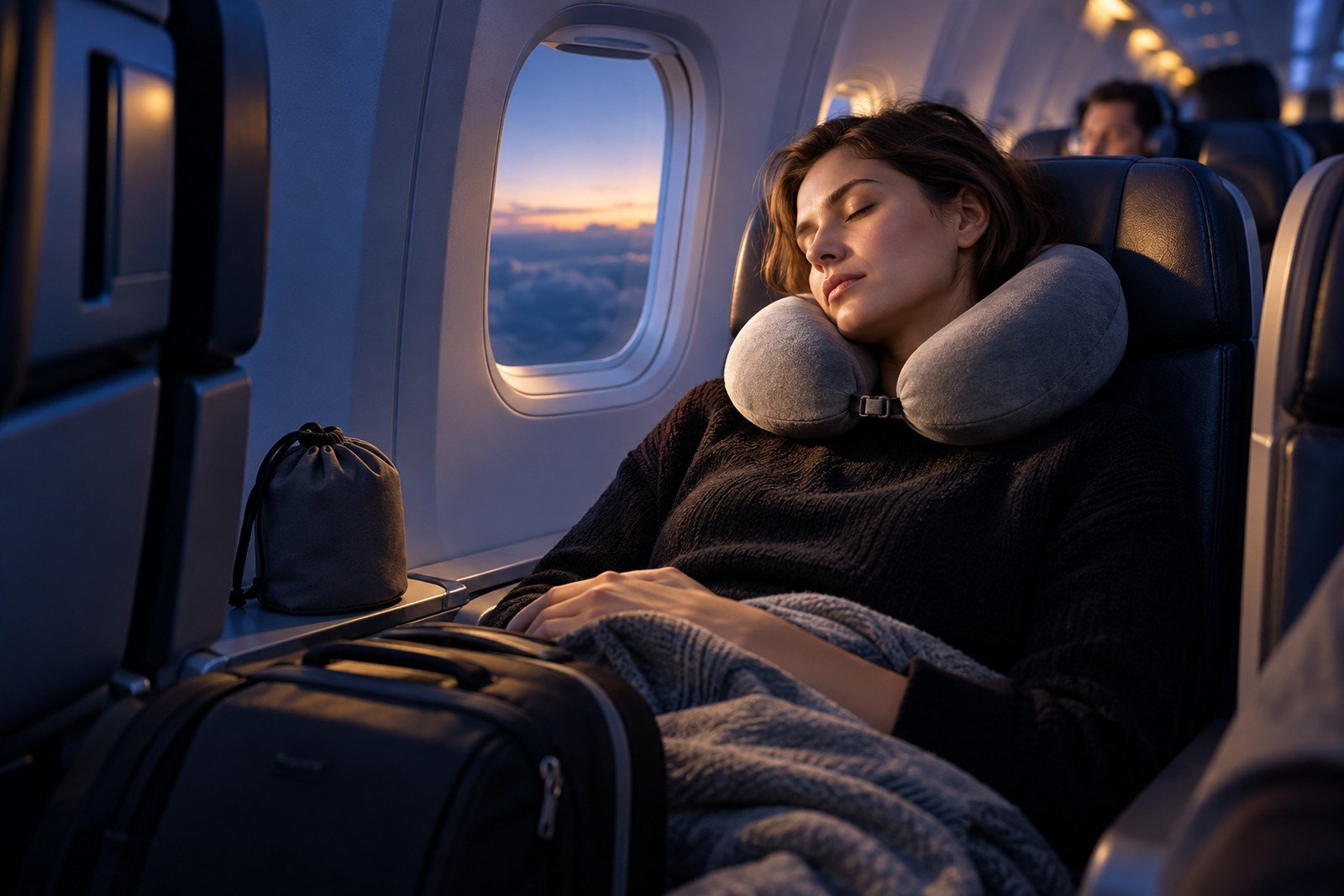
Travel pillow reviews often search for one winner, yet people do not sleep in one direction. Some heads fall towards the shoulder, some drop forward, some remain against the headrest and some alternate every few minutes. A thick U-shaped pillow can feel secure to one traveller and push another person’s head uncomfortably forward before the aircraft has left the gate.
Packed size changes the answer again. A memory-foam collar may provide broad, soft support but occupy the outside of a cabin bag. An inflatable pillow can pack into a shirt-pocket-sized pouch yet feel less stable or require pressure adjustments. A scarf-style brace is light and compact, although it creates asymmetric support and may feel warm around the neck.
This guide uses sleep direction, body shape, seat geometry and current manufacturer specifications to build a practical choice. It is buyer guidance, not a medical diagnosis. Anybody with recent neck surgery, significant pain, weakness, numbness or other concerning symptoms should follow professional advice rather than relying on a travel accessory.
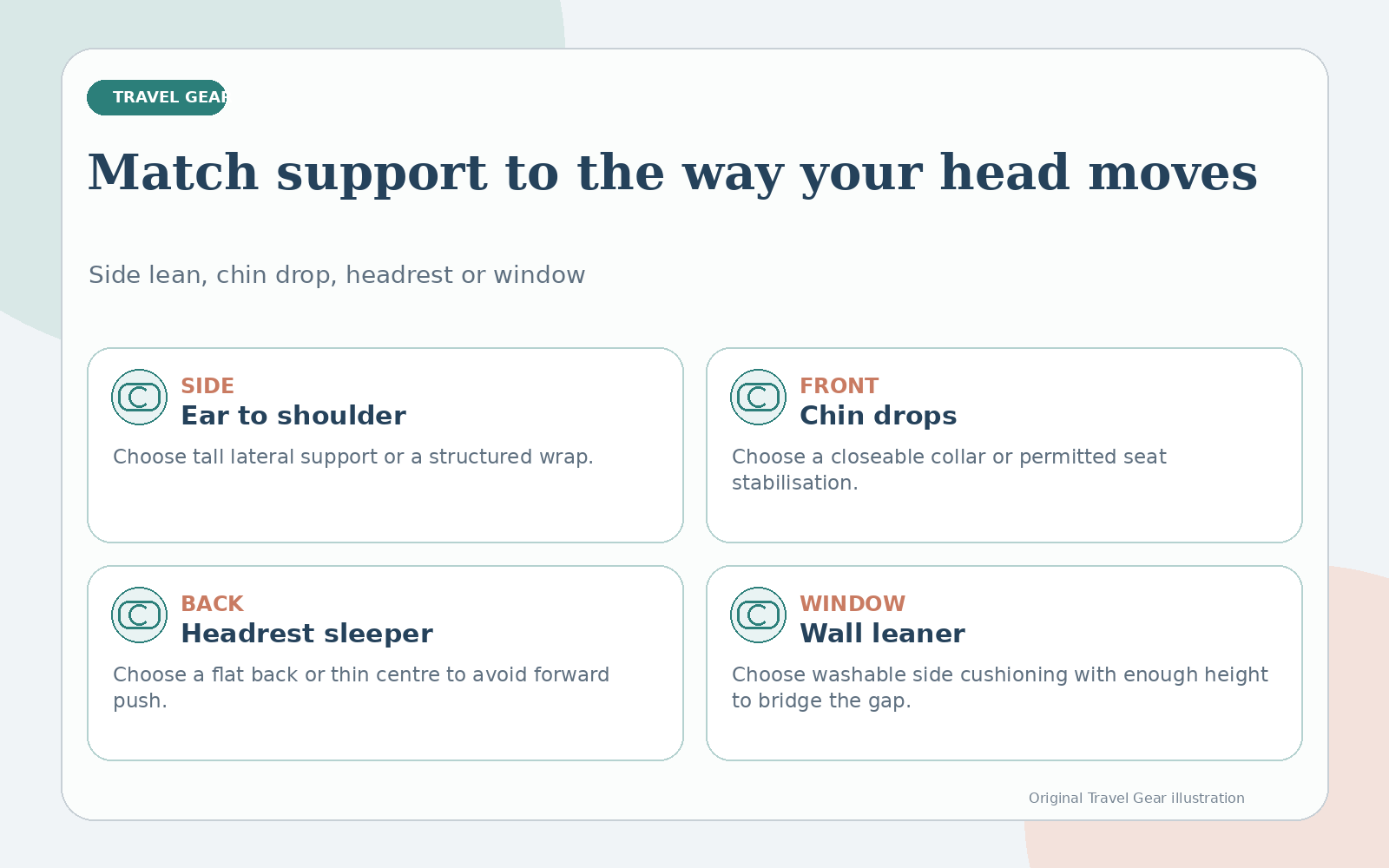
Tall asymmetric support
A wrap or brace should fill the gap between shoulder and jaw without forcing the opposite side upward.
Front closure and 360° support
Look for a collar that closes beneath the chin or works with the seat to resist forward nodding.
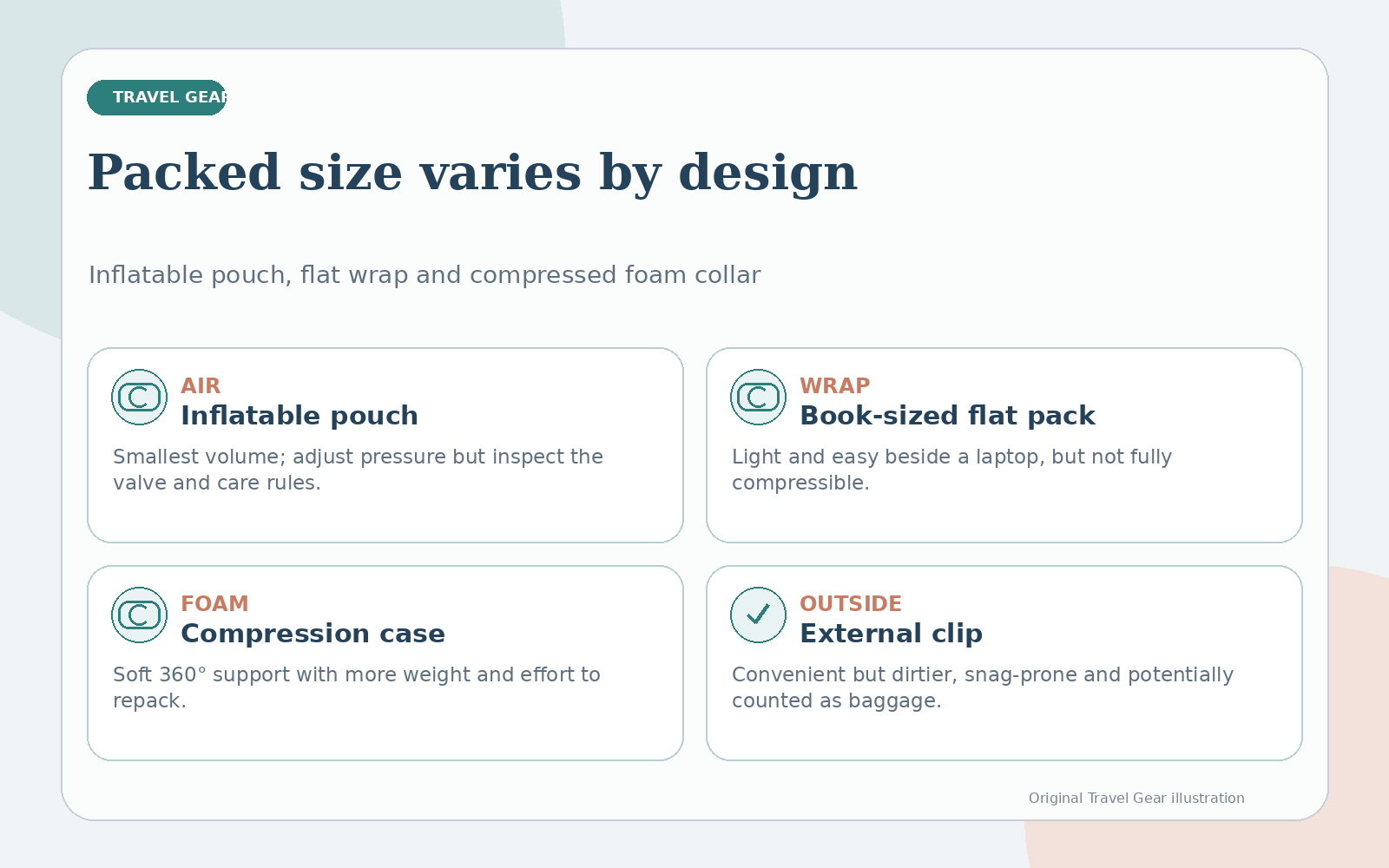
Inflatable pillow
Air provides volume only when needed; check the packed dimensions and the valve, not simply the word “compact”.
Rear thickness
Too much foam behind the neck can push the head forward, especially on seats with prominent headrests.
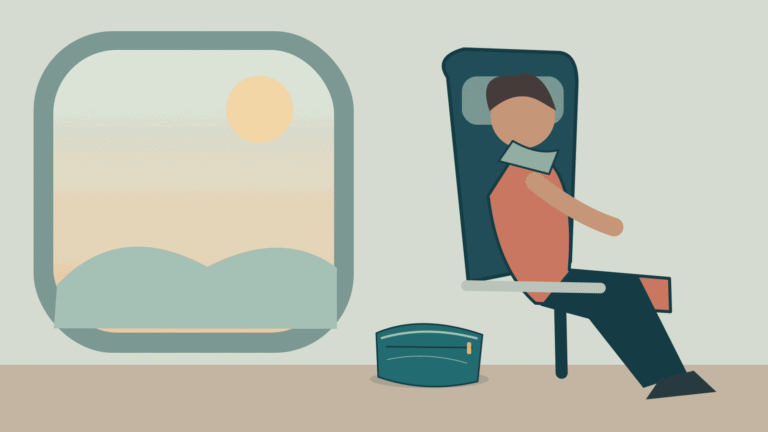
The travel pillow is trying to control motion in a seated position, not recreate a bedroom pillow.
Observe rather than guess
On your next train journey or while sitting in a supportive chair at home, notice the first movement as you relax. Does your chin fall towards your chest? Does one ear move towards one shoulder? Do you seek a wall or window? Do you stay against the headrest but wake because the back of the pillow is too thick?
That observation is more useful than copying a reviewer with a different neck length, shoulder width and seat. A pillow should fill a specific gap or resist a specific direction of motion. More foam is not automatically more support.
A neutral aim, not a rigid brace
NHS guidance on neck pain advises keeping the head aligned with the rest of the body during sleep and avoiding an awkward position. Seated travel can never perfectly reproduce a bed, and a travel pillow is not a medical collar. The practical aim is to reduce the repeated end-range tilt or forward drop that wakes you, while allowing normal breathing and small position changes.
Use this map as a starting point, then refine it for heat, packed size and seat compatibility.
| Sleep pattern | Support to look for | Likely design | Watch for |
|---|---|---|---|
| Head falls to one side | Tall support between shoulder and jaw; adjustable side position | Wrap/brace, high-sided collar or inflatable with enlarged side arms | Pressure on jaw, ear or opposite shoulder |
| Chin drops forward | Front closure, chin shelf or stabilisation against the seat | 360-degree collar, seat-strap pillow or overlapping wrap | Airway restriction, heat and straps incompatible with the seat |
| Head stays against headrest | Minimal material behind neck; moderate side wings | Flat-back memory foam or thin-centre inflatable | Rear bulk pushing the head forward |
| Leans against window | Soft, washable side cushion and enough height to bridge the gap | Compressible side pillow, wrap or high-sided U | Hard cabin surface, hygiene and shoulder compression |
| Changes position repeatedly | Adjustable circumference and support around more than one side | Closeable 360-degree collar or adjustable inflatable | Bulk and the need to re-position after reclining |
The pillow must bridge the distance between shoulder and jaw without becoming a hard wedge.
Asymmetric support can be efficient
A scarf-style brace such as the Trtl approach places a structured support on one side and wraps fabric around the neck. This suits a traveller who reliably leans left or right and wants low weight. It can be repositioned towards the front or opposite side, although doing so in a cramped seat takes more effort than turning a symmetrical collar.
High side wings suit switchers
A U-shaped pillow with enlarged side arms supports either direction and may suit somebody who changes sides. Check the gap between your shoulder and jaw while seated. A short-necked traveller may find a tall wing pushes the head away; a long-necked traveller may need more height than a soft, underfilled pillow provides.
Window leaning changes the surface
The cabin wall is farther away than it appears and may be cold or hard. A washable cover matters because the pillow contacts the wall. Avoid placing pressure on the window shade or controls, and do not rely on a loose pillow that can slide into the aisle during turbulence.
A conventional open U can leave the exact forward gap that this sleeper needs filled.
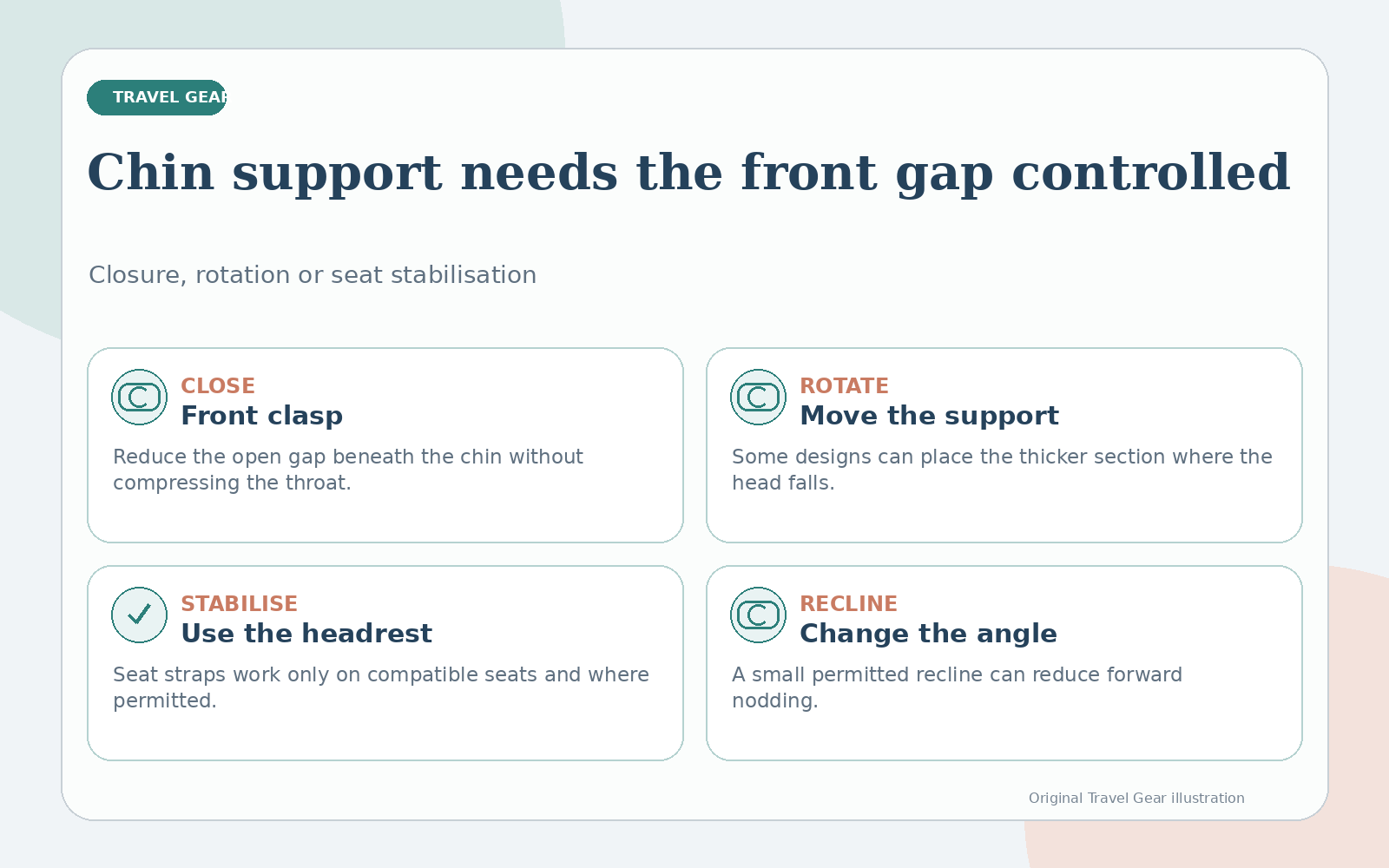
Close the circle
Look for a front clasp, overlapping ends or a design that can be rotated so the thicker section sits beneath the chin. The closure should support rather than compress the throat. You should be able to swallow, breathe and turn the head slightly without strain.
Seat straps can reduce repeated nodding
Some pillows use straps around the headrest area to hold the support in place. This may work well on a seat with adjustable headrest wings and an unobstructed attachment point. It may not work on a fixed shell, a seat without exposed headrest sections or where the airline asks passengers not to attach items. Never interfere with safety equipment or another passenger’s space.
Recline changes the angle
A small permitted recline can reduce the tendency to fall forward, while an upright seat increases it. Test the pillow with a seat back similar to the cabin rather than on a sofa. The same collar may behave differently when the headrest is prominent or the seat is very upright.
Rear bulk is the hidden reason many traditional pillows feel worse than no pillow.
Look for a flat back or thin centre
The Cabeau Evolution S3 publishes a flattened rear profile, while the Sea to Summit Aeros Premium Traveller narrows at the centre. Both ideas address the same geometry: the seat already occupies space behind the head, so adding a thick foam roll can flex the neck forward.
Side support can still matter
A traveller who begins against the headrest may drift sideways after falling asleep. Modest side wings or adjustable headrest wings can reduce that movement without enclosing the neck. Test with headphones, glasses and a hood if those are part of your normal flight setup.
Do not force the head against a rigid shell
Some modern premium-economy and business seats have fixed head surrounds. A large pillow can compete with the seat rather than complement it. In that situation, a very thin wrap, rolled scarf or no pillow may be more comfortable than a full collar.
“Compact” can mean shirt-pocket small, book-sized or merely compressible with considerable force.
Inflatable models win on volume
The Sea to Summit Aeros Premium Traveller is listed with a packed size of 9 × 7.5 × 4.5 cm and a packed weight of 93 g. That is genuinely small enough for a pouch inside a personal item. Air pressure can be adjusted to change firmness, although a valve, bladder and hand-wash-only construction create different maintenance considerations from foam.
Wrap designs are flat rather than tiny
The Trtl Original is listed at 22 × 24 × 9 cm and 133 g. It is approximately book-sized and light, but the internal support prevents it compressing like fabric alone. It may slide neatly beside a laptop or attach outside a bag, which can matter more than raw volume.
Memory foam compresses, then rebounds
Cabeau says the Evolution S3 packs to one-third of its original size in the included case. Ostrichpillow says the Go can reduce its volume by up to 60 per cent. Those claims describe compression ratios rather than exact packed dimensions, so consider the size of the supplied bag and how much force is needed to repack it. Cabeau also warns against storing its pillow compressed for more than one month.
External carrying is not free
A pillow clipped outside a backpack can brush floors, seats and overhead-bin surfaces. It may also make the bag exceed an airline’s interpretation of one personal item. A washable cover and a closed carrying pouch are useful when the pillow travels externally.
These products illustrate different design choices. The comparison is based on manufacturer specifications, not claimed personal testing.
| Model | Best match | Weight and packed information | Key design | Displayed price |
|---|---|---|---|---|
| Trtl Original | Consistent side leaner; light packer | 133 g; 22 × 24 × 9 cm | Structured side support wrapped in soft fabric; machine-washable fabric | £49.99 |
| Cabeau Evolution S3 | Chin dropper or switcher who wants 360-degree foam support | Compresses to about one-third in supplied case; weight not stated on the page checked | Flat back, raised sides, front clasp and seat straps | US$39.99 |
| Sea to Summit Aeros Premium Traveller | Minimal packer and firmness adjuster | 93 g packed; 9 × 7.5 × 4.5 cm packed | Inflatable, thin centre, enlarged sides and adjustable closure | US$49.95 |
| Ostrichpillow Go | Traveller prioritising soft memory foam over minimum weight | 420 g; compresses up to 60%; 28 × 30 × 17 cm uncompressed | Asymmetric memory-foam collar with washable cover | US$69 |
Prices and manufacturer specifications were checked on 21 September 2026. Regional stock, sales, currency and shipping can change.
Compare current UK listings by design type
Check the exact model, seller, return period, washable components and current dimensions rather than relying on a generic “travel pillow” title.
A returnable home test reveals more than squeezing the product in a shop aisle.
- Sit in a firm dining chair or office chair with a back similar to an aircraft seat rather than a soft sofa.
- Set the pillow as the instructions describe, then close your eyes and relax without deliberately holding your head upright.
- Notice where the head first moves and whether the pillow supports that direction before the neck reaches an uncomfortable angle.
- Check breathing, swallowing, jaw pressure, ear pressure and heat around the neck.
- Wear the headphones, glasses, hood or eye mask used on a real journey.
- Try a small recline and an upright position. Re-adjust rather than assuming one setup works for both.
- Pack the pillow into its case twice. If repacking is already irritating, it will not improve in an airport queue.
- Keep the packaging until the pillow has passed the test and the retailer’s return conditions are understood.
A pillow that works for ten minutes may become unpleasant after two hours.
Foam and fleece retain more warmth
Memory foam and wrap-style fleece can feel cosy in a cool cabin but hot during boarding or on a warm coach. Look for a breathable outer fabric, the ability to loosen the fit and a cover that can be removed without dismantling the support.
Washability varies by component
Trtl describes its soft fabric as machine washable. Cabeau and Ostrichpillow list removable washable covers. Sea to Summit instructs users to hand-wash the complete inflatable pillow with the valve closed and air-dry it. Read the specific care label because heat can damage foam, coatings or the inflatable bladder.
A carrying pouch is part of hygiene
Without a closed pouch, the pillow may contact aircraft floors, security trays and the outside of luggage. A drawstring case is better than a bare clip, provided the pillow can dry before storage. Never seal a damp pillow for the next trip.
The same pillow height can be supportive, useless or overbearing on different bodies.
Short neck or high shoulders
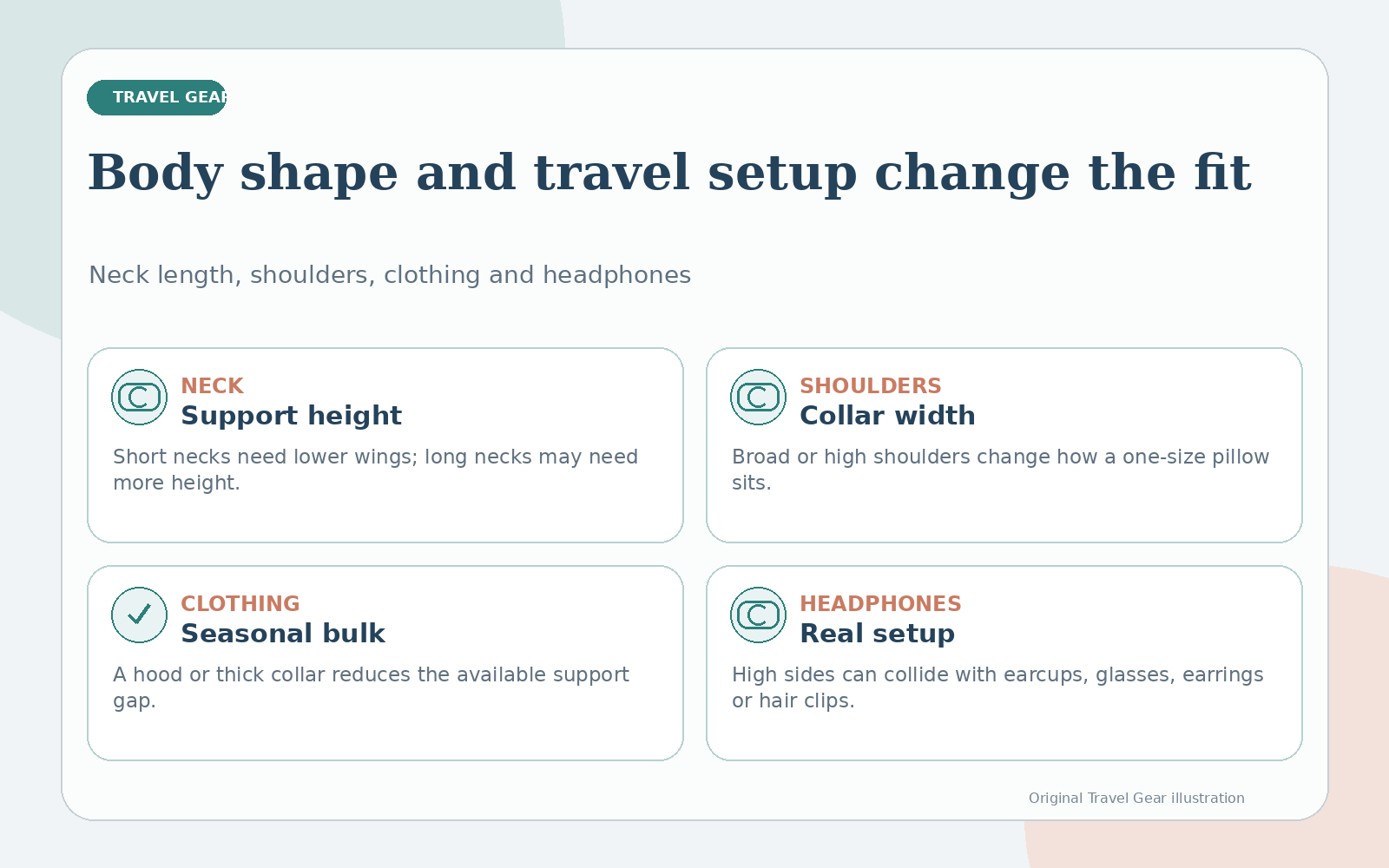
Very tall side wings may push the jaw upward. Choose adjustable air pressure, softer side material or a lower wrap position. Thick winter clothing further reduces the available gap.
Long neck or sloping shoulders
A low, underfilled U may collapse before supporting the head. Taller sides, a structured brace or a design that anchors to the seat can be more effective. Avoid overinflating until the pillow becomes hard and transfers pressure to the jaw.
Broad shoulders
A narrow collar may sit above the shoulders and feel constricting. Check the adjustable circumference and front closure range. A product described as one size does not mean one geometry.
Hair, headphones and earrings
Large headphones can collide with high side wings. Hair clips and earrings can create pressure points. Test the complete sleep setup rather than the pillow in isolation.
Comfort accessories remain secondary to crew instructions, the seat belt and unobstructed movement.
Keep the seat belt correctly fastened
The pillow should not route beneath, around or over the seat belt in a way that changes how the belt sits. During turbulence or when instructed, return the seat and accessories to the required position.
Do not attach to prohibited structures
Seat-strap systems need an appropriate headrest and permission under the operator’s rules. Do not loop straps around screens, tray tables, safety handles or another passenger’s seat mechanism. Cabin crew instructions take precedence over product instructions.
Adult pillows are not automatically suitable for children
Cabeau states that its adult pillows are too large to support children under 13 properly. Check the manufacturer’s age guidance and never use a product that could obstruct a child’s face or breathing.
Avoid using a rigid support as a medical collar
NHS guidance generally advises against wearing a neck collar unless a clinician has told you to do so. A travel pillow should provide temporary comfort and positional support, not immobilise an injured or painful neck.
There is no single best model, but there is usually a best compromise for the trip you actually take.
| Priority | Best starting design | Why and what to check |
|---|---|---|
| One-bag travel and minimum volume | Inflatable U with thin rear centre | Small packed dimensions and adjustable firmness; test valve comfort and leakage. |
| Consistent one-sided sleeper | Structured wrap or brace | High support where needed without a full foam collar; check heat and jaw pressure. |
| Frequent forward nodding | Closeable 360-degree collar or seat-compatible stabiliser | Front support can reduce chin drop; confirm breathing, seat compatibility and rear thickness. |
| Softness above packability | Compressible memory foam | Broad support and familiar feel; accept more weight and storage volume. |
| Hot sleeper | Inflatable or ventilated low-contact design | Less insulating material; use a washable, skin-friendly outer surface. |
| Headrest sleeper with short neck | Flat-back, lower-profile pillow | Avoids pushing the head forward; check that side wings are not too tall. |
Every design exchanges packability, softness, stability, heat and adjustment.
Inflatable and wrap advantages
- Very low packed volume or flat profile.
- Inflatable firmness can be adjusted.
- Wrap supports can target one problem direction efficiently.
- Lower weight suits strict cabin-bag limits.
- Often easier to store inside the bag rather than outside.
Inflatable and wrap disadvantages
- Air bladders can feel bouncy or develop leaks.
- Structured wraps may feel warm or asymmetric.
- Neither automatically controls forward chin drop.
- Small valves and closures can be awkward in darkness.
- Support may depend heavily on precise placement.
Memory-foam collar advantages
- Soft, continuous contact and broad support.
- High side wings can support changing positions.
- Front clasps can reduce the open gap.
- Removable covers are common.
- Less setup than inflating and adjusting a bladder.
Memory-foam collar disadvantages
- Greater packed bulk and weight.
- Can retain heat around the neck.
- Thick rear sections may push the head forward.
- Compression cases can be difficult to repack.
- One-size designs may not suit short necks or broad shoulders.
Most disappointing purchases result from matching the product to a review rather than to the sleeper.
Buying the thickest pillow
Extra foam behind the neck can push the head forward instead of supporting it.
Ignoring the direction of head drop
A side brace will not fully solve repeated forward nodding unless it can be repositioned appropriately.
Believing “compressible” means small
Check packed dimensions or the supplied case rather than a percentage alone.
Testing on a sofa
A soft couch does not reproduce an upright seat, headrest or limited shoulder space.
Forgetting heat and cleaning
A supportive pillow can still be unusable if it becomes hot or the cover cannot be cleaned easily.
Attaching straps anywhere available
Only use the system as permitted and never interfere with seat mechanisms, screens or safety equipment.
Practical answers for choosing, fitting and packing the pillow.
Which travel pillow is best for side sleepers?
Start with a tall side-support design or structured wrap that fills the shoulder-to-jaw gap. The correct height matters more than the brand.
Which design helps when my head falls forward?
Look for a front closure, overlapping support beneath the chin or a seat-compatible system that stabilises the pillow. Check breathing and throat pressure carefully.
Are inflatable pillows comfortable?
They can be, especially when slightly underinflated so the surface conforms rather than feeling rigid. They suit travellers who prioritise packed size and adjustable firmness.
Is memory foam better than inflatable?
Memory foam is usually softer and more familiar; inflatable designs are lighter and much smaller. The better material is the one that supports your movement without causing heat or rear bulk.
Should the opening of a U-shaped pillow face forwards or backwards?
Use the orientation that supports your actual head movement and follows the manufacturer’s guidance. Rotating the thicker section forward can help some chin droppers, but it may not fit every design.
How small should a travel pillow pack?
For strict one-bag travel, a packed size around a small pouch is valuable. For checked luggage or frequent long-haul comfort, a larger compressible foam collar may be an acceptable trade.
Can I clip the pillow outside my personal item?
You can where airline rules allow, but it may count towards baggage, become dirty or snag. A closed pouch inside the bag is cleaner and more predictable.
How do I stop a travel pillow making me hot?
Choose less neck coverage, breathable fabric or an inflatable model, loosen the closure during boarding and remove the pillow when awake.
Can a travel pillow prevent neck pain?
It may improve comfort by reducing an awkward position, but it is not a treatment guarantee. Persistent or significant symptoms need appropriate professional advice.
How often should I wash the cover?
Follow the care label and wash after trips where it contacted cabin surfaces or became sweaty. Dry every component fully before storage.
Choose support direction first, rear thickness second and packed size third.
A consistent side leaner should begin with a structured wrap or tall side-support pillow. A traveller whose chin repeatedly drops should prioritise a closeable front, 360-degree support or a permitted seat-stabilising system. Somebody who sleeps against the headrest should reject thick rear foam and look for a flat back or thin centre. When luggage space is the deciding constraint, a properly shaped inflatable provides the strongest packability advantage.
Whichever design you choose, test it for at least fifteen minutes in a firm chair with your real headphones and clothing. The pillow should reduce your normal movement without pushing the head forward, compressing the throat or creating a hard pressure point. A slightly less supportive model that packs easily, washes well and is used on every long journey is a better purchase than a bulky “best” pillow left at home.
Health claims are kept cautious; product comparisons use current manufacturer specifications.
- NHS: neck pain and stiff neck — advice on head alignment, low firm pillows, posture and when to seek help.
- Systematic review of pillow designs and neck outcomes — evidence that pillow shape and height influence alignment and that no single design guarantees better sleep.
- Trtl Original official UK page — current price, dimensions, weight, materials and care information.
- Cabeau Evolution S3 official page — flat back, seat straps, raised sides, front clasp, compression and list price.
- Sea to Summit Aeros Premium Traveller official page — packed size, weight, dimensions, valve, care and design.
- Ostrichpillow Go official page — weight, dimensions, compression claim, materials and price.
Illustrations in this article were created for Travel Gear. Third-party photographs, where used, are credited beside the image or in the source list.