Best Packable Tote Bags for Holidays

Best Packable Tote Bags for Holidays
Choose a holiday spare that carries comfortably, closes sensibly and folds away without becoming disposable luggage.
The best packable tote bags for holidays are not necessarily the ones that disappear into the smallest pouch. A spare bag earns its place when it makes an ordinary holiday task easier: carrying a layer to dinner, collecting a few groceries, taking a towel to the pool or keeping useful items beside you on a train. The difficulty is finding a bag that remains pleasant to carry after it stops being an empty demonstration.
A tiny shopper, a zipped shoulder tote and a convertible tote-backpack solve different problems. Treating them as interchangeable leads to familiar disappointments: handles that barely clear a coat, a bottle rolling across an unstructured base, or an open top that is inconvenient during a busy transfer. Your usual contents matter more than a promotional photograph showing an elegantly folded rectangle.
This guide compares six identifiable designs and makes conditional recommendations rather than declaring a universal winner. Manufacturer specifications and selected retailer listings were reviewed on 10 October 2026; no personal ownership, load testing or waterproof testing is claimed. The practical packing exercises are editorial suggestions for checking your own fit, not reports of experiments performed on these products.
Handle clearance
Try the loaded bag over the clothing you will wear.
Best Packable Tote Bags for Holidays: choose the job first
A spare for soft, ordinary belongings
A packable tote makes most sense when you can describe its job in one sentence. You might need a light bag for a cardigan and a book, a container for dry pool supplies, or a spare that leaves space in the suitcase until the last shopping trip. Those are manageable, specific jobs. Buying the largest bag available simply because it folds away is a less useful starting point.
Think about the period between picking the bag up and putting it down again. A short walk from a hotel room to breakfast is different from several hours carrying water across town. For the latter, two shoulder straps may matter more than a small packed footprint. A tote that is occasionally uncomfortable can become the wrong bag when that occasional task becomes your daily routine.
Decide whether an open top is acceptable
A zipped tote and an open shopper should not compete on capacity alone. When the bag is placed on a train seat or tipped while retrieving another item, a complete top closure gives you a way to contain the contents. Side snaps can change the shape of an opening, but they do not necessarily close the whole opening. Inspect the actual construction instead of treating every fastening as equivalent.
For valuables, keep the most important items in a closed, controlled location rather than loose beside a towel. Metropolitan Police guidance recommends keeping bags closed and close to you, and not hanging them on a chair where they are out of view. That advice is useful regardless of the bag's price or brand; it is not an endorsement of any tote here. [9]
How the shortlist was assembled
I compared identifiable designs by carrying format, closure, published size and weight, organisation and the plausibility of their holiday role. A current product page was more useful than a marketplace title with several unrelated keywords. The resulting recommendations are editorial judgements, not numerical scores derived from testing. Two options are explicitly conditional because availability or regional information was not sufficiently clear for an unqualified recommendation.
Six designs compared without mixing up their roles
| Exact design | Published size / weight | Best-matched role | Main limitation | Explore |
|---|---|---|---|---|
| Osprey Ultralight Stuff Tote | 18L; about 104g [1][2] | Light zipped spare | Minimal structure; assess the loaded handles | Official specs [1] |
| BAGSMART Faro Foldable Totepack | 25L; 300g; 32.5 x 17.5 x 41cm [3] | Tote-to-backpack flexibility | Not automatically within every airline allowance | Check Faro |
| TUMI Just In Case 156565 | 320g; 35.5 x 58.5 x 23cm [4] | Fold-flat suitcase companion | Do not substitute another Just In Case model | Check 156565 |
| Longchamp Le Pliage Original L | 346g; base 31 x 19cm, height 30cm [5] | Smarter everyday shoulder bag | No padded equipment protection | Official specs [5] |
| BAGSMART Moss Shopping Tote | 30L; reliable empty weight not established [6] | Conditional open-shopping role | Confirm closure, UK terms and availability | Check stock |
| FORCLAZ 15L 2-in-1, 8616572 | 15L; 240g; 45 x 35 x 15cm [7] | Smaller convertible comparison | Unavailable when reviewed | Official specs [7] |
Read the specification in context
Published figures describe the identified version, not every product with a similar name. In particular, TUMI uses Just In Case across different styles and generations. Longchamp's stated width here is measured at the base, not across the wider open top. A number can be accurate and still answer the wrong packing question when its measurement method is overlooked. [4][5]
The table deliberately leaves an unresolved weight blank rather than estimating from a photograph. Likewise, it does not invent capacities for models whose useful current specification was not established. A bag is not a rigid cuboid, so multiplying external dimensions does not reveal its true usable litres. Use published capacity as an orientation, then check your real belongings through the actual opening.
Lightweight and convertible options
Osprey Ultralight Stuff Tote: the light zipped spare
Osprey's 18L Ultralight Stuff Tote uses recycled 40D high-tenacity nylon and has a zipped main opening, stretch front pocket and key clip. The manufacturer's published US weight of 0.229lb is approximately 104g after conversion. That is a specification conversion, not a weighing performed for this article. The UK page identifies the same Stuff Tote design. [1][2]
This would be my first comparison for someone who wants an occasional zipped spare without a large empty-bag commitment. However, I would not translate the low weight into a recommendation for heavy groceries. A bag may contain a load that is unpleasant to carry by its handles. Test your normal bottle, layer and small essentials before deciding that a very light structure is the right compromise.
My suggested packing approach is simple: soft layers form most of the contents, while small hard objects stay together in one light pouch. Keep the key clip for a suitable key rather than attaching several heavy accessories. The attraction is a modest, uncomplicated backup. Turning it into a heavily compartmentalised day bag with multiple padded inserts would undermine the reason for choosing it.
BAGSMART Faro: useful when shoulder carry is not enough
The Faro Foldable Totepack is a 25L design listed at 300g and 32.5 x 17.5 x 41cm. It converts between tote, shoulder and backpack carry, folds into its own zipped pocket and uses Cordura nylon with water-repellent YKK zips. Those features identify a more versatile bag, not an ultralight pocket shopper. Water-repellent wording does not establish a waterproof compartment. [3]
I would consider Faro when the same spare may carry shopping briefly and then accompany a longer walk. Before buying, think about how often you would actually convert it. Extra straps are useful when used; otherwise they become extra fabric to manage. Examine where unused straps sit and whether the conversion still feels convenient once the bag contains your belongings.
A convertible bag also deserves a loaded trial in both configurations. Something that hangs neatly from two handles can arrange its contents differently against your back. Place awkward corners away from the contact area, and do not assume that a tote-backpack conversion provides the support of a dedicated walking pack. Choose it because changing carry mode solves a real problem on your trips.
Fold-flat options for a smarter holiday bag
TUMI Just In Case 156565: a suitcase companion
Case Luggage lists the TUMI Voyageur Just In Case Tote 156565 at 320g, with dimensions of 35.5 x 58.5 x 23cm. Its nylon construction folds flat into a zipped pouch, and the design includes a double-zip opening and Add-a-Bag luggage-handle sleeve. These figures belong to 156565; other Just In Case listings should not automatically inherit them. [4]
The practical reason to shortlist it is not that it can hold more than every alternative. It is the combination of a fold-flat format and a bag intended to sit alongside wheeled luggage. I would inspect the sleeve with my own case, because handle spacing and the loaded bag's balance matter more than the presence of a sleeve in isolation.
Consider where the tote goes after arrival. A bag that looks right for a city lunch or evening outing may replace another shoulder bag in your luggage. Conversely, taking it in addition to a handbag, backpack and shopping bag may simply multiply the number of things to manage. Its value is strongest when you can remove something else from the packing list.
Longchamp Le Pliage Original L: the everyday shoulder option
The identified black Le Pliage Original L, L1899089001, is listed at 346g. Longchamp gives dimensions of 31cm at the base by 30cm high by 19cm wide, with 25cm handle height. Its coated recycled-polyamide canvas has leather trim, a zipped top, snap fastening and two flat internal pockets. The familiar folding design is not a padded equipment carrier. [5]
I would compare it for someone who wants the spare to feel like their ordinary shoulder bag rather than technical travel equipment. That can be worthwhile if it will be used frequently beyond holidays. Nevertheless, choosing a familiar appearance should not replace a fit check: handle clearance, access with the bag under your arm and the space occupied by a protective sleeve remain practical questions.
A useful distinction is between folding flat and stuffing into a tiny ball. Follow the intended folds rather than compressing leather and hardware aggressively to win a packing contest. For travel, a flat bag against the side of a suitcase may be easier to retrieve than a densely stuffed pouch buried under several cubes. Smallest is not always the most convenient storage shape.
Two conditional alternatives worth understanding
BAGSMART Moss: more shopping-oriented, with checks outstanding
The Moss Shopping Tote is described as a reversible, foldable 30L nylon bag with side snaps and a luggage sleeve. The reviewed variant showed a notification option rather than straightforward availability, and its UK page displayed regional shipping text that needed clarification. It is therefore a conditional shopping option, not a promise of immediate UK delivery or a fully zipped alternative. [6]
For a reader who mainly wants room for light purchases, the format may be worth watching. However, I would obtain confirmation of the exact closure, empty weight and UK return arrangements before choosing it as an important journey-day bag. A larger capacity is not enough reason to overlook those unanswered practical questions, particularly close to departure.
FORCLAZ 15L two-in-one: a smaller reference point
Decathlon's identified FORCLAZ 15L two-in-one tote, 8616572, is listed at 240g and 45 x 35 x 15cm. It can be carried on the shoulder or as a backpack and folds into its own pocket. The UK listing was unavailable when reviewed, so it belongs on a comparison or restock list rather than an order-now recommendation. [7]
Its smaller capacity is useful as a planning reference. It encourages you to decide whether you really need a large spare or simply a compact carrier for a light layer and a few purchases. Do not substitute another similarly named Decathlon bag without checking the model. More importantly, do not delay an essential purchase indefinitely when a suitable bag you already own will do the job.
Measure the opening and the handles, not just the outside
Make a shape template for your awkward item
The widest item often decides whether a tote works. A book, a boxed purchase or a laptop in its sleeve may fit the bag's external width but fail to pass comfortably through the zip opening. Cut a piece of spare cardboard to the object's footprint and use that when checking a bag in a shop. Keep the test gentle and within the retailer's handling rules.
For a laptop, add its actual sleeve dimensions rather than using screen size as the measurement. Then consider what shares the compartment. A device that only fits when pressed against a bottle or a hard plug is not well accommodated merely because the zip closes. A dedicated bag with suitable protection may be the simpler solution for routine device carry.
Check handle drop with realistic clothing
Handle length and handle drop are not interchangeable descriptions. What you need is enough clearance between the top of the loaded bag and the handles for comfortable shoulder use. Try the bag over the coat or loose summer clothing you expect to wear. A comfortable empty-bag demonstration can change once a bulky towel pushes the top upwards.
Also check whether you can lower the bag from your shoulder without twisting awkwardly. This matters when standing in a queue or approaching a train seat. The right fit lets you move between carrying and access smoothly. Do not solve poor clearance by loading the bag so low that most of its nominal capacity becomes unusable.
Inspect the base while it is partly filled
An unstructured tote can become a narrow sling of fabric when only one heavy object sits inside. Try a partly filled arrangement as well as a full one. Notice whether a bottle rolls sideways, whether the base folds around a hard corner and whether the handles pull the mouth into an inconvenient shape.
You do not necessarily need a rigid base insert. A soft layer may already be part of your normal kit and can help organise the load. However, avoid adding a heavy organiser simply to make a minimalist tote behave like a structured handbag. At that point, compare the complete system with a bag designed for that role from the start.
Build a realistic load rather than chasing litres
A sample light-day calculation
Consider an illustrative load of a 300g bag, 500g of water, a 100g bottle, a 250g layer, a 200g book and 150g of small essentials. The total is 1.5kg. These are invented planning weights for demonstrating the calculation, not measurements of the recommended products. Replace every figure with your own kit before using the result to choose a bag.
Adding a second bottle and a few purchases can change the experience more than saving a small amount of fabric weight. This is why I would not choose a tote by grams alone. Weigh the contents you expect to carry most often, then decide whether one-shoulder or hand carry remains comfortable for the time involved.
Leave usable space rather than theoretical space
A tote packed to the top may have no convenient place for the jacket you remove halfway through the day. Leave room around the opening so you can close it without rearranging everything. The useful spare capacity is space that remains accessible while the bag is carried, not a gap that exists only after meticulous packing on a table.
For groceries, keep food and anything potentially leaky away from documents and clean clothing. Do not rely on the outside fabric to contain a broken container. A separate lightweight liner or existing food container may solve the problem, but it also changes the bag's effective capacity and weight. Count those additions when deciding between sizes.
Recognise when two straps are the better answer
When your ordinary load repeatedly makes you swap shoulders or carry the tote by hand, consider a backpack rather than searching for ever wider tote handles. A convertible option can be a useful middle ground, but its real fit matters more than the promise of several carrying modes. The bag should work with the way you move, not demand constant adjustment.
Use a packable tote during flights and transfers
A spare bag is not automatically an extra allowance
GOV.UK advises checking with the airline how many bags, and what sizes, you may carry. A tote being foldable, marketed for travel or purchased airside does not by itself establish an additional entitlement. Check the current conditions for the operating airline and your fare rather than relying on a general product description. [8]
A straightforward plan is to keep the empty spare inside your permitted luggage until you have a legitimate use for it. Before the return journey, decide where purchases will go without assuming that an expanded tote can be carried free. If the plan depends on repacking, rehearse that arrangement before reaching the gate rather than discovering that everything no longer fits.
Use a luggage sleeve without making the case unstable
A sleeve is a convenience feature, not a substitute for sensible loading. Place the bag so that it does not pull the suitcase sharply to one side, and check the combination while stationary before moving. Avoid leaving the case standing unattended with a top-heavy tote perched above it. The actual handle-and-bag pairing should determine whether you use the sleeve.
With the TUMI option, I would consider the sleeve part of the overall purchase only after that practical check. Otherwise you may be paying for a feature that does not work neatly with the luggage you own. A comfortable shoulder bag can still be useful without riding on the case; the important point is to buy for your real setup.
Keep the journey essentials separate from the spare
Do not make a newly unfolded tote the only home for passports, medication and every payment method merely because it is convenient. Decide which belongings must stay under your direct control, then arrange the spare around the remaining task. In particular, a shopping-oriented bag should not become an improvised valuables store while you concentrate on larger luggage.
On a train, think about access after sitting down. A small pouch containing the items you need during the journey can be easier to retrieve than opening a tote filled with clothing and purchases. Close the main bag again once finished. The objective is fewer loose objects to count when leaving, not another set of pockets to forget.
Match the tote to three common holiday days
A pool visit with dry supplies
A light towel, a cover-up and a reading book are a plausible soft load. Keep sunscreen or other liquids in a suitable separate container, and decide where damp items will go afterwards. A foldable tote can organise the trip to the pool without being a waterproof pool bag. Avoid confusing convenient fabric with a barrier that protects everything inside.
My preference for this role would be the simplest bag that carries comfortably and can be cleaned according to its instructions. An expensive leather-trimmed design may make less sense if it will repeatedly sit near splashes or wet ground. There is no need to use the same tote for every stage of a holiday when an existing washable carrier already covers this job.
A city afternoon with an evening stop
Here, shoulder comfort and an opening you can close easily are more important than squeezing the bag into a coat pocket. A book, light layer and a small purchase may be enough. Choose a colour and shape you will happily use later in the day, but keep the practical fit test unchanged. Appearance is a legitimate preference, not evidence of better carrying performance.
A fold-flat city option can replace another bag rather than accompany it. For that reason, the TUMI is worth comparing when your trip combines wheeled luggage and ordinary shoulder-bag use. Check the exact model and the loaded shape; do not buy solely because a product family is familiar.
A longer outing with uncertain purchases
An outing that may involve several hours of carrying is where a convertible format deserves more attention. Keep the initial load modest and leave room for a layer or small purchase. However, do not interpret an expandable day as permission to fill every available litre. The return walk is the part of the day when an uncomfortable load often becomes most noticeable.
The Faro is a reasonable design to investigate for this mixed role, provided both carry modes suit you. Alternatively, your regular daypack plus a very small shopper may be simpler. Compare those complete arrangements rather than judging one bag against another while ignoring the extra containers needed to make each work.
Rain, damp clothing and cleaning
Water-repellent is not a sealed compartment
Several shortlisted bags use water-repellent materials or closures, but this comparison does not establish any as an immersion-safe dry bag. A product's fabric description says less than a complete construction and closure specification. Protect water-sensitive contents according to their needs rather than expecting a light travel tote to solve every weather problem. [1][3][5][6]
For an ordinary shower, first think about where your vulnerable items are and how you will retrieve them without exposing everything. For a boat trip or a situation involving substantial water, choose protection intended for that use. A small proper protective pouch inside a tote may be useful, but its suitability should be judged independently of the outer bag.
Empty and air the bag before storing it
A tightly packed storage pouch is a poor place to discover that the tote still contains a damp cloth or food wrapper. Empty all pockets, remove loose debris and allow the bag to dry before folding it away. This is a practical storage routine, not a claim that every fabric can be washed in the same way.
Follow the instructions for the exact material combination. Travel bags with leather trim, coated fabric or specialised hardware should not automatically go into a washing machine because another packable bag can. Longchamp provides specific care guidance for its canvas and leather components; Decathlon gives different instructions for its identified tote. Treat those as model-specific directions. [5][7]
Keep the storage pouch easy to find
An attached pocket is harder to misplace, while a separate pouch may be easier to pack neatly. Either arrangement can work if you decide where the pouch goes while the tote is in use. Do not leave it loose in an unfamiliar hotel drawer. A consistent pocket in your main luggage is usually simpler than searching for it on departure morning.
Check the purchase before committing
Ask precise questions about missing information
Useful questions include the usable zip-opening width, whether the storage pouch is attached, and whether quoted weight includes that pouch. Ask for a photograph of a feature that matters rather than accepting a broad description such as travel-friendly. A specific answer can prevent a purchase that looks suitable online but fails your actual task.
For Moss, the outstanding issue is not merely choosing a colour. Clarify UK availability, the relevant delivery terms and the closure you are buying. A notification button is not a confirmed delivery date. When the trip is close, an existing bag with known fit may be a better decision than waiting for a conditional option. [6]
Run a gentle home comparison
Within the seller's return conditions, fill the bag with clean versions of your expected contents. Carry it over the intended clothing, sit down, retrieve the small-item pouch and fold it back into its storage format. Do not add stress tests, deliberate spills or loads beyond the instructions. You are checking suitability, not trying to prove durability.
Keep packaging until you have made the decision. Compare the complete purchase cost, including any necessary sleeve or organiser, rather than the bag price alone. No fixed prices are quoted here because offers and colours change; use the identified product links and manufacturer sources to confirm the terms that apply when you order.
Make the spare useful on checkout day
Separate the last items without losing track of them
Checkout is a different packing task from an ordinary day out. The main suitcase may already be closed while a charging cable, light layer and a few dry bathroom items still need a home. A tote can collect those final belongings, but give that temporary collection a clear destination. Do not let it become an unplanned extra cabin bag whose contents have nowhere to go later.
Before leaving the room, check the tote against a short list of what you deliberately placed inside. Then check the room separately. The purpose is to reduce loose objects, not to assume that gathering several items into one bag means nothing has been forgotten. Keep essential documents in their established controlled location rather than sweeping them into the last-minute collection.
Plan for purchases that do not fold
A soft spare can accommodate extra fabric more easily than a rigid box, but the bag's flexibility does not change the object's shape. When buying something bulky, consider the return journey before paying. Measure the box if necessary and decide whether it belongs in the suitcase, a permitted cabin item or an appropriate shipping arrangement. A tote is not a solution to every awkward souvenir.
Protect fragile purchases according to what they are, and do not rely on a layer of light bag fabric to provide cushioning. Keep hard corners away from delicate clothing and avoid packing something simply because the handles still meet. The correct decision may be to leave space in the main luggage or choose a smaller purchase, rather than expecting a folded spare to absorb every change of plan.
Pros and cons of travelling with a packable tote
Useful advantages
A spare can remain folded until needed, separate an ordinary day kit from larger luggage and replace a bulkier second shoulder bag. A simple design can also be easy to inspect when leaving a room or vehicle. Its strongest case is a clearly defined job, not hypothetical usefulness.
Compromises to accept
Minimal structure means the contents influence the carrying shape. One-shoulder or hand carry may not suit a sustained load, and a nominally large opening can be inconvenient when the bag is full. Extra pouches, padding and straps can erode the original weight and space saving.
Common mistakes that make a good tote feel wrong
Buying for maximum capacity rather than normal use
A large spare can encourage you to carry items you would otherwise leave behind. Start with the belongings needed for your usual outing, then allow sensible additional room. If a bag only feels useful when filled with unnecessary extras, its capacity is not solving the right problem. A smaller bag with a comfortable handle may suit the holiday better.
Choosing the smallest folded photograph
A bag that folds beautifully once may be awkward to repack while standing beside an open suitcase. Practise the ordinary storage routine rather than trying to reproduce a marketing image. Leaving the tote folded loosely and flat is acceptable when that works better. Compactness should support access, not turn packing into another time-consuming task.
Treating a sleeve or a snap as a security feature
A luggage sleeve helps organise a bag-and-case combination; it does not prevent the tote being taken. Likewise, snaps that narrow the opening should not be described as a fully secured main compartment. Keep the distinction between carrying convenience and control of belongings clear. Use the appropriate closure and keep important items in a location you can supervise.
Frequently asked questions
Which packable tote is the best overall choice?
There is no single winner for every holiday. I would start with Osprey for a light zipped spare, Faro for genuinely useful backpack conversion and TUMI 156565 for a fold-flat suitcase companion. Longchamp deserves consideration when ordinary shoulder-bag use is the main purpose. The better choice is the one that handles your actual load and clothing comfortably, not the one with the longest feature list.
Is a zipped tote better than an open shopper?
A complete zip is useful when containing loose belongings during transfers or when a bag may tip. An open shopper can be convenient for quick, low-value shopping tasks, but it is a different compromise. Decide what you will carry and where the bag will sit before choosing. Do not assume that side snaps provide the same closure as a zip running across the main opening.
Can a foldable tote replace a daypack?
It can for some short, modest-load outings. However, frequent walking with water, food and layers may be more comfortable with a bag designed for two-shoulder carry. A convertible tote is worth examining when your days vary, but the conversion itself is not evidence of a supportive harness. Try the complete load in both modes and choose according to comfort and access.
Should I choose nylon or polyester?
The fibre name alone does not settle the decision. Construction, coating, handle attachment, seams and the intended load all matter. Start with the named product's care guidance and documented features, then inspect how the bag behaves with your belongings. A fabric label does not prove that a bag is waterproof, indestructible or comfortable to carry for several hours.
Can I bring the tote as an extra free cabin bag?
Do not assume so. The operating airline and fare determine the allowance, and GOV.UK advises checking both the permitted number and size of bags. Plan where the folded or loaded tote fits within that allowance. Having space in the bag is different from having permission to bring another item into the cabin. [8]
Is a packable tote suitable for a laptop?
Only when the actual device, protective sleeve and remaining contents fit safely and the carrying arrangement is comfortable. A nominal screen size is not a measurement of the opening. Most lightweight spare-bag roles do not require electronics, and adding protection can change the weight calculation substantially. For routine laptop transport, a bag intended for that purpose may be more appropriate.
What should I do when a recommended colour is unavailable?
Check whether the same exact model exists in another suitable colour, then confirm that the specifications remain the same. Do not substitute a different generation because a shop groups it on the same page. Where stock or UK terms remain unclear, treat the choice as conditional. A known, suitable bag already in your cupboard is preferable to a rushed purchase with unresolved fit or delivery.
The tote I would choose for each holiday role
For a minimal zipped spare, I would begin with the Osprey Stuff Tote and a genuinely light packing list. For a trip where the bag will spend meaningful time on two shoulders, I would compare Faro with a proper daypack. When the aim is a smart shoulder bag that folds alongside a suitcase, TUMI 156565 and Longchamp are more relevant comparisons than an open grocery shopper.
My deciding check would be a loaded carry over realistic clothing, followed by opening, closing and repacking the bag without emptying it onto the floor. That small routine exposes a mismatch more usefully than a large capacity number. Keep Moss and the FORCLAZ option conditional until the relevant availability and product details are clear. A spare is successful when it simplifies the trip, not when it creates another bag to manage.
Sources and fact-checking notes
Product information was reviewed on 10 October 2026. Manufacturer descriptions establish the stated features, not independently tested performance. Selection advice and packing examples are editorial judgements. Stock, variants and seller terms can change; consult the exact item before purchasing.
- Osprey UK: Ultralight Stuff Tote18L design, materials, zip and carrying features.
- Osprey: Ultralight Stuff Tote specificationPublished 0.229lb weight; approximately 104g after conversion.
- BAGSMART UK: Faro Foldable Totepack25L, 300g, dimensions, three carrying modes and materials.
- Case Luggage: TUMI Just In Case Tote 156565The identified 320g model, dimensions, fold-flat construction and sleeve.
- Longchamp: Le Pliage Original L, L1899089001Base dimensions, handle height, weight, closure and care.
- BAGSMART UK: Moss Shopping Tote30L, foldable format and side snaps; availability and regional terms need confirmation.
- Decathlon UK: FORCLAZ 15L 2-in-1 tote, 8616572240g, dimensions and carry modes; unavailable when reviewed.
- GOV.UK: Hand luggage restrictionsAirline bag allowances and airport-specific security checks.
- Metropolitan Police: Pickpocketing preventionKeeping bags closed and under personal control; not a product endorsement.
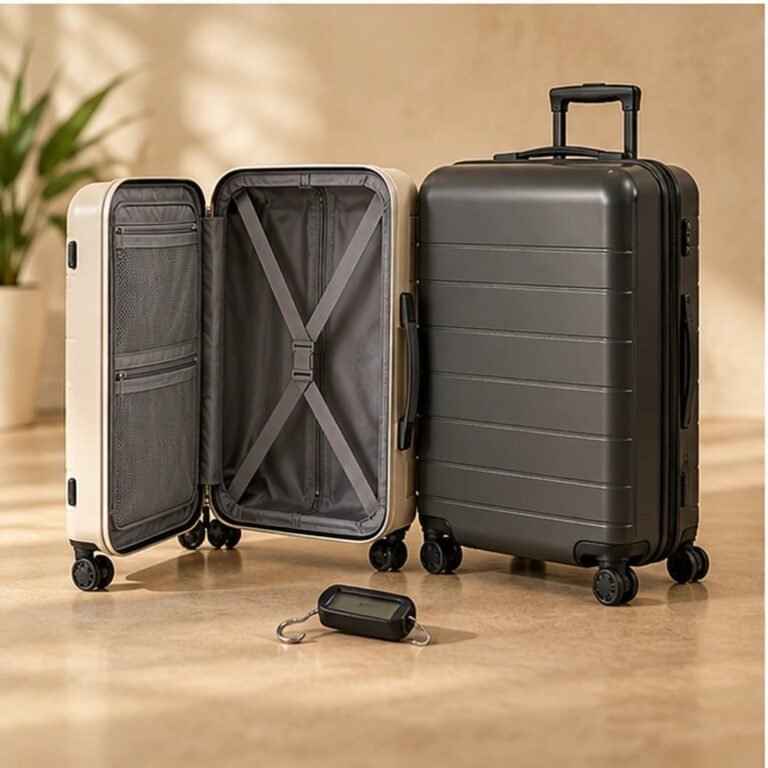
Illustrations are original concept drawings. They do not reproduce the named models, establish dimensions or demonstrate product performance. Buying links are provided only for identifiable destinations; a link does not guarantee an available offer, approved use or a delivery date.
Illustrations in this article were created for Taylor’s Trailblazing Travel Gear. Third-party photographs, where used, are credited beside the image or in the source list.