
How to Test Suitcase Wheels Before the Return Window Closes
A short, careful inspection is more useful than a damaging obstacle course.
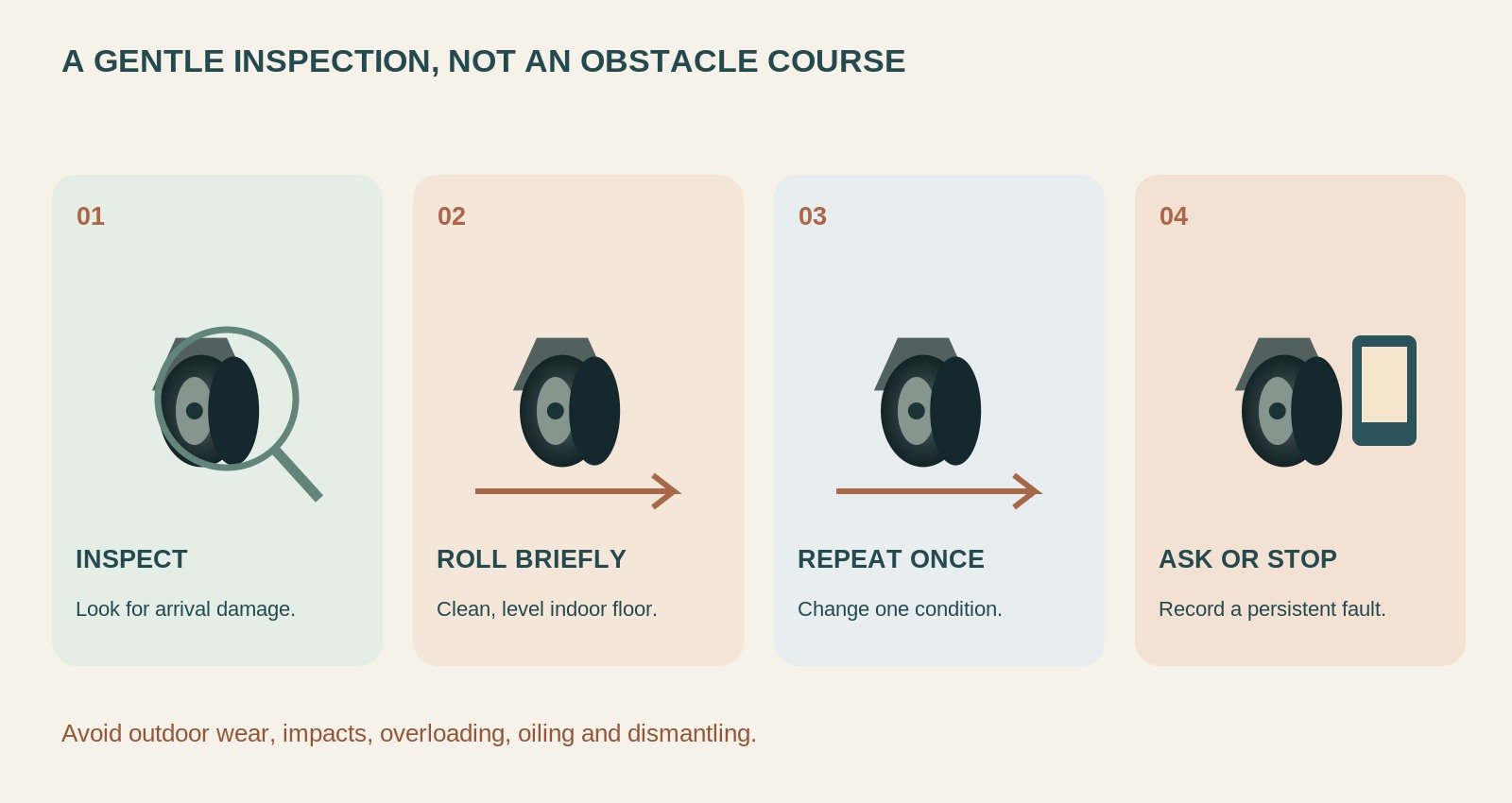
Original inspection illustration, not a photograph of a tested product. A return-window check should not involve impact testing or dismantling.
Learning how to test suitcase wheels before the return window closes is about spotting a problem early without creating one yourself. A short, careful indoor inspection can reveal binding, repeated rubbing or an obviously loose assembly. It cannot prove that a suitcase will survive years of travel, and an aggressive obstacle course can damage both the bag and your return options.
Begin with the seller’s conditions and the delivery date, not with a heavy load. Check what handling is permitted, keep packaging and labels, and ask before a prolonged or realistically loaded trial. Indoor use is not automatically harmless: wear can still occur, and the legal distinction is about necessary handling rather than simply where it happened. [1]
This is a suggested research-led inspection routine, not a laboratory test or a report of products tested by the author. Retailer policies and UK consumer sources were reviewed on 11 October 2026. The consumer-rights discussion is general information for typical purchases from traders, not advice deciding an individual dispute or a rule for every country and sales channel.
Some buying links may earn this website a commission at no extra cost to you. Recommendations are based on the stated research and practical suitability, not a claim of hands-on testing.
Check the deadline
Cancellation, dispatch, retailer goodwill and faulty-goods rights are different questions.
Clean, level, indoors
Avoid kerbs, stairs, outdoor grit and deliberate impacts.
Change one variable
Reverse direction and rebalance contents before blaming a particular wheel.
Record, then ask
Photograph a fault and contact the seller rather than taking the assembly apart.
How to test suitcase wheels: a gentle first-pass routine
Check the rules, then clear a small space
Read the return policy attached to your order and save a copy. Record the delivery date, the deadline for notifying the seller and the deadline for sending an item back where applicable. Do not assume the return period starts when you open the box or when your holiday begins.
Choose a clean, level indoor area with enough room for a few controlled steps. Move loose rugs, cables and objects that could catch a wheel. Keep the case away from stairs and protect delicate flooring appropriately. The purpose is to observe normal movement, not to demonstrate how much punishment the bag can take.
Inspect before you roll
Look at all wheel assemblies, their housings and the surrounding shell or fabric. Compare one side with the other, noting cracks, missing fasteners, obvious deformation or an unusual gap. Photograph anything concerning before attempting further movement. This preserves a useful record of how the item arrived.
Then check that packaging is not touching the wheels. Do not cut away product labels, protective parts or anything whose purpose is unclear merely to begin the test. If a shipping restraint prevents a necessary inspection, ask the seller how to proceed while preserving the return conditions.
Make only brief, controlled movements
Try a few gentle movements in the way the design is intended to be used. Keep control of the handle and stop at resistance rather than pulling harder. If the bag has four swivel wheels, allow them to align as you change direction. If it has two wheels, use its normal towing position.
A short first pass should tell you whether something needs further attention. It is not necessary to complete a predetermined number of laps. A persistent clunk, binding wheel or visibly damaged mounting is a reason to stop and document the symptom, not a reason to continue until the fault becomes more obvious.
Understand the wheel movement you are observing
Rolling and swivelling are different actions
A wheel turns around its axle to roll forward. On a spinner, the assembly also swivels to point in the direction of travel. These movements can produce different sensations. A brief change in resistance while a castor aligns is not the same observation as a wheel repeatedly catching during a straight run.
Record what you see rather than immediately naming a failed component. For example, note that the front-right assembly hesitates when changing direction, or that one wheel rubs its housing during each rotation. That description is more useful to a seller than a confident diagnosis of a bearing you have not inspected internally.
Two-wheel bags need a different comparison
A two-wheel suitcase or duffel is normally pulled at an angle, with the traveller supporting part of the load through the handle. Testing it upright as though it were a four-wheel spinner can produce a misleading impression. Compare the bag in its intended operating position.
For a design reference, the Respark 45 two-wheel underseater is a different format from a large four-wheel checked case. Its name does not establish fit for every airline, and it is not a tested recommendation here. The point is to recognise the wheel system before judging its movement. [2]
Twin wheels do not create a universal quality score
A twin-wheel assembly and a single-wheel assembly can each be well or poorly implemented. The number of small wheels visible in a photograph is not proof of low noise, low rolling resistance or long life. Mounting quality, clearances and the complete bag design also matter.
Do not time how long each wheel free-spins and treat the longest time as the best result. Different constructions and normal resistance can affect that observation. This guide does not provide manufacturer-approved tolerances for free-spin time or side play, so persistent functional symptoms deserve more attention than invented pass marks.
Set up a fair comparison without marking the case
Keep the conditions consistent
Use the same section of floor, the same direction and the same handle setting for repeated observations. Do not compare one bag on carpet with another on smooth tile and conclude that its wheels are worse. A fair home check changes one condition at a time.
You can note the start and end points using nearby room features rather than sticking tape to the suitcase or wheels. Avoid adhesive directly on finishes, tyres or fabrics. Keep the area simple so that any unusual noise or resistance is easier to associate with the bag rather than the test setup.
Use equipment you already have
A phone for photographs, a notebook and an ordinary tape measure are usually enough for the initial inspection. You do not need a force gauge, decibel meter or specialised measuring kit to describe a repeatable problem. Buying equipment can distract from the more urgent task of contacting the seller before a deadline.
A portable scale can help when a permitted loaded comparison is relevant, but it is optional. The Go Travel Digital Pro Scale is one example with a tape measure. Its measuring capacity is not a safe lifting recommendation, and the product description is not a calibration certificate. [3]
Do not turn inspection into cleaning or repair
A new wheel should not need sanding, oiling or dismantling before you decide whether the product is acceptable. If debris or packaging appears trapped, photograph it and ask the seller what to do. Do not make a mechanical alteration that changes the original symptom.
Likewise, avoid trying to remove evidence of wear before a return. Describe what handling occurred honestly. A clear record of a gentle inspection is more useful than a case that has been subjected to numerous undocumented interventions in an attempt to make a noise disappear.
Static checks: what to look at while the bag is still
Examine the wheel surface
Look for an obvious flat area, split, missing section or foreign material on the rolling surface. Rotate the wheel gently if it can be done without forcing it, keeping fingers away from pinch points. Stop if it binds or if moving it would require disassembly.
A visible mould line or a small cosmetic variation does not automatically establish a fault. Relate the appearance to function: does the same point repeatedly catch, rub or produce a bump? Photographing both the feature and the whole assembly helps the seller understand the context without guessing from an extreme close-up.
Inspect the mounting area
Look around the housing for cracks or signs that the assembly is pulling away from the body. Compare similar positions on the opposite side, while remembering that some designs are not perfectly symmetrical. Do not tighten visible screws simply because you can access them.
An assembly that appears severely loose, misaligned or damaged warrants a pause. Place the case safely and contact the seller. A new purchase should not require you to test whether the damaged mounting will withstand a heavier load before you can report the problem.
Check what is allowed to touch the floor
Some bags have feet or protective rails that contact the floor when parked. Those are not necessarily defects. Identify the intended rolling position before deciding that a rubbing sound is caused by the wheels. A bag pulled too upright or too low can bring another part of the body into contact.
Where the intended position is unclear, consult the product instructions or ask the seller. Do not infer it solely from a lifestyle photograph. The goal is to assess ordinary use of the design, not to find an angle at which any part of the bag can be made to scrape.
The empty rolling check
Start and stop gently
Move the empty case a short distance at a normal controlled pace. Notice whether it starts smoothly once the wheels are aligned and whether any sound repeats at a regular point. Keep your grip relaxed enough to observe the movement but firm enough to prevent the case running away.
Do not release a spinner to see how far it coasts. A free-rolling distance test adds little to a return-window inspection and can lead to a collision. The useful observation is how the bag behaves while being handled normally, not its performance as an uncontrolled rolling object.
Try a straight run in both directions
Repeat the same short path in the opposite direction. If a drift reverses relative to the room, the floor may be influencing the result. If the same assembly shows a repeated symptom in either direction, that gives you a more specific observation to report.
Do not present this as a definitive diagnostic test. Subtle slopes, hand position and wheel alignment can all affect movement. A repeatable result narrows the question; it does not prove a manufacturing defect or identify the precise internal component at fault.
Observe turning and sideways movement appropriately
For a spinner, make a gentle turn and a short sideways movement if the design supports it. Allow the castors time to align rather than dragging them sideways under force. A brief alignment movement is different from persistent binding once the bag is moving steadily.
For a two-wheel model, assess turning through the handle in its towing position. Do not demand the sideways manoeuvrability of a spinner from a fixed-wheel bag. An unsuitable wheel arrangement can justify choosing a different product, but it should not automatically be described as defective.
A loaded check needs a separate decision
Ask before a realistic travel-load trial
For a basic suitability check, a few clean items may be enough to understand balance and access, subject to the seller’s conditions. Avoid heavy improvised weights, loose books or water containers used simply to stress the wheels. The aim is information, not accelerated wear.
Keep the contents balanced
If a permitted light load changes the behaviour, check its distribution before blaming the wheels. One dense item in an outside corner can alter the way the bag tracks or tips. Rebalance the same contents and repeat only the short observation that raised concern.
Do not add more weight to make a problem easier to hear. If the case binds with an ordinary permitted load, document that load and stop. If there is uncertainty about acceptable handling, send the seller the initial evidence and ask what further check it would like you to perform.
Once you have decided to keep it, test your real routine
A normal pre-trip packing rehearsal is different from an inspection intended to preserve a change-of-mind return. After deciding to keep the case, you can assess your actual packing and accompanying bag arrangement within the manufacturer’s intended use. Keep the distinction clear rather than pretending every later trial remains an unused-goods inspection.
Even then, do not overload the case or undertake unsafe lifting. A manageable load and sensible handling matter regardless of whether a return window remains open. A suitcase can pass a brief home check and still be an unsuitable choice for the amount you planned to carry.
Separate wheel problems from floor and packing effects
A rough surface can make healthy wheels sound different
Carpet, tile joints and timber boards can produce different resistance and noise. Compare the symptom on another clean, level indoor surface where doing so is permitted and will not cause marks. Do not move outdoors merely to create a more dramatic recording.
A phone microphone can exaggerate some frequencies or change its recording level automatically. Use it to document a repeatable sound, not to claim a precise noise rating. A video that shows the wheel and movement clearly is usually more informative than a decibel number with uncontrolled conditions.
Check attached and loose items
A hanging label, zip pull, loose strap or internal object can create a noise that seems to come from the wheel area. Look without removing permanent components or altering the case. Secure only loose items in the intended way and see whether the sound changes.
Likewise, a bag placed on the trolley handle can alter balance and steering. For the first check, assess the case on its own. Later, when appropriate, evaluate the actual travel combination separately. Mixing those two observations makes it harder to tell whether the suitcase itself is the problem.
Do not create numerical tolerances
There is no universal consumer rule in this guide for an acceptable number of millimetres of wheel play or a minimum free-spin time. Different designs need different tolerances. If something appears excessive, ask the seller or manufacturer for the specification rather than inventing a pass-or-fail limit.
Describe severity through function: repeated rubbing, inability to roll normally, visible separation or persistent wobble. These observations remain useful even when you cannot diagnose the cause. A cautious, accurate description is stronger than an unsupported technical conclusion.
Record observations the seller can act on
Capture the product identity
Record the date of delivery and the date you first noticed the symptom. Keep the original product listing or order confirmation rather than relying on a page that may change later. This helps distinguish what was advertised, what arrived and what you observed during inspection.
Make a short, clear video
Show the whole case first, then the relevant wheel area during a brief controlled movement. Explain the surface, whether the bag is empty and whether the same problem occurs in both directions. Avoid a long sequence of increasingly forceful tests that obscures the original issue.
Take photographs of visible damage in good light, with one wider view and one close-up. Do not place the suitcase in a risky position to reach the wheel. An imperfect but safe photograph is preferable to balancing a heavy case above you for a clearer angle.
Keep facts separate from requests
A useful message states what arrived, what happens and what outcome you are seeking. For example: the case arrived yesterday; the rear-left wheel repeatedly rubs on a clean level floor during a brief empty inspection; photographs and a short video are attached; please advise on the appropriate return or remedy.
That is an example of wording to adapt, not a factual statement about your own purchase. Avoid claiming years of expected failure or diagnosing a broken bearing unless a qualified inspection has established it. Clear evidence and a specific request give the seller a much better starting point.
Decide whether to keep checking, ask or stop
Swipe or scroll within the table to see every column.
| Observation | First response | What to record | What not to do |
|---|---|---|---|
| Brief castor alignment when direction changes | Repeat one gentle movement | Direction and whether it settles | Drag sideways with force |
| Noise changes with the floor | Compare another suitable indoor surface | Surface and empty or loaded state | Present an uncontrolled phone reading as a lab result |
| Repeated rubbing at the same point | Stop and contact seller | Close-up and short movement video | Sand, oil or dismantle the assembly |
| Visible crack or mounting separation | Stop immediately | Arrival condition and product identity | Add weight to see whether it holds |
| Drift only with uneven contents | Rebalance the same permitted load | Position of items and repeat result | Keep adding weight until it tracks straight |
| Persistent abnormal wobble | Ask for assessment | Which assembly and when it happens | Invent a universal play tolerance |
One clear symptom is enough to ask a question
You do not need to prove the entire product defective before contacting the seller. A repeatable concern is sufficient to request guidance. Continuing until the problem becomes dramatic can create unnecessary wear and make the record less clear.
At the same time, a minor cosmetic difference or brief direction change is not automatically a fault. Keep the distinction between a product that does not suit your preferences and one that appears not to function properly. Both can affect your decision, but they may lead to different return processes.
Stop when the next test adds risk rather than information
If the only remaining idea involves more weight, a rougher surface or taking the wheel apart, pause. Send the evidence already collected. A retailer or manufacturer may have a suitable diagnostic process, and it is better to obtain that instruction than to improvise a destructive test.
Samsonite’s repair information discusses replaceable components and authorised service routes. That does not mean a buyer should dismantle a newly delivered case during a return-window check. Diagnosis, authorised repair and deciding whether to accept the purchase are separate stages. [4]
Understand the return deadline that actually applies
Ordinary online cancellation
For typical UK distance purchases from a trader, GOV.UK explains the usual right to notify cancellation within 14 days of receiving goods, followed by another 14 days to return them. Exceptions and contract details can matter. Do not wait until a trip has happened before checking the applicable process. [5]
Necessary handling and excessive use are not the same thing. Regulation 34 addresses diminished value caused by handling beyond what is necessary to establish the goods’ nature, characteristics and functioning, including handling beyond what might reasonably be allowed in a shop. It does not provide a blanket exemption for indoor rolling. [1]
Retailer goodwill windows
A seller may offer a longer change-of-mind policy, but that additional policy can have conditions. Case Luggage’s reviewed UK mainland policy gives 28 days for full-priced items and 14 days for reduced items, with unused-condition and packaging requirements. Its statutory-rights section remains separate. [6]
Do not treat the shorter sale-policy wording as removing statutory cancellation rights. Equally, do not assume a longer goodwill period allows unrestricted use. Read the order-specific terms, distinguish notice from dispatch deadlines and ask promptly when a policy seems unclear.
Faulty-goods rights are a different route
The Consumer Rights Act provides a short-term right to reject qualifying non-conforming goods, normally within a 30-day period determined by the statutory conditions. That is not the same as a 30-day right to return anything you simply dislike. The detailed rules, including repair or replacement waiting periods, can matter. [7]
Other remedies may remain after that initial period, so the end of an ordinary return window does not automatically erase every right concerning a fault. Keep the evidence and describe the issue accurately to the seller. For a disputed individual claim, seek appropriate consumer advice rather than relying on a general luggage guide.
Compare replacement features only after identifying the problem
The following examples illustrate different wheel and luggage formats. They were not rolled or durability-tested for this guide. A replacement should address the reason the first case was unsuitable rather than merely move you to a more expensive model.
Swipe or scroll within the table to see every column.
| Example | Design feature to investigate | Question before choosing | Model details |
|---|---|---|---|
| Essens 55, 146909 | Manufacturer discusses repairable wheel components | Is the exact part and local service route available? | View fixed-size cabin model |
| Upscape 55, 159400 | Four-wheel compact expandable case | Does it handle well in the mode you will actually use? | View current cabin version |
| Re-Lite 67, 154967 | Soft-sided checked spinner | Does front-pocket packing affect your balance? | View soft-sided example |
| Prodiver 79, 140884 | Two-wheel large duffel | Is the towing and lifting load manageable? | View wheeled duffel example |
| Upscape 75, 143110 | Larger four-wheel checked format | Is this size necessary for your trip? | View checked spinner example |
Stock and specifications still need checking
The displayed Essens 55 Radiant Yellow and Upscape 55 Black retailer variants were sold out when reviewed. These are comparison references rather than guaranteed offers. The Prodiver 79 manufacturer and retailer also disagree on empty weight, so confirm the supplied edition rather than treating the lower figure as established. [8] [9] [10] [11]
For the Essens wheel-repair feature, use the manufacturer’s information as a starting point and ask about the correct parts. Repairable does not mean every fault should be repaired by the buyer, or that all future work is free. Warranty scope and statutory rights answer different questions. [12] [13]
Choose the format that solves the observed difficulty
If the issue was an unsuitable towing angle rather than a fault, compare a spinner. If the case was simply too large to control comfortably, a smaller bag may be the better solution. Replacing like with like can reproduce the same problem when the underlying mismatch is size or layout.
A different fixed-size checked format such as the Essens 69 or a top-opening option such as the small Firenze wheeled holdall may be worth inspecting for specific needs. These links provide design references, not a claim that either has superior tested wheels. [14] [15]
What not to do during a return-window check
Avoid impact, endurance and weather tests
Do not drop the case, drag it down stairs, drive it over kerbs repeatedly or roll it through gravel to see what happens. Those actions can produce damage and do not constitute a gentle suitability inspection. They can also expose you or other people to unnecessary risk.
Avoid soaking, freezing or heating the wheels, and do not use abrasive surfaces to simulate years of travel. A home test cannot establish controlled durability simply by being demanding. Long-term performance claims require appropriate evidence, not a dramatic afternoon experiment on a product you may return.
Do not add aftermarket wheel covers before judging it
A cover changes the wheel’s contact surface and may affect clearance or movement. Assess the product as supplied before adding anything that could hide a symptom or introduce another one. An accessory should not be used to make a defective new assembly appear acceptable.
Likewise, do not apply lubricant without manufacturer or seller guidance. It can change the noise, attract dirt or affect materials, and it obscures the original condition. A new case that requires an improvised treatment deserves a conversation with the seller before any modification.
Do not miss a deadline while perfecting the evidence
Take enough photographs and a short recording to explain the issue, then contact the seller. Spending days trying to create a conclusive technical report can be less useful than giving clear notice promptly. You can provide additional information after the seller explains what is needed.
Keep a record of communications and any instructions received. If asked to carry out another check, make sure the request is clear and does not create an unsafe situation. Do not assume that a casual suggestion automatically authorises a damaging test or changes the applicable return conditions.
Preparing a return without changing the evidence
Follow the agreed process
Once a return or remedy has been arranged, use the seller’s instructions and the correct order reference. Do not send a case to an address copied from an old search result without confirmation. A retailer’s ordinary returns route and a manufacturer’s repair centre may be different destinations.
Clarify whether a collection or self-posting service is required and who is responsible for arranging it. Return costs and procedures can depend on the reason for return, the sales channel and the delivery location. Do not assume that a generic free-returns banner settles the details of an individual faulty-goods or overseas order.
Protect the case for the return journey
Use suitable packaging and keep the supplied accessories together. Case Luggage’s policy asks for securely packed goods in a sealed cardboard box or suitable packaging and advises keeping proof of posting or collection. Follow the specific instructions provided for your order rather than sending the suitcase back loose. [6]
Photograph the packed item and keep the evidence of the original concern. Do not add an improvised repair, lubricant or wheel cover before dispatch. If the seller has authorised a particular action, retain that instruction with your records so the condition of the returned product can be understood accurately.
Keep the tracking and correspondence
Save the collection receipt or posting record and the tracking reference until the matter is resolved. Note the date you notified the seller as well as the dispatch date. These are different events, and a record of both is more useful than relying on a single screenshot of an order status.
If the process stalls, refer back to the agreed instructions and the evidence already supplied. Avoid repeatedly handling or retesting the case while waiting for an answer. Once the relevant symptom has been documented, additional use usually adds uncertainty rather than helping the seller assess the original issue.
Reassess the replacement on its own merits
When a replacement arrives, check that the model, size and included components match the agreed remedy. Carry out a fresh gentle arrival inspection rather than assuming it must behave identically to the first item. Keep the paperwork linking the two deliveries and ask how any applicable dates are recorded.
A replacement may resolve a fault without resolving a separate suitability problem such as excessive size or an uncomfortable handle. Keep those judgments distinct. The objective is a functioning bag that suits your journey, not simply completion of an exchange while the original packing mismatch remains unaddressed.
Pros, limits and a practical decision record
What a careful home inspection can achieve
It can identify obvious arrival damage, repeatable binding or a wheel that rubs during normal movement. It can also reveal that the bag’s layout or towing position does not suit you. Early observations make it easier to ask the right question while ordinary return options are still available.
What it cannot prove
It cannot establish years of durability, quantify universal wheel quality or guarantee a retailer’s return decision. A quiet empty roll does not show how every future load or surface will behave. Keep the conclusion proportionate to the limited conditions you actually observed.
Keep a short inspection note
Record the model, delivery date, return deadlines, surface, handle setting and whether the case was empty. Add one sentence describing the result and one action: keep, ask the seller or stop because of a visible concern. This is enough for most initial decisions without turning the process into a complicated project.
When the result is satisfactory, put the packaging somewhere clean until you have completed the purchase decision. When it is not, leave the case in its documented condition and follow the seller’s process. The next useful step is communication, not progressively harder testing.
Frequently asked questions
Should new suitcase wheels spin freely for several seconds?
There is no universal free-spin duration used in this guide. Construction and normal resistance differ between wheel systems. A persistent functional problem while rolling is more informative than an arbitrary stopwatch threshold. Compare assemblies gently, do not force them and ask the seller for model-specific guidance if one behaves very differently or visibly rubs.
Is a slight wobble always a manufacturing fault?
Not necessarily. Different designs can have different normal clearances, and the floor or packing may affect what you notice. This guide does not set a numerical tolerance. Severe or persistent wobble, repeated rubbing or visible mounting damage should be documented and referred to the seller rather than diagnosed by guesswork or tested with increasingly heavy loads.
Can I test a suitcase outside and still return it?
Do not assume that you can. Outdoor surfaces can mark wheels and create wear, while ordinary return conditions and the legal assessment of necessary handling remain relevant. Ask the seller before any trial that could go beyond a reasonable inspection. A short clean indoor check is the more cautious starting point, but even indoor use is not automatically return-safe. [1]
How much weight should I use during a wheel test?
There is no universal test load recommended here. Start empty, and ask the seller before a realistic or prolonged loaded trial if you may return the case. Use only safe, proportionate handling consistent with the product instructions. Heavy improvised weights are unnecessary for documenting an initial concern and can make the inspection less safe and less defensible.
Can I tighten a loose wheel before deciding whether to return it?
For a new purchase with an apparent problem, contact the seller first. Tightening or dismantling can alter the evidence and may create another issue. Model-specific repairs can be straightforward when authorised, but that is different from an initial inspection. Keep the receipt, photograph the concern and obtain clear instructions before changing the assembly. [4]
What if the wheels fail after the ordinary return window?
A change-of-mind deadline is not the end of every possible remedy for a fault. Contact the seller with the product details, timing and evidence, and check the relevant consumer rights and warranty terms. The correct route depends on the circumstances. Do not assume that a long manufacturer warranty covers every type of wear or transport damage. [5] [13]
Should I buy a replacement before the seller responds?
Only make that decision in light of your travel deadline and budget; do not assume reimbursement of a second purchase. First ask about the proposed remedy and timing. If you do need another case, choose it around the identified problem and keep the purchases distinct. A rushed replacement can repeat the same size or handling mismatch.
The recommendation: inspect briefly, record clearly, act promptly
A useful wheel check is controlled and proportionate. Read the conditions, inspect the arrival state, make a few gentle movements and repeat a symptom only where doing so adds information without damage. Stop at a persistent problem and contact the seller with clear evidence.
The objective is not to prove that your suitcase is indestructible. It is to make an informed purchase decision while the relevant options are still open, without turning a manageable question about a new wheel into a damaged bag and a much harder returns conversation.
Sources and fact-checking notes
- Consumer Contracts Regulations 2013, regulation 34Reimbursement and diminished value where handling goes beyond what is necessary to establish the nature, characteristics and functioning of goods.
- Case Luggage: Respark 45 underseater (143311)Two-wheel underseater example. No blanket underseat or airline-fit approval is inferred from its name.
- Case Luggage: Go Travel Digital Pro Scale (2004.101)Retailer lists a 50 kg measuring capacity and 1 m tape measure. Neither is a recommended lifting load or a calibration certificate.
- Samsonite repair FAQModel-specific spare parts, authorised repair routes, proof of purchase and chargeable repair estimates. Not permission to dismantle a new purchase during a return inspection.
- GOV.UK: accepting returns and giving refundsUK consumer guidance distinguishing distance-selling cancellation, shop purchases, sale goods and faulty goods. The article provides general information, not individual legal advice.
- Case Luggage returns policyRetailer policy checked 11 October 2026: full-price and reduced-price windows differ; packaging, unused-condition and regional collection terms apply. Statutory rights remain separate.
- Consumer Rights Act 2015, section 22Time limits for the short-term right to reject non-conforming goods, including the usual 30-day period and repair/replacement waiting provisions.
- Case Luggage: Essens 55 (146909)Radiant Yellow page showed sold out. Check other colours and confirm that the fixed-size 146909 is selected.
- Case Luggage: Upscape 55 (159400)Black 159400 page showed sold out when checked. Used as a model comparison, not an in-stock promise.
- Samsonite Prodiver 79, model 140884Current manufacturer reference: 79 x 44 x 31 cm, 122 L and 3.4 kg. The retailer headline still says 3.2 kg; the difference is not silently reconciled.
- Case Luggage: Prodiver 79 (140884)Retailer uses the new name but retains a 3.2 kg headline; manufacturer specifies 3.4 kg. Confirm the actual supplied edition.
- Samsonite Essens 55, model 146909Fixed-size three-point-closure model, including manufacturer wheel-repair information; the collection also contains a different expandable zip model.
- Samsonite warranty FAQManufacturer warranty scope, exclusions, proof-of-purchase requirements and service arrangements; not a substitute for rights against a seller.
- Case Luggage: Essens 69 (146911)Retailer listing for the fixed-size medium case; check selected colour and current offer.
- Case Luggage: Bric's Firenze small wheeled holdall (BBJ15220)Retailer reference for the small wheeled holdall: 55 x 32 x 25 cm and 3.66 kg. Avoid confusing it with the larger BBJ15221.
- Case Luggage: Re-Lite 67 (154967)Retailer specifies 67 x 44 x 30/33 cm, 79/88 L and 2.9 kg. Selected stock and delivery remain subject to confirmation.
- Case Luggage: Upscape 75 (143110)Black page displayed Add to bag when checked. Current price, colour and dispatch must be confirmed before ordering.
Illustrations in this article were created for Taylor’s Trailblazing Travel Gear. Third-party photographs, where used, are credited beside the image or in the source list.