Best Anti-Theft Sling Bags
Best Anti-Theft Sling Bags
Five research-led choices, with practical checks for closures, fit, capacity and everyday access.
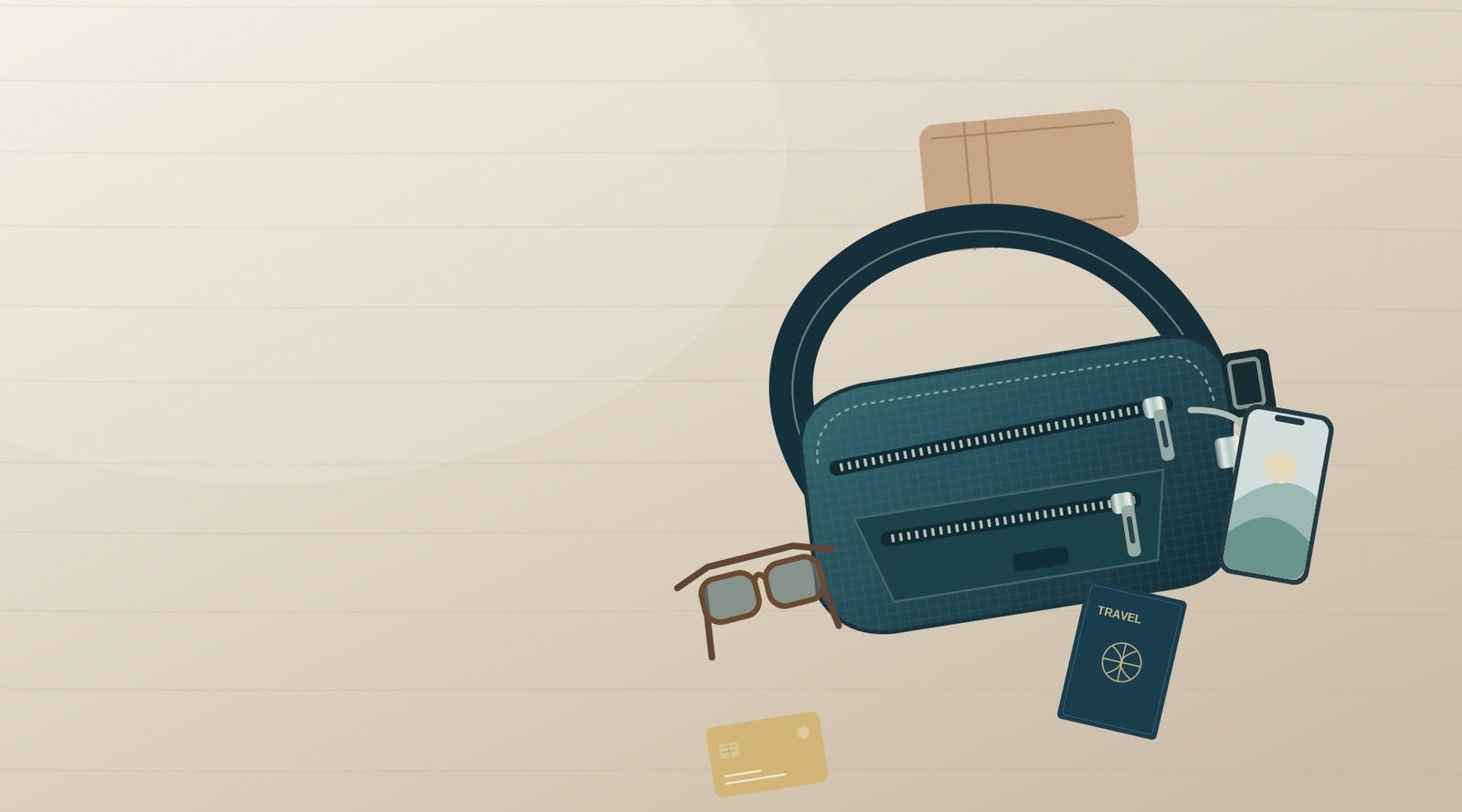
Concept illustration of a sling and a modest travel kit; not a photograph of a tested product.
The best anti-theft sling bags make everyday essentials easier to manage without creating a false sense that a bag can make theft impossible. The useful differences are practical: how the closure works, where the buckle sits, which items fit through the opening and whether the loaded bag remains comfortable when worn across your body.
A small sling can be appealing when pockets are not enough but a full backpack feels unnecessary. However, buying the most heavily equipped model is not automatically the answer. Extra hardware, fabric and capacity need to earn their place, especially when the result hangs from one shoulder for much of the day.
This guide compares five documented anti-theft designs and explains who each might suit. It also separates current manufacturer specifications from older marketplace names. No bag was personally tested for this article, and no recommendation should be interpreted as a guarantee against theft, a verified bottle-fit test or a promise that a particular retailer has every colour in stock.
Pacsafe GO
A compact starting point when phone, wallet and other small essentials are the main load.
V Action
Try its strap range and tall shape rather than assuming every 2.5-litre bag fits alike.
V Tech
More capacity has a purpose only when the electronics and other contents genuinely need it.
Security is conditional
Closures and reinforcement support a careful routine; they do not replace it.
How we chose the best anti-theft sling bags
Start with the load, not the lock
The best anti-theft sling bags in this comparison are the Pacsafe GO for a small everyday kit, V Action for slim vertical carry, V Urban for wider items, V Tech for a tablet-led load, and Travelon Classic for a more pocketed arrangement. These are different answers to different carrying problems, rather than a claim that one bag defeats every thief. Manufacturer specifications establish the features; the recommendations are our research-led judgement about how those features might work together. [1] [2] [3] [4] [5]
We compared closure design, strap security, usable shape, access and the implications of carrying everything on one shoulder. However, no cutting test, pickpocket simulation or long-term wear trial was undertaken for this article. There are no invented security scores or claims that a particular bag prevented a theft. We also avoided treating an RFID pocket as a substitute for a securely closed main compartment.
What earned a place
Every shortlisted model has documented physical security features beyond simply being a bag worn across the chest. A useful feature still needs to be manageable: a complicated closure left open after every purchase offers little practical advantage. The order therefore begins with the smaller everyday option before moving through more specialised shapes and larger capacities.
Compare the five shortlisted slings
Read the shape as well as the capacity
On a small screen, swipe inside the table to see every column.
| Option | Useful role | Maker specification | Before choosing | Compare |
|---|---|---|---|---|
| Pacsafe GO Sling Pack [1] | Small everyday essentials | 2.5L; zip clip and security buckle | Check bulky glasses cases and bottle needs. | Check listing |
| Pacsafe V Action / Vibe 150 [2] | Slim vertical carry | 2.5L; 33 x 16 x 6 cm; 370g | Strap circumference and older listing versions matter. | Check listing |
| Pacsafe V Urban / Metrosafe X [3] | Wider daily items | 5L; approximately 36.5cm wide; 370g | Try its span across your torso. | Check listing |
| Pacsafe V Tech / Vibe 325 [4] | Tablet-led capacity | 10L; 560g; current 11-inch tablet guidance | Not a verified 13-inch laptop fit. | Check listing |
| Travelon Classic Sling 42887 [5] | Pocketed organisation | Locking compartments; side bottle pocket | Check the exact design revision and bottle fit. | Check listing |
Two bags marked 2.5 litres can have very different openings and proportions. One may favour a long phone and flat documents; another may accept a sunglasses case more comfortably. Because stated capacity does not describe the narrowest part of the opening, measure awkward items before deciding that a litre figure is enough.
The table uses maker information for the named product families, not measurements taken by us. Retail listings can retain the older Vibe or Metrosafe names, particularly for Pacsafe models. Consequently, check the photographs, product code and listed features against the manufacturer's current page rather than assuming that every colour is the same generation. [1] [2] [3] [4]
Availability without the guesswork
Prices, sellers and colour availability change. The retailer buttons are starting points for checking a listing, not assurances of stock, a particular delivery date or the lowest price. Where the current maker name differs from an older retail name, that difference is flagged below. Do not select a replacement size merely because it appears in the same marketplace listing.
Pacsafe GO: a sensible starting point for light carry
Why it makes the shortlist
The GO is a 2.5-litre sling with a zip clip, a dual-release security buckle, a reinforced strap, eXomesh reinforcement and an RFID-blocking pocket. Pacsafe also lists internal attachment points for a wallet and keys. Its compact role is the reason it leads this comparison: it asks you to choose a small daily kit rather than fill an oversized bag. [1]
Our suggested starting load is a phone, slim wallet, keys, tissues and a small glasses pouch. That is a packing proposal, not a verified fit test. A hard sunglasses case or a bulky phone cover could change the result substantially. Therefore, lay those items together and compare their dimensions with the actual opening before ordering.
Who should pause before buying
Choose a larger format when water, an umbrella and electronics are all essential rather than occasional extras. Packing a compact sling until its front bulges can make its convenient opening surprisingly awkward. It can also leave the closure under tension when you are trying to secure it quickly.
For a light sightseeing load, the GO's appeal is the combination of manageable size and documented security details. Nevertheless, those details do not make it safe to leave on a cafe table while ordering. Treat the bag as something you keep with you, not a portable safe that can be left behind. [6]
Pacsafe V Action: for a slim, vertical arrangement
A different shape at the same nominal capacity
Pacsafe's current V Action page retains Vibe 150 in its address. The current specification is 2.5 litres, with a tall, narrow body and Roobar Sport closure hardware, PopNLock clip, reinforced strap and reinforced front panel. The maker gives a crossbody circumference of approximately 102-147 cm for the version checked. [2]
That makes fit more important than the litre figure suggests. A narrow bag may lie neatly against some torsos while placing its strap or buckle awkwardly on others. Rather than choosing it because it looks smaller in a photograph, measure the route the strap will take over the clothing you actually wear on holiday.
The right reason to choose it
Consider the V Action when flat essentials dominate your load and you prefer vertical organisation to a wider belt-bag shape. However, do not assume the more elaborate closure means more comfortable access. Practise the opening sequence slowly, then decide whether you would realistically complete it after paying for a drink or taking out a ticket.
This is not our default choice for a mixed, bulky kit. A large bottle and a thick case may undermine the slim profile that attracted you to it. The linked marketplace page uses Vibe 150 naming, so compare the offered item's photographs and specification with the current V Action description before paying; older fabrics or hardware must not be assumed identical.
Pacsafe V Urban: for wider everyday items
Space arranged horizontally
The V Urban, found at Pacsafe's Metrosafe X Urban Sling address, has a stated capacity of five litres. The specification checked describes a body approximately 36.5 cm wide and 20 cm high, with a stated weight of 370 g. Roobar Sport, PopNLock, strap reinforcement and eXomesh are listed for the current version. [3]
Its width is the key decision. Our judgement is that this shape deserves attention when a long glasses case, flat notebook or small organised pouch makes a narrow sling frustrating. However, the same span can feel excessive across a smaller torso. A cardboard rectangle of the published dimensions is a useful first check before arranging a proper fitting.
Access is part of the comparison
A wider opening can make contents easier to see, but it also encourages spreading many small objects through the bag. Put the genuinely valuable items in one internal location and keep everyday access predictable. A compact pouch may help, provided its extra bulk does not remove the space you bought the sling to gain.
Check how the loaded bag rotates from back to front without colliding with your elbow or a jacket pocket. Then try sitting down. A bag that feels unobtrusive while standing can sit across your lap or ribs when you take a train seat. Those are fitting questions, not faults that can be resolved from a capacity figure alone.
Pacsafe V Tech: when a tablet really is essential
A larger sling, not a tiny daypack
Pacsafe now presents the Vibe 325 family as V Tech. The current UK page specifies ten litres, approximately 560 g and a padded sleeve intended for an 11-inch iPad Pro and most 11-inch tablets. It also lists two lockable compartments and Roobar Sport security hardware. Do not turn that tablet statement into a promise of laptop fit. [4]
Our recommendation is conditional: shortlist it when a tablet, charger and other daily belongings genuinely need to stay together. Otherwise, a larger bag creates an invitation to add things that were not needed in the first place. The empty weight is only the beginning once electronics and water are included.
Check the single-shoulder trade-off
Try a representative load rather than assessing an empty bag. Walk, sit, reach across your body and rotate it forward. If you repeatedly lift the strap away from your neck or support the bag with one hand, a two-strap backpack may be the better solution even though the sling gives convenient front access.
Inspect tablet fit with the case fitted and the closure fully shut. A screen diagonal is not the same as the device's external height, width and thickness. Similarly, the internal sleeve should not be assumed to absorb drops or crushing forces simply because it is padded. Buy a protective device case separately when that is part of your actual need.
Travelon Classic: an alternative for pocketed organisation
A different layout to consider
Travelon's Classic Sling, style 42887, lists locking compartments, a slash-resistant body and strap, RFID card storage, a padded tablet sleeve and a stowable side bottle pocket. We have not converted the external shape into a claimed usable capacity: the pocket arrangement and the fit of your actual objects are more useful checks. [5]
This layout is worth comparing when separating small items is more important than achieving the cleanest possible exterior. However, an additional pocket is useful only when you know what belongs in it. A map of five forgotten compartments can be slower than a simpler bag with one organised pouch.
Test the bottle pocket with your bottle
Check retention while leaning forward and while putting the bag down. The existence of a bottle pocket does not prove that a tall insulated flask will fit securely. Its placement can also change the balance of a one-shoulder bag, especially as the rest of the contents become lighter during the day.
Availability deserves particular attention here. Travelon sells different colours and makes rolling product changes; the manufacturer warns that design details may vary. The UK listing should therefore be compared with the style number, current photographs and seller's return conditions. This is a layout-led alternative, not a promise that every older marketplace unit has identical components. [5]
Which security features deserve your attention?
Securing an opening
Start with the compartment that holds the items you could least comfortably lose. Can its zipper pulls be secured together or anchored as designed? Can you see and feel when the mechanism is properly engaged? A closure that appears secure in a photograph may still be easy for its owner to leave half-finished.
For this comparison, we prioritise a repeatable closing routine over the number of marketing terms attached to it. That is a practical judgement, not a claim that all closure designs resist interference equally. No independent ranking of attack resistance is available from our research, so it would be misleading to invent one.
Reinforcement and buckle design
Reinforced fabric and straps address different parts of a bag. A reinforced strap does not automatically mean the entire body is reinforced, and neither should be described as impossible to cut. Likewise, a buckle with an extra release step still needs to be fully engaged and appropriately positioned. Check what the manufacturer claims for the precise model. [1] [2] [3] [4] [5]
The useful buying question is whether the design adds a manageable obstacle to an opportunistic attempt without making your own routine so awkward that you bypass it. It is not whether you can forget about the bag afterwards. Metropolitan Police advice explicitly notes that even a zipped bag does not make belongings completely safe. [6]
Keep RFID in proportion
An RFID-blocking pocket concerns compatible radio-frequency communication while the relevant item is inside it. It does not lock the bag, stop someone taking the whole wallet or protect a phone account from a deceptive message. Because those are different mechanisms, buying more shielding does not resolve every travel-security concern.
Place access, closure and physical fit ahead of vague promises of complete identity protection. Then decide whether the designated shielded pocket is conveniently placed for the cards or document you intend to carry. A feature buried behind everything else may be technically present but annoying to use.
Fit the sling to your body and clothing
Measure the wearing route
A crossbody circumference is not necessarily the length of a loose strap laid on a table. Follow the maker's measurement description and use a flexible tape along the intended route across your chest and back. Include a jacket when cold evenings or air-conditioned transport are part of the trip.
Our suggested fitting check is to leave adjustment available in both directions. A strap at its absolute limit gives little flexibility when clothing changes. However, do not assume an aftermarket extension is compatible with proprietary security hardware. Ask the maker about an approved option rather than connecting an ordinary buckle to a reinforced system.
Rehearse seated access
Sit in a normal chair with the intended contents loaded. Retrieve a phone, return it and secure the compartment without lifting the entire bag onto a table. Then stand up, turn and bend to tie a shoe. This short rehearsal reveals more about your individual fit than comparing catalogue photographs of differently sized models.
Check strap edges near the neck, buckle pressure, movement at the underarm and whether a front-worn bag obstructs comfortable arm swing. A returnable purchase is especially valuable when you cannot try the model locally. Keep the tags attached and conduct the test indoors in accordance with the retailer's return conditions.
Try the access direction you actually use
A product photograph often shows the bag on one shoulder with its opening facing a particular way. Try your preferred shoulder and the hand you normally use to retrieve a phone. A closure can be easy to operate in one arrangement but awkward when the bag is rotated or the zipper pull finishes near the opposite underarm.
Check whether the manufacturer intends the strap to switch sides or the bag to be worn in several positions. Do not detach a fixed component merely to imitate a reversible design. Instead, decide whether the documented wearing options suit you before buying. Left-handed access, an existing shoulder preference or a habit of carrying another bag can all change the useful comparison.
Also consider two-handed operation. Some people are happy to support the bag with one hand while opening a security clip with the other; others need a simpler routine when handling a ticket or assisting a companion. Neither preference establishes the stronger security mechanism. It tells you which arrangement you are more likely to close properly after every use.
Build a small kit that stays easy to manage
Give each layer a purpose
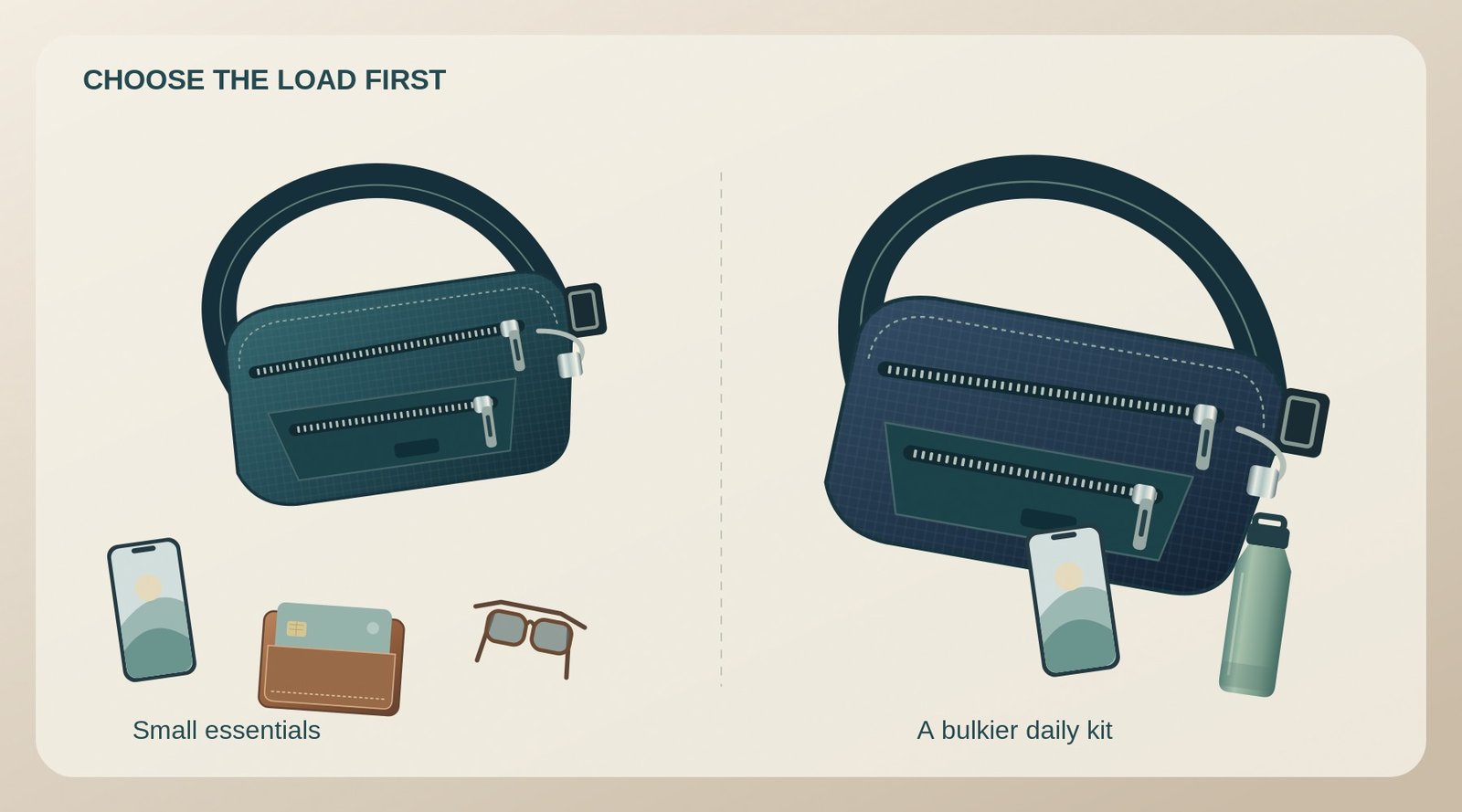
Think in three layers: immediate access, protected daily essentials and emergency backup. Tissues or a low-value transport leaflet belong in the first layer. A wallet and phone belong in a secured compartment. A genuinely separate backup card should not live in the same sling as every other means of paying.
That distinction matters because adding internal dividers only organises one container. If the whole container is lost, all its divisions go with it. A second card holder is useful only when it is stored separately and appropriately; the additional accessory alone does not create independence.
A realistic packing rehearsal
Remove the objects that do not earn their place. Old receipts, spare cables for devices left at home and an oversized purse can consume a surprising share of a small sling. However, do not remove an essential item merely to make a preferred bag pass the test. Choose a different bag when the necessary kit does not fit comfortably.
Keep small objects from changing position
Put keys where their attachment point and sharp edges will not rub a screen. Coil a short charging cable instead of letting it fall across the zipper track. Then rehearse putting the phone away one-handed while the bag remains supported. The aim is a predictable layout, not an elaborate system requiring several pouches for a handful of objects.
Use it sensibly on transport and at stops
Crowded trains and busy streets
Bringing a sling forward can improve your view of its opening, but it is not a guarantee against theft. Keep closures finished rather than relying on body position alone. Police advice recommends keeping bags closed, carrying them in front or diagonally across the chest and returning cards promptly after use. [6]
Avoid reorganising the entire bag while standing in a doorway or blocking a queue. Instead, step aside somewhere suitable before retrieving the item that has slipped underneath everything else. This is another reason to practise your layout before travelling: easier access reduces the need to empty the contents at awkward moments.
Flights and the extra-bag assumption
A small sling is still a bag. Do not assume wearing it means it sits outside the airline's item allowance. Ryanair's standard allowance is one small personal bag, while easyJet also gives one small under-seat bag; additional allowances depend on the booking. Check the rules for your flight and leave space to put the sling inside the permitted main bag when necessary. [7] [8]
This creates a useful packing constraint. A rigid or overfilled sling may fit your body perfectly but be awkward to nest inside a tightly packed cabin backpack. Rehearse the combined arrangement before leaving home rather than trying to find space at the boarding gate.
Cafes, toilets and charging stops
Keep the bag with you instead of placing it out of sight on the floor or hanging it behind a chair. A strap attachment feature should not become an excuse to walk away from valuables. Likewise, avoid routing charging cables so that you must leave the bag separated from you to use an available socket. [6]
Before moving on, use a brief count: phone, wallet, keys, bag. The routine need not be theatrical or time-consuming. It is simply easier to notice a missing item before you have walked away from the place where it was last used.
Weather protection and everyday care
Water-repellent is not a dry-bag promise
Several of these slings use a water-repellent shell, but that description does not establish a waterproof finished bag. Zips, seams and openings still matter. Protect documents and electronics separately when prolonged rain or splashes are realistic, and do not assume a fabric rating applies to an assembled compartment. [1] [2] [3] [4]
Keep the protective layer proportionate. A compact document pouch may solve the particular problem without turning the sling into a stack of nested cases. However, avoid trapping damp contents inside after the outing. Empty the bag and let wet items dry appropriately before packing again.
Inspect the parts that do the work
Follow the maker's care instructions, particularly around reinforced materials and security hardware. As a practical check, look for grit in zipper tracks, loose threads near load-bearing joins and a buckle that no longer closes positively. Do not oil, machine-wash or modify components unless the manufacturer recommends that treatment.
A bag with a damaged closure should not continue to be treated as if the original security specification still applies. Ask about repair or replacement parts, and keep the receipt and exact model details. Cosmetic wear and a broken functional component are different questions when considering a warranty claim.
Buying without paying for the wrong features
Compare the exact offer
Check the model name, product code, size and photographs together. Colour selectors sometimes expose different generations, while a familiar title can survive a product update. The retailer's delivery location, return address and seller identity also matter, particularly on marketplaces. A low headline price is not enough information to make the offer the best one.
We have not included temporary discount claims or supposed live prices. Before buying, compare the final delivered cost with the manufacturer's current listing and a suitable local stockist. When the generation cannot be established clearly, ask the seller rather than assuming that an old description is simply a harmless naming difference.
Decide what you would actually use
Write down the feature that justifies replacing your existing bag. Perhaps it is a closure you can finish reliably, a strap adjustment that fits over a coat, or a shape that accommodates your glasses without overfilling. If the answer is only a long list of reassuring names, pause and test the practical need again.
Pros and cons of choosing an anti-theft sling
What the category can offer
A sling can keep a modest kit together and make it accessible without taking off a full backpack. Documented closure and reinforcement features provide specific things to inspect instead of relying on a reassuring product name. For an appropriate load, a compact shape can also be easier to keep within view when you need to bring it forward.
Where the compromises remain
A single strap concentrates the load asymmetrically, while security hardware can slow your own access. Bigger models can encourage unnecessary contents, and a reinforced bag can still be lost or taken as a whole. Whether a sling is the better choice therefore depends on your normal load, the fit and a closing routine you are willing to maintain.
Common mistakes to avoid
Buying too large for the everyday load
Extra litres can make a bag less convenient when they encourage unnecessary contents. Start with what must travel on an ordinary day, then decide how often the exceptional larger load occurs. Renting, borrowing or using an existing backpack for that occasional day may be more sensible than carrying an oversized sling throughout the trip.
Confusing reinforcement with permission to relax
A closed, reinforced bag remains something that can be misplaced or taken as a whole. Avoid the temptation to leave it behind simply because the strap can attach to furniture. Good equipment should support attentive habits rather than replace them with confidence the evidence does not justify.
Ignoring the return test
Unpack the new sling at home while there is still time to change your choice. Check your normal phone case, glasses case and clothing combination, not just the empty bag. Finally, practise the closure until you know whether its operation suits you. Discovering an unsuitable fit on the first travel morning leaves fewer useful options.
Frequently asked questions
Are anti-theft sling bags actually theft-proof?
No. The useful features concern particular parts of the design, such as the opening, strap or reinforced panels. They do not make a bag impossible to steal or prevent its owner from leaving it behind. Judge a model by the documented features and how reliably you can use them, not by an absolute promise. A sensible carrying routine remains necessary even when the bag has several extra security mechanisms.
Is wearing a sling at the front enough on its own?
Front wear can make the bag easier to see and reach, but it does not replace finishing the closure. Also check whether the position is comfortable when walking and sitting, rather than keeping it somewhere awkward simply because the product photograph shows that position. The bag should remain under your control without obstructing ordinary movement. Review the arrangement when you enter a busy vehicle or stop to take something out.
Which size is best when I carry a water bottle?
Use the dimensions of the actual bottle, including its lid and handle, in a fitting test. A nominal capacity cannot establish whether a tall flask fits through a narrow opening or remains secure in an external pocket. Travelon Classic has a stated side bottle pocket, but that does not establish compatibility with every bottle. If water, a jacket and electronics all need to travel, compare a larger bag or a two-strap daypack. [5]
Does the V Tech fit a thirteen-inch laptop?
Do not buy it on that assumption. The current Pacsafe description used for this guide specifies an eleven-inch iPad Pro and most eleven-inch tablets, rather than a general thirteen-inch laptop promise. Older retail descriptions can differ. Compare your device with its case against the actual sleeve and obtain confirmation when the fit is essential; a diagonal screen measurement does not define the outside dimensions of the device. [4]
Can I add an ordinary strap extender?
Check with the manufacturer before adding an extender to a security strap or proprietary buckle. A connector that happens to fit mechanically has not necessarily been approved for the system, and it can change both fit and the function of the original hardware. Start with the maker's published measurement method and try the bag over your normal travel clothing. Choosing a better-fitting model is preferable to relying on an unverified modification.
Should every item go inside the RFID pocket?
No. Decide what the designated pocket is intended to shield and whether that matches your need. Keys, tissues and a glasses case do not gain the same sort of benefit from a radio-frequency shield as a compatible contactless item. More importantly, placing everything in that pocket may make access awkward. Physical closure, sensible organisation and independent backups address different problems from RFID shielding, so keep those decisions separate.
Will a small sling count as an extra cabin bag?
Do not assume a worn sling is automatically excluded from an airline's item count. Check the allowance on the actual booking and whether the sling needs to fit inside the permitted bag at the gate. Rehearse that combination while packing at home. Even a compact sling can be difficult to nest if it is rigid or tightly filled and the larger bag has no spare space. [7] [8]
What should I check before buying a sling for wearing over a coat?
Measure the crossbody route over that coat and compare it with the maker's stated method and adjustment range. Then consider buckle placement and whether you can operate the opening without taking the bag off. Leave useful adjustment for lighter clothing as well. A bag that just fits at its maximum setting may be less flexible than you expect when layers or the preferred wearing position change during the trip.
Is a ten-litre sling better than a small backpack?
Not automatically. Ten litres can be a useful size when you want a larger front-access format, but the load still hangs asymmetrically. Try the actual kit and pay attention to neck pressure, shoulder comfort and the temptation to support the bag by hand. When the contents are dense or you will carry them for long periods, a suitable two-strap backpack deserves a direct comparison rather than being dismissed because it looks larger.
What is the most useful check after the bag arrives?
Keep the tags attached and conduct a careful indoor fitting that meets the retailer's return conditions. Load the normal essentials, sit down, reach for the phone and finish the security closure several times. Check the bottle or glasses case rather than substituting a smaller object. This test cannot establish theft resistance, but it can reveal a poor personal fit or an access routine that would frustrate you every day.
The final recommendation
For a small, everyday valuables kit, begin with the Pacsafe GO and check that your real contents fit without forcing the zip. Choose V Action for a genuinely preferred vertical shape, or V Urban when the wider layout solves an identifiable packing problem. V Tech belongs on the shortlist when its tablet-led capacity is necessary; Travelon Classic is the alternative to inspect when separate pockets and a bottle pocket are the deciding features. [1] [2] [3] [4] [5]
The decisive test is not whether the bag has the longest feature list. It is whether you can carry it comfortably, find what you need and secure it again without turning every small transaction into a struggle. Buy the smallest suitable format rather than the smallest format in theory.
Keep a sensible backup outside the same bag, respect the carrier's baggage allowance and review the current listing carefully. Most importantly, accept the limits of the category. These slings can offer useful obstacles and organisation, but none gives a promise that your belongings cannot be lost or stolen.
Sources and fact-checking notes
Manufacturer pages and the linked policy guidance were reviewed on 10 October 2026. Several UK marketplace pages could not be fully inspected, so retail stock, offered generation and delivery must be confirmed before purchase. Named security features are maker claims, not independent attack-test results. No current-price or universal-fit guarantee is made.
- Pacsafe GO Anti-Theft Sling PackCurrent GO capacity, closure and reinforcement features.
- Pacsafe V Action / Vibe 150Current V Action specification and legacy Vibe 150 naming.
- Pacsafe V Urban / Metrosafe X Urban SlingFive-litre model, dimensions and physical security details.
- Pacsafe V Tech / Vibe 325Ten-litre current model, tablet guidance and security hardware.
- Travelon Anti-Theft Classic Sling, style 42887Pocket arrangement, dimensions and maker cautions about design changes.
- Metropolitan Police: pickpocketing precautionsPractical advice about closed bags, position and avoiding unattended belongings.
- Ryanair bag policyItem allowance; recheck the booked fare and travel date.
- easyJet cabin-bag FAQsSmall-bag allowance and booking-specific additional bags.
Illustrations in this article were created for Taylor’s Trailblazing Travel Gear. Third-party photographs, where used, are credited beside the image or in the source list.