
How Heavy Should an Empty Suitcase Be?
Compare the shell, the useful features and the hidden accessory weight before paying for a lighter case.
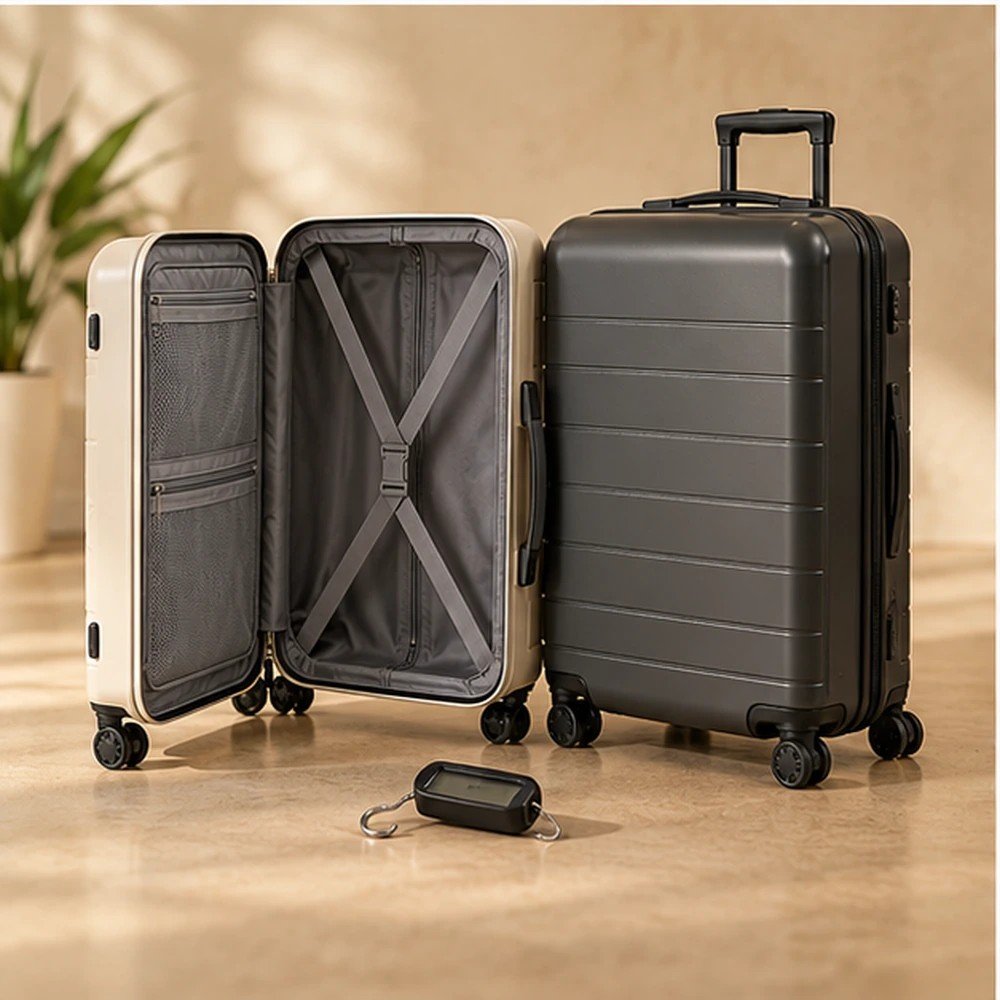
Original AI-created editorial illustration; not a photograph of a tested product.
How heavy should an empty suitcase be before you decide it is using too much of your baggage allowance? The answer is not one universal number. A cabin case under a restrictive limit deserves a different assessment from a large checked case carrying a modest wardrobe.
What matters is the relationship between the empty container, the possessions it needs to hold and the way you will move it. A lower figure can preserve useful allowance or reduce the complete load. However, the lightest specification does not automatically mean the best interior, the easiest lifting handle or the most sensible purchase for occasional travel.
This guide uses actual published examples to show the range, then puts those weights into everyday calculations. It also looks beyond the shell: a new collection of packing cubes, a substantial wash bag and other accessories can use up the saving before you add any clothes.
The aim is to decide whether to keep, repair or replace your case with a clear reason. The comparisons are based on manufacturer and retailer information, not personal endurance tests. Illustrative budgets and spending examples are labelled as calculations, while discrepancies in published specifications are kept visible rather than hidden inside a confident ranking.
About 2-3kg
Use your actual size and weight allowance, not this range alone.
About 3-4kg
Compare capacity, closure and useful features alongside grams.
Count organisers
A lighter shell can be offset by a heavier accessory arrangement.
Keep, repair or replace
Choose the action that solves your actual recurring problem.
How heavy should an empty suitcase be?
For ordinary leisure travel, useful comparison targets are roughly 2-3kg for a cabin spinner, 3-4kg for a medium checked case and 3-4.5kg for a large checked case. These are editorial shopping ranges, not safety standards, manufacturing requirements or a claim that every good suitcase sits inside them.
Lighter examples exist, especially in premium ranges. Aluminium shells, substantial frames and elaborate compartments can sit well above these targets. A heavier case can still be a sensible purchase when you deliberately value those features and have enough allowance left for your belongings.
Judge the complete trade-off, not one number
The useful question is how much weight you can remove without losing the capacity, handling, organisation or repairability that you actually need. A light case that is awkward to lift, too small for your equipment or difficult to repair may not improve your trips.
Equally, a heavy case does not become robust merely because it feels substantial in a shop. Empty weight is one measurable property. It does not independently tell you how long the wheels will last or how the shell will respond to a particular impact.
Use the ranges to shortlist, then calculate what the case leaves within your most restrictive regular allowance. If your packed bag is comfortably below that limit and handles well, you may not need to replace it at all.
Define "empty" before comparing suitcase weights
An empty suitcase should normally include the fitted lining, standard dividers, wheels, handles and other components supplied as part of the usable case. Take out packaging, shop labels and anything you personally added before weighing it.
A shipping weight is different. It can include the cardboard carton and protective materials, making it unsuitable for calculating your baggage payload. A marketplace’s “item weight” field can also be incomplete or refer to the wrong size, so check the exact model description.
Record your real starting configuration
If you always travel with a luggage cover, strap or removable organiser, record both the bare case weight and the normal ready-to-pack weight. That prevents you from celebrating a lighter shell while overlooking the accessories that immediately go back inside.
Do not strip out protective or structural parts to chase a target. A removable packing container designed to come out is different from dismantling a liner, frame or wheel assembly. Follow the manufacturer’s intended use rather than modifying the case on the basis of a small scale saving.
For a new purchase, use published specifications to narrow the search, then weigh the delivered case in the configuration you will actually use. A discrepancy worth querying is easier to address before the first journey than after you have packed to the final gram.
What real suitcase specifications look like
The examples below show why blanket statements such as “all large suitcases weigh 5kg” are unhelpful. These are published specifications, not our own laboratory measurements. The selection illustrates different constructions and sizes; it is not a ranking of the best suitcases.
| Exact example | Size or format | Published empty mass | What the comparison illustrates |
|---|---|---|---|
| Samsonite C-Lite 55cm expandable, 134679-1 | 55 x 40 x 20cm unexpanded | 2.1kg | A lighter cabin-spinner benchmark [1] |
| Aerolite M-Lite Premium Full Aluminium, Silver | 55 x 38 x 23cm | 4.85kg | Metal shell and front-access features carry a mass cost [2] |
| Samsonite Upscape 68cm | 75/83L medium | 3kg | A conventional checked-case comparison [3] |
| Tripp Holiday 8 Slate Medium | 66/75L medium | 3.6kg | Smaller capacity is not always lighter [4] |
| Samsonite Essens 69cm | 88L medium | 3.8kg | Roomy latch-closing format [5] |
| Samsonite Lite-Box Alu 69cm | 71L aluminium | 6.6kg | A substantial metal-shell alternative [6] |
| Samsonite C-Lite 75cm | 94L large | 2.8kg | Some large cases weigh less than many mediums [7] |
| Samsonite Proxis 75cm | 98L large | 3.1kg (note below) | Check the current model specification [8] |
Version note: Samsonite’s current Proxis page lists 3.1kg; an inspected retailer listing states 2.9kg. Use the manufacturer figure for planning and ask the seller about the supplied version when weight is decisive.
The table deliberately includes heavier products to show the range of trade-offs. Their presence is not a recommendation to carry a heavy shell under a restrictive allowance.
Calculate the case's share of your allowance
Subtract empty suitcase weight from the total allowance to find the maximum remainder for everything else. Then subtract organisers and other additions, and decide whether to leave a personal margin. The arithmetic is simple, but it needs the correct starting weight.
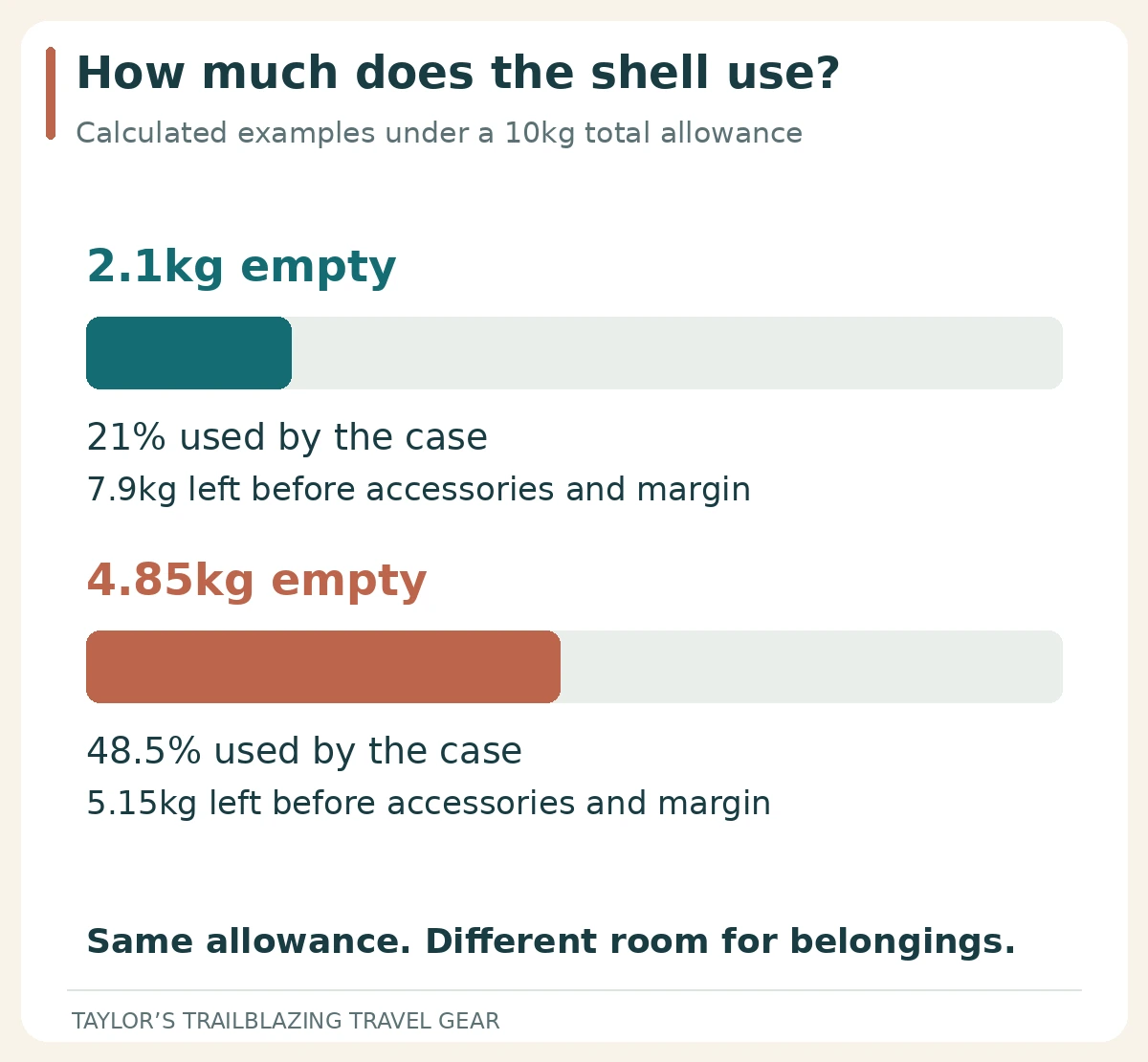
For example, under a hypothetical 10kg cabin limit, a 2.1kg case leaves 7.9kg before accessories and margin. A 4.85kg case leaves 5.15kg. The difference is 2.75kg: a meaningful change when the allowance is small.
Percentages make different limits easier to compare
The 2.1kg shell uses 21% of that illustrative 10kg limit, while the 4.85kg shell uses 48.5%. Under a 23kg checked allowance, a 3kg case uses about 13% and a 6.6kg case about 28.7%. These percentages are calculated examples, not recommended maximum shares.
A higher allowance can make the same suitcase more practical, but it does not make it easier to lift. Keep the airline’s permission separate from your preferred handling weight.
Check the actual allowance each time. British Airways, for instance, publishes different baggage arrangements by cabin and booking, and still requires passengers to lift their cabin bag into the overhead compartment unassisted. Do not select a case on weight allowance alone. [9]
Cabin luggage: the shell can consume half the budget
Cabin cases deserve particularly close attention because the empty container can use a large proportion of a modest weight allowance. Size also matters: a light 55cm spinner is not automatically the small under-seat bag included by every airline.
C-Lite 55cm expandable: preserve room for your belongings
The Case Luggage listing for the Mystic Plum C-Lite 134679-1 gives 2.1kg and an unexpanded 55 x 40 x 20cm exterior. It is an example to compare when you value a light wheeled container more than a complex front compartment. Check the exact listing because C-Lite versions and product identifiers differ. [1]
The linked Mystic Plum version was sold out when checked on 15 October 2026, so treat it as a specification example rather than an immediate purchase. Its useful contribution is the low starting mass, not an automatic promise of airline compatibility. Expansion changes the packed depth, and the actual airline allowance remains the final check.
Aerolite full aluminium: make the feature trade consciously
Aerolite’s silver M-Lite Premium Full Aluminium cabin model lists 4.85kg, 55 x 38 x 23cm and a front laptop compartment. That is a different product from Aerolite’s aluminium-frame model with STOP wheels. Do not mix their measurements or features. [2]
The full-aluminium model might interest someone who specifically wants that construction and front access. However, it would not be my default choice for a restrictive 7-10kg allowance. The shell takes too much of that budget unless the remaining packing list is unusually light.
Medium checked cases: compare capacity as well as mass
A 3kg medium case and a 3.8kg medium case can both be reasonable, but the difference should buy something you value. Look at their actual dimensions, closure arrangement and usable interior rather than assuming the heavier one simply has thicker material everywhere.
Upscape versus Tripp: a 600g difference with different capacities
Samsonite’s Upscape 68cm is listed at 3kg and 75/83 litres. Tripp’s current Holiday 8 Slate Medium is 3.6kg and 66/75 litres. Those figures show that the smaller-capacity example is not necessarily lighter. [3][4]
The point is not that a 600g difference settles the purchase. Handle comfort, price, layout and your ability to obtain the right size still matter. A traveller with several kilograms of spare allowance may prefer the case that feels more manageable rather than the lowest number.
The inspected Upscape retailer page showed Cloud White sold out. Keep the manufacturer page available when comparing the model; do not assume that an attractive listed price means your preferred colour can currently be ordered.
Essens: more room and a different closure
At 3.8kg and 88 litres, the Essens 69cm provides a roomier medium format with a three-point closure and removable packing containers. Those are tangible differences to evaluate, not reasons to dismiss it for weighing more than the Upscape. [5]
A sensible choice might be to accept the extra mass because that interior suits shared packing. An equally sensible choice is to reject it because your list fits a smaller, lighter bag and you do not need the additional room.
Large checked cases: light does not mean you must fill them
A large case can weigh less empty than a medium one, as the 2.8kg C-Lite 75cm illustrates. Its published 94-litre capacity provides space without a particularly heavy starting container. The 98-litre Proxis 75cm offers another large comparison at the current manufacturer weight of 3.1kg. [7][8]
Keep the saving rather than spending it automatically
If replacing a heavier case saves 1.5kg, you can use that as a lighter total bag. There is no obligation to add 1.5kg of souvenirs or clothing. For someone who dislikes carrying luggage up steps, reducing the complete load may be the main benefit.
However, a large lightweight shell still occupies a large space. It will not become easier to fit into a cupboard or small boot merely because its empty weight is impressive. Measure the exterior and try the practical lift points before committing.
Consider the packing layout after some items have been removed during the trip. A large case containing a small loose load may need better restraint to prevent contents shifting. Use the built-in straps and appropriate organisation instead of filling empty space with unnecessary heavy objects.
The buying decision should therefore include two targets: enough capacity for the list and a complete packed weight you are happy to move. The lightest large case is not automatically the most convenient case for a small load.
Why material labels do not predict the whole suitcase
Polypropylene, polycarbonate, textile and aluminium describe important aspects of construction, but they do not determine the finished mass by themselves. Frames, wheel assemblies, handle rails, lining and pockets all contribute. Compare whole products of similar size rather than ranking materials in isolation.
The Lite-Box Alu 69cm is a useful counterpoint: Samsonite lists its aluminium construction at 6.6kg and 71 litres. It demonstrates the possible cost in empty mass of a substantial metal-shell design. That specification does not, by itself, establish better protection for every kind of contents. [6]
Separate an aesthetic preference from a performance claim
You may prefer the appearance and feel of metal luggage. That is a legitimate preference, provided the weight penalty is deliberate. It becomes misleading only when the extra mass is treated as proof of superior durability without suitable comparative evidence.
Likewise, a flexible shell is not automatically flimsy, and a rigid-looking case is not necessarily strong at its wheel mounts. Without equivalent impact and endurance tests, avoid turning hand pressure in a shop into a confident longevity prediction.
Read the warranty and repair process for the exact product. Ask what happens when a wheel breaks, whether compatible parts can be identified and where the bag would need to go for assessment. Those answers may matter more over several years than a small difference in empty grams.
Compare like-sized cases without abusing grams per litre
Dividing empty grams by advertised litres can be a rough screening tool, but it is not a quality score. Published capacity methods may differ, expansion can inflate the denominator, and an awkward interior may make some of those litres less useful to your packing list.
For example, the C-Lite 69cm lists 2.5kg and 68 litres. The Nuon 69cm retailer listing gives 3.2kg and 79/86 litres. The Nuon has more published capacity but also more mass, while expansion changes the comparison again. A simple ratio cannot decide which case fits your actual possessions better. [10][11]
Use the ratio only to identify a question
If a case looks unusually heavy for its capacity, ask what accounts for the difference. It may have a frame, a substantial access panel or more elaborate organisation. Then decide whether those features are useful rather than automatically rejecting them.
A better final test is physical: do your important items fit, can you close the case normally and does the complete bag remain manageable? That test captures shape and handling in a way a spreadsheet ratio cannot.
Avoid comparing a compact cabin case with a large checked case on the same ratio and declaring a winner. Different sizes have different proportions of wheels, handles and usable volume; the comparison should answer your purchase question, not create an artificial league table.
Wheels, handles and pockets: where useful weight can live
A stronger-feeling handle or smoother wheel arrangement can be worth some additional mass, but the value depends on your route. A frequent airport traveller may prioritise controlled rolling, while someone carrying a case up stairs needs good fixed lifting handles and a manageable total load.
Test the things you touch repeatedly
Extend the pull handle through its available settings and make sure the position suits your height. Turn the case beside you without having to hold it at an awkward angle. Check the clearance between your hand and the shell at both fixed handles.
A little movement in a telescopic handle is not, on its own, a reliable diagnosis of failure. Compare the function, check that it locks as intended and ask about the design if you are concerned. Do not create a durability conclusion from one quick shake.
Front pockets and access compartments deserve the same practical assessment. They can be valuable for a laptop or documents, but add material and may reduce the main compartment’s useful shape. A compartment that duplicates the work of a separate bag you already carry may not justify its weight.
Ask whether the component is repairable. Samsonite’s spare-parts process relies on identifying the product, so retain the model information rather than assuming a visually similar wheel will fit. Repairability is a practical question about parts and support, not simply a marketing adjective. [12]
Weigh your empty suitcase at home without fooling yourself
Remove all contents and check small pockets, because a forgotten cable or wash bag can make an apparently heavy case seem heavier than it is. Remove packaging, but leave normal fitted parts in place. Close the suitcase and record its configuration.
Use a luggage scale according to its instructions, attaching it to an appropriate fixed carrying handle. Suspend the case fully clear of the floor and keep it from leaning against your body. Repeat the measurement if the reading is unstable or unexpectedly different from the specification.
A scale is useful only within a safe lift
Do not struggle to raise a heavy packed suitcase just to obtain a number. Use suitable platform equipment or assistance when needed. For an empty case, the lift is usually less demanding, but your own handling limits still matter more than completing a test unaided.
Go Travel’s Digital Scale Pro includes a tape measure and is listed at 91g. Its nominal 50kg weighing capacity is a device specification, not a recommendation that you lift a 50kg object. The display and unit setting should be checked before relying on the result. [13]
A bathroom-scale subtraction method can be a rough cross-check, but it combines two readings and may be too coarse to judge a small specification discrepancy. Where a few hundred grams would determine the purchase, use a more suitable measurement rather than treating a rounded result as definitive.
Add organisers to the budget before celebrating a lighter shell
Replacing a suitcase to save 500g while adding a much heavier organiser system may leave the total unchanged. Weigh the entire arrangement you plan to travel with, not just the item whose marketing emphasises lightness.
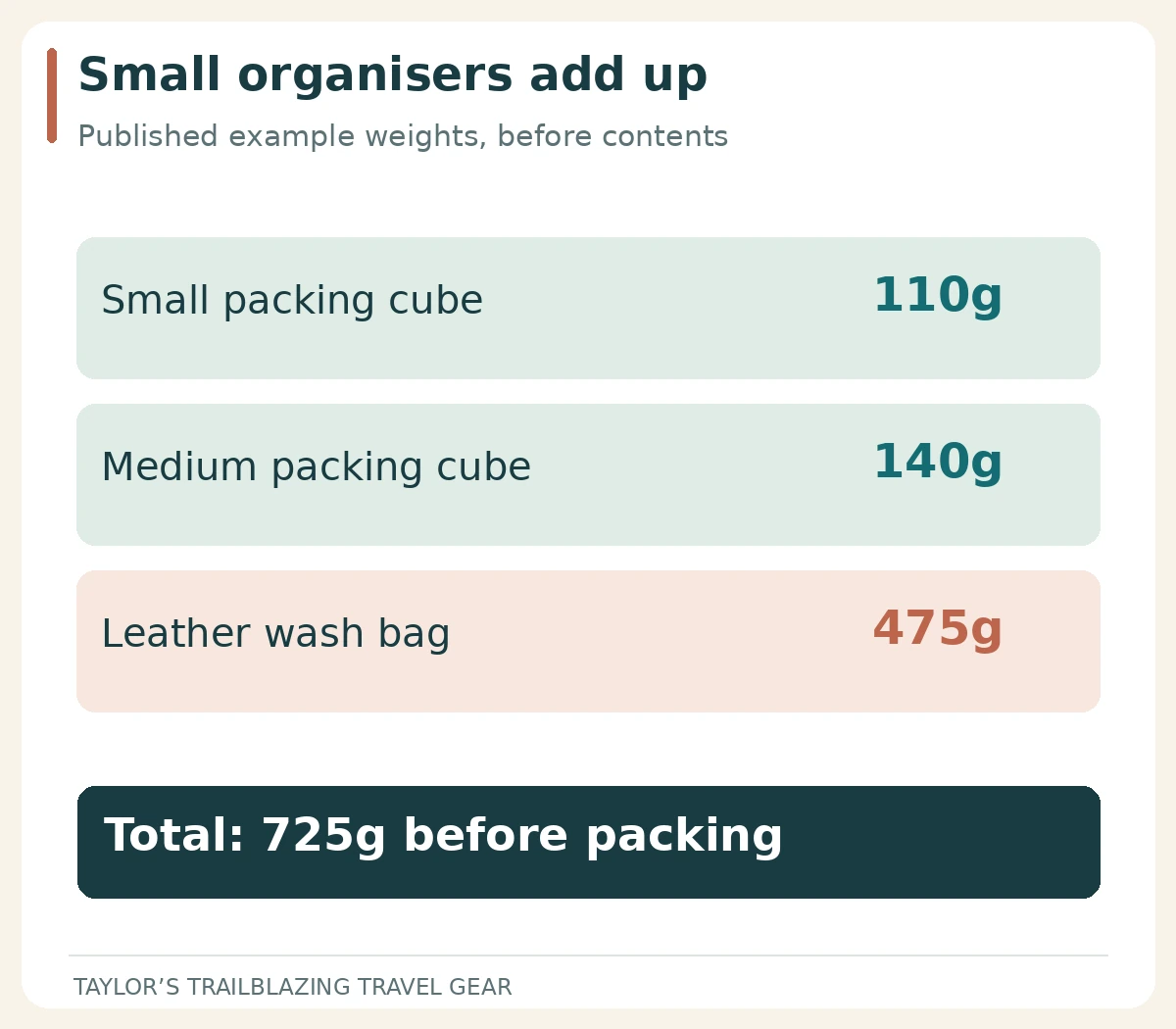
Case Luggage lists the Peak Design Small Packing Cube at 110g and the Medium at 140g. They provide different sizes for organising a load; the smaller one is not automatically preferable if several small cubes replace a single useful medium. [14][15]
Buy the organisation you need, not the entire set
One traveller may benefit from a small underwear cube and a separate main clothing cube. Another may need only the built-in divider. The useful calculation is the weight and convenience of the complete system, including any laundry or shoe bags.
The linked Sage Small cube was sold out on 15 October 2026. Use an organiser you already own or compare current colours before planning a purchase.
TORRO’s Leather Wash Bag is listed at 475g empty. That can be a perfectly deliberate choice for someone who values the material and structured compartments, but it is not a lightweight alternative to a simple pouch. Include the 475g before adding bottles and grooming items. [16]
These three published organiser weights total 725g. That arithmetic makes the hidden trade visible: a 500g saving on the shell can be more than used up by a new accessory arrangement. It does not mean the accessories are bad; it means the comparison should use the whole bag.
Decide whether paying for a lighter case is worthwhile
Start with the actual saving. Replacing a 4.5kg case with a 3kg one saves 1.5kg before any other changes. Replacing a 3.2kg case with a 3kg one saves 200g. Those are different propositions even when both products are advertised as lightweight.
Then ask when that saving helps. Does it keep your ordinary packing list below a recurring limit? Does it make the bag noticeably easier for you to lift? Or does it simply create room for items you could have left behind?
Use a personal value calculation, not a guaranteed return
As an invented spending example, suppose a lighter model costs an additional £150 and saves 1kg. If you expect to use it for 30 trips, the additional purchase cost averages £5 per trip. Those are hypothetical figures, not checked product prices or a prediction of lifespan.
That comparison can help you decide whether the convenience feels worthwhile. It is not a claim that the case will prevent a particular number of airline fees, because baggage charges depend on the booking and can change.
For infrequent use, borrowing a suitable case or keeping a reliable one may be better value. For frequent restrictive cabin travel, a substantial empty-weight reduction could matter more. Make the decision around your real pattern of trips instead of an aspirational itinerary you rarely take.
Keep, repair or replace: three different decisions
Keep the case when it fits your possessions, stays within the allowance and handles predictably. A serviceable bag does not become unsuitable because a newer model is lighter. Removing duplicate clothing may achieve a larger saving than replacing the shell.
Repair is worth investigating when a specific replaceable component is the problem. Identify the exact model, describe the fault and ask the manufacturer or an appropriate repairer about the intended remedy. Do not fit an approximate wheel and assume the case will stand or roll correctly afterwards. [17]
Replace when the mismatch is structural to your use
A case that is always too heavy empty for your cabin limit, too large for regular transfers or incapable of holding an essential item may be the wrong design rather than a damaged one. Repairing a wheel will not solve that underlying mismatch.
Before discarding a case, compare its real ready-to-pack weight with the alternative. Include any new accessories you would buy and note features you would lose. A lighter replacement with no useful lifting handle or less workable interior could trade one frustration for another.
Clean and store a retained case according to its manufacturer’s guidance. Avoid improvised chemical treatments and keep it dry before storage. Good care does not guarantee a particular lifespan, but there is little value in replacing luggage merely because a removable surface mark has been mistaken for structural damage. [18]
Heavy items belong where the rules and the layout permit
Reducing case weight does not change restrictions on its contents. The CAA requires power banks and spare batteries to travel in the cabin, with the airline’s detailed rules also applying. They should not be transferred to the hold simply to make a cabin bag lighter. [19]
Nor is transferring every dense item to your pockets a dependable packing strategy. You still need an arrangement that is comfortable, accessible and consistent with the operator’s conditions. Edit unnecessary items rather than designing the journey around hiding their weight.
Distinguish a useful organiser from ballast
Do not add heavy objects to stabilise a case that tips or rolls badly. Investigate packing balance, attachments, ground conditions and wheel damage. Extra mass consumes allowance and can make the resulting fall more difficult to manage without correcting the underlying cause.
If you need an organiser to stop clothing shifting, start with the restraints supplied with the bag. A compression set is optional. BAGSMART’s six-piece suitcase set can help separate categories, but only the pieces you actually use need to travel. Its compression feature is about volume, not removing the mass of the clothes inside. [20]
The goal is a balanced, useful load that you can manage throughout the journey. A low empty weight is a helpful starting point, not permission to ignore where and how the final contents travel.
The benefits and limits of chasing a lower empty weight
Where a lighter case helps
It preserves more of a restrictive allowance for useful belongings or lets you keep a lighter total load. The benefit is easy to calculate and can matter on repeated lifts, stairs and transfers. A substantial saving is particularly relevant when the existing shell consumes a large share of a cabin limit.
Where the number is not enough
It does not prove durability, repairability or comfortable handling. A lighter case can have a layout that wastes useful space, while a premium saving may offer little value to an occasional traveller. Accessories and extra packing can also erase the advantage before the first journey.
Avoid the common shopping shortcuts
Do not use shipping weight as empty case weight, compare different sizes without acknowledging the difference, or confuse a collection name with an exact current model. Check whether capacity is expanded and whether the listed dimensions include the parts your airline measures.
Avoid a false trade between “light” and “strong” without comparable evidence. The useful comparison is between specific cases, their construction, support and your intended use. A manufacturer’s test claim should remain a manufacturer’s claim unless independent evidence supports a broader conclusion.
Finally, do not treat the lightest option as a compulsory upgrade. A familiar case with a sensible packing list can be the best practical answer even when it would not win a specifications contest.
Frequently asked questions
Is 3kg heavy for a cabin suitcase?
It is towards the upper end of this guide’s ordinary 2-3kg comparison range, but context matters. Under a hypothetical 7kg limit, it leaves 4kg before accessories and a margin; under a more generous allowance it may be less restrictive. Check size and handling as well as the empty number.
Is 4kg too heavy for a medium checked case?
Not automatically. It may be acceptable when you want particular features and your usual load remains manageable. Compare it with similarly sized alternatives and calculate the actual remainder within your booking. A difference of a few hundred grams matters less when you routinely travel several kilograms below the limit.
Does an aluminium suitcase always weigh more?
Not every possible comparison will work out that way, because size and design differ. However, the particular aluminium examples in this guide are substantially heavier than the lighter polymer cases listed alongside them. Compare exact finished products rather than making a universal claim from a material label.
Should I remove the lining to save weight?
No, not unless the manufacturer explicitly designs that component to be removable and allows the intended use without it. A removable packing container is not the same as a structural or protective lining. Do not dismantle a case to obtain a small saving at the expense of its intended function.
Why does my scale disagree with the product page?
Check that you have the same model and size, have removed packaging and have not left anything in the pockets. Confirm the unit setting and repeat the reading with the bag freely suspended. If a meaningful difference remains, contact the seller rather than assuming either measurement must be correct.
Is the manufacturer’s average packing weight a maximum load rating?
Do not assume so. A suggested packing weight, an empty weight and a tested structural limit are different things. Use the airline’s rules for permitted baggage and ask the manufacturer when you need a specific load-rating answer. Your own packing list determines the actual completed weight.
Can I save more weight by using a backpack?
Possibly, but compare the entire arrangement and how you intend to carry it. A backpack may remove wheels and rails while transferring the load to your body. That is a different handling choice, not a universally better substitute for a suitcase. Consider the route, load and your comfort before switching.
What is the simplest way to make my existing suitcase lighter?
Remove unnecessary contents and duplicated organisers first. Weigh grouped items so you can see where the mass is concentrated. Do not remove structural parts or move restricted items into inappropriate baggage. If the empty case remains the main obstacle after editing the list, then compare a replacement.
A better target: the lightest case that still does your job
Use approximately 2-3kg for cabin, 3-4kg for medium checked and 3-4.5kg for large checked luggage as starting comparisons, not rigid definitions of a good suitcase. There are worthwhile exceptions, and your own allowance and handling needs determine which ones make sense.
Choose a lighter shell when the saving is meaningful and you retain the capacity, access and support you need. Accept extra weight when a specific feature earns it. Keep a sound existing case when the real problem is simply too many possessions.
The most informative number is ultimately the complete packed weight in a case you can use comfortably. Empty mass helps you get there, but it should support the decision rather than make it on its own.
Sources and fact-checking notes
Source review: 15 October 2026. Product information comes from the linked manufacturer or retailer pages. Airline conditions depend on the actual booking. Calculated budgets and practical judgements are identified in the text; no personal product testing is claimed.
- Case Luggage: Samsonite C-Lite 55cm expandable, 134679-1. Retailer listing for the Mystic Plum 134679-1 variant (sold out when checked): 55 x 40 x 20cm and 2.1kg.
- Aerolite: M-Lite Premium Full Aluminium Cabin Suitcase, Silver. 55 x 38 x 23cm; 40.25L; 4.85kg. Full-aluminium model, not the separate aluminium-frame STOP-wheel version.
- Samsonite: Upscape Spinner 68cm, 143109-1041. 68 x 47 x 28/31cm; 75/83L; 3kg; removable lining and suspension wheels.
- Tripp: Holiday 8 Slate Medium Expandable, item 46370. 65 x 45 x 28/32cm; 66/75L; 3.6kg. Manufacturer capacity takes precedence over conflicting marketplace fields.
- Samsonite: Essens Spinner 69cm, 146911-1549. 69 x 49 x 30cm; 88L; 3.8kg; three-point closure and removable packing containers.
- Samsonite: Lite-Box Alu Spinner 69cm, 122706-1004. 69 x 47 x 27cm; 71L; 6.6kg. An aluminium-weight comparator, not a lightweight recommendation.
- Samsonite: C-Lite Spinner 75cm, 122861-1041. 75 x 51 x 31cm; 94L; published empty weight 2.8kg.
- Samsonite: Proxis Spinner 75cm, 126042-1686. Current manufacturer weight 3.1kg; 75 x 51 x 31cm; 98L. Older retailer weights may differ.
- British Airways: baggage essentials. Checked-bag dimensions, per-piece allowance and fare-specific exceptions.
- Samsonite: C-Lite Spinner 69cm, 122860-1041. 69 x 46 x 29cm; 68L; published empty weight 2.5kg.
- Case Luggage: Samsonite Nuon 69cm, 134400. Exact retailer model listing. Treat colour availability and quoted specifications as variant-specific.
- Samsonite: spare parts. Identify model before ordering wheels or other parts; follow model-specific fitting instructions.
- Go Travel: Digital Scale Pro, 2004.101. 50kg maximum, 91g listed product weight, spirit level and built-in tape measure.
- Case Luggage: Peak Design Small Packing Cube, BPC-S-SG-2. Sage small variant; retailer lists 110g and 4.5/9L.
- Case Luggage: Peak Design Medium Packing Cube, BPC-M-SG-2. Sage medium variant; retailer lists 140g and 8/18L.
- TORRO: Leather Wash Bag, Black. 28 x 12 x 15cm; 475g; two compartments and water-resistant lining.
- Samsonite: repairs. Repair pathways and assessment by an authorised service centre.
- Samsonite: product care. Mild cleaning, drying and storage; avoid unsupported treatments.
- UK Civil Aviation Authority: Pack right. Safe flight.. Cabin carriage of power banks and spare batteries; keep essential items accessible.
- BAGSMART UK: 6PCS Compression Travel Packing Cubes for Suitcases. Named six-piece set, compression construction and included shoe bag.
Illustrations in this article were created for Taylor’s Trailblazing Travel Gear. Third-party photographs, where used, are credited beside the image or in the source list.