10-Day Carry-On Packing List With One Laundry Stop
10-Day Carry-On Packing List With One Laundry Stop
A six-change wardrobe, one properly timed wash and enough breathing room to travel home without a second bag.
A 10-day carry-on packing list works best when the laundry stop is part of the plan rather than a hopeful note at the bottom. You need enough clean clothing to reach the wash, something to wear while it is being cleaned, and time to receive or dry it before the next move. Counting those three stages avoids the familiar mistake of washing every wearable item at once.
The plan below is for one adult travelling for ten calendar days and roughly nine nights in mild or warm conditions. It assumes one proper laundry session after day five, with clothes usable by day seven at the latest. It is not an expedition, formal-event wardrobe or prescription for anyone who needs more frequent changes.
Every clothing count includes the departure outfit unless the table says otherwise. The target is a manageable bag, not the smallest possible online packing challenge. Clothing quantities, weight examples and laundry timing are editorial planning models; product details and baggage rules are separately sourced. No particular suitcase or backpack has been physically tested with this entire list.
Five days + a buffer
Six daily changes include the one you wear.
After day five
Keep the day-six outfit out of the wash.
Roughly 32–40 litres
An estimate to test—not an airline entitlement.
A drying window
The washed batch must be usable by day seven.
10-day carry-on packing list: the complete starting point
Use totals before adding extras
The baseline provides one clean top, underwear change and pair of socks for each of the first five days, plus a sixth clean set for the laundry window. This is deliberately more forgiving than a list that depends on repeated wear of every next-to-skin item.
Two everyday bottoms are included because many travellers can rewear suitable trousers or shorts between washes. That is a condition, not an instruction to wear something dirty. Add a third bottom or change the plan if your weather, activity, clothing or personal needs make that unrealistic.
Separate the worn outfit from the bag
Wear one top, one bottom, one underwear change, one pair of socks and your main walking shoes on departure. The other quantities go in the bag. The mid-layer may be worn or packed according to comfort, but it still needs to fit somewhere when you take it off.
| Item | Total for the trip | Worn on departure | Packed |
|---|---|---|---|
| Everyday tops | 6 | 1 | 5 |
| Underwear | 6 changes | 1 | 5 |
| Socks | 6 pairs | 1 pair | 5 pairs |
| Everyday bottoms | 2 | 1 | 1 |
| Sleepwear | 1 set | 0 | 1 set |
| Mid-layer | 1 | 0 or 1 | 1 or 0 |
| Light weather shell | 1 if appropriate | 0 | 1 |
| Main walking shoes | 1 pair | 1 pair | 0 |
| Second footwear | Optional only | 0 | 1 light pair only when justified |
Bras, swimwear, headwear, menstrual supplies, assistive items and other personal essentials depend on the traveller. Include them deliberately rather than treating this general list as permission to leave necessary items behind.
Decide whether this plan suits your trip
The assumptions that make it workable
Use this model for ordinary sightseeing, visiting friends, light work commitments or a relaxed holiday with broadly similar temperatures. A single reliable laundry stop replaces a second complete wardrobe. The benefit is reduced clothing quantity, not a promise that every traveller can use a tiny personal-item bag.
The six daily changes assume you are not regularly changing tops twice a day. Heavy exercise, humid conditions or work that soils clothing can change that calculation. Do not solve a mismatch by silently reusing something you would normally wash.
Identify exceptions before packing
Write down activities with special clothing needs: swimming, a smart dinner, a religious site, a cold early start or a long walk in wet weather. Prefer a suitable existing item that can cover more than one occasion, but do not force an unsuitable garment into a role just to maintain a low count.
If the trip includes a wedding, a large camera system, bulky medical equipment or several climates, the same laundry logic may still help. However, the stated volume target may no longer be appropriate. Adapt the bag and allowance to the real load.
Put the laundry stop where it can actually happen
Schedule it before the wardrobe runs out
The model washes after day five. That might mean a self-service machine on the fifth evening or a service whose collection and return fit the same window. Establish what the service accepts, when it closes and whether the quoted turnaround includes drying.
Avoid placing the only laundry session immediately before a hotel change. Your destination on the map is less important than access to a functioning machine or a dependable service. A two-night stay around the wash is a helpful planning choice because it creates recovery time.
Keep day six available
Reserve one clean top, underwear change and pair of socks before handing over the worn items. Also retain something suitable for sleeping and any bottom you need while the other is being washed.
The washed batch must be ready before you need it on day seven. That is the limit of this example, not a guarantee from a laundry provider. When a service cannot meet it, move the wash earlier or carry a larger clean-clothing reserve. A vague expectation that everything will dry overnight is not a schedule.
Follow the ten-day clean-change ledger
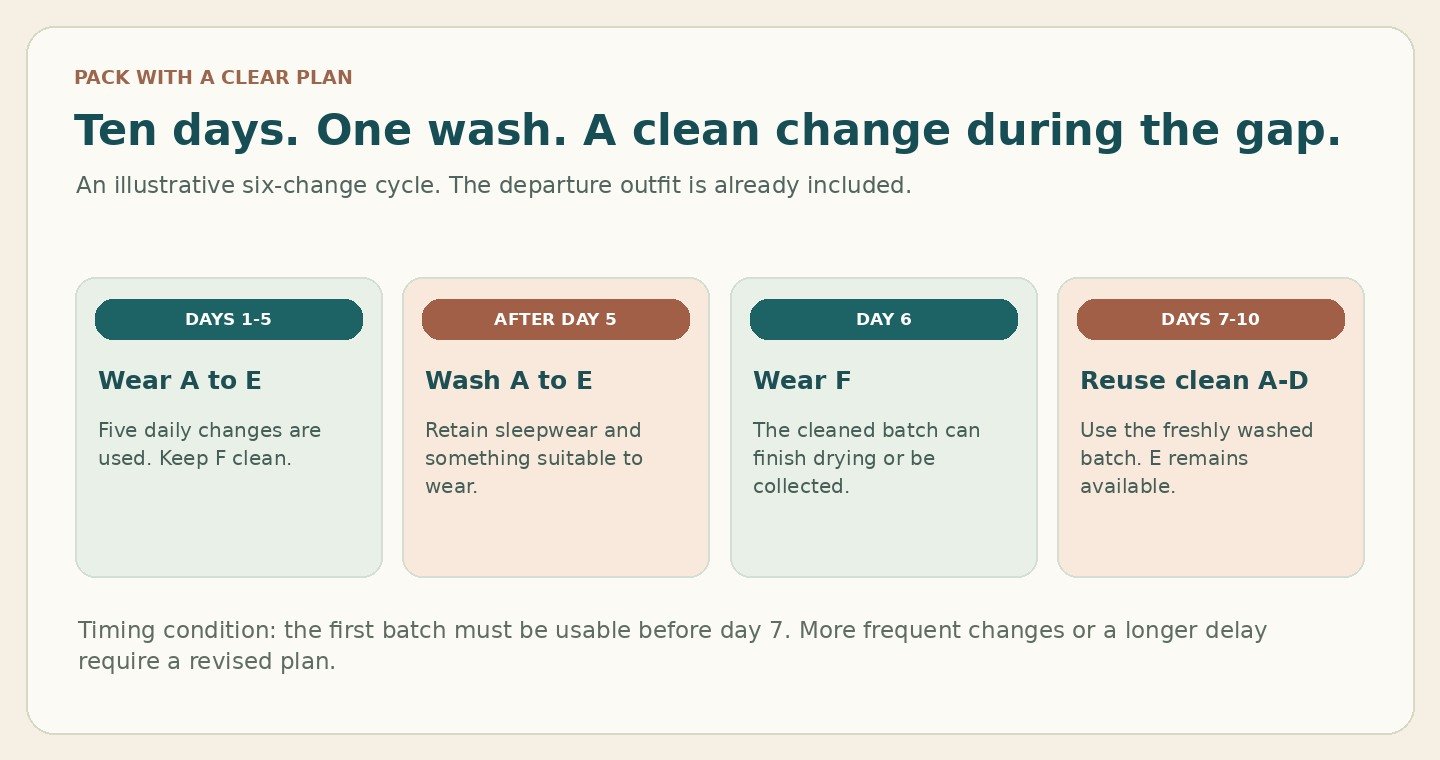
Six changes cover the gap
Label the daily sets A to F just for planning. Wear A to E on days one to five. Keep F clean. After the fifth day, wash A to E, then wear F on day six. Use freshly washed A to D on days seven to ten.
This is a clothing-inventory example, not a requirement to label actual garments or wear matching outfits. Tops, underwear and socks can each follow the same cycle even when their colours and combinations differ.
| Day | Clean set used | Laundry position |
|---|---|---|
| 1–5 | A, B, C, D, E in order | Five used sets accumulate |
| Evening 5 | Keep F untouched | Wash A–E; retain sleepwear and a wearable bottom |
| 6 | F | The washed batch may still be drying or awaiting collection |
| 7–10 | Freshly washed A, B, C, D | Washed E remains available in this model |
Notice what the spare actually does
The sixth set is not a permanent emergency reserve. It is used during the planned laundry gap. You still finish with one washed set available in this simplified model, but an unexpected extra change can consume that flexibility.
If the wash is delayed beyond the protected day, you need a real adjustment: collect a faster service, wash a small compatible item earlier, obtain another necessary change, or revise the packing plan before leaving. Do not pretend the original list covers unlimited delays.
Choose clothing that can share a wash
A small wardrobe needs compatible care
A six-top plan becomes awkward if two tops need specialist cleaning, one cannot mix with the rest and another takes much longer to dry. Read the labels before selecting the wardrobe. Prefer garments whose washing and drying requirements fit the laundry method you can realistically use.
That does not mean every item must be technical fabric or newly purchased. Familiar everyday clothing that you already understand is often the more dependable choice. Check colour transfer and shrinkage concerns at home rather than using the trip as the first wash.
Coordinate without making it rigid
Choose tops that work with either bottom and the same main shoes. A limited colour range can make this easier, but the goal is interchangeable use rather than a prescribed aesthetic. Include the clothes you genuinely enjoy wearing.
Try several combinations before packing. If one top only works with the extra shoes and special trousers, its real luggage cost is larger than the top alone. Keep a specific evening outfit only when the trip actually calls for it, not because ten days sounds too long to repeat anything.
Treat bottoms, sleepwear and bras separately
Not every category follows a daily cycle
The ledger tracks daily-change items. Trousers, shorts, skirts and sleepwear need their own schedule based on use and care. With two bottoms, keep one wearable while washing the other. Do not send both away unless you have a suitable alternative throughout the service window.
A third lightweight bottom can be a sensible addition when the first five days would otherwise be uncomfortable or impractical. Be honest about the added volume rather than assuming it appears free because it is not a top.
Reserve what cannot be unavailable
Where bras are needed, select enough suitable options to cover washing and drying without discomfort. The right count depends on support needs, activities and care requirements, so it is not hidden inside the underwear total.
Keep sleepwear accessible on the wash night. If it is also due for cleaning, wash it earlier or provide another appropriate arrangement. The phrase one laundry stop describes the planned main session; it does not make every garment magically available at the same time. Write down the exception rather than discovering it at bedtime.
Pick the bag after checking the allowance
Capacity is a planning aid, not permission
A roughly 32–40-litre bag is a reasonable starting range to trial with this mild-weather list. It is not a measured fit result, and it is not automatically allowed by an airline. Your fare determines how many bags you can bring and where they may be stored.
Ryanair currently includes a 40 × 30 × 20cm personal bag; its Priority option adds a 55 × 40 × 20cm cabin bag with a 10kg limit. easyJet’s small-bag limit is 45 × 36 × 20cm, while a booked large bag is up to 56 × 45 × 25cm. Check the exact booking before using either allowance. [1] [2]
Be wary of broad approval labels
The BAGSMART Blast backpack illustrates why specifications matter. Its page lists 42 × 31 × 20.5cm unexpanded and 42 × 31 × 25.5cm expanded. Those dimensions do not establish compliance with the smaller allowances above, despite broad underseat marketing. [3]
Measure your loaded bag and assess the actual operating airline. Expansion, full outer pockets and attached accessories belong in that check.
Use a modest weight budget
Leave room for the things you cannot compress
The example below is a planning allocation, not a measurement of the named products or an airline allowance. It is intended to expose trade-offs. A heavier bag, extra shoes or work laptop changes the total quickly.
| Category | Illustrative allocation | What the figure includes |
|---|---|---|
| Main bag | 1.1kg | Bag and attached carrying components |
| Packed clothes and spare footwear | 2.6kg | Excludes the outfit already worn |
| Toiletries and laundry items | 0.7kg | Containers as well as contents |
| Technology and documents | 0.9kg | Only the equipment you actually need |
| Organisers and miscellaneous essentials | 0.5kg | Pouches, rain protection and small items |
| Unallocated margin | 1.0kg | Room for measurement differences and route-specific needs |
The illustrative total is 6.8kg. Replace every row with your own measured load. The buffer is not spare permission to exceed a carrier’s limit, and a bag of that weight may still be uncomfortable for you.
Weigh the final arrangement
Do the check after packing your final layers, not while half the essentials remain on the bed. If your limit is lower, prioritise the biggest avoidable items first. Removing an unnecessary second device can be more useful than repeatedly shaving tiny amounts from underwear.
Arrange the clothing for the wash cycle
Keep the reserve visible
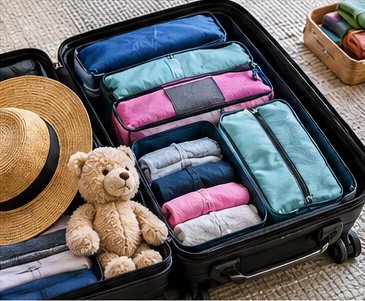
Put the day-six clean change in a distinct small group. It does not need special equipment, but it must not be scooped into the laundry by mistake. A different cube colour or an obvious position near the opening can be enough.
Use one main clothing cube for the other packed tops and one small space for underwear and socks. Try the arrangement before buying a complete set. The BAGSMART Blast cubes are a compression-zip example, but only the sizes that suit your bag need to travel.
Let clean space become laundry space
As items are worn, their clean compartment becomes emptier and the laundry section grows. A flexible sack can take over the released space. You do not need to reserve two full wardrobes’ worth of volume.
Choose a laundry method before choosing a kit
A machine or service needs fewer accessories
If your accommodation provides a washing machine, ask about detergent, drying and permitted use. A self-service laundry may sell detergent or include it in the wash. There is little benefit in carrying a bulky wash kit to duplicate a service you have already arranged.
For a staffed service, check whether delicate items, colour separation and your drying instructions can be accommodated. Keep anything irreplaceable or unsuitable for the offered method out of the batch.
A hand-wash option is not a drying guarantee
A purpose-built wash bag can help when you genuinely expect to hand-wash. Scrubba’s instructions describe washing, rinsing and hanging clothes to dry, and separately emphasise drying the bag itself after use. The washing stage does not eliminate the later drying stage. [6]
Do not assume all five days of laundry fit in one small washing batch. Follow the equipment’s fill instructions and garment labels. For this ten-day list, a proper machine or reliable service is usually the simpler basis for the main scheduled wash; small hand-washing can be a contingency.
Pack laundry supplies only when they have a job
A compact kit can be very small
For a planned machine wash, your kit may be nothing more than a flexible laundry sack and access to suitable detergent. Where you expect hand-washing, a small amount of appropriate detergent and a safe drying arrangement may be useful. Choose according to the method, not according to a generic accessories checklist.
Sea to Summit offers Wilderness Wash in small liquid sizes and Pocket Soap as dry leaves. Those are manufacturer-described washing options, not universal solutions for every fabric or sensitivity. Follow both the product and garment instructions. [7] [8]
Avoid adding a kit bigger than the saved clothing
A large wash bag, several bottles, a heavy line and spare towels can undo much of the space saved by laundering. Use the accommodation’s facilities where suitable and permitted. Ask whether towels can be used for blotting hand-washed items rather than assuming they can.
Keep any liquid detergent in a suitable closed container, away from food and medication. Check the container’s compatibility with its contents. Do not pour every toiletry or cleaning product into an arbitrary bottle just because it looks travel-sized.
Give the washed clothes time and safe space to dry
Drying is part of the stop
A garment is ready to repack when it is dry throughout, including seams, waistbands and thicker sections. Do not judge only the exposed surface. Build the plan around the actual drying method and room conditions instead of a promised universal number of hours.
Where a dryer is available, use it only for garments whose labels permit that treatment. Otherwise spread items with space between them and allow airflow. A tightly packed rack in a humid room can make a nominal overnight plan unreliable.
Keep room fixtures and exits clear
Use a permitted drying location and do not suspend laundry from sprinklers, electrical fittings or anything that must remain unobstructed. Avoid heaters and improvised high-heat shortcuts.
Before checkout, check the slowest-drying item first. If the main batch is not usable, activate the contingency while there is still time: ask about a suitable drying service or adjust the day’s schedule. The clean day-six outfit gives breathing room, but it does not replace the need to finish the laundry before day seven.
Limit shoes before tightening the packing cubes
Wear the pair that does the most work
Choose your main walking shoes around the actual surfaces and weather, and make sure you already know they are comfortable. Wear them in transit. A new pair that looks compact but causes discomfort is not a packing improvement.
A second pair is optional, not an automatic part of a ten-day trip. Light sandals may earn their place for a warm-weather holiday, while an evening venue may require another suitable option. Make the reason specific.
Count the complete footwear burden
Shoes need volume, sometimes a protective bag and occasionally extra socks or care items. If you take them, include those associated items in the load. Do not tuck damp or dirty soles against clean clothing.
Avoid solving a footwear problem with stronger clothing compression before you have challenged the need for the extra pair. For ordinary sightseeing, a versatile main pair and carefully chosen clothes often remove the need for an entire second footwear category. The right decision is personal, but it should be deliberate.
Build a toiletry plan for ten days, not ten bottles
Measure your own use
List the products you actually use, then estimate quantities from your routine at home. Ten days away does not require ten full-sized containers. However, do not underpack something necessary simply because a minimalist list omitted it.
Check what your accommodation supplies and whether you are comfortable relying on it. Suitable solids can reduce liquid-container clutter, but they still need a practical dry storage arrangement.
Keep security requirements separate from the wash bag
UK liquid rules vary by airport; check departure, transfer and return airports. A conservative small-container plan remains useful, but it is not correct to state that every UK airport now has identical limits. [9]
The BAGSMART Blast hanging toiletry bag is an organisational option where hanging access matters. Its stated 4.5-litre capacity is the bag’s storage capacity, not a security allowance for liquids. [10] A much smaller existing pouch may suit this list better, especially if your toiletries already fit neatly into the required transparent bag.
Keep technology small and accessible
Pack the functions you need
For many leisure trips, a phone, one suitable charger and the required cable cover the core tasks. Add a laptop, camera or reading device only when its role is worth the combined weight of the device, charger and protective storage.
Check your actual charging connections before leaving. A spare cable for a connector you do not use is just clutter, while the one forgotten compatible cable can be inconvenient. Destination plug compatibility and the electrical rating of the equipment are separate checks.
Keep battery rules in view
The CAA says power banks belong in the cabin, must be protected, are limited to two per person and must not be recharged on board. Follow your airline’s capacity, use and stowage instructions as well. It also advises against charging other devices from a power bank during the flight. [11]
Arrange any necessary battery-powered items so they can be removed if the cabin bag is unexpectedly checked into the hold. This is another reason not to hide all small equipment underneath compressed clothing. An easily removable pouch can help, without needing to become a large technology organiser.
Protect documents and personal essentials
Make one dependable access point
Keep your passport where it is secure but accessible during checks. Store a backup of essential travel information in a form you can use if your phone is unavailable. Avoid distributing irreplaceable items across several almost-identical small pockets without a clear system.
A TORRO leather passport holder is one organiser example; its stated 150g weight belongs in the luggage budget. Choose it for the practical grouping and access it provides, not because a security feature removes the need to look after your belongings. [12]
Do not minimise away what you need
Medication and other necessary personal items remain priorities. Check the relevant travel requirements and keep essential medication in your cabin belongings. The CAA specifically advises keeping essentials such as medicine in carry-on baggage. [13]
For someone who values more structured document organisation, the TORRO leather travel wallet is an alternative, but its listed 255g weight is a noticeable trade-off. [14] A simpler existing holder may be the better choice when the weight budget is tight. Neither option is a compulsory purchase.
Adjust for weather without packing a second wardrobe
Change the baseline, not every category
For warmer conditions, lighter tops and an appropriate bottom may replace heavier equivalents. For cooler days, an additional useful layer may matter more than several extra tops. Make substitutions first rather than automatically adding an entire seasonal module.
A forecast is only one input. Consider how long you will be outdoors, whether evenings are substantially cooler and whether the trip involves exposed transport or air-conditioned spaces. Select clothing for those actual uses.
Recognise when the model no longer fits
If you need bulky winter clothing or frequent changes after strenuous activity, a small carry-on target may require a different laundry schedule or a larger allowance. Do not force the original plan to work by ignoring comfort.
A rain layer also needs a drying and storage plan after use. Keep it away from clean clothing while damp and avoid assuming a standard cube is waterproof. The point of the ten-day model is to make the dependencies visible so that you can revise them before the trip.
The non-clothing checklist deserves its own space
Pack the complete travelling load
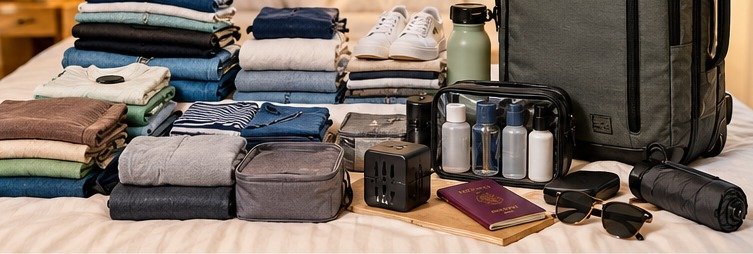
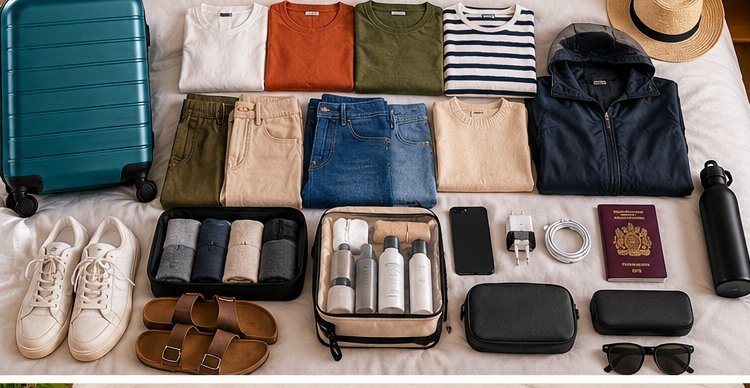
Clothing lists often look impressively small because toiletries, chargers, documents and daily essentials are missing from the photograph. Put every category on the bed before judging the bag. That includes containers and cases, not just their contents.
The checklist below is a starting framework. Personal needs may add items, while the accommodation or route may remove others. Do not take a large organiser merely because the small items are numerous: one accessible pouch may group them adequately.
| Category | Core items | Optional additions |
|---|---|---|
| Documents and money | Passport or required ID, payment methods, accessible travel information | A separate simple document pouch |
| Personal essentials | Required medication and personal-care items | Route-specific supporting documents or equipment |
| Toiletries | Toothbrush, chosen cleaning and care products, suitable containers | Only products not supplied or otherwise covered |
| Technology | Phone, compatible charger and cable | Necessary plug adaptor, approved power bank or work device |
| Laundry | Light laundry sack; access to suitable detergent | Hand-wash equipment only when it will be used |
| Day use | Weather layer and appropriate daily essentials | Bottle, hat, sunglasses or packable day bag as needed |
Make each optional item earn its place
Ask what will happen without the item and whether an alternative already in the bag covers the same function. A compact umbrella and a shell may both be justified for some trips; for others, one is unnecessary. A separate day bag should pack inside the flight allowance unless you have booked another item.
Keep essentials independent of clothing compression. You should be able to reach documents, necessary medication and the next charging cable without disturbing the clean-change reserve. The method works best when the wardrobe and the journey kit are organised together rather than treated as unrelated packing projects.
Plan the first laundry handover
Count what goes in
Before handing over a bag of laundry, empty pockets and count the garments. Check again that the clean day-six set is not included. Retain whatever you need for the current evening and the following morning, including a wearable bottom.
Communicate relevant care requirements clearly. A service’s standard wash may not suit every item, so exclude garments that require a process the provider cannot offer. If the service gives you a receipt or collection reference, keep it where you can find it.
Count what comes back
Check the return while there is still time to raise a problem. Match the number of items, confirm they are dry and set aside anything that needs more attention. Do not immediately bury the entire returned batch in the bottom of the bag.
Then rebuild the clean reserve logically. The plan is not dependent on receiving your exact original folds, but it does depend on having the next usable changes. A simple count is less error-prone than judging whether the laundry bag looks roughly as full as it did before.
Reduce toiletries with a home-use check
Estimate from your routine
Use the product for a few normal days before deciding how much to carry. An illustrative calculation is straightforward: if you actually use three millilitres per day, ten days needs about thirty millilitres before allowing a small margin. This is arithmetic, not a suggested dose for any particular product.
Some products need their original container or have specific storage requirements. Follow those requirements rather than decanting everything into matching bottles. Go Travel, for example, explicitly excludes certain contents from its silicone bottle instructions, demonstrating why container compatibility needs checking. [15]
Avoid a second shopping bag on the return
Replacing a nearly empty miniature with a full-sized bottle near the end of the trip can disrupt both the space and security plan. Buy only what you need and consider how the remaining contents will travel home.
Similarly, hotel products and gifts are not weightless extras. Add them to the final loaded-bag check. A good ten-day toiletry plan covers both daily use and the last flight rather than only making the outbound liquids bag look tidy.
Try the wardrobe through a normal week
Rehearse before the flight
Wear the chosen main shoes and typical clothing combinations during ordinary activities. Check whether the tops actually work with both bottoms and whether the weather layer is comfortable over the mid-layer. Small incompatibilities are easier to fix at home than when those are your only options.
Run a representative wash using the permitted care method. Check the slowest-drying seams and whether your preferred folding arrangement still works afterwards. This is a personal preparation exercise, not a laboratory certification of the fabric.
Change one thing at a time
When the trial reveals a problem, replace the unsuitable item or revise one assumption. Avoid responding by adding a whole second wardrobe. A more practical bottom, a better-timed laundry stop or one additional necessary change may resolve the issue.
Keep a brief note of the final counts. That prevents last-minute additions from quietly turning six total changes into six packed changes plus several extras. The list remains useful only while it describes the bag you will actually carry.
Useful organisers: buy for the task, not the photograph
Start with the smallest useful arrangement
A traveller who already owns two suitable cubes and a wash bag does not need a new coordinated system. First test the clean-change reserve, laundry separation and access to toiletries. If those work, spend nothing.
For mixed clothing groups, the Blast compression-cube set is a relevant reference. For easy separation of a small clean and worn load, compare the Peak Design Small cube. Choose the few pieces that fit rather than packing an entire set to justify owning it.
Consider alternatives without declaring a winner
The Sara Miller Black Botanic cube set offers another fabric-organiser option, but a matching appearance is not evidence of better fit. Its published set weight is worth including in your comparison. [16]
For rooms with little counter space, a hanging Blast toiletry bag may solve a genuine access problem. For a very restrained wash kit, it may simply be too much organiser. The recommendations here are role-based product examples, not a ranked hands-on test or an instruction to buy every item.
Rehearse the arrival and return-day repacks
Try using the bag, not just closing it
Pack the entire list, take the bag for a realistic walk and remove the items needed for the first evening. Check whether you can reach sleepwear and toiletries without spreading the full contents across the floor.
Next, move half the clothing into its laundry state. Fold it less perfectly, because the return journey rarely looks like the outbound photograph. The bag should remain straightforward to close with the same possessions.
Leave the last morning manageable
Put anything still damp in temporary suitable separation and deal with it promptly; do not hide it inside the clean-clothing system. Check pockets, charging points and drying spaces before leaving.
Repeat the weight and dimensions check once the actual return load is assembled. Gifts and replacement toiletries count. A small intentional margin is more useful than a bag that only meets the allowance in a carefully staged home arrangement. This final rehearsal catches problems while you can still remove unnecessary items.
For a final independent check, use a suitable existing scale or the Go Travel scale discussed earlier. Reweigh after adding return purchases; a remembered outbound total is not evidence of the current bag’s weight.
Pros and cons of one laundry stop
What the plan does well
A scheduled wash reduces the number of daily changes carried, creates a clear wardrobe cycle and can keep the bag manageable across ten days. The sixth clean set avoids depending on an instant laundry turnaround.
Because the clothing list is explicit, you can also see the effect of an extra activity or delayed service. You are making a defined adjustment rather than adding an unspecified handful of spare clothes.
What it asks you to accept
You need access to suitable washing and drying, time to use it and a willingness to repeat clothing combinations. Special-care garments, unpredictable laundry availability or frequent extra changes reduce the plan’s simplicity.
The bag target is also conditional. A traveller carrying a laptop, multiple shoes or substantial personal equipment may need more capacity even with the same laundry cycle.
Use the model where those trade-offs suit the holiday. There is no achievement in insisting on hand luggage when the resulting restrictions would make the trip uncomfortable or compromise essential needs.
Common mistakes in a ten-day carry-on plan
Losing track of worn versus packed
Six tops in total means five packed plus one worn, not six packed and another worn. Similarly, the day-six reserve must remain outside the wash. Counting it and then sending it to the laundry defeats the reason for carrying it.
Another mistake is washing every bottom or all sleepwear at once. Daily-change arithmetic does not automatically cover every clothing category.
Treating a laundry promise as a confirmed service
Check the collection time, return time and drying method. A property saying it has laundry nearby is not a reservation, and a washing machine without a usable drying option may not meet your schedule.
Do not assume new clothes wash or dry like the familiar garments they replaced. Trial them at home, follow care labels and keep the wardrobe compatible with the service.
Finally, remember the bag entitlement. A list that fits an overhead cabin bag does not automatically fit the free underseat item on a low-cost fare. Both the packing volume and the booking must work.
Frequently asked questions
Does the list mean six tops packed in the bag?
No. It means six tops for the trip in total: one worn on departure and five packed. Underwear and socks use the same counting convention. The sixth clean change is reserved for the laundry window, so keep it separate from the five used changes you wash after day five.
Why not pack only five daily changes?
Five changes reach the end of day five but leave no clean change while the wash is being processed or drying. A sixth gives one planned buffer day. You can pack fewer only by changing the assumptions—for example, a confirmed faster laundry schedule or acceptable rewear of particular garments—not by ignoring the gap.
What happens if the laundry takes two days?
This model has one clean change for day six and needs the washed batch by day seven. A longer delay requires another solution or a larger reserve. Confirm turnaround before relying on the plan, and move the wash earlier when the service or drying conditions are uncertain.
Can I use only the airline's free small bag?
Possibly with a very restrained personal load, but this list does not promise that fit. Its volume target is closer to a larger cabin arrangement. Check the free bag’s actual dimensions, test your own clothing and equipment, and buy the appropriate allowance rather than assuming carry-on and free personal item mean the same thing.
Must I buy quick-drying travel clothes?
No. Start with suitable clothing you already know. The important checks are comfort, compatible care and whether the chosen garments can be washed and dried within your actual stop. New technical clothing is not automatically necessary, and unfamiliar garments should be tested before becoming essential to the plan.
Is a washing bag necessary for one laundry stop?
Not when a suitable machine or dependable laundry service meets your needs. A washing bag can be useful when you plan to hand-wash, but it adds equipment and does not solve drying. Build the kit around the service you will use rather than carrying accessories for every possible method.
Should I pack a second pair of shoes?
Only for a specific need that the main comfortable pair cannot cover. A light second pair can make sense for swimming, warm evenings or another planned activity. Include its volume, weight and storage in the trial. Do not regard two pairs as compulsory merely because the trip lasts ten days.
Can the same clothes cover more than ten days?
The general principle can extend to longer trips when another suitable wash is scheduled before clean clothing runs out. The exact counts depend on change frequency, drying time and the longest interval between washes. A longer trip does not automatically require more clothes, but it does require a complete repeatable laundry cycle.
The final ten-day plan
Use six daily changes including the one you wear, with a main wash after day five and the sixth change protected for day six. Keep a wearable bottom and sleepwear available, and ensure the cleaned batch is ready before day seven. That is the mechanism that makes this list work.
Pack the smallest practical clothing system, familiar shoes, an appropriately reduced toiletry kit and only the technology needed for the trip. Check the actual loaded bag against every relevant allowance.
Before leaving, rehearse the laundry-state repack and a delayed drying window. If either exposes a problem, change the timing, reserve or luggage plan now. A carry-on list should make the holiday easier, not create a test you must pass at the expense of comfort and necessary belongings.
Sources and fact-checking notes
Research checked on 12 October 2026. Airline and authority pages support the rules; manufacturer and retailer pages support the named product features. Clothing counts, schedules, volume targets and weight budgets are editorial planning examples, not measurements from hands-on testing. Product availability and terms can change. Buying destinations are not evidence that every variant suits every traveller.
- 01Ryanair: current cabin baggage allowances
Checked 12 October 2026. Confirm current details before purchase or travel.
- 02easyJet: current cabin bag sizes and entitlements
Checked 12 October 2026. Confirm current details before purchase or travel.
- 03BAGSMART: Blast Travel Backpack, current size and expansion specification
Checked 12 October 2026. Confirm current details before purchase or travel.
- 04Case Luggage: Go Travel Digital Pro Scale, measuring functions
Checked 12 October 2026. Confirm current details before purchase or travel.
- 05Case Luggage: Peak Design Small Packing Cube, Sage, exact variant
Checked 12 October 2026. Confirm current details before purchase or travel.
- 06Scrubba: washing, drying and wash-bag care instructions
Checked 12 October 2026. Confirm current details before purchase or travel.
- 07Sea to Summit: Wilderness Wash, use and care information
Checked 12 October 2026. Confirm current details before purchase or travel.
- 08Sea to Summit: Wilderness Wash Pocket Soap, 50 dry leaves
Checked 12 October 2026. Confirm current details before purchase or travel.
- 09GOV.UK: liquids in hand luggage and airport-specific rules
Checked 12 October 2026. Confirm current details before purchase or travel.
- 10BAGSMART: Blast 4.5L Hanging Toiletry Bag
Checked 12 October 2026. Confirm current details before purchase or travel.
- 11UK Civil Aviation Authority: power-bank rule changes effective 27 March 2026
Checked 12 October 2026. Confirm current details before purchase or travel.
- 12TORRO: Leather Passport Holder, Black, storage and weight
Checked 12 October 2026. Confirm current details before purchase or travel.
- 13UK Civil Aviation Authority: Pack Right, Safe Flight
Checked 12 October 2026. Confirm current details before purchase or travel.
- 14TORRO: Leather Travel Wallet, storage and weight
Checked 12 October 2026. Confirm current details before purchase or travel.
- 15Go Travel: Squeeze It Trio 60ml bottles and product compatibility
Checked 12 October 2026. Confirm current details before purchase or travel.
- 16Case Luggage: Sara Miller London Black Botanic Packing Cube Set
Checked 12 October 2026. Confirm current details before purchase or travel.
Illustrations in this article were created for Taylor’s Trailblazing Travel Gear. Third-party photographs, where used, are credited beside the image or in the source list.