Are Airplane Foot Hammocks Worth It?
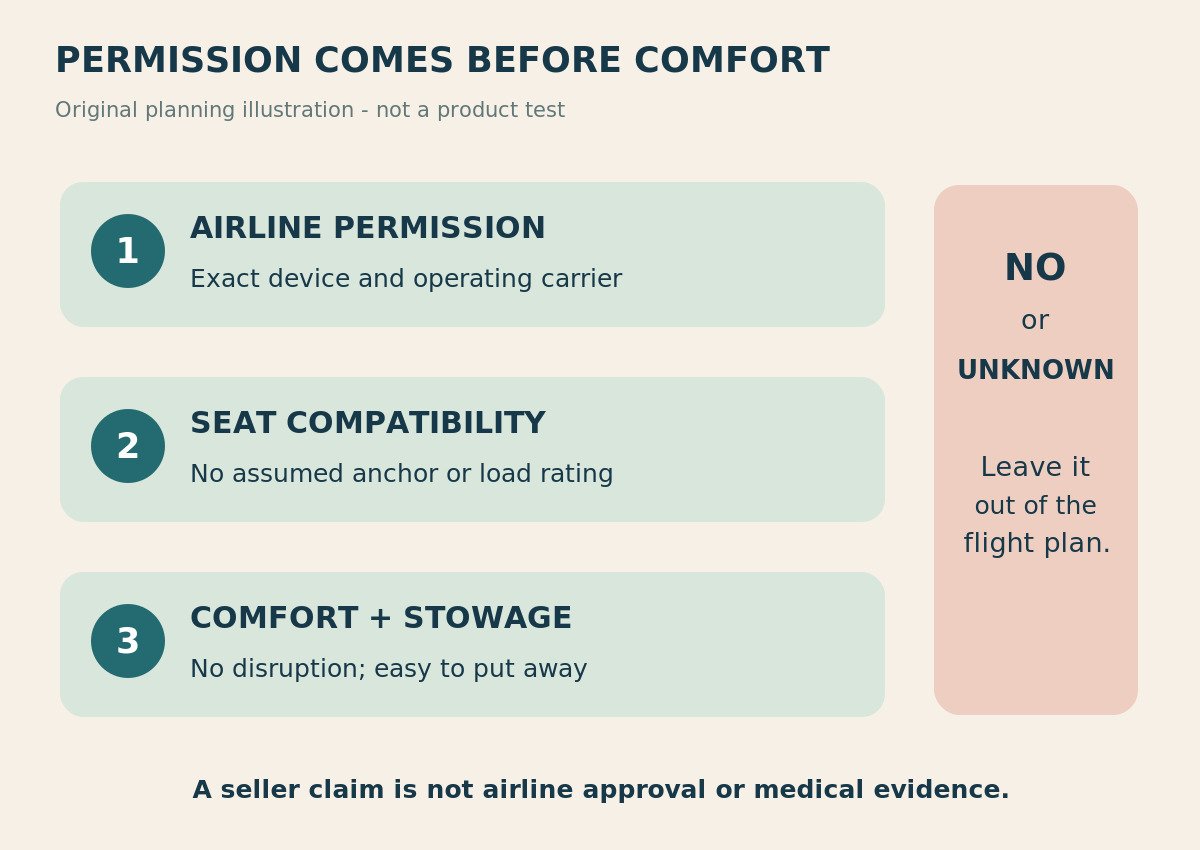
Start with airline permission, then assess the seat, your own comfort and the consequences for other passengers.
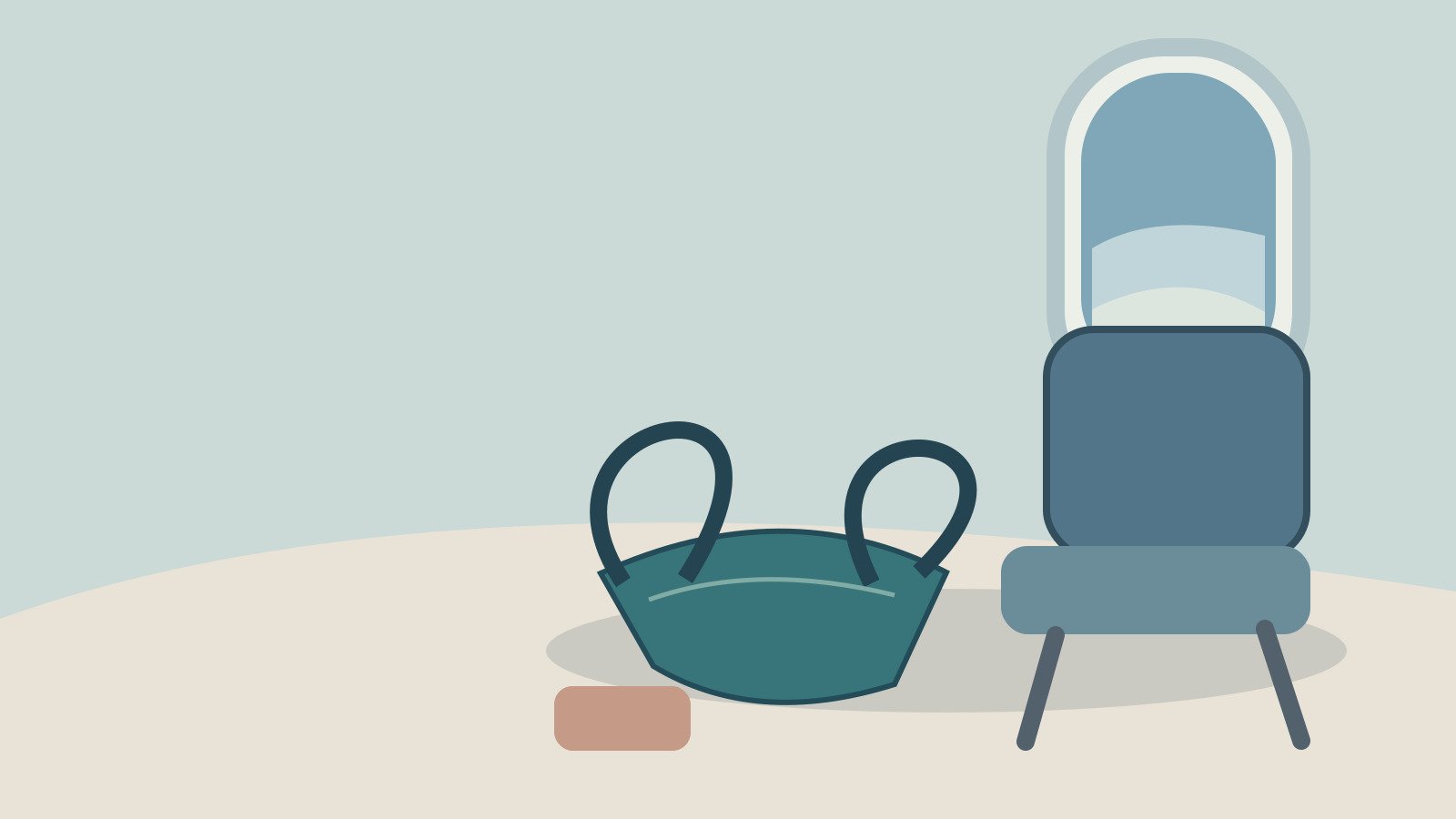
Original concept illustration: an unattached foot sling beside a seat. It does not show an approved installation.
Are airplane foot hammocks worth it? For many journeys, no: an accessory you cannot use has no in-flight value, however small its pouch. A sling may look inviting in a product photograph, but the tray table and seat in front belong to the aircraft, not to the accessory manufacturer.
That does not make every person who likes a foot sling mistaken. It means comfort is only one part of the decision. Permission, attachment points, knee space, quick removal and the passenger ahead all have to work together. A cabin-approved built-in footrest is also a different thing from a strap added by a passenger.
This guide is a research-led assessment, not a flight trial. It checks published airline guidance and separates seller descriptions from evidence. It does not recommend a hammock to prevent blood clots, treat pain or work around crew instructions. Where the rules or fit are unresolved, the practical answer is to leave it out of the flight kit.
Permission
A seller's airline-friendly claim does not override the operating carrier.
Seat geometry
More support can also mean less knee room or added pressure.
Not a treatment
A hammock is not an evidence-based substitute for movement or medical advice.
Pack less
Built-in support or a simpler comfort kit may make more sense.
Are airplane foot hammocks worth it? The permission-first answer
A useful accessory must be usable
The first question is not whether a hammock looks comfortable. It is whether the operating airline allows the exact kind of passenger-added device. British Airways prohibits attachments to aircraft seats, including tray tables and armrests; Singapore Airlines excludes foot hammocks; and Qantas identifies leg hammocks among devices which must stay at home. Those restrictions change the buying decision immediately. [1] [2] [3]
When a rule excludes the item, stop the in-flight comparison there. A small pack size, attractive price or positive review cannot create permission. You may still consider the product for a permitted non-aircraft setting, but that is a separate purchase with its own suitable support and instructions.
The narrower situation where it may be considered
On an airline which explicitly permits the exact design, a traveller might find the support comfortable. Even then, the seat geometry, attachment method, surrounding space and ease of removal must work. Permission alone does not prove that the hammock suits your body or that it will remain convenient throughout the journey.
The default recommendation is therefore not to buy a hammock as universal flight equipment. Establish permission first, then assess the remaining questions. This order avoids spending time comparing colours and padding on an item which would be left unused in its pouch for the entire flight.
Identify the device before asking about it
A hanging sling is not an inflatable footrest
A foot hammock normally supports the feet in fabric suspended from straps. A floor-standing inflatable support rests in the footwell and creates different clearance questions. Meanwhile, a child seat extender, a certified support device and an airline-installed footrest are different again. Calling all of them footrests can produce an unhelpful or misleading answer.
When contacting an airline, describe how the exact product is supported. Include a product photograph and a plain explanation of whether anything attaches to the seat, tray or armrest. A response about an inflatable cube does not establish permission for a hanging sling, even if both are sold under the same broad shopping category.
Distinguish carrying from using
Permission to carry an item inside a bag does not automatically mean permission to deploy it in the cabin. Your question should specify intended use during the flight, the operating carrier and any relevant seat or cabin details. Otherwise, a general baggage answer may be mistaken for approval of an attachment.
Keep this distinction clear when reading seller FAQs too. A statement that a product fits in hand luggage says nothing about its use on board. Likewise, a product photograph inside an aircraft cabin is a marketing image, not a record that the airline approved that configuration.
What the checked airline examples actually say
Three policies, not a worldwide list
The table summarises official guidance checked for this article on 11 October 2026. It is not a complete list of carriers and should not be used to infer that an airline missing from the table permits hammocks. Recheck the policy for every operating airline in an itinerary, including the return journey.
| Airline | Relevant published position | Practical consequence for a hanging hammock |
|---|---|---|
| British Airways | Named comfort-aid list; no attaching items to seats, tray tables or armrests | Do not plan to use a passenger-added hanging sling |
| Singapore Airlines | Foot hammocks and seat extenders are not permitted | Leave the hammock out of the in-flight plan |
| Qantas | Inflatable cubes may qualify under conditions; leg hammocks are excluded | Cube rules are not permission for a hammock |
Scroll the table sideways on smaller screens to see every column.
These examples come from the airlines’ published comfort and family-travel guidance. Although some surrounding text concerns children, the quoted prohibitions should not be turned into an assumed adult exception. Ask the airline when the scope is unclear rather than treating silence elsewhere as permission. [1] [2] [3]
What those examples do not establish
They do not establish a global rule, a permanent policy or an approval for another brand. Nor do they show that every object called a footrest is treated identically. Policies can distinguish devices by support method, size, cabin and location.
A buying guide should keep those limits visible. The safest practical plan is the one which remains useful when the hammock cannot be used. Do not base your whole comfort setup on obtaining an exception at boarding, especially when the official information already excludes the device.
Check the operating airline and the exact flight
A shared booking can include different rules
Read the operated-by information for each sector rather than relying only on the airline whose website sold the ticket. A connecting journey can involve more than one carrier and more than one cabin configuration. Record the answer for each relevant leg, not simply the first flight out.
If a reply is vague, ask a more specific question: does this policy permit a fabric sling supported by straps on the tray-table arms? That description is more useful than asking whether travel comfort accessories are allowed. Save the response and the date, while remembering that crew instructions on board still need to be followed.
Seat changes can remove a workable arrangement
Even an apparently suitable booking can change. A different seat or aircraft may have another tray position, less space or different equipment in the footwell. Do not assume the geometry seen in a seat photograph is guaranteed for the eventual flight.
This uncertainty should affect how much money and bag space you allocate. An optional accessory which may remain packed needs to justify itself differently from clothing you know you will wear. If the purchase only makes sense under one narrow seating arrangement, think carefully before treating it as an essential item.
Why a built-in footrest does not approve a DIY attachment
Aircraft equipment is a separate case
Qantas describes a foot net as part of the Economy seat experience on its listed 787 configuration. That does not conflict with a rule excluding passenger-added leg hammocks: an airline-installed feature is different from a separate accessory attached by the passenger. Check the actual seat provision rather than generalising from the aircraft type. [6]
The useful lesson is to investigate what the booked seat already provides. A built-in footrest or support may remove the reason for carrying an extra device. However, do not assume every aircraft, cabin or row includes the same equipment simply because one airline photograph shows it.
Avoid improvised attachment points
Do not treat a screen mount, seat pocket, armrest gap or other visible fitting as an alternative anchor. The absence of a suitable approved support point is a reason not to use the hammock. It is not a puzzle to solve by threading straps somewhere else.
A tray table’s apparent strength is also not a load rating for your accessory. This guide does not provide an allowable force, body-weight limit or attachment modification. The product and airline would need to establish appropriate use; a traveller should not test that by loading aircraft fittings until they appear to hold.
The comfort question comes after the permission question
Support can help one position while worsening another
A hanging support changes where the feet rest and how the legs are arranged. A person whose feet do not reach a comfortable resting position may find the idea appealing. However, raising the feet can also change knee position, reduce available space or create pressure at the fabric edge. This guide has not measured those effects in a flight trial.
Describe your actual issue before shopping. Is it dangling feet, a seat edge pressing uncomfortably, limited knee space or simply wanting to move? Those are different problems. A sling should not be treated as a general solution merely because its photograph suggests a more relaxed posture.
Do not confuse stillness with comfort
A position which feels pleasant briefly may become less comfortable when held for a long period. The ability to change position remains important. Avoid a device which makes you reluctant to move because getting in and out of it is awkward or because you are concerned about disturbing the attachment.
Stop using any arrangement which causes discomfort, numbness or troublesome pressure. For persistent pain, mobility needs or a medical condition, seek suitable advice and speak to the airline’s assistance team. A retail comfort gadget is not a substitute for an assessed support requirement.
Seat geometry: the space has several owners
Your knees, feet and bag share a small area
The footwell may need to accommodate your feet, permitted under-seat baggage and parts of the seat structure. A hammock does not create extra knee room. It rearranges where your feet sit within the available space and can interact with the bag you intended to keep close.
Think through the whole setup before considering a purchase. Where will the personal item go? Can it remain properly stowed? Can you move your feet normally without catching straps or pressing against a frame? A comfort plan which works only after moving baggage into an unsuitable location is not a workable plan.
Tray position changes the experience
A tray may be mounted on the seat ahead or stored in an armrest, and some seating arrangements have no seat immediately in front. Even where a tray exists, that does not establish that it is a permitted support point. The geometry question only becomes relevant after the airline has approved the exact use.
Avoid buying based on a photo which shows an unusually spacious setting. Compare the product’s stated requirements with your actual situation and leave unresolved details unresolved. An optimistic assumption about strap reach or clearance can turn an apparently compact accessory into something you cannot use.
Consider the passenger in front and the people beside you
The seat ahead is not part of your personal luggage
A hanging accessory can transfer movement or load to the structure supporting it. Even when an airline permits a particular arrangement, it must not affect the person ahead or interfere with their seat. A neighbour’s willingness to tolerate it does not override airline restrictions.
This is another reason to avoid swinging, bracing or pushing against a sling. The product should not become something you use to lever your body into a new position. If normal use disturbs another passenger or interferes with equipment, put it away rather than trying to persuade them that the discomfort is minor.
Access must remain straightforward
People may need to get up, and crew may need clear access to the row. A device which creates a tangle near feet or requires a complicated removal routine can be inconvenient even before an urgent situation arises. Assess how easily it can be put away, not only how comfortable it looks once deployed.
Do not attach a sling in a way that traps belongings or relies on leaving straps permanently across a shared route. The comfortable position is not the whole product experience. Getting into it, getting out of it and stowing it are equally important parts of the decision.
A hammock is not a blood-clot prevention device
Keep medical claims separate from comfort descriptions
Some sellers use language about circulation, swelling or pain. This guide has not established clinical evidence that a passenger-added foot hammock prevents deep vein thrombosis or treats those problems. A product description making a health claim should not be repeated as a proven benefit merely because it appears on several shopping pages.
CDC guidance identifies prolonged immobility as a risk factor and advises frequent leg movement and appropriate medical discussion for people at increased risk. Those recommendations do not become a recommendation to buy a hammock. Anyone with relevant medical concerns should discuss their own circumstances before travel. [5]
Do not build a treatment plan from a shopping page
Comfort and prevention are different claims. A position may feel pleasant without having a proven effect on a medical risk, and a gadget can make movement more awkward even while it supports the feet. Treat the device, at most, as an optional comfort item in a permitted setting.
New unexplained leg pain or swelling, chest pain or difficulty breathing should not be dismissed as a reason to adjust a travel accessory. Seek prompt medical attention for concerning symptoms; on board, alert the crew. This article is not a diagnostic guide and does not recommend medication or compression products for an individual traveller. [5]
Product references: what is and is not being recommended
Two support types and three other comfort targets
The following table is deliberately not a best-foot-hammocks ranking. It separates a hanging product from an inflatable support, then shows accessories addressing light, noise and warmth. The last three do not support the feet; they are relevant only when those are the actual sources of discomfort.
| Reference | What it addresses | Main limitation | Buying reference |
|---|---|---|---|
| Sleepy Ride footrest | A hanging fabric foot support | Airline attachment permission is essential | Check Sleepy Ride reference |
| FlyPal inflatable support | Floor-standing support, not a hammock | Separate airline and seat-location rules apply | Check FlyPal reference |
| Go Travel Dreamer | Light during rest | Does not solve foot or knee-space problems | View Dreamer at Case |
| Loop Quiet 2 | Noise reduction | Does not support the legs or guarantee awareness | Check Quiet 2 reference |
| Cocoon COOLMAX blanket | A covering for warmth | Adds packed bulk; not a support device | Check blanket reference |
Scroll the table sideways on smaller screens to see every column.
Use buying references only after choosing the right problem
These links are useful only when the item matches a need and the conditions of use are appropriate. Do not replace a prohibited hammock with an inflatable on the assumption that changing the support method automatically creates permission. The airline must allow the particular alternative too.
Marketplace offers and delivery were not consistently verifiable in the inspected pages. Confirm the exact version, seller and availability before purchase. The table identifies examples for comparison and does not claim that any of them was tested on your airline, aircraft or seat.
The hanging example: Sleepy Ride
A recognisable reference with significant limits
Sleepy Ride’s UK marketplace listing identifies a memory-foam footrest, while the brand catalogue showed its listed footrest variants as sold out when checked. That does not establish current stock at every independent seller, nor does it establish airline acceptance. The marketing language should not be treated as medical evidence. [7] [8]
Review the Sleepy Ride listing
The important research task is not finding the most persuasive comfort review. It is establishing the intended support method and whether the operating carrier permits it. Where the airline prohibits attachments or hammocks, this product is not an in-flight recommendation regardless of the remaining specifications.
Do not infer fit from height-based marketing
A seller may suggest that a product suits shorter travellers. That is not a guarantee based on your height alone. Seat height, leg proportions, seat depth, footwear and the actual support position can all affect whether the arrangement feels comfortable. This guide therefore does not set a universal maximum traveller height.
Ask for the product’s own dimensions and instructions where they matter, and do not transfer measurements from another brand. An adjustable strap still has limits, and an appealing photograph does not tell you how the item behaves in a different seat.
The inflatable alternative is not an automatic workaround
FlyPal is a different kind of object
FlyPal describes a two-piece inflatable support rather than a hanging sling. That difference can be useful when comparing categories, but it does not confer general cabin permission. Its presence on a marketplace page is not proof that it meets a specific airline’s current criteria. [9] [10]
Review the FlyPal inflatable reference
An inflatable occupies floor space and needs an appropriate inflation, deflation and stowage routine. Compare those requirements with the operating carrier’s published conditions, not with a blanket claim that inflatable footrests are allowed. Do not assume the product is equivalent to another named brand on an airline’s permitted list.
Qantas illustrates how conditional permission can be
Qantas permits qualifying inflatable cubes subject to conditions including manual inflation, quick air release, suitable placement and crew assessment. The device must be put away when the seat-belt sign is on, and there are cabin and seat-location restrictions. Its rules do not approve every inflatable product or overturn the exclusion of leg hammocks. [3]
Use that example to understand the level of detail required. A short yes-or-no answer about footrests can omit the very condition which makes your planned use unsuitable. Read the complete current guidance and ask about the exact item when necessary.
Spend on a different comfort problem only when it exists
Light and noise need different solutions
When the actual problem is cabin light, an eye mask may offer more reliable value than a device you cannot deploy. Go Travel Dreamer is a documented mask reference, but the choice still depends on fit and comfort. It does not create legroom or replace foot support. [11]
For noise, a correctly fitted earplug may be relevant. Loop Quiet 2 is included only as a noise-reduction example; it is not a medical or leg-support product, and it does not guarantee that announcements remain audible. Choose the product for its actual purpose, not because it belongs to the same broad comfort category. [12]
Warmth and clothing can be simpler to manage
A blanket or existing clothing layer may be useful when feeling cold is the main complaint. Cocoon’s COOLMAX blanket provides a product reference for that different need. Keep the belt accessible and the fabric within your own space; a covering should not be attached to aircraft fittings. [13]
Compare a dedicated travel blanket
There is no need to buy all three alternatives. Diagnose the actual discomfort, check what you already own and choose the smallest effective kit. Adding several unrelated accessories because a hammock is prohibited can create more clutter without solving the original problem.
What to ask before buying any support device
Send a clear, narrow question
Give the airline the exact product name, a link or photograph, and a description of how it is supported. State whether it hangs from straps or stands on the floor. Include the operating flight, cabin and seat location when known. Ask about use on board, not merely whether the item can be transported in baggage.
A useful question might explain that you are considering a fabric foot sling which would normally hang from the tray-table supports and ask whether that exact attachment is permitted. Do not soften the description to obtain a more favourable answer. Accuracy protects you from buying an item on the basis of a misunderstanding.
Record the conditions, not only the headline answer
If permission is conditional, save the full response including when the device must be stowed and which seats are excluded. Check whether approval is specific to a model, a passenger need or a flight. A general customer-service reply should not be expanded into a permanent worldwide approval.
When the reply remains unclear, the conservative packing choice is to leave the device out of the in-flight plan. That is not a failure to travel comfortably; it is a decision to avoid depending on something uncertain. You can still plan clothing, light control, entertainment and appropriate assistance around needs that are more predictable.
Before departure: a handling check, not a strength test
Inspect the product without loading unsuitable furniture
Read the supplied instructions and examine straps, seams, buckles and any storage pouch. Look for obvious damage or a mismatch with the listing. Do not hang the product from a household object merely because it resembles an aircraft tray, and do not perform a destructive load test to discover its limits.
Any permitted home use needs a suitable support explicitly compatible with the manufacturer’s directions. A chair or desk which happens to be nearby is not automatically appropriate. This guide does not provide substitute anchor instructions or a safe load calculation for improvised supports.
Practise the packing routine instead
You can assess whether the item opens, folds and returns to its pouch without attaching it to anything. Keep straps contained and check how much space the complete package occupies in your bag. That answers a practical travel question without attempting to certify the attachment system.
Also decide where the device will remain if unused. An optional item should not displace essentials or force a second bag. A comfortable-looking product which makes the rest of the packing plan less workable may have poor value even before the airline restrictions are considered.
Value: count flights where you can actually use it
Purchase price is only one part of worth
The meaningful denominator is permitted, useful occasions rather than every journey on your calendar. A hammock taken on ten flights but usable on none has no in-flight cost-per-use advantage. A small purchase can still be wasted when the rules were never checked.
As an illustrative budget calculation made on 11 October 2026, a GBP 20 accessory used on four permitted occasions represents GBP 5 per occasion before storage, cleaning or replacement. Used on one occasion, it represents GBP 20. These invented figures are arithmetic examples, not a current product price or an estimate that permission is likely.
Do not invent an approval percentage
This guide does not assign a probability that a random crew will allow a hammock. The published rule, exact device and flight circumstances matter, and guessing a percentage would create false confidence. A sensible decision can be made without one: confirm permission or plan without the item.
The same restraint applies to comfort. There is no evidence here for a universal improvement score or a particular number of hours of better sleep. Judge the proposed purchase against a specific need and the real conditions in which it could be used.
Accessibility needs deserve a different conversation
Start with the support you require
A traveller with a disability, injury or a specific support requirement should contact the airline’s assistance team before buying an ordinary retail hammock as a substitute. Describe the functional need rather than asking only whether one shopping link is allowed. British Airways points customers towards a separate process for approved seat-support devices. [1]
That distinction matters because a comfort accessory and an assessed support arrangement are not interchangeable. The airline may need details in advance, and a general product page cannot tell you what will be appropriate for your circumstances. Keep any advice from your clinician and the airline separate from a seller’s broad marketing claims.
Do not assume a note removes every restriction
Medical information can help the airline assess a request, but this guide does not claim that a letter automatically permits any device or attachment. Ask what information is required, which equipment may be accepted and how the arrangement will work for the actual booking.
When the answer is still unresolved close to departure, follow up through the appropriate assistance channel rather than planning to explain an improvised setup after boarding. Advance clarification gives you a better chance to make a workable plan without pressure on you, the crew or other passengers.
A final check before the item goes into the bag
Use a clear stop rule
Write down four answers: the operating airline permits this exact type, the seat arrangement is compatible, the product instructions can be followed and the item can be stowed promptly. An unknown answer is not the same as a yes. If one remains unknown, leave the hammock out of the planned in-flight setup.
Then ask whether it will still earn its space if the seat or aircraft changes. An optional accessory should not displace essentials just because you have already paid for it. Past spending is not a reason to carry something which no longer suits the journey.
Keep the decision simple at boarding
Have the item fully packed unless and until use is permitted in the circumstances. Do not attach it first as a way of demonstrating that it fits. If you are asked to keep it stowed, the rest of your comfort plan should continue without disruption.
That is the practical definition of a worthwhile optional accessory: useful under the right conditions, easy to leave unused and never dependent on improvisation. A hammock which does not meet that standard is better left for another suitable setting or omitted from the kit altogether.
Pros and cons of packing a hammock
The limited potential advantages
In an explicitly permitted and compatible setting, a fabric sling may provide a preferred resting position and can be compact when stored. Those are reasons somebody might investigate one. They are not proof of clinical benefit, universal comfort or suitability for aircraft seat fittings.
A removable item can also be left at home on unsuitable trips, which is why it should remain optional rather than become the centre of a flight routine. The purchase is easier to justify when you have a clear permitted use outside the particular flight, but that use must also follow appropriate support instructions.
The more significant drawbacks for air travel
Restrictions can eliminate use altogether. Where use is permitted, the device may still compete with legroom, baggage, tray access and another passenger’s comfort. Straps and removal add another task, and a product that must be stowed repeatedly may provide less convenience than its promotional photograph suggests.
For many travellers, those limitations outweigh the uncertain comfort benefit. The sensible alternative may be no new purchase, an airline-provided feature or assistance planned before departure. A buying guide should leave room for that answer rather than forcing every question into a product recommendation.
Common mistakes
Treating marketing as permission
Airline-friendly, compact and travel-approved wording should not replace the operating carrier’s guidance. Nor should a photo, a review or a past uneventful use be treated as a current approval. The most common mistake is checking rules only after the product has arrived.
Another is confusing a named permitted inflatable with a generic floor support or hammock. Device categories matter, and so do specific model names when the airline uses them. Do not borrow approval from a different design simply because both products are described as comfort accessories.
Planning around negotiation at boarding
Do not buy a prohibited device with the intention of asking several crew members until someone agrees. A busy cabin is not the place to resolve an unclear purchase. Seek clarification in advance and accept the on-board instructions without trying to demonstrate the product by attaching it first.
Finally, avoid health promises and improvised load tests. A pleasant resting position is not proof of improved circulation or clot prevention. An attachment which appears to hold is not evidence of approved safe loading. Keep the product within its documented purpose and leave it packed when the conditions are not met.
Frequently asked questions
Are foot hammocks allowed on every airline?
No. The official examples checked for this guide include explicit restrictions from British Airways, Singapore Airlines and Qantas. Other carriers need their own current checks, and absence from this article is not permission. Ask about the exact hanging design and intended on-board use rather than a vague category such as travel accessories. [1] [2] [3]
Can I attach one to the tray table if it feels strong?
Not on the basis of your own strength judgement. A tray table is not automatically an approved support point, and British Airways explicitly prohibits attachments to it. Follow the operating airline and product instructions; do not improvise anchors or load-test aircraft equipment. An apparently sturdy fitting does not establish that the use is permitted. [1]
Does approval of an inflatable footrest include a hammock?
No. A floor-standing inflatable and a hanging sling are different devices. Qantas’s conditional permission for qualifying cubes does not remove its exclusion of leg hammocks. Check the support method, model and full conditions. Do not replace a prohibited product with a different category without checking that alternative separately. [3]
Will a hammock prevent swelling or blood clots?
This guide has not established that benefit. Seller wording is not sufficient evidence for a medical claim. CDC guidance discusses movement and individual risk assessment, not a hammock purchase as a preventive measure. Seek suitable medical advice for your own risk factors or persistent symptoms rather than building a treatment plan from a product listing. [5]
Are built-in airline foot nets the same thing?
No. An airline-installed feature is part of the seat provision, while a passenger-added hammock introduces a separate attachment. A photograph of a built-in foot net therefore does not establish permission to add your own. Check what the actual booked seat provides and do not assume all cabins or aircraft configurations have the same equipment. [6]
Can shorter travellers benefit more?
Some may prefer a different resting position, but height alone is not enough to predict comfort. Leg proportions, seat depth, seat height and available space also matter. This guide does not set a universal height threshold or claim a tested benefit. Permission and compatibility must be established before comfort becomes a relevant in-flight purchase question.
Is it worth buying one for a single long flight?
Only after establishing that the exact use is permitted and that the product addresses a real need. A long flight does not make a prohibited accessory useful. Consider what support the seat already has and whether another actual discomfort, such as light or cold, is the more practical issue to address. No new purchase may be the best answer.
What should I do if the crew asks me to put it away?
Put it away promptly and follow their instructions. Do not move the straps to another fitting or try to negotiate through continued use. Plan before departure for the possibility that the accessory remains unused, and keep it easy to stow within your baggage. Comfort arrangements should never depend on ignoring the crew’s directions.
Final recommendation: leave it out unless the answer is clearly yes
Make optional equipment genuinely optional
For most readers considering a first purchase, a hammock is not an essential flight accessory. Confirm explicit airline permission, then assess compatibility, comfort and stowage. When any of those questions remains unresolved, choose a flight plan that does not rely on it.
The Sleepy Ride reference is included for readers researching the product type, not as permission to use it on a flight which prohibits hammocks. Put the operating carrier’s rules ahead of the buying link. A smaller, simpler comfort kit and a clear understanding of the seat can provide better value than an accessory which never leaves its pouch.
Sources and fact-checking notes
Sources checked 11 October 2026. Published specifications and policies are attributed above; fit judgements, packing suggestions and hypothetical calculations are editorial guidance, not measured test results. Product versions, offers and airline policies can change. No hands-on product testing is claimed.
- British Airways: permitted comfort aids and no seat attachments
- Singapore Airlines: excluded foot hammocks and seat extenders
- Qantas: inflatable cube conditions and excluded leg hammocks
- UK CAA: cabin safety, accessible buckle and crew instructions
- CDC: blood-clot risks during travel and frequent leg movement
- Qantas Economy: built-in foot net on the listed 787 configuration
- Sleepy Ride: brand catalogue and listed availability
- Sleepy Ride: identified UK marketplace footrest listing
- FlyPal: two-piece inflatable design; not a hanging hammock
- FlyPal: identified UK marketplace listing
- Go Travel Dreamer: alternative for light sensitivity, not foot support
- Loop Quiet 2: alternative for noise, not foot support
- Cocoon COOLMAX: alternative for warmth, not foot support
Illustrations in this article were created for Taylor’s Trailblazing Travel Gear. Third-party photographs, where used, are credited beside the image or in the source list.