Trtl Pillow vs U-Shaped Travel Pillow
Compare where the support sits, not just the outline on the shop shelf.
The Trtl pillow vs U-shaped travel pillow decision is less about which design looks more substantial and more about where you want support. A scarf-style wrap places an internal support beside the neck. A U-shaped pillow surrounds more of the neck with foam, filling or air. Those are different sensations, and neither is automatically comfortable for everyone.
Your seat makes the comparison more complicated. A thick headrest can push against the back of a pillow, headphones can meet its raised sides, and a warm fabric wrap can feel different after half an hour than it did during a quick try-on. Meanwhile, an inflatable pillow changes shape as you adjust its air, so judging it only when fully inflated can be misleading.
This is a research-led comparison, not a claim that these products were worn or sleep-tested for this article. Manufacturer specifications identify the constructions and care requirements; the fitting exercises below are practical ways to make your own decision. The aim is a manageable comfort accessory, not a promise of sleep, pain relief or medical support.
Scarf-style wrap
Positioning and tolerance of neck fabric are the first checks.
U-shaped foam
Compare side height and rear thickness rather than softness alone.
Inflatable U-shape
Air adjustment can matter more than maximum inflation.
Your seat and fit
A pillow cannot compensate for every seat position or sleep preference.
Trtl pillow vs U-shaped travel pillow: compare the support, not the label
What the scarf-style approach changes
The Trtl Original combines a fleece wrap with a removable internal support. The user positions that support and secures the fabric around the neck, following the brand’s instructions. It is therefore not simply a soft scarf or a smaller version of a foam horseshoe. [1]
The practical question is whether you like a defined support point and tolerate the wrapped fabric. Someone who dislikes material around the neck may reject the sensation before packed size becomes relevant. Another traveller may prefer the more specific contact point to a loose cushion. Neither reaction requires a universal verdict about the design.
What the U-shaped category includes
A U-shaped outline can contain dense foam, softer filling or an inflatable chamber. Rear thickness, side height, front closure and surface fabric vary considerably. Treating all these products as one alternative hides the very differences that often decide comfort.
For example, Cabeau’s Evolution S3 has raised sides and a deliberately thin back, while Go Travel’s Compact Snoozer uses an adjustable air chamber. Those features create different fitting and packing questions even though both are recognisably neck pillows. [4] [6]
Start with the way you sit and move
Notice your preferred resting direction
Before shopping, sit in a supportive chair without a pillow and notice where you naturally want to rest. Do you remain upright, lean towards one side or repeatedly change direction? This is an observation exercise, not an attempt to hold your head in an uncomfortable position or test how far it can fall.
A traveller who likes one consistent support point may be more interested in a scarf-style arrangement. Someone who changes sides may prefer a design that provides cushioning on both sides without repositioning. However, the actual height and shape still need to suit the wearer. A general preference is a useful starting point, not a fit guarantee.
Include the limits of the seat
An aisle seat offers different opportunities from a window seat, but neither provides permission to lean into another person’s space. Assess the pillow in a normal upright posture before considering a side lean. If your booked seat has an adjustable headrest, investigate its normal permitted positions rather than assuming the pillow must do every part of the job.
Also consider how often you stand, eat, read or talk during the flight. A product that is pleasant only when perfectly arranged may be less convenient for someone who constantly removes it. Ease of putting it on, taking it off and stowing it is part of comfort, not a minor detail after the purchase.
Four model examples and the distinctions worth checking
A construction comparison, not a sleep-test ranking
The examples below show the Trtl Original, its separate Cool model, a shaped memory-foam U-pillow and a compact inflatable. They were chosen for their differing constructions and documented care information. No score implies that one produced better sleep in a hands-on trial.
| Model | Construction | Published size or weight to note | Listing |
|---|---|---|---|
| Trtl Original | Fleece wrap with removable internal support | Current FAQ: 22 x 24 x 9cm; 133g | Trtl Original Grey on Amazon |
| Trtl Pillow Cool | Separate wrap-style model with different fabric | Current FAQ: 22 x 24 x 10cm; 254g | Trtl Cool on Amazon |
| Cabeau Evolution S3 | Memory-foam U-shape, raised sides, thin back | Check the exact Evolution S3, not the separately named TNE | Cabeau Evolution S3 Indigo on Amazon |
| Go Travel Compact Snoozer | Inflatable U-shaped design | Black manufacturer’s model: 28 x 33 x 11cm inflated; 70g | Compact Snoozer at Case Luggage |
These are manufacturer-published measurements checked on 11 October 2026, not measurements made for this article. The Trtl FAQ sizes should not be re-labelled as independently measured compressed packing sizes. The Compact Snoozer dimensions are explicitly its inflated dimensions. [1] [2] [6]
Product names matter more than a familiar logo
Do not combine specifications from the Original, Cool, Plus or other Trtl versions. Likewise, Cabeau’s Evolution S3 and TNE products are separately named designs. A retailer’s broad family listing may contain more than one colour or version, so confirm the actual selection before using a comparison table to make your final decision.
When the Trtl Original may make more sense
You prefer a defined support point
The Trtl Original Grey listing is worth considering when the wrap-style approach addresses a specific preference. Perhaps a loose U-shaped cushion keeps moving for you, or you would rather position one support than carry a fuller ring of foam. Those are practical reasons to investigate it, rather than reasons to assume it will prevent every kind of head movement.
Follow the manufacturer’s fitting sequence and make small adjustments. The support should not require you to force your head into a position you would not otherwise choose. If the arrangement repeatedly feels wrong, that is useful feedback about fit. Tightening the wrap harder is not a substitute for finding a comfortable position.
You can live with the fabric around your neck
The Original’s fleece is a material choice, not just a colour choice. Test your tolerance of the wrap sensation, particularly if you usually sleep with a loose collar. A traveller who likes a cosy scarf may respond differently from someone who regularly removes scarves indoors. [1]
Consider the rest of your clothing too. A bulky coat collar or hood can occupy the same space as the pillow. Try the arrangement over realistic travel clothing rather than a thin top that you will not wear on the journey. The correct comparison is between complete outfits and accessories, not isolated product photographs.
When a U-shaped pillow may make more sense
You want cushioning on both sides
A U-shaped design may appeal when you prefer a familiar cushion-like feel or expect to change resting direction. Yet look carefully at the space behind the neck. A thick rear section can interact poorly with an already substantial seat headrest, while a flatter rear profile leaves a different amount of room.
Cabeau’s Evolution S3 is an example with raised side support and a thin back. Its removable cover and front clasp are also relevant practical features. Those design choices are documented by the manufacturer; they do not establish a medical benefit or guarantee a comfortable fit for every traveller. [4]
The Evolution S3 Indigo listing should be compared with the exact shape you need, not simply with the word memory foam. If possible, examine how the sides meet your jaw and how easily the front opening can be adjusted and released. Leave enough freedom to move and remove the pillow comfortably.
You value immediate familiarity
Some travellers find a cushion easier to understand than a wrap with a positioning step. That can matter when they are tired or travelling with someone who helps manage accessories. However, familiar does not automatically mean suitable. A generic horseshoe that sits too low or too high may still fail to provide the contact you want.
Foam and inflatable U-pillows deserve separate comparisons
Foam gives a fixed starting structure
With a foam pillow, the underlying shape is mostly established by the design. You can adjust a clasp or positioning, but cannot deflate the rear section as you might with an air pillow. Compare the profile before buying, especially when your seat already has a pronounced headrest.
Foam also brings a storage question. Some products include a compression case, but the way they should be rolled and stored is model-specific. A soft object that can be squeezed briefly is not necessarily intended to remain tightly compressed between journeys. Check the manufacturer’s instructions rather than choosing purely from the smallest marketing photo.
Air lets you adjust firmness, with its own trade-offs
Go Travel’s Compact Snoozer includes a quick-adjust valve and a flat-back design. Its current manufacturer page lists a small storage pouch and wipe-clean care. The Compact Snoozer at Case Luggage is therefore a useful example for someone prioritising adjustable firmness and a small deflated item. [6]
Inflate according to the instructions, then assess comfort rather than automatically filling it as firmly as possible. Too much air can make the shape feel unnecessarily rigid for a particular seat. Conversely, a very soft inflation may not hold the contact point you want. The useful setting is the one that works for you without strain, not the largest possible pillow.
Heat and fabric: the difference you may notice later
A brief try-on cannot answer every comfort question
A fabric can feel pleasant when first touched and become distracting after longer contact. During a seated trial, notice whether you want to loosen the wrap, move a collar or remove the pillow. Keep the room reasonably representative of how you normally travel, without trying to recreate extreme conditions.
Do not assume that a breathable label guarantees a cool experience for every wearer. The amount of fabric, contact area, clothing and surrounding conditions all affect the practical impression. Treat published fabric descriptions as information about construction, then make a personal comfort assessment where the seller’s inspection and return conditions allow it.
The Cool model is not the Original with a different name
The Trtl Pillow Cool listing refers to a separate version. The current UK FAQ describes different fabric and lists 254g, whereas the Original FAQ lists 133g. It is therefore inaccurate to apply the Original’s weight to every Trtl product or assume a cooling-oriented version is automatically the lighter option. [2] [1]
Choose the model for a specific reason. If warmth is your main concern, first decide whether you like any wrap-style contact around the neck. A fabric change may be relevant, but it should not be used to ignore a more fundamental dislike of the construction. Compare the actual model, not the most attractive feature from several versions combined.
Headrests and rear thickness can decide the result
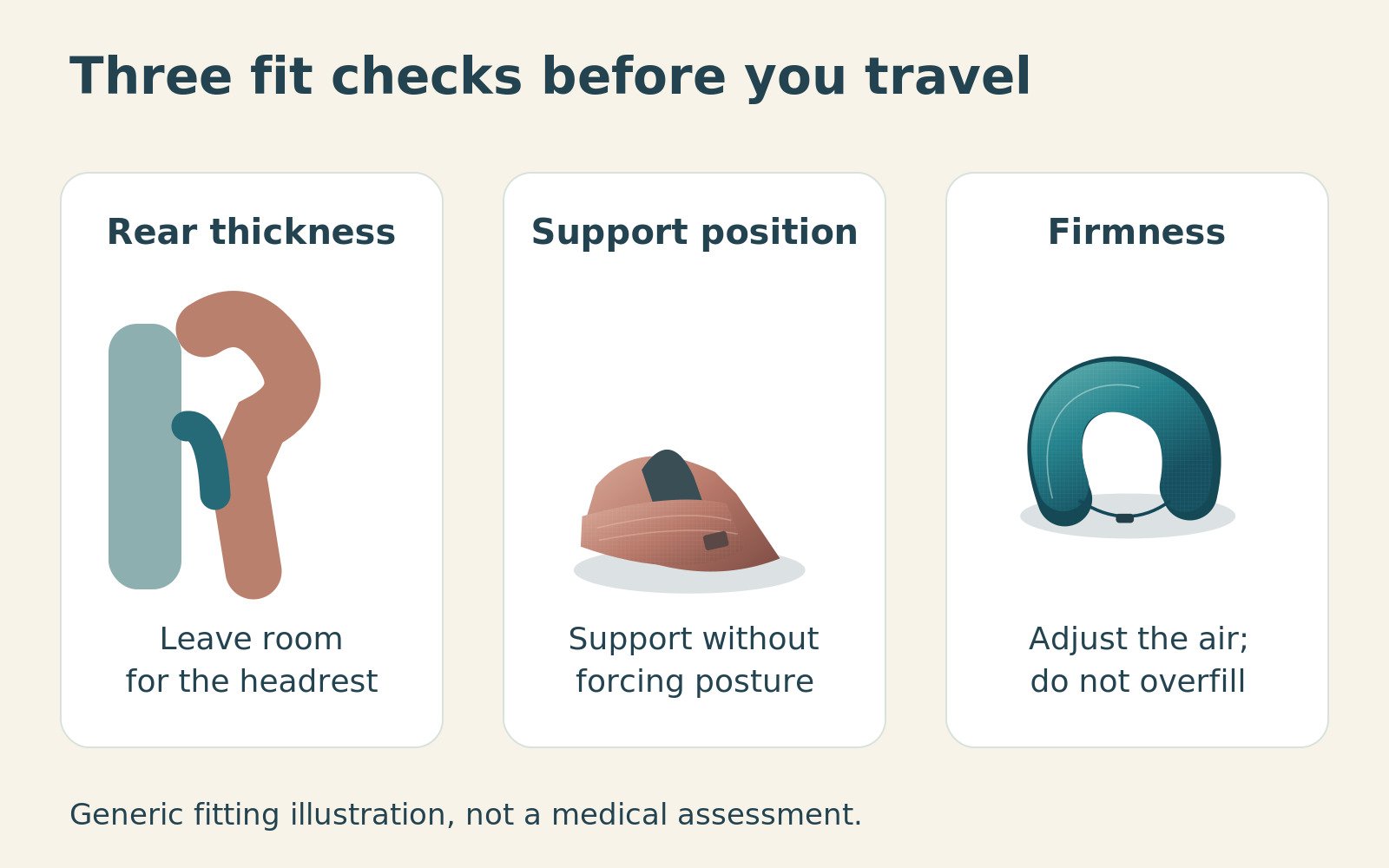
Look at the space behind the neck
A pillow that feels generous in your hand may take up space already occupied by the seat. During a home trial, sit back normally and check whether the combined arrangement changes the position of your head in a way you dislike. Do not push through that sensation because a product is marketed for aircraft use.
For a U-shaped design, compare the depth of the rear section with the height and shape of the seat’s support. For a wrap-style design, check whether the internal support and fastening stay in their intended position when you sit back. The relevant outcome is comfortable contact with freedom to move, rather than a textbook-looking pose.
Assess recline separately from upright use
A pillow that suits an upright chair may feel different when the seat reclines. Test a modest change of angle if you have an appropriate chair, while recognising that it will not reproduce your exact aircraft seat. Record which arrangement you preferred and whether you needed to reposition the pillow.
Keep expectations realistic. An economy seat does not become a bed because you add a more expensive accessory. If your chosen pillow only feels pleasant in a position unavailable on the actual journey, the home result is not very useful. Make the likely seat configuration part of the buying decision from the beginning.
Headphones, eye masks and clothing need room too
Build the comfort kit one item at a time
Begin with the pillow alone, then add your usual headphones. Check whether an earcup presses into raised pillow sides or whether a headband changes where you want to rest. Next add glasses or an eye mask if you use them. This order makes it easier to identify the item that creates an awkward contact point.
There is no need to buy every accessory from one brand. Matching colours do not establish matching fit. A compact earbud, over-ear headphone and flat mask each interact differently with a pillow and headrest, so the useful combination depends on the actual shapes you own.
Try ordinary movements, not just stillness
Look down at a book, turn towards a companion and reach for the normal pause control on your headphones. Remove the pillow without pulling the audio lead or catching the eye-mask strap. The arrangement should be manageable during meals, announcements and short conversations, not only during an uninterrupted staged photograph.
Also check the collar and any hood you plan to wear. A thick hood bunched behind the neck can change the result of the pillow trial. If you normally remove a coat once seated, test that sequence too. Small preparation choices can improve the usefulness of an existing pillow without requiring a different product.
Seat straps and attachment features require permission
A product feature is not an airline approval
The Evolution S3 includes a seat-strap system, but a manufacturer’s description does not establish permission to attach it to every aircraft seat. Ask the operator or crew before using an attachment. Do not obstruct another passenger’s screen, tray, movement or access, and do not improvise attachments to fittings that were not designed for the accessory. [4]
If you cannot confirm that the feature is permitted, assess the pillow without relying on it. That avoids buying primarily for a benefit you may not be able to use on your journey. The same principle applies to any comfort accessory that attaches to a seat or changes the space around it.
Keep the pillow easy to remove
You should be able to release and stow the accessory promptly when asked. Practise that movement at home, particularly with a wrap, clasp or strap system. A difficult fastening can become more inconvenient when you are wearing headphones, handling a blanket and trying to make room for a meal.
Follow crew instructions and keep the seat belt and access clear. The CAA’s cabin-safety guidance makes attention to briefings and directions part of the passenger’s responsibilities. A sleep accessory should not make it harder to respond, hear an instruction or leave the seat normally. [9]
Packed size: compare the complete item you will carry
Include the pouch, not just the pillow
A fair packing comparison includes any case, strap or storage pouch. A listed product weight may exclude that packaging, and a promotional compressed size may depend on a particular rolling method. Put the complete kit into the actual pocket or bag compartment rather than assuming it will fit because another product had similar measurements.
Sea to Summit’s past-season Aeros Premium Traveller page illustrates the distinction: it separately lists a 70g product weight and a 93g packed weight. That is not the same product as the brand’s similarly named camping pillows. The example shows why the measurement label and exact model both matter. [7]
Do not assume an external clip avoids baggage limits
Hanging a pillow from the outside of a bag can keep it accessible, but it can also expose it to dirty surfaces and make the bag awkward to handle. Check the airline’s current allowance and do not assume that an externally clipped item is automatically ignored. Stow it neatly when needed and protect the face-contacting surfaces.
For a very restricted bag, the Compact Snoozer listing is worth examining because an inflatable design can be deflated between uses. Nevertheless, include its pouch and allow time to inflate and pack it. A smaller packed object is only useful when you are comfortable using the inflated version.
A useful home trial before your departure date
Start with inspection and the seller’s conditions
Read the product’s fitting instructions and the retailer’s return terms before removing labels, washing or making extended use of it. A home check is not automatically a free long-term trial. Keep the packaging and inspect seams, fastenings, valves or supports for obvious problems while you still have time to contact the seller.
Where the conditions allow a comfort check, choose a clean chair and realistic clothing. Allow a suggested 15 to 20 minutes to compare initial fit and ordinary movements, rather than trying to force yourself to sleep. Stop if the arrangement feels uncomfortable. The purpose is to discover suitability, not to prove that a purchase must work.
Compare one change at a time
For a wrap, adjust the position according to the instructions before changing tightness. With an inflatable, change the air level a little and assess the result. For foam, compare the seat angle and clasp position without forcing the shape. Write down what improved the fit so that you can repeat it later.
Add the other accessories only after the pillow itself is acceptable. Then practise taking the complete arrangement off and packing it. A successful trial is not simply “I could sit still wearing it”; it is “I could fit, adjust, remove and store it without discomfort or confusion.” That is a much more useful preparation standard.
Washing: separate fabric, foam and internal supports
Follow the instructions for the exact construction
A washable cover does not mean every internal component should go into the washing machine. Trtl instructs users to remove its internal support before washing the fabric, while Cabeau distinguishes the removable cover from the memory-foam insert. Read the care label supplied with your exact version, particularly when a retailer’s general description is brief. [1] [4]
Do not use one brand’s instructions as a recipe for another pillow. An inflatable chamber, bonded fabric or rigid support may require different handling. Before a longer trip, decide whether the item can be cleaned and fully dried with the facilities you actually expect to have. Easy care at home may not mean convenient care during a short hotel stay.
Leave enough drying time before packing
Clean after the journey according to the label, then let all permitted components dry fully before storage. Avoid turning the packing pouch into a container for a damp pillow. If only the surface needs attention during travel, use the method recommended for that particular product rather than improvising with strong cleaners or heat.
Go Travel’s current Compact Snoozer instructions specify wipe-clean care, while Cabeau’s guidance does not permit washing the memory foam as though it were a fabric cover. These distinctions are more useful than a broad claim that travel pillows are all easy to wash. [6] [5]
Storage between trips affects the next journey
Do not leave every soft item compressed indefinitely
A compression case is designed to make transport easier, but storage instructions still matter. Cabeau’s current Evolution S3 page warns against keeping the pillow compacted for more than one month because it may affect recovery of the shape. That specific instruction should not be generalised into a storage rule for every foam product. [4]
After travel, unpack the pillow, inspect it and follow the recommended storage method. Check the cover and clasp while the trip is fresh in your memory. A small problem noticed at home is easier to investigate than a missing part discovered after boarding.
Keep the next departure simple
Store the pillow with its correct pouch and any removable parts so that nothing has to be reconstructed from a drawer of accessories. Keep the care instructions or a private photo of the label. If another traveller borrows it, explain the components that must be removed before cleaning and the parts that should not be forced into a smaller bag.
Before the next journey, inspect a valve for obvious wear, check a fastening and confirm that the fabric is clean and dry. This does not establish laboratory durability; it is an ordinary ownership check. A familiar product in good condition can be more useful than a new pillow chosen because of a headline feature alone.
Returns, guarantees and the cost of a wrong fit
Read the conditions behind the headline
Trtl’s UK returns page uses a 100-day window but requires qualifying items to remain in original, unused condition, with proof of purchase. It also excludes purchases from other sellers such as Amazon from the direct-store return process. Therefore, do not describe the headline as an unconditional 100-day sleep trial. [3]
Some product-page text also refers to US returns or delivery even when the page is being viewed through the UK shop. Use the applicable checkout and dedicated UK policy, and ask for clarification when wording conflicts. A guarantee is only useful when you understand which retailer handles the order and what condition the item must be in.
Compare likely use, not an imagined lifetime
Ask how many journeys will realistically involve upright resting. A pillow used regularly on long train trips as well as flights may justify more attention to fit and care than one bought for a single short sector. Conversely, a compact design that is pleasant enough and easy to carry may be the better purchase for occasional use.
Do not equate the highest price with the best personal support. The expensive option can still be wrong for your neck fabric preference, headrest or packing space. Put fit, manageable storage and clear retailer terms ahead of a brand promise, particularly when you cannot inspect the product in person before ordering.
Different journeys call for different priorities
A short flight with little intention of sleeping
You may not need a dedicated pillow at all. If you mainly read, watch a programme and move around during a brief journey, an accessory that takes up bag space may add little. Start with the seat’s normal adjustments and your usual clothing before assuming that every flight requires a full sleep kit.
An overnight journey in an upright seat
Prioritise comfortable contact against the actual style of headrest, easy removal and compatibility with your headphones or mask. Packed size still matters, but a very small pillow that you dislike wearing is not a useful saving. Test the whole arrangement and accept that no portable accessory guarantees continuous sleep in a shared cabin.
A multi-stop holiday with frequent repacking
Look closely at how the pillow is stored, cleaned and retrieved. An inflatable can reduce packed bulk but adds an inflation step; a wrap may be quick to stow but still needs protection; foam may occupy more space even when compressed. Choose the inconvenience you are happiest managing repeatedly, not just the product that looks most comfortable in isolation.
Fit depends on proportions, not a one-size label
Compare contact points rather than your usual clothing size
A label saying one size should not end the fitting process. Notice whether the pillow reaches the intended support area without pushing the jaw upward or leaving a gap you try to close by hunching. Shoulder position and the amount of space behind the neck can change how the same shape feels to different adults. A companion’s positive experience is useful context, not proof that your fit will match.
Keep the assessment practical. You do not need to calculate an ideal neck angle or copy a promotional pose. Sit normally, arrange the accessory as instructed and check whether its contact points are comfortable. Then remove it and compare. If the improvement is difficult to identify, do not assume that a longer or more expensive trial must eventually reveal one.
Treat children’s products as a separate decision
This comparison concerns adult travel accessories. Cabeau states that its cited pillows are designed for adults and are too large to provide appropriate support for children under 13. Do not assume that a front clasp or adjustable fabric turns an adult product into a suitable child-sized accessory. Follow the exact product’s age guidance and the airline’s requirements. [4]
For a child, a medical condition or a traveller who needs assistance with positioning, obtain appropriate advice rather than using adult product marketing as a substitute. The relevant requirements may be different from those of an independently moving adult. Keep fastenings easy to release and avoid any arrangement that restricts normal movement or interferes with safety equipment.
A packing exercise that gives bulk a real meaning
Choose the compartment before buying the pillow
Empty the part of your cabin bag where the pillow would live and put back the items that cannot move: documents, essential devices and any other genuinely necessary kit. Then assess the remaining space. A product can be compact in isolation and still be awkward when its rigid support or rounded shape does not suit the available opening.
Use a clean soft item of roughly comparable bulk as a temporary space marker, without pretending that it reproduces the pillow’s fit. Close the bag normally and check that the zip does not need to be forced. This simple exercise is particularly useful when comparing a foam pillow with an inflatable: it reveals whether the difference affects the rest of your packing plan or merely looks dramatic in a product image.
Test retrieval as well as storage
Put the bag under a chair and retrieve the pillow without emptying everything around it. Keep the face-contacting material away from the floor and avoid leaving the pouch loose where it can be lost. Then put it away again while seated. The easiest packing position at home is not always the easiest position during a crowded boarding process.
Also consider the return journey, when laundry, purchases or a less careful repack may change the space available. Leave a realistic margin rather than designing a bag that closes only when every item is arranged perfectly. A pillow that is comfortable but repeatedly strapped awkwardly outside the bag may need a different storage plan, not necessarily replacement with another support design.
Two travellers do not necessarily need two matching pillows
Share the comparison, not the expected result
When shopping as a couple, agree on the practical constraints together but make the comfort decision separately. One person may dislike neck fabric while the other prefers it; one may use large headphones while the other reads without them. Matching products simplify appearance, but they can hide different support preferences and different packing space.
Use the same clean-chair trial process for both people, within the retailer’s conditions, and record the preferred adjustments independently. Avoid persuading a companion that a design must be comfortable because it works for you. An honest negative result is useful: it can save carrying an unwanted accessory through several airports merely because it was bought as part of a pair.
Make ownership and care easy to recognise
Where two people choose similar colours, use a simple removable label on the storage pouch so each person can identify their own item. Keep the correct pouch and any removable support together. Do not mix covers or internal components unless the manufacturer explicitly confirms that they are interchangeable.
If one person manages the luggage, explain how each pillow should be stored. An inflatable needs a different packing routine from a foam design or a wrap with a support inside. Agree on a place for the accessories during meals and a quick check before leaving the seat. A little organisation can prevent lost pouches and reduce the temptation to stuff every comfort item into the nearest available space.
Judge improvement against the problem you wanted to solve
Give the trial one clear purpose
Before choosing a product, finish this sentence: “My current resting setup is uncomfortable because…” Useful answers identify a practical issue, such as excess material behind the neck, a cushion that sits too low, unwanted warmth or a pillow that is inconvenient to carry. A new design should be assessed against that issue rather than against a vague hope of perfect sleep.
After the trial, note what changed and what did not. A smaller packed item may solve the carrying problem without changing your preference for side support. A better-fitting cushion may feel worthwhile even though it takes more space. Separating those outcomes helps you make an honest trade-off instead of assigning every benefit to the product you most wanted to like.
Pros and cons of the two broad approaches
Scarf-style support: precise positioning, more fabric contact
A wrap-style pillow offers a defined support arrangement and can be an alternative to a loose cushion. Its limitations include the fitting step, contact around the neck and dependence on the individual finding the position comfortable. Model differences matter, so the Original’s weight and fabric should not be assigned to the whole Trtl range.
U-shaped support: familiar cushioning, highly variable bulk
A U-shaped pillow can offer contact on both sides and an intuitive cushion-like feel. However, rear thickness and side height vary, while foam and inflatable constructions pack very differently. Compare the actual shape and the complete stored kit. The category name tells you much less than a careful fitting trial.
Wrap-style opportunity
A defined support position can suit a traveller who is comfortable with fabric around the neck.
U-shape trade-off
Familiar cushioning comes in very different rear profiles and packing volumes; compare foam and inflatable versions separately.
Common mistakes that undermine the comparison
Calling every U-pillow the same product
A soft generic horseshoe, a sculpted foam pillow and an adjustable inflatable are not fair substitutes for one another in a comparison. When a previous U-shaped pillow disappointed you, identify why: rear bulk, loose fit, firmness, heat or storage. That diagnosis of the practical problem is more useful than rejecting every product with a similar outline.
Choosing from weight without checking the measurement
Confirm whether a figure includes the pouch and whether dimensions describe inflated, resting or compressed form. Do not combine one model’s weight with another model’s accessories. The most relevant packing measurement is the space the complete item actually takes inside the bag you plan to carry.
Making an uncomfortable arrangement tighter
Reposition according to the instructions, but do not keep tightening a wrap or clasp to force a preferred result. A travel pillow is a comfort accessory, not a restraint. If a medical condition, recent procedure or existing neck problem affects the decision, ask a qualified clinician what is appropriate rather than treating this product comparison as individual medical advice.
Frequently asked questions
Is a Trtl pillow better than every U-shaped pillow?
No. It is a different support design, and the U-shaped category contains very different products. A Trtl-style wrap may suit someone who likes a defined support point and tolerates fabric around the neck. A shaped foam or inflatable U-pillow may suit another traveller better. Seat shape, preferred movement and the rest of the comfort kit are more useful deciding factors than the outline alone.
Does the Trtl Original weigh the same as the Cool model?
No. The current UK product FAQs checked for this guide list 133g for the Original and 254g for the Cool, with different stated dimensions. These are manufacturer figures, not measurements taken for this article. Check the exact model and what the seller includes before using those numbers in a packing comparison. Do not assign one Trtl version’s specification to the whole range. [1] [2]
Are inflatable pillows less comfortable than foam?
Not inherently for every traveller. An inflatable offers adjustable firmness and a different packed-size proposition, while foam provides a more fixed underlying shape. The fit against your seat and your preference for the surface matter. Try sensible air adjustment rather than judging an inflatable only at maximum firmness, and follow its instructions. A small deflated package does not guarantee that you will enjoy the inflated pillow.
Can I use the seat straps on any aircraft?
Do not assume so. Ask the airline or crew before attaching an accessory and avoid obstructing another passenger or a seat function. A manufacturer’s description of straps is not an approval for every aircraft and cabin. Assess whether the pillow remains useful without that feature, because permissions or equipment may differ from the arrangement shown in promotional pictures. [4]
Can a pillow replace the aircraft headrest?
It is better treated as an accessory that must work with the seat, not a replacement for it. Rear thickness can interact with the existing headrest, and the useful position can change with recline. Use the seat’s normal permitted adjustments, then assess the pillow. Do not force your head into an uncomfortable posture to make a product seem effective.
Can I wash the entire pillow in a machine?
Only when the exact product’s care instructions allow it. Trtl requires removal of the internal support, and Cabeau distinguishes its washable cover from the foam insert. Go Travel’s Compact Snoozer is wipe-clean. Similar-looking products can require different treatment, so retain the label and leave adequate drying time. A washable exterior is not permission to immerse every component. [1] [4] [6]
Is the 100-day Trtl guarantee an unrestricted sleep trial?
The UK returns policy checked for this guide requires qualifying items to remain in original, unused condition and excludes purchases from other retailers from the direct-store process. Read the policy applying to the seller that takes your order. Keep proof of purchase and seek clarification before extended use where the wording is unclear. Do not rely on a headline without its conditions. [3]
Which type is easiest to carry in a small personal-item bag?
An inflatable can be attractive because it deflates, while some wrap-style designs may fit more neatly than a full foam pillow. However, compare the complete kit including pouch and fastenings, and do not assume an external clip avoids baggage limits. The easiest item to carry is only the better purchase when you are also comfortable wearing it for the intended journey.
Final recommendation: let fit decide the shape
Start with your preferred resting direction, tolerance of neck fabric and the space left by the seat headrest. A Trtl Original is worth considering for its wrap-style support; a well-shaped U-pillow is worth considering for more familiar cushioning. Within the U-shaped category, decide separately between foam structure and adjustable, packable air.
Then trial the complete arrangement with your normal headphones, clothing and eye mask, within the seller’s inspection conditions. Check how the pillow comes off, where it fits in the bag and how it must be cleaned. These ordinary ownership details often determine whether the accessory is used or left at home.
Choose the pillow that is comfortable and manageable for you, not the one with the broadest promise. Neither a wrap nor a horseshoe guarantees sleep, and there is no need to keep a design that only works when you force the rest of your travel setup around it.
Sources and fact-checking notes
- Trtl UK Original travel pillow Current product FAQ lists 22 x 24 x 9cm and 133g; fleece wrap with removable internal support.
- Trtl UK Pillow Cool Separate model: current FAQ lists 22 x 24 x 10cm and 254g.
- Trtl UK returns policy 100-day wording is conditional; Amazon orders are excluded from direct-store returns.
- Cabeau Evolution S3 product and care information Thin back, raised sides, seat straps and removable cover; this is not the TNE S3.
- Cabeau: cleaning the pillow and cover Cover and memory foam need different treatment.
- Go Travel Compact Snoozer 776.101 Black model: 28 x 33 x 11cm inflated, 70g; wipe clean only.
- Sea to Summit Aeros Premium Traveller, past-season model Published 70g product weight versus 93g packed weight; do not confuse with camping pillows.
- Case Luggage Compact Snoozer listing Check the assorted-colour selection before ordering.
- UK CAA: cabin safety
- Amazon UK Trtl Original Grey listing
Illustrations in this article were created for Taylor’s Trailblazing Travel Gear. Third-party photographs, where used, are credited beside the image or in the source list.