
Travel Blanket vs Large Scarf for Flights
Work out how much coverage you need, what you will wear after landing and whether a separate blanket earns its space.
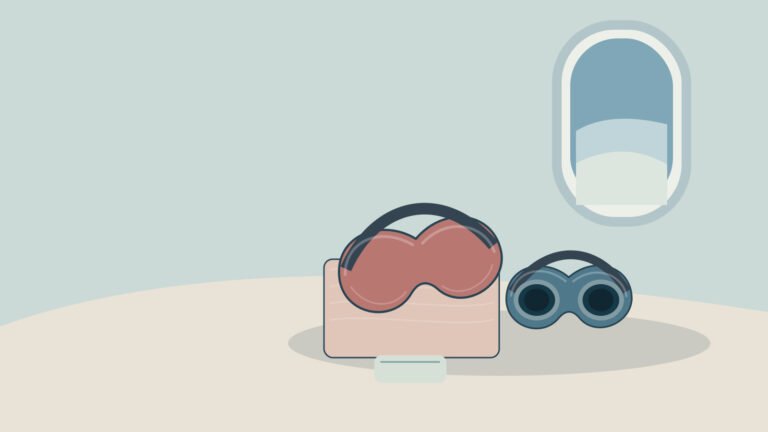
Original concept illustration: a folded blanket and fringed scarf in a travel setting; not product photography.
Travel blanket vs large scarf for flights is a packing decision before it is a shopping decision. A scarf may already belong in your outfit, whereas a blanket can offer a wider piece of fabric for your lap and shoulders. The better choice depends on what you need covered and what the same item will do after landing.
Imagine the seat rather than the product photograph. You are trying to reach a pocket, keep your belt accessible and move your legs without unwrapping half a wardrobe. A beautiful but narrow scarf may leave the exact area you wanted warm exposed. An oversized blanket may solve that while occupying space you needed for something else.
The comparisons below use published sizes and care information, alongside clearly labelled packing calculations. They are not temperature tests, and there is no claim that one fabric will feel warmer to every traveller. Start with a layer you already own, then use the examples to fill a specific gap.
Use an existing scarf
A layer already in your outfit may solve the problem without another item.
Check blanket width
Length alone does not show whether shoulders and lap stay covered.
Pack both properly
Include the pouch and compare the actual space each occupies.
Keep the buckle accessible
Wear the belt over the blanket when sleeping, following crew guidance.
Travel blanket vs large scarf for flights: start with coverage
Decide what must stay covered
A scarf that keeps your neck comfortable is not necessarily wide enough to cover your shoulders and lap at the same time. Before comparing fabrics, identify the job: warming your upper body, covering your legs, adding a light layer while resting or doing several of those things together. A clear job makes the size comparison much easier.
Try an existing scarf while sitting in a chair. Put your hands where they would normally rest and move them towards a book, phone or cup. Notice what becomes uncovered when you move. This is more useful than holding the scarf at full stretch and assuming its maximum dimensions describe its practical coverage.
Think in two dimensions
Length helps a layer reach further, while width gives room for shoulders, overlapping edges and movement. Neither dimension should be considered in isolation. A long, narrow rectangle can look generous in a product photograph yet require constant repositioning when draped over a seated person.
A dedicated blanket often provides a different shape, but check the actual model rather than assuming every travel blanket is large. Some are compact lap layers, while others are wider wraps. The right option is not the largest item available; it is the smallest one that covers the areas you care about without becoming awkward to manage.
When a large scarf is the smarter packing choice
One item can do two genuine jobs
A scarf makes a strong case when it is already part of the clothes you will wear at your destination. Using it during the flight then adds a function without necessarily adding another item. That is particularly attractive for a short trip where the bag is small and the wardrobe is deliberately limited.
Be honest about the second job. If you never wear large scarves, calling one a multi-use item does not guarantee that it will be used after landing. It may become a narrow blanket with tassels rather than a genuinely versatile accessory. Choose based on your normal clothing preferences rather than an imagined version of your travel style.
An existing scarf is a useful baseline
Before buying anything, compare the scarf you own with the coverage test above. You may find that it already works for a short flight, especially alongside the top or cardigan you planned to wear. A new blanket then needs to offer a clear improvement rather than simply look more travel-specific.
The baseline also helps when shopping. Write down what is missing: more width across the lap, less slipping from one shoulder, a cleaner storage solution or easier washing. Those observations turn the search into a targeted purchase. Without them, it is easy to buy another attractive rectangle which leaves the same area cold.
When a dedicated blanket earns its space
A separate clean layer can be useful
A blanket may make sense when you want an item reserved for resting rather than something worn outdoors throughout the day. The separation can simplify packing and cleaning, especially when your scarf is part of your outfit. This is an organisation preference, not a claim that one item is inherently hygienic or that a travel pouch sterilises it.
The extra width can also be useful when you want to change position without repeatedly rewrapping yourself. However, more fabric is only helpful while it remains inside your own space. An oversized layer dragging on the floor or hanging into the aisle is not a successful improvement in comfort.
Longer flights increase the value of easy handling
On a long journey you may alternate between resting, eating, reading and getting up. A layer which is easy to fold back and put away can be more useful than one which feels luxurious only while you remain perfectly still. Consider the number of times you will handle it, not merely the first impression when unfolding it.
A blanket’s separate pouch can help, provided it is easy to use in a seat and fits the space available in your bag. Avoid a packing method which requires a large table or exceptionally tight folding. You need a routine that works during the journey, not only on a tidy bed at home.
Useful measurements, including the parts not to count
Measure solid fabric rather than decoration
Fringes and tassels can be included in a scarf’s advertised length. They do not provide the same continuous coverage as the woven body, so note whether the stated measurement includes them. The RIIQIICHY example below explicitly includes fringes in its 200 cm length. [5]
Measure your own item without stretching it aggressively. Record length, width and the approximate area occupied when packed normally. For a scarf, also note the width left after folding it into the way you actually wear it. The most flattering neck arrangement may be different from the most useful seated covering.
Use geometry as a comparison, not a warmth test
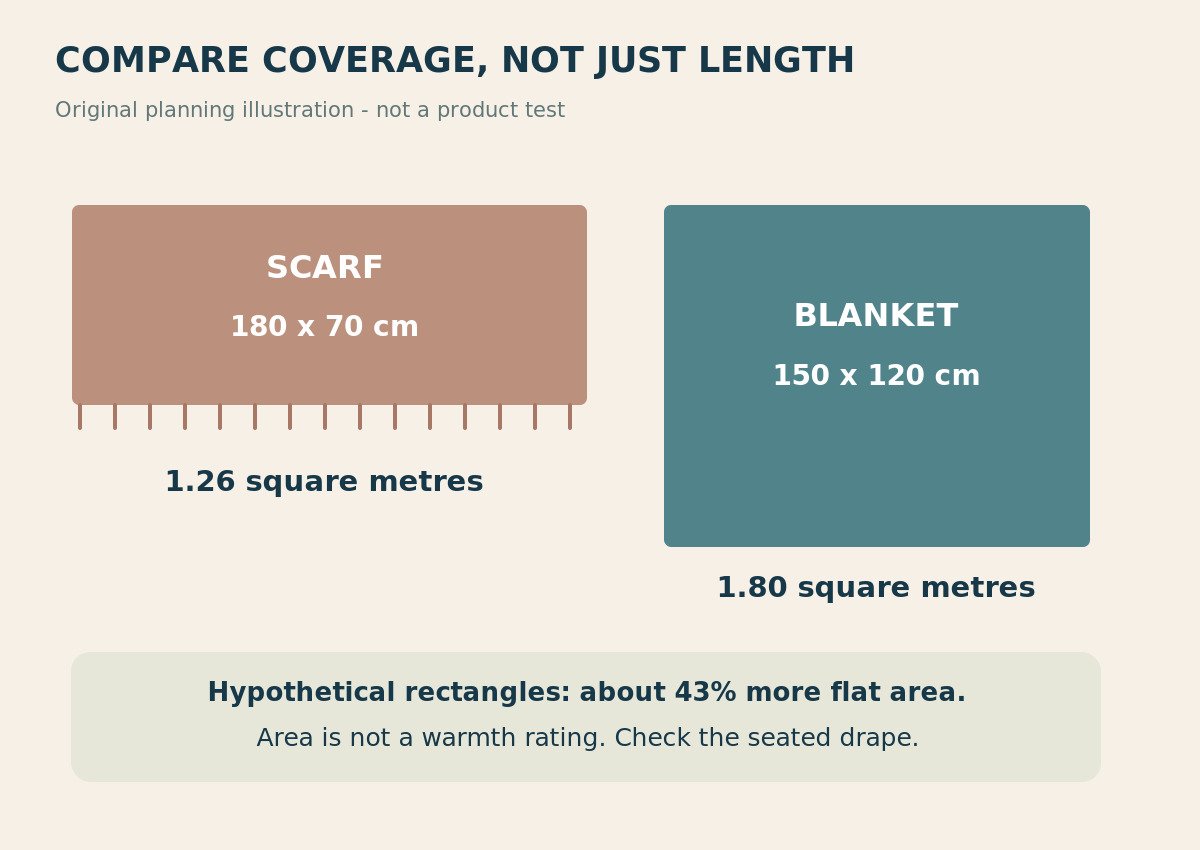
Consider two hypothetical rectangles: a 180 x 70 cm scarf and a 150 x 120 cm blanket. Their flat areas are 1.26 and 1.80 square metres. The blanket has about 43% more flat area, but that calculation says nothing by itself about insulation, thickness, draughts or how the edges sit on your body.
Folding a layer also changes the trade-off. Doubling it gives more layers over a smaller area, not free extra warmth across the original footprint. Try that arrangement while seated before deciding that a narrow scarf can replace a wider blanket merely because it is thick or long.
Five references that illustrate different approaches
Selection method and limitations
The products below were chosen to show a broad single-layer blanket, a simple fleece, a narrower blanket with a case, a quilted wrap and a large scarf. They are comparison references, not winners of a temperature or comfort test. The dimensions and materials are attributed to the relevant manufacturer or identified listing. [1] [2] [3] [4] [5]
| Reference | Useful published detail | Main reason to investigate | Main check | Buying reference |
|---|---|---|---|---|
| Cocoon COOLMAX EcoMade | 180 x 140 cm; current manufacturer weight 320 g | Broad single-layer coverage | Exact generation and colour | Check Cocoon blanket |
| Go Travel Classic 466.101 | 152 x 127 cm; 238 g | Straightforward fleece layer | Classic, not Deluxe wearable | Check Classic blanket |
| Cabeau Fold n Go | 36 x 60 inches, approximately 91 x 152 cm | Blanket with its own carry case | Width versus your preferred drape | Check Fold n Go |
| Trtl Mini Wrap | 140 x 110 cm open; 360 g | Quilted wrap with storage bag | 14 x 14 x 22 cm packed; check the drape | Check Mini Wrap |
| RIIQIICHY large shawl | 200 x 70 cm including fringes; polyester/viscose listing | Clothing layer that can become a wrap | Fibre label and useful unfringed length | Check large shawl |
Scroll the table sideways on smaller screens to see every column.
Do not assume every offer is available
The inspected marketplace views did not consistently show a current featured offer. In particular, the Trtl and scarf pages displayed no featured offer in their product summaries. Product identification is not the same as a confirmed purchase opportunity, so check seller, selected variant, delivery date and returns conditions. [5] [10]
The buying references are included to help compare exact products, not to create urgency. Where delivery or specifications remain unclear, use the manufacturer’s page or ask the seller. A suitable layer already in your wardrobe is often a better travel solution than a last-minute order chosen mainly because a photograph looks cosy.
How to read the blanket examples
Broad coverage versus a simple fleece
Cocoon’s current COOLMAX EcoMade page lists recycled polyester, a 180 x 140 cm size, 320 g weight and a 15 x 9 cm packing size. Older product information may differ, so match the version rather than transferring a remembered weight. The useful question is whether its broad shape suits your seated coverage and your packing routine. [1]
Review the Cocoon COOLMAX reference
Go Travel’s Classic blanket 466.101 is a simpler fleece reference, with a published 152 x 127 cm size and 238 g weight. Do not confuse it with the brand’s Deluxe wearable blanket. The Classic is worth examining when you prefer a conventional rectangle rather than a garment-like wrap. [2] [8]
Review Go Travel Classic 466.101
A case-led design and a quilted wrap
Cabeau describes Fold n Go as a French-microfibre blanket supplied with a carry case. Its published width is narrower than the broad Cocoon example, so compare the actual drape rather than assuming the carry case makes the products equivalent. The case’s secondary cushion uses are manufacturer descriptions, not evidence of tested support in this guide. [3]
Review the Cabeau Fold n Go reference
Trtl’s Mini Wrap is a quilted design with a roll-top storage bag and a pocket. The current FAQ gives an open size of 140 x 110 cm, alongside the published packed dimensions and 360 g weight. Compare that width with your seated drape rather than assuming the word wrap guarantees shoulder-to-lap coverage. [4]
Read a scarf label as carefully as a blanket label
Pashmina-style wording is not proof of cashmere
The identified RIIQIICHY listing describes a 70% polyester and 30% viscose blend, with a stated weight of 320 g. Its cashmere-like wording is a feel description, not a cashmere composition. The material field is also poorly labelled elsewhere on the page, so the sewn label and seller clarification matter. [5]
Review the RIIQIICHY shawl reference
A scarf can still be useful without being cashmere. The practical question is whether it feels acceptable to you, provides enough width and works with your destination clothes. Avoid paying for a fibre you have not actually established from a clear specification.
Construction matters beyond the fibre name
Two scarves described as polyester blends can differ in thickness, finish, weight, fringe length and stretch. The same is true of blankets sharing a broad material description. Fibre labels identify composition, not a universal ranking of warmth, softness or packing convenience. The formal fibre definitions should not be mistaken for performance ratings. [11]
Look for the combination of useful dimensions and a care routine you can follow. For a scarf worn as clothing, consider whether it catches on your bag hardware or becomes cumbersome when removed indoors. For a blanket, consider whether its case makes it easy to keep separate from the clothes you are wearing.
Warmth: separate personal comfort from product claims
A familiar layer is a better reference than a slogan
A product described as warm, cooling or temperature-regulating does not tell you exactly how it will feel on your next flight. Your clothing, preferences, seat environment and coverage all contribute. This comparison therefore avoids assigning a temperature range to any of the examples or claiming a measured winner.
Use a familiar item as the reference. If you know a particular cardigan is enough for most journeys, consider whether your scarf only needs to cover the lap. If you consistently want more coverage, a wider blanket may be the relevant change. Diagnose the missing coverage before assuming that a more expensive fibre is necessary.
Layers should remain easy to adjust
A modular arrangement can be practical: normal travel clothing plus one removable covering. You can then adjust the covering without unpacking or changing an entire outfit. However, do not add layers simply because they are individually small. A scarf, blanket, oversized hoodie and separate wrap can become a bulky solution to the same problem.
Choose the least complicated combination which meets your needs. The aim is to be comfortable through changes in the journey, not to achieve maximum insulation while sitting still for a product photograph. Easy removal and manageable storage deserve as much attention as the first impression of softness.
Packed bulk: compare like with like
Include the pouch and normal folding method
Weigh and pack the complete item, including the case you will actually carry. A bare scarf compared with a blanket inside a thick pouch is not necessarily a fair comparison unless that is genuinely how you will travel. Equally, do not exclude a pouch that is needed to protect or contain the blanket.
Use a normal, repeatable fold rather than the tightest compression you can manage once at home. You should be able to reproduce it while seated and without placing the fabric on a dirty floor. A layer that requires a lengthy packing ritual may be annoying after every meal or stop.
Bounding-box volume is only an estimate
Trtl’s published 14 x 14 x 22 cm packed dimensions give an external rectangular-box calculation of approximately 4.31 litres. That is not a measured internal bag volume or a claim that the soft package occupies a perfect cuboid. It is simply a way to visualise the space before purchase. [4]
Compare that estimate with the location available in your bag, not with a vague promise that everything is compact. The Mini Wrap listing is useful for checking the exact product, while the Cocoon reference illustrates a different packing approach. Confirm current specifications rather than borrowing dimensions from a similarly named blanket.
Wearing a scarf does not make all its bulk disappear
Plan for the moment you take it off
A scarf worn through the airport still needs somewhere to go when you are too warm, eating or passing through a situation where you remove it. Plan that storage space in advance. Otherwise, the apparently space-saving clothing layer can end up draped over the bag, occupying your hands or being left behind.
Try packing the scarf into the bag even if you expect to wear it most of the time. That simple test reveals whether your plan only works when every item remains in one ideal position. Travel is easier when the bag can absorb a removed layer without forcing you to repack its entire contents.
Do not assume an extra item is exempt
An accessory’s marketing description does not establish an airline’s baggage treatment. A blanket carried separately, a bulky pillow or a filled accessory pouch can raise different questions from a layer packed inside an allowed bag. Check the operating airline’s current allowance rather than treating a comfort item as automatically additional.
This guide does not provide a universal exemption for scarves, blankets or wearable wraps. The practical recommendation is to keep the kit within the allowance you booked and make it easy to stow. That approach avoids turning a small comfort decision into an unexpected argument at boarding.
Seat belts, meals and moving around the cabin
Keep the belt usable when you rest
The UK CAA recommends keeping the belt fastened during the flight, with the buckle accessible, and fastening it over a blanket when you are likely to sleep. Follow crew instructions and keep the covering arranged so it does not make the belt difficult to adjust or release. [6]
This is a useful home handling check: while seated with the layer draped normally, can you reach the area where the buckle would be without searching through folds? Do not simulate a restraint with improvised ties. You are assessing fabric management, not designing a new way to secure yourself to a seat.
Make a simple meal-time routine
Before a meal, fold the layer into your own space or return it to its pouch. Avoid leaving corners across the tray or under a cup. A large scarf may be easier to lift onto the shoulders, while a blanket may be easier to fold onto the lap; the best method depends on its size and your arrangement.
When getting up, gather the fabric so it does not trail or catch. Never attach it to the seat, screen, tray or another passenger’s space to keep it in position. A covering which repeatedly needs that sort of improvisation is a poor match for the seat and should be replaced by a simpler arrangement.
Window, middle and aisle seats create different handling needs
Window and middle seats
A window position may encourage side leaning, which can pull a scarf off one shoulder or trap part of a blanket behind your back. Check the drape while leaning gently rather than assuming a straight-ahead fit will remain unchanged. Keep fabric away from anyone else’s seat area and avoid using a neighbour’s space to spread it out.
In a middle seat, easy containment matters. A wider blanket can still work when folded to the appropriate footprint, but excess fabric is not automatically useful. Choose a layer you can manage without repeatedly lifting your elbows across the armrests. A compact, predictable routine is more considerate than constant rearrangement.
Aisle seats and frequent movement
An aisle position can make getting up easier, but a trailing corner is also easier to leave outside your own area. Keep the lower edge gathered and avoid letting fringe hang where it may catch. The item should be simple to put away before standing, particularly when you need to move promptly.
Do not choose a covering on the assumption that you will remain still for the entire flight. Consider how it works when another passenger needs to pass or when the crew needs access. The most useful flight layer is one you can manage calmly through those interruptions.
Washing and drying on the trip
Use the exact care label
A shared fibre does not guarantee identical care instructions. The cited Cocoon page allows a 30-degree machine wash and low tumble drying, while Go Travel’s Classic page says to wash at 30 degrees but not tumble dry. Those differences belong to the products, not to a general rule that every travel blanket can be treated alike. [1] [2]
Keep the care label available and use the method that applies to the delivered item. For a shawl, check whether the seller’s brief care field agrees with the detailed instructions. Where it does not, seek clarification rather than choosing whichever method sounds more convenient.
Build a drying margin into the itinerary
Do not wash the only warm layer immediately before an early transfer unless you have a realistic way to dry it properly. A damp item can be inconvenient to pack and may be unusable when you next want it. The necessary drying time varies with the item and conditions, so this guide does not promise a universal number of hours.
For repeated journeys, consider whether a dedicated blanket can remain separate while your scarf continues to serve as clothing. Conversely, a scarf that is easy to care for may make the second item unnecessary. The useful distinction is the routine you can carry out, not whether the packaging calls the fabric travel-ready.
Keep the resting surface separate from the messy jobs
Multi-use does not mean every use at once
A scarf can be clothing and a light covering, but using it as a beach mat, spill cloth and sleep layer during the same day creates a cleaning problem. The same applies to a blanket. Choose which secondary uses are genuinely compatible with the way you want to use it later.
There is no need to make a product perform every imaginable task to justify packing it. One reliable primary job and one realistic secondary job are enough. Overloading the plan with unlikely uses can make an unsuitable item seem more versatile than it will be in practice.
Store the pouch as carefully as the fabric
A pouch protects the layer from mixing loosely with the rest of the bag, but it also needs to remain clean. Keep it away from leaking liquids and shoes. When unpacking, check both the fabric and its container rather than assuming that anything inside a zip or roll-top bag is ready to use.
Avoid sealing a damp layer away for the rest of the trip. Let it dry according to its care instructions, then repack. A good organisation routine is simple enough to repeat after a tiring flight, which is why a slightly larger but easy-to-use pouch can be more practical than an exceptionally tight one.
Three realistic packing decisions
A warm-weather city break
For a short city break, an existing large scarf may be sufficient when it also fits your clothing plan. Start by testing it with the outfit you intend to wear on the flight. If the combination covers the areas that bother you, a separate blanket may offer little extra value for the space it occupies.
Consider what happens after landing in warmer conditions. You may remove the scarf immediately, so reserve a pocket or compartment for it. Do not build a packing plan which assumes that a warm layer can stay around your neck throughout the journey simply because that keeps it out of the bag.
A long overnight flight followed by several transfers
A dedicated blanket becomes more attractive when you want a consistent resting layer across several legs and do not want to use the scarf worn outdoors. Choose coverage and an easy storage method before looking at special features. Repeated handling makes a fiddly pouch or awkward fringe more noticeable.
Still, avoid buying a blanket just because the flight is long. The airline may provide a covering, or your existing layers may already be enough. Check what is included for the exact booking and decide whether carrying your own gives a specific benefit rather than duplicating something without purpose.
A cold-weather trip with a useful clothing scarf
When a substantial scarf is already part of the destination wardrobe, its flight use can be an efficient bonus. A blanket might still be worth taking for extra lap coverage, but compare the actual combination rather than automatically packing both. The scarf’s clothing role does not mean it is wide enough for every resting position.
Test whether folding or draping the scarf differently solves the coverage problem without creating an uncomfortable neck arrangement. You should not need to tie yourself into the layer. A loose, manageable wrap is more useful than a complicated configuration that takes several minutes to undo when you need to stand.
Value: use the item you already own as the zero-purchase option
Compare the additional benefit
A new blanket needs to improve something: width, a separate clean layer, easier handling or a more suitable care routine. A new scarf needs to make sense as clothing as well as a covering. Merely being described as a travel accessory is not an extra function.
As a hypothetical budgeting example prepared on 11 October 2026, a GBP 30 blanket taken on six trips costs GBP 5 per trip before washing or replacement. A scarf already owned creates no new purchase cost, although it still occupies space and needs care. Those figures are illustrative arithmetic, not current offers or an estimate of product lifespan.
Include the inconvenience cost
An accessory can be inexpensive yet inconvenient if it must be carried separately or repeatedly falls from the shoulders. Equally, a pricier item may be a poor choice when it stays at home because it is too bulky. Consider whether the item will actually be packed and used, not just whether its features look persuasive online.
A useful final question is whether you would still carry it without its travel branding. That removes some of the marketing appeal and leaves the practical object: a rectangle, a wrap, a pouch and the work required to keep them ready. Choose the arrangement that serves your journey, not the one with the most claimed functions.
A home trial that answers the right questions
Check drape, access and repacking
Use a chair and the clothes planned for the flight. Drape the layer, reach for an imaginary buckle, fold it away as though a meal has arrived and stand with it gathered safely. Then repack it into the intended bag compartment. This checks handling without pretending to reproduce cabin temperature or aircraft safety testing.
Write down any specific failure: the scarf leaves the lap exposed, the blanket blocks pocket access, the pouch is difficult to fill or fringe catches on the bag zip. Those observations point towards a different size or construction more clearly than simply recording that an item feels nice.
Compare ordinary use rather than an ideal pose
Try the arrangement after reading or sitting for a while, when you are less careful about keeping every edge perfectly placed. A layer that only works while you pose upright may be less useful than a plainer one which stays manageable. Do not turn this into a prolonged uncomfortable trial; stop and change the arrangement when necessary.
Keep the retailer’s return terms in mind before using a new item. A home handling check and a used travel trial may be treated differently. Preserve packaging and labels while you establish what is permitted, and avoid assuming that every seller offers an unrestricted comfort guarantee.
A personal-item-only packing audit
Give the covering a defined space budget
When travelling with one small bag, decide where the resting layer will sit before buying it. Place the things which must remain accessible first, then see what space is left. The covering should fit around that plan rather than forcing essential items into difficult-to-reach corners.
Use a soft mock-up only as a rough planning aid. A spare garment can show whether a particular pocket is a plausible home, but it will not reproduce the exact compression or weight of a product you have not bought. Keep those uncertainties separate from the dimensions published by the manufacturer.
Test the bag with the layer removed and replaced
Pack the bag, remove the scarf or blanket as though boarding has finished, then return it after a short interval. Notice whether it slides back into its place or requires the whole bag to be reorganised. Easy replacement matters because a comfort accessory may be handled several times during a flight.
A scarf worn at boarding can pass this test too. Its clothing role should not excuse the absence of a storage plan. When a bag only closes while the scarf is permanently worn, you have chosen a very specific arrangement which may become inconvenient later.
Two adults sharing limited packing space
Share the planning, not necessarily one small covering
A single narrow layer may be frustrating when two people want to use it at the same time. Decide whether each person needs their own covering or whether one genuinely will not use it. Do not assume a product described as large is comfortable for two seated adults without checking its useful width.
Separate smaller items can be easier to manage than one oversized blanket crossing the space between seats. Each person can adjust or remove their own layer without disturbing the other. That is a practical coordination advantage, not a claim that buying two products is always necessary.
Allocate the items by actual need
One traveller may prefer a scarf already included in their outfit while the other benefits from a dedicated blanket. The pair does not need matching products. Compare warmth preferences, washing routines and where each item will be stored rather than treating the purchase as a set.
Keep the shared bag balanced around access. If one person’s layer is buried beneath everything else, both may need to unpack whenever it is wanted. A small rearrangement of existing items can improve convenience more effectively than purchasing another pouch or a different branded covering.
Inspect hems, pockets and fastenings before travelling
Small details can change handling
Check for loose threads, rough seams or a pocket closure that catches when the fabric is folded. For a scarf, inspect the fringe and the transition into the main fabric. For a blanket, check that its storage fastener does not press uncomfortably against the body when the item is draped normally.
A pocket can be useful, but do not assume it is the best place for important documents while you sleep. Consider how the contents affect drape and how you will keep track of them when removing the covering. A feature only adds value when it supports a routine you can manage reliably.
Preserve the comparison after the first wash
After following the care instructions, check that the item still folds and fits its pouch normally. Notice any change in the seam, closure or overall shape before the next trip. Do not force a changed item back into a case just to retain the original packing plan.
These checks do not establish long-term durability, but they reveal practical problems early. A product that remains easy to wear, fold and store is more useful than one whose impressive list of features becomes awkward after ordinary care.
Pros and cons of the two approaches
A large scarf
The strongest advantage is genuine clothing use after the flight. It can make the resting layer part of an outfit rather than another packed object. The limitations are variable width, fringes which may exaggerate useful length and the possibility that a scarf comfortable around the neck is awkward over the lap.
Choose it when you like wearing it and its seated coverage is enough. Do not choose it solely because it can theoretically be worn outside the bag. You still need a place to put it when removed and a realistic cleaning routine between clothing use and resting use.
A travel blanket
A blanket can provide a dedicated covering with a shape chosen for resting. A matching pouch may make storage more straightforward. Its disadvantages include another item to pack, potential duplication of an existing layer and the risk of buying more bulk than the coverage benefit justifies.
Choose it when the extra function is clear and repeatable. A blanket is not automatically warmer, cleaner or easier to manage than every scarf. Compare the actual dimensions, construction and care requirements, then select the simplest option that makes the journey more comfortable without cluttering the seat.
Common mistakes
Comparing length and ignoring width
A long scarf may appear larger than a shorter blanket while offering less useful seated coverage. Check both dimensions and whether decorative fringe is included. Do not use flat area as a substitute for a drape check either; equal areas can form very different shapes when wrapped around a person.
Another mistake is treating cashmere-like wording as a fibre claim. Read the composition and ask about missing or conflicting details. A clearly described blend can be a perfectly sensible purchase, but it should be chosen for what it is rather than for a material implied by marketing language.
Forgetting the rest of the journey
Packing an item tightly once does not establish that it will be easy to stow after every use. Include the pouch, practise normal repacking and make sure a removed scarf can go inside the bag. A plan that depends on holding the item all day is not necessarily a space-saving plan.
Finally, keep the layer within your own space and the belt accessible. Avoid trailing corners, attachments to the aircraft and arrangements which make standing unnecessarily difficult. The point is a manageable comfort layer, not a personal enclosure which complicates movement or crew access.
Frequently asked questions
Is a large scarf enough for a long-haul flight?
It can be when the width and drape cover the areas you want warm and you are comfortable with your other clothing layers. Flight duration alone does not decide the answer. Test the scarf while seated, moving your hands and changing position. Choose a blanket when the scarf leaves a specific coverage gap or when you want a separate resting layer.
Are travel blankets always warmer than scarves?
No. The category does not establish warmth. Construction, thickness, coverage, clothing and personal preference matter. This guide has not measured thermal performance or assigned temperature ratings to the examples. Compare a candidate with a familiar layer and focus on the practical gap you want to solve, rather than assuming a product called a blanket must be warmer.
Should I include tassels in the measurement?
Record the advertised size, but distinguish the solid fabric from fringe when judging coverage. The cited RIIQIICHY listing includes fringes in its length, which is why that qualification is kept in the table. Measure the usable body of your own scarf and test its drape; decorative length does not provide the same continuous covering. [5]
Can I wear my seat belt underneath a blanket?
The cited UK CAA guidance says to fasten the belt over a blanket when you are likely to sleep and keep the buckle accessible. Follow the crew’s instructions and make sure the layer does not obstruct adjustment or release. Do not create an improvised restraint or attach the blanket to the seat to hold it in position. [6]
Does a travel blanket count as extra cabin baggage?
There is no universal exemption in this guide. Check the operating airline’s current rules for your booking, especially when the item is carried separately rather than packed inside an allowed bag. The simplest plan is to ensure the whole comfort kit can be stowed within the allowance you already have instead of relying on a product’s airline-friendly marketing.
Can I use a shawl as both clothing and a blanket?
Yes, when its dimensions and feel work for both roles. That is the main reason to choose a large scarf or shawl. However, plan cleaning and storage between uses, and avoid assuming that an item used for messy outdoor jobs remains ready as a resting layer. Two realistic functions are more valuable than a long list of unlikely ones.
Which is easier to wash during a multi-stop trip?
The answer belongs to the exact item, not the category. Check the delivered care label and think about where drying will happen before the next departure. Some blankets and scarves have convenient routines, while others need more care. Do not wash the only warm layer immediately before a transfer without a realistic way to dry and repack it.
Should I pack both a blanket and a large scarf?
Only when they do different useful jobs and the bag has room. For example, a clothing scarf and a wider dedicated lap covering may justify two items. Otherwise, start with the scarf you own and identify what it cannot do. Packing both automatically can duplicate bulk without producing a meaningful improvement in comfort or convenience.
Final recommendation: buy coverage, not a category
Start with the layer already in your wardrobe
Use a large scarf when it serves as clothing and passes the seated coverage test. Choose a blanket when you can name the extra benefit and accommodate its packed size. That decision is more reliable than assuming one category is inherently more luxurious, warmer or better for every long flight.
For a conventional fleece reference, revisit Go Travel Classic. For a clothing-first alternative, compare the large RIIQIICHY shawl with its stated blend and fringe-inclusive length in mind. Keep the purchase optional: an existing layer that works, stores easily and can be kept ready may be the best-value choice of all.
Sources and fact-checking notes
Sources checked 11 October 2026. Published specifications and policies are attributed above; fit judgements, packing suggestions and hypothetical calculations are editorial guidance, not measured test results. Product versions, offers and airline policies can change. No hands-on product testing is claimed.
- Cocoon COOLMAX EcoMade blanket: 180 x 140 cm, 320 g and care
- Go Travel Classic 466.101: 152 x 127 cm, 238 g and care
- Cabeau Fold n Go: 36 x 60 inch blanket and carry case
- Trtl Mini Wrap UK: construction and packed dimensions
- RIIQIICHY wrap: identified UK listing, composition and dimensions
- UK CAA: seat belts over blankets when sleeping
- Cocoon COOLMAX UK listing: selected eggplant version
- Go Travel Classic UK listing: model 466.101
- Cabeau Fold n Go UK listing: blue version
- Trtl Mini Wrap UK marketplace listing
- UK textile fibre definitions: names are not fabric-performance ratings
Illustrations in this article were created for Taylor’s Trailblazing Travel Gear. Third-party photographs, where used, are credited beside the image or in the source list.