Foam Earplugs vs Reusable Earplugs for Travel
Compare fitting, noise ratings, repeat use and hygiene without confusing a quieter journey with a medical promise.
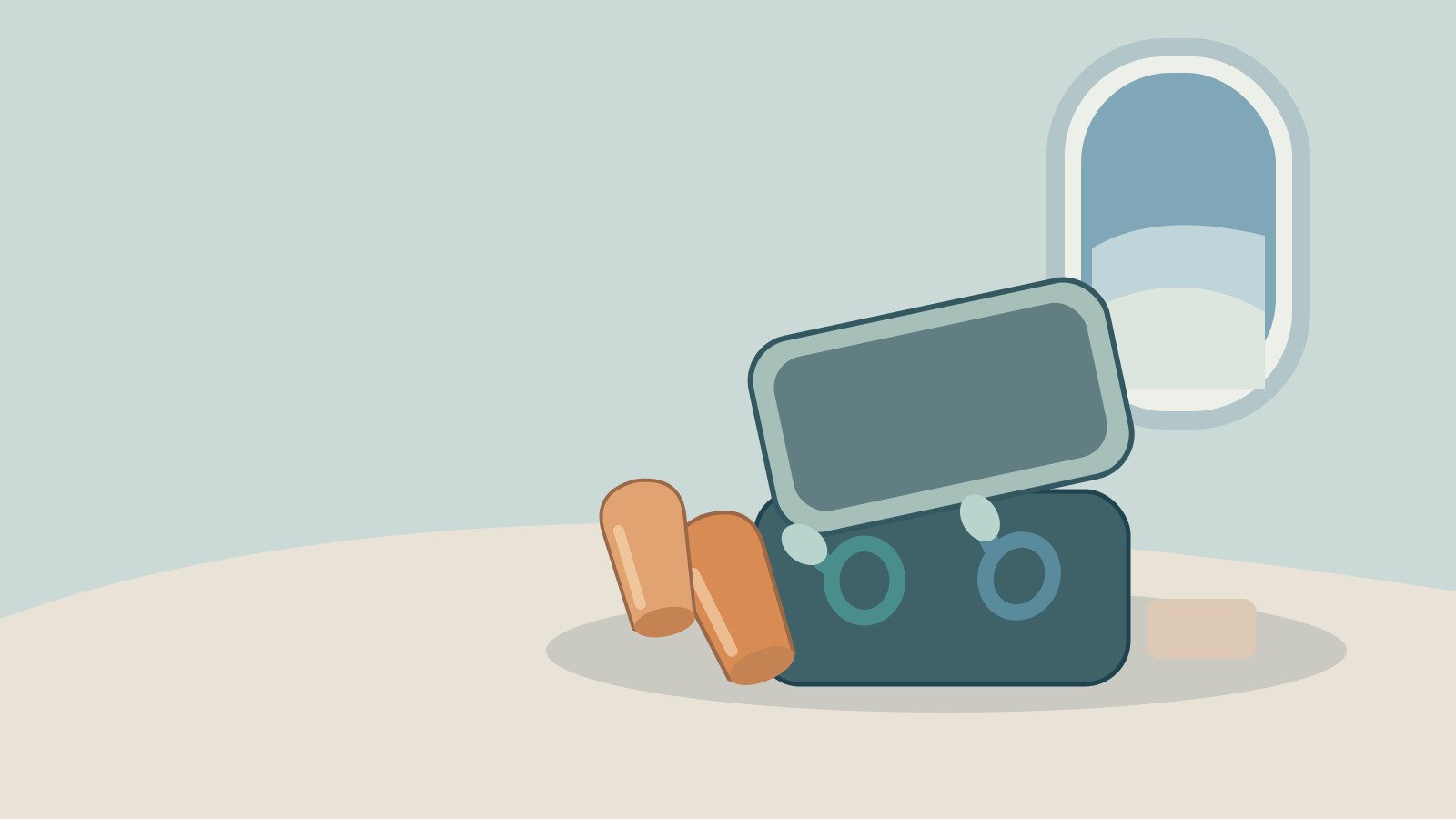
Original concept illustration: foam and reusable earplug shapes beside a storage case; not product photography.
Foam earplugs vs reusable earplugs for travel is really a choice about fit and routine. Disposable foam is easy to carry in small quantities, while a reusable pair gives you an item to clean, protect and find again. Neither approach works well when the plugs hurt, sit loosely or become too dirty to use.
A holiday can include very different listening situations: a busy departure lounge, a long flight, an unfamiliar hotel and a train announcement you must not miss. The most useful pair is not necessarily the one with the largest number on its packet. It needs to suit the moment and remain comfortable enough to leave in when appropriate.
This guide compares manufacturer information and public hearing-protection guidance. The product examples are not a hands-on ranking, and no cabin noise measurements were taken. Hearing protection for genuinely hazardous noise, persistent ear symptoms and pressure-related pain need more than a shopping comparison.
Small foam supply
Try a manageable pack rather than buying a large quantity before checking fit.
Reusable, if it fits
A good cleaning and storage routine makes repeated use practical.
Keep the rating label
SNR and NRR figures are not interchangeable shopping scores.
A separate question
Noise reduction does not by itself establish pressure-equalisation benefits.
Foam earplugs vs reusable earplugs for travel: choose a routine
The useful starting point
Foam plugs are compressed before fitting and then expand in the ear canal. Reusable designs arrive with a formed shape or replaceable tips and rely on the correct size and positioning. Both approaches can reduce noise, but the category alone does not tell you how much protection you personally obtain. NIOSH emphasises fit rather than treating the number on a packet as a personal result. [1] [2]
Think about when you will insert and remove the plugs. A pair used once after boarding creates a different routine from one removed repeatedly for station announcements, conversations and check-in. Choose something you can handle cleanly and confidently at those moments. A technically impressive product is not useful when its fitting routine is too awkward to follow.
Start small when fit is unknown
A small foam pack and a carefully chosen reusable pair are sensible ways to investigate the two approaches, but you do not need to buy both automatically. Begin with the main problem: discomfort, repeated replacement, difficulty inserting foam or an unreliable seal. Then choose an alternative that addresses that problem rather than simply changing brands.
Avoid buying a large multipack before you know the size and shape suit you. The cheapest cost per pair becomes irrelevant when most of the packet remains unused. Similarly, a reusable set with many tips only provides options; it does not guarantee that one of them will feel right in each ear.
Know which kinds of earplug you are comparing
Foam, formed tips and mouldable putty
This guide concentrates on roll-down foam and reusable in-ear designs intended for noise reduction. Mouldable putty which covers the ear opening is a separate construction with different fitting instructions. Do not transfer a roll-down method to a putty product or push a surface-sealing product into the canal.
Reusable also does not mean silicone in every case. Read the named material and the manufacturer’s instructions for the exact model. A brand can sell sleeping, swimming, music and flight products which look related but serve different purposes. Buying the right brand is not enough if the version in the basket addresses the wrong problem.
Earbuds are another category
An audio earbud with active noise cancellation is not automatically certified hearing protection. NIOSH warns against assuming that cancellation technology alone supplies that protection. For a leisure flight, some people may prefer headphones for entertainment, but that is a different comparison from choosing a passive earplug. [2]
Do not add music at a high volume to compensate for a poor seal. First establish what the device is designed to do and what listening situation you are trying to manage. A comfort accessory, a listening device and equipment for hazardous-noise protection should not be treated as interchangeable because each makes the surroundings seem quieter.
Noise ratings: keep the number and its label together
SNR and NRR are different systems
Product packaging may show SNR or NRR. They arise from different rating methods and should not be placed in a single biggest-number-wins league table. Retain the label when writing down a specification, and check that the number belongs to the exact product rather than another model from the same manufacturer.
For example, the manufacturer references used here identify Moldex Spark Plugs as SNR 35 dB, Loop Quiet 2 as SNR 24 dB and Mack’s Ultra Soft as NRR 33 dB. The Mack’s figure should not be treated as directly comparable with the SNR figures. These are published product ratings, not measurements of a traveller wearing them. [3] [4] [5]
Do not subtract blindly from cabin noise
A package rating is not permission to take an assumed cabin sound level, subtract the printed number and claim an exact level at your ears. Real fitting, the sound itself and the rating method complicate that calculation. This guide therefore does not publish a supposedly precise cabin-noise result for any of the examples.
For hazardous noise, individual fit assessment and suitable professional guidance matter. For ordinary travel comfort, the practical lesson is still useful: a good fit and sensible awareness are more meaningful than chasing a headline number. Keep expectations realistic; reduced sound does not mean complete silence or a guarantee of uninterrupted sleep.
Product examples and the questions they answer
How the shortlist was assembled
These five references illustrate inexpensive replacement foam, a larger foam supply, a reusable silicone design, a shaped sleep plug and a flight-specific filtered alternative. They are not ranked by customer stars or claimed sleep outcomes. Each was selected to make a different buying decision easier to understand. [3] [4] [5] [6] [7]
| Product | Type | Published rating reference | Important buying check | Buying reference |
|---|---|---|---|---|
| Moldex Spark Plugs 7800 | Roll-down foam | SNR 35 dB | Correct model and sealed pack quantity | Check 10-pair reference |
| Mack’s Ultra Soft | Polyurethane foam | NRR 33 dB on manufacturer page | Pack size and market-specific label | Check 50-pair reference |
| Loop Quiet 2 | Reusable silicone | SNR 24 dB | Quiet 2, not another Loop model | Check Quiet 2 |
| Alpine SleepDeep | Shaped reusable sleep plug | SNR 27 dB in the identified listing | Linked version is size S | Check SleepDeep size S |
| Alpine FlyFit | Reusable flight-filter design | SNR 17 dB | Follow flight-specific fitting instructions | Check FlyFit |
Scroll the table sideways on smaller screens to see every column.
A listing is not a delivery promise
Marketplace stock, seller identity and featured offers were not consistently available in the inspected views. Use the links to check the precise product and current offer rather than assuming that a particular pack will arrive before departure. A clean, genuine product already available locally may be a better practical purchase than an uncertain online delivery.
Check quantity in pairs rather than individual plugs. Also check whether a case or spare tips are included. Those details affect both value and packing, but they should not distract from fitting the product correctly. The listing references identify the products and pack or size shown, not a guarantee that every variation on the page is equivalent. [9] [10] [11] [12] [13]
When foam is the more practical choice
Occasional travel and easy spares
Foam is worth considering when you want a small supply of replacements without managing one expensive pair throughout a trip. You can separate enough clean pairs for the journey from the rest of a pack at home, keeping packaging or a suitable clean container as appropriate. Leave the unused bulk behind rather than carrying it simply because the purchase came in a large tub.
This approach can be particularly convenient when losing one pair would otherwise leave you without an option for the return flight. However, carrying spares is not a reason to fit plugs carelessly or keep using a damaged pair. Replacements are part of the routine, not a substitute for learning how the particular shape behaves in your ears.
Two foam references with different pack decisions
Moldex Spark Plugs 7800 provides a familiar roll-down foam reference. The linked UK listing is a ten-pair pack, which is a more manageable starting quantity than some industrial-sized boxes. Its published SNR should be read with the product instructions, not as a prediction of your own result. [3] [9]
Mack’s Ultra Soft is another polyurethane foam example; the linked pack contains fifty pairs. The manufacturer’s current US page gives NRR 33 dB and says these plugs should not be washed. Check the label on the supplied pack rather than borrowing a rating from a similarly titled marketplace entry. [4] [10]
When reusable plugs make more sense
A repeatable fit and an item worth looking after
Reusable plugs suit travellers who find a comfortable size and prefer maintaining a familiar pair. The routine then becomes fitting, removal, cleaning where instructed, drying and returning the plugs to their case. That can be straightforward, but it requires more attention than dropping an item loose into a pocket after every use.
Consider how you manage small possessions generally. Someone who reliably returns glasses to a case may find the routine natural. Someone who frequently misplaces small items may need a spare pair or may prefer inexpensive foam. Neither is a character judgement; it is simply a way to match the product to the behaviour that will actually happen during travel.
Loop Quiet 2 and Alpine SleepDeep
Loop Quiet 2 uses a reusable silicone construction and is a specific model, distinct from Quiet 2 Plus and the brand’s filtered designs. Check the tip options and cleaning instructions for the version you buy. The appeal is a repeatable fitting arrangement, not a guarantee that silicone feels comfortable to everyone. [5]
Alpine SleepDeep has a shaped, oval design and several size choices. The link here leads to size S, not a universal-fit recommendation. Select a size deliberately and distinguish the SleepDeep product from other Alpine sleep models. Its fit against a pillow is something to assess personally, not infer from the phrase side-sleeper friendly. [6] [12]
Fitting foam correctly is part of the purchase
Learn the sequence before the airport
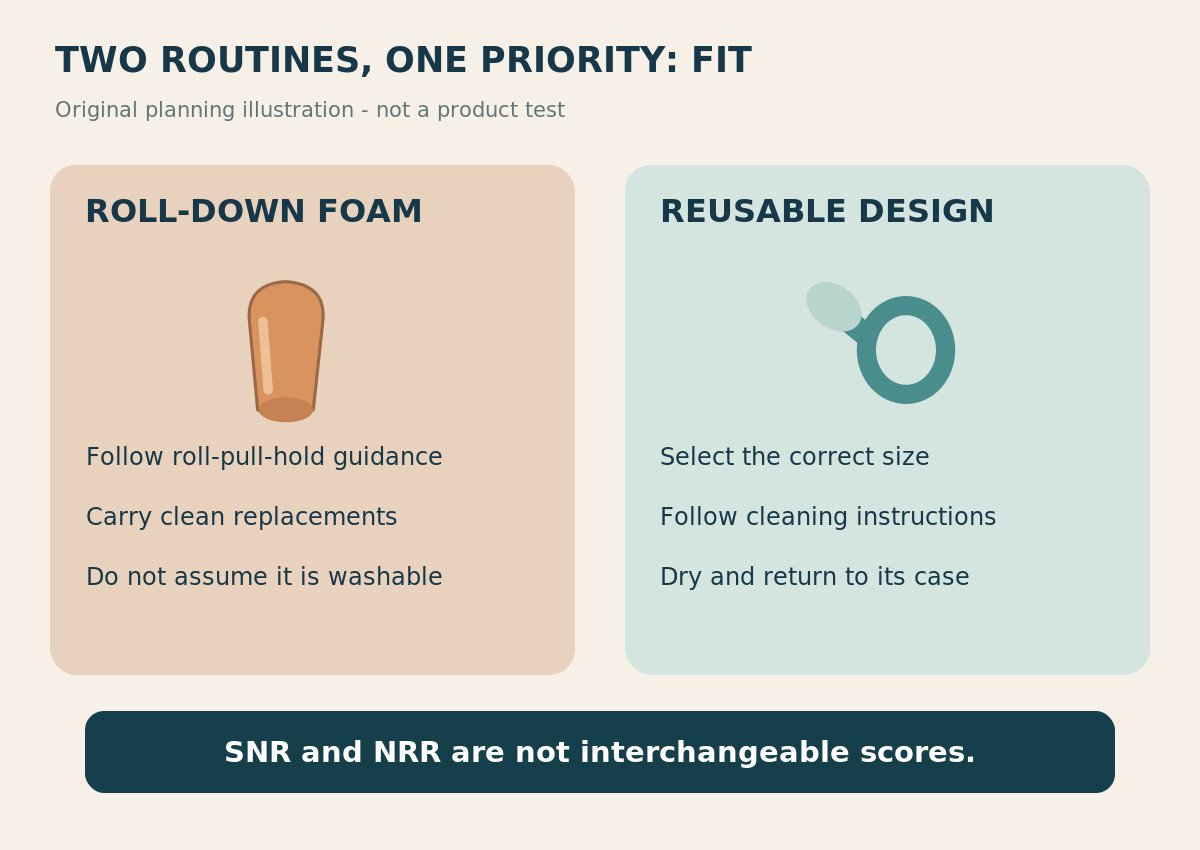
NIOSH describes a roll-pull-hold method: compress the foam into a narrow cylinder, use the opposite hand to pull the outer ear up and back, then hold the inserted plug while it expands. Follow the exact product instructions and use clean hands. The purpose is a properly seated plug, not forcing a large shape into an unsuitable ear canal. [1]
Practise in a calm place before travel so you are not learning while managing luggage and boarding announcements. If a plug repeatedly expands before you can position it, stop and reassess the technique or product rather than repeatedly handling the same pair with increasing frustration. A product that is difficult for you to fit may not be the right travel choice.
Comfort and removal also count
A useful fitting routine includes taking the plugs out as instructed. Do not yank them suddenly. Mack’s, for example, advises slow removal with a twisting motion to break the seal gradually. Read and keep the instructions for the product you choose, particularly when changing from a familiar design to another one. [4]
Pain is not proof that a plug is working well. Stop using a pair that causes pain, marked irritation or an uncomfortable sense of pressure, and seek appropriate advice for persistent symptoms. The aim is not to become accustomed to a bad fit because a large packet has already been purchased.
Reusable fitting: size before pressure
More force is not a sizing system
Use the manufacturer’s fitting method and the sizes actually intended for that model. A tip should not need excessive force to stay in place. Nor should you assume that a loose fit can be solved by inserting the plug further than instructed. Shape and size are part of the selection, not problems to overcome through persistence.
Where replacement tips are supplied, keep their sizes identifiable. Trying several without remembering which is which makes the process less useful. You may find that the two ears need different options, but follow the product’s guidance and do not improvise by cutting tips or combining parts from unrelated models.
Check the arrangement you will use
A plug comfortable while sitting upright can feel different when resting against a pillow or wearing headphones over it. Test that combination gently at home. Pay attention to any protruding part that meets the pillow and to whether adjusting the headphones dislodges the plug.
You do not need to create a loud environment to judge comfort. Keep the test ordinary and stop if anything hurts. A home comfort check is not an individual hearing-protection fit test, and it should not be presented as one. It simply helps you avoid discovering an obvious shape problem when you are already trying to rest during the journey.
Cleaning and replacement are not optional details
Follow the instructions for the material and model
Disposable foam should not automatically be washed for reuse. Mack’s explicitly says to discard its Ultra Soft plugs when soiled and not to clean them. That guidance should not be extended into an exact lifespan for every foam product, but it shows why a generic wash-and-reuse routine is inappropriate. [4]
For reusable plugs, use only the cleaning method specified by the manufacturer. Filtered products can have different requirements from a simple silicone design. Avoid applying heat, strong cleaning chemicals or improvised treatments on the assumption that anything described as reusable must tolerate them. Replace damaged components rather than trying to repair a surface that sits in the ear.
Give drying a place in the schedule
Do not finish cleaning and immediately seal damp plugs inside their case unless the instructions specifically allow that routine. Plan enough time for the required drying process. A case should also remain clean and usable, otherwise the cleaned plugs simply return to the same dirty storage space.
On a multi-stop trip, choose a consistent place for the case where it is not mixed with wet toiletries. Keep unused replacements separate from worn plugs. If the routine becomes impossible, a clean replacement used according to instructions is more sensible than stretching the life of a pair simply to preserve the idea of travelling with one reusable item.
Flight pressure pain is a separate problem
Noise reduction does not establish pressure relief
Foam and ordinary reusable noise-reduction plugs should not be assumed to prevent discomfort from cabin pressure changes. The CDC’s air-travel guidance discusses barotrauma as a pressure-equalisation issue, which is distinct from simply making sound quieter. Persistent or significant symptoms deserve appropriate medical advice rather than a more aggressive earplug fit. [8]
This distinction matters when reading reviews. A person reporting a quieter cabin is not evidence that the same product will help another traveller during descent. Likewise, an advertised flight product should not be treated as a treatment for every ear condition. Match the purpose and instructions to the actual problem you are trying to address.
Where a flight-specific product fits
Alpine FlyFit is included as a separate flight-filter design, not as the overall winner of a foam-versus-reusable comparison. The manufacturer provides flight-specific instructions and a stated noise-reduction rating. Check those details before purchase and do not assume the product makes flying appropriate when you have an ear problem requiring advice. [7]
Review the flight-specific FlyFit reference
The practical buying lesson is simple: first decide whether the main issue is noise, fit or pressure discomfort. They can occur together, but they are not the same issue. A single product name should not be used to blur those distinctions or promise a result that this comparison has not established.
Announcements, alarms and travelling companions
No universal promise of hearing everything important
Do not assume you will hear every alarm, announcement or companion while wearing earplugs. The surroundings, the fit and your own hearing all matter. A review saying that an alarm was audible is one person’s observation, not a safety guarantee for a different hotel room or departure lounge.
Plan when to remove the plugs. Boarding, safety briefings, changing platforms and conversations with crew are moments when clear awareness matters. If you are responsible for a child or another traveller, consider that responsibility before trying to reduce surrounding sound. The right product is sometimes the one left in its case until the appropriate moment.
Make the routine obvious to the people with you
Agree simple expectations with a companion: when you intend to rest, how they can get your attention and who is monitoring a departure update. That is more reliable than assuming the other person will notice everything automatically. Still, do not use a companion as a substitute for following safety instructions yourself.
Avoid creating a complicated system that depends on one vibration, one notification or one person never falling asleep. Travel changes quickly. Keep the plugs accessible for removal, and treat quieter surroundings as a comfort preference rather than permission to ignore what is happening around you.
Pack enough, without turning the case into clutter
Count usable pairs rather than loose pieces
For foam, prepare a realistic supply based on the product’s replacement instructions and the length of the trip. A small margin for a dropped or soiled pair is sensible. There is no universal number of pairs per flight because use patterns and manufacturer guidance vary, so avoid treating a packing estimate as a hygiene rule.
For reusable models, include the correct case and any spare tips you genuinely need. Do not empty all accessories into one loose pocket. A tiny labelled container or the supplied compartments can prevent a useful spare from becoming an unidentified piece at the bottom of your bag.
Keep instructions available without carrying a folder
Photograph the fitting and cleaning instructions, model name and any size information before leaving. This takes less space than carrying every leaflet, while helping you avoid borrowing instructions from a similar-looking product online. Keep the original packaging at home when it is useful for warranty, authenticity or replacement identification.
Store the plugs where you can reach them after your larger bag is stowed. The travel comfort and organisation guide explains the wider small-pouch approach. The aim is one reliable place for the items used during the journey, not buying an elaborate organiser solely to hold two small plugs.
Cost per use: useful arithmetic, not a lifespan claim
Set out the assumptions openly
A reusable pair can become economical with repeated use, but only if it remains suitable, is maintained correctly and is not lost. Foam can be economical for occasional use even when its cost per pair looks higher than a bulk purchase. The relevant comparison is the quantity you will actually use, not the largest theoretical number of uses.
Here is a hypothetical calculation prepared on 11 October 2026, not a current price comparison. Suppose a reusable pair costs GBP 24 and a clean foam pair costs GBP 0.40. Dividing 24 by 0.40 gives 60 foam-pair equivalents. That does not establish that the reusable pair will last sixty uses or that foam can be reused for a particular period.
Include the reasons the calculation may fail
A replacement case, lost tip, damaged plug or unsuitable fit changes the arithmetic. So does buying a large foam pack and using only a small fraction of it. Start with a realistic trial quantity and update the comparison after you know what suits you.
Do not let a break-even calculation persuade you to keep using a dirty or damaged product. Hygiene and fit come first. The same applies to sustainability claims: reusable describes a use pattern, not a complete environmental assessment. This guide does not claim that one category has a lower overall footprint without product-specific evidence.
A practical decision for three kinds of trip
One holiday with only two flights
For an occasional trip, a small quantity of a foam model you already know can be the least complicated option. Pack enough clean replacements, keep the instructions and avoid buying an unfamiliar large pack immediately before departure. A reusable pair is equally reasonable when it is already part of your routine.
The key is familiarity rather than novelty. You gain little by changing a comfortable, manageable setup simply because a newer product has a stronger marketing claim. Spend the preparation time checking where the plugs will live and when you will use them, rather than assuming the journey needs a new accessory.
Frequent work travel and repeat hotel stays
Regular travellers may appreciate a reusable model which fits reliably and has a straightforward maintenance routine. Make cleaning, drying and storage part of unpacking rather than an afterthought at the next gate. A small foam backup can still be useful, but it should be a considered spare rather than an excuse not to maintain the main pair.
For a concrete comparison, the Quiet 2 reference illustrates the reusable approach. The Moldex 7800 small-pack reference illustrates replacement foam. Neither purchase is necessary when you already have a suitable pair; the links help distinguish the options, not prescribe a shopping list.
Several overnight legs with limited facilities
On repeated night trains or flights, think about how often the plugs will be removed and where cleaning can realistically happen. Foam replacements may be simpler when you cannot maintain the reusable product according to its instructions. On the other hand, a familiar reusable pair may still work well when you have a dependable routine.
Do not decide from the journey count alone. Someone moving between hotels with washing facilities has a different situation from someone spending consecutive nights in transit. Map the actual opportunities to clean and dry the item, then choose the system you can follow without rushing or improvising.
What to check when the order arrives
Compare the actual pack with the order
Confirm the brand, model, size and quantity before opening sealed packaging. The same marketplace page can contain several variations, and an image of a case may not establish that every pack includes one. Check the manufacturer’s instructions are present and legible, especially when a seller supplies a repacked quantity.
Do not assume a marketplace headline is the authoritative technical label. Compare the markings on the genuine product packaging with the manufacturer’s information. If a rating or model description conflicts, ask the seller or manufacturer rather than selecting the larger number because it sounds more reassuring.
Preserve the information that makes replacement easy
Keep the order details and a photograph of the exact product label. This helps when buying replacements later, because a familiar-looking colour or short brand name may refer to several models. It also prevents a size-specific recommendation becoming an accidental purchase of a different tip or plug.
Check the seller’s hygiene and return terms before using the product. A returns window does not necessarily allow a worn earplug to be returned because it feels unsuitable. Where fit is uncertain, choose a purchase route which explains those terms clearly rather than assuming all sellers offer an unrestricted trial.
Frequent removal changes the practical comparison
A station connection is not an uninterrupted rest period
During a complicated connection, you may need to hear several announcements or speak to staff. In that situation, repeated insertion and removal can become more trouble than the comfort benefit is worth. Consider waiting until the journey reaches a quieter, more predictable stage before using earplugs at all.
Where repeated handling is expected, prepare the case and a clean place to manage the plugs before you need them. Do not balance them on a ticket machine or put them into a pocket containing coins and used tissues. That is a storage problem rather than a reason to choose one material automatically.
Decide what happens after removal
A product which is easy to remove still needs somewhere to go. Keep the case accessible without emptying the main bag, and do not mix an unused foam pair with the worn pair you have just taken out. If you cannot identify which is clean, the packing system is not helping.
This routine is especially useful when travelling alone. There is nobody else to hold the case while you handle a phone or bag. A simple sequence – stop in an appropriate place, manage the plugs, close the case and continue – is more practical than trying to do everything while walking through a busy terminal.
Unopened shelf life and in-use life are different
Read the storage conditions as well as the date
A shelf-life statement normally concerns an unused product stored in the specified conditions. It should not be interpreted as permission to use the same pair for years. Moldex, for example, states a four-year shelf life from production for properly stored, unused Spark Plugs; that is separate from the replacement routine once a pair is opened and worn. [3]
Check the date and packaging condition before putting an old supply into a travel pouch. Buying in bulk only makes sense when you can store and use the stock appropriately. A cheap box kept in poor conditions is not automatically a dependable reserve for several future holidays.
Inspect the case and small parts too
A reusable plug can be in reasonable condition while its case no longer closes securely. That creates a risk of loss or contamination during travel, so assess the complete system. Check that spare tips are the correct type and that any fastening still works before relying on the set for the return journey.
Do not assume an apparently similar replacement tip is compatible. Use the manufacturer’s specified parts and check availability before buying a product mainly for its replaceable components. Modularity is useful when the parts can actually be obtained and fitted correctly, not merely when the design appears to come apart.
Make a first-purchase comparison without overbuying
Set a clear trial question
Decide whether you are trying to improve insertion, comfort during rest or the maintenance routine. That question determines what you should observe. Comparing three brands at once without a clear problem can leave you with several partly used packs and little understanding of which change mattered.
For example, difficulty rolling foam points towards learning the correct technique or considering a formed reusable design. An uncomfortable protruding part points towards shape rather than simply choosing a higher rating. A case repeatedly left behind suggests a storage habit to improve before spending more on another small pair.
Stop when you have a workable system
A successful choice does not require proving that it is the best product for everyone. It needs to suit your ears, the intended listening situation and the cleaning or replacement routine. Once those conditions are met, further purchases may add complexity rather than value.
Keep a brief note of the exact model and size that works, together with anything you would change next time. That is enough to make a later replacement more informed. There is no need to turn ordinary travel preparation into an endless comparison exercise driven by new marketing claims.
Pros and cons in everyday travel
Foam’s strongest and weakest points
Foam can provide a simple, low-cost supply of clean replacements and is easy to distribute across a journey kit. Its disadvantages include the need to learn insertion, the possibility of an unsuitable shape and ongoing replacement. Buying a large packet does not eliminate those limitations; it merely changes the amount of stock at home.
The best foam choice is a product you can fit correctly and replace according to its instructions. Avoid judging it only by softness in your fingers or by the largest attenuation claim. Comfort in the ear and a dependable seal are different questions from how the uncompressed material feels in the packet.
Reusable’s strongest and weakest points
Reusable models can provide a familiar fitting routine and reduce the need to open new pairs frequently. They also require proper cleaning and storage, and may involve spare tips or a case which can be lost. A higher price does not guarantee a better fit, especially when the shape is wrong for you.
The best reusable choice is therefore not simply the most elaborate design. It is the one whose instructions, size and maintenance requirements suit your actual habits. When a traveller cannot maintain that routine, a clean replacement option can be more practical than forcing the idea of using one pair indefinitely.
Common mistakes to avoid
Confusing a specification with a personal result
Do not rank NRR and SNR together, assume noise reduction means pressure relief or treat a review about hearing an alarm as a guarantee. Those errors make a product seem more certain than the evidence allows. Keep the precise model, rating label and intended use together whenever you compare options.
Another mistake is fitting a product more forcefully because it seems to work better that way. Discomfort is a warning to reassess, not an achievement. Follow the instructions and seek appropriate advice for persistent ear symptoms rather than continuing a painful experiment during a flight.
Neglecting what happens between uses
Loose storage, damp cases, dirty hands and unidentified spare tips can undermine an otherwise sensible purchase. Prepare the routine before departure and check it again when unpacking. A reusable label does not mean never replace; a foam label does not establish that washing is permitted.
Finally, avoid buying plugs for another adult on the assumption that your favourite model will fit them. Share the decision process instead: intended use, fitting method, size, awareness needs and cleaning. That gives them a better starting point than a confident promise based entirely on your own ears.
Frequently asked questions
Are reusable earplugs always better than foam for flights?
No. Reusable plugs can suit regular use, but foam may be simpler for occasional trips or when clean replacements are easier than a maintenance routine. Fit, comfort and appropriate use matter more than the label. A familiar pair that you can use correctly is usually a more useful starting point than an unfamiliar product chosen only for its advertised rating.
Can I wash foam earplugs and use them again?
Do not assume so. Mack’s states that its Ultra Soft foam plugs should not be cleaned and should be discarded when soiled. Other products require their own instructions, so check the exact model. Washing a disposable plug is not a safe universal way to extend its life, and this guide does not recommend it. [4]
Is SNR 35 better than NRR 33?
Those figures should not be compared directly as if they came from one rating system. Keep the SNR or NRR label attached to each number and check the exact product. Neither figure tells you the reduction achieved by your own fit. For protection from hazardous noise, suitable fit assessment and professional guidance are more important than a simple shopping comparison. [2]
Will normal foam plugs stop my ears hurting on descent?
Noise reduction alone does not establish that benefit. Pressure-related discomfort is a separate issue, and persistent or significant symptoms need appropriate advice. Flight-specific filtered products also have their own limitations and instructions. Do not use a noise-reduction rating as evidence that a product will equalise pressure or make flying suitable with an existing ear problem. [8]
Can I sleep on my side with reusable plugs?
Some designs are intended for that use, but comfort remains individual. Check whether any part protrudes into the pillow and follow the manufacturer’s fitting instructions. Test gently at home without introducing loud sound. A side-sleeping claim is a reason to examine the shape, not proof that it will suit every ear or every travel pillow.
How many foam pairs should I pack?
Base the quantity on the product instructions, the trip length and how often you expect to replace a pair. Add a small margin for dropping or soiling one, while keeping unused pairs clean. There is no universal pairs-per-flight rule. Avoid carrying an entire bulk pack when a sensibly protected smaller supply covers your actual needs.
Will I still hear the cabin crew or a hotel alarm?
Do not rely on that. Hearing varies with fit, the surrounding sound and the individual. Remove plugs when you need clear awareness, including for safety information and important travel changes. A review saying that somebody heard an alarm does not establish what you will hear in another room, with another alarm or a different fitting result.
Are silicone-free plugs automatically safer for sensitive ears?
No single material label is an individual safety guarantee. Check all named materials, the fitting method and any relevant warnings, and consider known sensitivities. Stop using a product that causes pain or irritation. When symptoms persist, seek appropriate professional advice rather than assuming a different marketing label will solve the underlying problem.
Final recommendation: choose what you can use correctly
Make fit and maintenance the deciding factors
Choose foam when clean replacements and a manageable insertion routine suit your trip. Choose reusable plugs when the size works and you will maintain them as instructed. Neither category deserves an automatic win, and there is no need to replace a suitable product simply because another has a more striking claim.
Keep the limits clear: noise ratings are not personal measurements, ordinary noise plugs are not a pressure-pain treatment and reduced sound can affect awareness. A good travel choice is a comfortable, correctly used pair with a clean place to live and a realistic plan for replacement or maintenance.
Sources and fact-checking notes
Sources checked 11 October 2026. Published specifications and policies are attributed above; fit judgements, packing suggestions and hypothetical calculations are editorial guidance, not measured test results. Product versions, offers and airline policies can change. No hands-on product testing is claimed.
- CDC/NIOSH: foam earplug roll-pull-hold fitting method
- CDC/NIOSH: hearing protection and individual fit limitations
- Moldex Spark Plugs: polyurethane foam and SNR 35 dB
- Mack's Ultra Soft: NRR 33, replacement and no-washing guidance
- Loop Quiet 2: silicone construction and SNR 24 dB
- Alpine SleepDeep: sizes, oval design and 27 dB rating
- Alpine FlyFit: flight-specific design and instructions
- CDC Yellow Book: air travel and barotrauma
- Moldex 10-pair UK listing: pack identification
- Mack's Ultra Soft 50-pair UK listing: pack identification
- Loop Quiet 2 UK listing: product identification
- Alpine SleepDeep size S UK listing: size identification
- Alpine FlyFit UK listing: product identification
Illustrations in this article were created for Taylor’s Trailblazing Travel Gear. Third-party photographs, where used, are credited beside the image or in the source list.