
3D Eye Mask vs Flat Eye Mask for Travel
Choose the shape that seals out light without creating a new pressure point.
The 3D eye mask vs flat eye mask for travel decision starts with a simple question: do you want fabric touching your eyelids, or do you want space above them? A contoured mask uses shape to create clearance. A flat mask is usually slimmer and more flexible, but its fabric sits closer to the eyes. Neither arrangement automatically produces a comfortable, light-blocking fit.
The details around the edges matter just as much. A nose gap can admit light through an otherwise opaque mask. A strap adjuster can press against a headrest. Meanwhile, a deep cup that feels comfortable sitting upright may become noticeable when you lean sideways. These are practical fitting issues, not things a single blackout claim can answer.
This guide compares constructions, specific product examples and a realistic pre-trip assessment. It is research-led and does not claim hands-on sleep testing or clinical benefits. Use the published details to narrow the options, then choose the design that feels comfortable with your own headrest, headphones, hair and normal resting position.
3D eye cups
Space above the eyelids is useful only when the cups sit correctly.
Flat fabric
Easy to tuck away, but contact with lashes may be noticeable.
Check the edges
A thick cup or strap adjuster can become a headrest pressure point.
A comfortable seal
Pay for a fit you can use, not an untested blackout promise.
3D eye mask vs flat eye mask for travel: what changes?
Contouring creates a space, not a guarantee
A 3D or contoured mask has shaped areas intended to stand away from the eyelids. Some use fixed moulded cups; others let you move separate cups along a headband. Manta’s Original mask is an example with individually adjustable eye cups, while its PRO uses a different cup design. [1] [2]
That space can be useful when you dislike fabric brushing the eyes or lashes. However, the surrounding edges still contact the face, and the cups must sit in a suitable position. A mask with impressive clearance in a product photograph may not preserve the same space when compressed against your own headrest or pillow.
Flat describes the structure, not necessarily the fabric
A flat mask is a less sculpted fabric covering, often with some padding. It can be made from silk or other materials, and different examples use different straps and nose shaping. A flat design may pack easily but still need careful adjustment to prevent an edge lifting when your head moves.
Do not use silk as shorthand for flat. Slip sells separately named standard and contoured masks, while other brands offer several constructions under one broad sleep-mask category. Compare the exact product shape and fastening rather than assuming that a fabric word tells you how it will sit on your face. [3] [4]
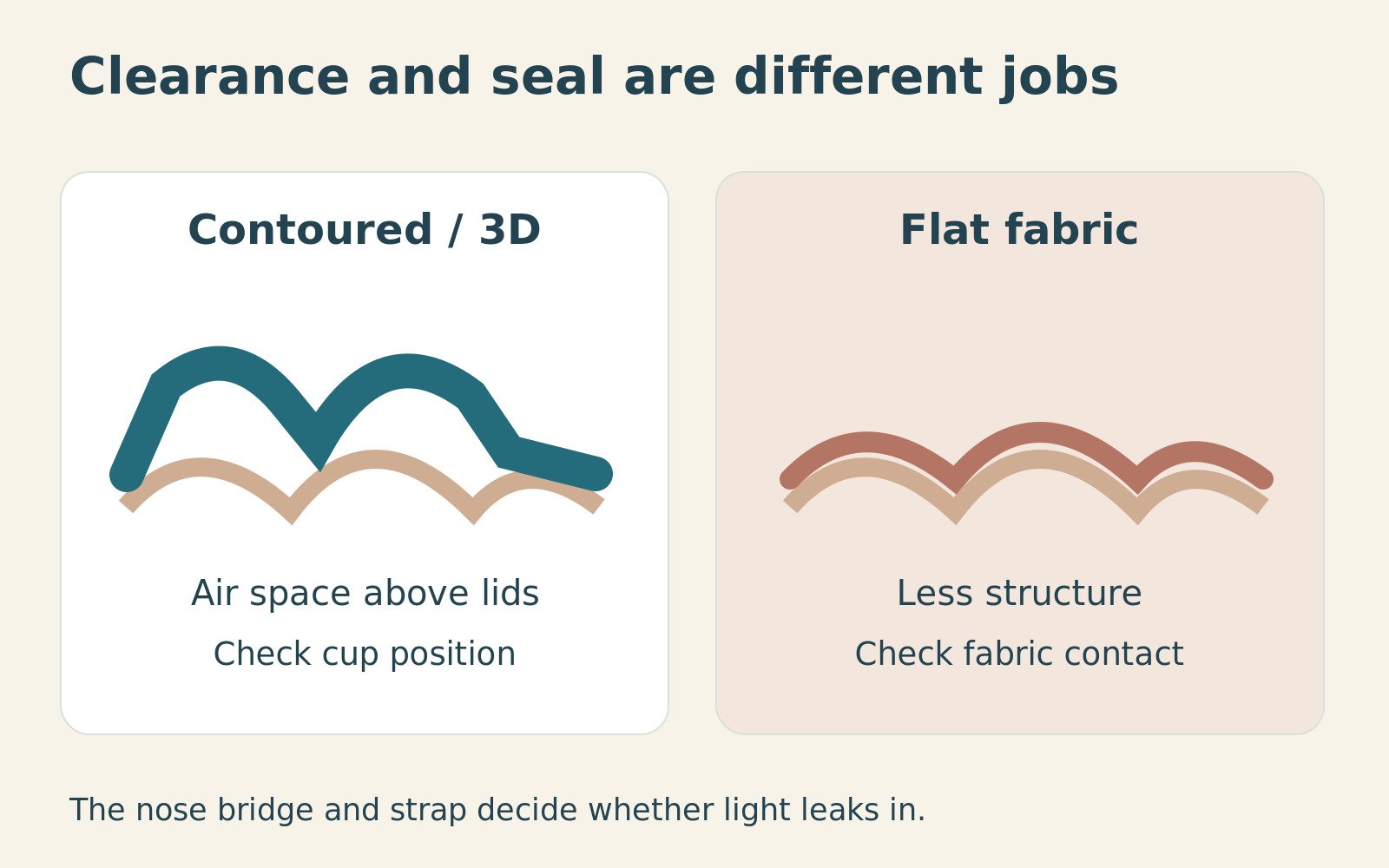
Eye clearance and light blocking are separate jobs
Check where the mask touches
For a contoured mask, the intended clearance should be above the eyes while the surrounding structure rests comfortably. For a flat mask, decide whether gentle fabric contact is acceptable to you. Neither design should require forceful tightening to compensate for a shape that does not fit.
Begin with a comfortable strap setting and make small adjustments. Move adjustable cups if the product allows it, rather than assuming the factory position matches your face. If a fixed contour does not sit well, that is a useful reason to compare another design. It is not evidence that every 3D mask will feel the same.
Find the actual path of a light leak
Light can reach the eyes around the nose or sides even when the material itself is opaque. During a normal indoor trial, notice where the light enters before tightening anything. A small change in nose placement or strap angle may matter more than making the band firmer.
Treat claims such as 100% blackout as manufacturer descriptions of intended performance, not a verified result for every wearer. Both Manta products use strong blackout language, but this article has not independently tested that claim. Your useful standard is a comfortable fit that blocks enough light for your intended resting situation. [1] [2]
Four practical examples, selected by construction
A shortlist to illustrate the differences
The examples below were chosen to show movable cups, a side-lean-oriented contour, a simpler domed design and a slim two-strap alternative. They are not a ranking based on measured darkness or sleep quality. The correct design depends on fit, care and the way you rest.
| Example | Construction to compare | Main check before ordering | Listing |
|---|---|---|---|
| Manta Original Sleep Mask | Adjustable O-shaped cups | Cup position and the space they occupy near the headrest | Manta Original on Amazon |
| Manta PRO Sleep Mask | Tapered C-shaped cups and angled strap | Comfort when leaning, rather than assuming the shape suits everyone | Manta PRO on Amazon |
| Go Travel Dreamer Eye Mask | Domed eye areas with adjustable band | Exact colour selection, nose fit and included pouch | Dreamer Eye Mask at Case Luggage |
| ALASKA BEAR two-strap mask | Retailer-described slim mulberry-silk version | Confirm the flat two-strap variant, seller and care label | ALASKA BEAR two-strap listing |
The Go Travel manufacturer’s reference is dark blue, while Case Luggage lists an assorted-colour option. Do not promise a specific colour from that retailer without checking the selected variant. Similarly, ALASKA BEAR sells different constructions, so the exact listing matters more than the brand name alone. [5] [6] [7]
Keep marketplace availability separate from suitability
The Amazon pages retrieved for the Manta Original and PRO did not display featured offers when checked on 11 October 2026. That does not establish that no seller can supply them, but it is not evidence of a confirmed current offer either. Check the seller, version and delivery terms before ordering. [8] [9]
When a 3D mask is the more promising starting point
You dislike eyelid or lash contact
If your main complaint about a simple mask is the fabric touching your eyes, investigate a contoured design. That is a specific problem for the shape to address. The Manta Original listing provides one adjustable-cup example, allowing a comparison between movable cup positions and a fixed moulded mask. [1]
During a permitted fit check, close your eyes naturally and notice whether the mask remains comfortable when you change position. You do not need to exaggerate blinking or press the mask into place. The aim is a relaxed fit that does not depend on holding the face or head unusually still.
You want adjustment beyond strap length
A movable-cup design can offer another fitting variable, but it also adds a setup step. Learn how the cups attach and whether they can be removed for cleaning. Keep the supplied instructions so you can restore a preferred arrangement after washing or packing.
Do not mistake more adjustment for an obligation to keep trying indefinitely. If repeated sensible adjustments do not produce a comfortable result, another shape may suit you better. A travel accessory should be usable when you are tired, not require a lengthy fitting session every time the cabin lights change.
When a flat mask is the more promising starting point
You value a slim, flexible item
A flat mask can be appealing when the bag is small and you are comfortable with fabric contact. It may tuck into a clean pouch without preserving a deep cup shape. However, consider the fastening as part of that slimness: a bulky buckle or gathered strap can still become noticeable against the headrest.
The ALASKA BEAR two-strap listing is one slim alternative to inspect. Its retailer description identifies mulberry silk and two adjustable straps; confirm the exact variant rather than using specifications from the brand’s contoured models. This guide does not independently verify its textile composition or a universal blackout claim. [7]
You already know simple masks suit you
If an existing flat mask is comfortable but its strap is worn or its size is wrong, you may only need a better version of the same basic idea. There is no obligation to move to 3D because the construction sounds more advanced. Identify the limitation of the old mask before choosing a replacement.
A standard Slip sleep mask is another fabric-focused reference, although the brand’s separately named Contour version is a different product. Use the correct product page and care instructions. A soft-feeling material does not remove the need to check the edge seal or the position of the strap. [3]
A light-leak test you can do without special equipment
Start in ordinary room light
Use a clean, dry mask and follow its fitting instructions, within the seller’s inspection conditions. Sit in a normally lit room rather than shining a bright torch directly at your face. Adjust the strap to a comfortable setting, close your eyes normally and notice whether an obvious band of light appears at the nose or sides.
Move only one thing at a time. If the mask allows movable cups, adjust their spacing before changing strap tension. With a flat design, check nose placement and the way the fabric lies across the cheeks. This makes the result easier to understand than changing every part of the fit simultaneously.
Repeat in the position you intend to use
Lean gently against a suitable chair back or pillow and turn the head as you normally would. Check whether the seal changes. A mask that blocks light perfectly while sitting bolt upright may lift at one edge during your actual resting position, while another may remain comfortable with less adjustment.
Write down whether the issue was light, contact, heat or strap pressure. Those are different problems, and a more expensive mask will not necessarily solve the right one. The test is a practical comparison for your own use, not a laboratory measurement or evidence that the same mask will fit other travellers similarly.
Side leaning and headrest contact
The outside shape matters as much as the inside
A deep eye cup can preserve clearance from the eyelids but occupy more room between your face and a headrest. When you lean, the outer edge may shift or compress. Therefore, evaluate a contoured mask from the side as well as from the front. The useful question is what happens in your ordinary resting position.
Manta describes the PRO’s tapered C-shaped cups and angled strap as features aimed at side sleepers. That makes the Manta PRO listing relevant to this particular comparison, but not an independently proven winner for every side-leaning traveller. Test the actual fit rather than relying on the label. [2]
Flat is not automatically pressure-free
A flat mask removes some cup bulk, yet a strap adjuster can still press into the back or side of the head. Check the position of the fastener against the surface you expect to lean on. Also notice whether the fabric shifts across the eyes when the strap changes angle.
The best result may involve a different strap route, another mask size or a different pillow arrangement. Avoid solving a headrest clash by pulling the mask uncomfortably tight. A small amount of light leakage may be less bothersome than a pressure point, so decide which compromise you genuinely prefer rather than chasing an absolute claim.
Straps, hair and quick removal
Treat the fastening as a core feature
Look at whether the mask uses a sliding adjuster, hook-and-loop fastening, one band or two. Consider where that system will sit when your head meets the seat. A strap that holds well while standing may shift or press differently when you recline, lean sideways or wear a hood.
Try the mask with the hairstyle you normally use for travel. A ponytail, clip or thick hair at the back can change the route of the band. You should not need to pull hair or trap it in a fastening to achieve a seal. If the attachment catches repeatedly, treat that as a practical drawback rather than an insignificant annoyance.
Make removal easy when you are tired
Practise lifting or releasing the mask in its intended way without dislodging headphones or pulling an audio lead. Keep glasses somewhere secure before covering the eyes; an ordinary sleep mask should not be assumed to fit comfortably over spectacles. Follow any product-specific guidance on compatible eyewear.
A mask also needs a temporary home during meals or conversation. A clean pouch is usually more useful than balancing it on the edge of a tray or pushing it between seat cushions. Decide where it will go before the flight so that removing it quickly does not become an invitation to lose it.
Fabric, warmth and the limits of material claims
Consider the whole construction
Silk, foam, modal, polyester and other materials can be combined in one mask. The fabric touching the face may differ from the filling, backing or strap. Read the complete description rather than assuming that a product name identifies every layer.
Manta lists soft cup fabrics and a separate head-strap construction for the Original, while the PRO uses perforated materials and ventilation features. Those details describe the design, but they do not establish how warm either mask will feel to you during a particular flight. [1] [2]
Let a realistic trial answer the sensory question
During a permitted seated check, notice whether you want to remove the mask after several minutes. Is the fabric pleasant but the strap awkward, or is the overall covered area the problem? A larger mask may block more peripheral light for one person yet feel too enclosing to another.
Avoid treating natural as a guarantee of comfort or synthetic as a guarantee of poor comfort. Similarly, do not assume that a cooling description means active refrigeration or an indefinitely cool surface. This comparison is about wearable construction and personal fit, not unverified claims about skin treatment, sleep stages or medical outcomes.
Cleaning rules can differ even within one brand
Read the product-specific label before washing
Manta’s Original and PRO guidance permits a cold machine wash in a laundry net, followed by air drying. Slip’s standard sleep-mask instructions instead specify cold hand washing and say not to put the mask in a washing machine. Those are different care routines, not interchangeable examples of a general rule for sleep masks. [1] [2] [4]
The shape matters too. A bonded contour, removable cup or padded fabric panel can respond differently to washing and pressure. Do not use a hotter cycle or a tumble dryer because another travel accessory tolerates it. Retain the label, particularly when ordering a marketplace variant whose description may be less detailed than the manufacturer’s own page.
Plan around drying and clean storage
Wash early enough that the mask can dry fully before packing. Keep the inside surface away from shoes, charging equipment and other objects in the bag. If you need to clean the mask while travelling, follow its own instructions and choose a time when it can dry properly rather than sealing it damp in a pouch.
For an item you use on several consecutive journeys, easy care may be a more useful advantage than a luxurious surface. However, convenience should not mean ignoring the label. A second simple mask can be worth considering for frequent use, but only if it solves a genuine clean-and-dry rotation problem rather than adding unnecessary accessories.
Packing flat and contoured designs differently
Preserve the shape you bought
A flat mask may fold neatly, while a contoured design may need its cups protected from sustained pressure. Follow the maker’s storage instructions instead of forcing either design into the smallest possible pocket. A temporary compressed photograph is not proof that a shaped mask should be stored that way between trips.
Place rigid chargers or plug adapters elsewhere so they cannot press into the mask’s eye areas. Keep hook-and-loop fastenings secured where appropriate so they do not catch other fabrics. The goal is to retrieve a clean, usable item without spending the first few minutes reshaping it or picking lint from its surface.
Choose a pouch that fits the actual use
Go Travel’s Dreamer includes a storage pouch and domed eye areas, making it a simpler contoured example to compare with larger modular designs. The Dreamer Eye Mask at Case Luggage is an assorted-colour listing, so check what colour is being supplied rather than assuming the manufacturer’s dark-blue reference is guaranteed. [5] [6]
A pouch is useful only when it remains easy to find. Give the mask a fixed place in the small bag or flight pouch you keep nearby. Do not bury it beneath the items needed only after arrival, and avoid leaving it exposed in a seat pocket without protection.
Match the mask to the journey, not a generic sleeper label
An upright flight or train journey
Prioritise quick fitting, comfortable strap placement and easy removal. Try the mask with the actual headphones and pillow you intend to use. A complicated cup arrangement may be worthwhile if it solves a clear contact problem, but a familiar flat design may be easier for short, interrupted rests.
A hotel room with unwanted light
You may care more about maintaining a seal while changing position than about the smallest packed size. Check the mask against the pillow and bedding position you normally use. A product that works for upright travel is not automatically your preferred option in bed, because the contact surfaces around the head have changed.
A small-bag trip with several transfers
Pay attention to packing, clean storage and how often you will retrieve the mask. A slim mask can be convenient, but do not choose it solely for low bulk if eyelid contact is the reason you stopped using a previous one. Carrying a slightly larger accessory can be sensible when it addresses a specific discomfort and fits the bag without forcing other essentials out.
Buying for comfort without assuming a free trial
Check inspection and return conditions first
Before extended use, removing labels or washing, read the seller’s conditions. Personal-use accessories may have hygiene or condition requirements, and different retailers can apply different processes. Do not assume that a manufacturer’s headline guarantee applies to an order placed through an unrelated marketplace seller.
Keep the packaging and a record of the exact model ordered. If the product received has different straps or cup shapes from the listing, ask the retailer before using it. Clear photographs of the unopened item and its label can help explain a mismatch without turning the conversation into a vague complaint that the mask feels different.
Identify the feature you are paying for
A higher price might buy adjustable cups, a different fabric, replaceable components or a more elaborate fastening. Decide which of those changes addresses your actual issue. If a simple mask already feels comfortable and seals adequately, a premium construction may not provide a meaningful improvement for your travel pattern.
Conversely, repeatedly buying cheap flat masks is not economical when you consistently dislike eyelid contact. In that case, trying a suitable contour is a more targeted comparison. The useful measure of value is whether the accessory is comfortable enough to use and straightforward enough to care for, not the number of features listed on its packaging.
A repeatable fit scorecard without invented performance ratings
Record observations rather than giving a universal star score
Use a short note for each candidate: initial comfort, light at the nose, light at the sides, headrest contact, strap handling and ease of packing. Mark each as acceptable, needs adjustment or unsuitable for you. These are personal observations, not published test scores that can be transferred to another person’s face.
Keep the trial conditions similar. Use the same chair, ordinary room lighting, hairstyle and companion accessories. If one mask is tested with a different pillow or a much tighter strap, the comparison becomes less useful. You are trying to identify the construction that fits your routine, not produce a winner by changing the circumstances.
Give discomfort more weight than a perfect-looking seal
A mask that blocks light only when tightened beyond comfort is not a successful fit. Try its permitted adjustments, but do not keep adding pressure to chase the darkest possible result. For someone with an eye condition, a recent procedure or specific clinical instructions, those instructions take priority over a general product comparison.
An honest result can be “the flat mask is easier to pack, but the contour is more comfortable for me” or the reverse. Accept that trade-off rather than forcing one product to win every column. That makes the final choice more reliable than borrowing another traveller’s rating or a brand’s broad promise.
Headphones and pillows: check the intersections
Straps should not compete for the same space
A mask band can meet an over-ear headband, the edge of an earcup or the side of a travel pillow. Put the items on in a repeatable order and notice where they overlap. If an adjustment to the mask breaks the headphone seal or moves the pillow, the combined arrangement needs another look.
Try one accessory at a time before blaming the mask itself. A different strap route, permitted cup position or simpler pillow arrangement may solve the clash. Equally, two individually comfortable products may simply be a poor combination. Do not assume matching brands are necessary, or that mixing brands prevents a successful fit.
Practise taking the whole kit off
Remove the mask, pause or remove the headphones and put the pillow aside without tangling a cable. This is a practical trial for meals, conversation and crew instructions. Keep the face-contacting sides clean while the items are temporarily out of use.
Do not walk through the cabin or navigate a platform while wearing a sleep mask. Remove it before moving, and pay attention to briefings and announcements. The CAA’s cabin-safety guidance reinforces the need to follow the crew rather than letting comfort accessories isolate you from necessary directions. [10]
Fixed contours or movable cups: a second choice within 3D
Fixed cups reduce the number of adjustments
A fixed contour has a predetermined spacing and shape. That can make fitting quick when the design suits you: arrange the mask, set the strap and use it. However, a strap adjustment cannot move the two eye areas independently. If their positions do not suit your face, a tighter band may simply pull the wrong shape closer.
During an inspection, look at whether the contour is moulded into the mask or attached as separate pieces. Do not assume that a photograph showing two rounded areas means those areas can be moved. The distinction is particularly relevant when your main reason for buying 3D is clearance rather than simply a thicker-looking mask.
Movable cups add flexibility and another ownership task
Separate cups can offer more control over spacing and angle, but you need to understand how to position and reattach them. Manta’s Original is one documented example. After finding a comfortable position, a private photograph of the arrangement can help you restore it after cleaning, without guessing each time. [1]
Check whether replacement components are available for the exact model and whether the manufacturer confirms compatibility. Do not mix parts simply because their fastening surfaces appear similar. A replaceable component can be useful, but only when it preserves the intended fit. Choose adjustment that solves your problem, rather than adjustment for its own sake.
Read the product pictures as a practical checklist
Look for views beyond the front of the mask
The front photograph tells you little about the shape that touches the face. Look for an inside view showing cup depth or padding, a rear view showing the fastening and a side view showing the outer profile. Also check whether the photograph includes a storage pouch that is actually part of the selected purchase rather than a separately sold accessory.
A close-up can make a small mask look substantial, while a folded photograph can hide a bulky adjuster. Use published measurements where available, but do not invent missing dimensions from the image. Ask the seller about a critical detail before ordering, especially when your bag space or preferred strap position leaves little room for error.
Keep the title, variant and description together
Marketplace pages can collect colours, sizes or related designs under one product family. Confirm that the selected option matches the construction discussed in the description and photographs. A review of a contoured version is not necessarily evidence about a flat version on the same page, and a star rating does not identify which version a reviewer received.
Save the exact item title, selected option and seller with the order. If the delivered mask differs, compare those details before removing labels or washing it. This small record is more useful than remembering that you ordered a silk mask or a 3D mask, because those labels describe broad categories rather than a precise product.
Pros and cons of the two shapes
3D: useful clearance, more structure to fit
A contour can keep fabric away from the eyelids and provide adjustment when the cups are movable. Its drawbacks can include greater bulk, pressure from outer edges during a side lean and more components to clean or reposition. Those are reasons to inspect the design carefully, not reasons to reject all contoured masks.
Flat: simple packing, more direct contact
A flat mask can be compact, flexible and easy to keep in a small clean pouch. Its drawbacks can include fabric contact with lashes and dependence on the nose shape and strap to maintain the edge seal. A soft material is not enough by itself; the whole item still needs to sit comfortably in your normal resting position.
Why choose a contour
Eye clearance can address unwanted fabric contact, especially when the cup positions can be adjusted.
Why choose flat instead
A slimmer structure can be easier to carry, provided the fabric contact and edge seal are comfortable for the wearer.
Common mistakes that lead to the wrong purchase
Treating blackout as a fit certificate
A manufacturer’s blackout claim does not establish how the mask seals around your nose or behaves against your headrest. Examine the design and complete a permitted fit check. A small persistent gap may matter more to you than an elaborate fabric description, while another traveller may tolerate that gap but dislike a firmer strap.
Confusing a fabric with a shape
Silk can appear in flat or contoured products. Foam can form a deep cup or a thin layer of padding. Compare the exact model and do not combine one version’s washing instructions with another version’s construction. Similar names and colours are not reliable substitutes for a clear product description.
Packing it damp or underneath rigid equipment
Let the mask dry as directed and protect the inside surface. Do not place a charger against shaped eye cups or assume that a small pouch prevents every type of pressure. A sensible packing location can preserve the comfort you selected, while a careless one can turn a good accessory into something that needs adjustment before each use.
Frequently asked questions
Is a 3D eye mask always better for travel?
No. It is a useful starting point when you dislike fabric touching your eyelids or lashes, but the cups and strap still need to fit. A flat mask can be better for someone who values a slim, flexible item and finds the fabric contact comfortable. Compare the actual resting position, nose seal and packing requirements rather than treating 3D as an automatic upgrade.
Will a flat silk mask block all light?
Not necessarily for every face. The fabric may be opaque while gaps around the nose or sides still let light in. Strap placement and movement also affect the result. Try a comfortable fit in ordinary room light, then repeat while leaning as you intend to rest. Do not tighten a poorly fitting mask uncomfortably just to pursue an absolute blackout claim.
What is the difference between Manta Original and PRO?
The Original uses adjustable O-shaped cups, while the PRO has tapered C-shaped cups and an angled strap, with additional ventilation-oriented construction. Manta presents the PRO as designed for side sleepers. Those are manufacturer-described differences, not evidence from an independent comparison in this article. Check which shape sits comfortably with your own headrest, pillow and strap position. [1] [2]
Can I wear a sleep mask over glasses?
Do not assume a standard mask is designed for that. Glasses can change the seal, create pressure points or be damaged if squeezed between the mask and a headrest. Check the exact product’s guidance and use a secure place for spectacles when removing them. The mask’s eye clearance is intended to be assessed on the wearer, not assumed to accommodate every frame.
Can all masks be machine washed?
No. Manta’s cited Original and PRO guidance permits cold machine washing in a net, while Slip’s standard sleep-mask instructions specify cold hand washing and prohibit machine washing. Other models can have different labels. Follow the exact product’s care instructions and allow it to dry fully before storage; fabric softness or a similar appearance does not establish the correct washing method. [1] [2] [4]
Which shape packs smaller?
A flat design often has less rigid structure, but compare the complete stored item, including its strap, adjuster and pouch. Some contoured masks are relatively compact, while modular cups may need more protection. Do not crush a shaped mask contrary to its instructions just to match a flat mask’s size. The useful comparison is the space required to carry the item in good condition.
What should I do if the mask feels uncomfortable?
Remove it and reassess the fit using the manufacturer’s instructions. Try permitted adjustments without forcing the strap tighter or pressing the cups into place. A different shape or fastening may suit you better. If an eye condition, recent procedure or clinical advice affects what you can wear, follow that guidance rather than relying on a general travel-gear article for an individual medical decision.
Is an expensive mask worth it for one short flight?
Only if its particular construction solves a problem that matters to you. A familiar simple mask may be sufficient for an occasional short rest. Spending more can be reasonable for a better personal fit or easier care across repeated use, but the price itself does not prove either benefit. Check the seller’s conditions and decide which feature you actually need before ordering.
Final recommendation: choose comfortable darkness, not a slogan
Start with the reason you want to change masks. If eyelid or lash contact bothers you, compare a suitable contour. If bulk and complicated fitting are the problem, inspect a simpler flat design. Then check the nose seal, strap position and headrest contact together, because they determine whether the chosen shape remains comfortable in use.
Keep the winner clean, dry and easy to retrieve, and trial it with the headphones and pillow you already carry. Do not replace a comfortable, functional mask merely because another one promises a more advanced sleeping experience.
The best travel mask is the one that blocks enough unwanted light without becoming the new distraction. A modest design that fits you is a better choice than a more elaborate one whose claims require you to ignore an uncomfortable strap, an awkward cup edge or a storage routine you will not follow.
Sources and fact-checking notes
- Manta UK Original Sleep Mask Adjustable O-shaped cups, materials and cold-machine-wash instructions.
- Manta UK PRO Sleep Mask Tapered C-shaped cups, angled strap and ventilation; manufacturer claims are not independent trial results.
- Slip UK Black Sleep Mask Standard silk design; do not substitute the separately named Contour model.
- Slip: care instructions for sleep masks Standard sleep mask: cold hand wash, not machine wash; shade air-dry.
- Go Travel Dreamer Eye Mask 733.101 Domed design, adjustable band, pouch and wash-at-30 instructions.
- Case Luggage Dreamer Eye Mask Retailer lists assorted colours; the manufacturer reference is dark blue.
- Amazon UK ALASKA BEAR two-strap mask Retailer-described slim, mulberry-silk two-strap version; composition, offer and care should be checked with the exact seller.
- Amazon UK Manta Original listing
- Amazon UK Manta PRO listing No featured offer displayed in the retrieved page.
- UK CAA: cabin safety
Illustrations in this article were created for Taylor’s Trailblazing Travel Gear. Third-party photographs, where used, are credited beside the image or in the source list.