
Silicone vs Plastic Travel Bottles: Which Leak Less?
Choose the closure and the formula match, not just the softest bottle.
Silicone vs plastic travel bottles is not a contest that can be settled by squeezing an empty bottle in a shop. The body, cap, valve, contents and packing position work together. A soft bottle with a dirty seal can leak; a simple plastic screw-top can travel perfectly well. Equally, a rigid bottle can crack or spill when its closure is unsuitable.
The useful question is which container works with your particular shampoo, cleanser or lotion and remains easy to close when your hands are wet. This guide compares published product details with a practical selection and checking routine. It does not claim a laboratory leak-rate comparison or hands-on testing of the named products.
Start with one or two bottles rather than a large matching set. Prove the combination at home, keep sensitive or unsuitable products in their original packaging, and give liquids a separate place in your luggage. A modest, dependable system is more useful than a colourful collection that needs constant supervision.
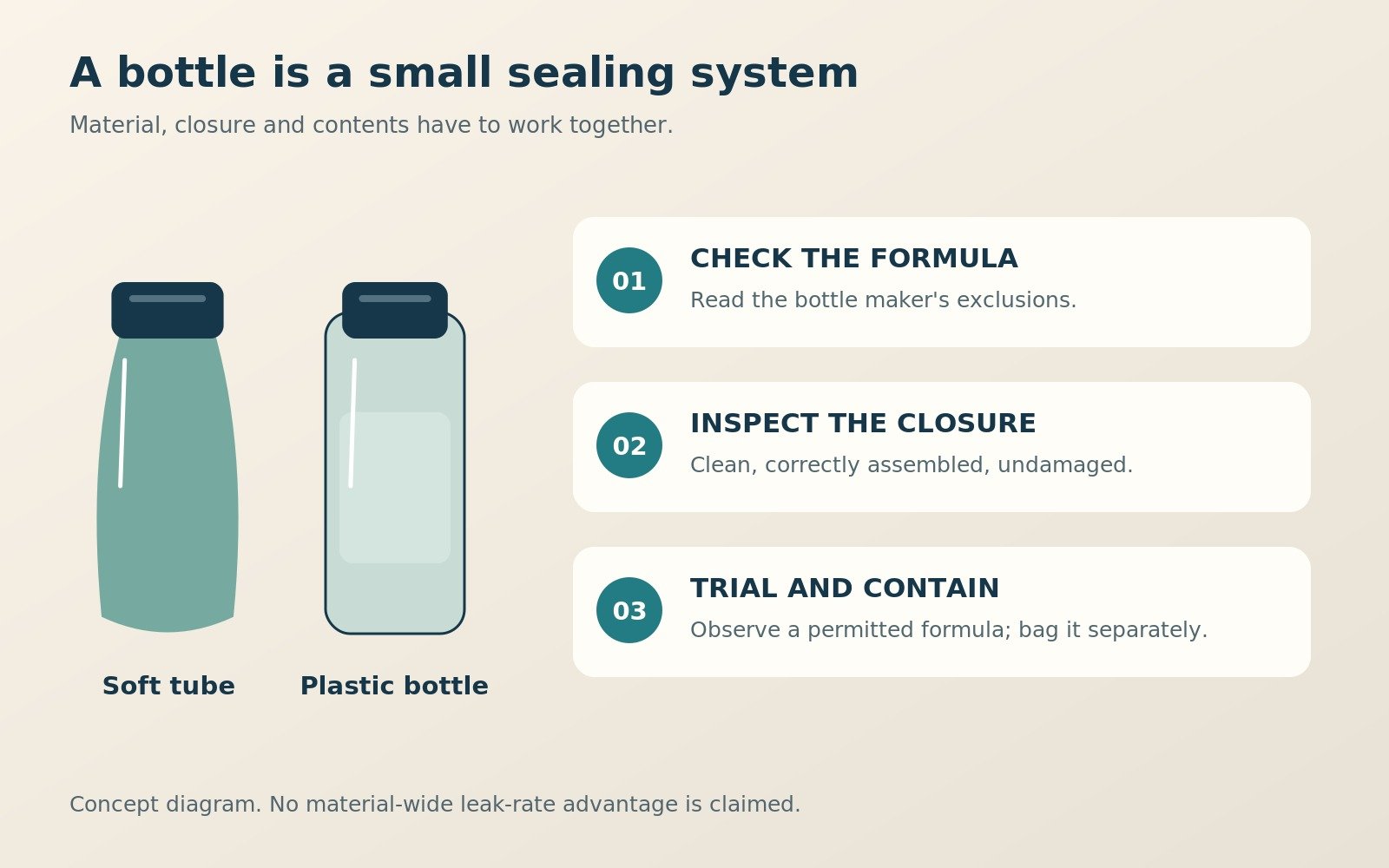
Check the closure
Look for a clean, undamaged seal and a cap you can close reliably.
Consider silicone
A soft body can make compatible shampoo or conditioner easier to dispense.
Choose individually
One bottle material and lid design may not suit every formula.
Test and contain
A home check finds obvious faults; a secondary bag limits a spill.
Silicone vs plastic travel bottles: the decision that matters
Choose a complete container, not a material label
In everyday shopping language, silicone bottles usually mean soft, squeezable tubes, while plastic bottles mean containers made from materials such as polyethylene, polypropylene or PET. Those plastic families are not interchangeable, and silicone bottles can still have plastic caps. GoToob+, for example, combines a silicone tube and valve with a polypropylene collar and cap. The apparent either-or choice already involves several materials. [1]
For a useful comparison, examine the complete route a liquid could take out of the bottle. There is the mouth where the cap attaches, the dispensing opening, and sometimes a separate valve or pump. Each interface deserves attention. An attractive body cannot compensate for a lid that catches awkwardly, a missing sealing part or an opening you cannot clean properly.
There is no defensible universal leak winner
The recommendation here is therefore conditional: select a closure you can operate reliably, confirm compatibility, and trial the actual contents. Silicone is appealing when squeezing helps dispensing. A straightforward plastic bottle can be appealing when you prefer a firm body and screw cap. Neither earns a blanket promise that your suitcase will remain dry.
Back to topUnderstand where a travel bottle can leak
Separate a cap problem from a body problem
A damp cap does not automatically mean the bottle material has failed. Product left around the opening during filling can look like a leak later. A cross-threaded screw cap can feel tight without sitting correctly. A flip lid may appear closed while its catch has not engaged. Begin by cleaning the outside and inspecting the closure before deciding what has gone wrong.
Likewise, liquid around the neck of a silicone tube deserves a careful check of the way its collar and cap are assembled. Follow the exact manufacturer’s instructions; do not improvise a tighter arrangement by trapping extra material in the threads. A container designed to seal one way can become less reliable when its parts are forced into a different position.
Dispensing behaviour is not the same as leakage
A thin liquid may flow out rapidly when you squeeze a soft bottle, even though the closed bottle seals properly. A thick conditioner may require more pressure, encouraging you to press harder than expected. Evaluate those experiences separately. The best bottle is not merely dry inside a bag; it also releases a manageable amount when you need it.
Try a normal dose over the sink, close the bottle, wipe it and inspect it again. Notice whether product remains in a recess around the dispensing opening. If the design is fiddly to clear, that matters on a short hotel stay with limited counter space. Easy everyday handling is part of reliability, not an optional luxury.
Back to topCompare the practical strengths of the two formats
| Decision | Soft silicone tube | Plastic bottle |
|---|---|---|
| Dispensing | Squeezing can help with compatible thicker products | Pouring, squeezing or pumping depends on the particular design |
| Closure | Often a flip cap plus valve and collar | May have a simple screw cap, flip lid or pump |
| Packing | Flexible body can be compressed by surrounding items | Firmer body can hold its shape but still needs protection |
| Contents | Check the maker’s exclusions and trial guidance | Check the particular polymer, cap and formula; plastic is not one material |
| Cleaning | Wide openings can help; cap care may differ | Access depends on neck size and whether the closure comes apart |
| Best reason to choose | Comfortable dispensing and easy access for cleaning | A suitable closure, useful shape and dependable formula compatibility |
On a small screen, swipe the table sideways. The rest of the article stays within the page.
Let the closure outweigh a small convenience gain
Imagine two bottles that both fit your wash bag. One is slightly softer, but its cap is difficult to align. The other is less pleasant to squeeze but closes cleanly every time. Unless the contents need the softer format, the easier closure is the more sensible starting point. This is a buying judgement, not a claim that stiffness itself prevents leakage.
Also consider who will use the kit. Someone with limited grip may prefer a broad flip lid to a tiny screw cap, while another traveller may find a firm screw closure easier to check. Ask whether the bottle works during an ordinary shower routine, not only when you are concentrating on it at the kitchen table.
Back to topCheck ingredients before decanting anything
Manufacturer restrictions differ
Go Travel’s Squeeze It Trio, reference 662, is a silicone-and-polypropylene design. Its maker advises against hair serums, oils and products containing alcohol. humangear’s GoToob+ guidance uses a different approach, listing some product groups as unsuitable and others for an overnight trial. Do not transfer one brand’s permission to another brand simply because both bottles are silicone. [2] [3]
A product described as shampoo is not automatically interchangeable with every other shampoo. Formulations vary, including between products from the same brand. Read the bottle maker’s guidance alongside the toiletry label. When a restriction clearly applies, choose another suitable container or keep the original packaging rather than conducting a trial the manufacturer has already advised against.
Keep demanding products in their original packaging
Some products have requirements beyond avoiding a visible spill. Sterile solutions, prescription liquids and other specialist preparations should not be treated as ordinary shampoo decanting projects. humangear specifically excludes sterile products and liquid or semi-liquid prescription medicines from its recommended GoToob+ uses. Retaining the intended container avoids creating a storage question that a travel bottle cannot answer. [3]
The same cautious logic is useful when you cannot establish whether a sunscreen, repellent or treatment is suitable for a new container. A short home observation cannot prove that a formula remains unchanged or performs as intended. Ask the product manufacturer where necessary. Saving a small amount of luggage space is not a good reason to guess.
Back to topStart a silicone comparison with a locking-cap design
GoToob+ illustrates why the lid matters
GoToob+ is a useful reference because its published construction identifies the silicone body and valve, polypropylene components and locking collar. Its large size is sold as 100ml in the linked UK three-pack. The manufacturer publishes a dry weight of 65g for one large tube, illustrating that a substantial silicone bottle is not automatically the lightest way to carry a small quantity. [1]
The locking feature is a reason to examine the product, not a guarantee against all spills. Check how the collar moves, whether you can read your contents label, and whether the filled tube fits your liquids bag without pressing against neighbouring caps. Buying the largest size merely because it is cabin-sized can make a very small toiletry load unnecessarily bulky.
Do not confuse GoToob with GoToob+
Product names and replacement parts matter. humangear distinguishes the older GoToob from GoToob+, and its support guidance warns that their caps are not interchangeable. A spare that looks approximately right is not a reliable solution. Confirm the edition before ordering replacement parts or assuming a review of an older bottle describes the current one. [3]
For a first purchase, a smaller quantity can be more informative than a full family set. Trial your most frequently used compatible toiletry, check the dispensing routine and then decide whether to expand. A successful bottle-and-formula pairing gives you a reason to buy another; matching colours alone do not.
Back to topA smaller silicone set may fit the trip better
Go Travel Squeeze It Trio: confirm reference 662
The reference 662 Squeeze It Trio contains three 60ml bottles. Go Travel lists silicone and polypropylene, non-drip caps and rear suction cups. This makes it a different product from the brand’s other similarly named sets, including larger bottles. Check the reference number and capacity rather than assuming every Squeezy listing has the same contents. [2]
The 60ml format may be worth considering when your measured needs fit comfortably below that capacity. It is not automatically enough for a particular number of days: hair length, washing frequency and the product itself change consumption. Treat the size as a container specification, then work out whether it suits your routine.
A suction cup is a convenience, not a packing feature
A rear suction cup can offer an alternative to balancing a bottle on a narrow shower shelf. However, that feature should not outweigh compatibility or cap quality. Check the surface and the maker’s instructions before relying on an attachment, and place the bottle where a fall will not cause trouble. You do not need to use every feature simply because it is included.
During packing, the important question is whether the complete bottle sits comfortably inside the liquids bag. Leave room to close that bag without forcing caps together. A set that hangs neatly in a promotional bathroom image may still be awkward alongside your own toothbrush, deodorant and other travel containers.
Back to topPlastic sets need just as much scrutiny
Nalgene’s Medium Travel Kit is not uniformly cabin-sized
Nalgene describes its Medium Travel Kit as six bottles ranging from one to four fluid ounces, two storage jars and two dispensing caps. It explicitly says the jars are not recommended for liquids. The largest bottles exceed 100ml, so the set should not be treated as an all-in-one answer for an itinerary with a 100ml container limit. [4] [5]
That distinction is easy to miss when a product is called a travel kit. Travel can include checked luggage, car journeys and other situations where the same size restriction does not apply. Select the pieces you actually need and inspect their capacity markings. A partly filled oversized container does not become a smaller container.
Do not invent the resin from the brand name
The official product description checked here does not provide a polymer-by-polymer specification for every component in that kit. This guide therefore does not label the complete set HDPE, LDPE or PET. A brand may use different plastics in different products, and a familiar material in one bottle does not establish the material of another.
For a demanding formula, ask about the exact bottle and closure rather than relying on a broad brand reputation. For ordinary compatible toiletries, evaluate the practical details: a readable capacity, a cap that seats evenly, an opening you can fill cleanly, and a shape that fits the bag. Those are useful checks whether the bottle is expensive or simple.
Back to topA fabric bottle is a third option, not proof against either material
Matador FlatPak changes the empty-space problem
Matador’s FlatPak Toiletry Bottle uses a coated-fabric format rather than a conventional silicone tube or rigid bottle. The current technical block specifies 90ml and 11.5g. However, the same page contains inconsistent 100ml wording elsewhere, so confirm the marked capacity and exact version when ordering. The linked marketplace listing is a three-pack, not a single bottle. [6]
A soft-sided container can be interesting when your toiletries load shrinks during a trip. However, packability is separate from compatibility and closure performance. Matador warns against products containing alcohols and explains that its bottle is not intended for food or drink. The format does not remove the need to read those restrictions. [6]
Compare like quantities rather than promotional ratios
A comparison between a nearly empty fabric bottle and a full silicone bottle says little about how your complete wash kit will fit. Start with the amount you intend to carry, then compare the containers and the secondary bag together. Include any extra protection or organisation you genuinely need, rather than comparing only empty product weights.
Keep the purpose of this third option clear. It may suit a traveller trying to minimise unused container volume, but it does not establish that fabric bottles leak less than plastic or silicone. A purchase should solve a packing problem you actually have. Otherwise, a compatible bottle already in your cupboard may remain the better choice.
Work out how much liquid you need
Measure your own routine
Rather than assuming 100ml is the correct size for every product, observe your normal use before the trip. You can estimate consumption from a known starting quantity and the amount remaining after several uses. Use the same product and a realistic routine. A weekend with one hair wash and a beach week with repeated showers are not equivalent packing tasks.
As a planning example, a product used at roughly 4ml per application for six applications requires about 24ml before allowing a modest contingency. That is arithmetic, not a recommendation for how much shampoo anyone should use. Your measured quantity may differ substantially. The point is to match the bottle to your actual need instead of filling every available container.
Leave the fill level within the maker’s guidance
Do not fill into the closure simply to fit the final spoonful. Follow any fill line or headspace instruction supplied with the bottle, and leave the dispensing mechanism free of product during assembly. More liquid is not useful when the cap cannot seat properly. Decanting neatly is easier with a stable bottle, a clear work surface and unhurried hands.
A smaller container can save space, but only if it holds the required amount without overfilling. Conversely, a large bottle carrying a tiny quantity may waste room in a liquids bag. Compare the filled size rather than treating every cabin-compliant capacity as equally convenient. A mixed set of capacities is often more practical than identical bottles.
Back to topRun a simple, non-destructive pre-trip check
Begin with a clean exterior and ordinary handling
Inspect a new bottle in good light. Look for damage, uneven threads, a loose catch or a missing part. Assemble it according to the instructions and check that the closure feels consistent through a few normal opening and closing cycles. Do not pull off valves, stretch collars or overtighten caps in an attempt to improve the design.
For a basic mechanical check, use an appropriate small amount of water where the manufacturer permits it, close the bottle and wipe the outside completely dry. Rest it in a tray on dry kitchen paper and change its orientation gently. This can reveal an obvious closure fault, but a successful water check does not establish compatibility with a different formula.
Trial only a product the guidance permits
After cleaning and drying as directed, trial a small amount of the intended compatible toiletry. Keep it contained, inspect the exterior and observe whether the bottle or contents visibly change. Use the manufacturer’s recommended period where given. An overnight observation can be a sensible screening step, but it is not a simulation of every condition your luggage might encounter. [3]
Record which formula, bottle and cap were used so the result remains meaningful. A new conditioner or replacement lid creates a different combination. If something leaks or changes unexpectedly, stop using that pairing and contact the relevant maker rather than trying to hide the problem with tape. The aim is a dependable routine, not passing a bottle at any cost.
Back to topDiagnose a doubtful bottle before replacing the whole kit
First, identify whether the outside was already wet
When a bottle leaves a mark on paper, clean and dry its exterior before drawing a conclusion. Product spilled during filling may remain around a hinge or beneath a collar. Note where the next damp patch appears and whether it returns after ordinary handling. Do not repeatedly squeeze a closed bottle hard just to create a dramatic result; that is not a fair representation of the use you intend.
A simple observation record can be useful: bottle and cap edition, contents, approximate fill level, position and the place where dampness appeared. Keep it brief enough to repeat. This separates an assembly problem from a pattern that follows one particular formula and gives the manufacturer something clearer to respond to than a general statement that all the bottles leak.
Distinguish a spill from an unexplained change in contents
Visible liquid outside the bottle is one problem. Contents becoming thicker, disappearing gradually or changing appearance are different observations. A dry exterior does not automatically prove that a product has remained unchanged. The container maker’s compatibility and storage guidance should govern the decision, not only the absence of a puddle.
When uncertainty persists, stop using that combination and retain the product in appropriate original packaging while you ask for advice. Do not add water, solvents or another toiletry to reverse a change unless the product manufacturer specifically directs it. A travel container is supposed to simplify the routine, not introduce a new mixing or restoration project.
Finally, keep the scale of the response proportionate. One damaged cap may call for the correct replacement; one incompatible formula may call for a different container. Neither observation proves that every silicone tube is unsuitable or that all plastic bottles are inferior. Troubleshooting the actual pairing avoids replacing an entire kit without understanding what failed.
Back to topPack to limit the consequences of a spill
Use secondary containment without confusing it with a seal
Place liquid containers in a suitable resealable bag that can close comfortably. That bag is a second barrier, not a repair for a leaking bottle. humangear recommends a sealed bag as a precaution, and Matador also suggests a zipper bag for additional protection. Neither recommendation means the bottle has been independently proven spill-proof in your luggage. [3] [6]
Position the liquids away from items that could puncture the bag or press directly on dispensing caps. Avoid using a tightly compressed clothing compartment to squeeze the wash kit into the last available gap. A bottle that works well during a gentle home check still deserves sensible treatment when surrounded by shoes, cables and other hard objects.
Make security access easy
Keep the liquids module reachable without emptying the entire bag. At airports requiring a separate liquids bag, an accessible arrangement reduces the temptation to leave a bottle loose in a pocket after screening. Check the departure, transfer and return airport requirements, because a relaxed rule at one airport does not establish the rule everywhere on the itinerary. [5]
After screening, restore the same arrangement rather than scattering containers through different compartments. This is especially helpful for a couple or family sharing toiletries: everyone should know which bag holds the liquids and how it closes. Consistent placement makes it easier to notice a damp container before it reaches clothing or electronics.
Back to topClean the closure as carefully as the bottle
Different parts can need different treatment
A broad mouth is useful only when you can also clean the cap and dispensing path. Check the maker’s care instructions for each component. GoToob+ guidance permits its tubes and collars on the dishwasher’s top rack but specifies hand washing for the flip caps. A general dishwasher-safe impression should not replace that distinction. [3]
Remove only parts intended to be removed, rinse away residue and allow everything to dry appropriately before storing or refilling. Do not introduce household cleaning chemicals that the bottle maker has not approved. Extra-strong treatment is not automatically better, particularly where a small valve or seal must retain its shape.
Avoid topping up unknown leftovers
Refilling on top of old residue makes it harder to know what is in the bottle, how long it has been there and whether a change is new. For a repeat trip, review the contents and clean the container as appropriate rather than assuming last month’s leftovers are still suitable. Travel bottles are a short-trip tool, not necessarily a long-term storage solution. [3]
Label the actual product, not just a vague category when confusion is possible. A second household member should not have to guess whether a clear bottle contains cleanser, conditioner or something else. Keep the original product information available where you need it. Identification is part of a useful kit, even when it is less exciting than choosing matching colours.
Back to topMatch the system to your journey
Short carry-on breaks
For a short break, begin with the products you will actually use and the quantities they require. A couple of suitable small bottles may be sufficient. Keep items that should remain in original packaging separate, and do not decant simply because there is an empty bottle in the set. Every additional container adds something to fill, label, check and clean.
A silicone bottle can be convenient for compatible thicker contents, while a suitable plastic screw-top may work well for another product. There is no requirement to choose one material for the whole wash bag. A mixed arrangement can reflect the formulas and your handling preferences more accurately than a uniform set.
Longer and multi-stop trips
Longer trips introduce refill and drying questions. Will you have a stable place to refill, enough time for the container to dry, and access to the same product? Carrying a larger original bottle in checked luggage can sometimes be simpler than repeatedly transferring an unfamiliar formula. Check the relevant baggage and product rules for that arrangement rather than assuming larger is unrestricted.
When reducing packed bulk matters, a fabric option can be considered alongside silicone and plastic, subject to its own restrictions. The Matador FlatPak three-pack is an example to inspect, not an automatic replacement for every bottle. Choose it because its changing shape helps your particular trip, not because a material comparison requires a fashionable winner.
Back to topJudge value by successful uses, not bottle count
Compare the useful pieces in a set
A ten-piece kit is poor value when several containers are too large, difficult to clean or unsuitable for your products. Write down the pieces you would genuinely use and compare the price of that functional kit. An included jar should not be counted as another liquid bottle when the manufacturer advises otherwise. This matters with the Nalgene set described above. [4]
No fixed live-price comparison is used here because marketplace offers, sellers and variants can change. Check the exact contents, delivery and return arrangements before ordering. The research did not independently confirm every current marketplace offer; a product page is not a promise that the preferred size is available for immediate delivery.
Replacements can matter more than a small saving
Ask whether the manufacturer supplies suitable replacement parts, and make sure a replacement really matches the edition you own. A reusable body becomes less useful if a damaged cap cannot be replaced correctly. However, do not assume availability merely because an old support page mentions a spare. Check the actual part and its current availability.
A GoToob+ set is worth comparing when the locking closure addresses a real need and the formulas are suitable. A Nalgene kit is worth comparing when its individual containers suit your arrangement. Neither is good value solely because its brand is familiar. The best purchase is the smallest dependable kit that you will keep using.
Back to topPros and cons without a material winner
Silicone: useful advantages
A squeezable body can help dispense compatible thick toiletries, and some designs offer a broad opening and a positive cap lock. Those features can make the daily routine easier. Silicone can therefore be a sensible choice when your main difficulty is reaching or dispensing the last usable portion without repeatedly shaking a rigid bottle.
The trade-offs include formula restrictions, possible pressure from other luggage contents and a dry weight that may be higher than expected. Multiple closure components also need correct assembly and cleaning. Choose the specific design because it works for your products and hands, not because silicone has been advertised as universally leakproof.
Plastic: useful advantages
A suitable plastic bottle can offer a straightforward screw closure, a firm shape and a range of capacities. Some travellers will find that simpler to inspect and pack. A modest container already proven with the intended product may be entirely adequate, especially when you do not need a flexible body for dispensing.
The trade-offs depend on the polymer, construction and closure rather than one general plastic category. Narrow openings can be awkward to fill or clean, and pumps or flip lids introduce their own checks. Clear material identification and product compatibility matter. A cheap bottle is not automatically unreliable, just as an expensive one is not automatically suitable.
Common mistakes worth avoiding
Mistaking cabin size for complete suitability
A 100ml marking addresses capacity, not compatibility, sealing or the number of bottles permitted in a particular liquids bag. Current UK guidance says airport arrangements can differ, including whether larger liquid containers are accepted. Check the actual airport instructions and plan for the stricter parts of your route rather than treating a bottle’s travel label as permission. [5]
Other avoidable errors include packing the largest container from a mixed kit without checking it, placing liquids in jars intended for thicker contents, and transferring a new formula immediately before departure. None is solved simply by changing from plastic to silicone. Make those checks before spending money on a replacement set.
Trying to fix uncertainty with more pressure
Overtightening, forcing a collar or crushing a bottle into a full bag are poor substitutes for a suitable design. Stop when a cap does not seat normally. Check for residue or damage and follow the maker’s guidance. A bottle that needs a complicated workaround every time you close it is not earning its place in a travel kit.
Finally, do not present a clean overnight tray as proof of future perfection. It is useful evidence about one combination under one set of conditions. Continue to inspect the bottle, keep it contained and reconsider the pairing when anything changes. That approach is more dependable than trusting a universal material ranking that the evidence does not support.
Back to topFrequently asked questions
Do silicone travel bottles leak less than plastic bottles?
Not as a universal rule. The sources reviewed do not establish a controlled leak-rate advantage for all silicone designs. Closure quality, assembly, formula compatibility, filling and packing all matter. Choose a specific container that suits the intended product and check it before travelling. A good plastic screw-top can be more useful than a poorly fitting silicone cap, while a well-designed silicone tube can make dispensing easier.
Can I put oils or alcohol-based products in silicone bottles?
Check the exact manufacturer’s instructions. Go Travel excludes oils and products containing alcohol from the Squeeze It Trio’s recommended use, while humangear provides more detailed restrictions and trial guidance for GoToob+. Do not generalise between brands. When you cannot establish suitability, retain the original product container rather than assuming a short home test proves long-term compatibility or preserved performance.
Will a half-full 125ml bottle pass a 100ml container limit?
Do not rely on it. Where a 100ml container limit applies, the container’s capacity matters rather than the quantity remaining inside. Airport rules differ, so check each relevant airport. A larger bottle in a travel kit may be useful for checked luggage or a car journey, but the word travel does not make every piece suitable for a restricted cabin liquids bag.
Should I wrap cling film under the cap?
This guide does not recommend modifying a closure with extra material as a standard fix. It may interfere with the way the original seal and threads are designed to meet. Use the bottle as instructed, investigate a persistent leak and replace an unsuitable or damaged part correctly. Secondary containment around the complete bottle is a more transparent precaution than relying on an improvised internal seal.
Can I put every part in the dishwasher?
No. Follow the care instructions for the exact product and its individual components. GoToob+, for example, distinguishes top-rack washing of the tube and collar from hand washing the flip cap. Do not infer a universal treatment from a broad washable claim. Clean the dispensing path, rinse thoroughly and let parts dry before storage or refill, without dismantling components that are not intended to come apart.
Are fabric bottles better for saving space?
They can be worth comparing when the container becomes smaller as the contents are used, but the complete kit still matters. Include the liquid quantity, closure and any secondary bag in the comparison. Matador FlatPak is a relevant example with its own ingredient restrictions. It is a third format to assess, not evidence that silicone or plastic bottles are inherently poor choices.
How long should I test a new bottle?
Use the manufacturer’s guidance and allow enough time to inspect both closure behaviour and the intended compatible formula. humangear suggests an overnight trial for new contents. A basic water check can reveal obvious mechanical leaks, but it cannot establish chemical compatibility. A short trial also cannot reproduce every travel condition or certify that a specialist product retains its performance after decanting.
Do I need a complete matching set?
Usually, matching is less important than usefulness. Start with the products and quantities you need, then choose suitable containers individually. A mixed arrangement of a silicone tube, a plastic bottle and original packaging can be more sensible than decanting everything into identical tubes. Add pieces only after you know the existing ones work and the full liquids bag remains easy to close and access.
Final recommendation: choose the formula, cap and routine together
The strongest answer to this comparison is not that one material always leaks less. Choose a suitable product-and-container pairing, a closure you can operate without fuss, and a capacity that reflects your actual consumption. Then perform a careful, non-destructive check and pack the bottles in secondary containment. Those decisions are more actionable than an unsupported ranking of silicone against all plastics.
For compatible thicker toiletries, a sound silicone design is a reasonable starting point. For a firm shape and a simple screw closure, assess a clearly specified plastic bottle. Keep specialist or uncertain products in their intended packaging. A small mixed kit, used consistently and maintained properly, is often the most practical result of this comparison.
Back to topSources and fact-checking notes
Research checked on 11 October 2026. Manufacturer construction and compatibility guidance is separated from practical packing judgement. No controlled material-wide leak comparison was found. Product links identify the stated packs; current seller offers can change.
- humangear: GoToob+ materials, sizes and construction
- Go Travel: Squeeze It Trio, reference 662
- humangear: compatibility, cleaning and filling guidance
- Nalgene: Medium Travel Kit, bottle sizes and jar limitations
- GOV.UK: liquids in hand luggage, including airport-specific limits
- Matador: FlatPak Toiletry Bottles, specifications and restrictions
Illustrations in this article were created for Taylor’s Trailblazing Travel Gear. Third-party photographs, where used, are credited beside the image or in the source list.