Best Travel Umbrellas for Windy Cities
Best Travel Umbrellas for Windy Cities
Balance wind resistance, useful coverage and the size you will carry all day.
The best travel umbrellas for windy cities balance three things that pull in different directions: a useful canopy, a frame that handles ordinary gusts and a folded size you will willingly carry. The strongest-looking option is not helpful when it stays in your hotel because it is too awkward for your bag.
This comparison looks at five compact designs from BLUNT, Knirps, senz and Fulton. It uses manufacturer specifications and practical purchasing judgement, rather than invented street tests. The emphasis is on ordinary rainy travel: walking to a station, crossing a square, waiting outside a museum or moving between meetings.
There is also a boundary. No umbrella recommendation here is a reason to walk into dangerous weather. Wind-tunnel figures describe equipment tests, not a promise that you can safely hold the umbrella in an exposed city street. In severe conditions, shelter and an appropriate hooded waterproof are the more sensible starting points.
1Best travel umbrellas for windy cities: compare the carry trade-offs
This shortlist compares five compact umbrellas with materially different folded sizes, weights and opening systems. The measurements are manufacturer specifications checked on 11 October 2026. They describe the named versions, not every umbrella in the same range or every patterned edition sold under a similar title.
Swipe or scroll the table sideways on a small screen.
| Umbrella | Weight / folded length | Coverage | Main difference | Details |
|---|---|---|---|---|
| BLUNT Metro[1] | 385g / 37.5cm | 100cm canopy | Automatic opening; modular, repairable construction | View listing |
| Knirps T.200 Duomatic[3] | 320g / 28cm | About 98cm canopy | Duomatic opening and closing; patterned variants differ | View listing |
| senz mini automatic[4] | 420g / 28.2cm | 91 x 91cm asymmetric canopy | Automatic model; do not confuse with 325g manual mini | View listing |
| Fulton Tornado 1[6] | 545g / 37cm | 120cm canopy span | Automatic opening and closing; vented canopy | View listing |
| Fulton Storm 1[7] | 230g / 18cm | 95cm canopy span | Five-stage manual folding frame | View listing |
How the recommendations were chosen
I considered useful coverage, everyday portability, operation, repair information and the clarity of the published specification. This is not a hands-on wind test. The order is a set of recommendations for different travellers rather than a score produced by opening all five umbrellas in identical gusts.
BLUNT Metro is the balanced starting point because its design combines a useful canopy with an explicitly repairable approach. Knirps addresses a shorter automatic package, senz offers a different canopy shape, and the two Fultons sit at opposite ends of the coverage-versus-packed-size trade-off. Choose the compromise that fits your normal bag and journey.
Availability deserves its own check
Stock, colours and marketplace sellers change. Several checked listings did not show a current featured offer, and some product pages group different generations or colours. Confirm the selected model and dimensions before purchase. No live price, delivery guarantee or universal wind-performance promise is implied by a link in this comparison.
2BLUNT Metro: the balanced starting point
Its strengths are broader than one wind claim
BLUNT lists the standard Metro with a 100cm canopy, a 37.5cm folded length and a 385g weight. It has automatic opening and a canopy that can rotate around the shaft. The manufacturer also describes a modular, repairable construction. Do not confuse automatic opening with a claim that every stage of closing and resetting is automatic. [1]
My reason for putting it first is the balance of usable coverage and a product designed with repair in mind. A city umbrella can be a frequently used item rather than disposable emergency kit. That makes the availability of service and parts worth investigating alongside the initial purchase, particularly if the folded size already suits your bag.
The long folded package is the important compromise
At 37.5cm, the Metro is not a tiny pocket umbrella. Measure the space in your day bag before assuming the word Metro means it will disappear inside. A bag with a wide opening can sometimes accommodate a longer object diagonally, but that can interfere with other contents or make retrieval awkward.
Consider the wet return journey too. An umbrella that fits only when dry and carefully positioned may be inconvenient once it needs a sleeve and quick storage. Plan where it goes while you are buying coffee, entering a museum or sitting on public transport, not only how it travels in your suitcase.
Read the wind claim in context
BLUNT describes wind-tunnel testing, but that is not an outdoor safety limit for the person holding the umbrella. A controlled test cannot predict every gust, exposed street or piece of flying debris. The useful takeaway is that wind resistance is part of the design, not that the Metro makes dangerous weather safe to walk through. [2][8]
3Knirps T.200: shorter packing with automatic operation
A useful format for a smaller day bag
The checked Knirps UK T.200 Medium Duomatic page lists a 28cm folded length, a 320g weight and a canopy of approximately 98cm. It uses eight ribs and automatic opening and closing. Patterned editions and country catalogues can show small specification differences, so confirm the exact selected version rather than borrowing figures from another T.200 listing. [3]
The attraction is straightforward: a substantially shorter folded package than the Metro while retaining a useful everyday canopy. That difference can matter more than a modest change in weight when your bag has a short internal compartment or a narrow top opening.
Automatic does not mean effortless in every respect
A Duomatic mechanism can make opening and canopy closing convenient, but the shaft still needs to be reset for storage. Check that you can operate the complete sequence comfortably. A button that feels easy in a product demonstration does not tell you how the whole mechanism will suit your hands when you are holding another bag.
Practise with sufficient clear space and keep fingers away from the moving frame. If a mechanism feels unsuitable, a simpler manual model may be a better purchase. The point is controlled operation rather than buying an automatic label and discovering that the reset stage is the difficult part.
Treat published wind testing as supporting information
Knirps publishes a 150km/h wind-tunnel figure for the checked T.200. Do not interpret that as permission to stand outside holding it in winds of that speed or as a directly comparable score against another brand's method. Different setups and criteria make a simple headline-number ranking unreliable. [3][8]
My judgement is that the T.200 is a strong comparison for someone who values compact automatic operation. The real deciding test is whether it fits your bag, opens predictably and provides enough coverage for the way you walk. Those are everyday benefits you can assess without needing to reproduce a wind tunnel.
4senz mini automatic: a different canopy shape
Choose the automatic version deliberately
The senz mini automatic is not the lighter manual mini. According to the manufacturer's comparison, the automatic version weighs 420g and measures 28.2cm folded, with a 91 x 91cm asymmetric canopy. The manual mini is listed separately at 325g. A retailer title that drops the word automatic can therefore create a misleading weight comparison. [4][5]
An asymmetric canopy is a different approach from a conventional evenly shaped umbrella. Consider where the coverage sits relative to your head, shoulders and bag. The stated length and width are not the same measurement as a circular canopy's diameter, so do not compare them as though the shape were identical.
Learn the handling rather than fighting the design
Read senz's instructions and practise positioning the canopy before using it in a busy street. A different shape may suit your walking routine, but only if it feels natural to orient and control. This is a personal operating preference, not evidence that asymmetric is automatically superior for every traveller.
The compact folded length can be attractive, although the 420g weight is not the lightest in this shortlist. If you are choosing it mainly to save space, compare the full packed dimensions with your actual bag. The best choice may be the one that is easiest to carry and retrieve rather than the one whose silhouette looks most unusual.
Keep the manufacturer's limit attached to the claim
senz advertises an 80km/h wind-resistance figure for the mini range. As with the other brands, that number should not be treated as a safe outdoor operating threshold or a result from the same comparative trial. Dangerous wind is a wider problem than whether an umbrella frame remains intact. [4][5][8]
The linked listing is for a mini automatic patterned option. Confirm that the seller's current version matches the mechanism and measurements you expect. The colour or print is secondary; the exact model and complete operating sequence are the important checks.
5Fulton Tornado 1: prioritise canopy coverage
A larger span with a clear packing cost
Fulton's Tornado 1 is the broadest option here, with a published 120cm canopy span. It weighs approximately 545g and measures 37cm closed. The design uses a vented canopy, an automatic opening-and-closing mechanism and fibre-reinforced polymer ribs. The exact product is G840-001 in the checked black version. [6]
I would consider it for a traveller who repeatedly finds small umbrellas inadequate around a coat and day bag. More coverage can be useful, but the wide span also needs space around other pedestrians. It is not automatically the best choice for narrow pavements or crowded entrances.
Decide whether you will actually carry it
The Tornado's folded length is similar to the Metro's, but its published weight is higher. That difference may be acceptable when the umbrella is used daily and the larger canopy solves a real problem. It is less attractive as an item you carry for a week and open once.
Check the fit in your usual bag with the rest of the contents present. An umbrella stored loose along the outside can be inconvenient when you sit down or put the bag through a narrow gap. A strap or pocket arrangement should hold it securely without creating an awkward protrusion.
Vented does not mean invulnerable
The vented canopy is intended to improve wind resistance, but it is not a guarantee against damage or loss of control. Fulton does not provide a directly comparable numeric wind limit on the checked Tornado page. Do not import a figure from a different Fulton model, such as the larger Cyclone, merely because both belong to a performance range. [6]
The Tornado makes sense when you deliberately choose coverage over minimum carry weight. For a small day bag or occasional emergency use, the Storm 1 may be easier to keep with you.
6Fulton Storm 1: the small-bag option
A short folded length is its main attraction
Fulton lists the Storm 1 at 18cm folded and approximately 230g, with a 95cm canopy span. It uses a five-stage manual frame with six ribs and fibre-reinforced polymer components. The checked black version is G843-001. Do not confuse it with other Fulton compact umbrellas whose names or dimensions differ. [7]
That 18cm package is the reason to put it on the shortlist. A smaller umbrella is more likely to remain in a compact day bag when the forecast is uncertain. An umbrella that is with you can be more useful than a larger one left behind, provided you accept its coverage and handling trade-offs.
Manual operation is not automatically a disadvantage
A manual mechanism avoids relying on a push-button opening sequence, but you still need to check how comfortably you can extend and close it. Practise the full operation and sleeve replacement. The right mechanism is the one you can manage reliably, not necessarily the one advertised as more convenient.
A compact multi-stage design also needs careful folding. Do not force the frame because the fabric is bunched incorrectly or another item is trapped near the mechanism. Read the instructions, align the folds and stop if something feels wrong rather than treating resistance as normal.
Choose it for portability, not an invented storm rating
The name Storm is not a certification. Fulton describes wind resistance but does not state a numeric wind threshold on the checked product page. Its place here is as a very portable option with a clearly specified frame and size, not as a promise to cope with hazardous weather. [7][8]
For short city walks, occasional showers and a small bag, that compromise may be exactly right. If you regularly need broad coverage for a larger load, compare the Tornado instead of expecting a compact 95cm canopy to do the same job.
7Windproof, wind-resistant and wind-tunnel tested
Ask what the number actually describes
Wind-tunnel claims can be useful evidence that a manufacturer has considered frame behaviour. They are not automatically comparable across brands. The published figures above come from different makers, and this article has not established a common test setup, holding method or pass-and-fail criterion. Ranking the umbrellas solely by those numbers would create false precision. [2][3][4]
The practical question is more modest: does the maker explain the design, provide a clear specification and offer useful support? That combination helps you choose an ordinary travel tool. It does not predict every gust around a building corner or remove the need to respond to worsening conditions.
The person is part of the situation
An intact umbrella does not prove that holding it is safe. The Met Office advises caution in strong winds because of broader hazards, including falling or flying debris. A canopy rating cannot address those risks or make an exposed route sensible. Check local forecasts and warnings rather than treating the purchase as protection from severe weather. [8]
If controlling the umbrella becomes difficult, stop trying to prove its advertised resilience. Move to suitable shelter when safe to do so and reassess the journey. The comparison is intended for ordinary travel decisions, not for deciding how far you can push a frame in a storm.
Thunderstorms need a different response
An umbrella is not lightning shelter. Follow current weather guidance and seek appropriate shelter rather than remaining outside because you are staying dry. The Met Office's thunderstorm advice is a more relevant source for that decision than an umbrella specification. [9]
8Measure the bag before choosing the umbrella
Folded length can matter more than a small weight difference
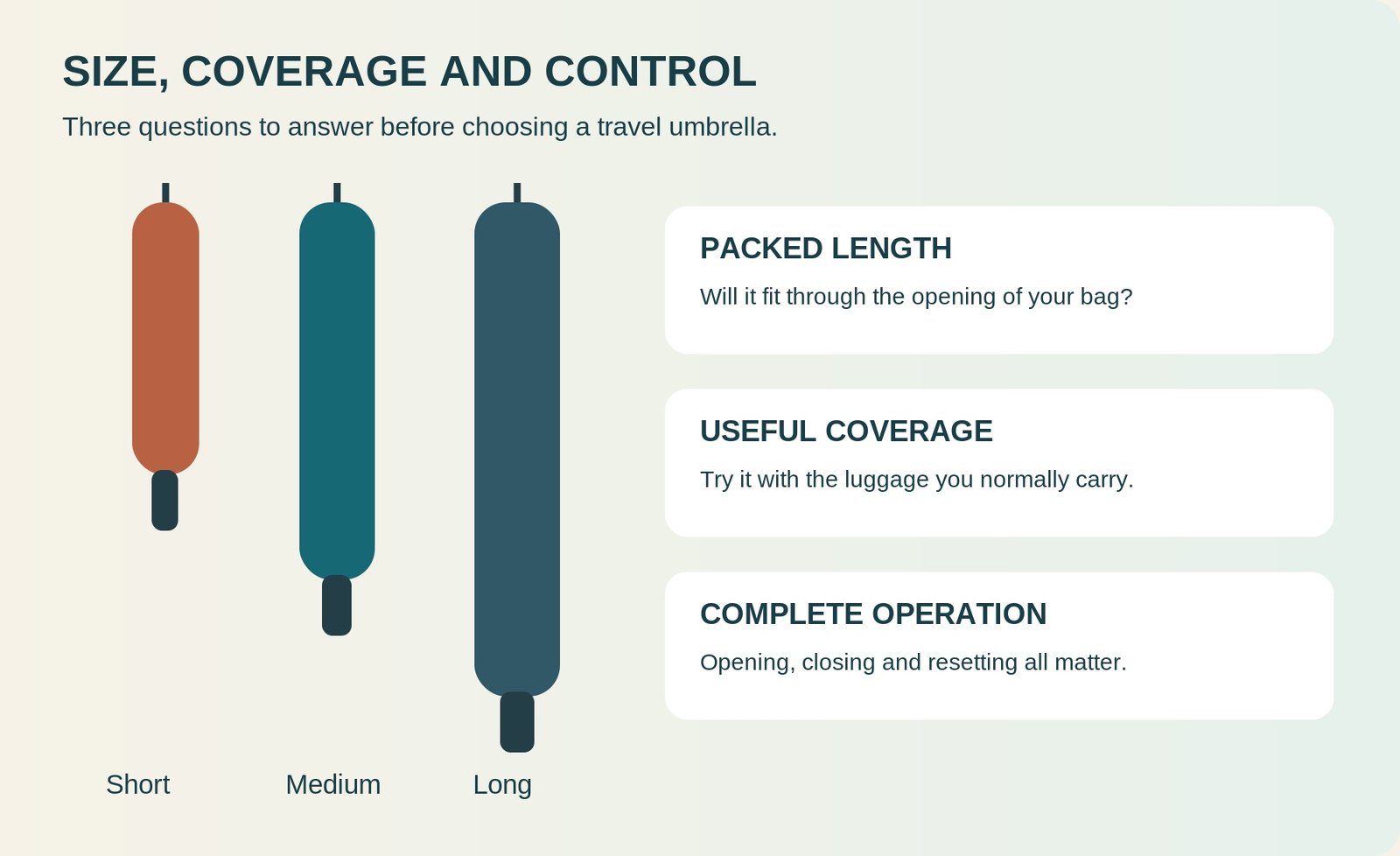
Use a ruler to measure the usable space inside your day bag, including the opening. Compare an 18cm Storm, a roughly 28cm Knirps or senz, and a 37-37.5cm Tornado or Metro. Those are materially different objects to fit beside a bottle, camera or lunch container. [1][3][4][6][7]
A diagonal fit is not always a practical fit. It can block the main opening or require moving other items every time you retrieve the umbrella. Try a harmless object of similar length as a planning aid, then check the real umbrella when it arrives. The sleeve and handle shape also need room.
Plan the wet-storage position
A dry umbrella in your suitcase is only half the problem. Decide where it goes after a short rainy walk. A separate suitable sleeve can help keep drips away from other contents temporarily, but the umbrella still needs to be opened and dried as directed afterwards. Do not confuse temporary containment with long-term storage.
An outside pocket can be convenient if it holds the folded umbrella securely. However, check that the item will not slide out when the bag is put down or tilted. Avoid using a pocket intended for a bottle as proof that every umbrella handle or sleeve will be retained equally well.
Carry-on labels are not airline permission
Check your airline and any relevant security guidance for the actual journey rather than relying on a retailer's generic travel-friendly label. This article does not give a universal rule for every carrier, airport or umbrella shape. Packing the umbrella inside an otherwise compliant bag is a separate question from carrying it as an additional loose item.
9Choose coverage for one person and their luggage
A canopy measurement is not a dry-zone guarantee
Diameter or span describes the umbrella, not a fixed area around your body that will remain dry in every direction of rain. How you hold it, your height, a backpack and the conditions affect the practical coverage. A 120cm span may be more useful for one person's larger load than a small canopy, but it also occupies more public space.
If you often carry a backpack, try the umbrella with that backpack on. Check whether the bag projects outside the canopy and whether you can hold the umbrella comfortably without an awkward arm position. A small waterproof cover or appropriate bag protection may address that problem more directly than buying a very wide umbrella.
Sharing is a separate use case
Two adults sharing a compact umbrella should not expect the same coverage as one person using it alone. Walking pace, height difference and the space between them matter. The larger Tornado can offer more span than the compact alternatives, but this is not a tested two-person dryness guarantee.
Sometimes two manageable umbrellas are simpler than one large item that neither person likes carrying. In other situations, a hooded waterproof is more practical, especially when you need both hands available. Choose the arrangement that suits the journey rather than assuming an umbrella must solve every rain-related problem.
10Two useful packing comparisons
A small crossbody bag versus a conventional daypack
Imagine a compact crossbody bag with a usable straight interior length of about 22cm. That is an illustrative bag measurement, not a claim about a named product. The 18cm Fulton Storm is an obvious candidate to investigate, while the longer models would need another carrying arrangement. Do not assume they fit because the bag's diagonal is longer: the opening, handle and other contents still matter. [7]
Now consider a conventional daypack with room for a roughly 38cm object. The Metro and Tornado may become practical options, but try the actual layout with a bottle and other essentials present. A nominal length allowance tells you that fitting may be possible, not that retrieval will be convenient or that a wet sleeve will have a sensible place.
Compare the weight difference with your priorities
Using the published figures, the Tornado is about 315g heavier than the Storm, while the Metro is about 155g heavier. Those differences are straightforward comparisons of stated empty weights, not measured test results. The extra carry weight may be justified by coverage, mechanism or a design you prefer; it may also be unnecessary for occasional short showers. [1][6][7]
Avoid converting those differences into an invented comfort score. A person who barely notices a heavier umbrella during a short walk may still dislike finding space for it inside a small bag. Someone else may willingly carry the extra weight because the larger canopy suits their regular route. The decision depends on the repeated inconvenience you are trying to remove.
Look past promotional size labels
Compact, mini and travel are useful search terms, but they are not standardised dimensions. In this shortlist alone, the folded lengths range from 18cm to 37.5cm. Read the actual number, confirm whether the handle and sleeve are included in it, and ask the seller when that is unclear. [1][3][4][6][7]
Photographs can make a folded umbrella look smaller or a canopy look broader than it feels in use. Use the measurements as the first screen, then a careful physical comparison where possible. That approach is more dependable than expecting a marketing category to tell you how the item will fit alongside your own belongings.
11Handles, buttons and the complete opening routine
Test with the hand you will actually use
A handle that feels comfortable in a photograph cannot tell you how it will work for you. Check grip, button placement and how much attention the mechanism needs. Try it with your usual bag on the other shoulder so that the exercise resembles your normal city walk rather than an empty-handed demonstration.
Keep sufficient room around you when opening any umbrella. Automatic mechanisms can move quickly, and ribs should not be opened into other people or nearby objects. Close the canopy before entering confined spaces and follow the maker's instructions for resetting the shaft.
Confirm the reset stage before keeping an automatic model
Automatic opening and closing can be convenient, but the reset stage remains part of the product. Someone with limited grip or difficulty applying the required force may prefer a different mechanism. There is no need to infer a medical condition or accept an awkward product simply because automatic sounds easier.
Check this while the item remains eligible for return under the seller's conditions. A purchase that requires a second person to reset it may not suit independent daily travel. The best buying information is the complete operating sequence, not only the button shown in an advertisement.
12A short acceptance check for a newly delivered umbrella
Confirm the product before opening it outdoors
Compare the label and selected variant with the order. Check that the mechanism is the one you intended, especially for the manual and automatic senz versions. Then measure the folded umbrella and compare it with the published specification. Small approximate differences are different from receiving an entirely different model or a size that plainly cannot fit your bag.
Inspect the sleeve and included accessories as well as the canopy. A replacement sleeve or carry strap may be convenient, but it should not be assumed to be included unless the listing says so. Keep the packaging and purchase details until you have established that the item is the correct version and suitable under the retailer's return conditions.
Operate it in a clear, controlled space
Follow the instructions, open it away from other people and complete the closing sequence. Check whether the button, handle and shaft reset feel manageable. Do not subject a new umbrella to a deliberate wind experiment in an attempt to validate a manufacturer's headline figure. The useful home check is normal operation and fit, not a destructive performance trial.
Look for an obviously distorted frame, an incomplete opening or a mechanism that will not behave as described. Contact the seller or maker rather than applying improvised force. A prompt enquiry about a newly delivered defect is more useful than continuing until the cause of a problem becomes unclear.
Put it into the real packing arrangement
Finally, place it in your normal bag with the usual contents and take it out again several times. Check whether the handle catches, whether it blocks another compartment and whether you can find the sleeve easily. This small exercise reveals repeated inconveniences that are invisible in an empty-bag fit test.
A product can be well made and still be the wrong travel umbrella for you. Discovering that while a return or exchange is available is a successful buying outcome, not a reason to persevere with a model you will rarely carry.
13Three city-travel situations
Commuting between stations and appointments
Here, repeated opening, closing and temporary storage may matter more than minimum suitcase weight. Compare the Knirps' shorter automatic package with the Metro's repairable approach. Decide whether the umbrella can be stowed without dripping onto paperwork or obstructing the bag's opening every time you reach your destination.
A reliable place for it is part of the system. Leaving a wet umbrella balanced against a cafe chair makes it easy to forget, regardless of how good the frame is. Create one consistent storage habit that keeps it visible and contained during brief indoor stops.
Sightseeing with a small day bag
When the umbrella is carried all day and used intermittently, the Storm's short folded length becomes more attractive. Accept that its smaller package is not the same proposition as a wide-canopy model. Pair it with appropriate clothing and a route that allows sensible breaks rather than expecting one small accessory to handle every condition.
Longer walks with a bulky backpack
The Tornado offers the broadest stated span here, while the senz provides a different canopy geometry to assess. Try the combination with the actual backpack and consider whether you can remain comfortably in control. If your hands need to be free or conditions make an umbrella awkward, choose appropriate clothing and shelter instead of continually fighting the canopy.
14Care, repair and when replacement makes sense
Let the umbrella dry before long-term storage
Follow the manufacturer's drying instructions and allow the fabric and frame to dry before putting the umbrella away for an extended period. Temporary storage in its sleeve during a journey is different from leaving it closed after the trip. Make drying part of the arrival routine rather than relying on remembering days later.
Check ribs, joints, the shaft and the opening mechanism for obvious problems. Do not continue forcing a jammed frame in the hope that it will straighten itself. A damaged umbrella is not restored merely because the canopy still opens most of the way.
Investigate repair before replacing a suitable model
BLUNT describes a modular repairable design, and that is worth checking when a component needs attention. Confirm the available service, parts and costs for your region and model. Do not assume that every repair is free or that a warranty automatically covers accidental damage. [1]
Keep the model name and purchase record. For any of the umbrellas here, those details make a support enquiry more useful than a photograph with no identifying information. Read warranty conditions at purchase, since manufacturer support and the retailer's return process are not the same service.
Replace the wrong design as well as damaged equipment
Sometimes the problem is fit rather than breakage. An umbrella that is consistently left behind, too awkward to reset or too large for crowded walking is not serving its intended role. A smaller or simpler design may be the right answer even when the existing frame is technically sound. Assess the repeated practical problem before buying a near-identical replacement.
15Advantages, drawbacks and common mistakes
What a good compact umbrella adds
An umbrella can provide quick coverage without changing clothing every time you move between indoors and outdoors. It can also be easy to share briefly or put away when a shower ends. The benefit is immediate, adjustable shelter within ordinary conditions, not a substitute for planning around severe weather.
The drawbacks are the occupied hand, the space needed around the canopy and the wet item you must manage afterwards. Compact mechanisms introduce their own operating routine. A traveller who spends most of the day handling luggage may reasonably prefer a hooded waterproof instead.
Mistakes that distort the comparison
Do not mix the weight of a manual senz mini with the price of an automatic model. Do not transfer a numeric Fulton wind claim from one product to another. Avoid comparing an asymmetric canopy's length and width directly with a circular diameter as though they describe identical coverage. Most importantly, do not buy a large folded umbrella without measuring your bag. [4][5][6][7]
Another common error is choosing only by the strongest-sounding name. Metro, Storm and Tornado are product names, not guarantees of safe use in the conditions they evoke. Read the construction and limitations, then decide whether the everyday handling fits the way you travel.
16Frequently asked questions
Which travel umbrella is best for strong winds?
There is no defensible universal winner from this research alone because the models have not been compared in a common independent test. BLUNT, Knirps and senz publish wind-related claims, but they do not establish a single comparable outdoor safety limit. Choose a manageable design for ordinary conditions and follow weather guidance when winds become hazardous. A stronger frame is not protection from flying debris or an unsafe route. [2][3][4][8]
Is automatic opening and closing worth paying for?
It can be convenient when you frequently move between buildings and public transport. However, check the entire process, including resetting the shaft and replacing the sleeve. Some users find a manual mechanism easier to manage. The useful question is whether the model works reliably for your hands and routine, not whether automatic operation is inherently better.
Will the smallest umbrella keep me dry enough?
That depends on your size, clothing, bag and the conditions. The Fulton Storm 1 offers a 95cm span in a very short folded package, but it is a different compromise from the Tornado's 120cm span. Try the umbrella with your normal day bag and accept that a smaller, easier-to-carry canopy does not promise the same coverage as a broader one. [6][7]
Can two people share these compact umbrellas?
Briefly, perhaps, but do not treat the published canopy size as a tested two-person guarantee. Height difference, walking pace and luggage change the practical result. The Tornado has the largest stated span here; two separate manageable umbrellas may still be easier for a pair walking for longer periods. Consider the actual journey rather than buying a compact model mainly for an occasional sharing scenario.
Does a wind-tunnel speed mean I can use it at that speed?
No. A manufacturer's test figure is not a personal safety threshold. The test setup, holding method and conditions differ from walking in a city, where debris and loss of control can be hazards. Check local forecasts and warnings, and seek appropriate shelter when needed. The umbrella is ordinary rain equipment, not permission to remain outside in dangerous weather. [8]
Should I buy the manual or automatic senz mini?
Choose by mechanism and carry weight after checking the current versions. The manufacturer's comparison lists the manual mini at 325g and the automatic at 420g, with a similar folded length. The automatic version is the one compared in this article. A retailer title that simply says mini is not enough to confirm which mechanism you will receive. [4]
Is it safe to keep a wet umbrella inside a backpack?
Use a suitable separate sleeve or compartment to contain drips temporarily and keep it away from vulnerable belongings. Then remove and dry the umbrella according to the maker's instructions. A sleeve is not a reason to store the umbrella wet indefinitely, and a water-repellent backpack does not protect its contents from moisture introduced inside it.
Do I need an umbrella as well as a waterproof jacket?
Not necessarily. An umbrella can be convenient for short city journeys, while a suitable jacket keeps both hands available and may be more practical when an umbrella is difficult to control. Some travellers benefit from both; others carry an umbrella they rarely use. Decide from your normal walking, luggage and weather exposure rather than buying two overlapping items automatically.
17The final choice: the umbrella you will carry and control
Start with the BLUNT Metro when a 37.5cm folded length fits your everyday bag and its repairable approach appeals. Compare the Knirps T.200 when a shorter automatic package matters more. The senz mini automatic is worth considering for its different canopy geometry, provided you deliberately choose that mechanism and weight.
Choose the Fulton Tornado when broad coverage is the priority and you accept the extra weight and space. Choose the Storm when a short, light package is what makes you keep an umbrella with you. Neither product name should be mistaken for a guarantee in severe weather.
Before keeping any model, test its fit in your bag, complete the opening-and-closing sequence and work out where it goes when wet. Those ordinary checks determine whether the purchase becomes useful travel gear. Wind-related claims are supporting information, not a substitute for a manageable umbrella and sensible judgement about the conditions.
18Sources and fact-checking notes
Research reviewed on 11 October 2026. Manufacturer pages supply the specifications and stated test limits; recommendations and packing examples are editorial judgement. Listings, versions and stock can change. No independent hands-on product testing was performed for this guide.
- BLUNT UK: Metro specifications, construction and warranty
- BLUNT: wind-tunnel explanation
- Knirps UK: T.200 Medium Duomatic specifications
- senz: mini automatic range and comparison with manual mini
- senz: mini automatic black specifications
- Fulton: Tornado 1 technical specifications
- Fulton: Storm 1 technical specifications
- Met Office: staying safe in strong wind
- Met Office: thunder and lightning safety
Illustrations in this article were created for Taylor’s Trailblazing Travel Gear. Third-party photographs, where used, are credited beside the image or in the source list.