Garment Folder vs Packing Cube: Which Keeps Clothes Neater?
Choose controlled folds for smarter clothes, flexible modules for everything else.
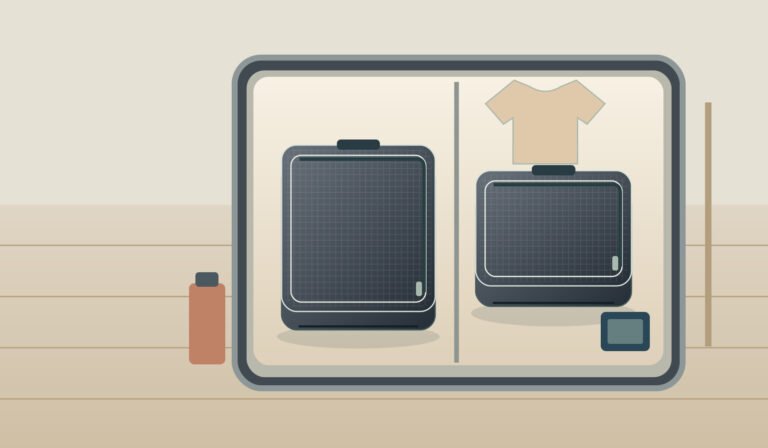
Concept scene: a controlled shirt stack beside flexible clothing modules.
The garment folder vs packing cube decision starts with what you want to keep neat. A collared shirt needs a different arrangement from socks, a jumper or a set of casual clothes. A folder helps maintain a controlled flat stack, while a cube creates a flexible compartment. Neither removes the effects of unsuitable folding, excessive pressure or packing clothes before they are properly ready to travel.
For many travellers, the useful answer is a small combination rather than an either-or purchase: one folder for smarter clothing and one cube for the rest. The mistake is building a complicated system around every garment, then discovering that the organisers themselves occupy the space you needed for your shoes or toiletries.
This guide compares published construction and dimensions with a practical packing routine. It does not claim an independently measured wrinkle reduction or hands-on testing of the products. Specifications were checked on 11 October 2026, and manufacturer claims such as up to seven items are treated as estimates rather than promises for clothing of every size and fabric.
Try a garment folder
A folding board and adjustable wings help maintain a flat, repeatable stack.
Use a packing cube
Flexible compartments suit underwear, knitwear and everyday outfits.
Compress selectively
Space saving is not a promise of wrinkle-free clothing.
One folder, one cube
Give smart clothing structure without organising every item twice.
Garment folder vs packing cube: choose by the clothing
When a folder is the better starting point
Consider a garment folder when a few shirts, blouses or trousers need a repeatable flat arrangement. The typical format uses a folding board and adjustable wings to hold a stack together. Eagle Creek’s Reveal Garment Folder M and Thule’s garment folder both use that general approach. The intended benefit is controlled folding and less movement within the stack, not the elimination of every crease. [1] [2]
A folder is particularly worth trying when you repeatedly open a suitcase and find smart clothes twisted between other items. However, it needs a suitable footprint inside the luggage. Buying one before measuring the interior can create a new problem: a broad, semi-rigid module that has to bend around a handle housing or press against a curved corner.
When a cube makes more sense
A cube is a useful starting point for mixed everyday clothing, underwear and items that do not need a uniform flat stack. It can keep categories together while remaining easier to distribute around the rest of your kit. Ordinary cubes and compression cubes are different variants: compression adds a mechanism for reducing the packed thickness of suitable contents, but the benefit depends on what is inside. [3]
Choose the cube because it helps you find and repack things, not because every garment supposedly needs its own container. A small cube for underwear and a second for casual clothes can be enough. When your wardrobe contains little that needs careful flat folding, a separate garment folder may add weight and complexity without solving a real problem.
Neat organisation and fewer creases are different goals
A tidy bag can still contain sharply folded clothes
A neatly packed rectangle is not necessarily a wrinkle-free rectangle. The fold lines still exist, and pressure from the rest of the luggage can bear on them. This guide therefore treats folder and cube performance as something to evaluate with your own clothing. The important outcome is how the garments look and what work they need on arrival, not how symmetrical the packing modules appear.
Before comparing products, identify the type of problem. Are shirts shifting into a heap, collars being crushed, trousers developing unwanted folds or small items becoming impossible to locate? A folder may help with the first problem while a different packing position solves the second. Better organisation and improved presentation can overlap, but one purchase should not be credited with solving every problem automatically.
Do not adopt absolute marketing claims
Some manufacturer descriptions use strong language about preventing wrinkles or eliminating ironing. Those statements are not independent evidence that your particular garments will arrive ready to wear. Treat them as descriptions of intended use and test the result. This is especially important for tailored garments, delicate fabrics or clothing needed immediately after a journey. [1] [2]
Set a realistic standard before packing. A casual linen shirt and a crisp business shirt may have very different acceptable appearances, even when both are neatly organised. Your decision should reflect that standard. An organiser can help maintain an arrangement, but it is not a replacement for the garment’s care instructions or a contingency plan for an important event.
Compare how the products hold clothing
Folding boards and adjustable wings
A folding board gives you a repeatable template, which can make a group of shirts easier to stack. Adjustable wings then hold that stack in position. Check the board’s size against your garments and the luggage interior, and find out whether it stays in the folder during use. Follow the manufacturer’s method rather than assuming every board works in the same way. [1] [4] [2]
Avoid treating maximum compression as the goal. Close the wings securely enough to retain the stack without distorting collars, buttons or delicate details. The appropriate amount depends on the clothes. A folder packed beyond a comfortable thickness may become difficult to position inside the suitcase, and extra pressure from surrounding items can undermine the reason you chose the folder.
Zipped cubes and compression zips
A standard cube mainly provides containment. A compression cube uses an additional closure to reduce the packed profile where the contents allow it. Thule’s small/medium set publishes both expanded and compressed dimensions, which is useful for comparing configurations. Those figures do not mean any quantity of clothing will compress to the minimum thickness shown. [3]
Close a cube without catching fabric and check its final shape. A bulging module can be difficult to arrange even when the zip closes. If the corners become dense blocks while the centre remains rounded, the result may use the luggage poorly. Less aggressive compression or a different cube size can be more practical than forcing every item into the smallest possible package.
Product examples: compare footprint before item counts
This table is selected to show different sizes and constructions, not a ranking based on product testing. Dimensions and masses are published values. Set weights should not be assigned to an individual cube, and up-to garment counts depend on the size and thickness of the contents.
| Product | Published size or composition | Published mass | What it helps you compare |
|---|---|---|---|
| Eagle Creek Reveal Garment Folder M | 36 x 26cm footprint; folding board; up to seven items | 270g | Compact folder format. Confirm the exact marketplace edition. [1] Check the Blue M listing |
| Osprey Ultralight Garment Folder S23 | 40 x 28 x 5cm; 6L; folding card included | Not shown numerically on the checked UK page | Wider internal-folder option without inventing a UK weight figure. [4] |
| Thule garment folder 3204862 | 42 x 31 x 8cm; folding board; up to twelve items | 400g | Larger footprint and a higher advertised garment count. [2] |
| Thule compression cube set 3204860 | One small and one medium cube | 200g per set | A two-module approach rather than a large collection. [3] Check the white cube-set listing |
| BAGSMART Blast Packing Cubes | Five cubes in three size groups, plus one shoe bag | Not used in this comparison | Several footprints; buy a set only when its pieces suit your luggage. [5] View Blast cube sizes |
| BAGSMART Faro Packing Cubes 6PCS | Two large, one medium, two small and one shoe bag | 750g advertised set total | A different six-piece arrangement; weigh your selected subset. [6] View the Faro set |
| Miffy compression set MA1001-002 | Four cubes plus a drawstring bag | 610g displayed set weight | Broad rectangular cubes; compare the individual sizes before buying. [7] View the Miffy set |
Do not compare the word Medium across brands
A medium folder and a medium cube need not have the same footprint. Even one brand’s naming can change between product generations. Use numerical dimensions and the exact model instead. The linked Blue Eagle Creek page identifies a Medium folder, but its metadata gives 34 x 34 x 25cm and a zip closure, conflicting with the manufacturer folder format. It also showed no featured offer. Do not use that metadata to establish fit; confirm the exact edition and seller before ordering. [8] [1]
A large set is not automatically better value
More pieces are useful only when they support the way you pack. A heavy set with several large cubes may be poorly suited to a small backpack, even when the price per piece looks attractive. Start with the compartments you need, then see whether a set supplies them conveniently. Leave unused pieces at home rather than treating the package contents as a packing checklist.
Measure the usable interior of your luggage
The opening can be narrower than the main compartment
Measure the flat area where the folder will sit and the opening through which it has to pass. Allow for padding, rounded corners, internal dividers and handle housings. A backpack may have enough nominal capacity for a folder but an opening that makes inserting it awkward. The dimensions of the complete bag are not a reliable substitute for this interior check.
Make a paper template matching the proposed footprint. Place it where the packed folder would go, then add a realistic stack of your clothes to judge thickness. Do not force the template around a corner and assume the real board will flex in the same way. The exercise is meant to reject unsuitable shapes before buying, not to prove that every product can be made to fit.
Protect the flat clothing zone
Put the folder somewhere the surrounding load will not crush collars or press hard objects into the garments. Keep plugs, shoes and toiletries in appropriate separate positions. A folder near the surface can be easy to remove on arrival, while one beneath heavy modules may be harder to retrieve without unpacking. Choose according to your actual arrival routine.
The Eagle Creek M marketplace listing is worth considering only after its 36 x 26cm family footprint has been checked against your luggage and the exact edition confirmed. A larger folder is not inherently better: unused wing area and a board that bridges the interior can make a smaller clothing stack less convenient. Size the organiser to the garments and the bag together. [1] [8]

Pack shirts with a repeatable, gentle method
Begin with clothes that are ready to wear
Follow each garment’s care instructions before packing. Do not use an organiser as a place to finish drying clothes. Prepare the shirts on a clean surface and check pockets, buttons and any removable accessories. A consistent starting condition makes it easier to judge whether the folder helps, because differences in the preparation will otherwise dominate your comparison.
Use the supplied board or instructions to create folds that fit the folder. Keep sleeves and hems within the intended stack rather than letting them become caught in the wings. Avoid folding decorative details or delicate fabric over hard edges without considering the garment’s care needs. A generic packing guide should not override specialist advice for an expensive or fragile item.
Keep the stack stable without making it a brick
Lay garments in a controlled stack and check that collars or button plackets do not create one excessively thick ridge. The aim is even support, not maximum pressure. Try a small number of shirts first and add more only while the folder closes naturally. The advertised item count is an upper-use description, not a requirement to fill every journey to that number.
Remove the top shirt and replace it during the trial. If doing so disturbs the entire arrangement, consider whether a smaller stack or a different grouping would work better. A folder can be effective for clothes used at one destination, yet less convenient when you want to retrieve individual outfits repeatedly. Evaluate access as part of neatness rather than treating it as an unrelated concern.
Pack a cube to support the clothes you put inside it
Fold or roll according to the garment, not a slogan
There is no single packing technique that this guide can promise will keep every fabric neatest. Use a method appropriate to the garment and compare the result with your normal routine. A cube can hold folded clothing as well as rolled items; its purpose does not require every piece to be rolled into the same shape. Leave room where structured details need it.
For casual basics, group items so you can remove what you need without emptying the cube. For example, keep underwear separate from the shirt you plan to wear on arrival. Do not place heavily soiled or damp items into the clean-clothing module. A clear separation routine is more useful than relying on the organiser’s fabric description to solve laundry problems.
Use compression only where it improves the result
The Thule small/medium compression set lets you compare two modestly sized modules rather than starting with a large multi-piece kit. Its manufacturer publishes configuration dimensions and a 200g set mass. Treat those as comparison information, not evidence that compression will improve every garment’s appearance. Current seller and offer details on the linked marketplace listing need checking. [3] [9]
When comparing an ordinary zipped arrangement with a compressed one, keep the contents identical. Inspect the clothing after the same storage period and decide whether the space saving is worth any change in presentation. A little extra thickness may be acceptable when it makes your clothes easier to use on arrival. The smallest possible module is not always the most useful module.
Match the system to different kinds of clothing
Shirts, trousers and tailored garments
A folder is a reasonable candidate for garments that benefit from a controlled flat stack, but structured jackets and special-occasion pieces need individual consideration. Do not assume a board and wings provide the same support as a garment carrier designed for hanging clothing. Long garments may also require folds that the internal folder format cannot avoid.
Where presentation is critical, discuss packing and care with the garment maker or a suitable specialist rather than relying on a universal rule. Plan what you will do on arrival if creases remain. That may mean allowing time for the accommodation’s appropriate facilities or arranging professional help, not automatically applying steam or a hot iron to an unfamiliar fabric.
Knitwear and wool require their own care judgement
Woolmark distinguishes hanging woven wool garments on suitable shaped hangers from gently folding knitted garments. That guidance is useful when planning what to do after unpacking, but the individual garment label still matters. Do not assume all wool items should be handled identically or that a delicate knit benefits from a tightly compressed flat stack. [10]
A cube can be a practical way to keep a gently folded jumper together, while a folder may serve smarter woven clothing. The important distinction is the garment’s construction and care needs, not merely the fibre name. Avoid stretching an item to match an organiser’s footprint. Choose a module that accommodates the clothing in an appropriate arrangement instead.
Build a mixed system without over-organising
One smart-clothes zone and one everyday zone
For a short business trip, start with a folder for the meeting clothes and a cube for casual basics. Keep footwear and toiletries separate. This creates clear zones without requiring a container for every outfit. The folder can come out first on arrival, while the everyday module remains intact until needed. Adapt the arrangement to the luggage opening rather than copying a generic flat-lay photograph.
A Blast cube set provides several size options, but that does not mean taking all five cubes. Use a small module alongside the folder and keep the spare pieces for other trips. Check the current size list because the older six-piece product URL now leads to the Blast Packing Cubes page. Product names and page layouts can change without making every previously quoted specification reliable. [5]
Keep the organisation proportionate to the trip
For a casual holiday, a folder may be unnecessary if your clothing already stays manageable in one or two cubes. For a trip with one important outfit, it may be worth adding a compact folder for that outfit alone. Evaluate the benefit in time saved and clothing usability, not in how complete the matching set looks inside the suitcase.
The Faro six-piece set has a different arrangement from Blast, including two large cubes and an advertised 750g total. That is a reason to compare the subset you need, not a reason to reject or recommend the whole set automatically. A single useful piece may support your routine; carrying the complete kit without a purpose may undermine a lightweight packing plan. [6]
Consider the shape of a broader cube
Larger flat modules can bridge the two approaches
A broad cube can hold a folded clothing stack while giving you a zipped enclosure rather than adjustable wings. It still lacks the same folding-board structure as a dedicated folder. That can be helpful when flexibility matters or unhelpful when you want a very repeatable flat arrangement. Compare the actual result with your shirts rather than assuming the format determines the outcome by itself.
The Miffy compression set includes broad medium and large cubes in its published size list. It is a useful example for checking whether a rectangular cube fits your luggage better than a folder. Consider the full set weight and leave unneeded pieces at home. The retailer’s largest-cube dimensions should not be read as the footprint of every item in the set. [7]
Do not force a large module into a narrow bag
A wide cube may suit a suitcase but sit awkwardly inside a tapered backpack. If it bends around the opening or pushes into a laptop sleeve, try a smaller footprint. The resulting gaps might be more useful for other items than the apparently efficient single rectangle. Your bag’s internal layout should influence the organiser choice before any garment-count claim does.
Likewise, avoid using a large module merely because it was included in a set. Two people sharing a suitcase may benefit from separate smaller cubes, while one traveller using a wide case may prefer a larger clothing zone. Organisation is successful when it reflects how the contents are used, not when it reproduces the manufacturer’s complete product arrangement.
Know when a garment carrier is a different decision
An internal folder is not a suit carrier
A garment carrier is a separate type of luggage or protective enclosure for hanging clothing. It may be appropriate when the garments are too long or structured for an internal folder, but it creates a different baggage and handling question. Do not count it as just another packing cube, especially when planning a cabin-only journey with a limited number of pieces.
TORRO’s Trifold Canvas Suit Carrier is an example of that separate category. The published folded footprint is 40 x 56cm and its mass is 1,100g; the checked page did not provide a packed thickness. Those facts are not enough to promise that it qualifies for a particular flight. Confirm all three packed dimensions and the permitted piece count before using it as an additional bag. [11]
Compare total handling rather than neatness alone
A carrier can keep special clothing separate, but you must carry, store and retrieve it alongside everything else. Consider whether you can manage that comfortably on the transport you use. A compact folder inside a suitable main bag may be more convenient for a few shirts, while a dedicated carrier may be justified for clothing that should not be packed in the same way.
For a wedding or important work event, build the arrival plan at the same time as the packing plan. Identify when the clothes will be unpacked and where they will be kept. More specialist luggage does not remove the need to inspect the garments and follow their care instructions. Choose the format that addresses the actual presentation requirements without adding unnecessary travel complexity.
Run your own fair comparison before buying more
Keep the clothing and conditions consistent
Use similar garments or repeat the trial with the same garment after restoring it to the same starting condition. Pack one arrangement in the folder and one in the cube, or compare each against your existing method. Keep the storage time and surrounding luggage load broadly consistent. Otherwise, you may be measuring differences in preparation or pressure rather than the organiser itself.
Take photographs of the garments before packing and after unpacking under similar lighting. Record whether the collar, front, sleeves or trouser legs need attention. There is no need to invent a scientific wrinkle score. A clear note such as suitable for the meeting after hanging, or needs pressing, is enough to decide whether the product improves your own routine.
Include access and repacking in the result
Remove the garment you would use first, then close the organiser and put it back in the bag. Notice whether the remaining clothes stay in a useful arrangement. A product that performs well during one uninterrupted journey may be less convenient across several hotel changes. Your result should include that difference rather than treating initial neatness as the only measure of success.
Also check weight, fit and the space left for everything else. An organiser that keeps shirts slightly neater but forces shoes into a separate bag may be the wrong trade-off. Compare the complete travel system. The packing-cube comparison guide can help distinguish containment and compression when deciding which part of the arrangement is actually delivering the benefit.
Arrival, cleaning and storage matter too
Unpack with the garment’s care instructions in mind
Remove important clothes when you reach a suitable place rather than leaving them tightly packed until the moment they are needed. Follow the garment label for hanging, folding, pressing or refreshing. Woolmark offers specific guidance for wool, but it should not be generalised to every textile or used to override a label on a lined or embellished garment. [10]
Do not assume that bathroom steam is a universal remedy. Some garments require particular care, and an unplanned treatment can create a different problem. The organiser decision should include a realistic arrival routine and appropriate facilities. A few minutes reserved for unpacking can be more useful than a more expensive container purchased on an absolute wrinkle-free claim.
Clean the organiser according to its construction
Eagle Creek says the folder itself is washable but the folding board should not be washed. Thule gives its own care guidance for folders and cubes. Follow those product-specific instructions rather than putting every organiser through the same machine cycle. A board, coating, fastening or mesh panel may need different treatment from a simple fabric pouch. [1] [2] [3]
Make sure the organiser is appropriately dry before storing it and keep any removable board with the correct folder. Inspect zips, wings and seams before the next trip. Damaged components can make a previously reliable arrangement awkward. A small maintenance check is more useful than assuming a branded packing system will always work without attention.
Judge value by the pieces you will actually use
Compare the cost of a useful system, not a complete collection
An inexpensive set is not necessarily economical if only one oversized cube is useful. Conversely, a pricier folder may be worthwhile when it repeatedly makes important clothing easier to use. This guide does not rank temporary discounts. Check current checkout totals, delivery and return terms for your address, then compare the exact products that solve your packing problem.
Start with one change and evaluate it before expanding the system. Borrowing a folder or using a paper template can help test the footprint before committing. You do not need to replace every existing pouch because the new organiser has a different colour or fabric. A mixed set that works with your luggage is more useful than a coordinated set that makes packing harder.
Keep accessories from consuming the weight budget
Compare the weight of the subset you carry, including any board. A full set mass and a single-product mass answer different questions. If you use only one cube, weigh that cube rather than assigning it the complete set’s weight. At the same time, do not omit organisers entirely from your packed total because they are not clothing.
When the margin is tight, remove unused pieces before compressing essentials harder. A lighter, simpler arrangement may work as well. The value of a folder is the structure it provides; the value of a cube is the containment or compression it provides. Once neither is improving the trip, the extra fabric and fasteners are simply another part of the load.
Sharing a suitcase without mixing up the clothing
Give the system clear ownership
When two people share luggage, organise by person or by the order clothes will be needed, rather than only by garment type. Two separate small cubes can be easier to manage than one large cube containing everyone’s basics. A folder may still be useful for the clothing needed for a particular meeting or event. Keep that module identifiable without adding a heavy labelling system or several extra pouches.
Agree which pieces will be removed at the first stop. If one traveller needs to retrieve a shirt while the other person’s clothes remain packed, trial that operation. A tightly interleaved stack can look efficient yet make access awkward. The extra division between two modules may be worthwhile even when it leaves a little more unused space around them.
Keep a simple inventory of the important outfit
For a special occasion, check the complete outfit together before separating it into modules. Include the small pieces that are easy to overlook, such as a belt or an appropriate underlayer, while keeping anything that could snag or stain clothing separately protected. This is an organisation exercise, not a reason to place every accessory inside the garment folder itself.
After packing, both travellers should know where the important module is and how to remove it without disturbing fragile contents. That shared understanding can save more time than buying a more elaborate organiser. The right system remains understandable when someone other than the person who packed the suitcase has to retrieve something in a hurry.
Pros and cons of folders and cubes
Garment folders
A folder can make flat folding repeatable, hold a small stack together and create a clear smart-clothing zone. It is attractive for travellers who repeatedly carry shirts or trousers that need orderly presentation. Its limitations are the board’s footprint, reduced flexibility around awkward interiors and the risk of over-compressing a stack. It does not guarantee that delicate or tailored clothing arrives ready to wear.
Packing cubes
Cubes offer flexible categories and can be easier to distribute through varied luggage shapes. Compression versions may reduce the bulk of suitable clothing, while ordinary cubes can prioritise straightforward access. Their limitations are potential overfilling, added organiser weight and the temptation to carry an entire set. A flexible cube does not automatically provide the same support as a garment folder, even when the clothes inside are folded flat.
Common mistakes that make clothes less usable
Packing for the photograph rather than the arrival
Avoid building a stack so tightly that removing one shirt disturbs everything. The useful arrangement should survive ordinary access and repacking. Similarly, do not position the smart-clothing module under hard, heavy objects merely because that makes the suitcase look tidy. Protect the parts of the clothing that matter to its appearance and leave enough room for the arrangement to work without force.
Treating item counts and compression claims as guarantees
Up to seven or twelve items is not a promise for every garment size and thickness. A packing cube’s smallest displayed dimension is not an assurance that your full load will reach it. Check the exact product, use realistic quantities and inspect the result. The same caution applies to marketplace naming: a familiar folder name may appear in several colours or generations with different details. [1] [2] [3]
Frequently asked questions
Does a garment folder keep shirts completely wrinkle-free?
No universal guarantee is justified. A folder supports a controlled stack, but the garment, preparation, folding and pressure inside the luggage still matter. Test it with your actual shirts and judge how much work they need on arrival. Treat strong wrinkle-free claims as intended-use descriptions rather than independent proof that every fabric will emerge ready for an important meeting.
Can I put folded shirts in a packing cube?
Yes. A cube does not require every item to be rolled. Use a footprint that suits the folded shirt, avoid crushing collars and do not overfill the module. Compare an ordinary zipped arrangement with any compression setting before assuming tighter is better. A broad cube can provide useful containment, but it does not necessarily provide the same structure as a folder with a board.
Should I use a folder and a cube together?
That can be a practical arrangement when you carry both smart clothing and casual basics. Give the folder a flat place in the luggage and use a modest cube for the rest. Keep the number of modules small enough that access remains simple. A combined system is useful when the two pieces perform different jobs, not when the same garments are being organised twice.
Are compression cubes bad for clothes?
That is too broad a claim. The result depends on the garment, the amount of pressure and the packing method. Compression can be useful for suitable casual clothing but should not be assumed appropriate for every delicate or structured item. Follow care guidance, avoid trapping fabric in zips and test the appearance of important garments before relying on the arrangement for a trip.
What size garment folder fits a carry-on backpack?
Measure the backpack’s usable interior and opening rather than relying on its litre capacity. A 36 x 26cm folder and a 42 x 31cm folder require different footprints, and thickness increases with the contents. Make a paper template and trial the planned clothing stack. The published examples in this guide are comparison dimensions, not a guarantee of fit in every carry-on bag. [1] [2]
Will a folder work for a suit jacket?
It depends on the jacket, the folder and the presentation you need. Structured or special-occasion garments may call for a different arrangement, such as a suitable garment carrier, and specialist care advice. Do not assume a folder designed for shirts provides the same support as luggage intended for hanging clothing. Plan an appropriate unpacking and care routine before the event.
Is the folding board supposed to stay inside?
Follow the instructions for the exact product. The board’s role and recommended placement may differ between designs. Do not remove it solely to save a small amount of weight if that compromises the intended structure, and do not wash it unless the manufacturer expressly permits that. Eagle Creek specifically distinguishes washing the folder from washing its board. [1]
How do I stop clean clothes mixing with laundry?
Use a clear separation routine rather than assuming one compression compartment will manage everything. Keep clean clothing in its assigned module and use a suitable separate bag for used items, with appropriate drying and airing when needed. Do not leave damp garments sealed with clean clothes for convenience. Our dirty-laundry packing guide explains a more practical approach for multi-stop journeys.
Final recommendation: give each organiser a distinct job
Choose a garment folder when controlled flat folding solves a repeated problem with smarter clothes. Choose a cube when flexible grouping and easy access matter more. Use compression selectively and judge it by the state of the garments and the completed luggage, not only by the thickness of the module.
A compact folder, a two-piece cube set or a carefully chosen subset of a larger kit are sensible starting points to investigate. Confirm marketplace editions and offers before ordering, and test the actual footprint in your bag. There is no need to buy all three approaches at once. [1] [8] [3] [9] [5]
Check the compact folder option Check the two-cube option Check the modular set option
The better system is the one that lets you unpack clothing in a usable state, find what you need and repack without a struggle. A folder and a cube can both contribute to that result, but only when their structure, size and number match the way you actually travel.
Sources and fact-checking notes
Product details and linked pages were reviewed on 11 October 2026. Published specifications are distinguished from illustrative calculations and planning advice. No hands-on product testing or independently measured performance results are claimed.
Both checked Amazon pages showed no featured offer. Other-seller availability was not independently confirmed. Do not transfer dimensions between generations. The Osprey UK folder page did not expose a numerical mass, so none has been invented.
- Eagle Creek Europe: Pack-It Reveal Garment Folder M 36 x 26cm footprint, 270g, folding board and up-to-seven-item manufacturer claim. No crease-free guarantee adopted.
- Thule UK: garment folder 3204862 42 x 31 x 8cm, 0.4kg, folding board and up-to-twelve-item claim; actual garment size changes capacity.
- Thule UK: compression cube set 3204860 Small/medium set, compressed and expanded dimensions, 0.2kg advertised mass and care instructions.
- Osprey UK: Ultralight Garment Folder, S23 40 x 28 x 5cm, 6L and included folding card. The parsed UK page did not provide a numerical mass.
- BAGSMART UK: Blast Packing Cubes Current destination of the older six-piece URL. Set comprises five packing cubes and a shoe bag; dimension ranges are not guaranteed filled thicknesses.
- BAGSMART UK: Faro Packing Cubes 6PCS Current six-piece listing, individual dimensions and advertised 0.75kg total; weigh only the pieces you carry.
- Case Luggage: Miffy compression set MA1001-002 Four compression cubes plus a drawstring bag; individual sizes and displayed 0.61kg set mass.
- Amazon UK: Eagle Creek Reveal Garment Folder M, Blue Blue M identity located, but no featured offer was shown. The 34 x 34 x 25cm and zip-closure marketplace metadata conflict with the manufacturer folder format; do not use them as confirmed specifications.
- Amazon UK: Thule 3204860 white small/medium set White 3204860 identity located; no featured offer shown. Other sellers, delivery and stock were not independently confirmed.
- Woolmark: caring for wool Woven-versus-knitted storage advice and refreshing guidance; always follow the individual garment care label.
- TORRO: Trifold Canvas Suit Carrier Standalone carrier, not an internal folder. Folded 40 x 56cm, 1,100g; packed thickness not specified on the checked page.
Illustrations in this article were created for Taylor’s Trailblazing Travel Gear. Third-party photographs, where used, are credited beside the image or in the source list.