
July Carry On Review: Research-Led UK Buying Guide
July Carry On Review: Research-Led UK Buying Guide
The classic 42-litre case, its useful extras and the UK buying checks that matter more than colour.
Original editorial concept of a reinforced-corner suitcase with a separate power bank; not an exact July product rendering.
A useful July Carry On review should answer a UK traveller’s practical questions before discussing the colour palette. Will the case fit the airline you normally use? How much of the allowance is left after the suitcase itself? Does the removable battery help your travel routine, and what does the warranty actually cover?
This guide focuses on the classic 42-litre July Carry On, not the Carry On Light, Trunk, Pro or every edition with a similar name. It also separates the optional CaseSafe configuration, because the current range contains combinations that should not be treated as one identical product.
The assessment uses current manufacturer information, UK help pages and airline policies. It is not a claim of ownership, a wheel test or a measured packing trial. Recommendations about who the case suits are research-led judgement. The detail matters here: a smart feature can be genuinely useful while still being the wrong reason to choose a case that misses your regular airline’s dimensions.
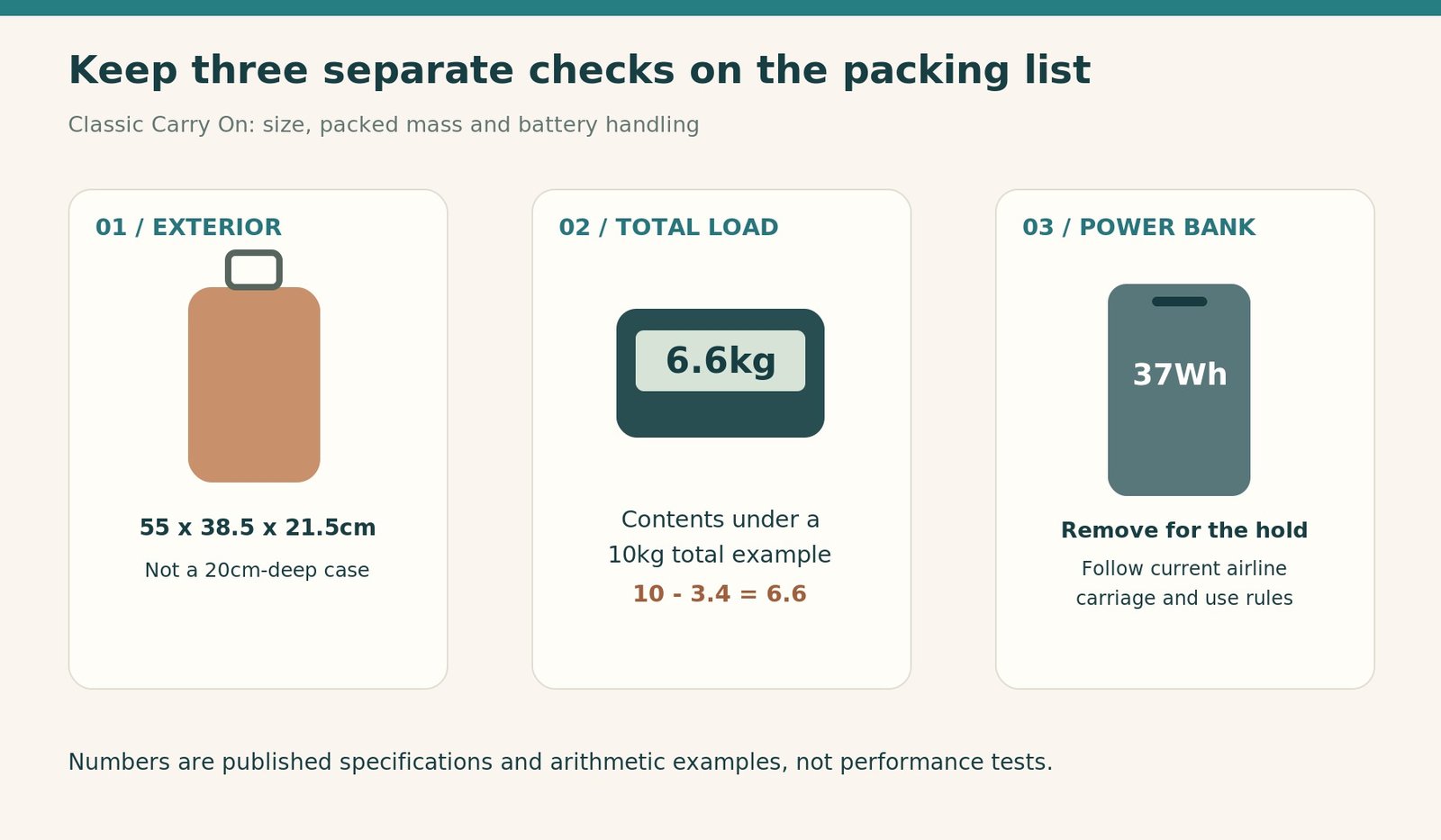
42L / 3.4kg
Capacity and empty weight describe different parts of the packing decision.
21.5cm depth
It is not a strict 20cm-deep cabin suitcase.
Useful, not universal
Ejectability does not override an airline's current carriage or use rules.
Unused only
Delay personalisation until fit and packing needs are settled.
July Carry On review: the classic model in context
The working specification
July’s current UK comparison gives the classic Carry On a 42-litre capacity, a 3.4kg weight and external dimensions of 55 x 38.5 x 21.5cm. The product page describes a polycarbonate shell, corner reinforcement, internal compression and a removable battery in the relevant configuration. These are published specifications, not measurements independently reproduced for this review. [15][14]
On smaller screens, scroll this table sideways for all columns.
| Check | Published baseline | What to do with it |
|---|---|---|
| Exterior | 55 x 38.5 x 21.5cm | Compare each side with the operating airline’s maximum. |
| Volume and weight | 42L / 3.4kg | Weigh the actual configuration and your own packed contents. |
| Battery | Removable on the relevant battery-equipped version | Read the selected title; some limited editions omit it. |
| CaseSafe | Separate configuration | Confirm the chosen tracker option and its own warranty. |
Use the complete model name when comparing an offer. The presence of Carry On somewhere in the title does not mean that a lighter version, a pocketed Pro model and a trunk-shaped case have the same size, weight or included components.
Check the selected configuration, not just the range page
The UK page allows a CaseSafe option, while July’s help centre explains that battery inclusion can vary for certain limited-edition colours. Read the exact product title and configuration immediately before ordering. A general photograph of a battery compartment is not confirmation of what your selected case includes. [20]
For a straightforward comparison, start with the classic configuration you would actually buy, record its listed specification and make every alternative compete against that baseline. Otherwise it is easy to assemble an attractive but imaginary suitcase from several different versions.
Dimensions: the depth is the main UK airline warning
Why 21.5cm should not become 20cm
A 1.5cm difference can sound trivial until you compare it with a rigid baggage sizer. The classic July’s listed 21.5cm depth is greater than a 20cm allowance. The correct conclusion is not that it definitely fails every physical check, but that it is not a published-dimension match and should not be recommended as one. [15][1]
Do not assume that packing less makes the moulded shell meaningfully shallower. You can reduce a bulge caused by overpacking, but the basic exterior dimensions remain part of the case. A cabin-suitcase label is a category description, not a universal permission to carry it aboard.
Measure the actual outside shape
Once the case arrives, measure height, width and depth including protrusions. Keep the measurement straight across the largest relevant distance rather than running a tape around a curve. Check that the case is closed normally and not being squeezed into an artificially favourable measurement.
The final fit decision should include all flight sectors. A case that suits the first airline can still cause a problem on a later regional connection. Use the operating airline’s published allowance and the baggage included with your booking, not a general statement made by the luggage brand.
Airline-fit table: where the classic case stands on paper
Compare the large cabin bag, not the free small bag
The July classic’s listed exterior falls within easyJet’s 56 x 45 x 25cm large-cabin-bag box and British Airways’ published cabin-bag dimensions. easyJet’s smaller free underseat allowance is a different entitlement, and the standard July case is not an underseat-bag recommendation. Policies were checked on 11 October 2026. [2][3]
On smaller screens, scroll this table sideways for all columns.
| Airline / bag category | Maximum exterior size | Research-led fit judgement |
|---|---|---|
| Ryanair larger cabin bag | 55 x 40 x 20cm | Classic depth exceeds the limit by 1.5cm. [1] |
| easyJet large cabin bag | 56 x 45 x 25cm | Classic fits the published size box; entitlement required. [2] |
| British Airways cabin bag | 56 x 45 x 25cm | Classic fits the published size box. [3] |
| Qatar cabin bag | 50 x 37 x 25cm | Classic exceeds the listed length and width. [4] |
Ryanair’s larger cabin bag has a 20cm depth limit, so the July’s 21.5cm depth is the obvious mismatch. Qatar’s 50 x 37 x 25cm rule presents a length and width mismatch. These examples show why describing the case as approved for all major airlines would be too broad. [1][4]
Keep permission and convenience separate
Having a suitable size does not guarantee an overhead space beside your seat. Similarly, an airline’s decision to place a bag in the hold does not remove your responsibility to take out items that must remain in the cabin. The battery makes that distinction especially important with the relevant July configuration.
Check the conditions again close to travel. A manufacturer comparison can help narrow a shortlist, but a current airline policy and your own booking are the more useful final references. Save the actual allowance rather than relying on a memory that the airline was generous last time.
Weight: a 42-litre case still needs a mass budget
Work out what is left before choosing accessories
Using the listed 3.4kg weight, a hypothetical 10kg total allowance leaves 6.6kg for contents. At 8kg it leaves 4.6kg; at 7kg it leaves 3.6kg. Those are arithmetic examples, not statements that the case meets the dimensions of a carrier using any particular weight limit.
The difference between volume and weight is central. A case can contain space for another jumper while already being too heavy. Equally, lightweight bulky clothing can fill it without approaching the allowance. Your own load determines which restriction matters first.
Weigh the configuration you are taking
The product specification is a starting point. Weigh the actual case with the selected battery, straps and other items you will carry rather than assuming that a promotional number precisely represents your packed configuration. Do not subtract an unverified battery weight from the specification and present the result as a measured suitcase weight.
A Go Travel Digital Pro Scale is one retail example for repeated checks. A borrowed scale is just as useful when it answers the same question. Check the finished bag after adding chargers and toiletries, then leave modest headroom below the limit. [9]
Shell and corner bumpers: interpret the construction honestly
The material description is not a drop-test result
July describes a polycarbonate shell with reinforced corners and aluminium bumpers. That identifies the design approach, but does not establish that the case will survive every impact or remain free of marks. This review has not measured shell deflection, tested the corners or compared damaged samples. [14]
Think about the likely handling. A case used mainly as cabin luggage and lifted into a car has a different routine from one regularly checked and transferred between several aircraft. Either can acquire marks. The question is whether the construction, closure and service arrangements suit the way you intend to use it.
Accept cosmetic wear without ignoring function
Decide whether you are comfortable with visible travel wear before choosing a finish for its pristine appearance. A scratch that does not affect use is different from a cracked structural area, damaged wheel mounting or failed handle. Do not assume that the presence of a bumper makes every kind of damage a warranty claim.
Inspect the delivered case for misalignment, uneven panel gaps or obviously faulty fittings. If something arrives damaged, document it and contact the seller rather than attempting to straighten or repair a part. An initial defect should not become your private experiment in luggage maintenance.
Wheels, handle and the ordinary moving experience
Adjustability is useful only when it suits you
The classic product page describes a multi-position telescopic handle and spinner wheels. Those details justify checking the available handle positions and how the case moves for your height, but not claiming that its wheels are objectively quieter than every competitor. No acoustic or rolling-resistance test was carried out here. [14]
On a clean indoor surface, practise starting, stopping and turning with a sensible trial load. Check whether the case stays easy to control and whether your feet catch it when walking naturally. A comfortable handle position can be more relevant than a long list of claimed materials.
Plan for stairs and uneven approaches
A spinner is not only used inside an airport. Think about station steps, kerbs, a gravel driveway or an old building without a lift. If those sections dominate your trip, compare a different luggage format before committing to a wheeled case because it looks convenient in a terminal.
Use the intended lifting handles and a load you can safely manage. The case’s capacity is not a target for how much you should lift. It is reasonable to choose a smaller load or seek assistance rather than treating an overhead allowance as an obligation to fill the suitcase.
Packing the classic interior
Build around your actual rigid items
July’s compression arrangement and laundry provision are useful organisation features, but they cannot decide how your shoes, toiletries and electronics will fit. Lay out the inflexible items first, then use softer clothing around the remaining shape. Avoid forcing plugs, buckles or hard toiletries against delicate belongings. [14]
Trial-pack the clothing you wear, not an imaginary set of thin summer outfits. A winter weekend, a work trip and a beach holiday place different demands on the same shell. Suggested trip lengths can help describe a category, but are not a reliable personal capacity guarantee.
Add cubes only where they help
A cube can make one section easier to remove without disturbing the rest. It can also create awkward unused spaces when its packed size does not match the available compartment. Compare each cube rather than assuming an entire six-piece set should be used together.
The BAGSMART compression set is an optional organisation comparison. Check its individual sizes against your trial arrangement and remember that compressed clothes retain their mass. A simple existing pouch or a smaller selection of cubes may be the better fit. [10]
The removable battery: what the feature actually provides
Identify the battery rather than repeating a broad charging promise
July’s UK classic power-bank guide describes a 10,000mAh, 37Wh lithium-polymer unit, stored in an ejectable compartment. It lists USB-C, Micro USB and USB connections. The useful attraction is a power bank that can be removed and carried separately, not a guarantee of fast charging for every device. [18]
A laptop’s charging requirements vary. Do not infer a suitable output profile merely because a cable fits or a product page says laptop charging. Check the current battery label, output specifications and the device manufacturer’s requirements before making that an important reason to buy the case.
Test removal before packing day
Learn the ejecting action while the case is empty and you are not at a gate. Confirm that the compartment opens normally and that you can remove the battery without unloading the suitcase. Keep the relevant cable and instructions available, but do not add unnecessary spare leads solely because multiple ports exist.
A small tech organiser can help separate the removed battery and cables from loose metal objects when used appropriately. The BAGSMART Bubble organiser is one layout to compare; it is an ordinary organiser, not certified fire containment or a reason to use a damaged battery. [11]
On 11 October 2026, the linked beige organiser required a stock notification. It is a layout comparison, not a dependable immediate purchase; confirm availability or keep using a suitable pouch you already own. [11]
Current flight rules are more specific than airline-approved marketing
The 2026 UK CAA guidance
The UK CAA’s published changes effective from 27 March 2026 say that power banks must remain in carry-on baggage, be individually protected when not in use and must not be recharged aboard the aircraft. It also says they should not be used to charge other devices on board and limits carriage to two per person. Follow any stricter operating-airline instructions. [5]
That makes an important buying distinction: being allowed to carry a power bank is not the same as being allowed to use or recharge it during the flight. A removable battery may be useful in the terminal or at the destination without being a suitable in-flight charging plan.
Prepare for a last-minute hold transfer
If the suitcase must go in the hold, remove the power bank and retain it appropriately in the cabin. Know where you will put it and any other essential items before handing over the bag. A detachable feature only helps when you can actually detach it at the required moment. [18][5]
Do not hide the battery inside clothing and assume that nobody will notice. Follow the rules given by the airline and crew, check the battery’s condition and rating, and seek clarification before travel when anything is uncertain. The suitcase brand cannot override those requirements.
China and battery markings: check before buying for that route
July’s own caution is specific
July’s current UK help information says its described power-bank stock does not carry the required CCC marking for travel within China and advises against taking that power bank there. It says appropriately marked future stock is being worked on, without providing a firm availability date in the checked information. [19][18]
This guide is not claiming that every future July battery will share that position. It is identifying a current manufacturer warning that matters to a buyer. Check the exact supplied unit, the latest manufacturer advice and your route’s requirements before depending on the battery feature.
The suitcase and the battery can be separate decisions
A route-specific battery problem does not automatically mean the empty suitcase is unusable. It may mean leaving the power bank at home and selecting another compliant charging arrangement. However, that reduces the value of buying this particular configuration for its included battery.
Before ordering, ask what is included and whether a non-battery option better matches your trip. Do not pay for a feature you will routinely remove without considering whether the remaining case still offers the best combination of weight, dimensions and layout for you.
Warranty: the case, battery and tracker are not one promise
What the luggage policy addresses
July’s UK warranty information describes a limited lifetime warranty for qualifying manufacturing faults in the luggage. It identifies functional components such as wheels, zips, handles and certain shell or bumper faults, while excluding misuse, cosmetic wear and other specified situations. Proof of purchase and the sales channel matter. [16]
The same policy lists a two-year warranty for the ejectable power bank. CaseSafe has a separate two-year ancillary manufacturing-fault warranty under its own FAQ. Therefore a lifetime-luggage headline should not be applied indiscriminately to every electronic component. [16][20]
Keep a realistic service expectation
Ask how a claim would be handled where you live and what happens if you are travelling elsewhere when the problem occurs. July notes that location and itinerary can affect resolution, and that shipping costs may fall to the customer when no longer residing in the original purchase region. [16]
A warranty does not replace a backup plan for an imminent departure. Keep the order evidence and product details, report a fault promptly and seek advice before modifying a component. A well-documented case is easier to discuss than a vague account of something that happened several journeys ago.
The 100-day returns policy is for unused products
Do not interpret the duration as permission to travel
July’s UK policy says ordinary returns must be made within 100 days of placing the order and meet unused, original-condition requirements. Personalised products and specified promotional or final-sale purchases are among the exceptions. Read the conditions attached to your actual order rather than relying on the number alone. [17]
The sensible use of the window is an at-home suitability check: dimensions, clean trial packing, handle operation and manageable lifting. It is not taking the case on holiday to find out how it handles real baggage belts and then returning it because you prefer another colour.
Delay irreversible choices
Personalisation may be attractive, but it can remove an ordinary change-of-mind return option. Settle the size, configuration and packing decision first. A gift recipient’s requirements deserve the same check; initials do not solve an airline mismatch.
Keep packaging that will safely protect a return and follow the return instructions. If the case arrives damaged, contact the support route specified by July rather than treating the situation as a routine unwanted-item return. A fault and a change of mind are different questions.
UK price, stock and delivery checks
Compare the chosen configuration at checkout
The classic Carry On page displayed £245 on 11 October 2026. That is a dated observation for the UK page, not a promise about every colour, upgrade or future promotion. Adding CaseSafe or choosing another model changes what is being compared, so review the complete selected title and price before paying. [14][15]
Do not import a discount code from a different country or assume a promotion covers all luggage. Check the delivery postcode, dispatch estimate and return restrictions together. For a trip soon after ordering, leave time to inspect the case and resolve a wrong or unsuitable item.
Consider the whole reason for buying
A battery you cannot use on your normal route, a size that misses your airline limit or a layout that frustrates access can outweigh a good headline offer. The useful question is whether the case removes a problem, not whether a limited-time colour makes the decision feel urgent.
Similarly, a set only represents value when you would independently choose the additional case. Matching luggage can be enjoyable, but each size has to fit its own transport role and storage space. Start with one suitable piece rather than treating the range as a required collection.
Accessories that can help without becoming a shopping list
A final weight check
When the trial pack is complete, add the contents of the last-minute toiletries bag and the charging kit before weighing again. That is often when an apparently comfortable allowance becomes tight. The scale is useful because it measures the finished decision, not because it carries a particular brand name.
Modular packing for several stops
For a trip involving repeated hotel changes, one removable clothing module can be more convenient than loose piles on both sides of the shell. Use cubes to make the first night’s items accessible and to keep the rest undisturbed. Do not assume compression makes wet or dirty clothing appropriate to store against everything else.
A compact electronics module
A removable cable kit can also be useful when the case goes overhead and your permitted smaller bag stays with you. Keep only the required cables and a compatible charger. Check the ordinary organiser’s current listing and size rather than buying a large pouch that consumes the space you were trying to save. [11]
Alternatives for different priorities
A lower-weight spinner
The Samsonite C-Lite 159482 is a useful comparison when the July’s empty weight is the objection. Its listed 2.1kg weight saves 1.3kg against the classic July baseline. The unexpanded dimensions are 55 x 40 x 20cm, while expansion increases depth to 23cm. Its wider shape, layout and price proposition still need their own assessment. [6]
On smaller screens, scroll this table sideways for all columns.
| Alternative | Published baseline | Reason to compare | Current listing |
|---|---|---|---|
| Samsonite C-Lite 159482 | 55 x 40 x 20cm / 2.1kg | Lighter spinner; expanded depth is 23cm. [6] | Compare C-Lite |
| Samsonite S’Cure 55cm | 55 x 40 x 20cm / 2.9kg | Three-point closure; selected Amazon colour and offer need checking. [13][12] | Check S'Cure listing |
| Osprey Ozone 40L | 55 x 35 x 23cm / 2.1kg | Lighter two-wheel option; not a 20cm-deep case. [8] | Compare Ozone |
A latch-closing cabin case
The S’Cure 55cm is worth investigating when you would prefer a three-point closure rather than a perimeter zip. Its published 2.9kg weight and 20cm depth create a different set of compromises. The linked Amazon page identifies the cabin size, but the colour metadata needs confirmation on the selected live offer. [13][12]
A different rolling format
The Ozone 40L is a two-wheel option listed by Case Luggage at 2.1kg and 55 x 35 x 23cm. It may interest someone who prefers pulling a soft-sided case, but it is not a strict 20cm-depth solution. Comparing it with July is a comparison of formats as much as brands. [8]
A worked example: choosing for two very different trips
A short city stay with a generous cabin allowance
Imagine three nights with one pair of shoes worn, a second light pair packed and clothing chosen to mix together. The classic July may have enough space, but the useful next step is a clean trial pack rather than relying on a suggested outfit count. Include the things that rarely appear in attractive packing photographs: toiletries, charger, medication and weather layers.
If the load is comfortable and the dimensions meet the booking, the decision becomes about organisation and handling. You may reasonably value the removable battery for time spent in the terminal, provided it is appropriate for the route and operated under the current rules. You may also decide that an existing power bank makes that feature redundant.
A longer trip with mixed airlines
Now imagine the same outward flight followed by a carrier with a shallower cabin limit. The suitcase has not changed, but the fit conclusion has. A good deal on a case cannot remove that conflict. You might choose a smaller-depth model or deliberately buy the appropriate checked-baggage allowance where available.
The latter choice creates another task: keep the battery and other restricted items out of the hold. It can also change your access needs while waiting for checked luggage. Compare the whole journey rather than declaring success because the first flight’s dimensions look favourable.
Use a go-or-no-go list
Before purchase, identify the non-negotiables: physical size, manageable loaded weight, required access and departure deadline. Then list the preferences, such as colour, included organisation and battery convenience. Reject a case that fails a non-negotiable before debating which preference is most appealing.
A clean indoor inspection before deciding to keep it
Confirm the order and supplied components
Compare the label and selected edition with the order confirmation. Look for damage and take photographs before discarding packaging. Check that the promised components are present, particularly when the configuration includes a power bank or CaseSafe tracker.
Inspect the rim, zips, wheels and handle operation without using excessive force. Try the case empty first and then with clean belongings. A problem that is obvious before travel should be raised immediately, not explained away as a normal part of breaking in a new suitcase.
Test the small operations you will repeat
Practise closing the compression arrangement, opening the battery compartment and lifting by the intended handles. Check that you can reach the items you will need in transit without emptying the case. A feature that is difficult for your hands deserves attention even if it works well for somebody else.
Keep the lock and personalisation decisions within the return policy’s conditions while deciding. If the model misses an essential requirement, return or exchange it through the appropriate process rather than hoping your preferences will change once the holiday starts.
Care and storage after a trip
Dry, inspect and separate the electronics
Let the case and any damp contents dry appropriately before storing them together. Check the wheel areas for visible grit and inspect the closure for anything caught in it. Follow the supplied product care instructions rather than applying an aggressive household cleaner to an unfamiliar finish.
Treat the power bank as a separate electronic item. Follow July’s charging guidance, avoid charging unattended on soft furnishings, and do not use a battery showing swelling, unusual heat or other damage. Keep it away from moisture and unsuitable storage conditions. [19]
Keep records that make future support easier
Save the order confirmation, exact configuration and any support correspondence. A photograph of the battery label can be useful when checking its rating before another trip. Update that record if a component is replaced rather than assuming that a new unit necessarily has identical markings or warranty details.
For the suitcase itself, judge whether parts remain reliable rather than demanding an unmarked shell forever. When a functional problem appears, document it and ask for the correct repair route. A cosmetic mark and an electrical concern call for very different responses.
Other July cabin models are different answers, not automatic upgrades
The light option changes more than the scale reading
July’s UK comparison lists the Carry On Light Expandable at 2.2kg and 40 litres, with a 54 x 36 x 24.5cm exterior. The lower weight is attractive for some travellers, but the depth is greater than the classic case’s listed depth. Therefore it is not a simple solution to a strict 20cm allowance just because the product name includes Light. [15]
This illustrates why specifications should be read horizontally across one model’s row. Choosing the lightest weight from one case and the shallowest dimensions from another creates an imaginary option. Compare the whole product, including the way the packed exterior behaves, before deciding that another version is the obvious improvement.
A trunk or pocketed version serves another packing preference
The same comparison lists a Carry On Trunk at 4kg and 42 litres, with a 55 x 38 x 22cm exterior. Its format may appeal for reasons unrelated to minimal weight. A pocketed model can also suit a traveller who repeatedly needs access to a laptop, but the external compartment and hardware belong in its own size and weight calculation. [15]
Do not assume that a case with a similar capacity will feel identical to pack. The internal division, opening shape and position of fittings determine what fits comfortably. A comparison table should lead to a trial with the actual model, not replace one.
Keep the classic recommendation narrow
The recommendation in this article remains about the classic Carry On. Other July products are mentioned to stop a naming mistake, not to apply the same verdict to the entire brand. A different edition can be the right choice, but it needs its own route, packing and configuration checks.
Make a simple electronics plan before departure
Record the questions that depend on your itinerary
For the battery-equipped case, keep a brief note of the exact battery rating, the airline’s carriage conditions and whether your journey creates a marking requirement. Record where the battery will travel if the suitcase is moved to the hold. This does not require a new app or a complicated travel folder; a small factual note is enough.
Check the position close to departure rather than assuming that the information used to buy the case will remain unchanged throughout ownership. The suitcase can be useful for years while airline rules, routes and supplied replacement components change. Rechecking the electronic item is a smaller task than rethinking the entire luggage purchase.
Keep the kit easy to inspect
Make the battery label accessible and avoid covering its important information with decorative stickers. Store it so that loose keys and coins cannot contact exposed connections. An organiser should make the process clearer, not conceal the item so deeply that removing it becomes a hurried unpacking exercise.
If the unit is damaged, unusually hot or behaving abnormally, do not treat a flight as the place to discover whether it still works. Follow the manufacturer’s safety advice and obtain an appropriate replacement or alternative arrangement before travelling. The convenience of an integrated storage slot is secondary to the condition of the battery itself. [19]
Buying for someone else or for a move abroad
Establish the recipient’s non-negotiables
A suitcase can be an appealing gift, but airline habits and lifting preferences are individual. Ask which carrier the recipient uses most, whether they want a wheeled case and whether they prefer to keep electronics separate. A colour choice is easier to resolve than discovering after personalisation that the case is too deep for their usual flight.
Retain order evidence in a form the recipient can use for support. Check the gift and personalisation conditions before assuming that an ordinary change-of-mind return remains available. A gift should arrive with clarity about the selected configuration, not just a general promise that it includes every feature shown somewhere in the range.
Consider where support would be needed
For somebody moving country, the purchase region and future location can affect the practical cost of service. July’s UK warranty information specifically discusses customers who no longer live in their purchase region. Confirm the likely arrangement rather than assuming that support and shipping will work identically everywhere. [16]
This does not make an international purchase inherently unsuitable. It means the total decision should include how a repair would be arranged, which proof is required and where the case can be sent. Those questions are easier to resolve before buying than during a move with a damaged handle and an approaching flight.
Advantages and drawbacks in proportion
Advantages
- A defined classic model with internal organisation and optional electronics configurations.
- An ejectable battery can be useful when its capabilities and route rules match your needs.
- Published UK warranty and return terms can be checked before ordering.
Drawbacks
- The 21.5cm depth is not a strict 20cm match.
- A 3.4kg baseline leaves less contents allowance than lighter alternatives.
- Battery inclusion, route markings and ancillary warranties require separate attention.
Who is the clearest candidate?
The classic July suits someone who wants its hard-shell format, appreciates its organisation and can use the removable-battery arrangement responsibly on their normal routes. It becomes less convincing when those routes require a strict 20cm depth, or when the case’s empty weight consumes too much of a small allowance.
That judgement leaves room for personal preference without turning it into a performance claim. A traveller may value the appearance and still accept that another case is lighter. Equally, someone who likes the design can decide not to buy it because the actual dimensions do not meet a frequent requirement.
Common mistakes with the July Carry On
Confusing the classic case with a lighter or larger sibling
Keep the model name, capacity, weight and selected extras together. A figure found on a range-comparison page may describe a different column. Do not carry a flattering number across to the product you prefer without checking the heading.
Treating the battery as universally usable
Ejectability is helpful, but it is only one part of the flight-safety question. Carriage, in-flight use, recharging and route-specific markings are separate checks. An airline-approved phrase on a product page should never replace those questions.
Personalising before confirming fit
A return restriction can turn an avoidable sizing mistake into an expensive inconvenience. Trial-packing and checking the exact airline limits are more useful first steps than choosing initials. This matters especially for a gift, where the recipient may travel differently from the person buying it.
Frequently asked questions
Is the July Carry On good value for UK buyers?
It can be when the dimensions fit your routes and the organisation and removable-battery feature have genuine value for you. It is harder to justify solely on appearance when a strict depth limit or low weight allowance creates an immediate mismatch. Compare the selected UK configuration and total purchase conditions, not a price or specification from another country.
Does it fit Ryanair’s larger cabin-bag allowance?
Not by the published classic dimensions: the 21.5cm depth exceeds Ryanair’s 20cm limit. Reports of individual passengers boarding do not change the written rule. Choose a genuinely compatible case or an appropriate alternative baggage arrangement rather than presenting the July as a guaranteed fit. [15][1]
Is the listed 3.4kg especially light?
It is not an ultralight figure compared with some cabin cases. The more useful question is how much weight it leaves for your own belongings. Measure the actual selected configuration and trial load rather than relying on a subjective lightness label. Added organisation and battery convenience must earn their place within that budget.
Can the included power bank charge a laptop?
July describes laptop charging, but useful compatibility depends on the particular laptop, cable and the power bank’s available outputs. Check the current supplied unit’s specifications rather than assuming that a USB-C port guarantees sufficient power. This review has not tested charging performance or runtime. [18]
Can I use the power bank during the flight?
Follow the operating airline and crew instructions. Current UK CAA guidance distinguishes carriage from use: it prohibits recharging power banks aboard and says they should not be used to charge other devices on board. Some airlines have stricter rules. Plan battery use for appropriate times rather than assuming the suitcase feature is an in-flight benefit. [5]
What happens if the case is gate-checked?
Remove the power bank and retain it in the cabin, appropriately protected, along with other items that cannot be checked. Learn the removal process in advance so the decision is not a rushed unpacking exercise at the gate. A removable battery is only useful for compliance when you actually remove it when required. [18][5]
Is CaseSafe included with every Carry On?
No. The exact configuration matters, and July also distinguishes some limited-edition battery inclusions. Check the selected model title and extras on the order. The tracker has its own component warranty and replaceable battery; it should not be treated as a universal feature of every case with July printed on it. [20]
Does the lifetime warranty include the power bank?
The UK warranty page separates the luggage’s limited lifetime manufacturing-fault cover from the ejectable power bank’s two-year cover. CaseSafe has separate ancillary terms too. Retain proof of purchase and read the policy applicable to the precise item rather than applying the broadest headline to the whole set. [16][20]
Can I try the case on a trip and then return it?
The ordinary UK 100-day return policy requires unused products in the specified condition. It is not a free travel trial. Personalised and certain promotional purchases have additional restrictions. Use a clean at-home suitability check before committing to travel, and contact support separately when the issue is a fault rather than preference. [17]
What should a traveller to China check?
July’s current UK help pages warn that the described power-bank stock lacks the required CCC marking for travel within China and advise not taking it there. Verify the exact unit, latest manufacturer advice and your route’s requirements before departure. Do not assume a future shipment or different edition has identical markings without checking. [19]
Final recommendation: choose the complete configuration, not a headline
The classic July Carry On is worth considering when its dimensions suit your flights, its empty weight leaves a comfortable packing budget and you will use the organisation and battery arrangement. It is not the strongest default for someone repeatedly facing a strict 20cm depth or trying to minimise every gram.
For a UK purchase, the most useful order of decisions is size first, manageable load second, then configuration, service and appearance. Check the battery and CaseSafe details separately, preserve your ability to return an unused case, and keep the warranty evidence attached to the actual order.
A good suitcase should make your normal journey easier without requiring you to overlook an important restriction. Choose July when that test is satisfied. When it is not, a different case or a simpler charging arrangement can be the more practical answer, even when you still like July’s design.
Sources and fact-checking
Research scope
The classic 42L case is the review baseline. CaseSafe and other July versions are kept separate. UK help pages supply the component-warranty and battery cautions; the CAA source takes precedence over general marketing about in-flight use. Selected configuration, current stock and route rules should be checked again before purchase and travel.
Sources reviewed on 11 October 2026. Specifications and policies are attributed above; calculations and practical packing examples are editorial analysis. Prices, selected colours and availability can change.
- Ryanair: current bag policy.
- easyJet: cabin bags and entitlements.
- British Airways: baggage essentials.
- Qatar Airways: baggage allowance.
- UK CAA: power-bank rules effective 27 March 2026.
- Samsonite UK: C-Lite 159482, 55cm expandable.
- Case Luggage: C-Lite 159482 retail listing.
- Case Luggage: Osprey Ozone 10006935, 40L two-wheel case.
- Case Luggage: Go Travel Digital Pro Scale.
- BAGSMART UK: six-piece compression packing cubes.
- BAGSMART UK: Bubble electronic organiser.
- Amazon UK: S'Cure 55cm listing; selected colour and offer require confirmation.
- Luggage Superstore: S'Cure 49539, 55cm specifications.
- July UK: classic Carry On.
- July UK: current carry-on comparison chart.
- July UK: product warranty policies.
- July UK: 100-day return conditions.
- July UK: classic Carry On power bank.
- July UK: power-bank safety and China marking caution.
- July UK: CaseSafe configurations and ancillary warranty.
Illustrations in this article were created for Taylor’s Trailblazing Travel Gear. Third-party photographs, where used, are credited beside the image or in the source list.