
CabinZero Classic 28L Review: Size, Weight and Airline Fit
CabinZero Classic 28L Review: Size, Weight and Airline Fit
A simple rectangular bag, a useful low weight, and a capacity number that needs context.
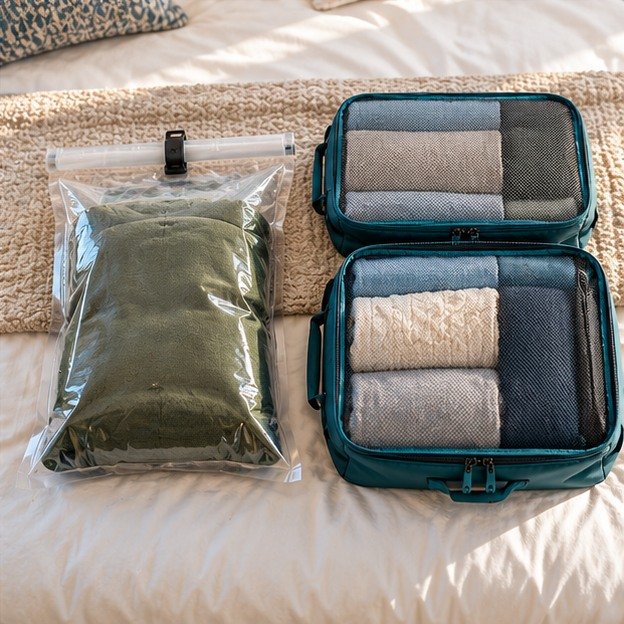
Original editorial packing scene; not a product photograph or exact CABINZERO rendering.
This CabinZero Classic 28L review is about the current Classic Backpack 28L, not the separately named Classic Tech, Military or a larger capacity in the same family. That distinction matters more than it first appears. A familiar rectangular shape can hide differences in the laptop arrangement, carrying features and item actually being supplied by a retailer.
The appeal is straightforward: a relatively light bag with a simple front-opening layout and published dimensions close to a budget-airline personal item. The harder questions are whether its capacity label helps you plan, whether the narrow airline margins survive your real packing, and whether the uncomplicated harness suits the weight you intend to carry.
No sample was owned, packed, weighed or taken through a gate for this assessment. This is a research-led review using current manufacturer information and official airline policies, followed by practical decision exercises. It keeps published claims separate from measured performance and treats a small, repeatable packing routine as more useful than an ambitious trip-length promise.
600g listed
Weigh the chosen colour and any added organisers.
Only 5mm across
The nominal width is close to the published limit.
28L is a label
Exterior box volume is not a measured usable capacity.
Identify the edition
Photographs and feature lists should match the actual stock.
CabinZero Classic 28L review: start with the current specification
The small set of facts that matters most
CABINZERO's current Classic 28L page lists a 600g empty weight, 39 x 29.5 x 20cm dimensions and a suspended sleeve for devices up to 15.6 inches. The body material is described as 600-denier polyester, with a 200-denier lining and YKK zips. These are published specifications, not measurements or durability findings from this review. [1]
On a small screen, scroll this table sideways to see every column.
| Item | Current published detail | Buying implication |
|---|---|---|
| Model | Classic Backpack 28L | Do not substitute Classic Tech or another capacity. |
| Exterior | 39 x 29.5 x 20cm | Tight margins under some personal-item limits. |
| Empty weight | 600g | Weigh the selected bag and accessories together. |
| Capacity label | 28L | Not independently verified usable packing volume. |
| Device description | Up to 15.6 inches | Compare the complete computer, not just its screen. |
| Main access | Front-opening clamshell | Organisation depends partly on how you pack it. |
Current descriptions can differ from remembered features
The present product page also advertises a trolley-handle sleeve. Consequently, an older review or marketplace photograph should not be used to assume either that the feature is always absent or that every remaining item has the current configuration. Ask the seller about the stock being dispatched rather than trying to resolve a mismatch from the family name alone. [1]
The identified Amazon destination describes a Classic 28L, but its complete offer and precise feature generation were not confirmed during the review. Check the selected colour, size and internal photographs carefully. A title that says Classic is necessary, but not always sufficient, to establish every feature you care about. [3]
The capacity label and the exterior tell different stories
Why 28 litres should not drive the decision alone
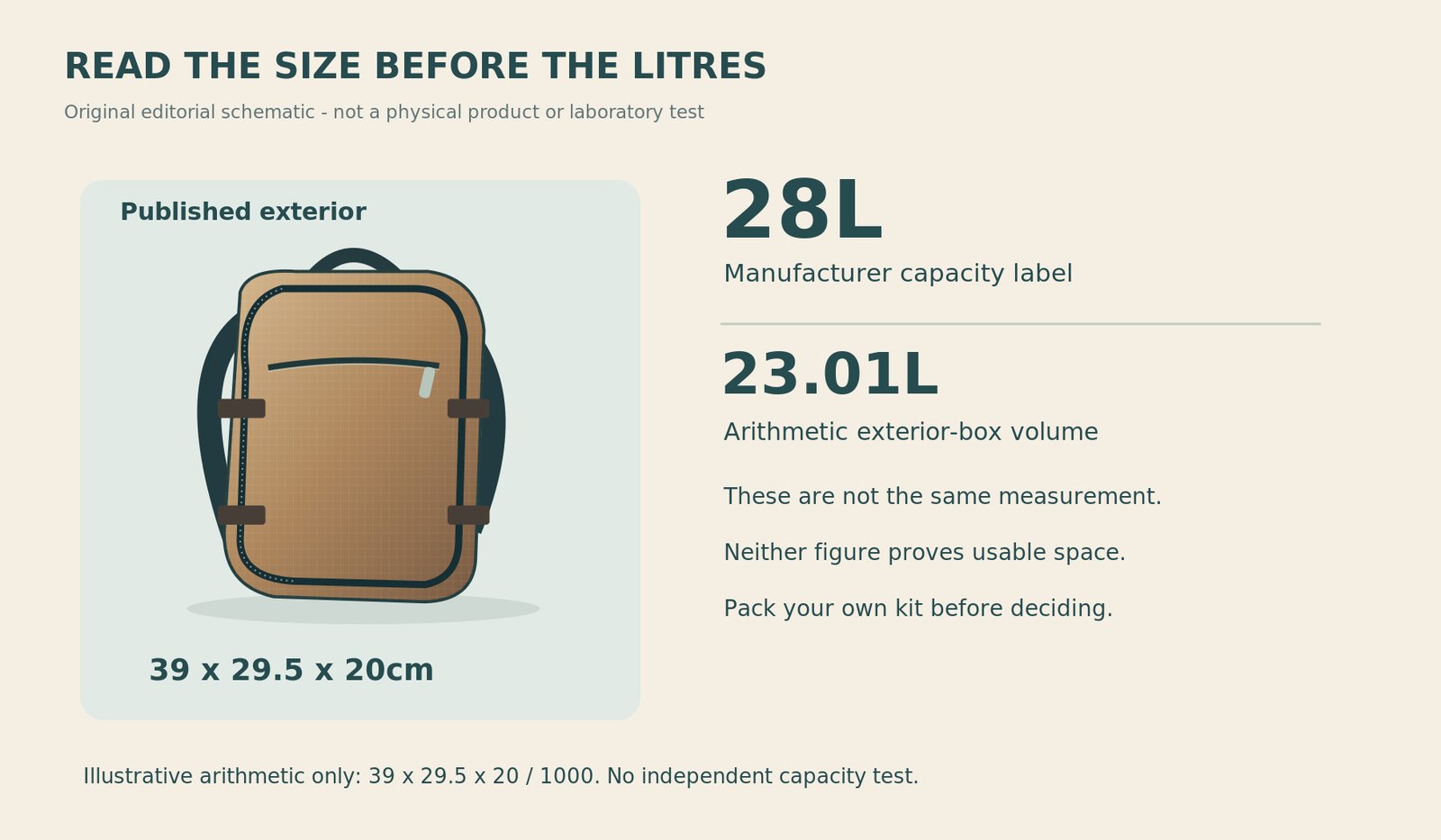
A soft bag can change shape, and capacity labels and quoted dimensions may be established differently. The manufacturer measurement method was not established for this review, so the discrepancy cannot be responsibly reconciled into a single corrected figure. Both published numbers are retained, with a clear warning not to use the litre label as proof of what will fit.
What the calculation can and cannot tell you
The calculation is useful when comparing a 28L label with another bag marketed as 20L or 24L. It prevents the assumption that the wardrobe capacity must increase by the same percentage as the labels. Conversely, it does not justify declaring that the Classic has exactly 23.01 litres of usable space; lining, structure, shape and packing all complicate that question.
For shopping, use exterior dimensions to assess airline compatibility and a packing exercise to assess your belongings. Those are different decisions with different evidence. A bag can have a debatable capacity label and still be a practical choice, provided the decision is made on what it actually needs to do.
Ryanair compatibility: the margin is small
Read the width carefully
Against Ryanair's current 40 x 30 x 20cm personal-item dimensions, the Classic's published exterior leaves 1cm in height, 0.5cm across the width and no spare depth. These are simple nominal comparisons, not demonstrated space inside an airport sizer. The half-centimetre width margin is particularly easy to lose through packing. [2]
A side that bows out around a hard object can use that margin without the bag looking dramatically overfilled. Likewise, the front pocket can push the completed depth beyond the listed figure. Do not judge the fit by whether the main zipper closes: closing the bag and meeting the permitted exterior are separate tests.
The most reliable shopping approach
Write the airline limit beside the bag's dimensions before choosing a size. Then pack the bag normally, including documents, chargers and anything stored externally. Measure the largest points while the bag rests naturally. A deliberate squeeze for the tape measure is not representative if the bag immediately expands again.
When you need dependable compliance without an airport argument, avoid planning around a configuration that must be forced into place. A slightly smaller bag or a different baggage entitlement may be worth more than marginal additional packing capacity. The Classic is a candidate for the allowance, not a reason to abandon the final measurement.
Other airlines: the word underseat is not universal
Match the specific piece of baggage
An airline can permit the Classic as a larger cabin bag while having a smaller limit for the second personal item. A manufacturer list of airlines therefore needs to be read alongside the carrier's own definitions. The important word is not simply the airline name but which bag allowance you are using.
On a small screen, scroll this table sideways to see every column.
| Allowance checked on 11 October 2026 | Maximum size | Nominal Classic comparison |
|---|---|---|
| Ryanair free personal item | 40 x 30 x 20cm | Inside, with narrow margins. |
| easyJet free small cabin bag | 45 x 36 x 20cm | Inside; packed depth still matters. |
| British Airways handbag/backpack | 40 x 30 x 15cm | Published depth is 5cm over. |
| British Airways larger cabin bag | 56 x 45 x 25cm | Inside the stated dimensions. |
| Qatar Airways carry-on | 50 x 37 x 25cm | Inside dimensions; weight and booking rules still apply. |
The table compares official published dimensions rather than recording flights taken with the bag. Confirm your operating carrier, fare, route and item count before travelling. [2] [4] [5] [6]
A mixed-carrier itinerary needs one coherent plan
The easiest outbound allowance may not be the one that controls your packing. Check the return flight and any separate connecting ticket before settling on the bag. A wardrobe arranged for one carrier can become inconvenient when another requires the same contents in a shallower piece.
Avoid treating underpacking as a guaranteed solution to the BA personal-item depth issue. It may change a soft bag's shape, but no such configuration was physically verified here. For a simple shopping decision, choose a bag whose published exterior already matches the smaller allowance or plan to use the Classic as the larger permitted piece.
Who is likely to appreciate this design?
A traveller who prefers fewer fixed compartments
The Classic is appealing when you want the main compartment to behave like a flexible packing space rather than a filing cabinet. It can suit clothing, a compact wash kit and a few work items without dictating a separate pocket for everything. However, that freedom means you must decide where the items belong and keep the arrangement reasonably consistent.
A traveller who changes between a weekend wardrobe and a mostly empty day bag may appreciate the simplicity. Someone who carries several small gadgets every day may prefer more dedicated organisation. Neither preference is inherently more efficient; the relevant issue is how often you need to retrieve each item while moving.
A traveller with a moderate, repeatable load
The low published empty weight is attractive when most of the contents are soft clothing. It is less informative when the bag will hold a dense computer-and-camera setup. A small exterior can conceal a substantial weight, so choose the bag around the load you will carry rather than assuming a compact design must be easy on every journey.
Consider where the bag will spend its time. A personal item accompanying a suitcase has a different role from the only bag you carry for a week. The same model can make sense in either role, but the kit and access routine should be designed for that role rather than copied unchanged from someone else's trip.
Packing a clamshell bag without losing its flexibility
Choose a small number of useful modules
A clothing cube can keep the main contents together when the bag opens. Yet a complete set of thick organisers can turn a flexible interior into a collection of rigid blocks. Begin with one or two modules and see whether they solve a problem. You do not need to fill every area with a purpose-built pouch.
BAGSMART compression packing cubes provide one range to compare, but none has been physically tested in this Classic for the review. Look at each cube's filled dimensions and the kit it will contain. A photograph of a matching set is not enough to establish how efficiently it will use the available compartment. [7]
Keep the front pocket from becoming a second main compartment
Quick-access space is useful for items you need frequently, not for everything that failed to fit elsewhere. Filling it with a bulky charger, wallet and snack can make the bag deeper even when the clothing section still appears tidy. Therefore, include the pocket contents in the first packing plan rather than adding them at the end.
Try closing the main compartment while the front pocket is already packed. Then remove and replace the item you are most likely to need in a queue. This exposes a layout in which the bag remains technically closed but every retrieval requires squeezing or rearranging neighbouring objects.
Leave a little room for an untidy morning
A successful layout should work without folding each garment to an exact millimetre. The contents will change shape after use, and a layer may need to be packed away quickly. A modest amount of working space can make a bigger difference to usability than squeezing in one extra optional item.
Two packing plans worth trying at home
A leisure weekend with no large computer
Start with a spare top, underwear, socks, sleepwear and a compact wash kit. Add necessary documents, a phone charger and the small extras you genuinely use. Wear the substantial footwear and outer layer appropriate for the journey rather than packing a second bulky version purely for reassurance.
This is a proposed test load, not a measured capacity claim. Clothing size, fabric and personal needs can change the result substantially. Pack your real items, photograph the layout for your own reference, then repeat it once without the photograph. The second attempt tells you whether the method is convenient rather than merely possible.
A short work trip
Start with the computer and its necessary protection, then the charger and the clothing that cannot be substituted. If those fixed items occupy most of the available space, make that limitation explicit. A smaller toiletry kit might help, but removing essential work equipment simply to preserve a one-bag label is not automatically sensible.
Next, practise using the bag during the working day. Can the computer come out without exposing underwear? Can the charging kit be removed without tipping the main contents onto a meeting-room table? A good travel packing layout should respect those moments as well as the airport measurement.
Laptop sleeve: useful information, incomplete certainty
Measure the whole device
The current manufacturer description states a suspended sleeve for devices up to 15.6 inches. A diagonal screen measurement does not describe the complete computer or any case around it. Consequently, a thick workstation laptop and a slim device with the same screen label may present different fitting problems. [1]
Compare chassis height, width and thickness with a confirmed sleeve measurement from the seller. Then check whether the opening allows straightforward removal. The claim is more useful when it is matched to your actual device than when it is repeated as a general assurance that every similar-sized computer will fit.
Additional protection has a space cost
An extra padded sleeve may be appropriate for your device and handling needs, but it also increases the dimensions. Test the combination rather than measuring the bare computer first and adding protection later. Likewise, avoid placing hard plugs or a dense charger where they press directly against the device.
This review has not performed a drop or impact test, so no level of protection is promised. A suspended sleeve is a design feature to consider, not proof that an expensive device is safe from every mishap. Your handling routine and the fit of the loaded arrangement still matter.
Carrying comfort: separate low weight from support
Look at the loaded shape
A lightly built bag can be pleasant with a modest wardrobe and much less appealing with several dense objects. Adjust the shoulder straps while wearing the intended load, and check whether the bag sits stably when you turn or bend. If it pulls away from your body, reconsider both the packing distribution and whether the design suits the job.
Do not assume that tightening the straps as far as possible improves the fit. The useful result is a stable load with a comfortable adjustment range, not a bag pressed into an awkward position. Compare another candidate with equivalent contents so that the difference is meaningful.
Decide around the hardest carrying stretch
An airport transfer involving a short walk is different from carrying the entire bag between accommodation and a station for much of a morning. Consider the less convenient stretch before buying. A simple harness may be entirely adequate for your routine without being the best choice for every possible journey.
Weight budgeting with the 600g starting point
Make the contents visible in the calculation
As an illustrative example, 3kg of contents plus the listed empty bag gives a 3.6kg total. Add a hypothetical 1.5kg computer, 0.4kg charger kit and 0.5kg water load, and the total becomes 6kg. The calculation shows how easily a compact bag becomes equipment-heavy without appearing completely full.
Use a scale to replace the assumptions with your real kit. The Etekcity digital luggage scale is one option, although its checked Amazon page displayed no featured offer. A reliable scale already in the house is a perfectly reasonable starting point; the essential task is recording the complete load, not buying another accessory. [8]
Preserve a sensible margin
For a flight with a 7kg total allowance, the nominal empty bag leaves 6.4kg for contents. That is not a recommended carrying target and does not establish compliance with an airline's other rules. It is simply the subtraction that should happen before the capacity label encourages you to keep adding things.
Reweigh after changing the wash kit or adding purchases. Small additions can be overlooked when each seems harmless in isolation. A written list of what changed is often more helpful than trying to remember why the bag felt lighter at the start of the trip.
Documents and daily access without excessive bulk
Choose an organiser for a real need
A TORRO passport holder may keep a passport and associated paperwork together, but its listed 150g weight should be included in the plan. That is not automatically excessive; it is simply a cost in weight for an organisational preference. Using the passport without a substantial holder is also a valid choice. [9]
Place documents where you can reach them without opening the main compartment fully. Then make a habit of returning them to the same location. A predictable routine often provides more convenience than a complicated wallet with several pockets you rarely use.
A fuller wallet is a different proposition
The TORRO solo travel wallet includes a removable card holder and is listed at 255g. It can suit someone managing more documents, but it represents a significant addition relative to the Classic's empty weight. Compare it with your existing wallet before treating it as the natural companion to a light bag. [10]
Also decide where a backup card belongs. Keeping everything in one well-organised item improves access but concentrates the consequences of losing that item. The detachable component is useful only when the separate-storage routine is deliberate, rather than remaining in the same bag by habit.
Tracking and identification: understand the separate jobs
A lost-and-found identifier is not live tracking
The Classic page lists a TSID or OKOBAN lost-and-found identifier. That should not be described as a GPS device or an automatic live location system. Check the registration and contact details associated with the supplied identifier, and keep them current so that the feature can perform its intended role. [1]
An ordinary contact method inside the bag can still be sensible. Choose a way to be reached without displaying unnecessary personal information on the exterior. A distinctive visual detail can also help you recognise the bag among similar luggage before a mix-up occurs.
A tracker holder does not include the tracker
For an AirTag you already own, a TORRO leather AirTag keyring is an optional holder. The tracker is sold separately. Use an attachment point that does not interfere with the zipper or create a snag, and remember that an extra device does not replace keeping the bag close during a busy journey. [11]
Avoid buying several overlapping identification accessories without a clear purpose. One handles contact information, another may hold a device, and another may simply make the bag recognisable. Those are different jobs. Keep only the pieces that solve a problem for your actual travel routine.
Weather resistance and fabric claims
Water-resistant does not establish waterproof protection
The current Classic is described as water-resistant. That is not a verified promise that the completed backpack can withstand immersion or prolonged rain without water reaching its contents. This review has not established a waterproof rating for the bag, so plan suitable secondary protection for sensitive belongings when the trip requires it. [1]
A sealed inner container for electronics and documents solves a different problem from an outer rain cover. Choose according to the exposure you expect and the access you need. Neither should be added automatically to a trip spent almost entirely between covered transport and accommodation.
Fabric weight is not a complete durability test
The denier figure identifies an aspect of the textile, not the lifespan of the finished backpack. Stitching, zipper construction, loading and handling also affect the experience. Avoid treating a heavier-sounding fabric number as proof that the bag will outperform every lighter alternative in all circumstances.
Inspect high-stress areas before travel: handle attachment points, seams near the opening and the places where straps meet the body. If something changes, address it before a departure rather than assuming a warranty will remove the inconvenience of a failure during the trip.
Use with a suitcase or as a secondary bag
Check the trolley-handle arrangement you receive
The current Classic product page advertises a trolley sleeve, but confirm that feature on the edition being sold. Once the bag arrives, try it on your own suitcase handle with the intended contents. A bag can have a sleeve yet still balance poorly on a particular case when heavily loaded. [1]
Position the load so that it does not make the combined luggage awkward to steer or lift. The convenience of a handle attachment should not encourage you to ignore the weight of the whole combination. You still have to negotiate steps and moments when the pieces need to be separated.
Keep the secondary role genuinely secondary
When the Classic accompanies checked luggage, it may only need documents, essentials, a spare layer and electronics. In that role, there is little reason to fill the remaining space just because it is available. A lighter bag can be easier to handle throughout the day and leaves flexibility when your needs change.
Conversely, using it as your only luggage requires more discipline about clothing and toiletries. Write two different packing lists when you expect to use both roles. Reusing the same large technology-and-accessory load for every journey can quietly undermine the advantage of a simple, low-weight backpack.
Alternatives selected for different priorities
Smaller and simpler
The Cabin Max Metz 20L is a useful comparison for a deliberately smaller wardrobe and a lower-cost approach. Its published 40 x 25 x 20cm exterior is narrower, but do not assume a proportional difference in usable space from the litre labels. Check the actual edition and whether its device organisation meets your needs. [12]
More adjustable capacity
The Osprey Daylite Expandable 26+6 at Case Luggage changes the proposition through expandable capacity. The specific retailer listing gives 43 x 33 x 16cm and 0.84kg before any separate expanded-size check. Its nominal exterior is not a free Ryanair fit, so it belongs in a comparison with the appropriate baggage entitlement rather than a like-for-like guarantee. The linked black Daylite was marked sold out on 11 October 2026; another available edition must be checked on its own specification. [13]
More dedicated organisation
The BAGSMART Blast 28L offers a different compartment layout, with a published 42 x 31 x 20.5cm exterior. It also exceeds Ryanair's free boundary on paper. Consider it when the layout solves a real work or packing problem and the airline allowance suits it, not merely because it shares a 28L label with the Classic. [14]
The alternatives are chosen to test three different priorities, not to imply hands-on ranking. Staying with the Classic can be the correct result when none solves a problem you actually have. Buying more features is useful only when those features improve the particular journey.
Price and seller checks
Start with a dated reference
CABINZERO's current Classic 28L page displayed £55 when checked on 11 October 2026. Prices, colours and promotions may differ when you shop, so compare the final cost for the exact edition. Do not transfer a price from Classic Tech, a bundle or another capacity merely because a search result uses similar wording. [1]
If a marketplace offers a substantial discount, ask why the descriptions differ before assuming you have found the same item for less. Older stock, a different colour, a separate edition or a third-party seller can change the practical purchase. None is automatically unacceptable, but each needs to be understood.
A short seller message can remove uncertainty
Ask the seller to confirm the model name, capacity selection, stated dimensions and whether the actual item has the current suspended sleeve and trolley attachment. Request an image of the internal label when stock identity remains unclear. A precise answer is more useful than an assurance that it is a popular cabin bag.
Then compare the Classic 28L seller listing with those confirmed details. The aim is not to collect the largest number of buying links; it is to avoid paying for a feature set that exists on a webpage but not on the bag you receive.
Warranty and returns are separate decisions
What limited lifetime means here
CABINZERO's current policy covers manufacturing defects for the product's lifetime, not the purchaser's lifetime. It identifies proof-of-purchase and authorised-seller conditions, and excludes ordinary wear. Therefore, the headline should not be turned into a promise of unlimited replacement whenever an old backpack becomes tired or no longer suits your packing needs. [15]
Keep your receipt and the actual model information. If a problem develops, document it clearly and contact the appropriate support route before arranging your own repair. A useful warranty depends partly on being able to establish which item was purchased and whether the issue falls within the terms.
The direct-store return window
The current direct-store policy describes 30-day returns, original packaging and intact tags, with return postage normally paid by the customer. Purchases from another retailer are handled through that retailer. Read the process before treating an indoor packing check as something you can extend into ordinary use on a holiday. [16]
Check the bag promptly rather than leaving it unopened until departure. Verify the selected edition, zipper operation and whether your device and essentials fit. A straightforward suitability problem is easier to address while the bag remains in returnable condition and there is still time to choose another option.
Care, storage and keeping the layout practical
Empty the awkward corners
After a trip, remove crumbs, sand and forgotten small objects before storing the bag. Inspect pockets rather than assuming the clamshell compartment contains everything. A cable left in a damp side area or a snack overlooked in the front pocket can make the next departure more complicated than necessary.
Follow the care instructions for your exact bag. CABINZERO's warranty guidance specifically advises against machine washing, so do not assume that a general polyester care tip overrides the completed product's instructions. Allow the bag to dry fully before storage and avoid creating a long-term compressed shape around bulky objects. [15]
Reassess the accessories after use
An organiser that remained closed for the entire holiday may be unnecessary. A charging pouch that repeatedly had to be moved may need a new position rather than a larger replacement. Use the first trip to simplify the layout instead of automatically adding another accessory to fix every minor inconvenience.
The BAGSMART cube range can be revisited when a specific size would improve access, while a luggage scale helps confirm whether those changes genuinely reduce the load. Replacing assumptions with your own repeatable observations is more useful than collecting more theoretical capacity advice.
A before-departure audit for the Classic
Check the configuration that will reach the gate
Pack the bag with every item you intend to carry, including the organiser that often remains in your hand until the last moment. Close pockets normally, tidy loose straps and measure the natural exterior. Repeat the check after opening and repacking the front pocket, because that is where a neat main load can become deeper.
Review the flight booking separately. The baggage piece, number of items and weight conditions should all match the plan. When using a different carrier on the return journey, keep those requirements with the packing list rather than assuming the outbound experience settles everything.
Make the important items easy to find
Choose a consistent place for documents, charging equipment and a layer you may need during the journey. Then practise retrieving each one in a limited space. This gives you a more realistic impression of the Classic's straightforward organisation than counting empty pockets on a product page.
Finally, write down which optional item would be removed first if the bag feels too full. A clear priority makes last-minute decisions easier. It also prevents the least useful object from surviving simply because it happened to be packed before something essential.
How to compare the Classic with a bag you already own
Use an equal kit rather than an equal litre label
Place the same clothes, wash kit and electronics into both bags. Keep the organiser choice consistent for the first comparison, then adjust it only when one layout clearly benefits from a different arrangement. This avoids accidentally comparing a carefully packed new bag with an untidy version of your existing one.
Measure the natural exterior of both after packing. A bag with an unremarkable capacity label may use its shape efficiently, while a larger advertised volume may not help with your particular rigid items. The useful evidence is whether the essential kit fits within the relevant allowance and remains easy to access.
Compare effort as well as the result
Notice how much work is required to close, carry and repack each bag. A bag that technically holds everything but needs repeated compression and rearrangement can be less useful than one with slightly less theoretical room and a calmer routine. Try removing a garment from the middle and replacing it without emptying the rest.
Then decide what the Classic would genuinely improve. It might reduce starting weight, provide a more convenient opening or suit an airline dimension better. If the answer is only that it is a new bag with a larger number in its name, keep the existing bag until a real limitation appears.
Shoes, wash kits and the items that defeat a rectangular plan
Shoes should be treated as a separate packing decision
A spare pair can occupy an awkward combination of volume and shape. Put it into the proposed load early rather than filling the bag with clothing first. Consider whether that footwear serves an actual activity or merely duplicates the pair used for travel. Essential specialist footwear should not be removed just to preserve a small-bag ideal.
A shoe bag can protect clothing from dirt, but it does not make the footwear smaller. Thin containment may be enough; thick padding around an already robust item may add little value. Test the final shape with the shoes enclosed, because an apparently spare corner can disappear once the protective layer is added.
Toiletry containers can make a modest kit unnecessarily rigid
Compare the actual contents with the size of the wash bag. A half-empty rigid organiser can occupy the same footprint as a full one, limiting how the Classic's flexible space is used. Decanting is useful only when appropriate for the product and your trip, so do not treat every container as something that can be reduced without thought.
Keep the wash kit accessible according to the rules of the airports on your itinerary. This review does not assume every checkpoint uses the same screening process. The bag-specific lesson is to avoid burying a potentially removable group beneath a tightly fitted computer or clothing cube.
Questions worth asking before choosing a colour or offer
Ask about stock identity before cosmetic preferences
Confirm the edition, device sleeve and trolley attachment first, then choose from the colours genuinely available for that version. A cheaper colour is only a like-for-like saving when the bag's configuration and seller conditions are the same. Do not let a preferred shade distract from a feature mismatch that will matter on every trip.
For a document-heavy load, compare the optional passport holder against your existing arrangement before adding it to the order. Accessories bought at the same time are still separate decisions. The initial basket should not grow simply because the backpack's low empty weight makes every additional item feel inconsequential.
Ask a question the seller can answer objectively
Rather than asking whether the bag is good for travel, ask whether the actual stock matches the published exterior, which model name appears on the label and whether a particular feature is present. An answer tied to an observable detail is easier to use than a general assurance about quality or airline compatibility.
Keep the reply with the order confirmation. If the delivered item differs, a clear description of what was confirmed helps explain the issue. It also protects your own decision from becoming a muddle of remembered product photographs, old reviews and specifications for several similarly named bags.
Advantages and drawbacks
Reasons it belongs on a shortlist
The current Classic combines a low published empty weight, a simple opening and nominal dimensions that can work for several useful allowances. Its relatively uncomplicated layout lets you change the contents without being tied to a large collection of fixed compartments. Those are meaningful strengths for a traveller who packs a moderate kit consistently.
Reasons to consider another design
The narrow airline margins require care, the capacity label should not be read as measured usable space, and device fit still needs confirmation. A heavier load may also call for a more developed carrying system. Furthermore, the presence of current features on the official page does not establish that every marketplace edition includes them.
Common mistakes to avoid
Comparing litres as though every brand measured identically
Capacity labels are a poor substitute for looking at external dimensions and a real packing list. A larger number is not proof of proportionately more usable room. Keep the unresolved label-versus-envelope discrepancy visible rather than correcting it to a convenient figure without evidence.
Buying the wrong Classic
Check the complete model name and capacity after every product selection. Classic, Classic Tech and other named ranges should not exchange features in your shopping notes. An attractive price is not useful when it applies to a different item from the one you intended to buy.
Treating an airline list as a blanket approval
A bag may satisfy one allowance on a carrier but not another. Match the exact piece permitted by your ticket, and assess the actual packed exterior. Neither a manufacturer badge nor an online boarding anecdote replaces that check.
Frequently asked questions
Is the current Classic 28L a Ryanair personal-item option?
It is a reasonable nominal-size candidate using the current manufacturer dimensions, but the margin is tight. Pay particular attention to loaded width and front-pocket depth. This review has not tested it in a physical sizer, so the conclusion is a specification comparison rather than a guarantee of acceptance for every packing configuration.
Why does the 28L label exceed the exterior-box calculation?
The manufacturer's measurement method was not established here, so the two figures cannot be definitively reconciled. The exterior multiplication gives 23.01 litres for a rectangular box, but that is not an independently measured usable capacity. Retain both facts and use your own belongings to decide whether the available space is enough.
Is the Classic the same bag as Classic Tech?
No. They are separately named products and should be checked against their own pages. Do not assume that a feature mentioned in one review applies to the other. The current Classic assessed here has a manufacturer-described suspended laptop sleeve, but that does not make its entire layout interchangeable with another range.
Will it hold a 15.6-inch laptop in a padded sleeve?
The complete dimensions matter more than the screen label. Ask for a confirmed sleeve opening and internal size, then compare your device with its protection fitted. A tight fit that makes removal awkward or presses on the computer is not a good result simply because the advertised screen sizes appear to match.
Is it suitable as a British Airways personal item?
The published depth is greater than BA's handbag or small-backpack limit, even though the Classic is within the larger cabin-bag dimensions. Do not confuse those two pieces. Underpacking may alter the shape, but no compliant shallower arrangement has been demonstrated in this review.
Does the lost-and-found tag track the bag live?
It should not be presented as a GPS tracker or a live location device. It is an identification and return feature whose usefulness depends on correct registration and contact information. A separate tracking device has a different role, and buying one still does not guarantee recovery of a misplaced bag.
Is the warranty a reason to buy used?
Do not assume the original purchaser's coverage transfers with a second-hand sale. The current policy contains eligibility and proof-of-purchase conditions. Evaluate a used bag through its actual condition, seller protections and price; seek confirmation from CABINZERO when warranty eligibility is central to the purchase.
Is it enough for a longer holiday?
It can be considered when the wardrobe, equipment and laundry routine genuinely remain compact. However, a longer trip is not simply a weekend load repeated on paper. Try your real clothing and fixed essentials, allow for used items changing shape, and choose more baggage when essential needs cannot sensibly be reduced.
Final recommendation: a practical shape beats an impressive label
The Classic 28L is most convincing for travellers who want a simple, relatively light bag and are willing to check the close airline margins carefully. It becomes less persuasive when the purchase depends on guaranteed maximum capacity, heavy equipment support or a feature assumed from another Classic edition.
Use the current manufacturer specification as the starting point, complete a realistic packing check and compare the exact Classic 28L offer with the edition confirmed. The right result is a bag that works with your belongings and booking, not a defence of a litre figure that this review has not independently measured.
Sources and fact-checking
Sources were checked on 11 October 2026. Product dimensions and weights are published figures unless explicitly described as arithmetic examples. No physical sample, airline-sizer trial or durability test was used for this review. Current offers, seller identity and the exact edition should be confirmed before purchase.
- CABINZERO: current Classic Backpack 28LCurrent page lists 600g, 39 x 29.5 x 20cm and a suspended laptop sleeve.
- Ryanair: official bag policyPersonal item and Priority cabin-bag dimensions checked on the review date.
- Amazon UK: Classic 28L listingCheck Classic, not Classic Tech, and confirm current-version features with the seller.
- easyJet: official cabin-bag allowancesSmall and large cabin bags are different allowances.
- British Airways: baggage essentialsHandbag and larger cabin-bag dimensions; check operating airline and booking.
- Qatar Airways: baggage allowancesCarry-on dimensions and Economy weight limit, with route exceptions.
- BAGSMART UK: compression packing cubesChoose the exact set and individual cube dimensions; no backpack-specific fit was tested.
- Amazon UK: Etekcity digital luggage scaleNo featured offer was displayed when checked; compare available sellers.
- TORRO: leather passport holderPublished holder dimensions and 150g weight; optional rather than essential.
- TORRO: solo leather travel walletDetachable card holder and published 255g weight.
- TORRO: leather AirTag keyringHolder only; tracker not included. Selected tan variant checked.
- Cabin Max: Metz 20L RPET product pageThe detailed block gives height 40cm, width 25cm and depth 20cm.
- Case Luggage: Osprey Daylite Expandable 26+6, model 10006130The linked black variant was sold out. Retailer lists 43 x 33 x 16cm and 0.84kg; expanded dimensions require a separate check.
- BAGSMART UK: Blast 28LThe 42 x 31 x 20.5cm bag is not a nominal Ryanair free-bag fit; variant availability varies.
- CABINZERO: Limited Lifetime WarrantyProduct-lifetime manufacturing-defect cover, with exclusions and proof of purchase.
- CABINZERO: cancellations, returns and refundsDirect-store policy; other sellers handle their own returns.
Illustrations in this article were created for Taylor’s Trailblazing Travel Gear. Third-party photographs, where used, are credited beside the image or in the source list.