Best Clear Airport Liquids Bags
Choose the bag for the checkpoint, not the approval claim printed on its packaging.
The best clear airport liquids bags are not automatically the most expensive reusable pouches. The useful choice depends first on the security rules along your route, then on the containers you actually carry. A bag can look transparent and travel-ready while being too large, difficult to close or poorly suited to the format requested at a particular checkpoint.
UK procedures are no longer uniform. Several major airports publish more generous arrangements, while the small-container and resealable-bag framework still matters elsewhere. This guide therefore separates the bag-buying decision from the airport rule and checks the departure, possible connection and return journey rather than assuming one procedure applies throughout. [1] [2] [3] [4]
The product comparison includes simple flat bags, a reusable pouch and bottle sets with clear cases. It is based on published information, not a record of personally passing these products through security. Claims such as TSA-approved, leakproof or airport-compliant are not treated as independent guarantees, and inconsistent specifications are flagged rather than quietly corrected.
Start by laying out every ordinary liquid, cream, gel and paste you intend to carry. Then choose a permitted bag that closes easily around that real collection. The following checks help you avoid buying an oversized cosmetics case for a small-bag checkpoint, or replacing perfectly useful bottles just to obtain a matching pouch.
This guide contains paid shopping links. Purchases through them may earn us a commission at no extra cost to you. As an Amazon Associate I earn from qualifying purchases. Recommendations are research-led, and illustrations do not show product tests.
A suitable flat bag
An uncomplicated starting point where traditional bagging is required.
Check the actual capacity
Transparency alone does not establish the permitted format.
Buy only useful sizes
A matching collection is not always the most practical kit.
The whole itinerary
A generous outward allowance may not apply on the way home.
Best clear airport liquids bags: start with the checkpoint rule
A transparent bag is not automatically an accepted bag
The best clear airport liquids bags are the ones that satisfy the checkpoints on your actual journey, close easily around the intended containers and remain practical to use afterwards. A large transparent wash bag may be excellent for a bathroom shelf while being unsuitable where a small resealable bag is required. Transparency is only one part of the decision.
For a route that includes a traditional one-litre bag requirement, a simple flat resealable bag is the least complicated starting point. Reusable zipped pouches and bottle sets can also be useful, but their dimensions, stated capacity and closure need checking. Do not assume that a premium label or a seller’s TSA-approved wording overrides the airport’s own instructions.
How this shortlist was selected
This is a research-led buying guide, not a record of bags personally taken through security. The choices represent a plain flat format, a reusable branded pouch and three bottle-and-pouch systems. They were selected for the different packing needs they address, using current official airport guidance, manufacturer descriptions and identifiable UK listings.
The ranking deliberately gives simplicity priority over appearance. No bag is described as universally accepted, independently leakproof or guaranteed to prevent extra screening. Where a product page supplies inconsistent dimensions or does not establish a clear capacity, that limitation is explained. Product availability and security procedures should be checked again before travel, particularly for connections and the return flight.
UK airport liquids rules checked on 10 October 2026
The familiar small-container arrangement still matters
GOV.UK says most airports limit ordinary liquids to containers of 100ml or less, even when a larger container is only partly filled. Where separate bagging is required, its guidance specifies one transparent resealable bag of no more than one litre, approximately 20 x 20cm, with the contents fitting comfortably and the bag able to close. Some airports permit containers up to two litres instead. [1]
For packing purposes, the key point is that bag capacity and individual container capacity are separate checks. A suitable small bag does not make an oversized bottle acceptable at a checkpoint using the 100ml limit. Likewise, several compliant bottles still need to fit the required bag without forcing it shut.
Larger allowances are airport-specific
Heathrow currently says liquids can remain in cabin baggage and allows containers up to two litres. Its guidance also tells travellers to follow staff instructions and check other airports. Edinburgh publishes a similar two-litre container allowance and says liquids can stay in the bag. Neither airport’s procedure should be assumed to apply to the rest of the journey. [2] [3]
Gatwick also publishes a two-litre allowance, with additional instructions about metal and double-walled containers. These differences are why this article does not repeat the outdated claim that every UK departure requires a 20 x 20cm liquids bag. Equally, it does not claim the small-bag rule has disappeared everywhere. [4]
The United States uses its own wording
TSA’s published rule allows travel-size containers of 3.4 ounces or 100ml or less within one quart-sized bag per passenger. A quart-sized requirement and a one-litre description are not identical wording, so check the actual bag specification rather than relying on a generic international-approved label. TSA also identifies exemptions and additional-screening procedures separately from the ordinary toiletries allowance. [5] [6]
A more generous departure airport does not change the rules at a later checkpoint. Check departure, any re-screening during connections and the airport used for the journey home.
Compare the bag formats before the brands
| Option | Most useful role | What is documented | What still needs checking |
|---|---|---|---|
| Flat 20 x 20cm resealable bag listing | A straightforward small-bag starting point | The identified listing states 20 x 20cm and a pack of eight | Confirm actual capacity, closure and the airport’s required format |
| Osprey Ultralight Liquids Pouch | Reusable storage for an existing bottle collection | Manufacturer markets a transparent one-litre pouch | Verify the current version; published measurement fields are inconsistent |
| Lifeventure Silicone Travel Bottle Set | A clear case plus three refillable bottles | TPU case; three 89ml silicone bottles | The case is not automatically a universally accepted security bag |
| Sea to Summit TPU Clear Zip Pouch with Bottles | Mixed smaller bottle sizes in a transparent pouch | Transparent TPU pouch; six bottles supplied | Check checkpoint wording and the exact product version |
| Go Travel Cabin Bottle Set, reference 658 | Four 100ml bottles and a compact clear case | Maker documents the bottles, caps and case dimensions | Different Go Travel sets contain different items |
Manufacturer details and the identified flat-bag listing underpin this comparison. The product descriptions are not independent security approvals. In particular, a bottle set’s compliant individual capacities do not prove that its outer case satisfies every checkpoint’s bag rule. [7] [8] [9] [10] [11]
Flat resealable bags: the simplest strict-checkpoint option
Why plain can be the better choice
Where the airport asks for a small transparent resealable bag, a plain flat format keeps the decision straightforward. It has fewer pockets, opaque borders and bulky structural parts to interpret. Moreover, it is easy to see whether the closure is actually shut rather than merely hidden behind a decorative flap.
The identified 20 x 20cm eight-pack listing is a product example to check, not an endorsement of every marketing claim in its title. Confirm the received dimensions and capacity, and reject a bag that does not match the airport’s requirements. The word leakproof in a listing should not be treated as evidence that the seal has been independently tested for travel. [7]
Do not turn the spare bags into extra allowances
A multipack can provide replacements or separate bags for different travellers. It does not mean one passenger may fill several bags where the rule permits only one. Keep unused spares flat and empty, and allocate filled bags according to the rules that apply to each person and checkpoint. [1] [6]
Before buying, check whether you already have a suitable clean, transparent, resealable bag. Reusing an appropriate bag is more sensible than purchasing a branded version simply because it appears on a travel-accessories list. Nevertheless, do not keep using a split seal or cloudy, damaged bag just to avoid replacing a low-cost item that needs to be clear and reliably closable.
Osprey Ultralight Liquids Pouch: reusable, but check the version
When a dedicated pouch is useful
Osprey presents the Ultralight Liquids Pouch as a transparent organiser for toiletries and airport use, and lists a one-litre capacity. It is relevant when you already have suitable small containers and want a reusable pouch rather than another bottle set. That separates the purchase of the bag from the purchase of containers you may not need. [8]
The practical benefit is having one recognisable place for the controlled items. You can move that module between different carry-on bags without rebuilding the toiletries arrangement every time. However, keep the kit small enough for the strictest relevant checkpoint, rather than treating a reusable pouch as permission to add extra cosmetics.
A specification caveat worth taking seriously
The UK product page’s dimensional and weight fields are internally inconsistent with each other and with its nominal capacity. This guide therefore does not repeat those fields as reliable measurements. Confirm the current version’s usable dimensions and the required bag format before ordering, particularly when a strict flat-bag checkpoint is part of the route. [8]
Check the Osprey black pouch listing for the exact version being sold. Carrying an empty suitable flat bag as a fallback can make a requested transfer easier, but it does not cure an oversized collection of bottles. The complete contents still have to fit the actual allowance. A backup format is useful preparation, not an extra volume entitlement.
Lifeventure Silicone Travel Bottle Set: when bottles are needed too
What the set contains
Lifeventure lists three 89ml silicone bottles in a zipped TPU outer case, with overall set dimensions of 210 x 130 x 45mm and a listed weight of 205g. The product code is 64220. These are manufacturer specifications for the set, not a measured capacity of the empty pouch. [9]
This is worth comparing when you need both a case and refillable bottles. The three equal-size bottles can simplify identification, especially when you label them clearly. Conversely, equal capacities are not automatically efficient for every bathroom routine. A product used sparingly may need a smaller container, leaving more practical room for an item that cannot be reduced as easily.
Keep the bottle and bag questions separate
The 89ml bottles fall below the common 100ml individual-container threshold, but that alone does not settle the outer-bag requirement. Lifeventure markets the set as airport compliant; the airport’s current rules still control acceptance. The stated outside dimensions should not be used as a DIY certification of the pouch’s capacity. [1] [9]
Consider this set when those bottles would actually be used. Before filling them, check the compatibility guidance for both the containers and the intended products. Keep medicines and products requiring particular packaging in the appropriate original containers rather than decanting them simply to complete a matching travel set.
Sea to Summit TPU pouch: mixed bottle sizes
Why mixed sizes can be practical
Sea to Summit’s current US product page describes its TPU Clear Zip Pouch with Bottles as containing three 89ml bottles and three 40ml bottles. It lists outside dimensions of 20 x 11 x 4.5cm and describes the pouch as water-resistant. Those details do not establish an independently tested security approval or a guarantee of perfect containment. [10]
The mixed capacities can suit a routine where some products are used much more than others. For example, a small amount of one cosmetic and a larger amount of a washing product need not occupy identical containers. That is an organisational advantage to consider, not a prediction of how long the supplied bottles will last for every traveller.
Do not rely on approval wording alone
The manufacturer’s page uses TSA and airport-approval language. This guide treats that as marketing, not a universal acceptance certificate. TSA publishes a quart-sized bag requirement for ordinary carry-on liquids, while UK checkpoint instructions can use a one-litre resealable format. Compare the particular pouch with the rules relevant to your route. [5] [10]
This option is most useful to investigate when you want a small, transparent mixed-bottle system and can verify the required format. It is less compelling when you already own suitable bottles or need to keep several products in their original retail packaging. Buy the set to solve the contents problem, not merely because six bottles look like better value than three.
Go Travel Cabin Bottle Set: check the reference number
The documented four-bottle version
Go Travel’s reference 658 includes four 100ml bottles and a clear carry case. The maker describes two screw caps, a flip-top cap and an atomiser, with overall dimensions of 155 x 170 x 40mm. It also states that the set is not suitable for dishwasher use. These details identify this particular version, not every Go Travel bottle pack. [11]
The range contains other products with different counts and materials. Therefore, compare by reference number as well as the product photograph. A three-bottle silicone pack and this four-bottle set should not be presented as interchangeable purchases simply because both use the same brand name.
When the case matters less than the bottles
A set can still be useful when its bottles suit your products but a checkpoint requires a different outer bag. In that situation, transfer the permitted containers into the required format rather than arguing from the packaging claim. However, ensure the entire ordinary-liquids collection fits; a separate cosmetics pouch does not disappear from the allowance because it is outside the branded set.
For somebody who already owns a suitable bag, a Go Travel three-pack of 100ml bottles is a separate bottle-only comparison, not the reference-658 set described above. Check the exact pack and compatibility instructions before filling it. [12]
The bag checks that matter more than a logo
Capacity and shape are different questions
A bag’s exterior width and height do not establish its usable internal volume. A deep gusset, thick seams and a rigid base can change the shape considerably. Conversely, a flat bag may spread out differently when filled. Use the manufacturer’s clear capacity statement where available, then follow the airport’s stated format rather than inventing your own approval from a ruler calculation.
If the checkpoint specifies approximately 20 x 20cm, start with that shape instead of searching for the deepest box-shaped pouch you can label one litre. The objective is an uncomplicated, inspectable kit, not extracting a theoretical maximum from ambiguous dimensions. The flat-bag example is useful precisely because its format is straightforward to compare with a flat-bag instruction.
Visibility and closure need a real-world check
Lay the filled bag on a plain surface and look through both sides. Can the containers be seen without moving a thick label, opaque pocket or decorative panel? You do not need to reproduce a scanner inspection at home; you are checking whether the bag’s basic transparency is doing the job you bought it for.
Close the bag without leaning on it or bending bottle caps against the seal. Then lift it and make sure the closure remains shut. A bag that opens immediately when picked up has failed a useful practical test even before any discussion of security rules. Remove or rearrange contents rather than hiding the problem inside a larger wash bag.
Check access inside your actual cabin bag
Put the pouch where you can find it without unpacking clothing, documents and chargers. Even where liquids may remain inside luggage, staff can request inspection or a later checkpoint may use a different procedure. An accessible position is therefore still useful when the outward airport has modern scanners. [2] [3]
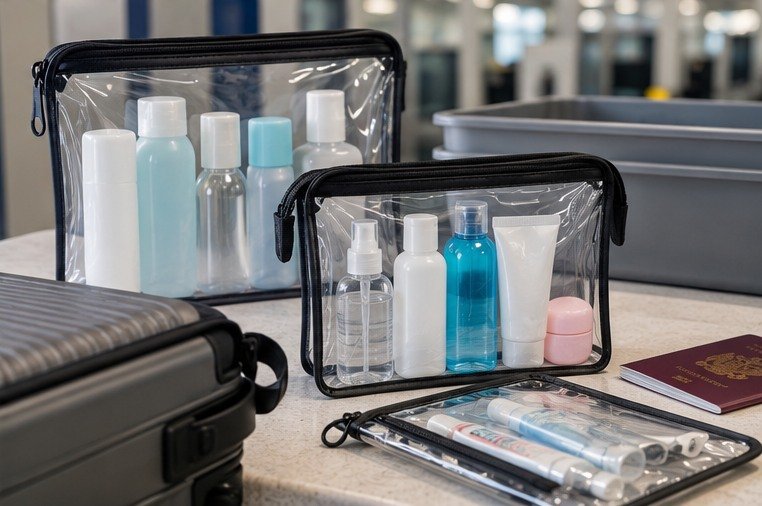
Choose and fill containers sensibly
Do not make 100ml the target for every product
A maximum permitted container size is not a packing recommendation. Build the kit from your real morning and evening routine, then use an appropriately sized container for each product when decanting is allowed. A short trip may not need the same quantities as a long one, but personal usage differs too much for a universal shampoo-per-day formula.
As a practical home exercise, use the proposed travel containers for several ordinary days before departure. That reveals whether they dispense properly, whether the labels remain clear and whether the amounts suit your routine. This is more useful than discovering at the destination that a thick conditioner will not leave a narrow bottle.
Compatibility is product-specific
Go Travel explicitly warns that one of its silicone-bottle products is unsuitable for certain hair serums, oils and products containing alcohol. That warning illustrates why travel bottles are not universal containers. Check the instructions for the exact bottle and the original product rather than borrowing compatibility claims from another item in the range. [13]
Do not mix products together to save space. Keep names and any necessary instructions identifiable, and retain original packaging where the product requires it. A matching clear set should not override a medicine’s storage instructions or a cosmetic maker’s packaging requirements. Seek suitable professional advice for medicine-specific questions rather than changing containers on the basis of a packing guide.
Test the closure over a suitable surface
Check caps, threads and seals before placing filled bottles near clothing. Wipe away product on the outside so a residue mark is not confused with a fresh leak. Then carry out a cautious side-storage trial over a washable surface or absorbent paper, following the container maker’s guidance.
Such a trial may reveal an obvious problem, but it does not guarantee performance under every flight condition. Keep the liquid kit away from documents and electronics where practical. A pouch provides an additional organisational layer; it should not be the only reason you trust a bottle with a damaged or unreliable cap.
Build the kit for the whole itinerary
Write down each screening point
List the departure airport, any airport where you expect to pass security again, and the return airport. Open their official guidance rather than relying on the country name alone. Note the container limit, the bag requirement and whether the liquids should remain in your cabin bag or be presented separately.
An illustrative journey might leave an airport allowing larger containers and return through one using the small-bag arrangement. Packing only for the outward flight would create an avoidable problem at the end of the trip. The sensible default is to choose a kit that meets the stricter known requirement, unless the itinerary clearly supports a different plan.
Keep exceptions separate from ordinary toiletries
Essential medicines, baby nourishment and some other items can have separate provisions. GOV.UK and TSA identify exceptions, but the documentation, quantities and screening arrangements depend on the item and jurisdiction. Check the relevant official guidance rather than placing ordinary cosmetics in an exception category to gain space. [1] [5]
For packing, keep the items and any required supporting information easy to identify. Do not scatter essential supplies across a casual assortment of refillable bottles. This article addresses bag selection and organisation, not personalised medical, customs or import advice.
Review the contents before coming home
Purchases and hotel products can change the kit. Check that any new bottle meets the applicable container rule and that the complete ordinary-liquids collection still fits the permitted bag. The fact that an item passed one checkpoint does not establish acceptance at another.
Duty-free liquids can have specific sealed-packaging and receipt conditions. Keep the original security packaging intact and check the applicable connection rules before opening it. A reusable toiletry pouch is not a replacement for a retailer’s required tamper-evident bag. [15]
A calm security and arrival routine
Before joining the queue
Know where the liquids pouch is, where travel documents are and which items may need separate explanation. Close the pouch properly before reaching the trays. Do not wait until somebody asks for the bag to discover that several products are in coat pockets and another is buried in a makeup case.
Read the current signs and follow the security team’s instructions. Heathrow and Edinburgh presently tell passengers to leave ordinary liquids in their bags, while other checkpoints may require separate presentation. The correct action is local, not whatever you remember doing on your previous trip. [2] [3]
After screening
Move to a suitable repacking space rather than trying to rebuild the kit while blocking the belt. Check that the pouch, any separately inspected items and your documents have all been collected. Then return the liquids to their usual place so you do not have to search for them again at the destination.
A dedicated Osprey pouch may help you maintain that repeatable location; a plain bag can do the same job if it fits the system. Organisation comes from the routine, not the brand. There is no need to upgrade a bag that is already clear, suitable, intact and easy to use.
In the bathroom
Take out only the items needed for the immediate routine and keep the rest together. Avoid leaving small bottles on several different shelves when checkout will be early. Before repacking, inspect caps and wipe the outside of the case so moisture from a bathroom surface is not carried into the main luggage.
The site’s simple carry-on toiletry system provides a wider framework for keeping liquids separate from dry tools and essential supplies. A clear airport bag is one component of that arrangement, not necessarily the only bathroom organiser you will use.
Three kit arrangements to try at home
A short trip with mostly retail minis
Lay out the exact small retail containers you already own before buying refillable bottles. A compact toothpaste tube, a small cleanser and a few labelled cosmetics may already fit a suitable clear bag. In this scenario, the useful purchase might be an empty pouch rather than a complete bottle set.
Keep the trial honest by including every ordinary liquid, cream, gel and paste that belongs within the relevant allowance. Do not photograph a neat bag while leaving the awkward products beside it. If the real collection will not close comfortably, review the products and packaging rather than choosing a bigger bag without checking the checkpoint rule. [6]
A repeat trip with a stable routine
A frequent traveller can build a consistent kit around the products that are actually used. Record the container capacities and give each bottle a clear name. Afterwards, keep a simple refill-and-check routine so the next departure does not begin with several unlabelled half-empty bottles.
The useful test is whether the kit can be prepared and checked without guesswork. A matching set may help, but different container shapes can also work when they suit the contents. Replace an awkward dispenser or unreliable cap on its own instead of rebuilding the entire system unnecessarily.
A shared packing session
For two people travelling together, lay out two separate ordinary-liquids collections when each traveller is subject to a one-bag allowance. Shared products can be assigned to one person’s kit, but avoid creating one oversized joint bag and assuming that two tickets make its format acceptable. Follow the actual checkpoint’s per-passenger instructions. [6] [14]
Keep each completed kit with the traveller responsible for it, or at least make its location unambiguous before joining security. An empty spare bag can be shared as a backup, while filled bags should remain easy to identify. This small amount of organisation is more useful than buying a large family cosmetics case that is convenient in the bathroom but awkward at the checkpoint.
Care, reuse and replacement
Clean according to the actual material
A soft plastic bag, TPU pouch, fabric-trimmed case and silicone bottle set can have different care requirements. Follow the manufacturer instructions and empty the contents before cleaning. Go Travel’s reference-658 page, for example, specifically excludes dishwasher use. A label saying reusable does not mean every cleaning method is suitable. [11]
Open the bag fully and allow internal corners, zip areas and bottle caps to dry before storage. Do not fold away a wet case simply because the outer surface looks clean. Keep the kit somewhere accessible so you can inspect it before the next flight rather than discovering a damaged seal during packing.
Replace the failing part, not automatically everything
A split bag may need replacement while the bottles remain useful. Conversely, a reliable pouch does not justify keeping a bottle with a damaged cap. Separate the two decisions. The Lifeventure silicone set makes sense when both components are required; replacing an entire matching set to solve one small failure may be unnecessary.
Check clarity, seams and closures before each trip. If a bag has become so clouded or damaged that its suitability is doubtful, use a clearer intact option. Reuse should support a dependable travel routine rather than become an argument for keeping an unsuitable bag in service.
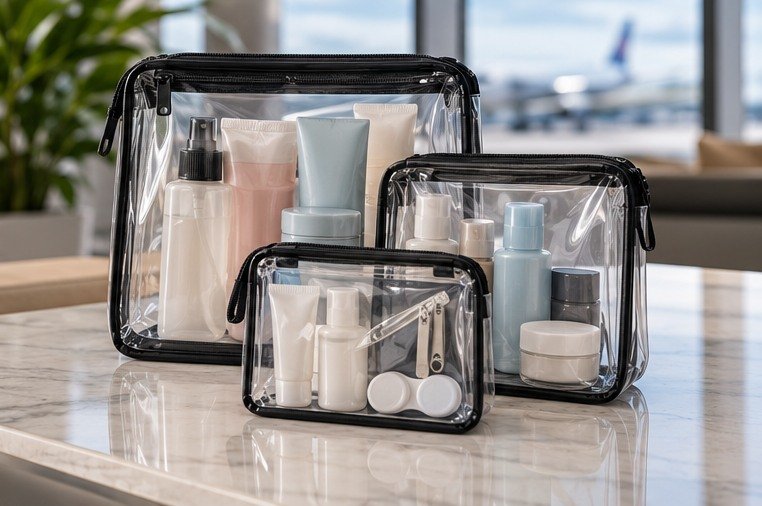
Pros and cons of a reusable clear pouch
Where it helps
A reusable pouch can make the liquids collection easy to recognise, move between bags and inspect before departure. When the container selection is stable, it also reduces the need to rebuild the same kit for every trip. A well-chosen case may be useful in the bathroom as well as in transit.
Where a plain bag is simpler
A structured pouch can add bulk, obscure capacity or encourage overfilling. It may also need to be replaced by the airport’s preferred flat format. For an occasional traveller using a small kit, a suitable plain resealable bag can be the more straightforward choice. Spend more only when the reusable design improves a repeated task.
Mistakes to avoid
Treating TSA-approved as worldwide permission
A retailer’s wording does not replace the published rules at the checkpoint. Read the bag capacity, shape and closure requirements yourself. This is particularly relevant when the journey crosses jurisdictions with different wording or when the product page makes claims broader than the evidence shown.
Counting only shampoo and shower gel
Pastes, creams and gels can also fall within liquids screening rules. TSA specifically lists items such as toothpaste, conditioner, mouthwash and lotion. Review the complete toiletries and cosmetics collection rather than placing anything that is not pourable outside the allowance by assumption. [6]
Packing a nearly empty oversized bottle
Where a container-size limit applies, a partly empty larger bottle does not become a smaller container. Check the marked capacity and choose an appropriate alternative when needed. Do not rely on explaining the remaining amount to security staff. [14]
Buying a set because it has more pieces
Extra bottles only help when they match the products and quantities you use. Too many identical containers can make the kit harder to close and harder to identify. Start with the routine and the products, then choose the case and bottles that fit them.
Forgetting to recheck the return airport
Rules and procedures can differ from the departure airport. Repeat the check before packing for home, especially after adding purchases. A saved screenshot can be a useful reminder, but it does not override newer instructions or the security team’s decision.
Airport liquids-bag questions answered
Do all UK airports still require a clear liquids bag?
No. The official pages checked for Heathrow, Edinburgh and Gatwick describe more permissive procedures, while GOV.UK still explains the small-bag framework used where required. Check the particular airport rather than treating either arrangement as universal across the UK. [1] [2] [3] [4]
Is a one-litre bag always the same as a quart bag?
Do not treat the labels as interchangeable certification. TSA uses quart-sized wording, while relevant UK guidance uses no more than one litre and an approximate flat size. Check the specific product and checkpoint requirement. A seller describing one bag as suitable for both does not remove the need to verify its actual format. [1] [6]
Can I use a clear makeup bag?
Possibly, but only when it meets the applicable size, capacity, transparency and closure rules. Some clear makeup cases are much larger than a security liquids bag or have opaque internal pockets. Buy for the checkpoint requirement first, then decide whether the same pouch is convenient for your cosmetics at the destination.
Can the bag contain ten 100ml bottles?
Do not assume that adding up the stated liquid capacities proves the bottles fit. Caps, walls, shoulders and unused spaces all occupy room. The complete collection must fit and close in the required format. Try the actual containers together rather than planning from the arithmetic alone. [14]
Is a zip better than a press seal?
The best closure is one that satisfies the airport’s requirement and works reliably with the intended contents. A zip may be convenient for repeated use, while a flat press-seal bag can be a simple match for traditional instructions. Neither mechanism independently guarantees leakproof performance or security acceptance.
Should I buy a bag and bottle set together?
Only when both are needed. A set can simplify the first purchase, but the supplied capacities may not match your products. The Lifeventure three-bottle option is a documented example to compare, whereas an existing bottle collection may only need a suitable empty pouch. Avoid buying spare containers without a purpose.
Do medicines have to fit with ordinary toiletries?
Some medicines can qualify for separate provisions, but the details depend on the item and the authorities involved. Check official guidance and any documentation requirements, and keep essential items identifiable. Do not change prescribed packaging or quantities merely to fit a cosmetic-bottle set. [1] [5]
Does a clear bag prevent leaks?
Not necessarily. Clear describes visibility, not a tested containment standard. Inspect the bottle closures and the bag construction separately. A pouch may help keep a kit organised, but a damaged cap or split seam should be addressed before travel rather than hidden inside another bag.
Is an expensive reusable pouch worth it?
It can be when you travel frequently and the format works across your usual routes. However, price does not settle capacity, compatibility or acceptance. Compare the repeated-use benefit with a plain suitable bag, and choose the option that keeps the kit manageable without complicating security preparation.
What should I do if staff ask for a different bag?
Follow their instructions and transfer the permitted contents when asked. An empty suitable spare can help, but the collection must still fit the actual allowance. Remove non-essential items or follow the airport’s available options rather than relying on the product’s packaging claim to settle the decision.
The recommendation: buy for the strictest relevant checkpoint
For a journey involving a traditional small-bag requirement, begin with a suitable flat resealable bag. It is the least complicated format to inspect and replace. For repeat travel, the Osprey pouch is worth comparing once the current version and required format are confirmed. Choose a bottle-and-case set only when its containers match the products you genuinely use.
The more generous procedures published by several UK airports can make departure easier, but they do not remove the need to check the rest of the route. Build one manageable ordinary-liquids collection, keep any qualifying exceptions identifiable and give the pouch an accessible place in the cabin bag.
A good airport liquids bag should make the rules easier to follow, not become a reason to debate them. Match the checkpoint, confirm the containers, close the bag without force and repeat the check before coming home.
Sources and fact-checking notes
Official guidance and product pages were checked on 10 October 2026. Procedures can change and may differ across departure, connection and return airports. Product marketing is not an airport acceptance guarantee. This guide concerns ordinary bag selection; item-specific medical, customs and dangerous-goods questions require the relevant authority.
- 1. GOV.UK – hand luggage liquidsUK airport variation and the bag/container framework where required.
- 2. Heathrow – hand baggage and liquidsCurrent Heathrow procedure and instructions to follow security staff.
- 3. Edinburgh Airport – liquids and electricalsCurrent two-litre arrangements and itinerary-wide checking advice.
- 4. London Gatwick – security screeningCurrent liquids procedure and container-material qualifications.
- 5. TSA – liquids, aerosols and gels ruleUS ordinary-liquids framework and separate exceptions.
- 6. TSA – liquids-rule FAQsPer-passenger bag requirement and common controlled toiletries.
- 7. Amazon UK – flat 20 x 20cm bagsAn identified listing; marketing claims are not independent approvals.
- 8. Osprey UK – Ultralight Liquids PouchNominal one-litre pouch; internally inconsistent measurement fields are not reproduced.
- 9. Lifeventure – Silicone Travel Bottle SetThree 89ml bottles, TPU case and set specifications.
- 10. Sea to Summit – TPU Clear Zip Pouch with BottlesCurrent US manufacturer page: three 89ml and three 40ml bottles; outside pouch dimensions.
- 11. Go Travel – Cabin Bottle Set, 658Four-bottle contents, outer measurements and care information.
- 12. Amazon UK – Go Travel three-bottle packA different bottle-only comparison, not the reference-658 set.
- 13. Go Travel – Squeezy Bottles compatibilityAn example of product-specific material compatibility restrictions.
- 14. Schiphol – liquids in hand baggageSpecific small-container and one-bag instructions; check current airport guidance.
- 15. Your Europe – luggage restrictionsGeneral EU traveller guidance, including duty-free security packaging.
Illustrations in this article were created for Taylor’s Trailblazing Travel Gear. Third-party photographs, where used, are credited beside the image or in the source list.