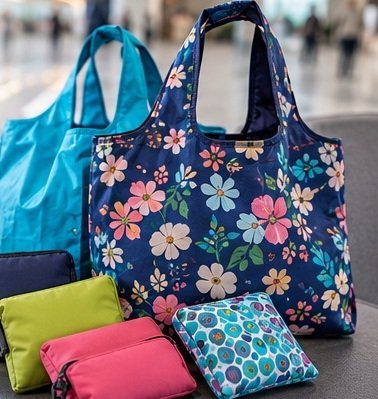

Personal-Item Backpack vs Cabin Suitcase
Compare two different luggage allowances as well as two ways of carrying your clothes.
Original concept illustration; not a depiction of a specific product or a hands-on test.
The personal-item backpack vs cabin suitcase choice is not just about preferring shoulder straps or wheels. You are often comparing two different luggage entitlements: a smaller bag under the seat and a larger bag in an overhead locker. The apparent saving from the backpack usually depends on taking fewer belongings, not on airlines treating backpacks differently.
That can be an excellent trade-off for a compact trip. However, it can also become false economy when essential equipment will not fit, the packed bag is uncomfortable or you end up buying a larger allowance anyway. A cabin suitcase is not automatically excessive simply because a smaller bag exists.
This research-led guide explains the size, packing and cost decisions for UK travellers, with current official rules and qualified product examples. It does not claim that we have tested every bag in an aircraft sizer. The objective is to choose the smallest practical luggage system for your actual trip, not to turn travelling with less into a competition.
Personal item can win
Useful when your essential load fits without an uncomfortable packing routine.
Pay for usable space
Footwear, work equipment or cold-weather layers can justify the larger allowance.
Size is not bag style
A backpack may be an overhead bag; a small wheeled case may be an underseater.
Check every flight
Different carriers and fare inclusions can change the comparison completely.
Personal-item backpack vs cabin suitcase: two separate decisions
The allowance comes before the carrying style
The personal item is normally the smaller piece assigned to the space under the seat in front, subject to the airline’s rules. A cabin suitcase usually refers to a larger overhead piece, although small wheeled underseaters also exist. The category name on a retailer’s page is not the baggage entitlement on your booking.
As a result, you could choose an overhead travel backpack or an underseat wheeled bag. Those alternatives are useful when you prefer a particular carrying method. Do not let the usual pairing of small backpack and larger suitcase hide the possibility that size and format can be chosen separately.
On a smaller screen, scroll inside the table to see every column.
| Decision | Personal-item backpack approach | Larger cabin suitcase approach |
|---|---|---|
| Space | A smaller essential load must genuinely fit | More room can accommodate necessary bulk |
| Potential cost | May avoid a larger bag extra on suitable fares | May be included or require a larger allowance |
| Movement | The load stays on your shoulders | Can roll on suitable surfaces; still needs lifting |
| Onboard access | Small essentials may stay close, subject to crew instructions | Plan a permitted essentials arrangement |
| Best evidence | Measured, repeatable packing plus comfortable fit | Measured packing plus workable rolling and lifting |
| Main trap | Extra loose bags or overfilled outer pockets | Buying space which encourages unnecessary items |
Compare the whole system, not the empty bags
List every piece you plan to carry: main bag, handbag, computer bag and anything used for purchases. Then work out which pieces the booking permits and which must fit inside another bag. A small backpack is not a free solution when the remaining belongings are carried in two extra totes.
Equally, a suitcase may be more useful when it lets you consolidate the load. The comparison should include what remains outside it and whether you can handle everything comfortably. Make the airport configuration explicit before deciding which purchase looks cheaper.
Back to top ↑Three UK-facing airline allowances that show the difference
Check the operating airline and the booked option
Ryanair lists a 40 x 30 x 20cm small personal bag and a 55 x 40 x 20cm, 10kg second cabin bag for Priority customers. easyJet lists a 45 x 36 x 20cm small bag and a 56 x 45 x 25cm large bag when included or booked. Rules checked 9 October 2026. [1] [2]
British Airways lists a 40 x 30 x 15cm handbag or backpack alongside its 56 x 45 x 25cm cabin-bag dimensions. The smaller BA depth demonstrates why a bag matching one airline’s underseat allowance may not match another’s. Confirm the rules for the operating carrier and ticket rather than assuming every flight uses the same rectangle. [3]
On a smaller screen, scroll inside the table to see every column.
| Airline | Small personal piece | Larger cabin piece | Key distinction |
|---|---|---|---|
| Ryanair [1] | 40 x 30 x 20cm | 55 x 40 x 20cm; 10kg | Larger piece is tied to the appropriate booked option. |
| easyJet [2] | 45 x 36 x 20cm | 56 x 45 x 25cm | Up to 15kg each; large bag must be included or booked. |
| British Airways [3] | 40 x 30 x 15cm | 56 x 45 x 25cm | The handbag depth is narrower than the two small-bag examples above. |
Included does not mean unlimited
Check the number of pieces as well as dimensions and weight. A jacket, small pouch or shopping bag can affect the practical arrangement even when it seems minor. Keep the belongings within the allowance actually offered, and follow the crew’s storage instructions on the aircraft.
Retailer phrases such as ‘airline approved’ should lead to a dimension check, not end the research. They rarely identify every carrier, fare and configuration relevant to your itinerary. Save the current official allowance beside the shortlist so that comparisons remain anchored to the booking.
Back to top ↑Understand how much space the smaller allowance gives up
Use box volume as an illustration, not a bag capacity claim
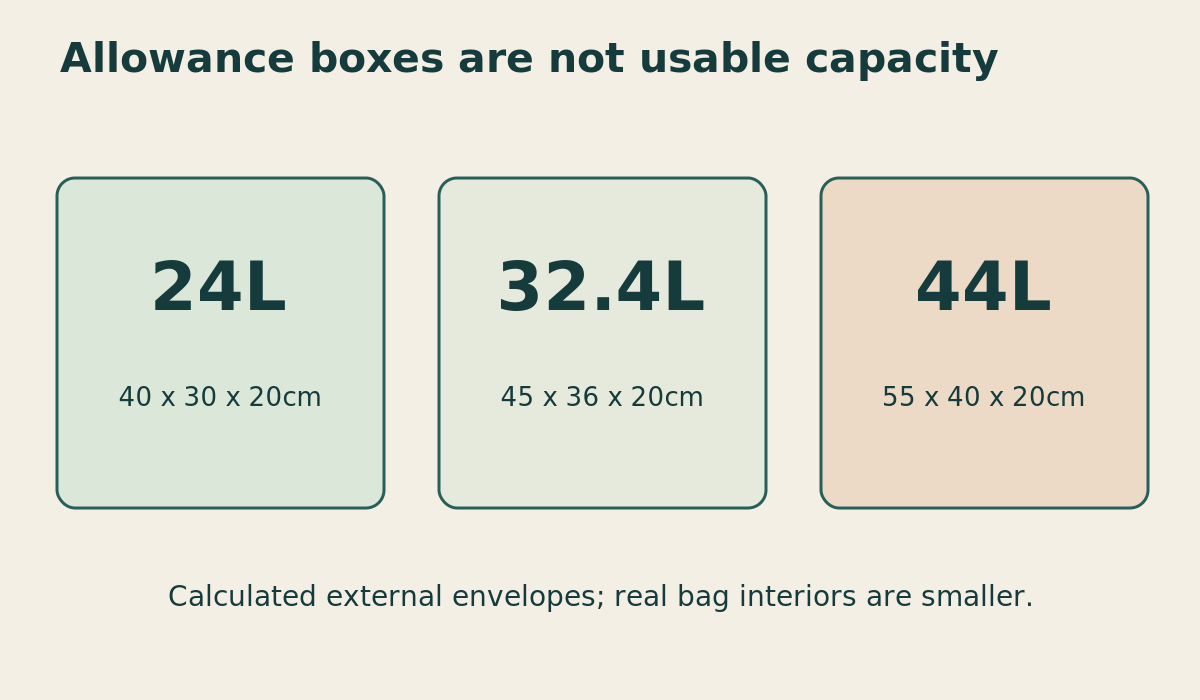
Multiplying 40 x 30 x 20cm produces a 24-litre rectangular envelope. Multiplying 45 x 36 x 20cm produces 32.4 litres. These are calculated external boxes based on the cited airline dimensions, not promises about how much usable clothing space any bag contains. Fabric, padding, curves and internal divisions all matter. [1] [2]
For comparison, a 55 x 40 x 20cm external box is 44 litres. That illustrates why an overhead allowance can make a substantial difference, but it does not mean every suitcase with those dimensions offers forty-four usable litres. Wheels, handles, shell thickness and the internal layout occupy part of the envelope.
The difficult object can matter more than the total
A bag may have enough nominal volume while being the wrong shape for a laptop or spare shoes. Conversely, a modest packing list can work in less space when its objects fit the layout well. Compare the least flexible belongings with the opening and internal dimensions before trying to optimise clothing compression.
This is why ‘I travelled for a week with twenty litres’ is not a useful guarantee for another person’s trip. Different footwear, clothing sizes, equipment and laundry arrangements change the problem. Your own trial list is the better evidence.
Back to top ↑Build the essential load before choosing the smallest bag
Put non-negotiable items on the table first
Begin with the objects which cannot simply be replaced by a smaller version: required work equipment, suitable clothing for the planned activities and personal essentials. Add the toiletries and charging equipment you actually use. Only then consider spare outfits and convenience duplicates.
For a suggested short-trip trial, separate what you will wear from what must fit inside the bag. Include a removed outer layer in a second test, because the bag may need to hold it later. A packing system which works only while you wear every bulky item can be awkward in a warm terminal or on the return journey.
Distinguish a useful reduction from a costly compromise
Removing an unnecessary spare charger is different from leaving behind equipment you need for work. Wearing one appropriate pair of shoes for several activities is different from taking unsuitable footwear simply to fit a smaller bag. Make those choices around the trip, not around the size label you hope to achieve.
If the essentials already fill the personal item, leave room for access and ordinary repacking before declaring success. A bag which closes only with pressure may not remain within the permitted outline once clothing is less neatly folded. A larger allowance can be the practical, honest solution rather than a failure to pack efficiently.
Back to top ↑Three small-backpack examples, with their limitations visible
CABINZERO Classic 28L: check the current generation
CABINZERO lists the current Classic 28L at 39 x 29.5 x 20cm. Those dimensions sit within Ryanair’s published small-bag rectangle, but the loaded shape still needs checking and the 20cm depth exceeds British Airways’ 15cm handbag limit. This is a specification comparison, not an airline certification. [4] [1] [3]
Older listings can show different weights or design details, so match the generation rather than combining figures from several retailers. The attraction is a relatively simple small-bag layout; whether it works for you depends on the objects, access and loaded comfort.
Daylite 26+6: useful easyJet comparison, not a universal underseater
The Daylite’s normal 43 x 33 x 16cm dimensions fit within easyJet’s published small-bag limits on paper, but exceed Ryanair’s small-bag height and width. Its expansion mode needs a separate measurement. That makes it an airline-specific candidate rather than a bag to recommend identically for every low-cost carrier. [5] [2] [1]
Mous 23L: a different product from its larger travel pack
Case Luggage lists the Mous Optimal 23L backpack at 45 x 34.1 x 17.3cm and 1.5kg. Its published dimensions fit the easyJet small-bag rectangle, but not Ryanair’s smaller height and width or BA’s handbag depth. It is also relatively substantial in empty weight for a small personal-item plan. [6] [2] [1] [3]
Back to top ↑What a larger cabin suitcase can make easier
More usable room can remove several compromises at once
A larger allowance can accommodate clothing, a second pair of shoes or work equipment without forcing every item into a tightly interlocked arrangement. That may make the journey easier to pack and repack. However, the extra space is only useful when the case can be handled comfortably on the route.
Wheels can reduce carrying on appropriate surfaces, but the bag still needs lifting at steps and into storage. Trial those tasks with the full load before assuming a suitcase is the effortless option. The handle and wheel arrangement should suit how you walk, not just look smooth in an empty display.
Use a compatible case as a benchmark
The Samsonite Essens 55cm is listed by Case Luggage at 55 x 40 x 20cm, 2.8kg and 39L. On published dimensions it provides a useful benchmark for Ryanair’s Priority second-bag size, while clearly being too large for the free small personal item. The booking and loaded weight still matter. [7] [1]
Its closure and internal modules offer one way of organising a larger load, not a claim that every traveller needs that particular design. Compare the packing footprint with your clothes and decide whether the structure earns its empty weight over a softer bag.
Back to top ↑Compare total trip cost without guessing future fees
Begin with what you already own
A small bag can avoid an additional baggage purchase on a suitable fare, but buying a new one has a cost. If an existing suitcase works and the larger allowance is already included, replacing it purely to travel underseat may save nothing on that journey. Write down the real starting position before comparing products.
Use this simple method: new bag cost, plus the relevant luggage extras for every flight, plus any genuinely necessary accessories. Compare the total for each workable system. Do not insert a generic baggage fee from an old article, since route, date and booking option can change the quote.
Include the costs created by the compromise
A smaller bag may require laundry, a different transfer plan or leaving behind something you later need to replace. Some of those choices are perfectly sensible; others undermine the apparent saving. Consider only costs which would actually arise, rather than inventing a financial penalty for every inconvenience.
Likewise, the suitcase should not receive credit for carrying unnecessary belongings. A bigger bag is good value when the additional space serves the trip, not when it simply accommodates more duplicates. Keep the packing list consistent while comparing the quoted baggage options.
Use a break-even calculation only with real inputs
When buying an underseat bag for repeated trips, divide its additional purchase cost by the baggage saving on a genuinely comparable trip. That gives a rough break-even number of journeys, not a guaranteed return. The calculation is only useful if the bag will continue to suit the relevant carriers and packing needs.
Do not assume that every future holiday will have the same allowance or equipment requirement. A bag can still be worthwhile for convenience even when the arithmetic saving is modest, but that should be an explicit preference rather than an invented income-style forecast.
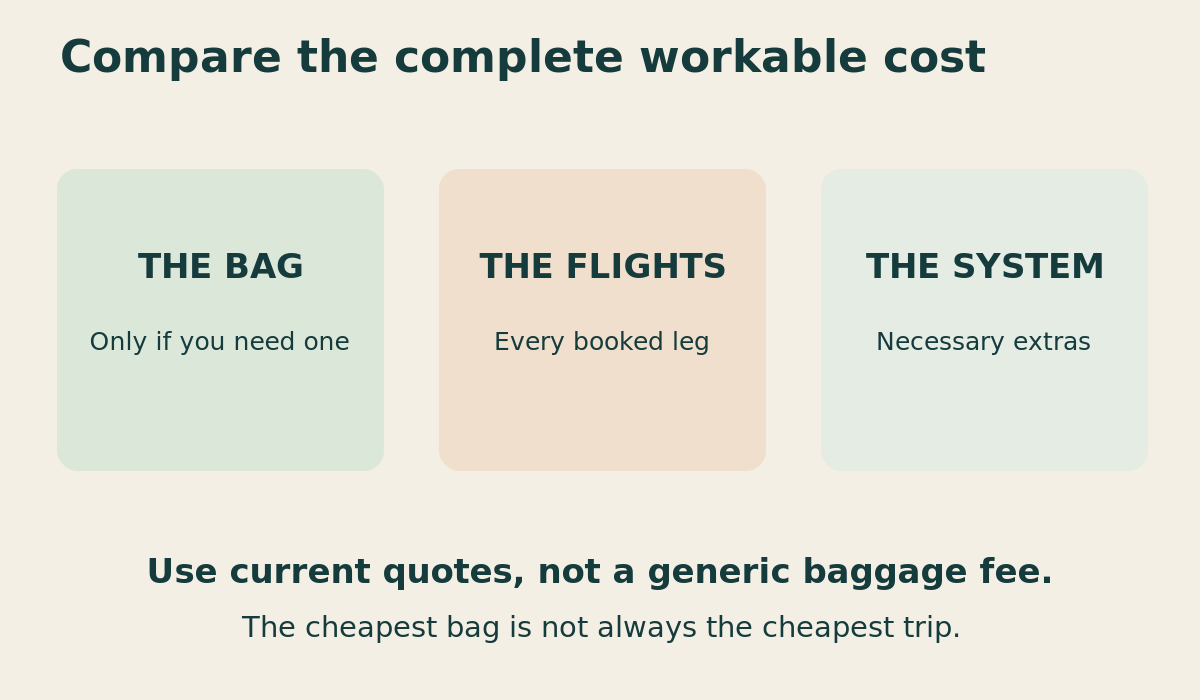
Use compression to improve order, not to defeat dimensions
Clothes can compress; equipment often cannot
Compression can reduce some trapped air in clothing. It does not reduce the mass of the contents or make a laptop shorter. Therefore, work around the rigid objects first and use clothing organisation to fill the remaining space without pressing hard items into each other.
A small personal-item bag may benefit from only one cube, not a complete set. Check whether the cube’s footprint suits the bag and whether you can still reach the items used in transit. An organiser which makes the interior tidy but blocks the zip or laptop opening has not improved the system.
Leave the front pockets honest
Put the objects you expect to use into the outside pockets before measuring. A bag which fits only with those pockets empty may still work, but you need to pack that way deliberately. Overfilling quick-access storage is an easy way to turn a compliant-looking outline into a deeper one.
Also test the return arrangement with worn clothing separated. If the bag only closes with the original careful folding, reduce the list or choose more usable space. The goal is a practical travel system, not a one-time packing photograph.
Back to top ↑Think about the load on you and the space near your feet
Underseat convenience comes with a space trade-off
A personal item can keep essentials close during a flight, subject to crew instructions, but it occupies the allocated space beneath the seat. Think about whether the bag stays closed, whether straps can be contained and whether you can retrieve a small item without unpacking the main load.
Do not assume every aircraft seat provides identical unobstructed storage. Follow the airline and crew’s directions, especially where seating positions affect how belongings must be stowed. The legal allowance and the practical onboard arrangement are related questions, not a reason to argue that a particular pocket should always be accessible.
Small volume does not guarantee comfortable carrying
A dense bag full of technology can weigh more than a larger bag of light clothing. Compare the packed weight and how it sits against your back. Padded straps alone do not establish a good fit, and the maximum weight an airline permits is not a target you need to reach.
The Mous 23L example makes this trade-off visible: its 1.5kg empty weight is part of choosing that design before any equipment is added. It may be worthwhile for your organisation needs, but compare the complete system with a simpler bag rather than assuming every small backpack is lightweight. [6]
Back to top ↑When paying for the suitcase is a sensible choice
Necessary footwear or clothing can settle the question
A formal event, cold-weather clothing or a genuine need for two pairs of shoes may make a personal-item-only list impractical. Those are valid reasons to compare a larger allowance. Start with the required items and avoid treating minimal luggage as more important than the purpose of the trip.
For example, a short work-and-dinner trip can be harder to pack small than a longer casual holiday with laundry. The number of nights does not reveal the wardrobe shape. Trial the difficult objects first and see whether the remaining space allows comfortable access to the everyday essentials.
Technology needs its own protective space
Fit the computer, charger and any required accessories without bending a sleeve or applying pressure from packed clothing. A case may offer more room, but it still needs a suitable protective arrangement. If you must work before check-in, check how quickly the device can be removed and replaced.
A compatible case such as the Essens is worth comparing when the main problem is genuinely insufficient clothing space. However, its extra capacity does not by itself create a dedicated laptop-access solution. Choose the internal arrangement and any separate allowed personal item around your actual work routine. [7]
Back to top ↑Can a personal item and a suitcase be the best system together?
Sometimes the sensible comparison is not either-or
Where the booking permits both, a small personal bag can hold active essentials while the suitcase carries clothing. That can reduce the need to open the larger case during a journey. However, it also creates two pieces to manage through stairs, doors and storage.
Decide what belongs in each bag before buying a matching set. Keep the personal item light enough to be useful independently and avoid duplicating equipment between the two. A suitcase’s trolley handle can help carry a compatible bag on suitable surfaces, but you still need to lift and separate the pieces when required.
Check the small bag's airline fit independently
A backpack which works as the larger personal item on one carrier may not match another’s tighter handbag limit. The Daylite’s normal dimensions, for example, suit the easyJet small-bag comparison but exceed BA’s 15cm handbag depth. Combining it with a suitcase does not change those measurements. [5] [2] [3]
Do not assume group travel pools every allowance
Two people travelling together may have different bag options or equipment needs. Check whether the specific booking allows any sharing of weight or pieces before combining everything into one bag. A shared suitcase also changes who must lift the load and what happens when the travellers separate briefly.
Keep necessary personal items accessible to the person who needs them rather than concentrating every essential in one main case. A space-efficient group system should still work when one traveller goes ahead, one bag is stored or a piece of luggage has to be checked.
Back to top ↑Keep the essentials removable without carrying another full bag
A small transfer pouch can be useful
Identify what must remain accessible if the main bag is stored or taken for the hold. A modest pouch can keep those items together, but it should fit within the luggage you are permitted to retain. Avoid building the whole system around an unbooked extra bag appearing at boarding.
A larger document wallet is optional. TORRO’s travel organiser can be compared where its layout suits the documents you carry, but its dimensions and weight need to earn their place in a small personal item. A simple zipped pouch may be enough for a traveller carrying fewer papers. [8]
Prepare for a cabin bag being placed in the hold
The CAA advises keeping power banks and spare batteries with you in the cabin and removing relevant batteries or lithium-powered devices when a cabin bag is taken for the hold. Make that removal possible without unpacking all the clothing, and check the operating airline’s instructions before travelling. [9]
Documents and necessary personal essentials should also remain in a deliberate accessible arrangement. The exact packing choice depends on your belongings, but burying them inside a tightly filled suitcase creates avoidable work when storage arrangements change. A useful bag system can adapt without leaving critical items inaccessible.
Back to top ↑Measure the packed bag as an object, not a promise
Use three separate measurements
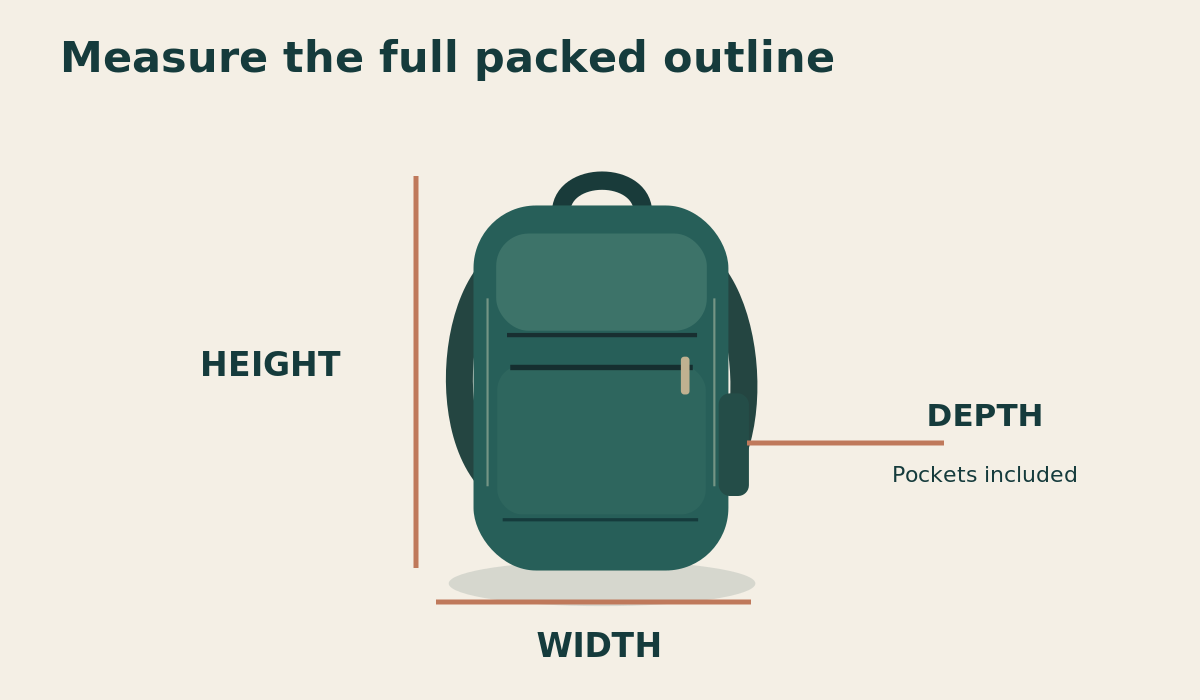
Close the bag with the normal load, contain straps as intended and place it on a level surface. Measure the longest external points in each direction, including the relevant wheels, handles and filled pockets. A rigid item inside may determine the minimum size even when the fabric around it appears soft.
Compare those measurements independently with the permitted dimensions. Do not add them together unless the operator explicitly uses a total-dimension rule for that particular allowance. For the cabin examples in this guide, a narrow bag does not gain permission to be too deep.
Make the home test repeatable
Record the configuration: expansion closed, bottle pocket empty or full, laptop fitted, and the number of clothing modules. That lets you repeat the check before the return journey instead of relying on a measurement taken with a different load. A bag that needs a particular arrangement should be packed consistently.
A home cardboard outline can be useful as a rough packing aid, but it is not an official sizer or a guarantee of acceptance. Leave a sensible margin where possible and rely on the actual airline rules, not on an assertion that a bag should pass because it squeezed into a homemade frame.
Three ways the decision can turn out
A compact casual weekend
For an illustrative two-night trip with a modest wardrobe, no work equipment and an appropriate free small-bag allowance, a personal-item backpack can be the straightforward answer. Test the toiletries and return clothing arrangement rather than assuming a small number of nights makes any bag suitable.
A Daylite 26+6 may be a candidate for the easyJet normal-size comparison, but it is not the equivalent choice for Ryanair’s smaller rectangle. Choose the model around the actual carrier and keep expansion separate from the flight configuration. [5] [2] [1]
Several bulky essentials and limited laundry
Here the larger cabin allowance may be the better value even when it costs more. It can remove the need to force clothing around equipment or rely on uncertain laundry arrangements. The case still needs to suit the route, but extra usable room is serving a real purpose.
Compare a measured case such as the Essens with a larger travel backpack as well. You may want the capacity without wheels, or the wheels without a highly divided interior. The important improvement is the workable packing system rather than the label ‘suitcase’. [7]
A small bag that nearly works
Before buying anything, remove one unnecessary bulky object and simplify the organisers. Try a single clothing module instead of several, or use a smaller toiletries arrangement containing the items you actually need. These changes can be more useful than purchasing another bag with only slightly different nominal capacity.
Compression cubes are worth comparing when loose clothing is the remaining problem, but they cannot resolve a computer that is too long or a bag that is structurally too deep. Use them to improve the layout after the dimensional problem has been solved. [10]
Back to top ↑Before you pay for a bag or a baggage upgrade
Compare the exact configuration at checkout
Confirm the product size, model and selected variant, then compare the flight allowance for every relevant leg. Retail pages can group several capacities or display dimensions from a different configuration. Save the exact figures you used so that a later change of colour or model does not quietly alter the shortlist.
Avoid treating a current promotion as part of the bag’s permanent value. This guide does not quote a guaranteed price, stock level or delivery date because those depend on the chosen retailer and variant. Check the current total and return conditions before committing, especially when departure is close.
Give the trial a chance to change your mind
Keep tags and packaging while you complete a clean indoor packing and carrying test, following the seller’s conditions. If the bag does not fit the essentials or feels wrong when loaded, use the available return process rather than trying to justify the purchase with future trips it might suit.
Likewise, check whether the airline lets you add the appropriate larger allowance in advance and compare the current quote. Do not plan to resolve an oversized bag at the gate. The better decision is the one made with the real bag, real belongings and real booking in front of you.
Back to top ↑Use three decision checkpoints instead of one rushed purchase
Before you book the flights
Compare the available baggage options alongside the packing list, not after choosing the cheapest headline fare. A fare with a useful larger allowance can be a different proposition from one which only includes a small bag. Use the actual quotes for the route and dates rather than assuming one pricing structure applies everywhere.
Check connecting and return flights at the same time. The most generous leg does not determine the bag you can use throughout the trip. Write down the strictest relevant outline for the system you intend to carry, and keep the bag count beside it so that a separate computer bag is not forgotten.
At this stage, you do not need to buy luggage immediately. Test the essentials in a bag you already own and identify the specific shortfall. Knowing that you need more depth for a particular object is more useful than deciding vaguely that you need a ‘better cabin bag’.
When the bag arrives
Compare the received model with the order and the dimensions you researched. Then pack it before removing tags or taking it outside, following the return conditions. Check both the full exterior and the usable opening: the correct nominal size can still be a poor match for the belongings.
Try retrieving the item you will need in transit and returning it while the rest remains packed. Check whether the straps or handles are comfortable with the complete load, and whether the bag can be lifted in the way the journey requires. A measurement pass does not replace a handling check.
If the trial fails, identify the reason before buying another bag. A different layout may solve blocked access without adding capacity. Alternatively, a rigid essential may genuinely require a larger allowance. That distinction prevents a series of nearly identical purchases which never address the actual problem.
Shortly before travel and before coming home
Recheck the operating carrier’s current instructions and the allowance shown on the booking. Restore the configuration used for the successful trial, including the state of expansion zips and external pockets. A bag bought for a particular size should not gradually grow as last-minute objects are added.
Before the return flight, repeat the check with worn clothing and any purchases inside. Keep a plan for the outer layer you may remove and make sure the essential pouch remains accessible. The return is not exempt from the size rules just because the outbound journey went smoothly.
These checkpoints are deliberately simple. They separate a booking decision, a product-fit decision and a final packing decision instead of expecting one product label to answer all three. Once each stage works, you can travel with the smaller bag confidently or choose the larger allowance without treating it as a compromise in skill.
Back to top ↑The advantages and compromises you are choosing
Personal-item backpack
The main advantages are a compact system, potentially avoiding a larger baggage purchase on suitable fares, and keeping a small set of belongings together. It can work particularly well when your packing list is genuinely modest and the loaded fit is comfortable.
The compromises are less space, more pressure on the packing list and carrying the load on your body. The bag may also need a very specific arrangement to stay within the allowance. Those trade-offs are acceptable only when they do not undermine the purpose or comfort of the trip.
Cabin suitcase
The main advantages are more usable room and rolling transport where the route supports it. It can simplify a bulkier wardrobe and reduce the need for tightly compressed packing, especially when a larger allowance is already included.
The compromises include empty weight, lifting tasks, storage footprint and possibly an additional luggage cost. A case is not automatically easier on stairs or in a small room. Choose it when the extra space and carrying method solve actual problems rather than encourage unnecessary packing.
Mistakes to avoid when choosing the smaller option
Treating marketing language as permission
A bag described as personal-item size may be aimed at a different airline or market. Use the current dimensions for your booking and compare the packed outline. An enthusiastic review from another traveller cannot establish what your carrier permits.
Making the saving depend on extra loose bags
The smaller main bag is not really solving the problem when the remaining belongings are carried separately outside the allowance. Consolidate the airport arrangement before measuring, including the items you expect to buy or remove during the journey.
Ignoring the second packing attempt
A bag which fits after twenty minutes of perfect folding may be awkward after ordinary use. Repack worn clothing and add the removed outer layer before deciding that the personal item is sufficient. A little spare room can be more valuable than winning the smallest-bag comparison.
Back to top ↑Personal-item and cabin-suitcase questions
Can I use a backpack as my larger cabin bag?
Yes, when the backpack meets the larger bag’s size, weight and booking conditions. Shoulder straps do not make it a personal item automatically. A substantial travel pack can use the same overhead allowance as a suitcase, which is useful when you prefer carrying to rolling but still need the larger packing space. [1] [2]
Can I take a wheeled bag under the seat?
Potentially, if the entire bag, including wheels and handles, fits the relevant personal-item allowance and the airline’s conditions. Check the exact model rather than assuming every underseater sold by a retailer matches every carrier. The carrying format is separate from the permitted external dimensions.
Does a twenty-eight-litre label prove Ryanair compatibility?
No. Different bags with that label can have different shapes. Compare the three external dimensions with Ryanair’s current small-bag allowance and measure the bag after packing. The current CABINZERO example and BAGSMART’s Blast illustrate why capacity alone is insufficient: their published outlines are not the same. [4] [11] [1]
Is a personal item enough for a week away?
It can be for some packing lists, but the calendar alone cannot answer. Clothing choices, laundry access, technology and footwear are more useful variables. Trial your essentials and the return arrangement. Do not rely on another traveller’s experience when the items and dimensions involved are different.
Are compression cubes worth buying for a tiny bag?
Only when they solve an organisation or bulk problem without making the interior harder to use. One appropriately sized cube may be useful; an entire set may be unnecessary. Check that the cube can be removed and replaced while the rest of the bag stays packed, and remember that compression does not reduce weight.
Is the cheaper option always the personal item?
No. A new bag, required laundry or an eventual larger baggage purchase can change the calculation. Equally, the suitcase may cost nothing extra when you already own it and the allowance is included. Compare the total workable system using the current booking quote rather than assuming one format always saves money.
Can I expand my backpack after boarding?
Do not treat expansion as a way to bypass the permitted dimensions or obstruct the available storage space. Follow the crew’s instructions and keep the bag in an appropriate stowable configuration. Expansion is most useful when a different stage of the trip permits the larger size, not as an assumed exception to cabin rules.
Which is better for someone who does not want to carry much?
Compare a lighter load, an appropriate wheeled bag and a route with manageable lifting. A small backpack may still be heavy when filled with dense equipment. There is no need to choose an uncomfortable personal-item system solely to avoid a larger bag; your practical carrying needs are part of the decision.
Back to top ↑Choose the smallest system that remains practical
Let the packing trial settle the argument
Use a personal-item backpack when the essentials fit the actual booked dimensions, access remains easy and the loaded bag feels manageable. That is a useful small-luggage system, not simply a bag which can be forced shut once. Confirm all carriers and repeat the measurement before the return journey.
Use a cabin suitcase when extra space or wheels solve a real need and the transport plan supports it. Paying for a suitable allowance can be a sensible choice when the alternative creates uncomfortable packing or unnecessary compromise. A larger travel backpack is also worth considering when capacity is the issue but wheels are not your preference.
The final decision should survive three checks: everything necessary has a place, the full airport arrangement matches the booking, and you can handle it comfortably. Once those are satisfied, there is little value in making the bag smaller merely to prove that you can.
Back to top ↑Sources and fact-checking notes
- 01 Ryanair: bag policiesReviewed 9 October 2026. Match the exact product version or current transport conditions before purchase or travel.
- 02 easyJet: cabin bagsReviewed 9 October 2026. Match the exact product version or current transport conditions before purchase or travel.
- 03 British Airways: baggage essentialsReviewed 9 October 2026. Match the exact product version or current transport conditions before purchase or travel.
- 04 CABINZERO: current Classic Backpack 28LReviewed 9 October 2026. Match the exact product version or current transport conditions before purchase or travel.
- 05 Case Luggage: Osprey Daylite Expandable 26+6Reviewed 9 October 2026. Match the exact product version or current transport conditions before purchase or travel.
- 06 Case Luggage: Mous Optimal 23L backpackReviewed 9 October 2026. Match the exact product version or current transport conditions before purchase or travel.
- 07 Case Luggage: Samsonite Essens 55cmReviewed 9 October 2026. Match the exact product version or current transport conditions before purchase or travel.
- 08 TORRO: leather travel wallet and passport organiserReviewed 9 October 2026. Match the exact product version or current transport conditions before purchase or travel.
- 09 UK Civil Aviation Authority: Pack right, safe flightReviewed 9 October 2026. Match the exact product version or current transport conditions before purchase or travel.
- 10 BAGSMART UK: six-piece compression packing cubesReviewed 9 October 2026. Match the exact product version or current transport conditions before purchase or travel.
- 11 BAGSMART UK: Blast 28L BasicReviewed 9 October 2026. Match the exact product version or current transport conditions before purchase or travel.
Illustrations in this article were created for Taylor’s Trailblazing Travel Gear. Third-party photographs, where used, are credited beside the image or in the source list.