RFID-Blocking Travel Wallets: Define the Risk Before You Buy
Separate contactless-card skimming, passport-chip privacy, physical wallet theft and online fraud before paying for a shielding layer.
Original Travel Gear image
RFID-blocking travel wallets are often sold with a dramatic story: a stranger carries a scanner, passes close to your pocket and silently steals enough data to empty an account or copy a passport. The technology behind contactless cards and electronic passports is real, but that sales story combines several different threats and skips the safeguards already built into modern systems.
A useful buying decision begins by naming the asset and the attack. Are you worried about a payment card being read at close range, a stolen card being tapped after the wallet disappears, a passport chip responding without your knowledge, or an employee access card triggering the wrong reader? A shielding layer can reduce radio communication while an item is inside. It cannot stop a thief taking the wallet, a merchant data breach, card details typed into a fake website, social engineering or account takeover.
This guide uses current payment-industry information, ICAO passport standards and official product specifications. Prices and availability are examples checked on 21 September 2026 and should be rechecked before purchase.
Reduces radio communication
Conductive material around a compatible card or chip attenuates the signal while the item is fully inside.
Read versus use
Reading limited data is not the same as creating a valid payment, cloning a modern chip or accessing an account.
The wallet itself disappears
A zip, sensible carrying position, spare card and fast bank reporting usually matter more than shielding.
Low-cost, low-friction reassurance
Choose it when the wallet is good on its own merits and blocking adds little bulk or inconvenience.
The wallet creates a small radio shield; it does not encrypt, cancel or monitor the items inside.
RFID and NFC describe communication, not one universal risk
Radio-frequency identification covers several technologies and frequencies. Contactless payment cards and many electronic passports operate in the high-frequency 13.56 MHz range and communicate over a short distance with a compatible reader. Near-field communication is the closely related technology used by phones and many payment terminals.
An RFID-blocking wallet normally includes conductive material that weakens the electromagnetic field reaching a card or passport. The item may stop responding while fully enclosed. Performance depends on coverage, seams, openings, frequency and the power and position of the reader, so a marketing label is not the same as independent certification.
Blocking is passive
The wallet does not know whether a reader is legitimate. It simply makes communication harder while closed. When you remove the card, the normal contactless function returns. That can be useful for privacy and preventing accidental reads, but it cannot warn you about a fraudulent website or stop a payment after a card has been physically stolen.
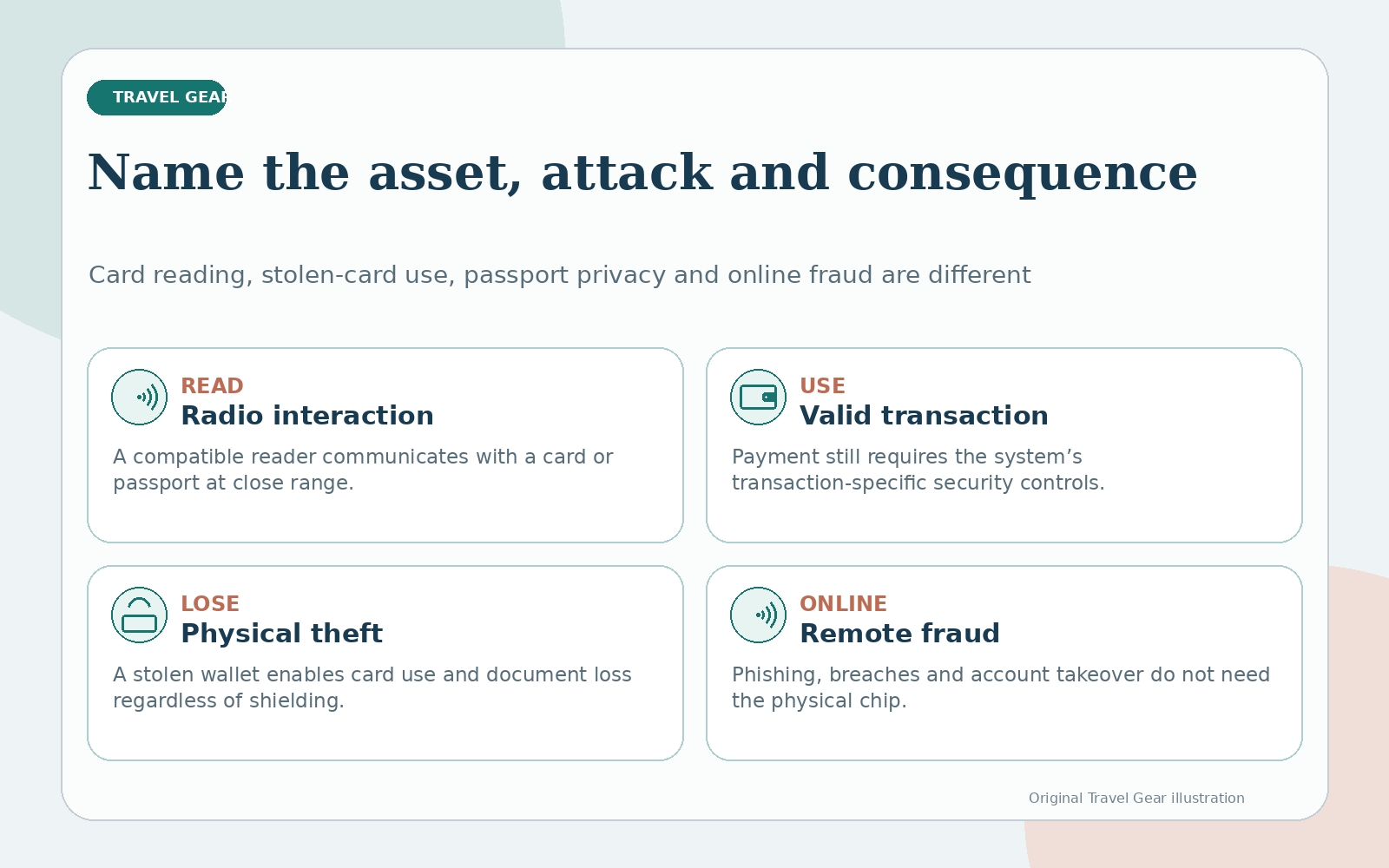
Four concerns are often bundled together even though they need different controls.
Concern 1: close-range reading of a contactless card
A compatible reader may be able to communicate with a card at close range. The practical impact depends on what the card exposes and whether captured information can be used elsewhere. EMV contactless payments generate a one-time security code for each transaction, which limits simple replay and counterfeit use.
Concern 2: contactless spending after physical theft
This begins with the wallet or card being lost or stolen, not with a radio scan through the fabric. UK Finance says customers remain protected from unauthorised fraud and should contact the card provider as soon as a card is missing. The wallet’s zip, carrying position and your reporting speed address this risk more directly than an RFID layer.
Concern 3: passport-chip privacy
Electronic passport chips store data used to validate the document. ICAO guidance describes access-control mechanisms such as Basic Access Control and PACE, which require information derived from the data page or a card access number before chip contents are read. Shielding adds another physical layer while the passport is stored, but the core protection is the passport system’s access control and cryptography.
Concern 4: access and transit credentials
A blocking compartment can stop an office pass or transport card responding when you do not want it to. That is useful when several cards interfere with each other. It can also be inconvenient if you expect to tap a gate without removing the card.
Fraud statistics establish that losses exist; they do not prove that walk-by RFID skimming is the usual cause.
Contactless use is enormous
UK Finance reported that 19.2 billion contactless debit and credit card payments were made in the UK during 2025, worth £311 billion. It described the contactless fraud rate as very low and said existing consumer protections remain in place. The same guidance listed an average contactless payment value just under £18.
The fraud category is broader than covert scanning
UK Finance’s 2026 annual fraud release reported £46.8 million of contactless fraud losses for 2025. That number should not be presented as £46.8 million of RFID-skimming losses. Contactless fraud can involve a lost or stolen physical card or device being used at a terminal. By comparison, remote purchase card fraud — where card information is used for online or telephone purchases — reached £423.5 million.
Limits and bank controls still apply
As of the March 2026 UK Finance guidance, the usual single-card contactless limit remained £100, with background controls requiring a PIN after a number or value of transactions. The Financial Conduct Authority had given providers flexibility to adjust limits where strong fraud controls exist, so individual providers may change their approach and communicate that to customers.
Modern chip transactions use changing security data rather than a reusable static swipe record.
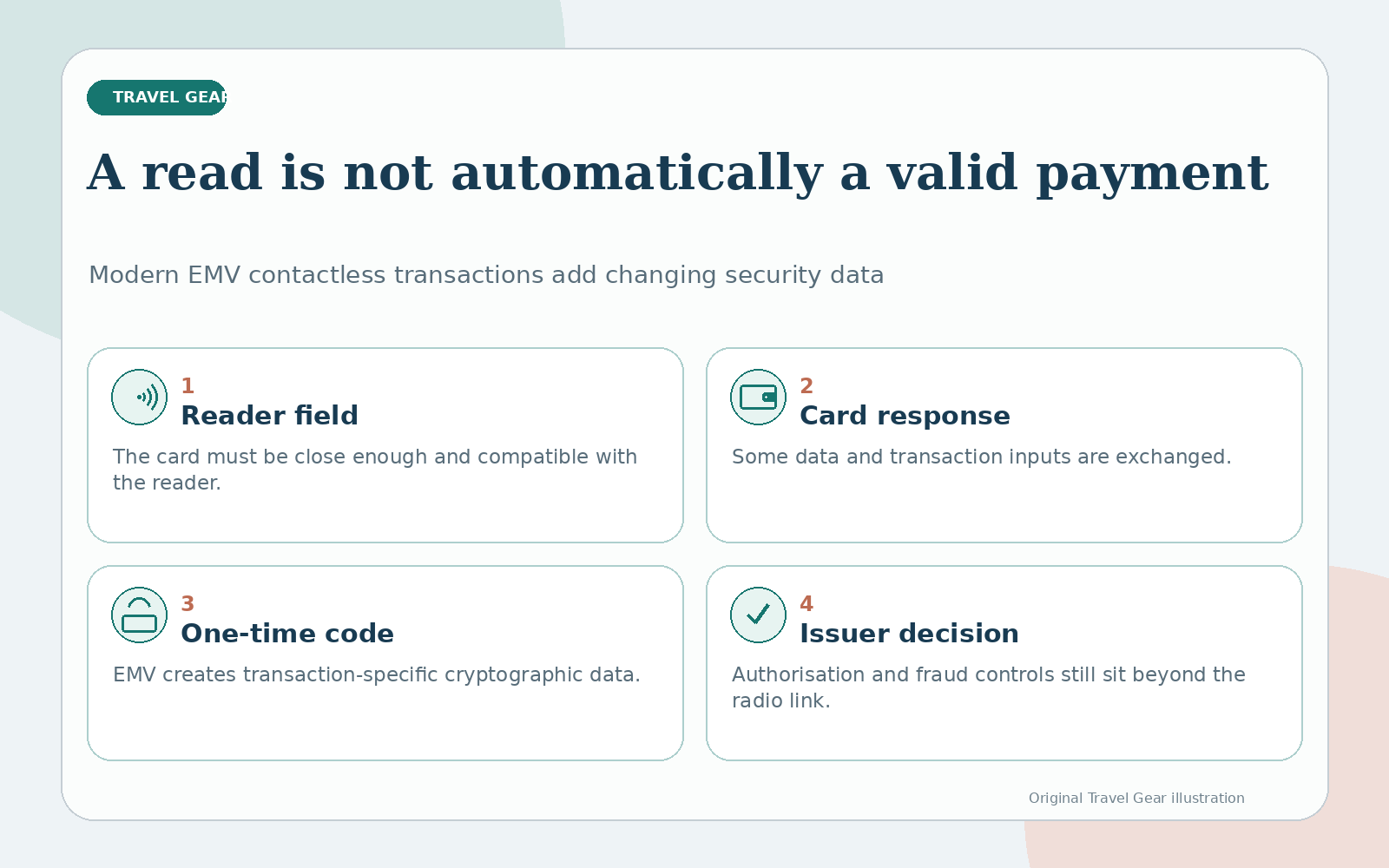
Each transaction generates a one-time code
EMVCo, the body that manages the global EMV specifications, states that an EMV contactless transaction generates a one-time security code. Visa and Mastercard describe the same principle: the card and terminal create transaction-specific cryptographic data, which is designed to prevent simple replay and counterfeit use.
Limited data can still deserve care
This does not mean every piece of card information is secret or every implementation is perfect. Researchers have demonstrated relay, protocol and terminal attacks under controlled conditions. The buyer question is whether a passive wallet shield materially reduces the risks you are likely to face compared with stronger habits such as freezing a missing card immediately, using transaction alerts and refusing unexpected authentication requests.
Mobile wallets change the storage decision
Phone-based payments typically use device authentication and tokenised card credentials. An RFID wallet does not protect a phone against account takeover, a weak passcode or malicious software. A traveller who mainly uses a locked phone and carries one physical backup card has a different exposure from somebody carrying six cards together.
Passport chips are not designed to reveal their contents freely to any reader in the room.
Access control uses information from the physical document
ICAO’s ePassport guidance explains that Basic Access Control derives a key from the machine-readable zone on the data page, while PACE uses a password such as the machine-readable zone or card access number to establish protected communication. These mechanisms are intended to prevent skimming and eavesdropping.
A closed shielding cover is an extra layer
An RFID-blocking passport wallet can prevent or weaken radio communication while the passport is fully enclosed. That may appeal to privacy-conscious travellers and costs little when integrated into a wallet they already need. It is not evidence that an unshielded, closed modern passport is broadcasting readable personal data across an airport.
Physical document security remains decisive
A passport lost with the wallet creates immediate disruption regardless of RFID. Keep a secure digital copy in an account protected by strong authentication, record the passport details separately and know how to report a loss. Do not carry the original every day unless local rules or the itinerary require it.
The value rises when shielding solves a real organisation or interference problem at almost no cost.
| Use case | Likely value | Why |
|---|---|---|
| Several contactless bank cards and a passport in one organiser | Moderate | One closed shield creates a simple storage rule and can reduce accidental or unwanted reads. |
| Office, hotel, cruise or access credentials carried with payment cards | Moderate | Shielding can prevent the wrong credential responding, though not every card uses the same frequency or protocol. |
| One bank card in a zipped inner pocket | Low | Physical control, alerts and rapid card freezing are usually the higher priorities. |
| Traveller who taps a transit card through the wallet | Potentially negative | Blocking may force the card to be removed every time and can make gates less convenient. |
| Traveller primarily worried about online fraud | Very low | A shield cannot stop phishing, merchant breaches, malware or card details entered online. |
| Buyer who values reassurance and likes the wallet anyway | Reasonable | The extra layer can be worthwhile when it adds little bulk and does not displace more useful features. |
A bad travel wallet with a conductive lining is still a bad travel wallet.
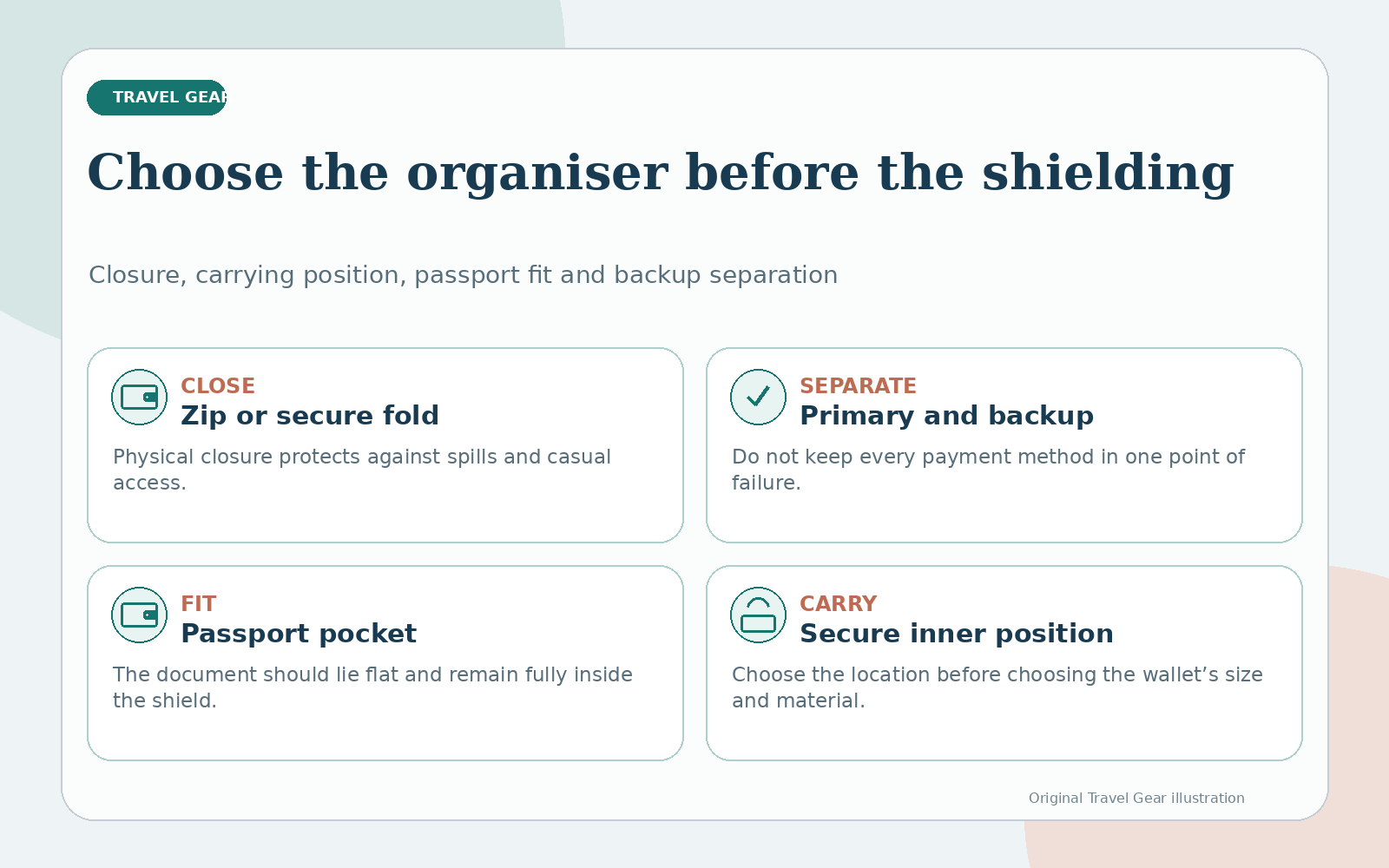
Full enclosure matters
Check whether the whole wallet is lined or only selected card slots. A passport may extend beyond a small shield, and an open zip-around organiser may not block effectively. Manufacturers should state which compartments are protected rather than relying on a logo alone.
Closure and carrying position protect against the more common loss
A zip-around closure keeps cards, cash and documents from falling out and makes casual access more obvious. A detachable wrist strap can help while moving through a checkpoint, provided it is not treated as a secure anchor. The wallet should fit a zipped inner bag pocket or money belt without creating a visible bulge.
Organisation should support your border routine
Choose enough slots for the cards you actually carry, a passport pocket that does not bend the cover, separate currencies and a boarding-pass or document sleeve only if paper documents are part of your trips. A large family organiser is convenient at check-in but creates a single point of failure if every passport and card remains together all day.
Size and weight are more important than premium materials
A heavy leather folio may be pleasant in a cabin bag but too bulky for a secure body pocket. A slim aluminium card case protects cards but may not hold cash, coins or a passport. Decide where the wallet will be carried before choosing the format.
The examples show four formats: compact card case, passport organiser, zip wallet and premium leather travel wallet. They are not ranked as if one format suits everyone.
| Product | Format | Published capacity and size notes | Displayed price |
|---|---|---|---|
| Samsonite Alu Fit range | Aluminium card wallet | Compact card-only formats; models on the UK page ranged around 10.2 cm long with different thicknesses | £24–£65 across listed models |
| Pacsafe RFIDsafe V150 | Passport organiser with strap | Six card slots, passport, cash, coins, boarding pass and pen; about 17 × 12.4 × 2 cm; about 141 g | US$59.95 |
| Travelon Passport Zip Wallet | Light zip-around organiser | Four card slots, passport, cash, coin pocket and pen; 4.5 × 6 × 0.75 inches; 0.2 lb | US$33 |
| Bellroy Travel Wallet | Premium leather bifold | Four to ten-plus cards, passport, tickets, bills, hidden cash and micro pen | US$145 |
Manufacturer prices and published specifications were checked on 21 September 2026. UK availability, exchange rates, import costs and colours can change.
Compare the format before the finish
Search by the exact product or by wallet type, then check whether shielding covers the passport pocket as well as the card slots.
A phone test is a useful functional check, not a laboratory certification.
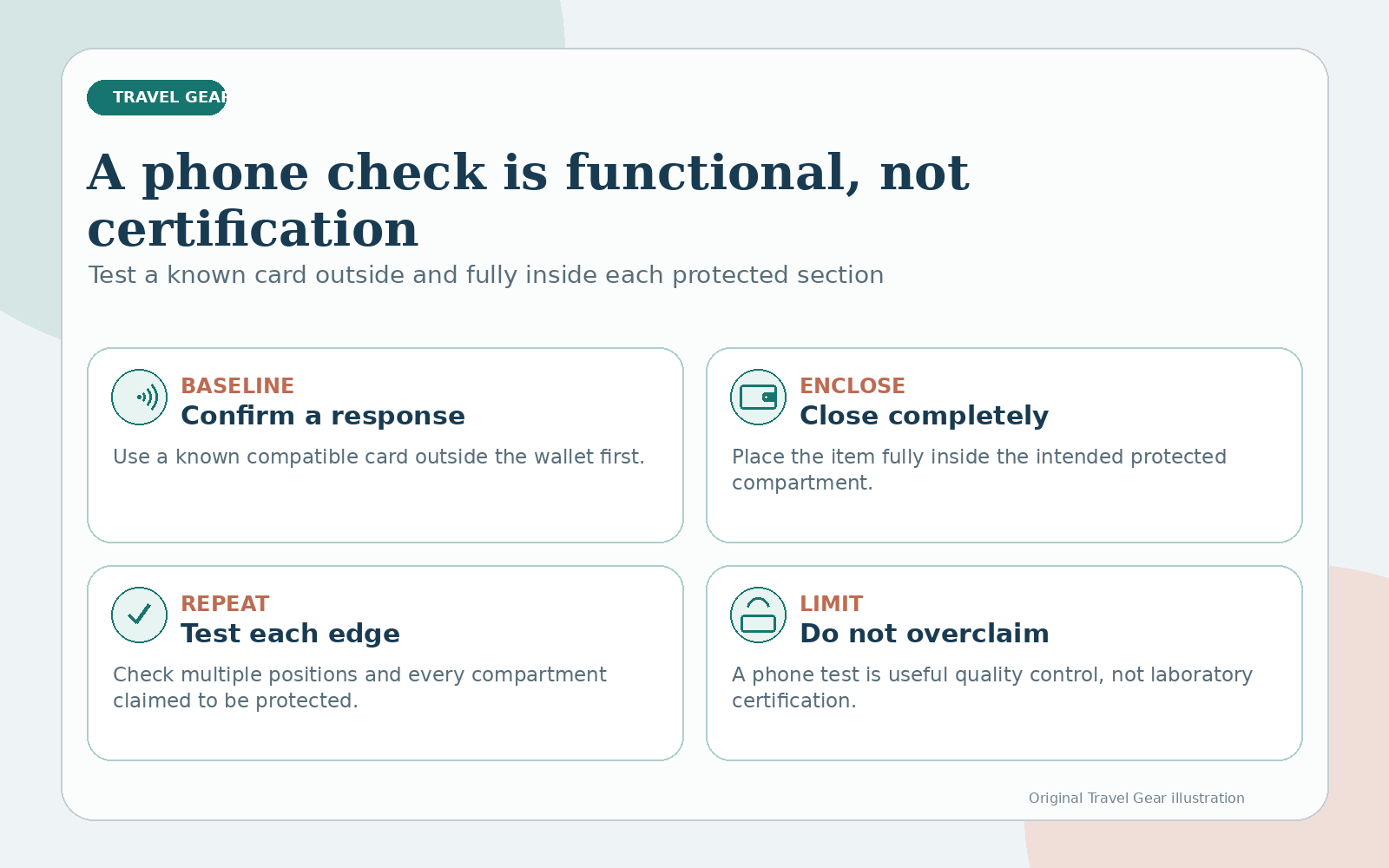
Use a known compatible card
If your phone can read an NFC tag or compatible transit card, confirm that it responds outside the wallet. Place it fully inside the intended protected compartment, close the wallet and repeat from several positions. A lack of response suggests the wallet is attenuating that particular phone-card combination.
Test every protected area
A wallet may block in the centre but leak at an open edge or unlined pocket. Test the card slots and passport sleeve separately. Do not bend or repeatedly scan a passport merely to prove a point; follow the document issuer’s handling guidance.
Understand the limitation
Phone power, antenna position and protocol differ from dedicated readers. Passing a home test does not prove performance against every frequency or attack. Failing the test may also reflect a card that the phone cannot read in the first place. Treat the check as quality control for daily use, not a security guarantee.
This list is more important than the shielding specification.
Physical theft
A thief who takes the wallet also takes the cards and passport. Use a secure carrying position and split backups.
Card-not-present fraud
Online purchases use card information, account access or authentication. Radio shielding does not affect them.
Phishing and impersonation
A wallet cannot stop you being persuaded to reveal a code or authorise a transfer.
Merchant or service breaches
Stored data can be compromised without the physical card being near the attacker.
Phone compromise
A blocked card does not secure a weak phone passcode, account recovery route or infected device.
Cash loss
Notes and coins receive no benefit from radio shielding and still need sensible storage.
Use shielding as one optional layer inside a more complete plan.
- Carry one primary payment method and one backup from a different account or network where practical.
- Store the backup separately so one stolen wallet does not remove both.
- Enable transaction notifications and learn how to freeze each card from another device.
- Record issuer contact details somewhere that is not inside the wallet.
- Use a zipped inner pocket or body-worn pouch in crowded areas rather than a loose trouser pocket.
- Keep the passport dry, flat and accessible only when needed.
- Reject unexpected requests for one-time codes, remote access or “safe account” transfers.
The feature can be sensible without being essential.
Advantages
- Adds a passive privacy layer with no battery or app.
- Can stop accidental reads and card clashes while closed.
- Often costs little when already included in a good wallet.
- Creates a simple rule for storing a passport and contactless cards.
- May provide reassurance without changing travel behaviour.
Disadvantages
- Can be oversold as protection against all fraud or identity theft.
- May block a transit or access card you want to tap quickly.
- Extra lining and structure can add bulk.
- Coverage and testing claims are not always clear.
- Can distract buyers from closure, carrying position and backup planning.
Avoid solving the smallest risk while creating a larger inconvenience.
Buying on fear alone
Define the card, document and likely attack before accepting a dramatic claim.
Ignoring the closure
An open bifold can spill contents or invite a hand even when its lining blocks radio signals.
Carrying every passport together
A family organiser is efficient at the desk but concentrates the consequences of loss.
Expecting protection from online fraud
Shielding has no effect on phishing, compromised websites or account takeover.
Assuming every slot is protected
Check whether the passport sleeve, cash section and outer pocket are inside the shield.
Forgetting transit convenience
A properly blocked travel card will usually need to be removed to tap.
Answers that keep the radio-frequency issue in proportion.
Do RFID-blocking wallets really work?
Well-constructed shielding can attenuate compatible radio signals while a card or passport is fully enclosed. Performance varies with coverage, frequency and reader strength, so the label alone is not a universal guarantee.
Can someone charge my card through my pocket?
A close-range contactless interaction is technically possible, but a fraudulent payment also needs payment infrastructure and leaves a transaction trail. Industry sources describe covert walk-by payment as impractical compared with lost-card use and other fraud routes.
Can contactless card data be cloned?
EMV contactless transactions use one-time security data designed to prevent simple replay and counterfeit use. Reading some card information is not the same as creating a valid clone.
Does my passport need an RFID cover?
Electronic passports use access-control mechanisms intended to prevent unauthorised reading. A shield is an optional extra privacy layer, not a substitute for physical document security.
Will a metal wallet block all RFID?
It may block common high-frequency cards when properly closed, but performance depends on gaps, construction and the technology being used. “All RFID” is too broad a promise without test data.
Can I test the wallet with my phone?
You can perform a basic NFC response test with a known compatible card. It shows how that card and phone behave, not certified protection against every reader or frequency.
Will blocking damage my cards or passport?
Passive shielding does not normally damage the chip. Avoid bending, magnets where inappropriate, moisture and excessive heat, and follow the document or card issuer’s handling guidance.
Why does my travel card stop working through the wallet?
That is the intended effect of effective shielding. Place the transit card in an unshielded outer holder if you need rapid tapping and accept the different security trade-off.
Are RFID sleeves enough?
A sleeve can be a lighter, cheaper option for one or two cards. It may be fiddlier than a lined wallet and needs replacing if it tears or leaves the card partly exposed.
Is aluminium better than fabric shielding?
Material alone does not decide performance. Coverage, seams, closure, durability and whether the format suits your carrying routine matter more.
Treat RFID blocking as a bonus feature, not the product’s main security claim.
Choose an RFID-blocking travel wallet when it is already the right size, closes securely, organises your passport and cards well and fits the place where you intend to carry it. A full-coverage zip organiser can be useful for a multi-card international trip; a simple sleeve may be enough for one passport or backup card; a regular zipped wallet may be the better choice when shielding would interfere with daily transit use.
Do not expect the lining to prevent the fraud types most likely to cost time or money. Your stronger protections are keeping the wallet physically controlled, separating a backup card, enabling alerts, freezing a missing card quickly, protecting the phone and refusing unexpected authentication requests. When those habits are in place, RFID blocking is a reasonable extra layer rather than a false promise.
The analysis separates payment-system evidence, passport standards and manufacturer claims.
- UK Finance: contactless cards information — current limits, usage volumes, average transaction value and consumer protection.
- UK Finance Annual Fraud Report 2026 release — 2025 contactless, remote purchase, lost and stolen fraud figures.
- EMVCo: EMV Contactless Chip — one-time security code and specification overview.
- ICAO ePassport validation guidance — BAC, PACE and the purpose of access controls.
- Samsonite UK RFID wallet range — displayed models, dimensions and prices.
- Pacsafe RFIDsafe V150 official page — capacity, dimensions, weight and list price.
- Travelon Passport Zip Wallet official page — size, weight, capacity and price.
- Bellroy Travel Wallet official page — capacity, materials and list price.
Illustrations in this article were created for Travel Gear. Third-party photographs, where used, are credited beside the image or in the source list.