Travel Adapter vs Voltage Converter: The Label Check That Matters
One line on the appliance or charger usually tells you whether a plug adaptor is enough or whether voltage is the real problem.
A plug that fits is not proof that an appliance is electrically compatible. The travel adapter vs voltage converter decision can usually be resolved by one small line of print on the device or its power supply.
Many phone, tablet and laptop chargers accept 100–240V and need only a safe destination adaptor. Hair dryers, irons and other high-power appliances are more likely to be single-voltage and can be poor candidates for lightweight converters.
This guide uses a label-first decision method, current safety guidance and real product specifications checked on 20 September 2026. It does not assume that “universal” marketing language equals universal electrical compatibility.
Read INPUT first
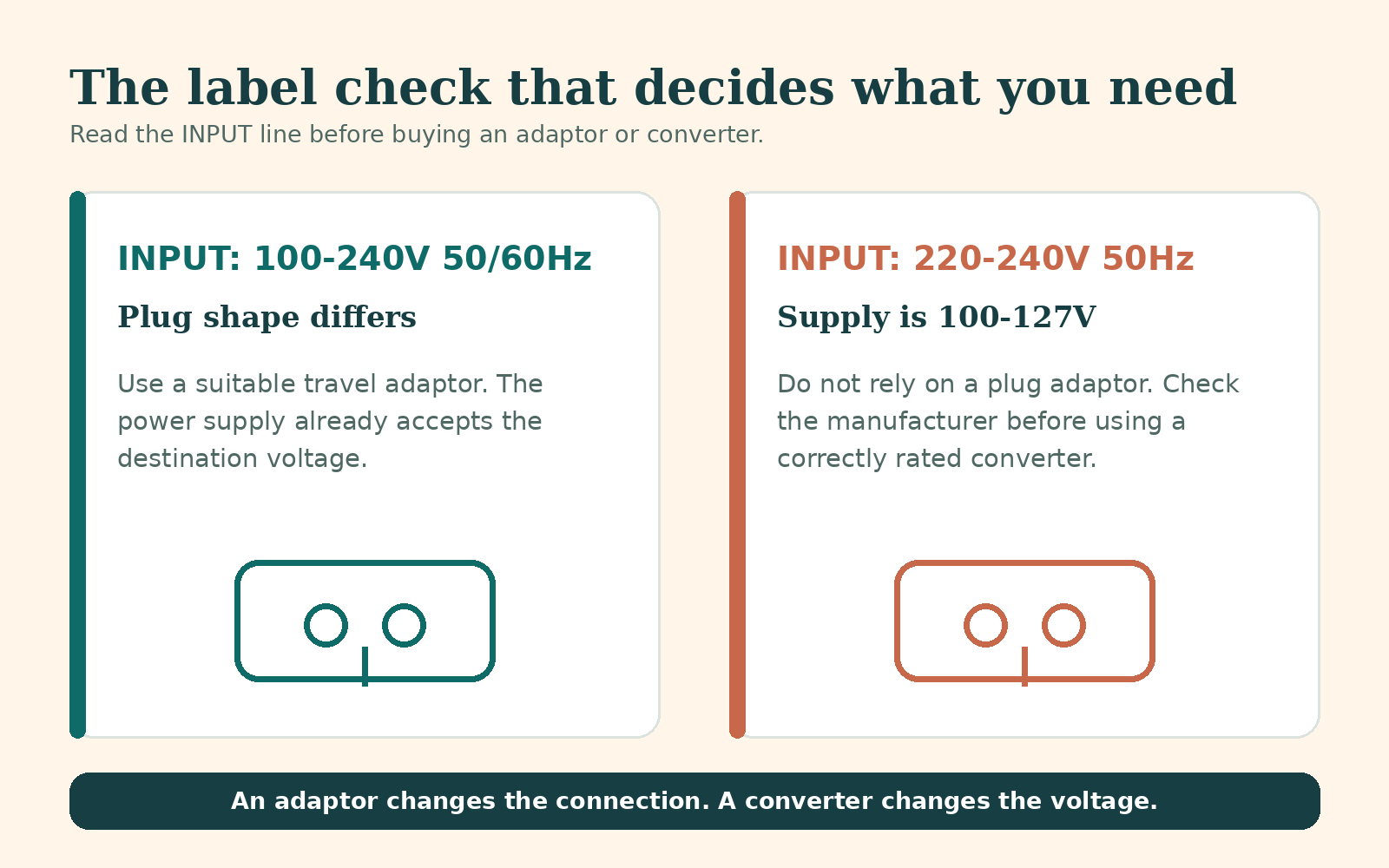
100–240V and 50/60Hz usually means a plug adaptor is enough.
Changes the connection
It does not change voltage or frequency.
Changes voltage
It must match direction, load type and continuous wattage.
Prefer purpose-built travel models
Hair tools and kettles are often poor converter candidates.
A travel plug adaptor solves only the mechanical mismatch between the plug on your device and the wall socket at the destination. It does not alter the electricity arriving at the appliance. That distinction is why buying a universal adaptor before reading any labels can still leave you with equipment that is unsafe or unusable.
Work in a fixed order. First identify the destination socket type so the plug can connect safely. Next compare the local supply voltage with the appliance input range. Finally check frequency, especially for equipment with motors, clocks, heating controls or other timing-sensitive parts. Many modern electronic power supplies accept both 50Hz and 60Hz, but the label has to say so.
| Question | Where to check | What the answer changes |
|---|---|---|
| Will the plug fit? | Destination socket type and adaptor compatibility | Whether a plug adaptor is required. |
| Will the voltage match? | The device or power-brick INPUT line | Whether an adaptor is enough or voltage handling is required. |
| Will the frequency match? | The Hz range on the label and destination supply | Whether motors, clocks or controls may behave incorrectly. |
Power supplies often carry several rows of tiny print. The decision-making line starts with INPUT. A phone charger might say “100–240V~ 50/60Hz”; a UK hair tool might instead say “220–240V~ 50Hz”. Those two labels demand different travel plans even when both products happen to end in a familiar plug.

How to interpret common labels
- INPUT 100–240V, 50/60Hz: wide-range input. Use the correct plug adaptor and stay within the adaptor’s current and wattage limits.
- INPUT 220–240V only: designed for higher-voltage supplies. In a 100–127V country it may not work properly; use a converter only if the manufacturer confirms suitability.
- INPUT 100–120V only: designed for lower-voltage supplies. Connecting it directly to 220–240V through a simple adaptor can damage the appliance and create a safety risk.
- A small selector marked 110/120 and 220/240: manual dual voltage. Set it before plugging in and follow the appliance instructions.
The OUTPUT line describes what a charger sends to a phone, tablet or laptop after conversion. It is useful for charging compatibility, but it does not tell you whether the charger itself can accept the destination mains supply. Read both lines, but use INPUT for the travel-voltage decision.
The words are often mixed together in marketplace listings. In simple terms, a travel adaptor changes the physical connection. By contrast, a voltage converter or transformer changes the voltage. Some combined products contain both functions, but they should state that explicitly; a universal socket on the front does not prove that voltage conversion is taking place.
| Product | What it changes | What it does not guarantee | Typical use |
|---|---|---|---|
| Plug adaptor | Pin shape and socket connection | Voltage, frequency or device compatibility | Wide-range phone and laptop chargers. |
| Step-down converter | Higher supply voltage to a lower device voltage | Suitability for every motor, electronic circuit or heat appliance | A manufacturer-approved 110–120V device used on a 220–240V supply. |
| Step-up converter | Lower supply voltage to a higher device voltage | Correct frequency or enough continuous wattage | A manufacturer-approved 220–240V device used on a 100–127V supply. |
| Dual-voltage appliance | The appliance is designed for more than one voltage range | Correct plug shape or automatic switching | Purpose-built travel hair tools and some shavers. |
Switch-mode power supplies used by many phones, tablets, cameras and laptops are commonly designed for 100–240V at 50/60Hz. Apple’s current guidance, for example, specifies 100–240V input for compatible iPhone power adapters, and its Mac support pages focus on matching USB Power Delivery wattage rather than carrying a separate mains-voltage converter.
That does not make every charger universal. Read the exact brick you are packing, not a specification remembered from a similar model. Replacement chargers, docking stations, older devices and low-cost marketplace products can have different input ranges. If a detachable mains lead connects to the brick, the brick may be universal while the lead or plug still needs replacing or adapting.
Do not confuse charger wattage with mains voltage
A 65W USB-C charger can still accept 100–240V input, while a 1,600W hair dryer may be limited to one mains range. Wattage tells you the scale of power involved; voltage range tells you whether the product can connect to the supply. Both matter, but they answer different questions.
Heat appliances are where casual converter shopping causes the most trouble. Hair dryers, kettles, irons and some styling tools draw far more power than a phone charger. They also use heating elements, motors and temperature controls that may not behave well with lightweight electronic converters. Even when the voltage direction is correct, the converter must support the appliance’s continuous load and the manufacturer must permit that type of use.
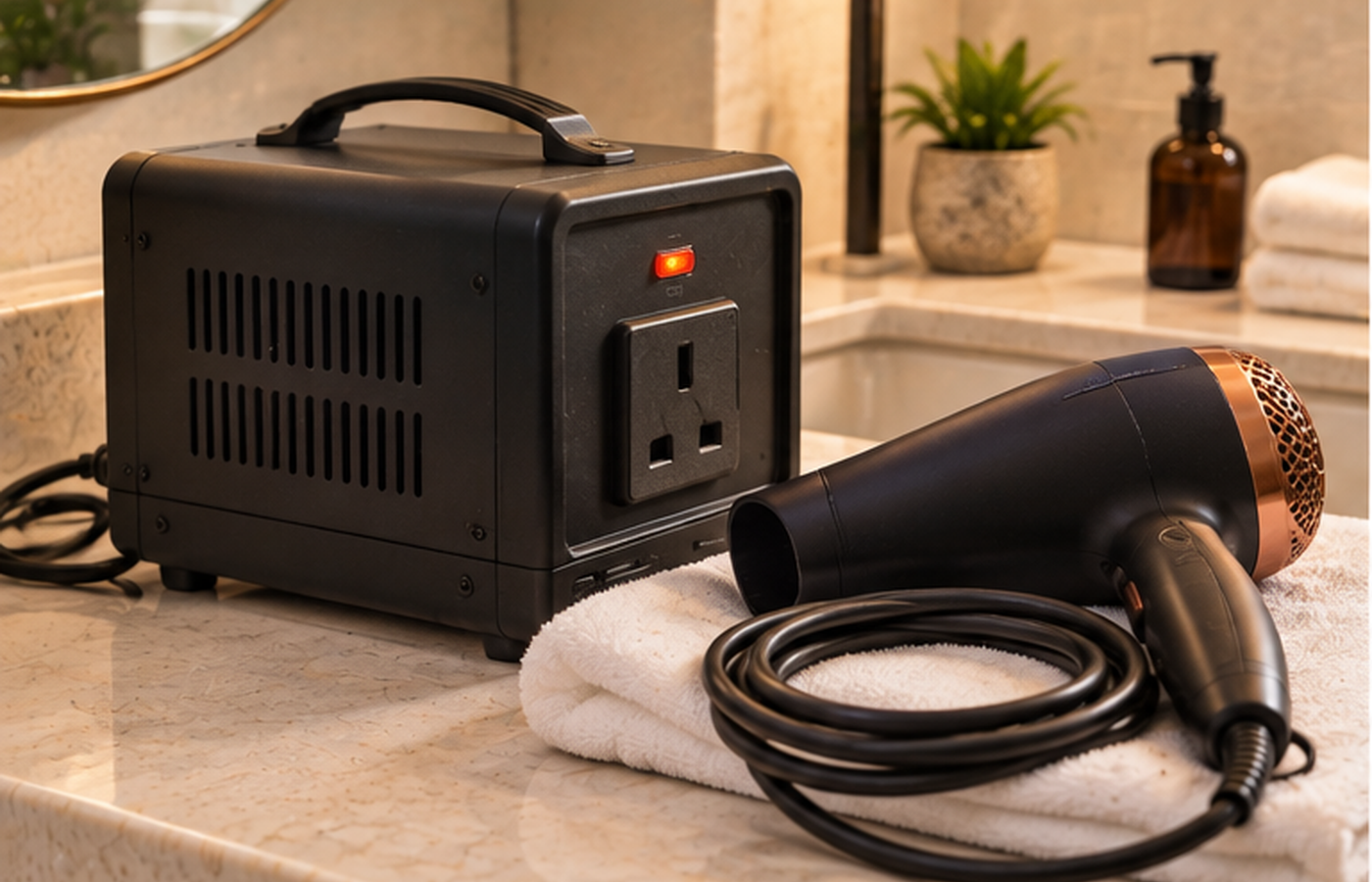
For a short trip, the most reliable answer is often to use the hotel appliance, buy a genuinely dual-voltage travel version or obtain a suitable appliance locally. Dyson’s 2026 travel guidance illustrates the design difference by describing a purpose-built travel dryer that automatically adapts across 110–240V; the key lesson is the stated input capability, not the brand name.
A converter becomes relevant when three conditions are all met: the appliance input does not include the destination supply; the manufacturer allows use with the proposed converter or transformer; and the converter provides the correct voltage direction with sufficient continuous capacity. Missing any one of those checks turns a technically plausible purchase into a guess.
Step-down and step-up are not interchangeable
Travelling from the UK to the United States with a 230V-only appliance would require stepping the local 120V supply up. Travelling in the opposite direction with a 120V-only appliance would require stepping 230V down. Some products are bidirectional, but many are not. The selector and sockets must be unambiguous, and the unit must be configured before connection.
Electronic converter or transformer
Small electronic converters can be marketed for simple heating loads, whereas heavier transformers may be intended for continuous use and a broader range of equipment. Neither category is automatically compatible with sensitive electronics, motor-driven products or medical equipment. Electrical Safety First advises checking with the manufacturer because some electronic appliances are not suitable for converter use.
Every adaptor and converter has a current or wattage ceiling. Electrical Safety First recommends checking that the connected appliance does not exceed the rating shown in amps or watts. The ceiling may change with supply voltage: the SKROSS PRO World & USB data sheet, for example, states 700W at 100V and 1,750W at 250V and clearly says that the product does not convert voltage.
Converters may advertise a large peak figure while permitting a lower continuous load. Use the continuous rating for anything that runs longer than a brief surge, and leave practical headroom rather than operating at the printed maximum. Motors can draw more at start-up, while heat appliances can remain close to their rated power for several minutes.
| Label item | Why it matters | Safer interpretation |
|---|---|---|
| Maximum amps | Sets the current limit of the adaptor or fuse | Do not exceed it with one device or a multi-socket combination. |
| Maximum watts | Sets the load at a stated voltage | Check whether the rating changes at 100V and 230V. |
| Continuous rating | What a converter can sustain | Use this, not a short peak figure, for normal operation. |
| Duty time | Some converters permit only short use | A “10-minute” unit is unsuitable for continuous electronics. |
A safe voltage match does not fix an unsafe connection. Some compact adaptors accept an earthed plug but do not carry the earth connection through to the destination socket. Others are intended only for double-insulated appliances, identified by the square-within-a-square symbol. If the equipment requires an earth, the entire adaptor chain must preserve it.
For UK users, Electrical Safety First states that travel adaptors sold with a UK plug or socket section must meet BS 8546. A fused UK plug does not remove the need to check the adaptor’s own fuse, current rating, shutters, pin construction and destination compatibility. Buy from a reputable retailer, inspect for looseness or heat damage and unplug when not in use.
Avoid unstable stacks
A heavy universal adaptor, charger and several cables can lever itself out of a loose wall socket. A short extension lead designed for the destination or a charger with interchangeable plug heads may reduce strain. Do not stack an adaptor into another adaptor unless the manufacturer explicitly supports the arrangement.
Countries can use more than one socket type, and hotels may add universal sockets or low-power bathroom outlets. The destination check should identify the nominal voltage, frequency and socket types for the actual places on the itinerary. A stopover can create a second plug requirement even when the main destination uses the same voltage as home.
Universal hotel sockets are not proof of universal electrical compatibility. They can accept several pin shapes while still delivering the local mains voltage. Likewise, a shaver socket may be isolated and power-limited. Read the socket markings and hotel instructions before connecting anything more demanding than the intended appliance.
The following examples show how the same destination can produce different answers. They are decision patterns, not permission to ignore the label on the exact product.
| Device label | Destination supply | Likely solution | Reason |
|---|---|---|---|
| Laptop brick: 100–240V, 50/60Hz | 230V, 50Hz | Correct plug adaptor only | Input range already covers the supply. |
| UK hair dryer: 220–240V, 50Hz | 120V, 60Hz | Prefer local or approved dual-voltage dryer | Plug adaptor does not correct voltage or frequency. |
| Travel shaver: 100–240V, 50/60Hz | 120V, 60Hz | Correct plug adaptor | Wide-range input. |
| US-only appliance: 120V, 60Hz | 230V, 50Hz | Manufacturer-approved step-down solution or do not use | Both voltage and possibly frequency differ. |
| Manual dual-voltage iron: 110/120 or 220/240V | 230V, 50Hz | Set selector to 220/240 and use adaptor | The selector makes the appliance compatible when correctly set. |
Current listings show why specification reading matters more than product category. Prices and availability below were checked on 20 September 2026 and can change.
| Example | Checked specification | Price context | What it illustrates |
|---|---|---|---|
| SKROSS PRO World & USB | 100–250V input path, 7A maximum, up to 1,750W at 250V; no voltage conversion | Model and retailer prices vary | A universal adaptor can be powerful while still not converting voltage. |
| Apple 20W-class USB-C adapter guidance | 100–240V, 50–60Hz for compatible adapters | Brand and retailer prices vary | Many electronic chargers are wide-range. |
| Purpose-built dual-voltage travel hair dryer | Model-dependent 110–240V capability | Commonly about £25–£100+ | Buying the right appliance can be simpler than carrying a high-wattage converter. |
| Travel voltage converter | Direction and continuous wattage vary widely | Commonly about £30–£100+ | The correct choice depends on load type, not only headline watts. |
A home test cannot reproduce a foreign mains supply, but it can reveal poor mechanics, confusing controls and an impractical packing setup. Do not attempt to simulate a different voltage with improvised wiring. Instead, inspect and rehearse the parts that can be tested safely.
- Photograph the INPUT and wattage labels on every device and charger.
- Confirm the adaptor accepts the actual plug, including an earth pin when required.
- Check that the adaptor’s destination pins extend fully and lock firmly.
- Add the expected charger or appliance and confirm the stack does not sag out of the wall socket.
- Read the converter manual for voltage direction, load type, continuous rating and duty time.
- Label any manual 110/230V selector and practise setting it while the appliance is unplugged.
- Pack each item in the intended pouch and ensure a converter’s ventilation openings remain unobstructed.
Advantages
- Can support a genuinely single-voltage appliance when the maker approves the load and converter type.
- May avoid replacing a specialist item for a long stay.
- A properly rated transformer can provide a stable voltage change for compatible equipment.
Limitations
- Adds bulk, weight, heat and another possible failure point.
- Does not automatically correct frequency or make every motor and electronic circuit compatible.
- High-wattage converters are often less convenient than a dual-voltage or local appliance.
- Incorrect voltage direction or selector position can damage equipment immediately.
A plug adaptor has a different balance: it is small and usually essential, but it is safe only when the appliance already accepts the destination supply and the adaptor preserves the necessary earth and load rating.
- Assuming a universal socket means universal voltage.
- Reading the USB OUTPUT line and missing the mains INPUT line.
- Buying a “2,000W” converter without checking whether that is peak or continuous and which appliance types are allowed.
- Using an unearthed adaptor with equipment that requires an earth connection.
- Forgetting to set a manual dual-voltage selector before connection.
- Stacking heavy adaptors and chargers until the wall connection becomes loose.
- Using a converter for medical or specialist equipment without manufacturer approval.
- Testing a questionable setup for the first time after arrival, when returning it is difficult.
Does a travel adaptor convert 230V to 110V?
No. A standard travel adaptor changes the plug connection only. Voltage conversion must be explicitly stated and correctly rated.
What label means I only need a plug adaptor?
INPUT 100–240V, 50/60Hz normally indicates that the power supply accepts the principal global mains ranges. You still need a safe adaptor for the destination plug.
Can I use a UK hair dryer in the United States with an adaptor?
Not unless the dryer itself supports the local voltage and frequency or the manufacturer approves a suitable converter. Many UK domestic dryers are not designed for 120V travel use.
Is a higher-watt converter always safer?
No. Capacity is only one factor. The voltage direction, continuous rating, waveform or converter type, duty time and appliance compatibility all matter.
Do I need a converter for a laptop?
Most modern laptop power supplies are wide-range, but check the exact INPUT label. If it says 100–240V, a suitable plug adaptor is normally enough.
What does the square-within-a-square symbol mean?
It identifies Class II or double-insulated equipment, which does not rely on a protective earth in the same way as Class I equipment.
Can I connect a power strip to a travel adaptor?
Only when the adaptor and strip are permitted for that arrangement, the earth path is preserved and the combined load remains within all ratings. A destination-approved extension is often safer.
Will a converter also change 50Hz to 60Hz?
Usually not. Many travel converters change voltage but leave frequency unchanged, which can matter for motors, clocks and controls.
Build the decision around the appliance label. When INPUT covers 100–240V and 50/60Hz, buy a reputable destination adaptor that preserves the required earth and stays within its load rating. When the appliance is single-voltage, first ask whether it is worth taking at all. A purpose-built dual-voltage or local appliance is often the more reliable answer for hair dryers, irons and other high-power products.
Use a converter only after the manufacturer confirms compatibility and you have matched voltage direction, frequency implications, continuous wattage, duty time and load type. That slower process prevents the common mistake of solving the visible plug problem while overlooking the electricity behind it.
The article was checked against the following authoritative and manufacturer sources. Product prices and availability are dated examples rather than permanent claims.
- Electrical Safety First — travel adaptor safety — accessed 20 September 2026.
- Electrical Safety First — using electrical appliances abroad — accessed 20 September 2026.
- Apple Support — power adapters for iPhone — accessed 20 September 2026.
- SKROSS — PRO World & USB technical data — accessed 20 September 2026.
- Dyson — travel hair-dryer voltage guidance — accessed 20 September 2026.
- IEC — why plug and socket systems differ — accessed 20 September 2026.