Travel Backpack vs Duffel Bag for Multi-Stop Trips
The right bag is the one you can carry, open and restore repeatedly when the trip stops being neatly packed.
Original concept illustration; not a depiction of a specific product or a hands-on test.
A travel backpack vs duffel bag decision becomes more interesting after the second or third change of accommodation. On departure morning, either bag can look organised. Later, the clothes are partly worn, a charger has moved, the next train is approaching and the route to the room includes steps. That is when the carrying method and packing layout begin to matter.
A backpack is often the stronger starting point for repeated public-transport changes and luggage walks. However, a duffel can be simpler when most movement is between a vehicle and a room, particularly when broad access matters more than long-distance carrying. Convertible designs sit between those options, but their shoulder straps need inspecting rather than accepting at face value.
This guide compares the systems through research and practical planning examples. Product specifications are sourced; judgements about which arrangement suits a journey are explained rather than presented as invented test scores. The focus is a multi-stop holiday with ordinary travel belongings, not a claim that one bag can replace specialist equipment for every expedition.
Backpack is the starting point
Keep both hands available, provided the harness and packed weight work for you.
A duffel can be simpler
Wide access and a flexible body suit short carries between transport and rooms.
Inspect the harness
Two shoulder straps do not make every duffel equivalent to a framed travel pack.
Repack used clothing
A system should still work after several stops, not only on departure morning.
Travel backpack vs duffel bag: compare the repeated tasks
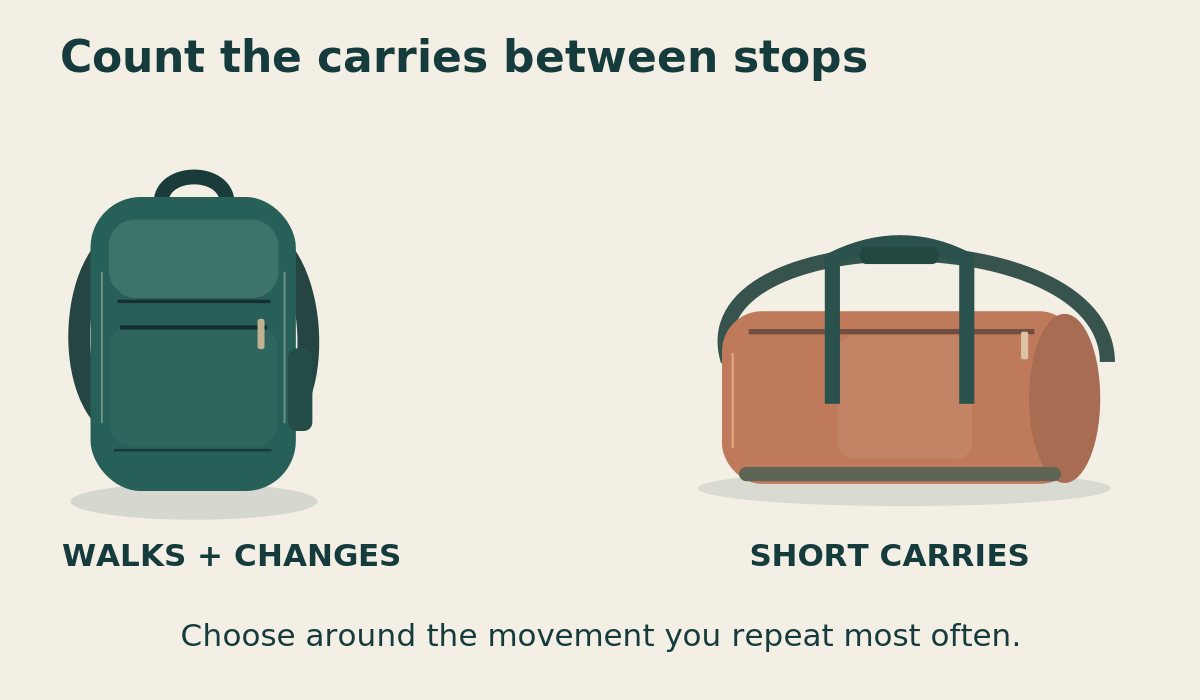
The number of nights is not the number of carries
A week in one room can involve fewer luggage movements than a three-night trip with a different bed each night. Therefore, begin by counting transfers, not by assigning a bag size to the calendar. Include station entrances, vehicle loading, storage at accommodation and the return to transport.
Next, identify how often you need to open the main bag during those movements. A duffel’s broad opening can be helpful when you regularly remove a clothing module from the top. A backpack may be easier to keep with you while moving, but its access pattern needs to work without exposing the whole wardrobe in a queue.
On a smaller screen, scroll inside the table to see every column.
| Task | Travel backpack | Shoulder duffel | Convertible duffel |
|---|---|---|---|
| Repeated walking | A fitted harness can be useful | A one-sided load needs a careful trial | Inspect the actual backpack mode |
| Short vehicle transfers | Works, though a harness may be unnecessary | Often a straightforward format | Can offer more options than needed |
| Packing access | Depends on opening and compartments | A broad opening can simplify access | Duffel access with extra carrying hardware |
| Organisation | May be built into the bag | Often relies on a few modules | Check whether modules affect carrying comfort |
| Flight dimensions | Frame and pockets can fix the outline | The filled body may be deep | Straps do not change the permitted dimensions |
Judge the least convenient version of the trip
The useful question is not how the bag performs while empty or perfectly packed. It is how it works when the clothing is less tidy, the load is slightly uneven and you need to move again. That situation should appear in the home trial rather than become a surprise after the first stop.
This comparison does not score the categories as universally better or worse. A traveller with short vehicle-to-room carries may accept a shoulder duffel’s limitations quite reasonably. Someone changing trains and walking to several guesthouses may place much more value on a fitted backpack harness.
Back to top ↑Map the carries before choosing a capacity
Make a simple transfer inventory
Write each leg as a sequence of handling tasks: carry from the room, move to transport, load, retrieve, walk to the next room, unpack. Add any period when the luggage stays with you before check-in. It is easy to overlook that last part when a booking page only shows the scheduled journey time.
A suggested planning notation is short carry, moderate walk or sustained carry. Define those bands around your own experience rather than a universal time limit. The labels help reveal a trip with many small interruptions which together make a heavy shoulder bag less appealing.
Count hands as well as distance
Think about what else you need to manage: a ticket, a handrail, a child’s hand or a door. A backpack can keep your hands available, although its size and balance still matter. A duffel carried by its handles occupies one hand; using its shoulder strap changes the task but does not make the weight disappear.
Also consider the objects carried with the main bag. A small daypack and a shoulder duffel can be workable for a short transfer, but two loaded backpacks worn front and back are a different arrangement from one well-fitted travel pack. Trial the complete system rather than assessing each bag separately.
Why a travel backpack often suits transfer-heavy journeys
The load remains attached while you move
A travel backpack can keep the belongings close through stairs, barriers and short changes of transport. That is a practical advantage when you repeatedly need to switch attention between the bag and the route. However, a poor fit or an excessive load can undermine it quickly.
Look for a carrying system suited to the weight you actually pack. Osprey’s fit guidance distinguishes torso length, shoulder fit and hipbelt fit, so do not assume that tightening two straps turns any large bag into a comfortable travel pack. Use the adjustment sequence for the model and check the loaded position. [1]
Framed travel designs are one useful benchmark
The Fairview 40 S26 combines travel access with a frame, adjustable torso and a stowaway harness. Its manufacturer lists 55 x 35 x 23cm and 1.47kg. Those features make it a sensible reference when comparing a supported travel pack with a duffel that merely adds removable shoulder straps. [2]
The linked Amazon UK listing identifies the black 40L model 10007374. Confirm the model and seller before ordering, and compare it with the manufacturer’s current specification rather than relying on a broad product-family title. This remains a fitting candidate, not a recommendation that it will suit every body. [3]
Back to top ↑Where a conventional duffel is genuinely convenient
A broad opening can simplify room-to-vehicle travel
A duffel can work like a flexible container for several packing modules. You can place it on a suitable surface, open the top and remove the item required without unfolding two large halves. For a car-led trip, that access pattern may be more useful than a sophisticated backpack harness.
The flexible body can also make it easier to organise around an irregular combination of clothing and equipment. Nevertheless, softness is not unlimited capacity. An overfilled duffel becomes bulky, can be awkward to close and may place pressure on items near the zip. Judge it in the shape it will actually have when packed.
A shoulder strap is a short-carry convenience, not magic
Inspect the strap width, padding, adjustment and attachment points, and check whether the bag stays controlled at your side. A strap which slides, twists or lets a heavy bag swing may be irritating even over modest distances. Try both the handle and shoulder modes while the normal contents are inside.
BAGSMART’s REIKI 30L illustrates this type of organised shoulder duffel. Its UK page lists 45 x 24 x 27cm and 0.95kg, with a separate shoe area and detachable crossbody strap. It is a useful format to inspect for short carries, not evidence of a load-bearing backpack harness. [4]
Back to top ↑Convertible duffels need their own comparison
Two straps do not make two bags equivalent
A duffel with backpack straps can be useful when an occasional staircase interrupts a mostly vehicle-led journey. But check how the harness is attached, where the bag sits, whether the contents press into your back and how much adjustment is available. The conversion feature should be judged as a carrying system, not as an extra tick on a specification list.
The Osprey Transporter Duffel 40 S25 has a padded stowaway harness and a published 53 x 32 x 31cm outline. Its 0.96kg weight is for the non-wheeled 40L duffel. Do not confuse it with the Transporter wheeled models, which have different construction and measurements. [5]
A wheeled duffel solves a different problem again
Adding wheels can reduce carrying on suitable surfaces, but it introduces a frame, wheel hardware and additional empty weight. It also does not remove the need for lifting at steps or into vehicles. Compare the wheeled design with a case as well as with the plain duffel.
Samsonite’s Ecodiver foldable wheeled 4-in-1 is a larger luggage option, listed by Case Luggage at a maximum 82 x 40 x 25cm, 80L and 2.2kg. That maximum configuration is not a cabin-size recommendation. It belongs in a checked-luggage or compatible ground-transport discussion, with each configuration verified separately. [6]
Back to top ↑Check airline dimensions before relying on a soft shape
Measure the least compressible parts
A duffel can look smaller than a structured backpack because its fabric collapses when empty. Once filled, however, shoes, organisers and the base determine the shape. Measure the packed bag at its widest points and include handles or protrusions where the airline requires them.
Ryanair publishes 40 x 30 x 20cm for its small personal bag and 55 x 40 x 20cm for the Priority second bag. easyJet publishes 45 x 36 x 20cm small and 56 x 45 x 25cm large, with the large allowance needing to be booked or included. Rules checked 9 October 2026. [7] [8]
On a smaller screen, scroll inside the table to see every column.
| Example | Published dimensions | Airline-size implication |
|---|---|---|
| BAGSMART REIKI 30L [4] | 45 x 24 x 27cm | Shortest side is 24cm: not a paper match for a 20cm-deep allowance. |
| Osprey Transporter Duffel 40 S25 [5] | 53 x 32 x 31cm | Shortest side is 31cm: exceeds the listed 25cm easyJet large-cabin depth. |
| Osprey Fairview 40 S26 [2] | 55 x 35 x 23cm | Fits the easyJet large rectangle on paper; exceeds Ryanair Priority depth. |
| Mous Optimal Travel, normal [9] | 55 x 35 x 20cm | Matches the Ryanair Priority rectangle on paper, not the free personal item. |
| Ecodiver wheeled 4-in-1, maximum [6] | 82 x 40 x 25cm | Maximum configuration belongs in a larger-luggage discussion, not cabin recommendations. |
Rotation can help; wishful compression does not
Compare the three dimensions in the orientation that actually fits the permitted space. A duffel does not need to stand upright like a suitcase, but all three measurements must still fit simultaneously. Spare length cannot cancel an excessive shortest side, and a rigid item may prevent the compression you imagined.
The Transporter Duffel 40’s published 31cm shortest side exceeds the 25cm easyJet large-cabin depth as well as Ryanair’s 20cm limits. The REIKI’s 24cm shortest side also rules out those 20cm-deep allowances on paper. These comparisons are reasons to choose an appropriate allowance or another bag, not promises about what a gate agent might overlook. [5] [4]
Back to top ↑Decide whether you need a container or a compartment system
Open space is flexible but needs a method
A simple duffel gives you freedom to arrange the contents, which is valuable when the load changes between stops. In return, you need a consistent way to separate clothing, toiletries and small items. Without one, the same open space can become a deep mixed pile by the third morning.
A compartment-heavy backpack provides more fixed places, but those places need to match your equipment. A pocket that is too small for the actual charger does not improve organisation. Before paying for extra divisions, check whether the objects fit and whether you can remember the arrangement without inspecting every zip.
Technology-led packing may favour a travel backpack
Mous’s Optimal Travel Backpack provides a useful example of an organised 40L travel design, expandable to 45L. Its stated 2.2kg shell is considerably more substantial than a simple soft container, so compare the benefit of the organisation with the weight and space it takes. The accessories shown in some bundles are not all included with the bag alone. [9]
For a multi-stop working trip, dedicated computer access may save repeated rearrangement. For a clothing-led holiday with little technology, the same design may be more bag than you need. The useful distinction is the equipment and access pattern, not an assumption that more compartments are always worth buying.
Back to top ↑Keep transit essentials outside the clothing puzzle
Give frequently used items a fixed home
Identify the objects you need between rooms: travel documents, a payment method, a cable, a layer and anything else specific to the journey. Put them in an accessible place which remains usable after the main bag is packed. Test retrieving them while the bag is resting securely, rather than assuming every pocket works equally well when loaded.
A small organiser can move between a main bag and a day bag without requiring each loose item to be transferred individually. However, the organiser should not become the only location for every backup and valuable. Convenience and concentration of risk are separate questions.
Match the organiser to the pocket
TORRO’s travel wallet has a published 18.5 x 13.5 x 2.5cm size and 255g weight. That is a meaningful addition to a small front pocket, so compare it with a simpler pouch before deciding. Its practical value is the document arrangement; this guide does not present RFID protection as a solution to losing the whole wallet. [10]
On a trip with repeated border or ticket checks, a consistent document routine can be useful whichever main bag you choose. Once the check is finished, return the documents to their normal place before moving on. A fixed routine is more helpful than adding another pocket without deciding what belongs there.
Back to top ↑Design the packing system for stop three, not day one
Use modules that can change size
A clean-clothing module, a worn-clothing separation area and a toiletries arrangement give you a simple starting point. As the trip progresses, clean clothing shrinks while the worn section grows. Allow the spaces to change instead of forcing both into fixed compartments which were only suitable on departure.
Compression cubes can help retain order, but avoid making every cube a hard block. In a duffel, excessively rigid modules can waste the soft corners. In a backpack, they may make the load press into the back panel or prevent a useful pocket from opening.
Separate by the next action as well as by item type
For an overnight stop, you might need sleepwear, toiletries and one change of clothing first. Put that small group where it can be reached without opening every other module. At a longer stay, you may instead want to unpack the clothing more fully while leaving transit equipment organised.
The method should support both situations. Try switching between an overnight stop and a three-night stay at home, then repack without restoring every item to showroom neatness. A bag which tolerates that change is more useful on a multi-stop trip than one which only works with a highly precise packing order.

Vehicle-led travel can be a strong case for a duffel
The important carries may be short and predictable
On a journey where the bag moves from car to accommodation and back, a conventional duffel can offer convenient access without paying a weight or complexity cost for a substantial harness. Check the actual distance, stairs and loading height, because ‘travelling by car’ does not guarantee the bag is never carried far.
Consider the shape of the available luggage space as well. Several soft bags can sometimes be arranged more flexibly than rigid cases, but do not use that flexibility to crush fragile belongings or obstruct necessary visibility and access. The bag should work within the vehicle’s safe loading arrangement, not dictate it.
Keep the travel day simple
A shoulder duffel such as the REIKI 30L is worth inspecting when clothing access and short carries are the priorities. Its shoe section can separate items, but it occupies part of the same overall space. Trial the shoes and clean clothing together rather than counting the compartment as extra capacity. [4]
If the bag will be left with accommodation while you go out, a small day bag may complete the system. However, include that bag in your loading and flight plan. A convenient two-bag setup becomes less convenient when both are full and you unexpectedly need to carry them together.
Back to top ↑Public transport rewards a controlled, compact load
Hands-free movement is only useful with a good fit
A backpack can simplify steps, ticket barriers and changes where you need a free hand. It also keeps the main bag attached while you move between a platform and a vehicle. Nevertheless, remove or reposition it appropriately in crowded interiors rather than turning with a large load behind you.
For a restrained clothing list, the Daylite 26+6 is a smaller travel-pack example to compare. Its published normal dimensions are 43 x 33 x 16cm, so it is not a paper match for Ryanair’s free small-bag height and width. Use it within an appropriate booking rather than assuming a compact look guarantees acceptance. [11] [7]
Several changes make a poor strap more noticeable
A shoulder duffel which feels acceptable for one short carry may become less appealing when the same task recurs throughout the day. Try the actual load before relying on the shoulder strap for a transfer-heavy itinerary. Switching shoulders is not evidence that the original load or bag is suitable.
A supported travel pack such as the Fairview may be the more productive comparison when the carries cannot be shortened. However, choose the fit first and do not use its capacity as an invitation to add belongings. A better harness can improve a sensible system; it does not make unnecessary weight free. [2]
Back to top ↑A laptop-led multi-stop trip needs a different priority order
Protect access before chasing spare clothing space
A computer, its charger and any required work equipment create a relatively inflexible load. Fit those objects first, with appropriate protection and without pressing hard accessories against the device. Then see what clothing space remains. This avoids discovering that the laptop only fits when the main bag is partly empty.
A dedicated compartment can be helpful if you repeatedly work before check-in or after checkout. But test the compartment with the complete packing arrangement: a useful opening must remain accessible when the bag is full. Do not assume a product’s advertised screen size describes every laptop’s external dimensions.
Count what the organisation replaces
The Mous travel model may interest someone who would otherwise carry several separate technology pouches. Compare the actual included layout with that existing system before adding a modular bundle. Manufacturer protection claims are not hands-on drop-test results from this guide, and fragile items still need careful packing. [9]
For a trip with no computer, that weight and organisation may not be justified. A simpler backpack or duffel could leave more room for clothing without changing how you use the bag. The correct choice is the one which serves the real working requirement, not the most elaborate option available.
Back to top ↑Weather, damp clothing and storage surfaces
Plan how the contents stay protected
Ask what might happen between stops: a wet platform, a short exposed walk or clothing packed before it has fully dried. A manufacturer’s water-resistant fabric description does not settle every one of those situations. Consider the openings, seams and protection around the contents as well as the outer material.
In an open duffel, separate vulnerable objects from damp gear and avoid making them bear the pressure of the rest of the load. In a backpack, check whether wet clothing in an exterior pocket presses against a device sleeve or changes the outline. The layout should accommodate the situation without a complete rebuild.
Dry and reset when you reach a suitable stop
Use the next practical opportunity to dry damp items and restore their storage arrangement. Sealing them away may help a transfer, but it does not make prolonged damp storage a good plan. Leave enough time and space at accommodation for that reset rather than depending on the next travel day to solve it.
For the bag itself, follow model-specific cleaning instructions. Osprey’s care guidance recommends gentle cleaning and ventilated drying, and treats wheeled chassis differently from ordinary fabric packs. Do not assume that a tough-looking duffel or travel pack can simply be machine washed after a muddy journey. [12]
Back to top ↑Prevent a changing load from becoming an awkward load
Put dense objects where the carrying method can manage them
The same packing layout may not work equally well on your back and at your side. A heavy charger in the outermost duffel pocket can pull the bag away from the body; a hard object against a backpack’s back panel can create an uncomfortable pressure point. Test the load in every carrying mode you intend to use.
Internal compression or restraint can help prevent movement, but it should not force the contents into unsafe pressure against electronics. Fill gaps thoughtfully and keep modules stable without treating the zip as a compression tool. If the bag needs excessive force to close, reduce or rearrange the load.
Recheck after the contents change
Laundry, purchases and changing layers can alter balance even when the total quantity of luggage seems similar. After repacking, lift the bag in the intended way and make sure it still sits predictably. A brief check is easier than discovering a shifting load while boarding a train.
This is another reason to avoid packing at the absolute limit. Some flexible room makes it easier to keep the arrangement stable when clean and worn clothing exchange places. Spare capacity has a practical role here; it is not simply an invitation to fill the bag with extra objects.
Back to top ↑Run a multi-stop rehearsal at home
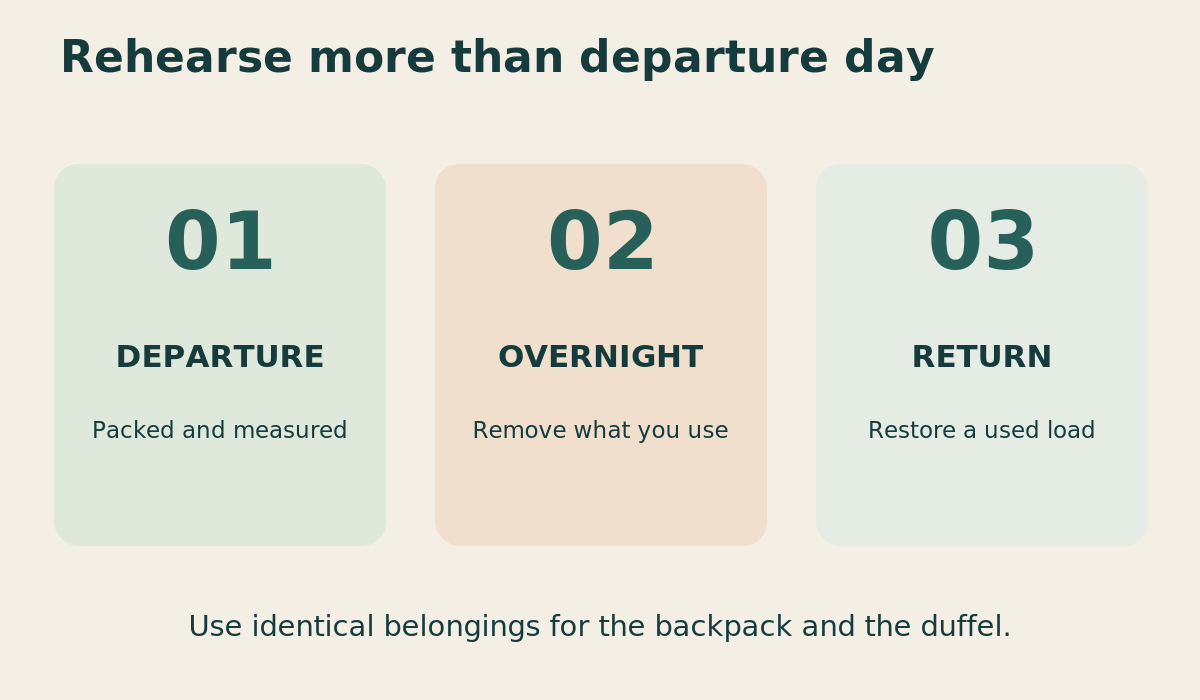
Simulate departure, an overnight stop and the journey home
First pack the normal list, measure the bag and try the carrying method. Then remove the items for one night, set aside worn clothes and restore the bag. Finally, repack as though the holiday is ending, with the toiletries and outer layer in the less tidy arrangement you expect after use.
Use the same belongings for the backpack and duffel. Otherwise, you may accidentally give one candidate an easier trial. Keep notes about specific problems such as blocked access, a strap which twists or a module which cannot be replaced without emptying the rest.
Compare organisers with and without the bag's own divisions
A compression set is worth testing only where it improves the arrangement. Try one clothing module first, then add another if it solves a separate problem. In particular, avoid lining every compartment with another organiser simply because a matching set looks tidy in a photograph.
The BAGSMART set offers different sizes, so compare their actual footprint with the bag rather than assuming they are designed for that particular model. Their role is organisation and some bulk management, not reducing the mass of the packed clothing. [13]
Plan for checked luggage without mixing up the essentials
Larger luggage can be the honest answer
Some multi-stop trips genuinely involve equipment or clothing which does not fit a small cabin system. In that case, compare a suitable checked bag and manageable day bag rather than pretending every itinerary should be a minimalist challenge. The main luggage still needs a realistic carrying and loading plan at each stop.
A wheeled expandable duffel such as the Ecodiver 4-in-1 may serve that role where its dimensions and configurations suit the transport. Check the actual configuration you will use and do not infer cabin acceptance from a folded product photograph. The maximum eighty-litre specification describes a substantially larger bag. [6]
Keep a removable essentials set
Before handing over any bag, identify what must remain with you. The CAA advises keeping spare batteries and power banks in the cabin and removing relevant batteries or lithium-powered devices when a cabin bag is taken for the hold. Follow your operating airline’s instructions and make the removal practical in your packing layout. [14]
Documents, necessary personal essentials and fragile equipment also need a deliberate plan rather than being left in the least accessible corner. A removable pouch can help, but it must fit within the cabin arrangement you are allowed to keep. Do not assume an unexpected hold request creates an unlimited extra hand-luggage allowance.
Back to top ↑Shared equipment changes how a group should divide the bags
Assign shared items without creating one unmanageable load
Two people may share toiletries, an adapter or some other equipment, but that does not mean one person should carry every dense object. Allocate the shared items alongside the personal clothing lists and check each finished bag. A balanced group plan is more useful than two equal-capacity bags with very unequal contents.
Discuss who will need the item during a transfer. A shared charger buried in the bag which is least accessible may complicate the journey. Likewise, putting all the documents into one main duffel can create unnecessary dependence on that bag being immediately available. Keep the active travel arrangement deliberate.
The main luggage format can differ between travellers. One person may prefer a supported backpack while another uses wheels or a short-carry duffel. There is no need to make everyone use the same style simply because matching bags look organised; individual carrying ability and the contents still matter.
Keep an individual essentials plan
Shared luggage can be economical in space, but each traveller should know where the items needed during the journey are kept. Consider the practical impact of separating briefly, boarding at different times or leaving one bag in storage. A simple individual essentials set can make that situation easier without duplicating the whole packing list.
When one large bag replaces two smaller ones, trial the lifting task carefully. Fewer pieces do not automatically mean less effort, especially if the combined load is too heavy for one person to handle comfortably. Check the transport allowance as well: pooling baggage weight or bag counts depends on the actual booking rules, not on travelling together.
Finally, agree how the shared items return to the bags after use. Multi-stop travel exposes unclear systems quickly because the next departure arrives before everyone has reconstructed the original packing arrangement. A consistent home for each shared object is more useful than adding another organiser without assigning responsibility.
Back to top ↑Make each change of transport a controlled sequence
Prepare before you reach the narrow doorway
Before boarding, secure loose straps and close pockets, while keeping the ticket and other immediate essentials accessible. A convertible duffel may need its unused straps tucked away; a backpack may need to come off before you turn in a crowded aisle. Do that preparation in a suitable space rather than blocking the entrance.
Once aboard, follow the operator’s storage instructions and keep walkways clear. Think about how you will retrieve the bag without pulling on a fragile external pocket or snagging another passenger’s belongings. The location which is easiest to reach is not always the location where luggage may safely be placed.
This sequence does not require a complicated checklist. It simply separates preparation, movement and storage so that you are not trying to adjust the bag while handling every other task. The benefit applies to both formats and is especially useful when a trip involves repeated short connections.
Reset the bag before the next departure
At the room, put the transit essentials back into their established positions as soon as practical. Recharge only the equipment you need, then return the correct cables to the travel arrangement. Check that items used during the stay have not migrated into furniture or an extra bag which was not part of the plan.
Before leaving, lift the main bag once in its intended carrying mode and check that it closes without unusual pressure. Look at the straps and the floor around the packing area. A small reset now is easier than discovering an open side pocket or an unbalanced load halfway through the next transfer.
For the final journey home, use the same sequence rather than treating the return as an exception. Worn clothing and purchases may change the contents, but the transport dimensions and need for accessible essentials remain. A good multi-stop system is repeatable in both directions.
Back to top ↑Look for repairable details and a useful return process
Inspect the stress points of the chosen format
For a duffel, examine handle stitching, strap attachments, the main zip and the base. For a backpack, add the harness adjustment hardware and the connection between the carrying system and the body. A failure at one of those points can matter much more than a cosmetic scuff.
Ask the retailer how faults and repairs are handled for the exact model. A long warranty term is not a complete description of what is covered. Compare exclusions, proof-of-purchase requirements and whether a relevant replacement part is available, rather than assuming every brand uses the same meaning of lifetime cover.
Do the trial before your travel date becomes a deadline
Order with enough room for a careful indoor trial and any necessary return, checking the seller’s current conditions first. Keep the chosen variant and model number on the shortlist so that a different size is not accidentally substituted during shopping. Avoid personalisation until you understand its effect on returns.
A bag which solves one clear problem may be better value than a premium multi-mode design with features you never use. However, a cheap strap system which makes every transfer unpleasant is not a bargain either. Compare the improvement with the journeys you actually expect to make, not with an idealised future itinerary.
Back to top ↑Three multi-stop choices worked through
Several train changes with small accommodation rooms
For this illustrative trip, begin with a manageable backpack and a clothing layout which allows one-night access without emptying everything. The repeated carrying tasks favour hands-free movement, while the small rooms make a controlled opening useful. Keep the travel-day essentials separate from the clothing modules.
A convertible duffel remains an option if its harness trial is successful, but do not assume it is equivalent just because the capacity is similar. The deciding evidence is how the packed bag sits and how easily you can restore the system after each stop.
A road trip with short room-to-car carries
Here a shoulder duffel may be the simpler choice. Broad access can make it easy to remove an overnight module while the remaining belongings stay packed. Judge the available vehicle space and the real lifting tasks before choosing a larger size.
A daypack can handle outings while the main clothing bag stays at accommodation. Nevertheless, have a plan for occasions when both bags must move together. The route is vehicle-led, not a guarantee that every entrance, parking arrangement or room will be immediately beside the car.
Work equipment combined with frequent moves
For a working trip, the computer and its access requirements should lead. A dedicated travel backpack may reduce the number of separate pieces you handle, provided its empty weight and layout are justified by the equipment. Try the laptop, charger and clothing in the exact configuration you plan to use.
A duffel with a separate protected computer arrangement can still work for short carries. The important thing is not to leave the technology as an afterthought squeezed between clothing modules. Choose one coherent system and rehearse the transfer rather than combining bags only on departure morning.
Back to top ↑Advantages and compromises of each approach
Travel backpack
Its strongest advantages are hands-free movement and the possibility of a fitted carrying system for repeated walks. Suitable travel layouts can also provide organised access without requiring a separate computer bag. Those benefits are most useful when they solve tasks repeated throughout the itinerary.
The compromises include carrying the load continuously, possible heat and pressure, and the weight of a more substantial harness or compartment system. A backpack is not automatically comfortable or cabin-compliant. It earns its place through the loaded trial and the transport check.
Conventional or convertible duffel
A duffel offers broad access and a flexible packing space, often with simple handling for short transfers. A convertible version can add another carrying option when that option is genuinely usable. The format can be particularly sensible when vehicles do most of the long-distance moving.
The compromises include one-sided shoulder carrying, potential swinging or sagging, and less inherent organisation in a simple open compartment. Convertible straps do not remove those concerns automatically. Evaluate each mode separately and accept the bag only when the intended uses work with the real load.
Common multi-stop packing mistakes
Treating departure-day neatness as proof
A bag packed carefully once has not yet demonstrated a useful multi-stop routine. Repeat the packing after removing clothing and adding a worn-item section. If it only closes in the original perfect order, simplify the system before the trip.
Buying a conversion feature without trying it
Backpack straps may be suitable for occasional short movement but uncomfortable for the full transfer you have planned. Trial that specific mode with identical contents before calling a convertible duffel the best of both formats.
Ignoring the return configuration
The bag needs to accommodate used clothing, a removed layer and any planned purchases without changing into a size the booking does not permit. Leave a deliberate margin, and do not treat an expansion zip or spare tote as automatic permission for extra cabin luggage.
Back to top ↑Multi-stop backpack and duffel questions
Is a duffel bag allowed as hand luggage?
It can be, provided its packed dimensions, weight and bag count meet the allowance you booked. The word ‘duffel’ does not create a different rule. Check the full shape with handles, pockets and contents included, and do not use an empty product photograph as evidence that an overfilled bag will fit. [7] [8]
Is a forty-litre duffel the same size as a forty-litre backpack?
No. Capacity and external shape are different measurements. A broad, deep duffel can have the same nominal volume as a taller, narrower backpack while fitting a different space. Compare all three dimensions and the least compressible parts, then trial the exact objects you intend to pack.
Are convertible duffels a good compromise?
They can be when you need occasional backpack carrying alongside broad duffel access. Check harness padding, adjustment, attachment points and the way the packed contents sit against your back. For repeated long carries, compare them directly with a supported travel backpack rather than assuming the added straps deliver the same experience.
Should I choose a wheeled duffel instead?
Consider one when much of the route supports rolling and you still want the duffel-style storage arrangement. Include the wheels, frame and handle in the weight and size comparison. You will still need to lift the bag at steps and into vehicles, so the wheel feature does not replace the handling trial.
How do I stop everything mixing inside a duffel?
Use a small number of identifiable modules and give transit essentials a fixed accessible position. Allow the clean and worn clothing areas to change size as the trip progresses. Too many rigid organisers can waste the flexible space, so begin with the simplest arrangement that you can restore after an overnight stop.
Can I take a duffel and a daypack together?
Only within the bag count, dimensions and weight permitted by the relevant transport booking. Decide whether the daypack travels inside the main bag or as a separate allowed item. Also trial carrying both together, since two individually manageable bags can become awkward when you need to handle them at the same time.
Which option is better when I dislike carrying weight?
Do not force the decision into two shoulder-carried formats. Consider an appropriate wheeled bag, a shorter transfer or a lighter load. A backpack harness may help some people manage a sensible load, but this guide cannot determine what is comfortable for you. The practical route and your own successful trial should decide.
Does a soft bag let me buy a smaller baggage allowance?
Only when the bag genuinely meets that allowance in its packed configuration. Flexibility can help accommodate irregular space, but it is not permission to exceed dimensions. Shoes, frames and firm modules may limit compression, and a bag which fits only after removing belongings does not solve where those belongings will travel.
Back to top ↑Choose the carrying method, then make the packing repeatable
For frequent walking, start with the backpack
A fitted travel backpack is the stronger starting point when public-transport changes, steps and luggage walks repeat throughout the itinerary. Compare the harness with the real load, then make sure the dimensions work for every leg. A supported option such as the Fairview is worth trialling rather than assuming every travel pack carries alike. [2]
For short carries, keep the duffel in contention
A conventional duffel can be the more straightforward answer for vehicle-led travel and easy room access. The REIKI 30L is one example to compare, with its shape and shoulder-carry limitations made explicit rather than hidden behind a general carry-on label. [4]
Finally, choose a packing arrangement which survives the third stop. Being able to find the essentials, separate used clothing and close the bag without a complete reconstruction is what makes a multi-stop system useful. The best bag is the one that remains manageable after the carefully packed departure version has become an ordinary travelling bag.
Back to top ↑Sources and fact-checking notes
- 01 Osprey: sizing and fittingReviewed 9 October 2026. Match the exact product version or current transport conditions before purchase or travel.
- 02 Osprey Fairview 40 S26: manufacturer specificationsReviewed 9 October 2026. Match the exact product version or current transport conditions before purchase or travel.
- 03 Amazon UK: Fairview 40 black, model 10007374Reviewed 9 October 2026. Match the exact product version or current transport conditions before purchase or travel.
- 04 BAGSMART UK: REIKI 30L duffleReviewed 9 October 2026. Match the exact product version or current transport conditions before purchase or travel.
- 05 Osprey Transporter Duffel 40 S25: manufacturer specificationsReviewed 9 October 2026. Match the exact product version or current transport conditions before purchase or travel.
- 06 Case Luggage: Samsonite Ecodiver foldable wheeled 4-in-1Reviewed 9 October 2026. Match the exact product version or current transport conditions before purchase or travel.
- 07 Ryanair: bag policiesReviewed 9 October 2026. Match the exact product version or current transport conditions before purchase or travel.
- 08 easyJet: cabin bagsReviewed 9 October 2026. Match the exact product version or current transport conditions before purchase or travel.
- 09 Mous: Optimal Travel Backpack specificationsReviewed 9 October 2026. Match the exact product version or current transport conditions before purchase or travel.
- 10 TORRO: leather travel wallet and passport organiserReviewed 9 October 2026. Match the exact product version or current transport conditions before purchase or travel.
- 11 Case Luggage: Osprey Daylite Expandable 26+6Reviewed 9 October 2026. Match the exact product version or current transport conditions before purchase or travel.
- 12 Osprey: backpack cleaning guidanceReviewed 9 October 2026. Match the exact product version or current transport conditions before purchase or travel.
- 13 BAGSMART UK: six-piece compression packing cubesReviewed 9 October 2026. Match the exact product version or current transport conditions before purchase or travel.
- 14 UK Civil Aviation Authority: Pack right, safe flightReviewed 9 October 2026. Match the exact product version or current transport conditions before purchase or travel.
Illustrations in this article were created for Taylor’s Trailblazing Travel Gear. Third-party photographs, where used, are credited beside the image or in the source list.